
Paraffin wax is a petroleum-derived candle wax chosen for strong scent throw, bright color, firm structure, and low cost.
In candle making, paraffin wax is used to make scented candles, colored candles, molded candles, votives, tealights, wax melts, and some container candles. This guide explains how paraffin wax performs, where it works well, and where its drawbacks can affect the finished candle.
“Best” means the best fit for the candle type, fragrance goal, color result, structure, cost, and beginner practicality. Food, cosmetic, industrial, and medical paraffin uses are outside this candle-making guide.
What Is Paraffin Wax in Candle Making?
Paraffin wax is a candle-making wax made from refined petroleum waxes and used when a candle needs strong fragrance, clear color, firm shape, or low material cost.
For candle makers, paraffin wax is not just “wax” in a general sense. It is a specific candle material sold in slabs, pellets, beads, granules, and pre-blended formulas. It can be poured into jars, molded into shapes, used for votives and tealights, or made into wax melts, but the right format depends on melt point, hardness, additives, and the finished product.
Here, paraffin wax means supplier-labeled candle paraffin or candle paraffin blends, not food-grade, skincare, therapeutic, or industrial paraffin products.
A simple way to identify candle-use paraffin wax is to read the supplier label for the intended project type. A pillar paraffin is made for freestanding candles, while a container paraffin blend is made to behave better inside jars.
| Label term | What it usually tells a candle maker | Best use signal |
|---|---|---|
| Slab paraffin | Solid block that must be cut or broken before melting | Bulk pouring, pillars, votives, production batches |
| Pellet or bead paraffin | Small pieces that melt and measure more easily | Beginner batches, small pours, testing |
| Fully refined paraffin | More refined wax with lower oil content than rougher grades | Cleaner finish, clearer buyer labeling |
| Semi-refined paraffin | Less refined than fully refined grades | Check supplier use notes before candle use |
| Pillar paraffin | Harder wax made for freestanding candles | Pillars, votives, molded candles |
| Container paraffin blend | Paraffin adjusted for jar use | Container candles that need better adhesion |
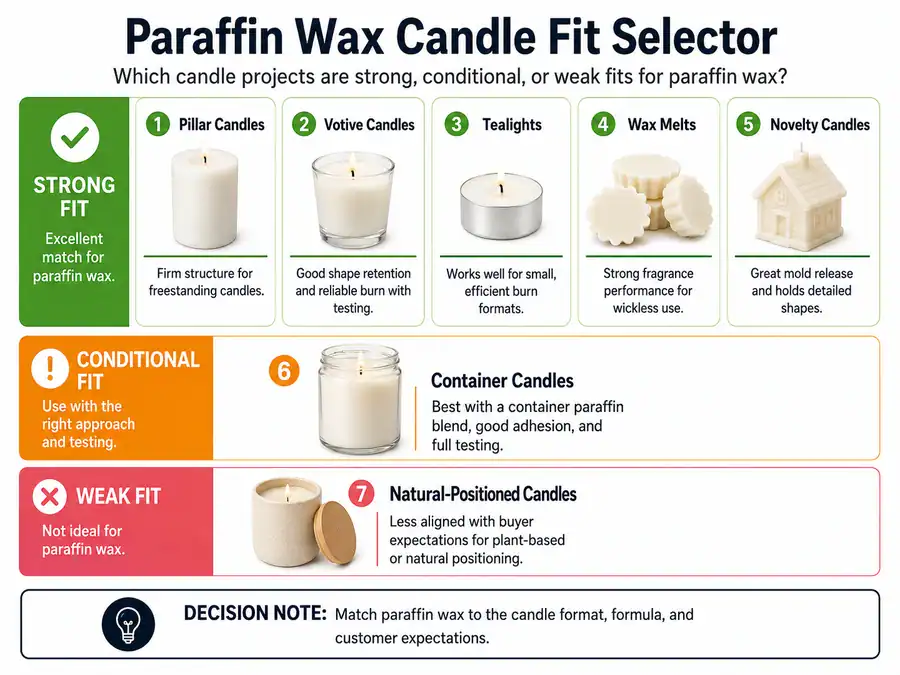
To choose paraffin wax, start with the candle format before choosing by price. If the project is a pillar, the wax needs enough hardness to stand on its own. If the project is a jar candle, a container blend is safer than assuming any paraffin wax will adhere well to glass. If the project is a wax melt, wick behavior matters less, but scent release, firmness, and mold release matter more.
Paraffin wax differs from soy wax mainly in source and performance profile. Soy wax is plant-based and often chosen for natural positioning, while paraffin wax is petroleum-derived and often chosen for scent throw, color strength, mold release, and lower cost.
How Paraffin Wax Performs in Candles
Paraffin wax performs well when the candle goal is strong scent, bright dye, defined shape, smooth finish, and predictable mold release.
Its main strength is output. Paraffin wax usually accepts fragrance and dye readily, so it is popular for scented candles, colored candles, novelty shapes, votives, tealights, and wax melts. Its main weakness is fit. The same properties that make paraffin useful in molded candles can create shrinkage, poor jar adhesion, or buyer-perception issues when the wax is used in the wrong project.
| Performance factor | How paraffin wax behaves | What that means for candle makers |
|---|---|---|
| Scent throw | Often releases fragrance strongly when tested with the right oil and wick | Good fit for scented candles and melts |
| Color | Takes many candle dyes cleanly and brightly | Good fit for bold, decorative candles |
| Structure | Can be firm enough for molded candles | Good fit for pillars, votives, tealights, and shapes |
| Mold release | Often shrinks as it cools | Helpful for molds, less helpful in some jars |
| Jar adhesion | Straight paraffin may pull away from glass | Container blends are often a better choice |
| Burn quality | Depends on wax, wick, fragrance load, and airflow | Testing matters more than wax choice alone |
| Buyer perception | Petroleum origin may concern some customers | Better for makers who can label and explain tradeoffs clearly |
For best results, judge paraffin wax by candle type, not by a single “good” or “bad” label. A hard paraffin that works well in a pillar may be the wrong choice for a jar. A softer container blend may be better for glass but less useful for freestanding shapes. A scented wax melt may benefit from paraffin’s fragrance release without needing wick testing at all.
A practical selection sequence is:
- Pick the finished product first: jar, pillar, votive, tealight, mold, or melt.
- Match the wax type to that format.
- Check whether the wax is straight paraffin or a paraffin blend.
- Test dye, fragrance, and finish in a small batch.
- Adjust wick, fragrance load, or wax formula before making a larger batch.
This is why paraffin wax is often treated as a candle-performance wax. It can make strong, colorful, structured candles, but it does not remove the need for testing.
Pros of Paraffin Wax for Candle Making
Paraffin wax gives candle makers strong fragrance performance, bright color, firm structure, broad availability, and a lower-cost starting point.
The main advantage of paraffin wax is control over the finished candle. It can carry scent well, show dye clearly, hold molded shapes, and work across many product types when the wax formula matches the project. That is why many commercial scented candles, votives, tealights, pillars, novelty candles, and wax melts use paraffin or paraffin blends.
| Pro | Why it matters in candle making | Best fit |
|---|---|---|
| Strong scent throw | Paraffin often releases fragrance clearly when tested with the right oil and wick | Scented candles, melts, votives |
| Bright dye results | It usually takes candle dye cleanly | Decorative candles, seasonal colors, novelty shapes |
| Firm structure | Harder paraffin can support freestanding forms | Pillars, votives, molded candles |
| Good mold release | Cooling shrinkage can help candles release from molds | Metal molds, votive molds, shaped candles |
| Lower material cost | Paraffin is often budget-friendly compared with many specialty waxes | Beginners, testing, larger batches |
| Wide availability | It is easy to find in many candle-supply formats | Slabs, pellets, beads, pre-blended waxes |
These benefits matter most when the goal is a candle that smells strong, looks clean, and holds its shape. A maker pouring colored holiday votives, scented wax melts, or molded decorative candles may get more practical value from paraffin wax than from a softer wax that needs more adjustment.
Paraffin wax is not automatically the best wax for every maker. Its pros are strongest when performance, color, scent, cost, and shape matter more than plant-based sourcing or natural-product positioning.
Use this quick fit check before buying paraffin wax:
- Choose paraffin wax if scent throw is a top goal.
- Choose paraffin wax if bright or dark dye matters.
- Choose paraffin wax if the candle needs to stand without a jar.
- Choose paraffin wax if you want a lower-cost testing wax.
- Reconsider paraffin wax if your product line must be plant-based, natural-positioned, or sustainability-led.
Cons and Tradeoffs of Paraffin Wax
Paraffin wax has drawbacks tied to petroleum origin, buyer perception, soot concerns, shrinkage, jar adhesion, and sustainability expectations.
The biggest tradeoff is not one single candle failure. It is the fit between the wax, the candle format, and the customer expectation. Paraffin wax can make excellent candles, but it may be a poor match for makers who need plant-based branding, low-shrink container adhesion, or a product story centered on renewable ingredients.
| Con or tradeoff | What it means | How to reduce the problem |
|---|---|---|
| Petroleum-derived source | Some buyers avoid petroleum-based candle wax | Label honestly and offer alternative waxes when needed |
| Sustainability concern | Paraffin is not plant-based or renewable in the same way soy or coconut wax is positioned | Use it where performance matters most, not where eco-positioning is the main promise |
| Soot perception | Customers may associate paraffin with soot or smoke | Test wick size, fragrance load, and burn behavior |
| Shrinkage | Paraffin can pull away as it cools | Use the right formula for molds or containers |
| Jar adhesion issues | Straight paraffin may not cling cleanly to glass | Choose a container paraffin blend instead |
| Overheating sensitivity | Poor melting control can affect finish and safety | Use controlled heat and a thermometer |
The soot issue needs careful framing. Paraffin wax is part of the burn system, but it does not act alone. Wick size, fragrance load, dye amount, airflow, melt pool size, and user burn habits can all affect smoke and soot.
For full wax-family safety and low-soot selection, use the dedicated candle wax safety and cleaner-burning wax pages instead of expanding the health debate here.
Paraffin wax also needs honest buyer positioning. A maker selling “natural” candles may find paraffin hard to justify because customers often connect natural candles with soy, beeswax, coconut, or other non-petroleum waxes. A maker selling bold fragrance, vivid color, novelty shapes, or affordable candles may find the tradeoff acceptable.
Use this decision rule: choose paraffin wax when performance is the main goal, and avoid it when the product promise depends on plant-based sourcing, renewable-wax messaging, or minimal petroleum association.
Burn Quality, Soot, and Wick Interaction
Paraffin wax can burn well, but soot and smoke depend on the full candle system, not the wax alone.
A paraffin candle’s burn quality comes from the wax, wick, fragrance load, dye amount, container size, airflow, and burn time working together. When one part is mismatched, the candle may smoke, soot, tunnel, burn too hot, or leave too much wax behind.
| Burn issue | Likely candle-making cause | Practical correction |
|---|---|---|
| Black soot on jar glass | Wick may be too large, fragrance load may be too high, or airflow may disturb the flame | Test a smaller wick and reduce variables one at a time |
| Tall flame | Wick may be oversized for the wax and container | Retest with a smaller wick size |
| Weak flame | Wick may be too small, clogged, or fighting too much dye or fragrance | Test a larger wick or simplify the formula |
| Smoking after lighting | Wick may be too long or the candle may be in a draft | Trim the wick and test away from airflow |
| Uneven melt pool | Wick may not match the container diameter or wax blend | Run a full burn test before scaling |
| Strong odor but poor burn | Fragrance load may be too high for the wick system | Lower fragrance or retest the wick series |
This is why paraffin wax should not be judged by soot claims alone. A poorly wicked soy, coconut, beeswax, or paraffin candle can burn badly. A well-tested paraffin candle can burn more cleanly than a poorly tested “natural” candle with the wrong wick.
For candle makers, the safest practical rule is to test the finished candle as a unit. Do not test paraffin wax, fragrance oil, dye, and wick as separate ideas and assume they will behave the same together.
A good paraffin candle burn test should answer four questions:
- Does the flame stay controlled after the wick is trimmed?
- Does the melt pool reach the right width without overheating the container?
- Does the candle smoke, soot, or mushroom more than expected?
- Does the scent throw stay acceptable after wick changes?
If a paraffin candle soots, fix the burn system before rejecting the wax. Start with wick size, then fragrance load, then dye amount, then container or mold format. The result is a more accurate diagnosis than treating paraffin wax as the only cause.
Environmental, Ethical, and Buyer-Perception Tradeoffs
Paraffin wax has buyer-perception tradeoffs because it is petroleum-derived and does not carry the same plant-based positioning as soy, coconut, or some other waxes.
This matters most when the candle is sold, gifted, or branded around ingredient values. Paraffin wax may perform well, but some buyers avoid it because they prefer renewable, plant-based, local, vegan-positioned, or less petroleum-associated materials. Other buyers care more about price, fragrance strength, color, and candle style.
| Buyer concern | What paraffin wax means for the candle | Better fit may be |
|---|---|---|
| “I want a plant-based candle.” | Paraffin wax is not plant-based. | Soy, coconut, or plant-wax blends |
| “I want the strongest scent.” | Paraffin wax is often a strong fit when tested well. | Paraffin or paraffin-heavy blends |
| “I want bright colors.” | Paraffin usually takes dye well. | Paraffin or some blended waxes |
| “I want a natural-positioned product.” | Paraffin can conflict with that message. | Beeswax, soy, coconut, or other natural-positioned waxes |
| “I want a low-cost candle.” | Paraffin is often cost-friendly and easy to source. | Paraffin, blends, or bulk wax options |
| “I want no petroleum association.” | Paraffin is a poor fit for that promise. | Non-paraffin wax families |
The ethical decision is not only about whether paraffin wax can make a good candle. It is about whether the wax fits the promise attached to the candle. A maker selling bold novelty candles for color and scent may choose paraffin wax honestly. A maker selling a natural, plant-based, sustainability-led line may need a different wax type.
This guide does not cover full climate analysis, legal labeling rules, or medical claims. Those topics need separate evidence and narrower rules. For candle-making choice, the useful question is simpler: will your buyer accept a petroleum-derived wax in exchange for performance benefits?
A practical label decision looks like this:
- Use paraffin wax when scent, color, structure, and cost are the main selling points.
- Use soy, coconut, beeswax, or blends when ingredient positioning matters more.
- Be clear about the wax type instead of hiding it behind vague wording.
- Avoid calling paraffin wax natural, plant-based, or renewable.
- Offer an alternative wax line if your audience is split between performance and ingredient concerns.
Paraffin wax can be a good candle-making material and a poor brand fit at the same time. That contrast is the key tradeoff.
Best Uses for Paraffin Wax in Candle Making
Paraffin wax is best used when the candle needs strong scent, bright color, firm shape, clean mold release, or lower material cost.
The best paraffin wax use depends on the candle format. A hard paraffin may suit molded candles, while a softer container blend may suit jars. A wax melt may benefit from paraffin’s scent release without needing a wick. This is why “best” means best project fit, not best wax for every candle maker.
| Candle product | Paraffin wax fit | Why it works |
|---|---|---|
| Pillar candles | Strong fit | Hard paraffin can support a freestanding shape |
| Votive candles | Strong fit | Shrinkage can help release the candle from the mold |
| Tealights | Strong fit | Paraffin can hold scent and color in a small candle |
| Wax melts | Strong fit | No wick is needed, so scent and shape become the main goals |
| Novelty candles | Strong fit | Bright dye and firm structure help shaped designs |
| Container candles | Conditional fit | Container paraffin blends work better than many straight paraffin waxes |
| Natural-positioned candles | Weak fit | Petroleum origin conflicts with plant-based or natural branding |
Use paraffin wax when the finished candle should be bold, scented, shaped, affordable, or visually clean. Reconsider paraffin wax when the candle must be plant-based, low-shrink in glass, or sold mainly on natural ingredient claims.
A useful selection rule is:
- Choose the candle type first.
- Match the paraffin wax formula to that type.
- Use pillar paraffin for freestanding shapes.
- Use container paraffin blends for jars.
- Use tart or melt blends for wickless fragrance products.
- Test scent, dye, finish, and burn behavior before making a large batch.
The key decision is whether paraffin wax matches the candle you plan to make.
Paraffin Wax for Wax Melts and Tarts
Paraffin wax works well for wax melts and tarts because it can release fragrance strongly and hold molded shapes without wick testing.
Wax melts and tarts are wickless scented wax pieces warmed in a melter. Since they do not burn with a flame, the maker does not need to balance wax, wick, flame height, and melt pool in the same way as a candle. The main goals are scent release, mold release, surface finish, hardness, and packaging stability.
Detailed wax-melt wax selection, warmer behavior, and blend comparison should stay on the dedicated best wax for wax melts page.
| Wax melt goal | How paraffin wax helps | What to test |
|---|---|---|
| Strong fragrance release | Paraffin often carries scent well | Test fragrance oil type and load |
| Defined shape | Firmer paraffin can hold molds and details | Test release from silicone or clamshell molds |
| Clean break | Harder blends can snap or divide neatly | Test firmness after cooling |
| Smooth top | Paraffin can form a clean surface | Test pour temperature and cooling conditions |
| Bright color | Paraffin usually accepts dye well | Test dye strength before scaling |
| Summer shipping stability | Higher-melt or blended formulas may hold up better | Test storage temperature and packaging |
Paraffin wax is often a better fit for melts than for some jars because wick behavior is removed from the project. That does not mean any paraffin wax will work. A melt that is too soft may smear in packaging, while a melt that is too hard may release fragrance less evenly for the chosen warmer and room size.
For a first wax melt test, pour a small batch, cure or rest it as your supplier recommends, then warm one piece in the same style of warmer your customer is likely to use. Judge cold scent, warm scent, mold release, surface finish, and how the wax behaves after cooling again.
For this paraffin wax article, the main point is narrow: paraffin can be a strong wax-melt choice when scent release, shape, color, and cost matter more than plant-based positioning.
Paraffin Wax for Pillars, Votives, and Molded Candles
Paraffin wax is a strong fit for pillars, votives, and molded candles because harder formulas can hold shape and release from molds as they cool.
Freestanding candles need structure. A pillar, votive, or shaped candle cannot rely on a jar to support the wax, so the wax must be firm enough to stand, burn, and handle without collapsing. This is one of paraffin wax’s clearest candle-making strengths.
| Candle format | Paraffin wax fit | What matters most |
|---|---|---|
| Pillar candles | Strong | Hardness, melt point, wick size, surface finish |
| Votive candles | Strong | Mold release, controlled shrinkage, cup fit |
| Tealights | Strong | Small-format burn behavior and scent balance |
| Taper-style molds | Conditional | Rigidity, cracking risk, and wick centering |
| Novelty shapes | Strong | Color, detail, firmness, and release |
| Silicone molds | Strong to conditional | Mold detail, surface marks, and cooling behavior |
Paraffin wax often shrinks as it cools. In a jar, shrinkage can look like poor adhesion. In a mold, that same behavior can help the candle pull away from the mold wall and release cleanly. This is why a drawback in one candle format can become a benefit in another.
For molded paraffin candles, choose the wax by structure first and fragrance second. A high-fragrance formula that becomes too soft may lose detail or dent easily. A wax that is too hard may crack, frost, or show surface flaws if poured or cooled poorly.
A practical molded-candle check looks like this:
- Pick a paraffin wax labeled for pillars, votives, or molds.
- Test one small candle before making a set.
- Check mold release after full cooling, not while the wax is warm.
- Inspect the surface for cracks, sink areas, or rough patches.
- Burn-test the finished candle with the final wick and fragrance.
The key rule is simple: paraffin is often one of the best wax choices when the candle must hold a freestanding shape.
Paraffin Wax for Container Candles and Blends
Paraffin wax can work in container candles, but container paraffin blends are usually a better fit than straight hard paraffin.
Jar candles need different wax behavior than pillars. A container candle does not need to stand alone, but it does need stable adhesion, a smooth top, a safe melt pool, and a wick that matches the jar diameter. Straight paraffin may pull away from glass or show wet spots, especially if the formula is made for molded candles rather than jars.
| Container issue | Why it can happen with paraffin wax | Better choice or correction |
|---|---|---|
| Wax pulls from glass | Hard paraffin shrinks as it cools | Use a container paraffin blend |
| Wet spots appear | Wax and glass contract differently | Test jar temperature and cooling conditions |
| Top surface sinks | Cooling contraction leaves a depression | Adjust pour method or use a suitable blend |
| Flame burns too hot | Wick may be too large for the jar and wax | Retest wick size |
| Weak scent after wick changes | Burn system may not match fragrance load | Test fragrance and wick together |
| Poor finish in clear jars | Formula may suit molds better than glass | Choose wax labeled for containers |
A container paraffin blend may include other waxes or additives to improve adhesion, opacity, texture, or scent performance. This does not make the wax automatically better in every way. It makes the wax more suitable for a jar candle goal.
Use straight paraffin with caution in jars. It may work for some designs, but it should not be treated as the default container wax. When a supplier labels a wax as pillar wax, votive wax, tart wax, or container wax, that label is a project-fit clue.
A jar-candle test should answer these questions:
- Does the wax adhere acceptably after cooling?
- Does the top surface look clean without repeat fixes?
- Does the wick create a controlled melt pool?
- Does the glass stay within a safe burn range?
- Does the scent remain acceptable after wick correction?
For paraffin wax selection, the main rule is to match the wax formula to the container instead of pouring a hard molded wax into a jar and expecting it to behave like a jar wax.
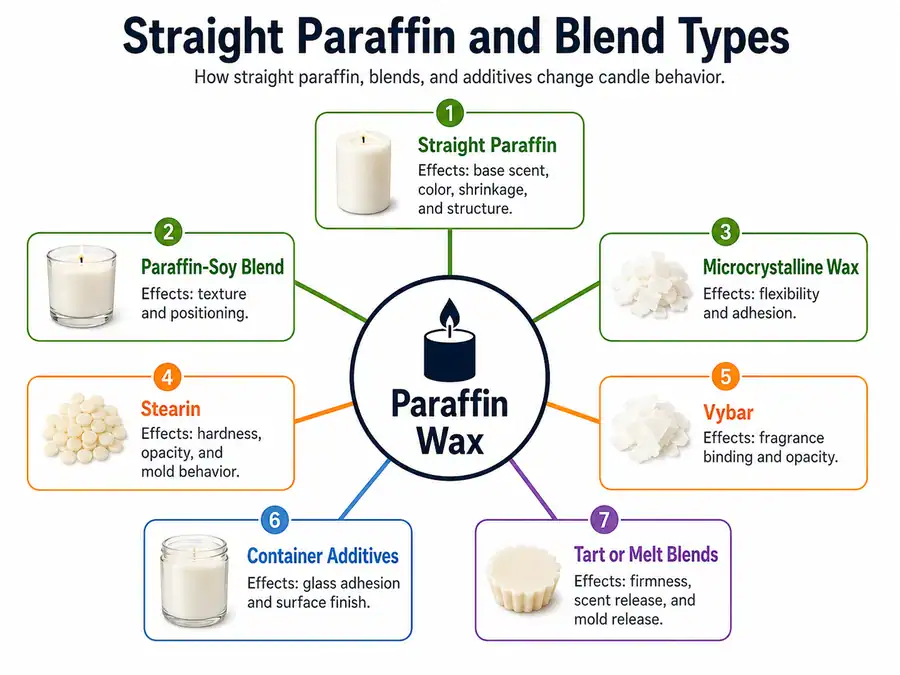
Straight Paraffin vs Paraffin Blends and Additives
Straight paraffin wax is mostly paraffin, while paraffin blends include other waxes or additives to change scent throw, hardness, opacity, adhesion, or finish.
This difference matters because many candle makers buy “paraffin wax” and expect one behavior. In practice, a pillar paraffin, container paraffin blend, tart blend, and additive-modified wax can behave very differently. The right choice depends on the candle type, not the word paraffin alone.
| Wax or additive type | What it changes | Common candle-making purpose |
|---|---|---|
| Straight paraffin | Base scent, color, shrinkage, and structure behavior | Pillars, votives, molds, testing |
| Paraffin-soy blend | Texture, appearance, and buyer positioning | Container candles and hybrid product lines |
| Microcrystalline wax | Flexibility and adhesion | Reducing brittleness or improving structure |
| Stearin | Hardness, opacity, and mold behavior | Pillars, votives, and firmer candles |
| Vybar | Fragrance binding and opacity in some formulas | Scented paraffin candles |
| Container additives | Glass adhesion and surface finish | Jar candles |
| Tart or melt blends | Firmness, scent release, and mold release | Wax melts and tarts |
An additive is not a shortcut around testing. A wax modifier can help one problem and create another. For example, a harder blend may release from a mold well but perform poorly in a jar. A container blend may improve glass appearance but lack the rigidity needed for a freestanding pillar.
Use this selection path before adding anything to paraffin wax:
- Choose the candle format first.
- Buy a wax already made for that format when possible.
- Add modifiers only to fix a clear problem.
- Change one variable per test batch.
- Keep notes on wax type, additive amount, fragrance, dye, wick, and result.
Straight paraffin is often the better learning wax because it shows the base behavior clearly. Blends and additives become more useful when the maker knows what needs to change: scent strength, mold release, jar adhesion, opacity, hardness, or finish.
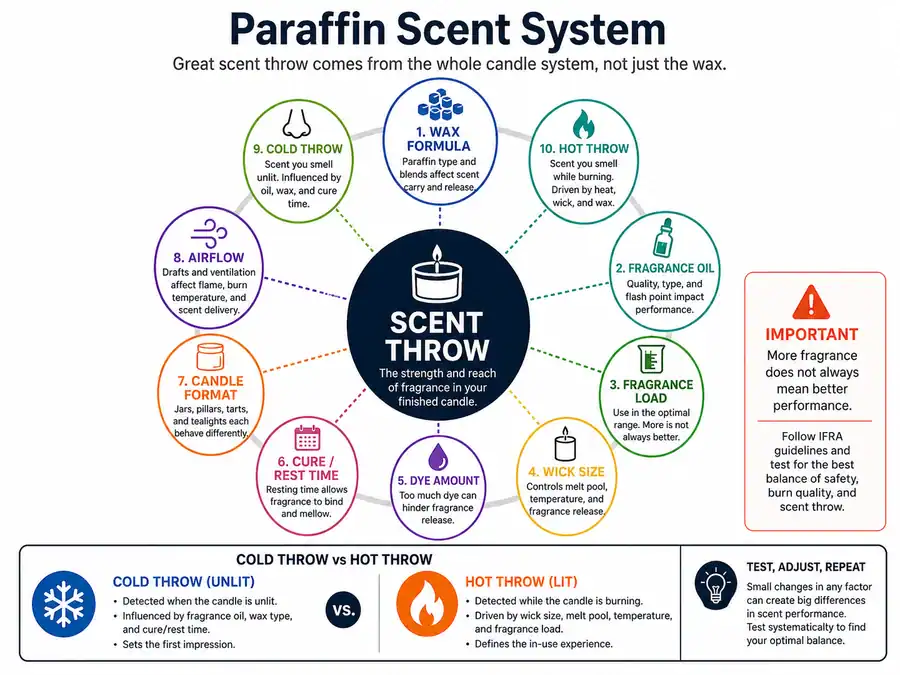
Scent Throw and Fragrance Load with Paraffin Wax
Paraffin wax is often chosen for strong scent throw, but fragrance performance still depends on wax formula, oil type, wick choice, and testing.
Scent throw means how well a candle releases fragrance. Cold throw is the smell before lighting, while hot throw is the smell during burning or warming. Fragrance load means the amount of fragrance oil used in the wax. More fragrance does not always mean a stronger or better candle.
| Scent factor | What it affects | Why it matters with paraffin wax |
|---|---|---|
| Wax formula | How the wax holds and releases scent | Straight paraffin and blends may behave differently |
| Fragrance oil | Strength, volatility, and burn behavior | Some oils work better than others in paraffin |
| Fragrance load | Scent level and burn stability | Too much oil can hurt burn quality |
| Wick size | Melt pool, heat, soot, and scent release | A wick change can change hot throw |
| Dye amount | Burn behavior and visual result | Heavy dye can affect the wick system |
| Cure or rest time | Finished scent balance | Some formulas need time before judging scent |
| Candle format | How scent reaches the room | Melts, jars, votives, and pillars release scent differently |
Paraffin wax has a strong scent reputation because it often carries fragrance clearly, especially in scented candles and wax melts. That reputation should not be treated as a guarantee. A weak fragrance oil, poor wick match, excessive oil, or unsuitable candle format can still produce a weak or smoky result.
A safe testing sequence is:
- Follow the wax supplier’s fragrance guidance.
- Make a small test batch with one fragrance oil.
- Test cold throw after the candle has rested.
- Burn or warm the candle in the final format.
- Judge hot throw, flame behavior, soot, and surface finish together.
- Change fragrance load or wick size one step at a time.
Paraffin wax can be a strong choice for scented candles, but the goal is not to force in as much oil as possible. The goal is a candle that smells clear, burns correctly, and fits the product type.
Color, Dye, and Finish with Paraffin Wax
Paraffin wax is a strong choice for colored candles because it usually accepts candle dye cleanly and can create bright, defined visual results.
Color performance is one of paraffin wax’s clearest advantages. It can show bold reds, deep blues, dark seasonal shades, pastels, and novelty colors more easily than many softer or more opaque waxes. This makes paraffin useful for decorative candles, holiday collections, shaped candles, layered candles, and wax melts where appearance matters.
| Visual goal | How paraffin wax helps | What to test |
|---|---|---|
| Bright color | Takes many candle dyes clearly | Dye type and amount |
| Dark shades | Can hold stronger color well | Wick effect and possible bleeding |
| Smooth finish | Can cool into a clean surface | Pour temperature and cooling rate |
| Mold detail | Firm formulas can hold edges and shapes | Mold type and release |
| Layered candles | Color separation can look sharp | Pour timing between layers |
| Translucent effects | Some paraffin formulas allow light-through effects | Wax grade and dye strength |
Candle dye should be tested in the final wax formula, not judged in melted wax alone. A color can look dark in the melting pot and lighter after cooling. Heavy dye may change burn behavior, especially in wicked candles, so the final test should include the wick, fragrance, and finished candle format.
A simple color test path is:
- Melt a small amount of paraffin wax.
- Add a measured amount of candle dye.
- Pour a small sample in the final mold or jar.
- Let it cool fully before judging color.
- Burn-test wicked candles before repeating the formula.
Paraffin wax is especially useful when color is part of the candle’s value. For this paraffin wax guide, the key point is that paraffin often gives makers a clearer visual result than waxes chosen mainly for natural positioning.
Melt Point, Hardness, and Candle Structure
Paraffin wax melt point and hardness determine whether it fits jars, pillars, votives, molds, tealights, or wax melts.
Melt point means the temperature range where wax begins changing from solid to liquid. In candle making, melt point is not just a technical label. It affects structure, release, surface finish, container fit, shipping stability, and how the candle behaves during burning or warming.
| Wax behavior | What it affects | Better fit |
|---|---|---|
| Lower melt point | Softer feel and easier melting | Containers, softer blends, some melts |
| Medium firmness | Balance between structure and workability | Votives, tealights, general testing |
| Higher melt point | Firmer shape and better heat resistance | Pillars, molded candles, some melts |
| Strong shrinkage | Easier mold release but weaker jar adhesion | Molds, not clear glass jars |
| High hardness | Better structure but possible cracking | Freestanding candles |
| Softer blend | Better jar behavior but less freestanding strength | Container candles |
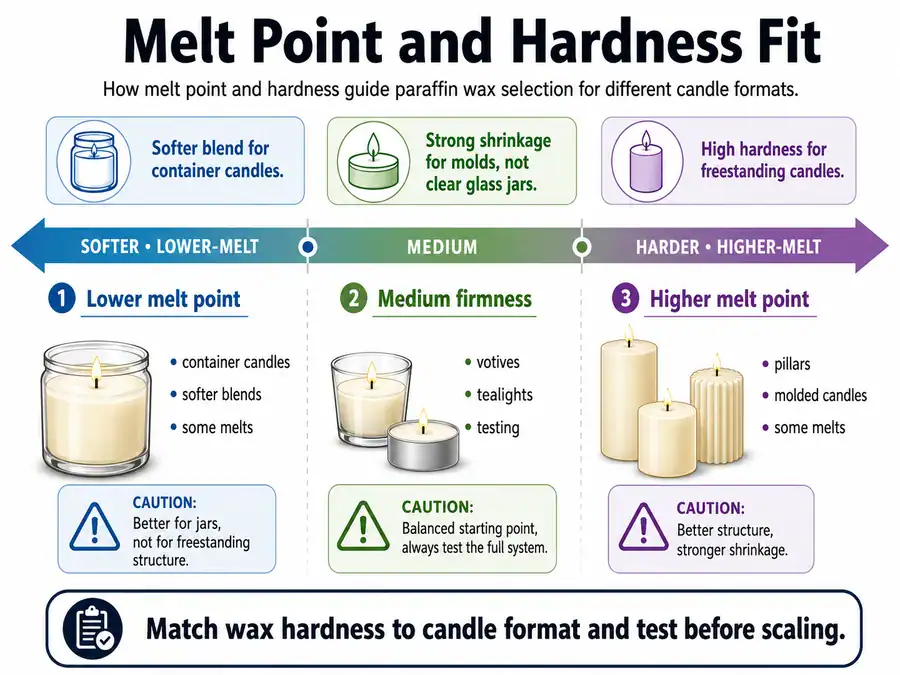
Hardness should match the candle’s job. A pillar needs enough structure to stand without a jar. A container candle needs wax that works with glass, wick size, and melt pool behavior. A wax melt needs enough firmness to package and handle, while still releasing scent when warmed.
Use this decision rule:
- Choose harder paraffin for pillars, votives, and shaped candles.
- Choose container paraffin blends for jars.
- Choose tart or melt blends for wax melts.
- Avoid judging wax by melt point alone.
- Test structure, finish, and use behavior together.
The wrong melt point can create the wrong candle even when the wax is high quality. If a candle cracks, slumps, pulls from glass, or melts too easily in storage, the issue may be wax fit rather than maker skill.
Shrinkage, Adhesion, and Mold Release
Paraffin wax often shrinks as it cools, which can help molded candles release but can hurt glass adhesion in container candles.
Shrinkage is not always a flaw. In pillars, votives, and shaped candles, cooling shrinkage can pull the candle away from the mold wall and make removal easier. In clear jars, that same pullback can create wet spots, gaps, or visible separation from the glass.
| Cooling behavior | Helpful result | Possible problem |
|---|---|---|
| Wax pulls away from mold | Easier release for pillars and votives | Candle may shrink more than expected |
| Wax pulls away from glass | None in most jar candles | Wet spots or poor adhesion |
| Center area sinks | Shows cooling contraction | Top may need correction |
| Edges release cleanly | Better molded detail removal | Edges may chip if wax is too hard |
| Wax hardens firmly | Better shape stability | More cracking risk if cooled too fast |
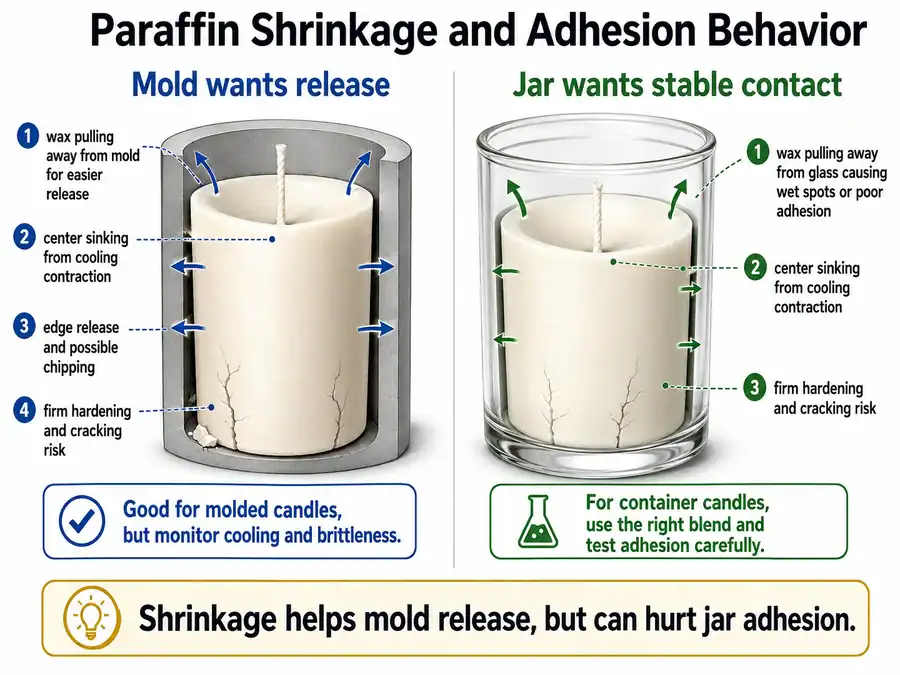
For molded candles, shrinkage can be part of the design. A votive or pillar that releases cleanly from a metal mold may need that small contraction. For container candles, adhesion usually matters more than release, so a container paraffin blend is often a better choice than straight pillar paraffin.
Use this quick diagnosis:
- If the candle sticks in the mold, check wax hardness, cooling time, and mold type.
- If the jar shows wet spots, check whether the wax is made for containers.
- If the top sinks, test pour temperature, cooling speed, and repour method.
- If the candle cracks, test a softer blend or slower cooling.
- If the candle dents easily, test a firmer wax or different formula.
Paraffin wax gives candle makers useful structure, but it must be matched to the surface around it. A mold wants release. A jar wants stable contact. Treating those two goals as the same is what leads to many paraffin wax problems.
Paraffin Wax vs Soy, Beeswax, Coconut, and Other Waxes
Paraffin wax is best compared with other candle waxes by scent, color, structure, source, cost, and product positioning.
No candle wax wins every category. Paraffin wax often performs well for fragrance, color, molded shape, and price. Soy wax often fits plant-based branding and container candles. Beeswax brings a natural wax story and firm structure. Coconut wax is often used in softer blends. Gel wax serves a different visual purpose and is not a direct replacement for most wax candles.
| Wax type | Main strength | Main tradeoff | Best fit |
|---|---|---|---|
| Paraffin wax | Scent throw, color, shape, cost | Petroleum-derived source and buyer concerns | Scented candles, pillars, votives, melts |
| Soy wax | Plant-based positioning and jar use | Softer structure and sometimes weaker color or scent | Container candles and natural-positioned lines |
| Beeswax | Natural wax identity and firm structure | Higher cost and a distinct natural scent | Premium, simple, or traditional candles |
| Coconut wax | Soft feel and blend appeal | Often needs blending for structure | Luxury container blends |
| Palm wax | Crystal effects and hardness | Sourcing concerns for some buyers | Decorative or textured candles |
| Gel wax | Clear visual effects | Different handling and safety needs | Transparent novelty candles |
The right comparison depends on the candle promise. If the promise is strong fragrance and vivid color, paraffin wax may be the better fit. If the promise is plant-based ingredients, soy or coconut blends may fit better. If the promise is a traditional natural wax, beeswax may be easier to explain to buyers.
For full wax-family selection, this paraffin summary should route back to the Candle Wax Types guide and to sibling wax explainers such as soy wax and beeswax.
Use this decision rule:
- Choose paraffin wax for scent, color, molds, melts, and lower-cost testing.
- Choose soy wax for plant-based jar candles.
- Choose beeswax for a natural wax story and firm, simple candles.
- Choose coconut blends for softer premium container candles.
- Choose gel wax only when the clear visual effect is the main goal.
Choose paraffin wax when its performance strengths match the candle type, and choose another wax when source, branding, or container behavior matters more.
Cost, Availability, and Buying Paraffin Wax
Paraffin wax is often a budget-friendly candle wax because it is widely sold in slabs, pellets, beads, and pre-blended candle formulas.
Cost matters when a maker is testing recipes, pouring larger batches, or learning candle behavior through trial and error. Paraffin wax is commonly used for this because it is easy to source and available in formats that fit beginners, hobby makers, and larger production batches.
| Buying factor | What to check | Why it matters |
|---|---|---|
| Candle type | Pillar, votive, container, tealight, or melt | The wax must match the project |
| Wax format | Slab, pellet, bead, granule, or blend | Smaller pieces are easier to measure and melt |
| Supplier label | Candle-grade use notes | Helps avoid non-candle paraffin |
| Melt point | Low, medium, or higher range | Affects structure and heat behavior |
| Additives | Blend, stearin, Vybar, or container modifiers | Changes scent, hardness, adhesion, or finish |
| Batch size | Small pack or bulk box | Bulk only makes sense after testing |
| Shipping conditions | Heat exposure and packaging | Wax can soften, dent, or clump in warm conditions |
The lowest-priced paraffin wax is not always the best buy. A cheap hard wax may waste money if the project is a jar candle and the wax pulls away from the glass. A slightly higher-cost container blend may save time if it reduces surface flaws and adhesion problems.
Detailed price-per-pound, bulk-order, and cost-per-candle math belongs on the dedicated candle wax cost page.
Use this buying path:
- Pick the candle format before comparing prices.
- Buy a small amount for testing first.
- Choose pellets or beads if easy measuring matters.
- Choose slabs if bulk cost matters and cutting is not a problem.
- Move to larger quantities only after scent, dye, wick, and finish tests pass.
Paraffin wax is often a practical first testing wax because it gives clear feedback on fragrance, dye, wick behavior, and structure. For paraffin specifically, buy by project fit before buying by price.
Grades, Formats, and Label Terms for Paraffin Wax
Paraffin wax labels describe refinement level, physical format, and intended candle use, so they should guide the buying decision.
A candle maker does not need an industrial wax lesson to buy paraffin wax well. The useful question is whether the wax is made for candles and whether the supplier describes the right candle format. Food, cosmetic, packaging, and industrial waxes are outside this candle-making decision.
| Label or format | What it means for candle makers | Best buying use |
|---|---|---|
| Fully refined paraffin | More refined wax with low oil content compared with rougher grades | Cleaner candle supply choice |
| Semi-refined paraffin | Less refined than fully refined wax | Use only when supplier confirms candle fit |
| Slab | Large solid block | Bulk batches and production |
| Pellets or beads | Small pieces | Easy weighing, melting, and beginner testing |
| Granules | Loose small pieces | Small pours and fast measuring |
| Pillar wax | Formula made for freestanding candles | Pillars, votives, molds |
| Container wax | Formula made for jars | Container candles |
| Tart or melt wax | Formula made for wickless products | Wax melts and tarts |
| Pre-blended paraffin | Paraffin mixed with waxes or additives | Easier project-specific selection |
The most useful label is the intended candle use. “Paraffin wax” alone does not tell you whether the wax suits a jar, pillar, votive, melt, or tealight, so choose the grade and format that matches the project before comparing price or additives.
Is Paraffin Wax Beginner-Friendly?
Paraffin wax can be beginner-friendly when the wax is matched to the candle type and tested in small batches.
Beginners often like paraffin wax because it melts predictably, accepts fragrance well, takes dye clearly, and comes in easy-to-measure pellets or beads. The learning curve usually comes from choosing the right formula, controlling heat, matching the wick, and understanding shrinkage.
| Beginner question | Paraffin wax answer | Best beginner move |
|---|---|---|
| Is paraffin easy to melt? | Yes, with controlled heat and a thermometer | Use a small batch first |
| Is it good for scent? | Often yes, when the fragrance and wick are tested | Start with one fragrance oil |
| Is it good for color? | Yes, it usually takes candle dye clearly | Test dye in cooled wax |
| Is it good for jars? | Only if the wax is made for containers | Buy a container paraffin blend |
| Is it good for molds? | Often yes, especially firmer formulas | Use pillar or votive paraffin |
| Is it mistake-proof? | No, it still needs testing | Change one variable at a time |
The easiest beginner path is not to buy the cheapest paraffin wax. It is to buy the paraffin wax labeled for the project. A beginner making wax melts should choose a melt or tart wax. A beginner making pillars should choose a pillar wax. A beginner making jars should choose a container blend.
A first paraffin wax project should stay simple:
- Choose one candle type.
- Choose wax labeled for that candle type.
- Use one fragrance oil and one dye color.
- Pour a small test batch.
- Judge scent, color, surface finish, and burn behavior before scaling.
Paraffin wax is forgiving in scent and color, but it is not forgiving when the wrong wax format is used. The best beginner result comes from matching wax to project before adjusting fragrance, dye, wick, or additives.
Basic Handling, Storage, and Melting Safety
Paraffin wax should be stored dry, melted with controlled heat, and handled with basic candle-making safety habits.
The main safety concern for candle makers is not ordinary solid paraffin storage. It is careless melting, overheating, open flame exposure, spills, and poor workspace control. A thermometer, stable melting setup, clear workspace, and small test batches reduce common mistakes.
| Handling area | What to do | Why it matters |
|---|---|---|
| Storage | Keep wax dry, covered, and away from dirt or fragrance spills | Cleaner wax gives more reliable test results |
| Melting | Use controlled heat and monitor temperature | Overheated wax can affect safety and finish |
| Workspace | Keep the area clear and stable | Reduces spills and contamination |
| Ventilation | Work in a comfortable, ventilated room | Helps manage fragrance and heat exposure |
| Fragrance handling | Add fragrance according to wax supplier guidance | Poor timing can weaken scent or affect finish |
| Fire safety | Keep wax away from direct flame and unattended heat | Melted wax can become hazardous when misused |
| Cleanup | Wipe spills carefully and avoid pouring wax down drains | Prevents clogs and surface damage |
For beginners, a double boiler or dedicated wax melter is safer than placing wax directly over uncontrolled heat. A thermometer is not optional guesswork; it tells you when the wax is ready for dye, fragrance, and pouring.
Use this basic handling sequence:
- Prepare molds, jars, wicks, dye, fragrance, and tools before melting wax.
- Melt paraffin wax slowly with controlled heat.
- Monitor temperature rather than relying on appearance.
- Add dye and fragrance only within the supplier’s suggested range.
- Pour small batches until the formula is tested.
- Let candles cool in a stable area away from drafts.
- Store unused wax sealed and labeled.
This section covers maker handling basics, not medical claims, workplace regulations, or industrial safety rules. For paraffin wax selection, the practical rule is simple: handle the wax carefully, melt it with control, and test the finished candle before making more.
Use this section for candle-making handling only; indoor air-quality, toxicity, and compliance questions need the dedicated candle wax safety article.
Final Recommendation: When Should You Use Paraffin Wax?
Use paraffin wax when candle performance matters more than plant-based sourcing, especially for scent, color, molded shape, and lower-cost testing.
Paraffin wax is a good fit when the candle needs a clear fragrance throw, bold dye, firm structure, clean mold release, or an affordable test formula. It is a weaker fit when the candle must be marketed as plant-based, natural-positioned, renewable, or free from petroleum association.
| Candle-making goal | Use paraffin wax? | Better reason |
|---|---|---|
| Strong scented candles | Yes | Paraffin often carries fragrance well when tested correctly |
| Bright colored candles | Yes | It usually shows candle dye clearly |
| Pillars and molded candles | Yes | Harder formulas can hold freestanding shapes |
| Wax melts and tarts | Yes | Scent release and shape matter more than wick behavior |
| Beginner testing | Yes | It is widely available and often cost-friendly |
| Clear-glass jar candles | Conditional | Use a container paraffin blend, not random hard paraffin |
| Plant-based candle line | No | Soy, coconut, or plant-wax blends fit that promise better |
| Natural wax positioning | No | Beeswax, soy, or other non-paraffin waxes are easier to explain |
| Sustainability-led branding | Usually no | Paraffin’s petroleum source may conflict with the product message |
The simplest decision is this: choose paraffin wax for performance-led candles, and choose another wax when ingredient story matters more than scent, color, shape, or cost.
Paraffin wax is not the best candle wax for every maker. It is best when its strengths match the candle’s job. If the candle needs scent, color, structure, mold release, or lower cost, paraffin wax can be a practical choice. If the candle needs a natural or plant-based story, another wax family is usually a better fit.
FAQs About Paraffin Wax for Candles
Is paraffin wax good for candle making?
Yes, paraffin wax is good for candle making when the project needs strong scent, bright color, firm shape, or lower material cost.
It works especially well for scented candles, pillars, votives, tealights, molded candles, novelty candles, and wax melts. For jars, use a container paraffin blend instead of assuming any paraffin wax will work.
What is paraffin wax made from?
Paraffin wax is made from refined petroleum waxes.
In candle making, the useful point is not the full refining process. The useful point is that paraffin wax is a petroleum-derived candle material, not a plant-based wax like soy or coconut wax.
What are the main pros of paraffin wax candles?
The main pros are strong scent throw, bright color, firm structure, easy availability, and lower cost.
These advantages make paraffin wax useful for candles where fragrance, dye, shape, and budget matter more than natural or plant-based positioning.
What are the main cons of paraffin wax candles?
The main cons are petroleum origin, buyer concerns, sustainability perception, possible shrinkage, jar adhesion issues, and soot concerns when the candle system is poorly tested.
Most burn problems should be tested through the full candle system: wax, wick, fragrance, dye, container, airflow, and burn time.
Is paraffin wax better than soy wax?
Paraffin wax is often better for scent throw, bright color, molded shapes, and lower cost, while soy wax is often better for plant-based jar candles.
The better wax depends on the candle goal. Choose paraffin for performance-led candles and soy for plant-based positioning.
Can paraffin wax be used for container candles?
Yes, paraffin wax can be used for container candles, but a container paraffin blend is usually the better choice.
Straight hard paraffin may pull away from glass, show wet spots, or behave more like a pillar wax than a jar wax.
Is paraffin wax good for wax melts?
Yes, paraffin wax can be a strong choice for wax melts because it can release scent well and hold molded shapes.
Wax melts do not need wick testing, so the main checks are fragrance release, firmness, mold release, finish, and packaging stability.
Does paraffin wax cause soot?
Paraffin wax can be part of a sooting problem, but soot depends on the full candle system.
Wick size, fragrance load, dye amount, airflow, melt pool, and burn habits can all affect soot. Test the finished candle before blaming the wax alone.
Is paraffin wax natural?
No, paraffin wax is not a natural or plant-based candle wax.
It is petroleum-derived. Makers who need a natural-positioned candle line usually choose soy, beeswax, coconut wax, or other non-paraffin wax options.
What type of paraffin wax should beginners buy?
Beginners should buy paraffin wax labeled for the candle type they plan to make.
Use pillar paraffin for pillars and molds, container paraffin blends for jars, and tart or melt wax for wax melts. Project-fit labeling matters more than the word “paraffin” by itself.