The main candle wax types are soy, paraffin, beeswax, coconut, and blends, and the right choice depends on candle form, scent strength, heat tolerance, cost, and brand positioning.
Use this page to compare the main wax families first, then move to the linked child guides for process details or troubleshooting. It is for makers who need to narrow the field fast, not for readers who are already tuning additive percentages or fixing one specific defect. The goal is to help you choose the right wax family before you spend time testing jars, wicks, fragrance, and cure time. If you want the full workflow around wax, wicks, containers, fragrance, and testing, start with the complete candle-making guide.
Compare the Main Candle Wax Types
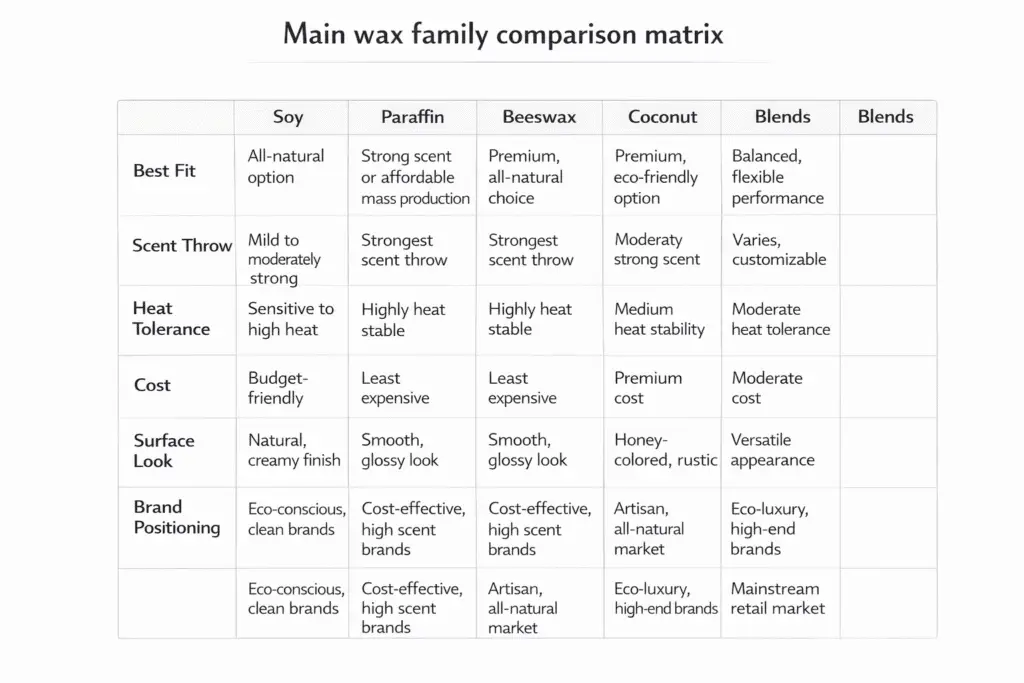
Soy, paraffin, beeswax, coconut, and blends solve different candle goals, so the best wax type is the one that matches your format, throw target, heat exposure, budget, and brand story. Start with the criteria table, then use the scenario and chooser blocks to narrow the field before you move into deeper testing.
| Criteria | Soy | Paraffin | Beeswax | Coconut | Blends |
|---|---|---|---|---|---|
| Best fit | Container candles with a plant-based story | Strong-scented candles, colorful candles, budget lines | Pillars, tapers, premium natural candles | Premium container candles | Most retail lines that need balance |
| Scent throw | Medium | High | Low to medium; native honey note can compete | Medium to high | Tunable |
| Burn behavior | Slow, steady, but sensitive to process | Predictable and easy to tune | Slow and firm | Smooth, often soft, often premium-feeling | Depends on formula |
| Surface look | Creamy; may frost or show wet spots | Smooth and glossy | Natural color; may bloom | Smooth, creamy, clean-looking | Depends on formula |
| Ease for beginners | Moderate | Easy to moderate | Moderate to hard | Moderate | Moderate |
| Heat tolerance | Moderate | Good | Good | Lower unless hardened or blended | Formula-dependent |
| Cost | Mid-range | Low to mid-range | High | High | Mid-range |
| Brand story | Plant-based, “clean” positioning | Performance-first, not eco-led | Natural, heritage, artisan | Plant-based, premium | Flexible story based on the formula |
| Main watchout | Frosting, wet spots, cure sensitivity | Soot if badly wicked, weaker eco story | Cost and natural scent interaction | Softness, shipping heat, blend dependence | You still need testing; blends are not automatic fixes |
Winner by scenario
- Choose soy if you want a plant-based container candle and you can tolerate some process sensitivity.
- Choose paraffin if scent throw, color payoff, and low material cost matter most.
- Choose beeswax if you want natural free-standing candles and premium positioning.
- Choose coconut if you want a smooth, high-end container candle and can accept higher cost.
- Choose a tested blend if you want one workhorse wax family that balances throw, appearance, cost, and handling.
- Choose harder systems or harder blends first if your candles face hot rooms, warm shipping lanes, or summer-heavy sales.
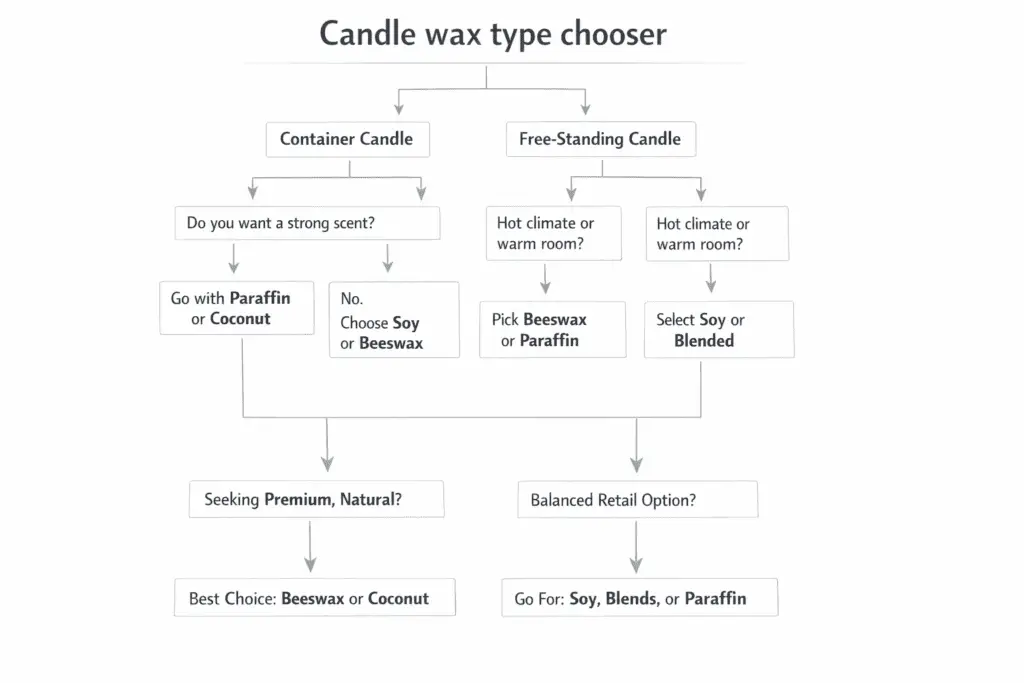
How to choose the right wax in 5 steps
- Pick the candle form first. Containers usually push you toward soy, paraffin, coconut, or blends. Free-standing pillars and tapers push you toward beeswax, harder blends, or other firm wax systems.
- Decide how much scent throw you need. If strong hot throw is non-negotiable, paraffin and many blends usually win. If you want a softer scent profile, soy or beeswax may be enough.
- Check your heat exposure. Warm rooms, summer shipping, and hot markets punish soft waxes. That matters more than branding language.
- Choose your material story. If plant-based or natural positioning matters, soy, coconut, beeswax, or selected blends make more sense than straight paraffin.
- Choose one family and test one format first. Do not compare five wax families across five jar sizes at the same time. Start with one jar, one wick family, and one fragrance load.
Cost, effort, and risk notes
- Lowest material cost usually starts with paraffin, but that does not automatically make it the best fit for an eco-led or luxury-led brand.
- Lowest testing effort often starts with paraffin or a well-supported blend, because many suppliers provide stable container formulas and clear wick guidance.
- Highest branding leverage often comes from beeswax, coconut, or plant-led blends, but those choices usually raise raw-material costs and can narrow your operating window.
- Highest heat-risk usually sits with softer systems, so climate and shipping should influence wax choice before aesthetics do.
For a deeper decision path, see how to choose the best wax for candle making. For a narrower side-by-side on the three most common starting options, see soy vs beeswax vs paraffin. If scent throw is your main filter, go straight to best candle wax for maximum scent throw.
What each main wax family is actually good at
Each main wax family wins for a different reason, so you should treat wax choice as a trade-off decision rather than hunt for one universal best wax. The practical question is not “which wax is best?” but “which wax best fits this candle, this room, this price point, and this customer promise?”
Soy wax
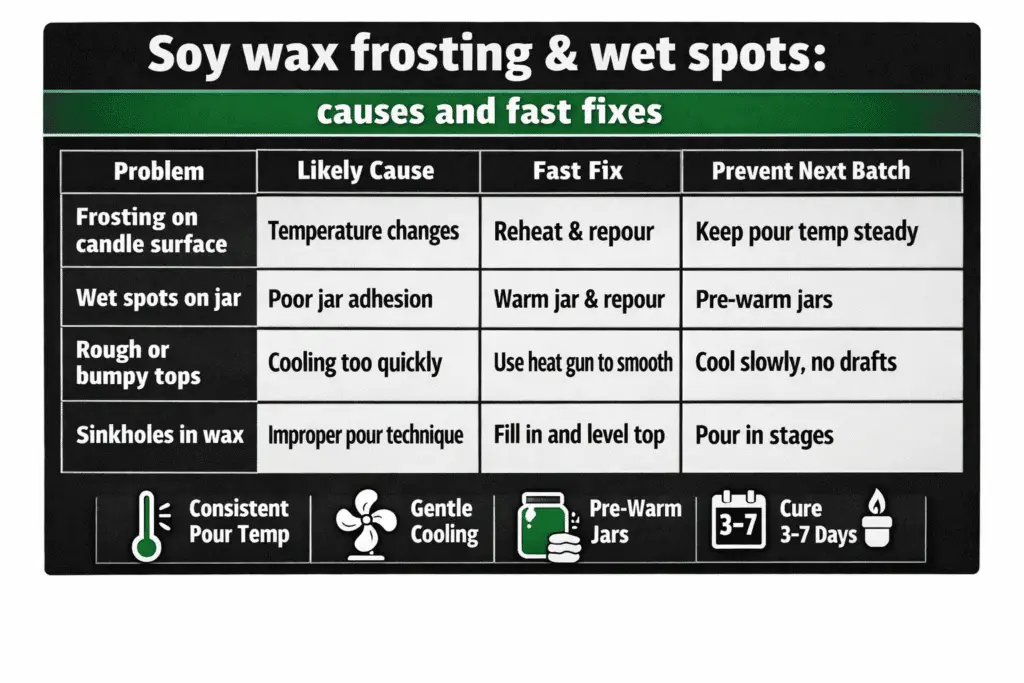
Soy wax is best for plant-based container candles. Its main strength is a familiar natural-positioning story with slow, steady container performance. Its main watchout is process sensitivity: frosting, wet spots, and cure behavior show up sooner than many beginners expect.
Soy also teaches an important lesson about wax choice: the “natural” story and the performance story are not always the same story. Readers who choose soy should expect a narrower process window and more cosmetic testing around frosting, wet spots, and cure behavior. For issue-specific help, see how to fix common soy wax candle issues.
Paraffin wax
Paraffin wax is best for makers who prioritize strong scent throw, vivid color, and easier tuning at lower cost. Its main strength is predictable performance across many candle formats. Its main watchout is that it is weaker for natural or eco-led branding and still needs proper wick control to avoid soot.
Its main trade-off is not mysterious: paraffin usually wins on throw and easy tuning, but it loses branding ground when the product story depends on natural or eco-led language. It still needs proper wick testing and container discipline, especially if you are chasing smooth tops and cleaner burns in jars. For a narrower defect page, see how to fix sinkholes in paraffin candles. For jar fit and heat control, keep container selection tips and wick sizing rules close while you test.
Beeswax
Beeswax is best for premium natural pillars and tapers. Its main strength is firm structure, slow burn, and a strong artisan or heritage story. Its main watchout is cost and its native honey note, which can limit fragrance flexibility.
Beeswax rewards clear intent. Choose it when the native material is part of the product value, not when you need the cheapest or most neutral wax. If you plan free-standing candles, keep wick sizing and wax selection by candle type in view early, because beeswax usually exposes weak wick decisions quickly.
Coconut wax
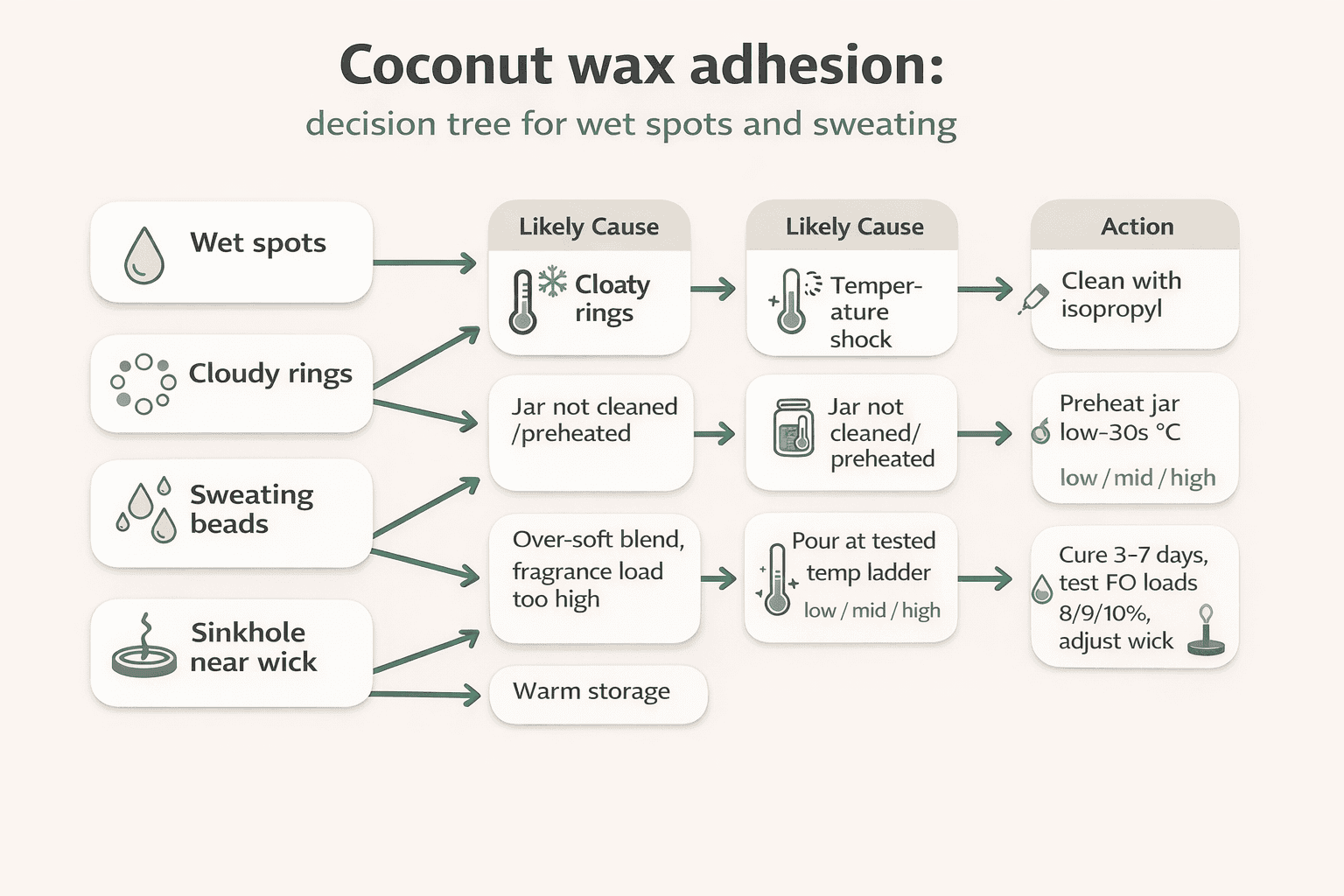
Coconut wax is best for premium-feeling container candles and upscale blends. Its main strength is smooth appearance and strong performance in the right formula. Its main watchout is softness, heat sensitivity, and higher raw-material cost.
Coconut wax becomes attractive when you want a high-end surface, a premium story, and good scent performance without defaulting to paraffin. The trade-off is that softness and warm-room behavior matter earlier in development. For a full basics page, see what is coconut wax and how does it compare. For jar prep and vessel fit, keep container prep tips nearby as you test.
Blended waxes
Blended waxes are best when you need balance rather than purity. Their main strength is tunable performance across throw, appearance, structure, and cost. Their main watchout is that “blend” is not a solution by itself—you still need to know what problem the formula is meant to solve.
The important idea is that blends should be chosen with a goal, not treated as a magic fix. A soy–paraffin blend, a coco–apricot blend, and a soy-heavy “natural” blend are solving different problems even when the label still says “blend.” For a process page, see how to blend different candle waxes. For the wider workflow, revisit the candle-making overview.
Specialty waxes to know, but not start with
Specialty waxes matter after you know your main wax family, but they should not replace the core comparison between soy, paraffin, beeswax, coconut, and blends. They become relevant when you have a narrow visual, sourcing, or format goal rather than a broad “which wax should I use?” decision.
- Palm wax is most relevant when crystal or feathered pillar texture is part of the design.
- Rapeseed / canola wax is worth considering when regional plant-based sourcing matters, especially for container lines.
- Apricot-based blends can suit premium-feeling container candles, but softness and shipping heat still matter.
- Gel is a specialty transparent system with its own safety and compatibility rules, not a normal substitute for standard candle waxes.
- Bayberry and other niche waxes matter when the goal is tradition, seasonal identity, or a very specific finish.
If one of these is your real target, move into a dedicated child guide or supplier-specific testing path instead of treating it as your starter wax.
Modifiers come after base-wax choice
Modifiers and hardeners matter after you choose a base wax, not before. If you still have not settled on soy, paraffin, beeswax, coconut, or a blend, keep this page focused on base-wax selection.
Use additives only when the candle is already close to correct and you need a narrower fix.
- More structure or heat resistance: microcrystalline wax, rice bran, sunflower, stearin, or other harder support waxes
- More gloss or surface firmness: candelilla, carnauba, montan, or similar specialist additives
- More pillar or mold control: structure-focused modifiers chosen for release, firmness, or finish
For bench work, go to additives and enhancers and how to mix candle additives.
Common problem patterns by wax family
Most wax problems repeat in predictable patterns, so a short symptom summary helps you decide whether you need a different wax family or just better testing. This block is not a full troubleshooting manual. It is a routing tool that tells you what each wax family tends to struggle with first.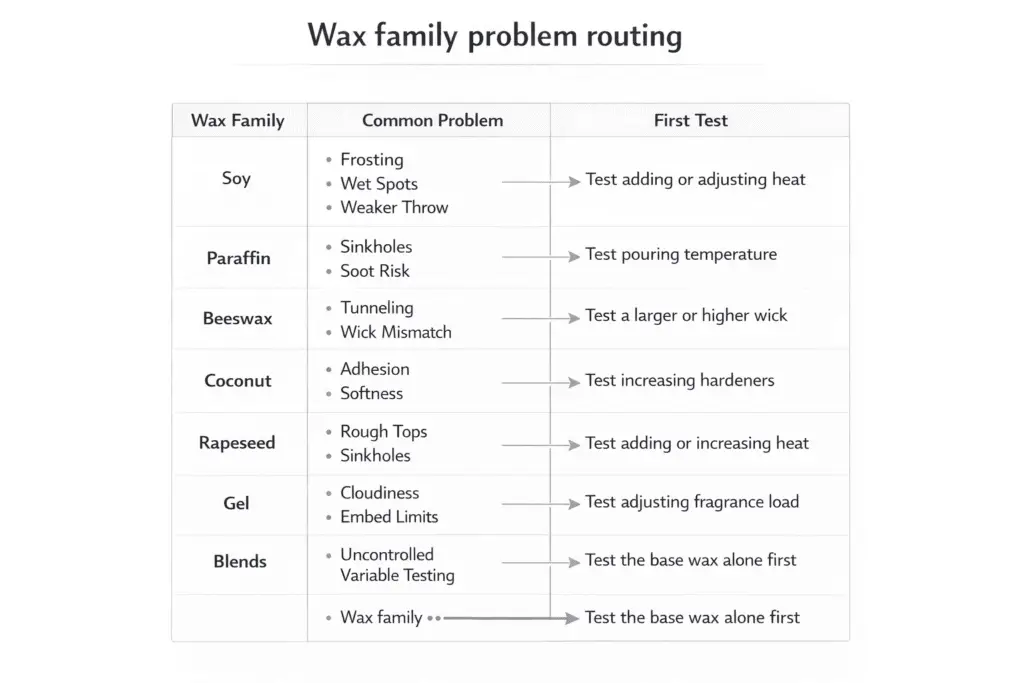
Wax type Common issue What it usually means First thing to test Detailed guide Soy Frosting, wet spots, weaker throw than expected Process-sensitive container wax with tighter cosmetic tolerance Pour consistency, cure time, wick fit, glass prep Soy wax problems fix Paraffin Sinkholes, soot when over-driven, overheated jars Good performer that still needs wick and cooling discipline Wick series, fill height, cooling pace Paraffin sinkholes fix Beeswax Tunneling, drip behavior, wick mismatch Firm natural wax that exposes wick errors quickly Wick family and candle form Wick sizing guide Coconut Adhesion issues, sweating, warm-room softness Premium-feeling but softer system that shows heat stress early Jar prep, room conditions, fragrance load Coconut wax basics Rapeseed / canola Sinkholes, rough tops, slow-set cosmetic issues Plant-based container system that still needs cooling control Pour rhythm, jar prep, cooling stability Choose the right wax Gel Cloudiness, bubbles, safety limits with embeds Specialty clarity-driven system, not a normal jar wax substitute Fragrance compatibility, vessel safety, wick choice Safety and compliance Blends Unclear results because too many variables changed at once Good potential, but only if testing stays controlled One-variable testing, same jar, same wick, same FO How to blend waxes
If your real question is now defect-specific rather than choice-specific, stop here and move into the narrower page. That is how a wax-types seed page should help: fast comparison first, then exact routing when the question becomes technical.
FAQ
The main candle-wax questions usually come down to beginner fit, scent throw, burn speed, container use, blends, climate, and sustainability claims. These short answers are here to resolve the most common comparison queries without forcing you into a child page too early.
What is the best candle wax for beginners?
For many beginners, the best starting wax is the one that matches the candle format they want to make. Soy, paraffin, and beginner-friendly blends are the easiest starting points for container candles because they are widely available and have strong supplier support.
Which wax gives the strongest scent throw?
Paraffin and many paraffin-containing blends usually give the strongest hot throw. Coconut blends can also perform very well, while soy is often softer unless the formula, wick, fragrance, and cure are all dialed in.
Which wax burns the longest?
Burn length depends on the full candle system, not wax alone. In broad terms, beeswax burns slowly, soy can burn steadily in containers, and coconut blends can also last well when they are formulated and wicked correctly.
Which wax is best for container candles?
Soy, paraffin, coconut, and many blends are the main container-candle choices. The right pick depends on whether you care most about scent throw, plant-based branding, smooth appearance, or heat tolerance.
Are blends better than single waxes?
Not automatically, but they are often more practical. A good blend can balance scent throw, appearance, structure, and cost better than a single wax, which is why many working product lines end up using blends.
Which wax is best for hot climates or warmer shipping routes?
Harder waxes and harder blends usually start with an advantage in warm conditions. Softer systems can still work, but they often need more packaging discipline, tighter climate control, or modifier support.
Is soy always more sustainable than paraffin?
Soy usually fits a plant-based brand story more easily than paraffin, but sustainability is still a supply-chain question, not just a label word. Readers who care about this factor should compare sourcing, transport, additives, and packaging rather than assuming one short label tells the whole story.