Straight paraffin is usually the best starting wax for maximum hot throw in container candles.
Paraffin–soy and coconut–paraffin blends come closest when you stay within safe fragrance-load ranges and match the wick to the jar. Here, strong scent throw means repeatable hot throw in standard container candles; cold throw still matters, but this page compares the waxes that project best when lit. This guide compares the main wax options, shows where blends fit, and explains which setup variables matter once you have a front-runner while keeping the focus on wax choice first and deeper testing second.
Quick comparison: which wax usually throws the strongest?
Straight paraffin usually leads for raw hot throw, while paraffin-rich blends come closest when you wick and load them correctly. Soy can perform well, but it usually needs more cure time and tighter wick matching to reach the same room-filling strength. Gel can smell strong too, but it sits outside the easiest starting path for most makers.
| Wax family | Hot throw | Cold throw | Cure speed | Main trade-off | Best starting use |
|---|---|---|---|---|---|
| Straight paraffin | Strongest | Strong | Fast | More soot risk if over-wicked; less “natural” positioning | Maximum room-filling throw in containers |
| Paraffin–soy blend | Strong | Good | Moderate | Needs ratio + wick tuning to avoid behaving like muted soy or hot-running paraffin | Sellers who want strong throw with a softer ingredient story |
| Coconut–paraffin blend | Strong to very strong | Strong | Moderate | Supplier formulas vary a lot; softness can change wick needs | Premium-feeling containers with strong throw at moderate FO |
| Pure soy | Moderate | Good | Slow | Usually needs longer cure and tighter wick matching | Buyers prioritising plant-based wax over maximum projection |
| Gel | Strong when correctly built | Strong | Moderate | Narrower safety window and stricter fragrance/container compatibility | Niche projects, not the default starting answer for this query |
The fastest starting rule is simple: choose straight paraffin if maximum hot throw is the goal, paraffin-dominant blends if you want a compromise, and soy only when ingredient preference matters more than raw projection. For readers comparing the broader candle wax types cluster, this page narrows the choice to the wax families most likely to deliver the strongest repeatable throw.
Best wax by scenario
Choose the wax that matches the result you need first, then tune wick size, FO%, and cure time around that decision. This saves time because you are testing a likely fit instead of treating every wax as an equal starting point.
| If your main goal is… | Start with… | Why it usually wins | Main watch-out |
|---|---|---|---|
| Maximum hot throw in a medium or large room | Straight paraffin | Fast, fluid melt pool and the strongest typical hot throw | More soot risk if over-wicked |
| Strong throw with a softer ingredient story | Paraffin–soy blend (paraffin-dominant) | Keeps much of paraffin’s projection while softening the formula story | Ratio and wick tuning matter |
| Strong throw with a premium-feeling finish | Coconut–paraffin blend | Strong scent, good fragrance solubility, smoother appearance | Supplier formulas vary more |
| Plant-based positioning matters more than raw projection | Pure soy | Better fit for buyers who prioritise plant-based wax | Usually weaker hot throw and longer cure |
Beeswax, palm, rapeseed, and gel are not the default winners for this query. They can fit special projects, but they are not the clearest starting answer when you want the strongest repeatable scent throw in a standard container candle.
If two waxes look close on paper, let the tie-breaker be your actual jar, your target room size, and how much cure time you can tolerate before testing.
Why Paraffin Wax Projects the Strongest Hot Throw
Direct answer: Straight paraffin gives the strongest hot throw because a thin, mobile melt pool releases fragrance quickly when you stay within safe load limits and wick correctly.
Straight paraffin often delivers the strongest hot throw because it melts into a thin, mobile pool that releases fragrance molecules quickly at the same wick size and fragrance load as other waxes. When you compare the main wax families, paraffin behaves like a highly efficient fuel: once the wick is correctly sized, it forms a wide, even melt pool that pushes scent into the room faster than most plant-heavy blends. That hot throw advantage is what people describe as “room-filling” or “throwing down the hall.”
On a materials level, paraffin’s relatively low melt viscosity lets fragrance diffuse freely around the wick instead of being trapped in a stiff network. As the flame heats the wax, the pool becomes a thin liquid that constantly feeds vaporised fragrance into the hot zone above the wick, where it can disperse into the air. In contrast, highly crystalline plant waxes can hold onto some of those molecules longer, so the same wick and fragrance load may smell softer.
Performance still lives or dies on your test setup: jar diameter, wick series, wick trim, and fragrance percentage all change how that melt pool behaves. Keep wicks trimmed to safe lengths and match them to the jar and wax family; safety baselines like ASTM F2417 and major candle associations emphasise staying within controlled container temperatures and avoiding visible smoking or flaring. A paraffin candle that roars, mushrooms heavily, or overheats the jar isn’t “good throw” — it’s a safety problem and a sign you’ve pushed the wick or fragrance too far.
Safety note: Strong throw is only a win when the candle still burns inside the wax supplier’s documented range and without visible soot, flaring, or overheating. Treat standards and supplier documentation as guard rails, then compare waxes inside those guard rails rather than using scent strength alone as the deciding metric.
A simple example test is to burn three identical paraffin jars in a medium-sized room and log how far away you can clearly smell them at 30, 60, and 120 minutes. Note pool diameter (relative to jar width), flame height, and any soot on the rim. Over a few rounds, you’ll see that strong-throw paraffin tests usually share the same look: a glossy, low-viscosity pool reaching close to the glass, a steady flame, and only a thin ring of unmelted wax during early burns. That visual is why many makers rely on close-up photos as a quiet but powerful record of how well a paraffin formula projects.
Hot throw is also tied to the fragrance itself and how it’s built to behave in paraffin. A fragrance & scenting guide can help you prioritise oils that are rated for hot throw, compatible with paraffin, and within your supplier’s safe load range. When you weigh up soy vs beeswax vs paraffin, remember that buyers experience the candle first through strength, evenness of burn, and safety; “natural” ingredients matter, but they don’t replace careful testing of wick, wax, and fragrance together.
How to Tune Paraffin–Soy Blends for Strong Hot Throw
Direct answer: Paraffin–soy blends throw strongly when paraffin stays dominant, you stay within the supplier’s documented fragrance-load range, and you adjust wick size for each ratio instead of chasing throw with more oil.
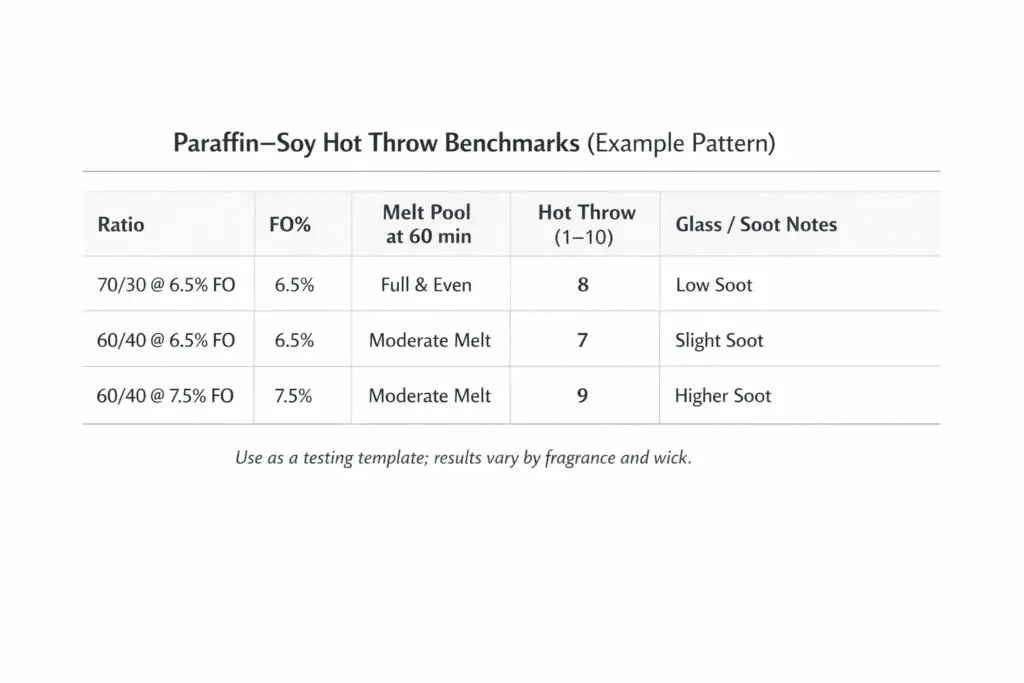
Blends of paraffin and soy are popular because they promise a balance between the strong throw of paraffin and the marketing appeal and appearance of soy, but that balance only appears when you tune ratios, fragrance load, and wick choice deliberately. If you come in with a rough wax types overview, paraffin-rich blends (for example, 70/30 or 60/40) generally behave more like straight paraffin in terms of melt pool and projection, while very soy-heavy mixes start to pick up soy’s tighter structure and slower pool formation. Your first decision is where on that spectrum you want to sit for your audience and price point.
Once you’ve chosen a starting ratio, treat wick and fragrance percentage as linked decisions rather than separate dials. A cooler wick that works beautifully in a stiff soy container may underperform in a paraffin–soy blend, leaving a shallow pool and muted scent, while a hotter wick designed for paraffin can run too aggressive if you push FO to the upper end of the range. It helps to map out a small ladder test: two ratios (such as 70/30 and 60/40), one or two wick series, and a fixed starting FO that sits comfortably below the supplier maximum.
You also need to respect how much fragrance the blend can realistically hold. Supplier documentation should set the ceiling; many container blends perform best somewhere in the middle of the documented range, but the exact ceiling varies by formula. Push far beyond that and you risk oil pooling, surface sweating, and smoky flames — all of which hurt real-world throw even if the candle smells strong up close. It’s better to refine the ratio and wick than to keep dumping in more fragrance.
Instead of treating one ratio as universally best, run a small controlled ladder test. Compare two ratios—such as 70/30 and 60/40—at the same mid-range fragrance load and within the same wick series. Keep the version that reaches a near-full melt pool, throws strongly by the second or third burn, and keeps the glass clean.
Use this simple pass/fail screen when you compare parasoy ratios.
- Keep it if the melt pool forms evenly, the flame stays steady, and the scent stays strong without visible soot.
- Re-test it if the throw is close but the melt pool is slow or patchy.
- Reject it if you see sweating, smoking, heavy mushrooming, or overheating, even when the scent seems stronger.
Those pass/fail checks tell you whether the blend and wick are delivering paraffin-like projection without pushing the candle beyond a stable burn. Safety baselines like ASTM F2417 and supplier SDS sheets are your guard rails here; if a configuration raises container temperature too much or shows heavy smoking, it’s out, no matter how impressive the scent.
Methods: To tune paraffin–soy blends, many makers pour at least three jars per ratio (for example, 70/30 and 60/40) at a fixed starting fragrance load, then test two or three adjacent wick sizes in the same series. They record jar diameter, pool diameter at 60 minutes, visible soot, and a 1–10 hot-throw rating across three burns. Units: pool diameter in millimetres or as a fraction of jar width; fragrance in percent of wax weight. Limitations: results depend on the specific fragrance, vessel material, and room conditions, so repeat promising combinations with different scents and rooms before calling them “final.”
Why Coconut–Paraffin Blends Can Match Throw at Lower FO%
Direct answer: Coconut–paraffin blends can sometimes match paraffin’s strong throw at moderate fragrance percentages because the softer coconut phase holds and releases oils efficiently when you wick and cure them properly.
When you compare straight paraffin to mixed waxes, one of the surprises is how well coconut wax blend performance holds up even when you dial fragrance oil down a little. Coconut-heavy blends behave more like a creamy solvent than a brittle wax, so fragrance molecules stay well dispersed and migrate easily into the melt pool. That means you can sometimes get strong scent at moderate fragrance load compared with a paraffin-only formula that needs more oil to feel equally “room-filling.”
The structure of coconut–paraffin blends is key here. Paraffin contributes a firm backbone and excellent burn mechanics, while the coconut portion softens the blend and improves fragrance solubility. In practical terms, jars poured at a moderate FO% in a good coconut–paraffin container blend can rival or beat a straight paraffin test poured at a higher percentage, as long as wick and vessel are tuned correctly. The difference becomes obvious when you walk out of the room and come back after an hour: the blend still greets you at the door instead of fading into the background.
You still need to respect supplier limits and treat paraffin vs coconut wax as different animals when you read technical sheets. Some coconut–paraffin systems tolerate higher maximum FO than straight paraffin, but climbing toward that ceiling increases the risk of sweating, weeping, and unstable flames. A smarter strategy is to start in the middle of the recommended range, then adjust wick size and coconut fraction before touching FO percentage. This keeps container temperature under control while you search for the sweet spot where the melt pool is fluid, glossy, and strongly scented without visible smoke.
From a small-business perspective, this is where blends get financially interesting. If you can achieve comparable or better throw with slightly less fragrance, you protect your margins and reduce the chance of customers complaining about oily tops or smoking wicks. Tools like digital thermometers, scale-accurate test batches, and simple burn logs become low-cost “lab equipment” that pay for themselves quickly. Over a few test rounds, you’ll see patterns: certain fragrances bloom beautifully at moderate loads in coconut–paraffin, while others need more paraffin or a different wick series to project well.
Methods: To compare coconut–paraffin blends with straight paraffin, many makers pour matched sets of jars using identical vessels, wick series, and FO percentages within the safe documented range. They rate hot throw at 30, 60, and 120 minutes on a 1–10 scale while also logging container temperature, melt pool depth, and any signs of oil separation. Limitations: every wax base, fragrance oil, and room layout behaves differently, so treat your first set of tests as calibration, not final truth, and repeat winning combinations with at least one other fragrance family before standardising your production formula.
Is Gel Actually the Best Choice for Strong Scent Throw?
Direct answer: Gel can smell very strong, but it is not the default best-wax answer for most candle makers because compatibility and safety limits are tighter than with standard container waxes.
For this query, gel is better treated as a special-case material than a mainstream winner. If you want the strongest uncomplicated starting point, paraffin still leads. If you want a balance of strong throw and easier container-candle testing, paraffin–soy and coconut–paraffin blends are usually more practical than gel.
Use gel only when you are intentionally building a gel-safe system with approved fragrance, gel-rated wick choices, and heat-appropriate containers. That keeps this page focused on wax selection instead of turning it into a full gel-safety tutorial.
What to Tune After You Choose a Wax
Once you have a likely winner, setup variables matter more than switching wax families again. Fragrance-load range, wick series, cure time, vessel size, and room conditions decide whether a promising wax actually performs well in your jar.
Keep the follow-up work narrow: use the supplier sheet as your guard rail, test one wick ladder inside the documented FO range, and give the candle its normal cure window before calling the wax weak. If a promising formula still underperforms after those checks, move into deeper weak scent throw fixes instead of reopening the wax comparison from scratch.
For step-by-step validation, use separate guides for wick types and sizing, choosing a candle container, testing scent throw in different rooms, and additives for scent throw rather than turning this wax-choice page into a full troubleshooting workflow.
Use this short validation checklist after you pick a wax.
- Check the supplier sheet for intended use, fragrance-load range, cure window, and wick guidance.
- Start with one vessel, one wick series, and a mid-range fragrance load inside the documented range.
- Give the candle its normal cure time before deciding the wax is weak.
- Re-test if you change vessel size, material, or the room where you judge throw.
- Route deeper only when the chosen wax still underperforms after those checks.
Common questions about wax and strong scent throw
Why does my paraffin candle smell stronger than my soy candle at the same FO%?
Paraffin usually forms a thinner, more mobile melt pool that releases fragrance faster, while many soy blends hold onto fragrance in a tighter crystal network and need more careful wicking to match throw.
Can I fix weak throw just by adding more fragrance oil?
Sometimes a small increase helps, but once you approach the supplier’s maximum you risk sweating, oil pooling, and soot. Often, wicking, cure time, or vessel choice will fix more than another percent of FO.
How many candles do I need for a large living room?
A single medium jar may fill a small, closed room, but open-plan spaces often need two or three medium jars or one larger, hotter-burning setup, placed where air moves gently instead of in strong draughts.
Is wicking up always the answer when I want more scent?
No. Wicking up without adjusting FO or vessel can drive soot and overheated jars. It’s safer to move along a wick–FO trade-off curve, nudging one slider at a time and discarding any combination that fails basic safety checks.
Why does my candle smell weak right after pouring but stronger a week later?
The wax and fragrance need time to “set” together. During cure, the internal structure stabilises and hot throw usually improves; judging a soy or coconut blend at 24–48 hours can lead you to scrap a formula that would have been excellent at its proper cure time.