No single wax is objectively “best”: soy suits plant-based container candles, beeswax suits premium long-burning candles, and paraffin suits strong fragrance at lower cost.
Choose soy when you want a vegan container candle with balanced cost and a clean look, beeswax when you want a premium candle that burns long and adds a natural honey note, and paraffin when strong scent throw, bright color, and low cost matter more than natural sourcing. The sections below compare burn cleanliness, scent throw, burn time, ethics, price, and heat tolerance so you can pick the right wax quickly.
Soy vs Beeswax vs Paraffin at a Glance
Soy is the middle-ground option, beeswax is the premium long-burning option, and paraffin is the lowest-cost option with the strongest scent throw. Use this table first if you want the fastest answer.
| Criterion | Soy wax | Beeswax | Paraffin wax |
|---|---|---|---|
| Best fit | Mid-priced scented container candles | Premium tapers, pillars, and lightly scented candles | Budget-friendly scented candles with strong hot throw |
| Clean burn / soot risk | Usually low when wicked and trimmed correctly | Usually low and steady; still wick-dependent | More likely to show soot when over-wicked, heavily fragranced, or burned too long |
| Scent throw | Good, especially after cure | Mild with added fragrance; natural honey note can compete with added scent | Usually the strongest and easiest to push in larger rooms |
| Burn time | Usually longer than paraffin | Usually the longest | Usually the shortest |
| Natural aroma | Mild to nearly neutral | Distinct honey-like aroma | Mostly neutral |
| Sustainability / ethics | Plant-based and vegan; sourcing quality matters | Natural but animal-derived and not vegan | Fossil-derived |
| Color / finish | Can frost or show wet spots in jars | Natural warm tone; less flexible for bright colors | Smooth finish and strong color payoff |
| Heat tolerance | Moderate; soft container blends dislike heat | Highest of the three in most everyday uses | Moderate to high depending on blend |
Best Wax by Use Case
The best wax by use case depends on what you value most: soy is the all-round container choice, beeswax is the premium natural choice, and paraffin is the strongest scent-value choice.
- Choose soy for vegan, plant-based container candles with balanced price, clean appearance, and good all-round performance.
- Choose beeswax for premium gifts, natural tapers or pillars, long burn time, and a warm honey-like aroma without relying on heavy added fragrance.
- Choose paraffin for the strongest hot throw, the brightest dye payoff, and the lowest entry cost.
- Choose beeswax or a harder paraffin blend for hotter environments, market stalls, or shipping routes where soft waxes can deform.
- Choose soy for a mid-tier home-fragrance line where customers care about plant-based positioning but still expect solid scent and value.
- Choose paraffin when your top priority is bold fragrance performance in a larger room at a lower cost.
Use how to choose the best wax for candle making if you want a broader framework before you commit to one wax family.
Clean burn and soot: soy vs beeswax vs paraffin
A genuinely clean-burning candle leaves little to no visible soot on the container or nearby surfaces under normal, well-trimmed use.
A clean-burning candle is one that leaves little to no visible soot on the jar or lid after a standard 3–4 hour burn with a properly sized and trimmed wick. Instead of chasing a single “cleanest” wax, it helps to compare soy, beeswax, and paraffin performance overall and then zoom in on soot patterns on glass, walls, and nearby surfaces.
Soy and beeswax usually produce the cleanest-looking burn when the wick is correctly sized and trimmed, while paraffin is more likely to show soot sooner when the candle is over-wicked, heavily fragranced, or burned too long. In other words, soot is usually a candle-design and burn-habit issue first, not a simple wax-family verdict.
If your priority is the lowest visible soot, beeswax and a well-made soy candle usually have the edge. If your priority is maximum scent strength, paraffin can still be the better fit, but it needs tighter wick control to stay clean on glass and nearby surfaces.
For a fair comparison, trim the wick to 1/4 inch, burn in 3–4 hour sessions, avoid drafts, and compare like-for-like jars while changing only one variable at a time. Cosmetic issues such as wet spots & sinkholes affect appearance, but they do not prove that a candle is burning dirty.
With that kind of structured testing, you’ll usually find that soy, beeswax, and paraffin can all burn acceptably clean for home use once the system—wick, wax, fragrance, jar, and habits—is tuned.
Scent throw: which wax smells strongest?
Strong, room-filling scent comes from how you balance wax type, wick heat, fragrance load, and cure time—not from wax choice alone.
Strong scent throw comes from balancing fragrance load, wick heat, cure time, and wax type so the melt pool is hot enough without overdriving the wick. Instead of blaming one wax alone, think in terms of how you optimize scent throw variables across waxes—fragrance percentage, wick family, jar size, and realistic room expectations.
Paraffin usually throws fragrance the most aggressively and reaches strong hot throw with the least effort, which is why it often performs best in larger rooms. Soy can smell excellent too, but it usually depends more on cure time and wick fit before you judge it fairly. Beeswax has its own natural honey note, so added fragrance is often lighter and can compete with the wax itself.
Cure time and wick fit often explain why a soy candle smells weak at first. Test at 24 hours, 3–4 days, and a week or more for soy blends, then judge hot throw in a realistic room with the right jar size and steady flame. If a candle smells good on cold sniff but underperforms when lit, use fix weak scent throw for deeper troubleshooting rather than pouring in more fragrance. Strong scent still has to stay within safe flame and container-temperature limits, especially in larger jars or hotter rooms, so wick heat and container temperature control matter as much as wax choice.
Burn time and value: which wax lasts longest?
Burn time is how many safe burning hours a candle provides; efficiency is how many hours you get per gram of wax and per unit of cost.
Burn time is simply how many hours a candle produces a safe, usable flame; efficiency is how many hours you get per gram of wax and per unit of cost. Before you tweak formulas, it helps to get burn time and efficiency basics clear: the same jar can last very different hours depending on wax, wick, and diameter.
When you compare candle burn time by wax, most tests put beeswax at the top, soy in the middle, and paraffin shortest for the same size candle. That’s why a pricier wax can still make sense if you care about cost per hour rather than price per jar.
In like-for-like candles, beeswax usually lasts the longest, soy often lands in the middle, and paraffin tends to burn faster. Exact burn hours still depend heavily on jar diameter, wick series, fragrance load, and how hot the candle runs, so this page should keep the comparison directional unless you are publishing controlled test results from your own candles.
Jar diameter, wick series, fragrance load, and flame size still change the final result, which is why a narrow jar can outlast a wider one even with the same wax. For a fair comparison, log wax weight, vessel diameter, wick, and total safe burn hours, then use that data to judge both hours per candle and value per hour instead of relying on label claims alone.
Once you see burn time and efficiency as numbers you can measure and improve, choosing between soy, beeswax, and paraffin becomes less about marketing claims and more about whether a given recipe delivers the burn profile and price point your customers expect.
Sustainability and sourcing: how the waxes differ
Sustainability differences between waxes come from their resource base—fossil fuel, farmland, or beekeeping—and from how carefully producers handle sourcing, land use, and animal welfare.
When people compare soy vs beeswax vs paraffin on sustainability, they are usually weighing renewable-material positioning, animal-derived vs vegan preference, and how transparent the supply chain is. That is why the debate overlaps with broader questions about natural vs synthetic candles, not just burn performance.
Soy wax often fits brands that want a plant-based and vegan option, but farming practices, regional sourcing, and supply-chain transparency still matter. That is why certifications and regional sourcing matter as much as the label “soy.”
Beeswax can appeal to buyers who want a natural material and a premium product, but it is animal-derived and its ethical case depends on how hives are managed. Paraffin is fossil-derived, which is why it usually fits value and scent-performance positioning more than eco-focused positioning.
A practical buying rule is simple: choose soy when vegan and plant-based positioning matter most, choose beeswax when natural premium positioning matters most and you are comfortable with animal-derived materials, and choose paraffin when performance and price matter more than sustainability messaging.
Cost and availability: what you pay for
Wax cost decisions make more sense when you look at cost per hour of burn, not just cost per kilo of raw material.
Raw wax price is only one part of the decision. Testing time, cosmetic risk, customer expectations, and claim risk matter too.
- Lowest upfront cost: paraffin
- Highest raw-material cost: beeswax
- Highest cosmetic troubleshooting risk in jars: soy
- Strongest sustainability objection risk with customers: paraffin
- Best premium-story fit: beeswax
- Best middle-ground for price vs values: soy
Paraffin is usually the cheapest and most widely available, soy often sits in the middle, and beeswax is commonly the most expensive and more variable in supply, so you should compare candle wax cost per jar by looking at both raw wax price and burn time.
In practice, paraffin suits entry-level or value lines, soy suits mid-tier products with a plant-based story, and beeswax suits premium ranges where buyers will pay more for longer burn and a natural feel. Availability also varies by region and order size, with paraffin and standard soy blends usually easier to source in small test quantities than beeswax.
Heat tolerance and shipping: which wax handles heat best?
Heat tolerance planning means matching wax melt ranges and packaging to your hottest realistic storage and shipping conditions.
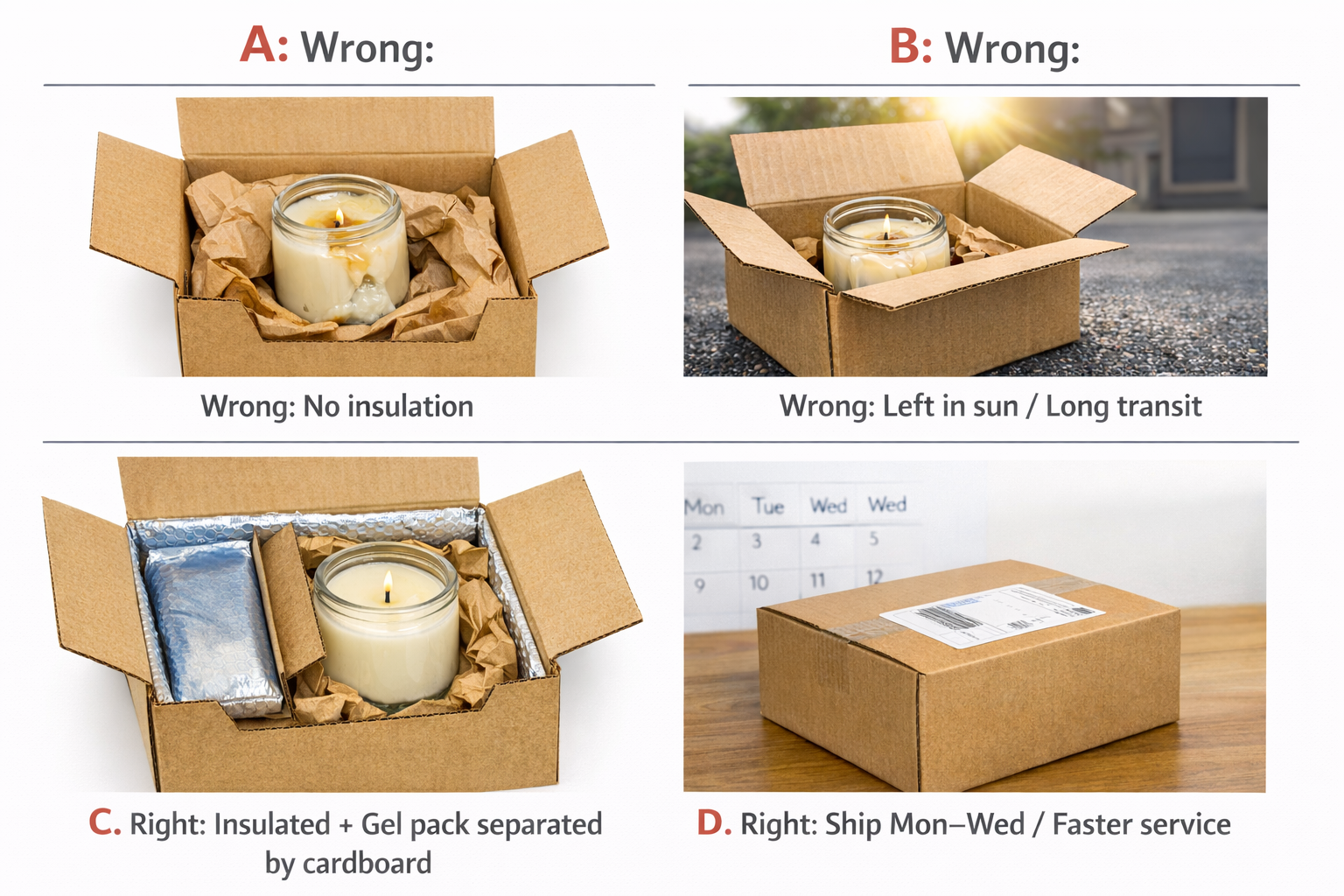
You plan melting point and heat tolerance by checking each wax’s melt range, your local climate, and how hot parcels or storage spaces get, then designing recipes and packaging to stay below that temperature in transit.
In everyday use, beeswax usually handles heat best, paraffin performance depends heavily on the blend and melt point, and soft container soy blends are the most likely to soften or deform in hot storage or shipping. That makes beeswax or harder paraffin-style pillar blends the safer choice for hot stalls, sunny rooms, and summer transit, while soy performs best when the formula and packaging are chosen specifically for container use.
If summer shipping matters, use a hot weather shipping for candles plan instead of assuming wax alone will solve the problem. Faster services, insulated packing, and avoiding long weekend storage matter more for soft soy container candles, while beeswax and harder paraffin blends usually give you a wider safety margin in hot weather.
When a recipe is close but still too soft, a harder blend, a sensible fragrance load, full cure, and better packaging usually matter more than switching the whole product line.
What Affects Results More Than Wax Alone
Wax type matters, but three variables often change the outcome faster than switching from soy to beeswax or paraffin: wick fit, fragrance plus cure, and vessel plus heat exposure.
- Wick fit: The wrong wick can make any wax tunnel, soot, mushroom, or throw weak scent. Use a wick size estimator before you blame the wax.
- Fragrance and cure: A good wax can still underperform if the fragrance load is too high, too low, or not cured long enough.
- Blend and vessel choice: If one wax is close but not perfect, the fix is often a blend or a different vessel instead of a full wax switch. See how to blend waxes for next-step testing.
For the full process around wax, wicks, fragrance, and testing, use the main candle-making guide.
Quick Answers Buyers Usually Want
Buyers usually choose beeswax for burn time, paraffin for scent throw and lower cost, and soy for vegan, plant-based container candles.
- Best for longest burn: beeswax
- Best for strongest scent throw: paraffin
- Best for vegan container candles: soy
- Best for lowest upfront cost: paraffin
- Best for premium natural gifts, tapers, and pillars: beeswax
Which wax burns longest?
Beeswax usually lasts the longest in like-for-like candles, with soy commonly in the middle and paraffin usually burning faster.
Which wax has the strongest scent throw?
Paraffin usually throws scent the most aggressively, especially in larger rooms or highly fragranced candles.
Which wax is best for vegan candles?
Soy is the clearest fit because it is plant-based, while beeswax is animal-derived and paraffin is fossil-derived.
Which wax is best for luxury gifts or natural tapers?
Beeswax is usually the strongest fit because it burns long, looks premium, and brings its own natural honey-like aroma.
Which wax is best on a tight budget?
Paraffin is usually the cheapest option and the easiest way to get strong fragrance and bright color at lower cost.