
The right candle wax is the one that fits your vessel, climate, and goals—and that you can test consistently.
This guide helps makers choose wax for jars, pillars, melts, or a first product line. It compares the main wax families by vessel fit, scent performance, finish, heat tolerance, burn behavior, and cost.
Use the table and scenario picks to build a shortlist, then test that shortlist before buying in bulk. The goal is to choose a wax you can repeat safely and profitably.
Quick start choices (if you just want a recommendation):
- If you’re a brand-new maker pouring 6–10 oz glass jars in a normal indoor climate, start with a mainstream container soy or coconut–soy blend designed for jars in the 2.5–4 inch range.
- If you live in a very hot climate or ship in summer, look for a slightly firmer container wax or parasoy blend with a higher melt point and “summer-safe” notes in the description.
- If your priority is a strong sustainability story and you’re willing to accept more testing, explore local rapeseed, coconut–soy, or beeswax blends and build your range around a few well-documented, traceable suppliers.
Wax Type Selection — What to choose for your vessel and climate
Choose candle wax by matching the wax family to your vessel, climate, scent goals, finish expectations, and budget.
Container waxes suit jars, while pillar and melt formulas need a harder profile with cleaner release. The best wax is the one that performs predictably in your setup, not the one with the loudest supplier claims.
Side-by-side wax comparison
Use this table to narrow your shortlist before you order samples.
| Decision factor | Soy container blend | Coconut–soy blend | Parasoy / paraffin blend | Beeswax / beeswax blend |
|---|---|---|---|---|
| Best fit | Beginner container jars and plant-based positioning | Premium container candles with smoother tops | Strong-throw jars, easier finishes, warmer-weather selling | Natural, slower-burning pillars or premium small batches |
| Hot throw | Good with the right wick and cure | Usually strong and rounded | Usually the easiest path to big throw | Mild unless lightly scented or blended |
| Surface finish | More frosting and adhesion quirks | Smoother and creamier | Smoother, glossier, more forgiving | Natural finish; not ideal if you want bright colors |
| Heat and shipping tolerance | Varies by blend; summer-specific versions help | Can be soft in hot shipping unless the blend is firm | Usually the safest for hot-weather jars | Firm, but cost and vessel fit still matter |
| Burn behavior and burn time | Often steady in jars, but total burn time still depends on wick choice and blend design | Often even and creamy in jars, but softness can change how the candle pools and lasts | Often reaches a full melt pool easily, while total burn time still varies by formula and setup | Often slower-burning in suitable formats, especially when used unscented or lightly scented |
| Beginner-friendliness | Good | Good once you accept higher cost | Very good for fast feedback and fewer cosmetic issues | Moderate; more niche and costlier to learn on |
| Sustainability story | Stronger than paraffin if sourcing is clear | Strong if the blend is transparent | Weaker natural story, stronger performance story | Strong natural story, but limited and expensive |
| Relative cost | Low to medium | Medium to high | Low to medium | High |
| Best next step | Test in one jar with 2 wick sizes | Test against soy in the same vessel | Test if throw and smooth tops matter most | Test only if natural positioning or long burn matters most |
Best wax by candle type and selling conditions
Choose wax by starting with candle type and selling conditions, then narrow to one or two families.
- 6–10 oz glass jars in a normal indoor climate: Start with a mainstream soy container wax or a coconut–soy blend made for your jar diameter.
- Premium jar candles where smooth tops matter most: Test coconut–soy against soy in the same vessel and fragrance.
- Hot-weather markets or summer shipping: Shortlist a firmer container soy or a parasoy blend with stronger heat tolerance.
- Pillars, votives, and wax melts: Use a dedicated pillar or melt wax instead of a container wax.
- Brand-first natural positioning: Compare soy, rapeseed, coconut–soy, and beeswax blends only after checking traceability, repeat availability, and cost per candle.
The goal here is not to crown one universal “best wax.” It is to eliminate the wrong wax families quickly, then test the two best-fit options for your vessel, climate, and selling conditions.
Best candle wax by scenario
If you are pouring your first run of glass jars, start with a mainstream soy container wax or a coconut–soy blend that matches your jar diameter. If you care most about strong hot throw and smooth tops, shortlist a parasoy or paraffin-heavy container blend. If you sell or ship through hot weather, favor a firmer container blend with clear summer or high-heat notes from the supplier. If you make pillars, votives, or melts, skip container wax and use a dedicated pillar or melt formula. If your brand story depends on natural or local sourcing, shortlist soy, rapeseed, coconut–soy, or beeswax only after checking traceability and repeat availability.
How to shortlist one or two waxes before buying in bulk
Use one jar, one fragrance, and one wick series so the wax is the main variable.
This first round is meant to remove guesswork, not to optimize everything at once. Keep the setup simple enough that you can tell whether the wax deserves a second round of testing.
- Pick your main vessel and one fragrance family you already trust.
- Shortlist no more than two candidate waxes for that format.
- Pour small test batches at the supplier’s recommended ranges instead of changing multiple variables at once.
- Score each wax for full melt pool, hot throw, finish quality, heat tolerance, and repeatability after cure.
- Keep the wax that gives the best overall balance in your real room and shipping conditions—not the wax that wins only one metric.
For a broader material overview, start with Types of Wax Used in Candle Making. For the next decision layer, compare Soy vs Beeswax vs Paraffin: Pros and Cons.
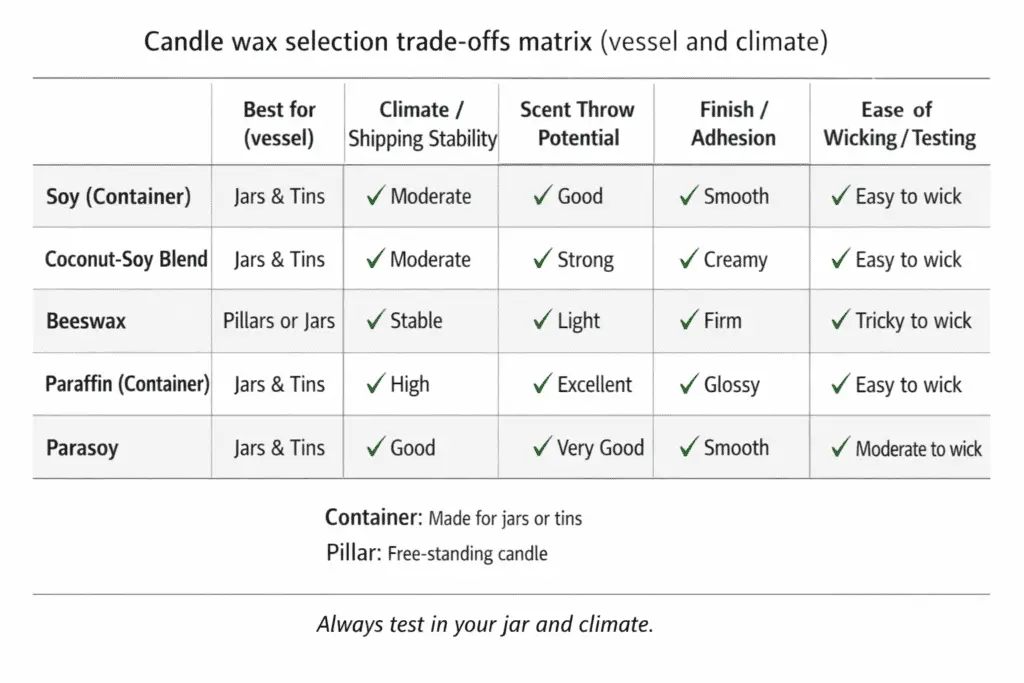
Think of wax families as tools: container soy or coconut blends that stay slightly softer in the jar, pillar or votive blends that shrink and release from molds, and specialty blends like parasoy that trade some “natural” story for smoother tops or stronger throw. Instead of hunting for a mythical “best wax,” you’ll get better results by picking one that matches your jar diameter, project type, and climate, then learning its quirks through testing.
A simple way to narrow options is to start from your most common candle format. If you mostly pour 7–10 cm (roughly 2.75–4 inch) glass jars, look for a container wax specifically designed for that size range, with supplier notes about adhesion and scent throw above all. Makers working with pillars, votives, or wax melts need waxes that are harder and shrink slightly as they cool, so they release cleanly from molds without cracking. If you have both jars and melts in your line, it often makes sense to use two related waxes from the same supplier—one container blend, one pillar/melt blend—so you can understand how each behaves without juggling too many variables at once.
You can also treat wax choice as part of your brand positioning. A straight paraffin container wax often gives very strong hot throw and easy glass adhesion with minimal frosting, but the “petroleum-derived” story doesn’t fit every brand. A pure soy or rapeseed wax advertises itself as plant-based and renewable, yet may frost more, need longer cure times, and require more careful wicking to reach the same throw. Blends like coconut-soy or parasoy try to balance those trade-offs: the vegetable component helps you talk about renewable content, while the paraffin or coconut portion can smooth tops, improve glass adhesion, and support stronger fragrance.
Climate and storage conditions are another key axis. If you ship or store candles in very warm environments, a slightly higher-melt or firmer blend can prevent soft, dented tops and slumping, especially for larger-diameter jars. Makers in cooler homes or studios might prefer a wax that softens and pools a little more easily so that customers don’t complain about tunneling during winter. When in doubt, check the supplier’s recommended melt point range and look for notes about “summer-safe” or “high heat” blends if you live in or ship to hot regions.
From a cost and monetization angle, wax choice also affects margins and how easily you can scale. Container soy or parasoy blends are often widely available and competitively priced, while niche plant waxes or premium beeswax can cost much more per kilogram and fluctuate with harvests. If you plan to sell at markets or wholesale, it’s worth running a quick cost-per-candle calculation for each candidate wax, including shipping and likely waste, so you don’t build your entire range on a material that will be hard to restock or price profitably six months from now.
Methods note: The jar-size ranges, climate bands, and comparison labels in this guide are shortlist ranges, not universal rules. They reflect common supplier descriptions and test variables such as jar diameter, wick series, fragrance family, room temperature, and cure time. Check the technical data sheet for your exact wax, then confirm the result in your own jar, room temperature, and wick series before scaling.
Cost, effort, and risk before you commit
These trade-offs show where testing usually gets easier, costlier, or riskier before you scale a wax choice.
- Lowest testing friction: parasoy or paraffin blends usually give fast feedback on throw, adhesion, and smooth tops.
- Lowest brand-story friction: soy, coconut–soy, rapeseed, and beeswax are easier to explain on product pages, but they usually need tighter process control.
- Highest material-cost risk: beeswax and some premium coconut blends can make small mistakes expensive.
- Highest summer-shipping risk: very soft container blends can look perfect on the bench and still arrive dented or slumped in heat.
- Biggest production mistake: using one wax for jars, pillars, and melts without re-testing each format.
Key filters that change your wax choice
These filters help you narrow a wax shortlist before you move into wick tuning, cure work, or troubleshooting.
Use them to remove poor-fit wax families early, then test the surviving options in your real vessel and climate.
1. Scent throw vs. finish
If your highest priority is strong hot throw and easy-looking tops, parasoy or paraffin-heavy blends usually deserve a place on the shortlist. If your priority is plant-based positioning, start with soy or coconut–soy and accept that finish and throw may need more testing. For a deeper throw-first comparison, see Best Candle Wax for Maximum Scent Throw.
2. Heat tolerance and shipping
If you sell in hot weather or ship through summer, favor a firmer container blend and check the supplier’s melt-point or warm-climate notes. A softer luxury blend can still be the wrong business choice if it arrives dented or slumped.
3. Vessel type
Use container wax for jars and dedicated pillar or melt formulas for freestanding candles and wax melts. Do not assume one wax will perform well across jars, pillars, and melts without re-testing.
4. Wick, load, and cure
Wick size, fragrance load, and cure time affect final performance, but they are validation steps after you shortlist the wax. Keep them controlled during testing instead of letting the wax-choice page turn into a full process manual. Use How to Choose the Best Wick for Candle Making and Cure Time by Wax Type (Chart) when you move from choosing to optimization.
5. Finish tolerance
Some makers will accept light frosting or minor wet spots in exchange for plant-based positioning; others need smoother tops and stronger adhesion for retail presentation. Decide that trade-off early so you do not test the wrong wax family for your brand. For soy-specific troubleshooting, see How to Fix Common Soy Wax Candle Issues.
6. Scale risk
Before you commit, check repeat availability, traceability, and cost per finished candle. A wax that looks great in one small batch can still be the wrong production choice if supply, heat tolerance, or margin stability is weak.
7. Burn time and burn behavior
Use burn behavior as a tiebreaker after vessel fit is solved. Some beeswax and firmer blends can burn more slowly, while paraffin-forward blends often establish a full melt pool more easily; both outcomes still depend on wick, fragrance load, and jar size.
Supplier checks before you scale a wax choice
Before buying in bulk, confirm that the wax is documented enough to support your product claims and stable enough to support repeat production.
This page is about choosing the right wax family. Full labeling and market-specific compliance work should happen after the wax shortlist survives testing.
- Confirm whether the wax is for containers, pillars, or melts.
- Request the technical data sheet and SDS.
- Check the supplier’s stated fragrance-load ceiling, recommended wick series, and any summer or hot-weather variant.
- If sustainability is part of your offer, verify blend transparency, origin, and traceability before using that claim on product pages.
- Do not scale a wax until one vessel, one wick series, and one fragrance family have passed your own burn tests.
Final wax-selection recap
Choose wax in this order: vessel type → climate and shipping conditions → scent and finish goals → sourcing and margin reality → small-batch testing.
For most jar makers, the best first move is to test one mainstream soy container wax against one coconut–soy or parasoy alternative in the same vessel. Keep the winner, drop the rest, and only then move deeper into wick tuning, cure windows, and finish troubleshooting.
FAQ
These FAQ answers resolve the last wax-choice questions that usually remain after you build a shortlist.
Use them to confirm beginner fit, scent-throw trade-offs, format fit, hot-weather handling, and the next page to read.
What is the best candle wax for beginners?
For most first-time makers pouring glass jars, a mainstream soy container wax or coconut–soy blend is the safest place to start because it balances availability, cost, and learnability.
Is soy or paraffin better for scent throw?
Paraffin and parasoy usually make it easier to get strong hot throw, while soy can still perform well when the wick, fragrance load, and cure time are matched correctly. For a throw-first shortlist, see Best Candle Wax for Maximum Scent Throw.
Should I use the same wax for jars and pillars?
Usually no. Container wax is designed to stay in the vessel, while pillar and melt wax needs cleaner release and more structure.
Which wax handles summer shipping better?
A firmer container blend or summer-specific version is usually a better bet than a very soft luxury blend, but the final answer still depends on packaging, route heat, and jar size.
What should I read next?
If you are still choosing between major families, read Soy vs Beeswax vs Paraffin: Pros and Cons. If you already picked a wax and need burn support, use Candle Wick Types and Sizing Guide and Cure Time by Wax Type (Chart).