

The best wax for glass jars or tins is container wax matched to adhesion, heat behavior, scent throw, appearance, and use conditions.
Container candle wax for glass jars and tins must stay bonded, burn predictably, and hold fragrance inside a vessel. Here, “best” means best-fit for the container format and the candle’s outcome, not the single strongest or prettiest wax everywhere. Glass jars make adhesion, wet spots, and visible finish more important, while tins often make portability, heat transfer, and forgiving presentation more important. Start by excluding pillar and mold waxes, because this comparison only works after the wax is fit for container candles.
There is no single best wax for both glass jars and tins in every use case; the best choice changes when the priority shifts from visible finish to scent throw, heat stability, or travel use.
Start With Container Wax, Not Pillar Wax
Container wax is wax formulated for candles poured into vessels such as glass jars and tins.
This page compares only container-compatible waxes, so “best wax” means the best-fit wax for jar or tin use. It does not mean the best wax for pillars, molds, tapers, embeds, or every candle format.
A container wax is usually softer than a self-supporting pillar wax because it does not need to stand alone after cooling. The vessel supports the candle, while the wax needs to bond reasonably well to the wall, hold fragrance, and form a usable melt pool inside that container. That is why the first choice is not “soy vs paraffin vs coconut” yet. The first choice is whether the wax belongs in a container at all.
| Wax type | Fit for glass jars | Fit for tins | Why it matters |
|---|---|---|---|
| Soy container wax | Strong candidate | Strong candidate | Common container choice with a softer vessel-fit profile |
| Coconut-soy blend | Strong candidate | Strong candidate | Often chosen for smooth finish and balanced container behavior |
| Paraffin container blend | Strong candidate | Strong candidate | Often used where adhesion, scent throw, and finish are priorities |
| Soy-paraffin blend | Strong candidate | Strong candidate | Balances natural-wax positioning with stronger performance goals |
| Beeswax-heavy blend | Conditional | Conditional | Can be firmer and may need blending for container performance |
| Pillar wax | Poor primary choice | Poor primary choice | Designed to stand alone, not cling to vessel walls |
| Mold wax | Poor primary choice | Poor primary choice | Built for release from a mold, not container adhesion |
In this comparison, forgiving means the wax gives acceptable adhesion, finish, scent behavior, and burn control with fewer visible or handling problems in the chosen container.
Pillar wax can sometimes be used in a vessel when it is part of a tested blend, but it should not be the main candidate for this comparison. Harder does not automatically mean better. In jars and tins, better means the wax fits the container, supports the intended scent and finish, and does not create avoidable pull-away or cracking.
Use Candle Wax Types for Pillars vs Containers as the better next topic if the real question is about self-supporting candles, molds, or taper-style wax behavior. Wick size for glass jars and tins matters later, but it should not replace the first filter: choose a container wax before comparing jar and tin performance.
Which Wax Handles Adhesion and Wet Spots Better in Glass Jars vs Tins?
Coconut-soy, soy-paraffin, and paraffin container blends usually handle visible glass-jar adhesion better, while tins are more forgiving because they hide side-wall gaps.
Waxes and blends that shrink less visibly and adhere more cleanly are usually better for clear glass jars. Tins are more forgiving because they hide many side-wall defects, but they do not make the wax itself better.
Wet spots are visible air gaps where the wax has pulled slightly from the container wall. Pull-away is the wider version of that separation. Pull-away can be cosmetic when the candle still burns correctly, but it becomes a selection warning when the wax repeatedly separates, cracks, or leaves wide gaps in the same vessel style.
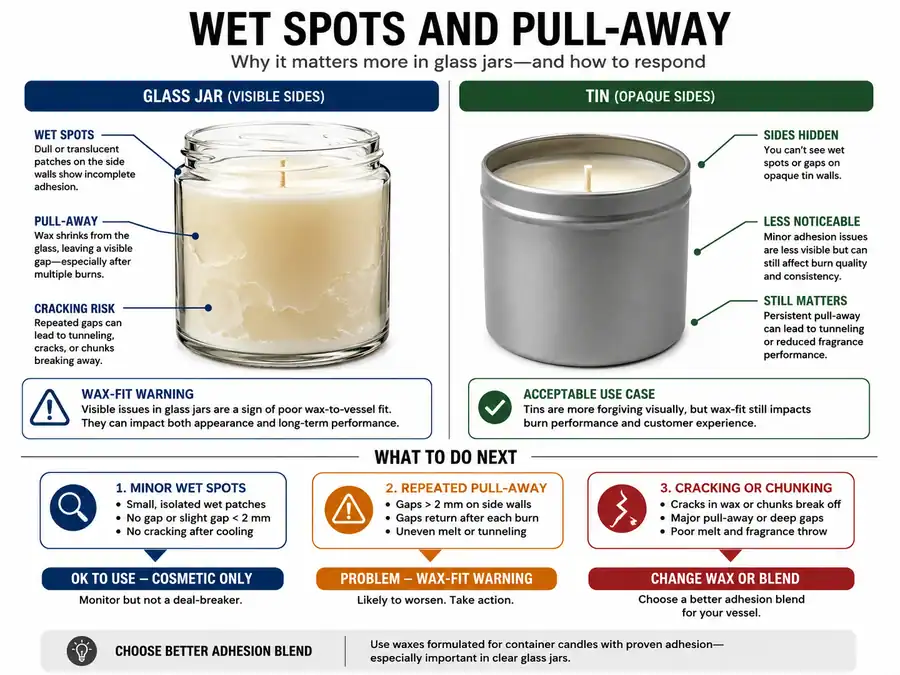
| Wax family | Glass jar adhesion fit | Tin forgiveness | Best use case |
|---|---|---|---|
| Soy container wax | Good, but wet spots can show | High | Beginner jars or tins where natural-wax preference matters |
| Coconut-soy blend | Often cleaner-looking | High | Display jars, gifts, and smoother finish goals |
| Paraffin container blend | Often strong adhesion | Medium to high | Clear glass where wall appearance and throw matter |
| Soy-paraffin blend | Balanced | High | Makers who want fewer cosmetic issues without leaving container blends |
| Beeswax-heavy blend | More conditional | Medium | Niche formulas where firmness is controlled by blending |
A glass jar punishes cosmetic flaws because the side wall is part of the finished look. A tin hides the same side-wall gap, so a wax that looks imperfect in glass may still be acceptable in a tin if the burn, scent, and surface finish are stable.
Failure log: cosmetic issue or wax-fit warning?
Use this log to separate normal cosmetic pull-away from repeated wax-container mismatch that should change the wax choice.
| Issue | What it usually means | Selection action |
|---|---|---|
| Wet spots in a clear jar | Cosmetic adhesion gap from cooling and shrinkage | Choose a wax or blend with better glass adhesion before changing the whole container plan |
| Pull-away after cure | Wax-container mismatch or cooling behavior issue | Treat repeated wide gaps as a wax-fit warning |
| Minor side-wall marks in a tin | Often hidden by the opaque wall | Judge the candle by burn, scent, and top finish instead |
| Cracking or deep separation | More than normal cosmetic pull-away | Move into wet spots, sinkholes, and rough tops troubleshooting |
| Smooth top but poor side adhesion | Finish and wall behavior are not matching | Choose a blend with better side-wall behavior for clear glass |
For a display candle in clear glass, coconut-soy, soy-paraffin, or paraffin container blends often make more sense than a wax that is acceptable only because the vessel hides flaws. For a utility tin, a forgiving container wax can be the better choice even if it would not look perfect through clear glass.
Quick answers on wet spots and adhesion
Are wet spots always a candle failure?
No. Minor wet spots are often cosmetic, especially when the candle burns correctly and the wax stays stable.
Do tins fix wet spots?
No. Tins usually hide side-wall flaws because the wall is opaque. They do not correct the wax behavior that caused the gap.
Should you change wax or container first?
Change the wax or blend first when repeated wet spots matter in clear glass. Change the container only if the visual goal or product use case has changed.
Wet spots and rough tops belong in a troubleshooting guide when the goal is to repair a defect. Wick size for glass jars and tins belongs in a wick guide when the issue is overheating, tunneling, or melt-pool control. Heat-safe candle containers belong in a safety guide when the question is vessel suitability rather than wax fit.
Why the Same Wax Looks Worse in Clear Glass Than in a Tin
Clear glass increases cosmetic visibility, while tins are more forgiving because the opaque wall hides side-wall adhesion flaws.
The wax has not changed, but the evaluation standard has. In a clear jar, frosting, wet spots, pull-away, and uneven side adhesion become part of the candle’s appearance. In a tin, the side wall is hidden, so the buyer mainly sees the top surface, scent experience, and burn behavior.
That difference changes the best-fit recommendation. Choose a cleaner-looking blend for glass when the candle is meant for gifting, retail display, or photography. Choose a forgiving container wax for tins when portability, lower visual pressure, and practical use matter more than side-wall perfection.
A tin can hide a cosmetic issue without solving the root cause. If the same wax shows rough tops, poor burn behavior, or repeated separation across containers, treat that as a wax-fit or process problem rather than a reason to choose tins by default.
How Glass Jars and Tins Change Heat Behavior for Different Candle Waxes
Tins usually transfer side heat faster than glass jars, so the best wax is the container blend that stays stable under the vessel’s heat pattern.
A tin usually transfers side heat faster than a thick glass jar, while glass often warms more slowly and makes melt-pool balance more visible. The best wax is the one that stays stable under that container’s heat pattern, not the wax that melts fastest.
A melt pool is the liquid wax area that forms around the flame during burning. In a glass jar, the wax often needs a steady burn that reaches the edge without overheating the vessel or leaving heavy side wax. In a tin, the thinner metal wall can warm the candle body faster, so a soft wax or high-fragrance blend may feel less forgiving when heat builds.
Wax-fit benchmark grid for jar vs tin heat behavior
Use the grid to choose a starting wax family before wick testing, not to diagnose tunneling, overheating, or soot.
This grid is a practical selection benchmark, not a lab guarantee. Use it to compare likely behavior before burn testing.
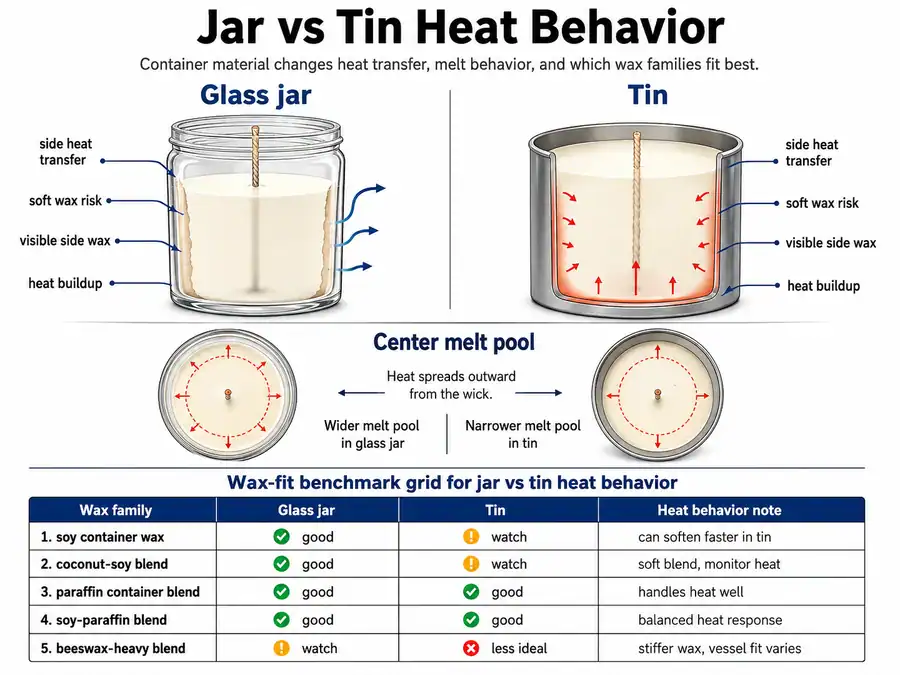
| Wax family | Glass jar behavior | Tin behavior | Best-fit implication |
|---|---|---|---|
| Soy container wax | Steady, but can leave visible side wax if the setup is mismatched | Often forgiving in smaller tins | Good starting wax when appearance and simple handling matter |
| Coconut-soy blend | Smooth finish and balanced melt behavior in many jars | Usually forgiving, but can soften in warm storage | Strong choice for gift jars and polished tins |
| Paraffin container blend | Often strong throw and clean adhesion | Can perform strongly, but heat buildup still needs testing | Good for performance-led candles |
| Soy-paraffin blend | Balanced melt behavior and improved performance goals | Often practical for tins and jars | Good middle path for fewer tradeoffs |
| Beeswax-heavy blend | Can be firmer and more conditional | May need careful blending to avoid poor melt behavior | Use only when the blend is made for containers |
Fast melt is not automatically good performance. A wax that melts too quickly can create heat stress, weak structure, or poor burn control. A wax that melts too slowly can tunnel or leave heavy side wax. The better recommendation is the wax family that supports a predictable melt pool in the chosen vessel.
Method note: This grid uses container-wax behavior patterns, vessel-material logic, and supplier-style wax-family distinctions. It is a decision grid for wax selection, not a substitute for a burn test in the exact jar or tin.
Soy container wax can work well in both formats, but it may need more careful testing in wide vessels or warm storage. Coconut-soy blends often suit jars when smooth appearance and balanced burn matter. Paraffin container blends or soy-paraffin blends often fit users who want strong performance and fewer cosmetic frustrations.
Heat behavior should not turn this page into a wick chart. If the candle tunnels, overheats, drowns the wick, or leaves heavy side wax, the next decision belongs in How to Choose Wick Size for Glass Jars and Tins. This page only decides which wax type is the stronger starting point for the container format.
Use this rule: choose wax by container format first, then confirm burn behavior with wick testing. The opposite path creates false confidence because a poor wick can make a good wax look wrong, and a poor wax fit can make wick changes look like the only problem.
If safe container use becomes the main concern, use Heat-Safe Candle Containers. If the jar itself becomes the decision point, use Best Candle Jars (Heat-Safe Options + Sizes).
Which Wax Gives the Best Scent Throw in Glass Jars vs Tins?
Paraffin container blends and soy-paraffin blends usually give the strongest hot throw in both jars and tins, but the best scent wax still has to fit the vessel.
Paraffin container blends and soy-paraffin blends often give stronger scent performance, while soy and coconut-soy blends are often chosen for softer finish, cleaner-label positioning, or balanced jar use. The right choice depends on whether hot throw, cold throw, or appearance matters most.
Strong scent does not mean exceeding wax or fragrance-load limits; it means choosing a wax family that releases fragrance well without losing stable container behavior.
Cold throw is the scent you smell before lighting the candle. Hot throw is the scent released while the candle burns. A wax can smell strong cold but weaker when burning, or it can need a better-matched fragrance oil before it performs well hot.
Scent-throw comparison table for jars and tins
This table compares scent goals by wax family and container format; it does not set fragrance-load percentages.
| Scent goal | Glass jar wax fit | Tin wax fit | Best-fit direction |
|---|---|---|---|
| Strong hot throw | Paraffin blend or soy-paraffin blend | Paraffin blend or soy-paraffin blend | Choose performance-led container blends |
| Smooth gift candle | Coconut-soy or soy blend | Coconut-soy or soy blend | Balance scent with finish |
| Beginner-friendly scent testing | Soy container wax | Soy container wax | Start simple and compare fragrance behavior |
| Retail display jar | Coconut-soy, soy-paraffin, or paraffin blend | Less dependent on side-wall appearance | Match throw with visible finish |
| Travel or utility tin | Soy, coconut-soy, or blended container wax | Strong fit | Prioritize stable scent and storage tolerance |
Method note: This comparison uses wax-family behavior, container visibility, and scent-performance tradeoffs. It does not replace fragrance oil compatibility testing for the exact wax, oil, load, wick, and vessel.
Glass jars can make scent decisions more demanding because the wax must smell good and look good through the wall. A tin gives more room to choose based on scent and use case because side-wall defects are hidden. That makes tins more forgiving, but it does not make every wax stronger.
A strong scent goal can push the choice toward blended waxes, especially when the user wants reliable hot throw. A softer aesthetic goal can push the choice toward soy or coconut-soy blends, especially in clear glass where the finish becomes part of the product.
Quick answers on scent throw
Which wax smells strongest in jars and tins?
Paraffin container blends and soy-paraffin blends often perform best when strong hot throw is the main goal.
Is the strongest-smelling wax always the best wax?
No. Stronger scent is not the best choice if the wax loses adhesion, sweats fragrance, burns poorly, or looks bad in a clear jar.
Can the same wax smell different in a jar and a tin?
Yes. The container changes heat behavior, and heat behavior changes how the wax releases fragrance during the burn.
Fragrance oil choice, cure time, and load limit can change the result, but those are recipe and formulation details. For this comparison, the useful decision is simpler: choose a container wax family that supports the scent goal without creating visible jar flaws or unstable tin performance.
If the real problem is fragrance-oil pairing, use Fragrance Oil Compatibility for Container Waxes. If the real problem is exact load limits or additives, use Additives and Maximum Fragrance Load for Candle Wax. If scent performance changes because the candle is overheating or tunneling, use How to Choose Wick Size for Glass Jars and Tins.
When a Stronger Scent Goal Requires More Blend Support
Stronger scent goals usually push wax selection toward performance-led container blends, not more fragrance oil by default.
Higher scent ambition is not the same as adding more fragrance oil. A wax can reach its practical limit, lose surface quality, sweat fragrance, burn poorly, or smell unbalanced if the formula is pushed beyond what the container blend handles well.
Use this short selector when scent strength is the main pressure point.
- Choose a performance-led container blend when hot throw matters more than natural-wax positioning.
- Choose coconut-soy or soy when scent needs to stay balanced with smooth finish and gift-ready appearance.
- Choose soy-paraffin when you want a middle path between throw strength and container behavior.
- Treat sweating, rough tops, or poor burn as signs that scent strength is outrunning wax fit.
- Move to a fragrance-load guide when the question becomes exact percentages, additives, or recipe limits.
For glass jars, strong scent still has to share priority with adhesion and visible finish. For tins, strong scent can take more priority because the side wall is hidden, but the wax still needs stable burning and storage behavior.
Choose a more performance-led container blend when hot throw is the main outcome. Choose soy or coconut-soy when the scent goal is balanced with appearance, beginner handling, or a softer product profile.
When Climate, Shipping, or Travel Changes the Best Wax Choice
Warm storage, shipping, and travel make wax stability more important than side-wall appearance alone.
This is still a wax-selection decision, not a packaging, courier, or breakage-cost guide. The point is to decide whether the candle will live in a stable indoor setting or face heat, movement, gifting, storage, or travel after pouring.
Glass jars and tins fail differently under real-world handling. A glass jar protects the candle visually and structurally, but it adds breakage risk and makes side-wall flaws more visible. A tin is lighter and travel-friendly, but metal can dent and may warm faster in hot storage.
| Use condition | Glass jar wax priority | Tin wax priority | Better-fit direction |
|---|---|---|---|
| Stable indoor display | Clean adhesion, smooth top, balanced scent | Clean top and reliable scent | Choose the wax that fits the visual and scent goal |
| Warm room display | Adhesion, smooth top, stable scent | Stable surface and scent | Choose a blend that resists sweating and visible pull-away |
| Summer shipping | Stable finish and reduced cosmetic risk | Heat tolerance and dent-resistant packing | Avoid waxes that soften or sweat easily in the expected route |
| Gift candle | Clean visual finish and reliable scent | Clean top finish and portability | Match wax to the recipient use case, not only the vessel look |
| Travel tin | Less relevant unless jar is protected | High priority | Choose a forgiving wax with stable scent and surface behavior |
| Retail photography | High side-wall appearance pressure | Lower side-wall pressure | Choose the cleanest-looking jar blend first |
Use this checklist before choosing the wax.
- Choose a cleaner-looking container blend when the candle will sit in clear glass for display.
- Choose a forgiving container wax when the candle is a practical tin for travel, gifting, or casual use.
- Choose a more stable blend when warm rooms, summer storage, or shipping exposure are likely.
- Avoid treating a travel tin like a display jar; its best wax may prioritize stability over side-wall perfection.
- Avoid treating a display jar like a utility tin; its best wax must survive visual inspection through the wall.
Tins often suit travel or utility candles because they are lighter, opaque, and less visually demanding. That makes soy, coconut-soy, and blended container waxes practical choices when the candle is meant to be carried, stored, or gifted casually.
Use a firmer or more stable container blend when heat exposure is likely. Use a cleaner-looking blend when the candle must look polished in clear glass. Use a forgiving wax when the candle is a practical tin rather than a display jar.
If the main concern is storage process, use Seasonal Storage and Shipping for Candles. If the main concern is broken glass, thermal shock, container approval, or safe burn conditions, use Heat-Safe Candle Containers. If the issue is tunneling or overheating after the wax is chosen, use How to Choose Wick Size for Glass Jars and Tins.