
The best wax for pillar candles vs container candles is the wax that best fits the candle format first: firmer, self-supporting waxes usually suit pillars, while softer, adhesion-friendly waxes usually suit containers. Here, best means the best structural and performance fit for a freestanding pillar candle or a container candle, not the strongest-scent wax, the easiest overall wax, the best wax for hot climates, the best wax for glass jars vs tins, the cheapest wax, the safest wax, the most natural wax, or the most sustainable wax.
The best wax depends on whether the candle must stand on its own or burn inside a jar. Pillars need shape retention, cleaner mold release, and controlled wall support during the burn. Containers need better adhesion, smoother cooling, and scent performance that fits the vessel. That split makes soy, paraffin, beeswax, palm, and blends easier to judge without treating one wax as best for every format.
This page compares wax by pillar-versus-container format fit first. Strong scent throw, hot-climate storage, jar material, and full making steps stay as secondary filters or next-step pages.
Best Wax Families for Pillar Candles vs Container Candles
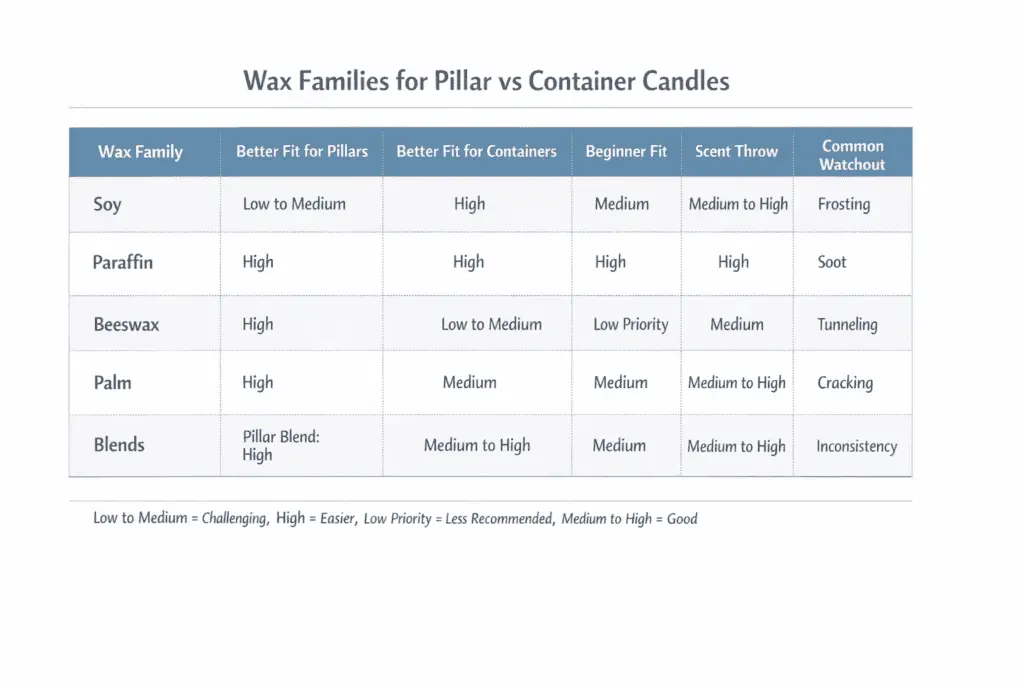
Pillar candles usually work best with wax families that can hold shape, release well enough for freestanding use, and keep reasonable edge definition. Container candles usually work best with wax families that cool with better sidewall contact, smoother tops, and steadier jar performance.
The candle wax types guide helps when you want the broad wax-family map before narrowing to a pillar or jar pick.
In this table, Beginner ease in this format means how forgiving the wax usually is for that candle type, and Scent-throw headroom in this format means how much room the format usually gives for scent-focused testing before tradeoffs show.
| Wax family | Better fit for pillars | Better fit for containers | Beginner ease in this format | Scent-throw headroom in this format | Common watchout |
|---|---|---|---|---|---|
| Soy | Low to medium unless it is a pillar blend | High | High for jars | Medium to high | Softness can limit freestanding shape |
| Paraffin | High | Medium to high | High | High | Can feel less forgiving if overheated or over-scented |
| Beeswax | High | Medium | Medium | Low to medium | Strong natural character can compete with added fragrance |
| Palm | Medium to high | Medium | Medium | Medium | Finish and crystal look vary a lot by formula |
| Blends | Medium to high when built for pillars | High when built for containers | High | Medium to high | Performance depends on what the blend is trying to solve |
This comparison groups common family behavior by format, ease, finish, and scent room rather than naming one winner. Exact results still shift with the recipe, fragrance level, mold design, jar shape, and pour process.
Quick picks by goal: when a pillar-first wax wins and when a container-first wax wins
Choose a pillar-first wax when shape retention, cleaner mold release, crisp detail, or freestanding burn support matter most. Choose a container-first wax when jar adhesion, smoother tops, and scent-focused testing room matter most. Choose a mixed-use blend only when you accept a compromise and test it in the exact format you plan to make.
Use scent, climate, and vessel choice only as tie-breakers after the format split is clear.
If scent is the main goal after format fit is set, Best Wax for Strong Scent Throw is the better next filter. If vessel choice starts to change the answer, Best Wax for Glass Jars vs Tins narrows that decision faster. If room heat or shipping becomes the real risk after the format split is clear, Best Candle Wax for Hot Climates and Summer Shipping becomes the better tie-breaker.
That shortlist becomes much clearer once hardness stops looking like a quality score and starts looking like a format signal.
Pillar Wax vs Container Wax: Why Hardness Changes the Format
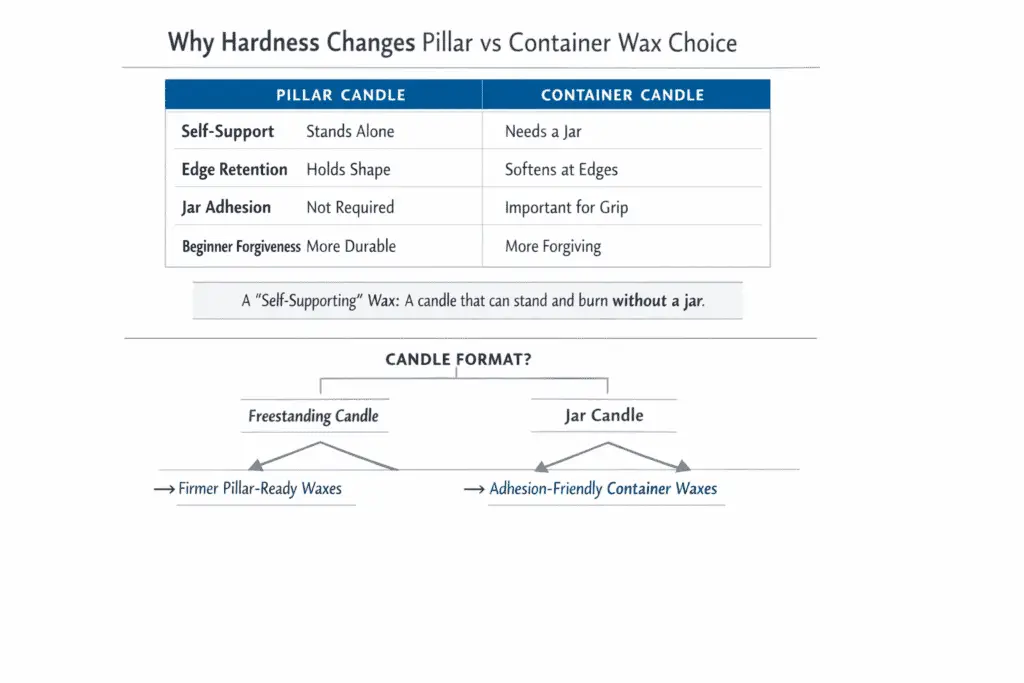
Pillar wax is usually harder and more self-supporting, while container wax is usually softer and picked for jar adhesion and even melt behavior.
Hardness matters because a pillar has to stand without vessel support and keep a workable outer wall as it burns. A container candle uses the jar as structure, so softer wax can give up some rigidity in exchange for smoother sides and steadier contact with the vessel.
The candle wax types guide is useful when you want the big-picture map before narrowing to a pillar or jar formula.
Self-supporting wax means the candle can stand and burn without a jar holding it upright.
| Format need | Pillar candles | Container candles |
|---|---|---|
| Self-support | High | Low |
| Edge retention | High | Low to medium |
| Jar adhesion | Low priority | High priority |
| Beginner forgiveness | Medium | High |
Read that matrix as format logic, not as a global scorecard. A softer wax is not worse by default. It is often better matched to a jar because the vessel carries the shape and the wax can focus on cooling behavior and sidewall contact.
Decide whether the candle must stand on its own.
- If yes, shortlist firmer pillar-ready waxes first.
- If no, shortlist jar-first waxes that favor adhesion and smooth cooling.
Can you use soy for pillars? Some pillar soy blends can work, but soft container soy usually needs a vessel.
Can pillar wax work in jars? Yes, but it often gives rougher tops, side pull-away, or a less forgiving finish than a container-first blend.
Can one wax work for both pillars and containers?
Yes, but usually as a compromise rather than the best answer for both formats. A mixed-use wax can work when the formula is built for freestanding shape and jar behavior together, but pillar-first waxes often look rougher in jars and container-first waxes usually still need vessel support. Treat one-wax-for-both as a testing shortcut, not as the default winner.
For the broader family shortlist beyond this format split, How to Choose the Right Wax for Your Candles is the next comparison. When the wax is chosen and the mold work begins, How to Make Pillar Candles (Molds, Second Pour, Finish) becomes the practical next step. When jar behavior becomes the real test, How to Make Candles in a Jar (Container Candles) fits better than forcing pillar logic onto a wax that was built for a vessel.
Once hardness looks right on paper, mold release and shrink behavior decide whether that pillar wax will actually leave the mold cleanly.
How Mold Release and Shrink Behavior Affect Pillar Wax Choice
Pillar candles need waxes that release cleanly from molds and shrink in a manageable way, while container candles are not judged by mold release at all.
That matters because a pillar has to leave the mold cleanly, keep its edges, and stay intact after unmolding. A wax that behaves well in a jar can still be a poor match for molded pillars if it sticks, cracks, or loses fine detail too easily.
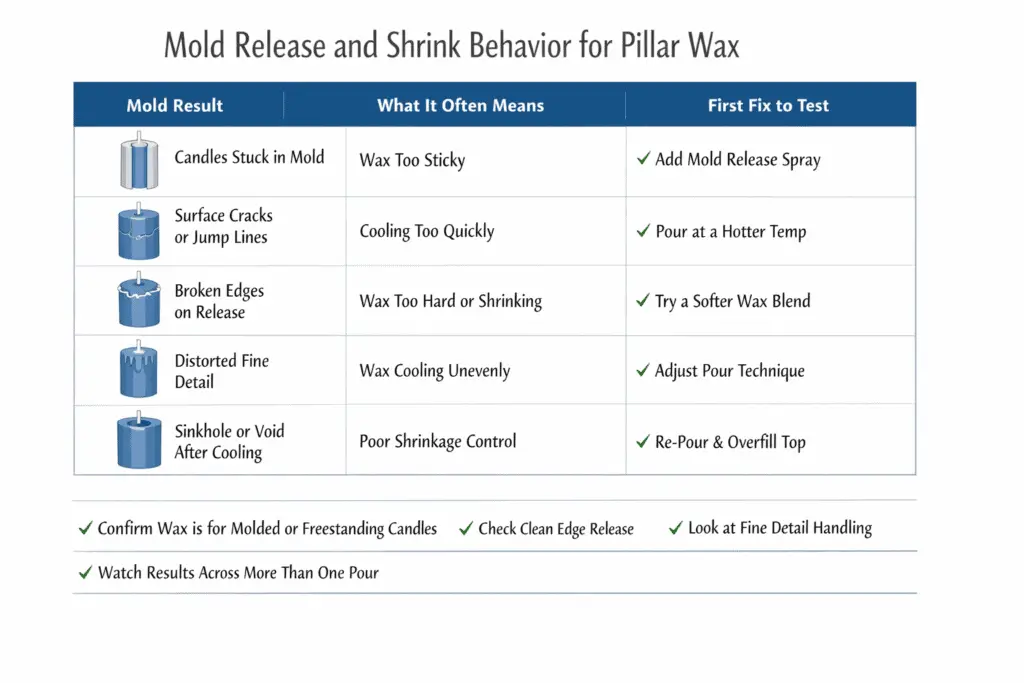
| Mold result | What it often means | First fix to test |
|---|---|---|
| Candle sticks in mold | Wax is too soft for the mold setup, or it did not pull away enough during cooling | Try a firmer pillar-ready wax first |
| Surface cracks or jump lines | Shrink happened too fast or unevenly | Slow the cooling and recheck wax choice |
| Broken edges on release | Wax is too brittle for the mold shape, or unmolding happened too early | Let the candle set longer and test a less fragile formula |
| Distorted fine detail | Wax stayed too soft, or heat stayed trapped too long | Use a wax with better detail retention for molded pillars |
| Sinkhole or void after cooling | Shrink pulled inward too fast or unevenly | Recheck shrink behavior and test a second pour or a more suitable pillar wax |
Start with basic mold-fit checks before you compare fragrance, color, or brand. Shrink behavior is the amount a wax pulls away from the mold as it cools. A small amount helps unmolding. Too much can leave cracks, jump lines, damaged detail, or a void after cooling.
Use this quick check before you commit to a pillar wax:
- Confirm that the wax is sold or tested for molded or freestanding candles.
- Check whether it releases with clean edges instead of dragging along the mold wall.
- Look at how it handles detail. Fine patterns, corners, and raised shapes expose weak mold fit fast.
- Watch cooling results across more than one pour. A wax that works once but cracks often is still a risky pick.
This section is about selection, not a full mold tutorial. If you already chose a mold-friendly wax and need the process steps, How to Make Pillar Candles is the better next read. If the wax is close but not quite right, How to Blend Different Candle Waxes can help you adjust firmness or finish without starting from zero. If you are still narrowing the shortlist, How to Choose the Right Wax for Your Candles is the better comparison page.
A useful rule is simple: for pillars, clean release and controlled shrink are part of wax fit, not minor extras. For jars, that same issue drops in importance because the container replaces the mold as the main concern.
How Container Wax Adhesion Changes the Best Jar Wax
Container candles usually perform best with waxes chosen for vessel adhesion and smooth cooling, even when those waxes are too soft for pillars.
That is why a wax can look weak for freestanding candles and still be the right jar wax. In container candles, the goal is not self-support. The goal is a wax that cools with better sidewall contact, fewer visible gaps, and a cleaner-looking finish in the vessel.
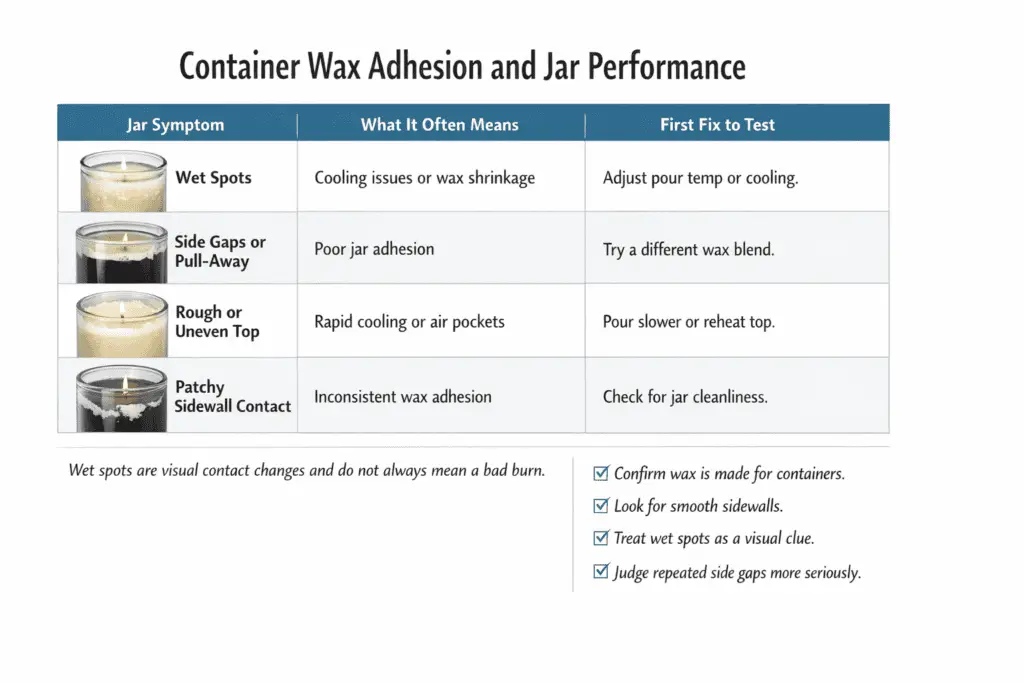
| Jar symptom | What it often means | First fix to test |
|---|---|---|
| Wet spots | Often a cosmetic look change between wax and glass | Check consistency across pours before changing wax |
| Side gaps or pull-away | Wax cooled away from the jar wall too much | Test a jar-first wax or adjust pour and cooling conditions |
| Rough or uneven top | Wax may not be matched well to the container setup | Recheck wax type, pour temperature, and cooling conditions |
| Patchy sidewall contact | Adhesion is inconsistent rather than fully failing | Compare another container blend before judging the jar itself |
The candle wax types guide helps here because it separates freestanding performance from jar performance. Adhesion is how well the wax stays in contact with the container wall as it cools. Good adhesion usually gives smoother sides and fewer visible gaps. Wetting is the visual contact between wax and glass, and wet spots do not always mean the candle will burn badly.
Use this format-first check for jar wax:
- Confirm that the wax is made for containers, not for molded pillars.
- Look for smooth sidewalls and stable contact with the vessel after cooling.
- Treat wet spots as a visual clue, not an automatic failure.
- Judge repeated side gaps or heavy pull-away more seriously than one cosmetic patch.
For many beginners, that single distinction saves a lot of wasted testing. A jar candle can still be good even if the glass does not look perfect every time. But repeated pull-away, uneven sidewalls, and poor finish usually mean the wax is a weaker match for the vessel.
A few wet spots can stay cosmetic, but repeated side gaps, heavy pull-away, and rough tops point to a weaker jar match.
If you need process help after choosing the wax, How to Make Candles in a Jar is the next step. If the vessel itself becomes the bigger question after you choose a jar-first wax, Best Wax for Glass Jars vs Tins is the better comparison. If you are still deciding between families before you test a jar blend, How to Choose the Right Wax for Your Candles will narrow the shortlist faster.
Pillar vs Container Wax for Fragrance Load and Scent Throw
Container candles usually give you more room to chase scent throw, while pillars need a tighter balance between fragrance and structure.
That difference matters because jar candles can rely on the vessel for support, but pillars still need the wax to hold shape, release cleanly, and burn with control. A format-first scent comparison is useful here because it keeps scent goals tied to format instead of treating every wax as if it performs the same way.
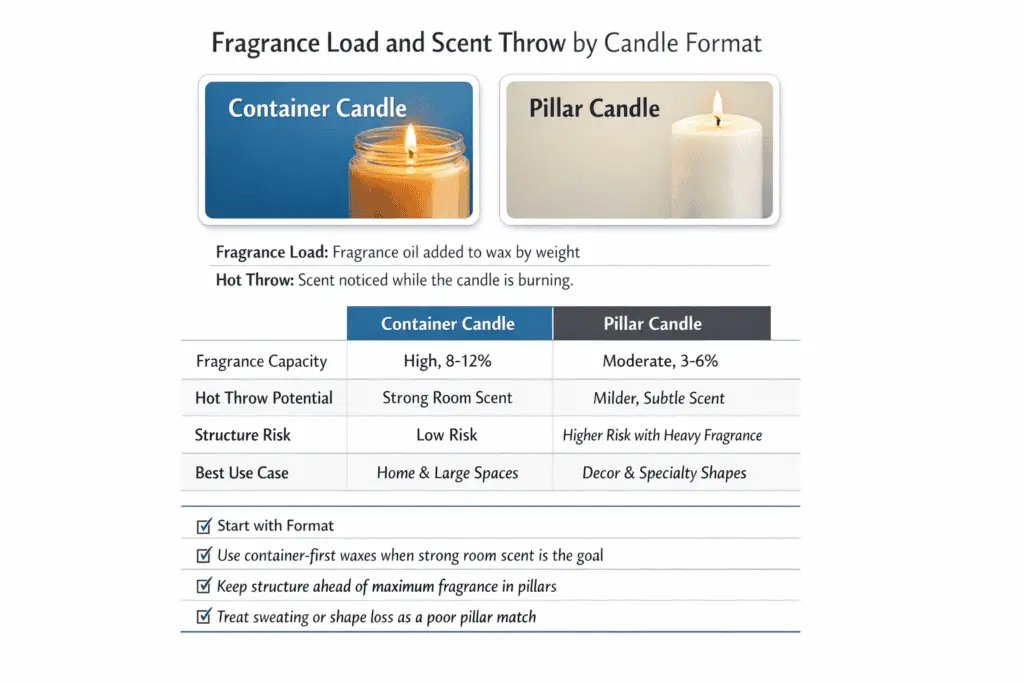
| Format goal | Container candles | Pillar candles |
|---|---|---|
| Fragrance capacity | Usually higher tolerance for scent-focused testing | Usually lower tolerance before structure starts to suffer |
| Hot throw potential | Often easier to push stronger | Often needs a more balanced target |
| Structure risk from heavy fragrance | Lower to medium | Medium to high |
| Best use case | Strong room scent in a vessel | Scented freestanding candles that still need shape |
Read this table as a format comparison, not a universal ranking. Fragrance load is the amount of fragrance oil added to the wax by weight. Hot throw is the scent you notice while the candle is burning.
These checks help you shortlist by scent goal without losing format fit:
- Start with the candle format, not the wax label alone.
- If strong room scent is the main goal, container-first waxes usually give you more room to test.
- If you want a scented pillar, keep structure ahead of maximum fragrance.
- Treat any wax that smells strong cold but sweats, softens, or loses shape as a poor pillar match.
A common mistake is chasing the strongest possible scent in every format. That works against pillars more often than it works against jars. A freestanding candle can smell good and still fail the real job if the extra fragrance softens edges, weakens release, or raises the risk of sweating.
This quick trouble check helps separate normal limits from overload:
- Sweating often points to fragrance overload, wax compatibility limits, or cooling and storage issues in that format.
- Strong cold throw with weak hot throw often means the full burn system is off, not just the wax choice.
- A jar candle can often stay scent-focused longer than a pillar because the container carries the shape.
For deeper scent testing after the format decision is made, Best Wax for Strong Scent Throw is the next useful filter. If the phrase itself needs unpacking, What Is Fragrance Load in Candle Making? clears up the measurement side. If you are still choosing between wax families before you test, How to Choose the Right Wax for Your Candles is the better comparison page.
Burn pattern is the next tie-breaker, because a wax that smells good on a cold sniff can still behave badly once the flame starts working through it.
Why Burn Behavior Differs in Pillars and Containers
Pillars need waxes that keep a supportive outer wall as they burn, while container candles are built around a steady melt pool inside the jar.
That is why the same wax can feel right in one format and wrong in the other. A burn-pattern comparison helps make that shift easier to see because it frames the goal as burn pattern, not just hardness or softness.
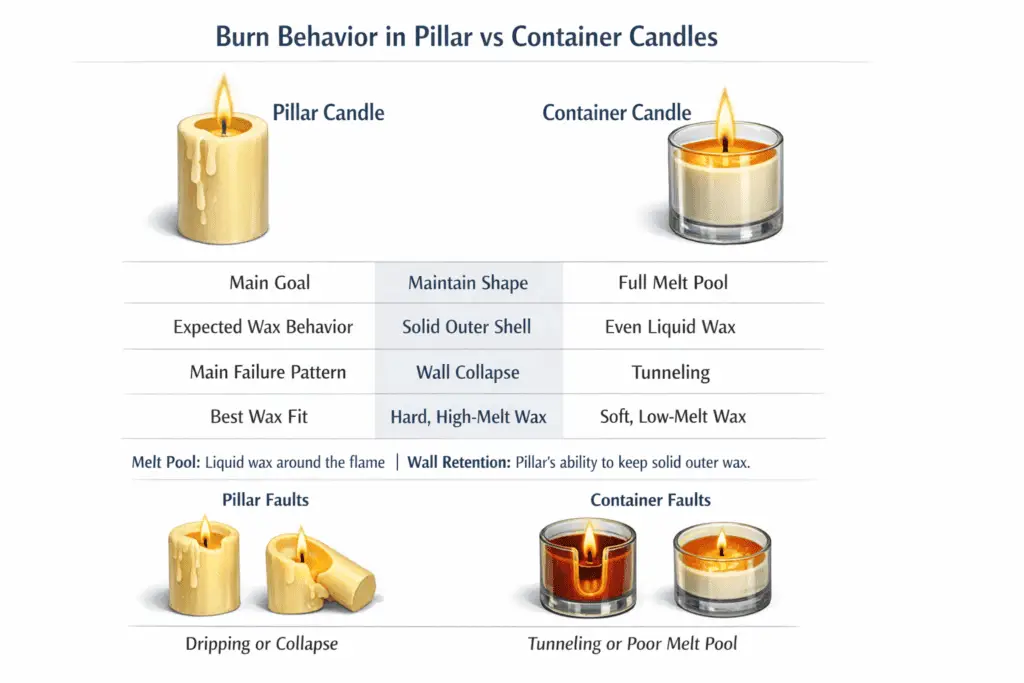
| Burn trait | Pillar candles | Container candles |
|---|---|---|
| Main goal | Keep a stable outer wall | Reach an even melt pool in the vessel |
| Expected wax behavior | Controlled shape loss | Full pooling inside the jar |
| Main failure pattern | Excess dripping or collapse | Tunneling or poor melt-pool spread |
| Best wax fit | Freestanding support comes first | Vessel behavior comes first |
Use that matrix as a burn map. Melt pool is the liquid wax that forms around the flame during a burn. Wall retention is the ability of a pillar candle to keep enough solid wax around the outside while the center melts.
These checks help you judge the burn pattern you actually want:
- For pillars, look for a wax that keeps enough outer wall to hold shape through the burn.
- For containers, look for a wax that works toward an even melt pool inside the vessel.
- If a pillar drips too fast or slumps early, the wax may be too soft for that format.
- If a container tunnels again and again, the wax-and-burn system may be mismatched for the jar.
A small flame problem can look like a wax problem, so How to Choose the Right Wick for Your Candle matters after you narrow the wax. But the wax still sets the basic burn pattern first. A jar does not need the same outer-wall support that a freestanding pillar needs.
This short fault check keeps the format split practical:
- Excess pillar dripping often points to a wax that is giving up structure too easily for freestanding use.
- Repeated tunneling in a container often means the candle is not reaching the burn pattern that jar candles are meant to have.
- A wax that looks calm and even in a jar can still be the wrong choice for a pillar because the container is doing part of the structural work.
When you move from selection into making, How to Make Pillar Candles (Molds, Second Pour, Finish) fits freestanding testing better than jar logic. For vessel testing, How to Make Candles in a Jar (Container Candles) is the cleaner next step because the burn goal changes with the container.