
For first-time jar candles, beginner-friendly container soy or an easy parasoy blend is usually the most forgiving wax choice.
Start here if you want a wax that gives you a good first candle without tight process control. You will be able to choose by jar use, scent goal, and defect risk before buying the wrong wax. The focus stays on candle wax types that suit beginner container candles, normal home setups, and realistic first-batch expectations. That makes it easier to start with the forgiving options, then narrow down the best fit for your project.
Most forgiving candle waxes for first-time makers
For first-time jar candles, beginner-friendly container soy or an easy parasoy blend is usually the most forgiving wax choice.
A forgiving wax gives you more room for small pouring mistakes, steadier jar behavior, and a better shot at a presentable first candle. For most home setups, that matters more than chasing the strongest possible scent from the first batch.
If you want the broad family map first, Candle Wax Types is the phrase to keep in mind before you narrow the choice.
Here is a modeled beginner benchmark that puts ease first:
| Wax family | Small temp mistakes | Surface finish | Wick-testing burden | Scent result confidence | Beginner fit |
|---|---|---|---|---|---|
| Container soy | Good | Good | Lower | Medium | Very good |
| Easy parasoy blend | Good | Good | Lower to medium | Good | Very good |
| Straight paraffin container wax | Medium | Good | Medium | Good | Good |
| Pillar wax used in a jar | Poor | Poor | Higher | Low | Poor |
Parasoy is a soy-and-paraffin blend made to give soy some easier handling and faster scent payoff. Hot throw means the scent strength you notice while the candle is burning.
Methods note: This table is a modeled beginner benchmark, not a lab result. It weighs supplier application notes, jar-use guidance, and the brief’s four proof points: forgiveness, surface consistency, wick-testing burden, and scent-result confidence. Manufacturer technical sheets and the National Candle Association were treated as the first check for format claims, while forum patterns were used only to spot repeat beginner pain points.
In plain terms, forgiving means fewer rough tops, fewer sinkholes, less punishment when your pour timing is a little off, and a shorter road to a candle that looks and smells decent. That is why container soy stays a strong first pick for many new makers. An easy parasoy blend often comes next when you want a bit more scent confidence without making the process much harder.
For soy vs parasoy for beginners, soy usually wins on a calm learning curve, while parasoy often wins when you want a little more scent punch and still want a fairly easy pour. Neither one is magic. The better pick depends on whether your first goal is low stress or stronger payoff.
Use this short starter path to narrow the choice:
- Pick container soy when this is your first jar candle and you want the lowest-friction start.
- Pick an easy parasoy blend when you still want a beginner-friendly wax but care more about scent strength.
- Skip pillar wax for jars, even if the marketing sounds appealing, because the format mismatch creates failures that look like bad wax choice.
In maker forums, beginners often report that a wax feels “bad” when the real issue is a first batch poured with a narrow margin for error. That pattern shows up a lot with sinkholes, rough tops, and quick frustration after one weak-looking result.
For most beginners, container soy and easy parasoy blends usually mean fewer early wick changes. If you want the middle ground between soy ease and stronger throw, Parasoy Wax for Candles (Blend Guide + Pros/Cons) is the next stop before you branch into project-specific choices.
Choose wax by candle format first
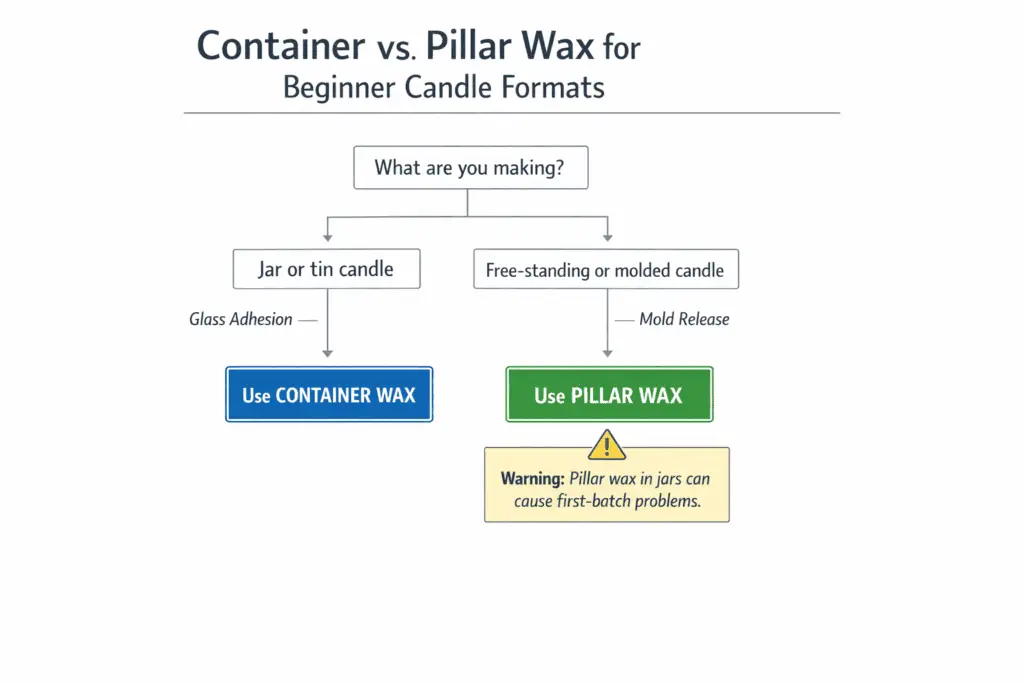
For a first jar candle, use a container wax, because pillar waxes are made for free-standing candles, not glass adhesion.
Choose by project format before you compare scent, brand, or price. A lot of disappointing first candles come from using the wrong wax type for the vessel, not from buying a weak formula.
When you need the broader map first, Candle Wax Types is the phrase that sets up the big categories before you buy.
A container wax is made to stay in a jar or tin and hold to the vessel as it cools. A pillar wax is made to release from a mold and stand on its own after unmolding.
Use this decision matrix before anything else:
| Wax type | Best use | Glass adhesion | Mold release | First-batch risk in jars | Best beginner use |
|---|---|---|---|---|---|
| Container wax | Jars, tins | Good | Poor | Lower | First jar candle |
| Pillar wax | Free-standing candles | Poor | Good | High | First pillar or molded candle |
| Beginner-friendly blend | Jars, some brand-specific uses | Good | Varies | Lower to medium | Jar makers wanting easier results |
Methods note: This matrix is modeled from supplier application sheets that separate waxes by intended use, not by broad “best wax” claims. The check points are format fit, adhesion success, mold release, and beginner complexity. Its job is to stop wrong-format buys, not rank every formula on the market.
So what is the best wax for jar candles? A container wax. That is the clean answer. If you are making your first candle in glass, start there and ignore pillar-focused formulas unless your project is meant to come out of a mold.
Container wax vs pillar wax is not a minor detail. It is the first yes-or-no filter. Container wax fits jar candles because it is meant to cling to the vessel and burn there. Pillar wax forms free-standing candles because it is meant to release cleanly instead of sticking to glass.
Can beginners use pillar wax? Yes, but only when the project is actually a pillar, tart, or molded shape. It is a poor first choice for jar candles. What happens if you choose the wrong wax type? You get problems that feel confusing fast: pull-away from the glass, odd adhesion, slumping, poor release, or a result that makes you blame the wax when the project choice caused the issue.
These three steps keep the choice clean:
- Decide whether your candle will stay in a vessel or stand on its own.
- Match the wax to that format before you think about scent strength.
- Shortlist only two or three wax families after the format is settled.
How to Choose the Right Wax for Your Candles becomes useful once you already know whether you are buying for a jar, tin, or mold. If your project choice is still split, Best Wax for Pillar Candles vs Container Candles is the exact comparison that clears up the format mismatch. If your vessel choice is down to metal or glass, Best Wax for Glass Jars vs Tins is the next phrase worth checking before you lock in a wax.
Warm-room stability check before you buy: if your candles will sit in a very warm room, do not treat every soft container wax as identical. Check the product notes for the use case, because some container waxes are made for normal indoor jar use and some handle warmth a bit better. Keep that as a tie-breaker, not your first filter.
The main point stays simple: best wax for first jar candle means a container wax first, then a beginner-friendly family inside that bucket, and the next filter is scent strength without turning your first batch into a heavy testing project.
Best wax for strong scent throw without advanced testing
For beginners who want stronger scent without advanced testing, an easy parasoy blend or beginner-friendly paraffin container wax is usually the simplest starting point.
If strong hot throw is your first goal, start with an easy parasoy blend or a beginner-friendly paraffin container wax. Container soy can still work, but it often asks for more patience before you judge the result.
This quick sort keeps the tradeoff clear:
| Wax path | First-batch scent confidence | Ease for beginners | Best first use |
|---|---|---|---|
| Container soy | Medium | Very good | Lowest-stress first jar candle |
| Easy parasoy blend | Good | Very good | Jar candle with stronger scent priority |
| Paraffin container wax | Good | Good | Jar candle where scent comes first |
Strong scent does not mean you should jump straight to the hardest wax path. It means you choose the option that gives better scent payoff while still matching a first jar candle and a normal home setup.
If scent strength is the whole project, Best Wax for Strong Scent Throw is the deeper comparison once you know you still need a beginner-friendly starting point.
Once scent is clear, the next decision is which wax fits the exact first project on your work table.
Beginner wax picker: match your first project to the right wax
Match the wax to the first project in front of you, because a jar candle, molded candle, and scent-first test batch do not need the same starting wax.
You do not need one “perfect” wax for every first project. You need the wax that fits the vessel, the goal, and the amount of testing you want to do on day one.
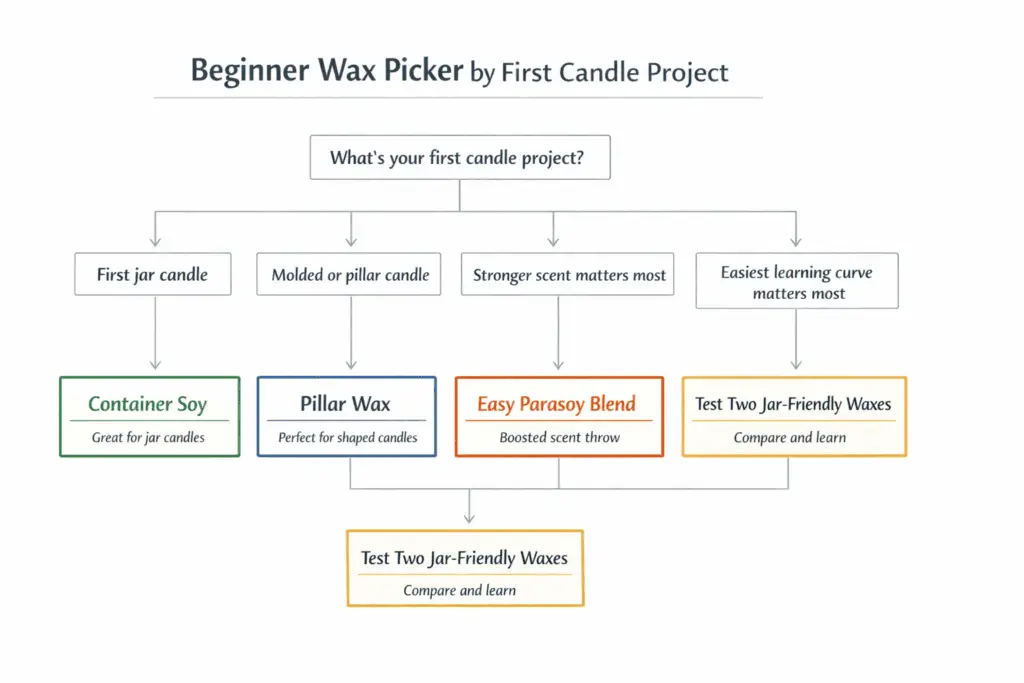
This short picker covers the most common beginner starts:
- Pick container soy for a first jar candle when ease and a calm learning curve matter most.
- Pick an easy parasoy blend for a first jar candle when you still want beginner-friendly handling but care more about scent strength.
- Pick pillar wax only when your first project is a molded or free-standing candle.
- Pick two jar-friendly waxes for a side-by-side test when you are split between easier handling and stronger scent.
This simple first-batch test plan keeps the choice honest without turning the project into a big lab exercise:
- Choose one vessel style and one fragrance so the wax is the main variable.
- Make small batches in the same container size.
- Judge surface finish, scent, and ease before you buy a larger amount.
If you still feel split after that, return to your project type instead of chasing more wax names. A first jar candle, a pillar, and a scent-first test batch each ask a different question.
The last filter is surface behavior, because smoother tops and fewer early defects can matter more than a small difference in scent.
Waxes that give smoother tops and fewer beginner defects
For fewer rough tops and sinkholes, beginners usually do best with forgiving container soy or easy parasoy blends made for jars.
A sinkhole is a dip that forms as wax cools, and a rough top is an uneven surface after the first pour. The goal is not a perfect top every time. The goal is a wax that gives you a better-looking first result without punishing small mistakes.
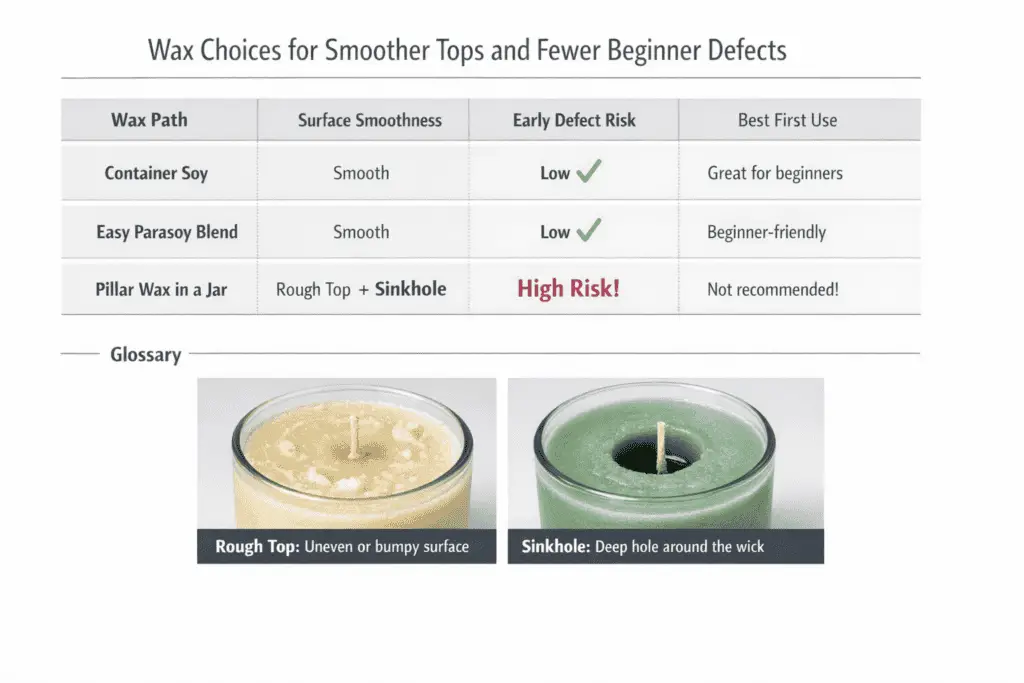
This quick comparison keeps the defect question in the right lane:
| Wax path | Surface smoothness for beginners | Early defect risk | Best first use |
|---|---|---|---|
| Container soy | Good | Lower | First jar candle with ease first |
| Easy parasoy blend | Good | Lower to medium | Jar candle with easier handling and better scent payoff |
| Pillar wax in a jar | Poor | High | Not recommended for first jar candles |
Smoother tops usually come from the right format match and a forgiving jar wax, not from jumping to a more difficult wax family too early. That is why container soy and easy parasoy blends stay near the front for beginners.
If rough tops or sinkholes keep showing up after you fix the wax match, use Fixing Common Problems with Soy Wax Candles to troubleshoot the batch instead of abandoning the wax too early.
Common beginner wax questions
Is soy wax good for beginners?
Yes. Container soy is often the calmest starting point for first jar candles because it is forgiving and widely available.
Should beginners start with paraffin or parasoy for stronger scent?
If scent strength matters more than the easiest learning curve, start with an easy parasoy blend or a beginner-friendly paraffin container wax.
Can beginners use pillar wax in jars?
No. Pillar wax is a poor first choice for jar candles because it is made to release from molds, not cling to glass.
When should beginners judge scent throw?
Judge it after the cure time listed by the supplier, because fresh pours can smell different from the finished burn.