

A tealight candle is a small, shallow candle contained in a thin metal or plastic cup, usually used for short lighting, warming, or decorative sessions.
A tealight candle usually has wax, a short wick, and a thin cup that keeps the melted wax contained. “Tealight,” “tea light,” and “tea candle” usually describe the same small candle format. Most standard tealights are used where a low flame, compact size, and limited burn time fit the setting. This guide explains what tealights are, their usual size, how long they burn, and frequent uses without turning into a making, safety, or buying guide.
What Is a Tealight Candle?
A tealight candle is a small candle in a thin cup that holds wax and a short wick.
The name comes from the format’s use in teapot warmers, although modern tealights are also used for holders, lanterns, warmers, and accent lighting.
The cup lets the wax melt across the candle while staying contained. “Tealight,” “tea light,” and “tea candle” usually mean the same cup-based candle type. Tealights are commonly described as small, circular candles in thin metal or plastic cups, and they are often used for accent lighting, warmers, and decorative setups.
A tealight is different from a loose mini candle because the cup is part of the product. That cup shapes the wax pool, supports the wick tab, and helps the candle fit many tealight holders. It does not turn every surface into a suitable place to burn the candle, so holder choice still matters.
What Are Tealight Candles Made Of?
Tealight candles are usually made of wax, a short wick, and a small cup, with scent or dye added only in some products.
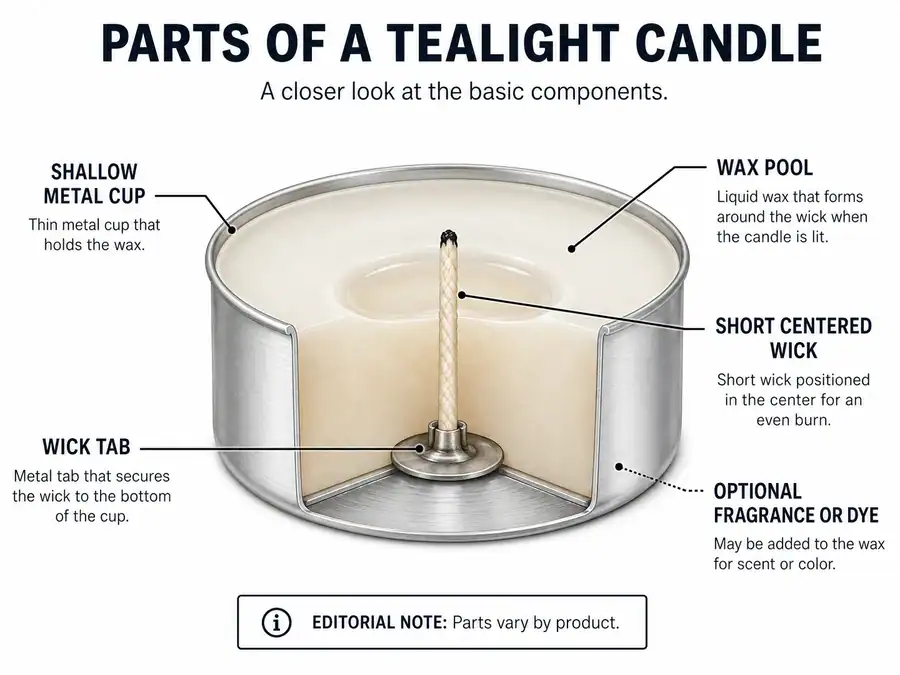
| Tealight part | What it does | What varies by product |
|---|---|---|
| Wax | Provides the candle fuel | Paraffin, soy blends, beeswax blends, color, scent |
| Wick | Carries melted wax to the flame | Wick thickness, tab style, centered placement |
| Cup | Holds the wax and gives the candle its shape | Aluminum, clear cup, deeper cup, wider cup |
| Wick tab | Holds the wick base in place | Size and attachment style |
| Fragrance or dye | Changes scent or appearance | Optional, not part of every tealight |
These parts identify the tealight format; they are not a full making recipe. Wax melting temperatures, wick sizing, fragrance load, and pouring steps belong in a dedicated tealight-making guide.
Tealight vs Votive and Container Candles
Tealight candles differ from votive and small container candles mainly by cup format, height, burn expectation, and holder use.
| Candle type | Format | Holder relationship | Usual use |
|---|---|---|---|
| Tealight candle | Short candle in a thin cup | Often placed inside a holder, lantern, or warmer | Accent light, wax warmers, table decor, short sessions |
| Votive candle | Taller small candle without the same shallow cup format | Usually needs a close-fitting votive holder | Longer table decor, religious use, event displays |
| Small container candle | Wax poured into a jar, tin, or vessel | The container is part of the candle | Fragrance, room decor, gifting |
The key distinction is that tealights are shallow, cup-contained candles, while votives are taller and usually depend on a separate votive holder. This comparison only helps identify what counts as a tealight; a full tealight-vs-votive guide should compare holder fit, burn time, decor use, and buying cases in more depth.
What Size Are Tealight Candles?
Most standard tealight candles are about 38 mm wide and 16–22 mm tall, but product dimensions can vary.
In inches, that is roughly 1.5 inches wide and about 0.6–0.9 inches tall. Here, “standard” means a common retail and holder-fit range, not a legal rule or exact manufacturing specification. General reference sources describe many tealights at about 38 mm by 16 mm, while retail examples list 1.5-inch-wide tealights with taller extended-burn formats.
| Size detail | Typical expectation | Why it matters |
|---|---|---|
| Diameter | About 38 mm / 1.5 in | Helps the tealight fit standard holders and warmers |
| Height | About 16–22 mm / 0.6–0.9 in | Affects wax amount and burn duration |
| Shape | Short, round, wider than tall | Separates tealights from votives and tapers |
| Cup | Thin metal or clear cup | Holds the wax and supports holder use |
| Fit check | Product listing or holder label | Confirms compatibility before use |
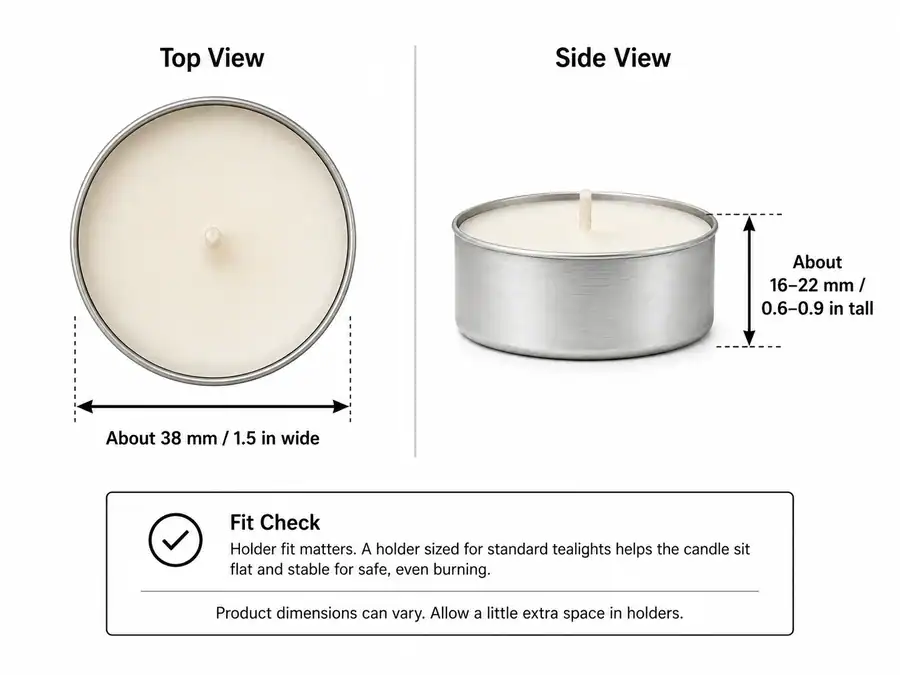
Methods note: These size values are practical ranges drawn from common tealight descriptions, not a universal standard. Always check the product listing, holder instructions, or supplier sheet when a holder, warmer, lantern, or event setup needs exact fit.
A tealight that is slightly wider, taller, or sold as “extended burn” may not behave like a basic retail tealight. Larger or deeper tealights can hold more wax, which may change the burn time and the holder fit. That is why size and burn time should be read together instead of treated as separate facts.
How Long Do Tealight Candles Burn?
Most standard tealight candles burn about 3–5 hours, while mini or extended-burn tealights can burn shorter or longer.
That range is a practical expectation, not a guarantee for every tealight. Burn time depends on wax fill, wick size, wax type, cup depth, airflow, holder design, and the product’s own construction. Some retail tealights are sold as 4-hour or 4.5–5-hour candles, while extended-burn tealights are sold at 6–8 hours or longer.
| Tealight type | Expected burn range | Main variables | Best next step |
|---|---|---|---|
| Standard tealight | About 3–5 hours | Wax fill, wick, airflow | Check the product label |
| Mini tealight | Often shorter | Smaller wax fill | Plan replacements |
| Extended-burn tealight | Often longer | More wax or modified design | Confirm holder depth |
| Scented tealight | Varies | Wax, fragrance, wick, product design | Do not assume a longer burn |
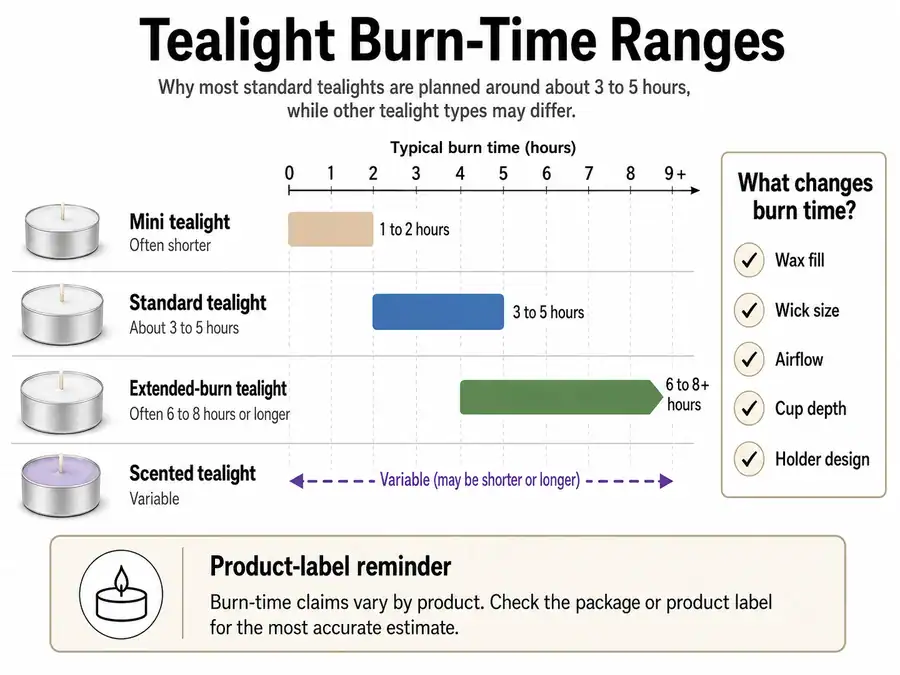
A larger tealight often burns longer because it may hold more wax, but size alone does not decide burn time. A shallow cup, drafty room, poor wick placement, or incompatible holder can shorten the session.
For a 4-hour dinner setup, one standard tealight per holder may be enough if the candle label says it can burn for at least 4 hours. Longer events may need replacement tealights, especially if the candles are mini, scented, or placed where airflow changes the flame.
Methods note: These burn-time ranges are practical planning ranges. Exact burn time should come from the product label or a dedicated burn-time test, not from the candle type alone.
If a tealight burns out early, leaves extra wax, or performs unevenly, that belongs in a burn-time testing, wick, or tealight-making guide. This page gives the basic range so you can identify the candle and plan a short use session.
What Are Tealight Candles Commonly Used For?
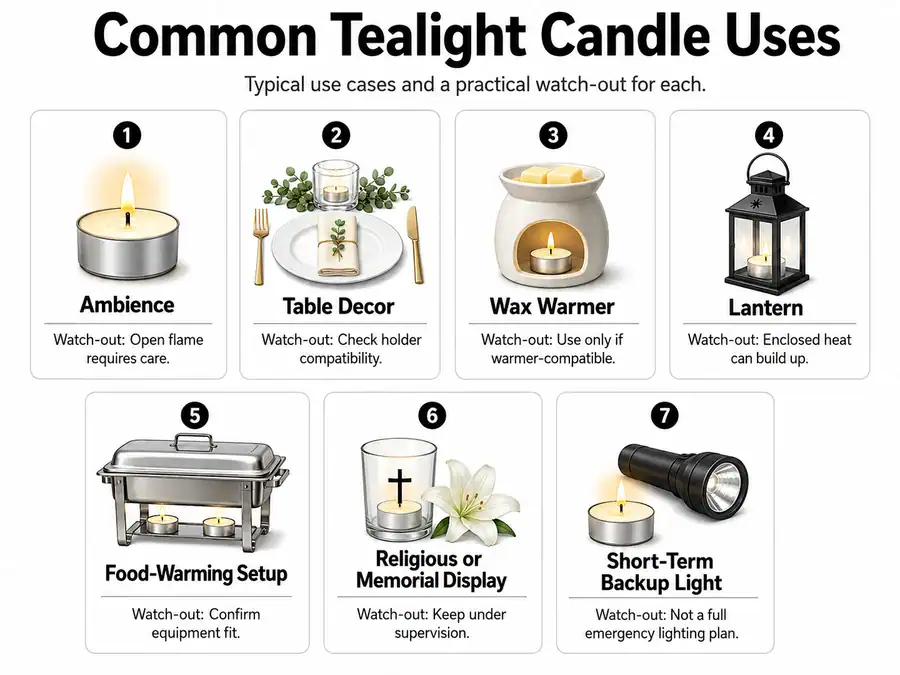
Tealight candles are commonly used for ambience, table decor, wax warmers, lanterns, food-warming setups, religious or memorial displays, and short-term backup light.
Here, “commonly used” means frequent real-world uses. It does not mean every use is the safest, cheapest, most professional, or best choice. The reason tealights fit these uses is their small cup format, low-profile flame, short burn time, and compatibility with holders or warmers.
| Use case | Why tealights fit | Watch out for | Use a separate guide for |
|---|---|---|---|
| Ambience | Small flame and low-profile glow | Still an open flame | Tealight safety guide |
| Table decor | Compact and easy to arrange | Holder compatibility | Tealight holder guide |
| Wax warmer | Works as a heat source for some warmers | Warmer must be made for tealights | Wax warmer guide |
| Lanterns | Small replaceable candle | Enclosed heat area | Safety guide |
| Food-warming setup | Short heat source in some setups | Equipment must be compatible | Food warmer guidance |
| Religious or memorial display | Short symbolic light | Placement and supervision | Safety guide |
| Backup light | Temporary small light | Not a full emergency lighting plan | Preparedness guide |
Unscented tealights often make more sense around meals, memorial displays, or mixed-scent rooms because they add light without adding fragrance. Scented tealights are more often used for ambience, but scent choice is separate from the basic definition of a tealight.
Do Tealight Candles Need a Holder?
Most tealight candles have their own thin cup, but they are still usually placed inside a compatible holder, warmer, lantern, or heat-safe setup.
The tealight cup holds the wax and wick as part of the candle. The holder is the outside object that supports placement, display, or a specific use. Those roles are related, but they are not the same.
| Item | Role |
|---|---|
| Tealight cup | Holds the wax and wick as part of the candle |
| Tealight holder | Supports placement, display, or the use setting around the candle |
A tealight cup does not answer every heat, surface, or placement question. Candle safety guidance from the National Candle Association and European Candle Manufacturers Association stresses suitable holders or heat-resistant bases, distance from flammable items, and supervision of burning candles.
For holder styles, sizing, and placement choices, use a tealight holder guide. For fire, pets, children, enclosed holders, or heat-sensitive surfaces, use a tealight safety guide.
Metal-Cup vs Clear-Cup Tealights
Metal-cup and clear-cup tealights are both tealight candles; the main difference is the material and appearance of the cup around the wax.
A metal-cup tealight usually hides more of the wax and is common in multipacks. A clear-cup tealight lets more light pass through the cup, which can look cleaner in glass holders, centerpieces, or visible displays.
| Cup type | Main visible difference | Common use reason | What not to assume |
|---|---|---|---|
| Metal-cup tealight | Opaque cup around the wax | Multipacks, warmers, simple holders | Not automatically better for every holder |
| Clear-cup tealight | Visible or translucent cup | Glass holders, decor, displays | Not a guarantee of safety or longer burn time |
“Clear” means the cup is visible or translucent in appearance. It does not prove better safety, better recyclability, higher heat resistance, or longer burn performance. Those claims need product-specific evidence or a separate guide.
Use this page to identify tealight candles, understand their usual size, estimate basic burn time, and match them to frequent short-use settings. For making instructions, use a tealight candle-making guide. For longer burn-time testing, use a dedicated burn-time guide. For open-flame placement, pets, children, enclosed holders, or heat-sensitive surfaces, use a tealight safety guide. For choosing between tealights, votives, and container candles, use a candle-type comparison page.