

Taper candles are slim, usually long candles designed to burn upright in candlesticks, candelabras, or compatible holders. Their narrow shape makes them useful for formal dining tables, mantels, ceremonies, weddings, holidays, and other upright decorative displays.
Unlike pillar or container candles, taper candles generally depend on holder fit for stability, straight burning, and surface protection. They can drip when wax, wick, airflow, angle, holder fit, or burn time causes melted wax to run instead of staying near the flame.
What Are Taper Candles?
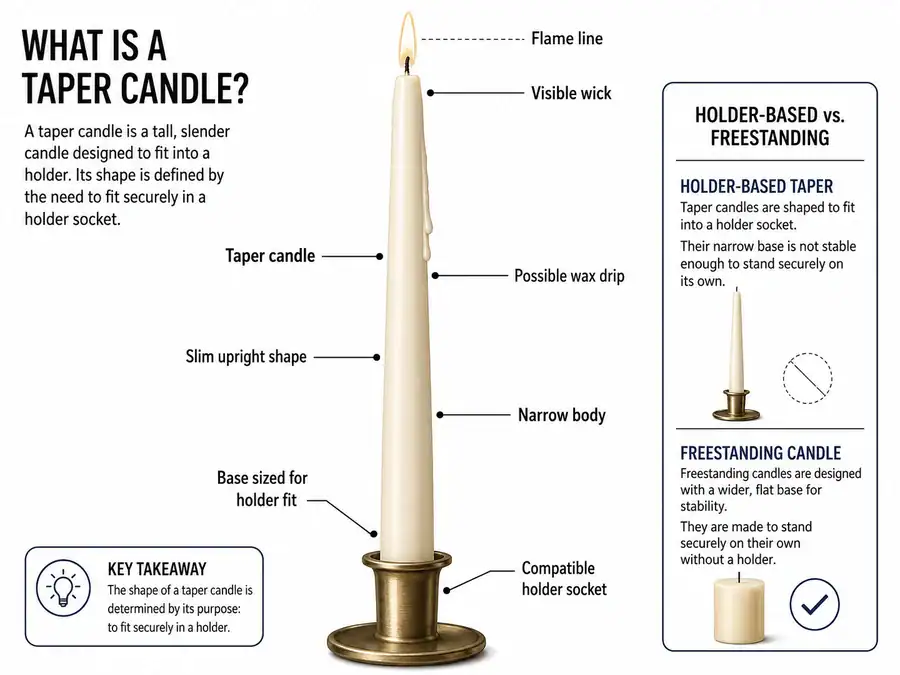
A taper candle is a slim, usually long candle designed to burn upright in a compatible holder. The holder may be a candlestick, candelabra socket, taper insert, or other stable nonflammable support that fits the candle base.
Taper candles are commonly used on dining tables, mantels, holiday displays, wedding tables, ceremonial settings, and other formal upright displays. Their shape gives height and a visible flame line, while the holder keeps the candle vertical and helps control where melted wax can fall.
| Feature | What it means |
|---|---|
| Candle type | Slim upright candle |
| Shape | Long, narrow body with a base made for a holder |
| Holder requirement | Usually needs a candlestick, candelabra, insert, or compatible holder |
| Typical use | Dining, mantels, weddings, holidays, ceremonies, and formal decor |
| Drip expectation | May drip depending on wax, wick, airflow, tilt, holder fit, and burn conditions |
Taper candles are not the same as pillar candles, votives, tea lights, or chime candles. Pillars are wider and usually self-standing, votives sit in cups or holders, tea lights are short metal- or cup-held candles, and chime candles are smaller narrow candles used for shorter burns.
Dinner candles often overlap with taper candles in everyday shopping language when they are tall, slim, and made for upright holders.
This page defines taper candles and their everyday use. Step-by-step taper candle making belongs in a dedicated making guide.
What Shape Is a Taper Candle?
A taper candle has a slim vertical body and a base intended to sit in a compatible holder. Its shape affects both how it looks and how safely it burns in a formal display.
The narrow body creates height without the mass of a pillar candle. The base matters because it must sit snugly enough to keep the flame centered, reduce leaning, and limit one-sided wax runoff.
| Part | Practical role |
|---|---|
| Wick | Carries the flame at the top of the candle |
| Body | Creates the tall, narrow upright look |
| Base | Fits into the holder socket or insert |
| Holder socket | Supports the candle so it can stand upright |
A taper candle’s shape is functional, not just decorative. If the base is too loose, the candle can lean. If it is too tight, forcing it into the holder can crack the wax or make removal difficult.
Pillar candles can stand on their own because their wide base supports the body. Taper candles rely on a fitted holder to create the same upright stability.
Why Do Taper Candles Need Holders?
Taper candles generally need holders because their slim shape is not designed for freestanding use. A holder is a compatible candlestick, candelabra socket, taper insert, or stable nonflammable support sized for the taper base.
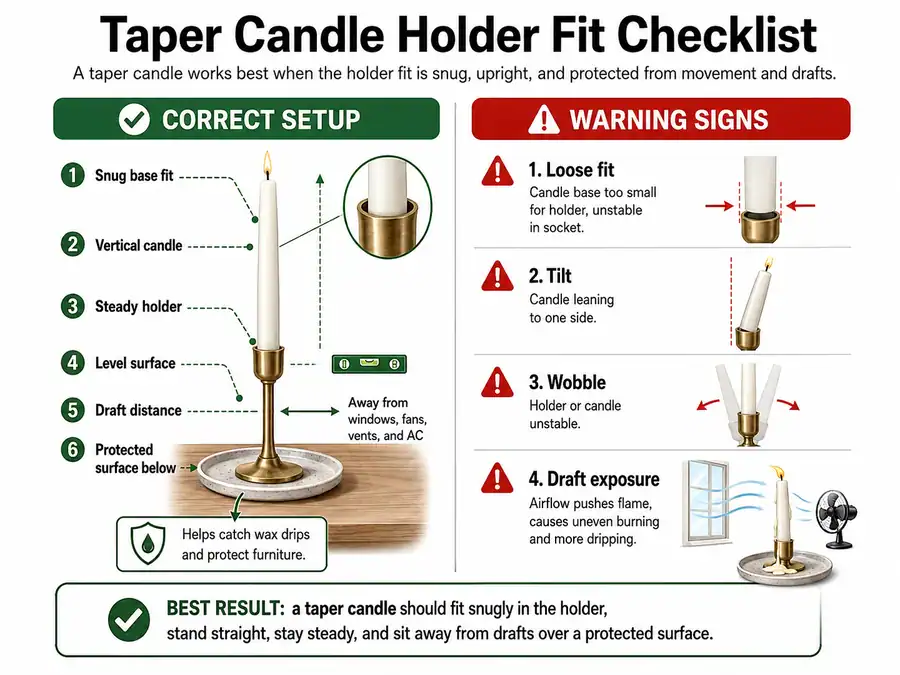
The holder does more than display the candle. It keeps the taper upright, supports the base, reduces leaning, and helps melted wax fall in a more predictable direction. A loose or tilted holder can make the candle lean, which can move the flame off center and increase one-sided dripping.
| Check | Why it matters |
|---|---|
| The base fits the holder | A snug base reduces wobble and leaning |
| The candle sits vertical | A centered flame burns more evenly |
| The holder does not wobble | A steady holder lowers tip and drip risk |
| The surface is level | A tilted surface can tilt the flame and wax pool |
| The candle is away from drafts | Moving air can push heat to one side |
| The surface below is protected | Wax can still drip even with a well-fitted taper |
A holder does not mean any container that can physically hold a candle. For taper candles, the holder must support the narrow base in an upright position. Storage cups, loose jars, decorative bowls, or improvised objects are not the same as a fitted taper holder.
If the main problem is choosing the right candlestick, socket size, insert, or candelabra style, that belongs in a dedicated taper candle holder guide. This section only explains why the holder is necessary for basic use.
How Should Taper Candles Sit in a Holder?
A taper candle should sit upright and snugly in its holder before lighting. A vertical, secure fit keeps the flame closer to the candle’s centerline and helps reduce leaning, uneven melting, and wax runoff.
A stable taper is seated firmly enough that it does not rock during normal indoor use. Stable does not mean windproof, childproof, safe unattended, or suitable for every event space. It only means the candle is vertical, supported, and unlikely to lean during supervised indoor burning.
| Setup point | What to look for |
|---|---|
| Base seated fully | The candle reaches the bottom of the socket or sits firmly in the insert |
| Candle vertical | The body points straight up, not to one side |
| No wobble | The holder and candle stay steady when placed on the table |
| Level surface | The holder sits flat without rocking |
| Draft distance | The flame is not near vents, open windows, or strong air movement |
| Drip planning | A tray, bobeche, or protected surface is used when wax runoff would matter |
Leaning matters because it changes how heat reaches the wax. When the flame sits closer to one side, that side can soften faster, making wax run down the candle instead of staying near the melt area.
Do not light a taper that leans sharply, rocks in the holder, or sits above the socket without support. Fix the fit first, replace the holder, or use a proper taper insert rather than trying to burn an unstable candle.
What Sizes Do Taper Candles Come In?
Taper candle size usually means height and base diameter, and base diameter matters because it determines holder fit. “Standard” taper size means common retail shorthand, not a universal technical size that fits every holder.
Many retail taper candles are sold around a common 7/8-inch base, but holder sockets and candle bases vary, so the safer rule is to measure the holder and confirm a snug vertical fit.
Height affects how tall the candle looks in a table, mantel, or candelabra display. Base diameter affects whether the candle sits straight, wobbles, feels too tight, or needs a different holder.
| Size factor | What it affects | Holder-fit meaning | Buyer note |
|---|---|---|---|
| Height | Visual impact and burn planning | Taller tapers may feel more formal but need steadier placement | Choose height based on table sightlines and holder weight |
| Base diameter | Socket fit | The base must match the holder opening closely | Check the holder before buying replacement tapers |
| Base shape | How the candle seats | Slight shape differences can change tightness | Two tapers with similar labels may fit differently |
| Holder depth | How much support the base gets | A shallow socket may feel less secure | Avoid lighting a candle that rocks or leans |
| Display location | Stability and wax planning | Dining tables, mantels, and candelabras need different clearance | Plan for height, flame space, and wax protection together |
A taller taper can create stronger vertical decor, but height alone does not make a candle better. A shorter taper that fits the holder securely is usually more practical than a tall taper that leans.
For exact base matching, a taper candle holder sizing guide should handle socket dimensions, inserts, adapters, and fit checks. This page uses size only to explain taper identity, holder dependence, and practical use.
What Should You Do If a Taper Candle Does Not Fit the Holder?
Do not light a taper until it sits snugly and vertically in the holder. A poor fit can make the candle lean, drip unevenly, crack at the base, or sit too loosely to burn with confidence.
If the taper is too loose, use a correctly sized holder, a proper taper insert, or a wax-safe adapter made for that purpose. If the taper is slightly too tight, a small base adjustment may help, but forcing the candle can split the wax or damage the holder.
| Fit problem | What it usually means | Safer response |
|---|---|---|
| Candle wobbles | Base is too small for the socket | Use a better-fitting holder or taper insert |
| Candle leans | Base is uneven, socket is loose, or surface is tilted | Re-seat the candle, check the surface, or change holders |
| Candle will not enter socket | Base is too wide or misshaped for the holder | Do not force it; use another taper or holder |
| Wax cracks at the base | Too much pressure was applied | Stop using that candle in that holder |
| Candle sits high above the socket | The base is not fully supported | Choose a holder with deeper or better-matched support |
| Candle drips to one side | The flame or candle body may be off center | Fix the fit and check for drafts before relighting |
A small amount of base shaping can be used only when the taper is slightly oversized and the adjustment does not crack the candle. Do not melt the base over an open flame, pack the holder with paper, balance the candle loosely, or use an unstable object as a holder.
A dedicated taper candle holder guide should cover inserts, socket types, and buying choices. This section only covers the safe decision rule: the taper should be snug, vertical, and steady before lighting.
Why Are Taper Candles Used for Formal Decor?
Taper candles are used for formal decor because their slim height and visible flame create an upright, polished display in holders. In this article, “formal” means dining, ceremony, wedding, holiday, mantel, and event-style decor, not legal formality or luxury-only styling.
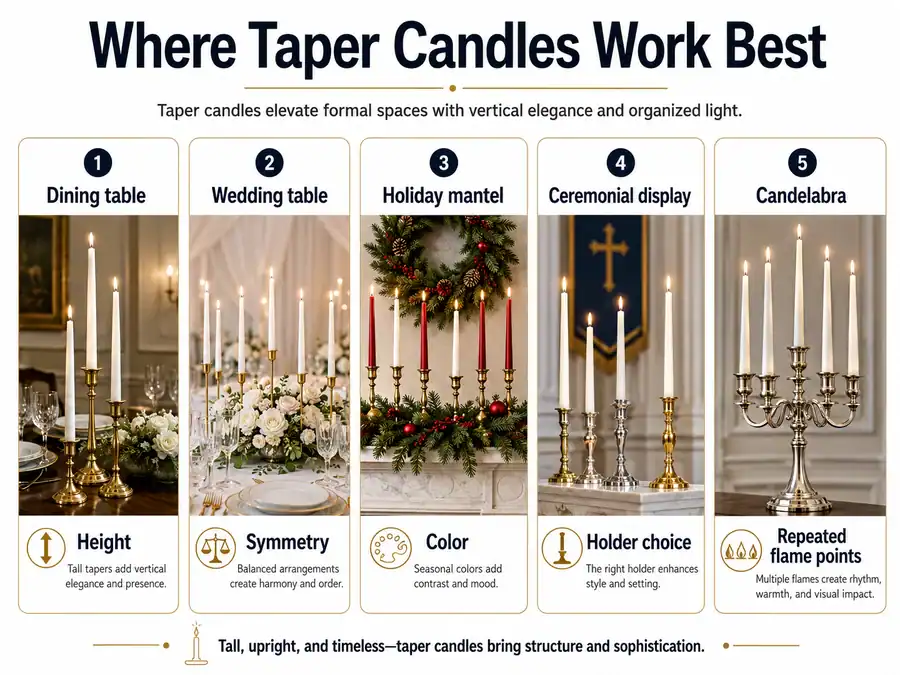
Their shape adds vertical lines to a table, mantel, altar-style display, or candelabra. Repeated tapers can create rhythm and symmetry, while color and holder choice can make the same candle feel traditional, minimal, seasonal, or dramatic.
| Setting | Why taper candles work there |
|---|---|
| Dining tables | They add height and flame without taking up much table width |
| Weddings | They create repeated flame points across long tables or ceremony displays |
| Holiday tables | They add seasonal color and height to centerpieces |
| Mantels | They frame artwork, garlands, mirrors, or floral decor |
| Ceremonial displays | They give a clear upright flame point in a holder |
| Candelabras | They create symmetry through repeated vertical candles |
Formal use still depends on practical setup. A taper that looks right but leans, drips onto fabric, blocks faces at dinner, or sits in a loose holder is not ready to burn.
A full wedding, holiday, or tablescape guide can cover deeper styling plans. This section explains why taper candles fit formal decor as a candle type.
How Do You Use Taper Candles on a Dining Table?
Use taper candles on a dining table where they add height without blocking guests or dripping onto surfaces. The best setup uses stable holders, clear sightlines, surface protection, and usually unscented candles.
Taper candles work well down the center of a table because they take little horizontal space. They can sit in pairs, rows, mixed-height holders, or candelabras, but each candle should still sit straight and away from flammable decor.
| Setup point | What to check |
|---|---|
| Sightlines | Guests should be able to see each other across the table |
| Holder stability | Each holder should sit flat and hold the taper snugly |
| Spacing | Flames should not crowd flowers, napkins, menus, or garlands |
| Scent | Unscented tapers usually work better near food |
| Wax protection | Use holders, trays, bobeches, or heat-safe surfaces where wax could matter |
| Drafts | Keep candles away from open windows, vents, and strong air movement |
Unscented taper candles are usually safer for dining comfort because fragrance can compete with food and bother guests. A subtle scented taper may work on a mantel, entry table, or sideboard, but the dining table is usually better kept fragrance-light.
Do not place taper candles where sleeves, flowers, paper menus, or hanging decor can touch the flame. A formal table can still be simple: snug holders, clear spacing, protected surfaces, and candles that do not block conversation.
Can Taper Candles Be Used in Candelabras?
Taper candles can be used in candelabras when the sockets fit the candle bases securely. A candelabra works like a multi-arm taper holder: each socket must support the candle upright without wobble.
Candelabras make taper candles feel more formal because they repeat height, flame points, and vertical lines in one display. The main practical check is still fit. A beautiful candelabra can still be a poor match if the taper bases are too narrow, too wide, tilted, or only partly supported.
| Check | Why it matters |
|---|---|
| Socket diameter | The taper base should fit snugly without being forced |
| Socket depth | A deeper socket gives the candle more support |
| Arm balance | Uneven candles can make the display look crooked |
| Candle height | Similar heights create a cleaner formal line |
| Surface below | Multi-candle displays can create more wax exposure |
| Air movement | Drafts can make several flames flicker or drip unevenly |
Do not assume every candelabra fits every taper candle. If the tapers lean, rock, or sit high above the socket, change the candle size, use a proper insert, or choose a better-matched holder before lighting.
Antique value, rewiring, and electric candelabra parts are separate topics. This section only covers taper candle fit, upright display, and decorative use in candle-holding candelabras.
Where Are Taper Candles Used in Ceremonies and Events?
Taper candles are used in ceremonies and events as decorative and symbolic flame points. In this article, event use means visual placement, ambience, and holder-based display, not ritual instruction or venue rules.
They often appear where a tall, narrow flame gives structure to a formal setting. The candle’s job may be decorative, symbolic, or atmospheric, but the setup still depends on stable holders, protected surfaces, and clear space around the flame.
| Setting | How taper candles are commonly used |
|---|---|
| Weddings | Lining tables, ceremony displays, mantel-style arrangements, or reception decor |
| Holiday gatherings | Adding height and seasonal color to table or mantel displays |
| Memorial displays | Creating a quiet upright flame point in a stable holder |
| Formal dinners | Framing place settings or centerpieces without using wide candles |
| Banquets and receptions | Repeating candle height across long tables |
| Altar-style displays | Adding symmetrical flame points in holders or candelabras |
Taper candles should not be treated as a substitute for event safety planning. For public venues, houses of worship, rented spaces, or catered events, the event organizer should follow the site’s candle-use rules.
A wedding candle or holiday candle guide can cover styling ideas in more detail. This section only explains where taper candles commonly fit as a formal candle type.
How Do Color and Finish Affect Formal Taper Candle Decor?
Color and finish change how formal, seasonal, minimal, dramatic, or coordinated a taper candle display feels. The best choice depends on the occasion, holder material, table setting, room palette, and how much contrast you want.
White and ivory tapers often feel classic because they blend with linens, florals, silver, glass, and ceramic holders. Black, burgundy, forest green, navy, metallic, or bright seasonal tapers create stronger contrast and make the candle part of the design instead of a quiet accent.
| Choice | Best use | Decor effect |
|---|---|---|
| White or ivory | Weddings, formal dinners, holidays, mantels | Classic, soft, clean |
| Black | Modern tables, evening settings, dramatic mantels | High contrast and graphic |
| Burgundy, green, navy, or brown | Autumn, winter, holiday, and moody table settings | Rich, seasonal, grounded |
| Pastel colors | Spring tables, showers, soft weddings | Light, gentle, decorative |
| Metallic finish | Parties, holidays, formal candelabras | Reflective and dressier |
| Matte finish | Minimal tables, stoneware, natural holders | Quiet and modern |
| Gloss finish | Glass, polished metal, and festive displays | Brighter and more reflective |
A formal taper display does not need expensive candles. It needs a clear match between the candle color, the holder, and the setting. Repetition matters too: several matching tapers in a row often look more formal than one unusual candle placed by itself.
Avoid choosing color alone. A candle that matches the table but drips on fabric, sits loosely in the holder, or blocks guests at dinner will not work well in use.
Do Taper Candles Drip?
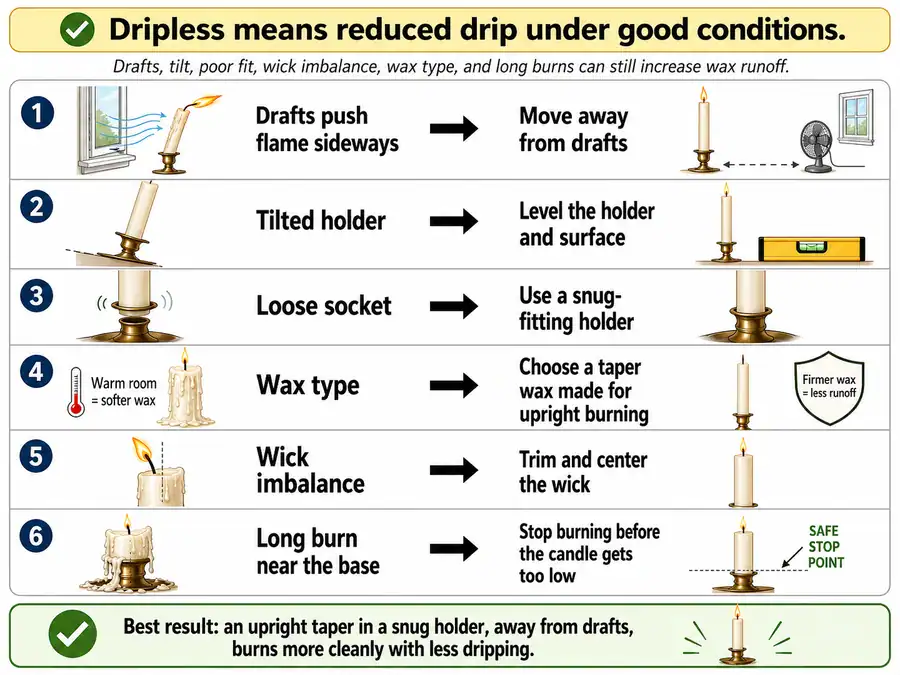
Taper candles can drip, but dripping depends on wax, wick, airflow, angle, holder fit, and burn conditions. “Dripless” means reduced-drip under the right conditions, not a promise that wax will never run.
A taper candle is more likely to drip when the flame burns off center. This can happen when the candle leans, the holder is loose, the room has drafts, the wick burns unevenly, or the candle is allowed to burn too close to the holder.
| Cause | What happens | Practical response |
|---|---|---|
| Drafts | Moving air pushes the flame and heat to one side | Move the candle away from vents, windows, and fans |
| Tilted holder | Wax melts more on one side | Re-seat the candle or change the holder |
| Loose socket | The taper wobbles or leans | Use a snug holder or proper insert |
| Wax type | Softer or lower-melt wax may run more under heat | Match the candle to the setting and protect surfaces |
| Wick imbalance | The flame pulls heat unevenly | Trim only when appropriate and stop using a badly burning candle |
| Long burn near the base | Heat reaches the holder area | Extinguish before the flame gets too close to the socket |
To reduce dripping, keep taper candles upright, use snug holders, avoid drafts, protect the surface below, and stop burning before the flame reaches the holder. These steps matter even when a product is labeled dripless.
A deeper dripless candle or candle troubleshooting guide can cover testing, wax behavior, and recurring burn problems. This section only explains the main conditions that affect taper candle drip behavior.
Are Dripless Taper Candles Really Dripless?
Dripless taper candles are reduced-drip candles, not candles that can never drip. They are meant to limit wax runoff when they burn upright, in a snug holder, away from drafts, and under normal indoor conditions.
A dripless claim can fail when the candle leans, the holder is loose, the room has airflow, the wick burns unevenly, or the candle burns too close to the holder. The word “dripless” describes expected performance under good conditions, not a guarantee against every setup problem.
| Problem | Why a dripless taper may still drip | What to check |
|---|---|---|
| Candle leans | Heat gathers on one side of the wax | Re-seat the candle vertically |
| Holder is loose | The candle can wobble as it burns | Use a snug holder or proper insert |
| Draft hits the flame | Air pushes heat off center | Move the candle away from vents, fans, or windows |
| Wick burns unevenly | The flame may melt one side faster | Stop using a badly burning candle |
| Candle burns too long | Heat reaches the lower wax and holder area | Extinguish before the flame gets close to the socket |
| Surface is unprotected | Small wax runs can still reach the table | Use a bobeche, tray, or heat-safe protective surface |
Treat dripless tapers as lower-mess candles, not no-maintenance candles. They still need upright placement, surface protection, and supervised burning.
A full dripless candle guide can compare product claims, wax behavior, and recurring drip problems. This section only explains what “dripless” means for taper candles in normal use.
Why Do Drafts Make Taper Candles Drip or Flicker?
Drafts make taper candles drip or flicker because moving air pushes the flame and heat off center. When heat gathers on one side of the candle, wax can melt unevenly and run down the taper.
A draft does not have to feel strong to affect a taper candle. Air from a vent, open window, fan, doorway, or busy walkway can move the flame enough to cause flicker, smoke, uneven melting, or one-sided dripping.
| Draft source | What you may notice | Better placement |
|---|---|---|
| Heating or cooling vent | Flame bends in one direction | Move the holder away from direct airflow |
| Open window | Flame flickers or wax runs on one side | Close the window or move the candle |
| Ceiling or table fan | Flame moves repeatedly | Turn the fan off or relocate the display |
| Doorway or walkway | Flame shifts when people pass | Move the candle to a calmer spot |
| Outdoor or patio setting | Flame becomes unstable | Use a different candle setup suited to outdoor use |
| Tall centerpiece nearby | Air moves unevenly around the flame | Give the candle clearer space |
“Draft-free” means low-airflow indoor placement, not a sealed room. It also does not mean a dripless taper will never drip. It means the flame has a better chance of staying centered so the wax melts more evenly.
If a taper candle keeps flickering or dripping on one side, check airflow before blaming the wax. The candle may perform better in a snug holder, on a level surface, and away from moving air.
How Do You Protect Surfaces From Taper Candle Wax?
Protect surfaces from taper candle wax with stable holders plus wax-catching or heat-safe protection underneath. A fitted holder reduces leaning, but it does not remove the need to plan for possible drips.
A bobeche is a small collar or dish that sits around a candle holder to catch wax. Drip plates, trays, wide holder bases, and heat-safe surfaces can also help protect linens, mantels, tabletops, and candelabra areas.
| Protection method | Best use | What it helps with |
|---|---|---|
| Bobeche | Candlesticks and some candelabras | Catches small wax runs near the holder |
| Drip plate | Formal table settings or mantels | Adds a wax-catching layer under the candle |
| Tray | Grouped tapers or mixed decor | Protects a wider display area |
| Wide holder base | Dining tables and sideboards | Catches some wax before it reaches the surface |
| Heat-safe surface | Mantels, shelves, and tabletops | Reduces risk from heat and wax contact |
| Washable runner or protective layer | Tables with linens | Makes wax cleanup less damaging |
Surface protection means wax and heat planning, not fireproofing. A tray or bobeche can catch wax, but it does not make a taper candle safe near paper, dried flowers, curtains, or unattended settings.
If wax mess is the main concern, combine three steps: use a snug holder, keep the candle upright, and place wax-catching protection below the burn area.
What Are Taper Candles Made Of?
Taper candles may be made from paraffin, beeswax, soy blends, stearin blends, or other candle waxes. The wax can affect appearance, firmness, burn behavior, scent use, price, and drip expectations.
Wax type should be understood as a practical product detail, not a promise of perfect performance. A beeswax, soy-blend, or paraffin taper can still drip if it leans, burns in a draft, sits in a loose holder, or burns too close to the base.
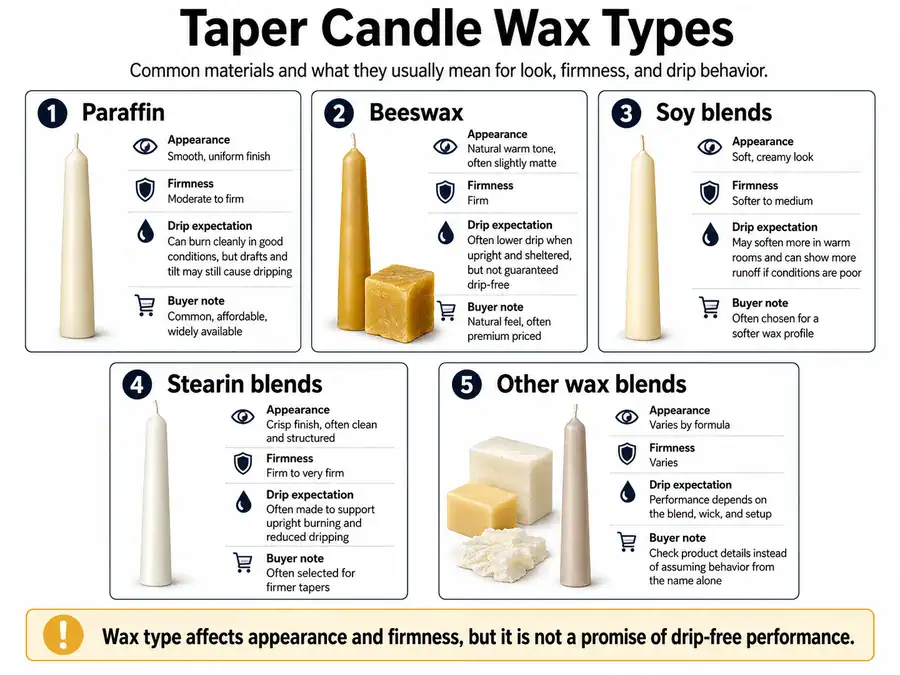
| Wax type | Common appearance | Typical taper use | Drip expectation | Buyer note |
|---|---|---|---|---|
| Paraffin | Smooth, clean, often bright in color | Common retail taper candles | Can perform well, but depends on design and conditions | Often used where color range and affordability matter |
| Beeswax | Natural yellow or filtered lighter tones | Traditional, decorative, and premium tapers | Often firm, but not automatically drip-free | “Natural” describes wax source, not guaranteed safety or performance |
| Soy blends | Softer-looking finish, often blended for structure | Used when brands want plant-based positioning | May vary by blend and candle design | Pure softness can be an issue, so many tapers use blends |
| Stearin blends | Firm, structured finish | Often used to improve hardness and shape | Can support cleaner shape retention | Blend details matter more than the label alone |
| Other wax blends | Varies by brand | Specialty, colored, scented, or decorative tapers | Depends on formulation and burn setup | Check use instructions and holder fit |
“Natural” means the material source is named, such as beeswax or plant-based wax. It does not automatically mean safer, cleaner, healthier, dripless, or better for every setting.
Wax details matter most when they affect the taper’s use. For dining, scent and drip control may matter more than the wax label alone. For formal decor, color, finish, holder fit, and surface protection often matter just as much as material.
A candle wax guide can cover wax chemistry, additives, and formulas in more depth. This section only explains wax as it affects taper candle behavior and buyer expectations.
Should Taper Candles Be Scented or Unscented?
Taper candles can be scented or unscented, but unscented tapers are often better for dining. “Scented” means added fragrance, not proof of mood, wellness, or aromatherapy effects.
Unscented taper candles let food, flowers, and room scent stay in the background. This matters most at dinner tables, weddings, banquets, and long gatherings where guests sit close to the candles.
| Choice | Best setting | Main benefit | Main caution |
|---|---|---|---|
| Unscented tapers | Dining tables, weddings, ceremonies, formal dinners | Keeps fragrance from competing with food or guests | May feel less atmospheric in non-dining spaces |
| Lightly scented tapers | Mantels, entry tables, sideboards | Adds scent away from food | Still may bother sensitive guests |
| Strongly scented tapers | Rarely best for formal dining | Creates a noticeable room scent | Can clash with meals, flowers, or perfume |
| Seasonal scented tapers | Holiday mantels or non-dining displays | Adds a themed detail | Better kept away from plates and glassware |
| Beeswax-scented tapers | Natural wax displays | May have a mild honey-like wax aroma | Still not scent-free for every guest |
For a dinner table, unscented is the safer default. For a mantel, entryway, or decorative sideboard, a mild scent can work if the candles are away from food and guests have space from the fragrance.
Do not choose scented tapers for formal settings only because they sound more premium. Holder fit, color, height, drip behavior, and guest comfort usually matter more.
Are Hand-Dipped and Molded Taper Candles Different?
Hand-dipped and molded taper candles differ mainly by production method, appearance, and consistency. Hand-dipped tapers are built by repeated dipping, while molded tapers are formed in molds.
For buyers, the difference shows up in surface texture, shape consistency, color variation, and how “artisan” or uniform the candle looks. The method does not automatically prove that one candle burns better, drips less, or fits every holder.
| Type | How it is made | Common look | Buyer expectation |
|---|---|---|---|
| Hand-dipped taper | Built up through repeated wax dipping | Slight variation, layered look, handmade feel | Good when visible craft and small differences are part of the appeal |
| Molded taper | Wax is formed in a taper-shaped mold | More consistent shape and surface | Good when matching sets and predictable sizing matter |
| Rolled taper | Wax sheet is rolled around a wick | Textured or spiral surface | Often decorative, but fit and burn behavior still need checking |
| Machine-made taper | Produced for consistency and scale | Uniform shape, color, and size | Useful for events that need many matching candles |
A hand-dipped label describes the production style, not guaranteed quality. A molded taper can be well made, and a hand-dipped taper can still drip, lean, or fit poorly if the holder or burn conditions are wrong.
Step-by-step dipping, mold design, wax formulas, and wick sizing belong in a taper-candle-making guide. This section only explains the terms as buyer-facing product language.
How Do Taper Candles Compare With Other Candle Types?
Taper candles differ from other candle types because they are slim, upright, and normally used in holders. Their main identity is the combination of narrow shape, holder dependence, and formal vertical display.
A taper is not defined only by being decorative. It is defined by how it stands, how it burns, and how it is used. Pillars, votives, tea lights, chime candles, dinner candles, and container candles each solve a different display or burn need.
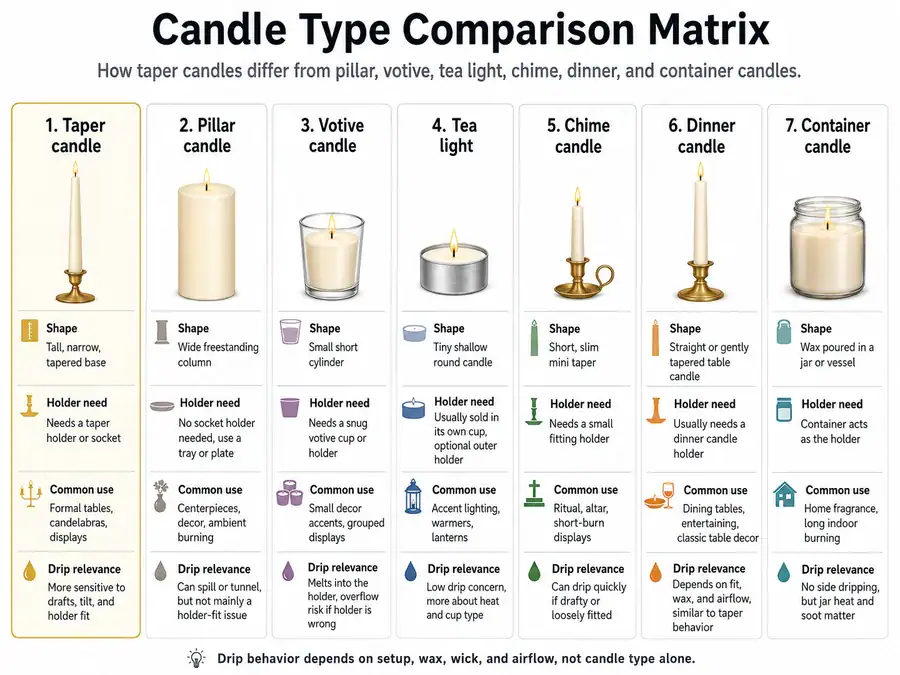
| Candle type | Shape | Needs a holder? | Common use | Drip relevance |
|---|---|---|---|---|
| Taper candle | Slim and upright | Yes, in most use | Dining, mantels, candelabras, ceremonies, formal decor | Drip depends on wax, wick, airflow, angle, holder fit, and burn time |
| Pillar candle | Wide and self-standing | Usually no separate holder needed, but a plate is often used | Centerpieces, lanterns, mantels | Wax may pool or run down the side |
| Votive candle | Short and small | Yes, usually a votive cup | Small accent lighting, grouped displays | Wax is usually contained by the cup |
| Tea light | Short, shallow, often in a cup | Comes in its own cup or sits in a tea light holder | Warmers, lanterns, small accents | Wax is usually contained in the cup |
| Chime candle | Small, narrow, short-burn candle | Yes | Short rituals, small holders, compact displays | Can drip if holder fit or airflow is poor |
| Dinner candle | Tall table candle | Usually yes | Dining tables and formal meals | Often overlaps with taper candles in retail language |
| Container candle | Wax poured into a jar or vessel | The container is part of the candle | Scented rooms, gifts, everyday use | Wax remains inside the container |
Dinner candles and taper candles can overlap in everyday shopping language. In this article, “taper candle” means a slim holder-based candle used upright, whether it is sold for dining, candelabras, mantels, or formal decor.
A full pillar-vs-votive-vs-taper comparison should compare burn time, cost, placement, and use cases in more detail. This section only gives the category boundaries needed to understand taper candles.
When Should You Stop Burning a Taper Candle?
Stop burning a taper candle before the flame gets close to the holder, socket, nearby decor, or surface below. The goal is to leave enough unburned wax to prevent excess heat at the base.
A taper candle becomes less forgiving near the end of the burn. The flame is closer to the holder, the remaining candle is shorter, wax may collect near the socket, and a leaning candle may become harder to manage.
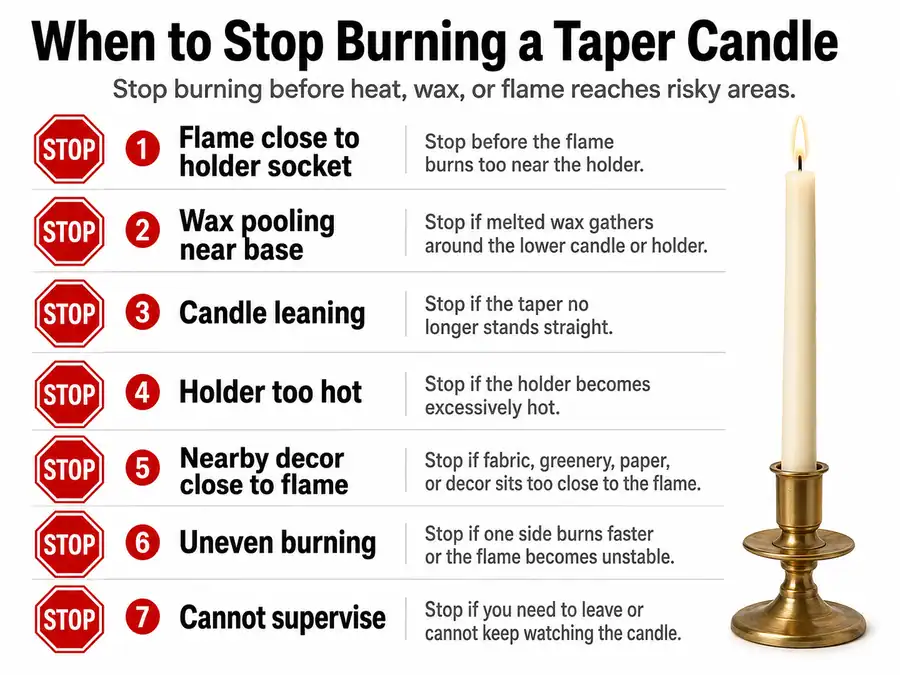
| Stop burning when… | Why it matters |
|---|---|
| The flame is close to the holder socket | Heat can affect the holder or remaining wax |
| Wax is pooling near the base | Melted wax may run into or around the holder |
| The candle starts leaning | The flame may move off center and increase drip risk |
| The holder feels too hot | Heat is reaching the support area |
| Nearby decor is close to the flame | Flowers, paper, fabric, or greenery can become unsafe |
| The candle is burning unevenly | Uneven heat can create extra wax runoff |
| You cannot supervise the candle | Taper candles should not be left burning unattended |
Do not try to burn a taper all the way down just to use every bit of wax. A small leftover base is normal and safer than letting the flame reach the holder area.
If burn time is the main question, a candle burn-time guide can compare candle types. For taper candles, the practical rule is simpler: stop before the flame, heat, or wax reaches the holder in a risky way.