

For formal tables, start with tapers for height, votives or tea lights for repeated glow, containers for low mess, pillars for larger displays, floating candles for contained water displays, and flameless candles when flame constraints matter.
Candle types are form factors such as taper, pillar, votive, tea light, floating, container, and flameless candles chosen for a specific table or event use. For formal events, “best” means the candle fits the setting, stays stable, lasts through the planned moment, and supports the table style without adding cleanup problems. Tapers suit traditional height, votives and tea lights suit repeated low-profile coverage, pillars suit larger displays, floating candles suit contained decorative bowls, containers reduce wax mess, and flameless candles fit constraint-heavy venues. Formal events here include seated dinners, wedding receptions, ceremony displays, banquet tables, cocktail areas, entry tables, and outdoor formal setups where candle form factor affects fit. This page compares event fit, not wax recipes, wick sizing, scent blending, or venue fire-code compliance.
Quick Candle Type Comparison for Formal Events
Taper, votive, tea light, pillar, floating, container, and flameless candles each fit a different formal-event constraint.
Tapers suit formal height and tradition, votives and tea lights suit repeated low-profile table coverage, pillars suit larger displays, floating candles suit contained decorative water displays, containers reduce wax mess, and flameless candles fit constraint-heavy venues. The parent Candle Types guide can define each format in more depth; this page compares which form factor fits dinner tables, weddings, and formal events.
A candle type is the candle’s physical format, not its wax recipe, wick size, or fragrance blend. For this page, “best” means best fit for formality, table footprint, stability, event duration, cleanup, scent control, holder need, and flame constraint.
| Candle type | Best formal-event fit | Strongest use case | Avoid when | Support needed |
|---|---|---|---|---|
| Taper candles | Classic, formal, vertical table rhythm | Formal dinners, banquet tables, traditional wedding tables | Tables are narrow, windy, or filled with tall flowers | Snug taper holders or candelabras |
| Pillar candles | Substantial displays with more visual weight | Altars, entry tables, mantels, large center displays | Place settings are tight or guests need clear sightlines | Heat-safe plate, tray, lantern, or hurricane |
| Votive candles | Repeated soft glow with contained wax | Wedding receptions, long dinner tables, clustered centerpieces | The venue needs a very tall or dramatic look | Votive cups or heat-safe holders |
| Tea lights | Small accents and dense low-profile coverage | Accent bowls, small tables, scattered reception glow | The event needs long unattended burn time | Metal or plastic cup, holder, tray, or vessel |
| Floating candles | Decorative water-based displays | Glass bowls, low centerpieces, entry or accent tables | The table may be bumped or the vessel is shallow | Wide bowl, water vessel, stable base |
| Container candles | Cleaner wax control and modern presentation | Minimalist dinners, lounge areas, gift tables | Matching containers clash with the formal style | Heat-safe jar, tin, or glass container |
| Flameless candles | Flame-restricted or fabric-heavy settings | Venues with flame limits, long events, child-heavy spaces | Real flame is central to the visual mood | Batteries, charging plan, or remote controls |
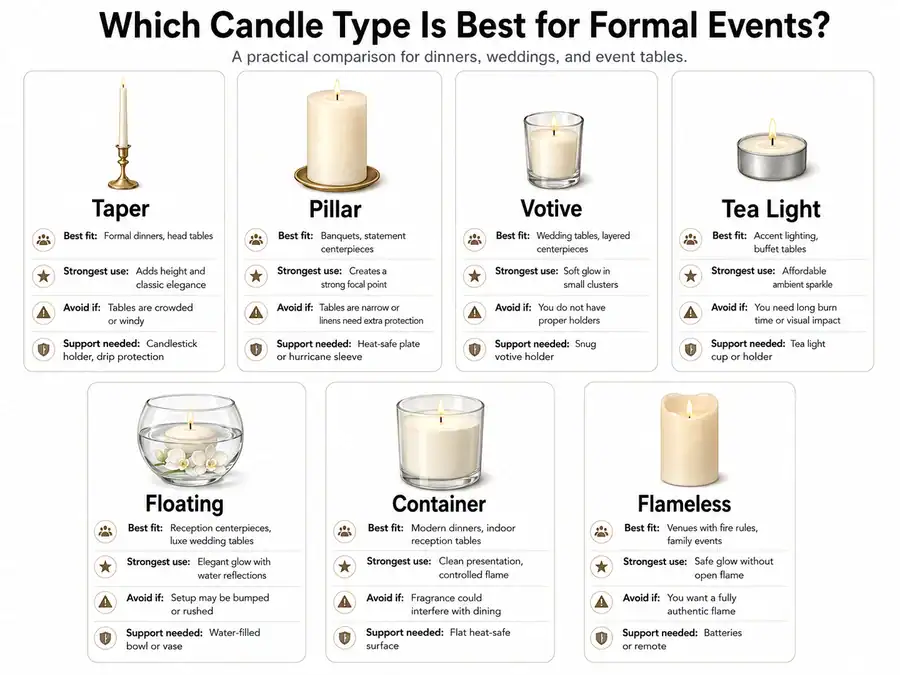
Methods Box: This matrix is a modeled event-fit benchmark, not a product test. It compares candle formats by formality, table footprint, holder dependency, visible mess, duration risk, and suitability for dinner or wedding settings. Brand-specific burn time, size, and venue permissions should be checked before purchase or setup.
Taper candles are the strongest choice when the table needs height and ceremony, but they depend on fitted holders. Pillar candles create weight and presence, yet they can crowd smaller dining tables. Votives and tea lights are easier to repeat across many tables, but small formats may need replacement planning. Floating candles work best when the water vessel is part of the display. Container candles reduce exposed wax issues. Flameless candles trade real flame for control, repeatability, and easier setup in restricted spaces.
Use taper candles for classic formal tables, pillar candles for larger display zones, votive candles for repeated reception glow, tea lights for small accents, floating candles for contained water displays, and flameless candles for venue-constrained events when those deeper format choices need their own page.
Wedding Ceremony Candles vs Reception Table Candles
Wedding ceremony candles can be staged and symbolic; reception table candles must work around guests, food, timing, and cleanup.
Ceremony candles can be larger, more symbolic, or placed in controlled display areas, while reception table candles must prioritize sightlines, stability, duration, cleanup, and table density. “Wedding” here means candle-type suitability by wedding moment, not ritual instructions, religious symbolism, vendor planning, or full wedding design.
| Wedding moment | Better candle type fit | Why it fits | Avoid when | Route deeper intent to |
|---|---|---|---|---|
| Aisle display | Pillars, lanterned pillars, flameless candles | Visible from a distance and easier to stage along a path | Fabric, guests, or movement sit close to open flame | Candle Safety for Events |
| Altar or ceremony table | Pillars, tapers, container candles | Creates a focal point without needing many small candles | Wind, unstable surfaces, or venue restrictions apply | Unity Candle |
| Unity candle moment | Tapers plus one central pillar or container candle | Separates lighting action from the main display candle | The user needs ceremony wording or ritual steps | Unity Candle |
| Reception dinner tables | Votives, tea lights, low tapers, flameless candles | Repeats glow without taking over table service | Tall flames block conversation or decor is crowded | Wedding Candle Centerpieces |
| Sweetheart table | Tapers, votives, pillars, flameless candles | Can carry more visual focus than guest tables | The table is narrow or photo props crowd the surface | Wedding Candle Centerpieces |
| Cocktail or lounge areas | Container candles, votives, flameless candles | Keeps wax contained and reduces setup variation | Guests may move drinks, bags, or fabrics near the flame | Candle Safety for Events |
| Outdoor ceremony or tent | Flameless candles, lanterned pillars, protected containers | Reduces wind and fabric-placement issues | Real flame is required for a symbolic moment | Candle Safety for Events |
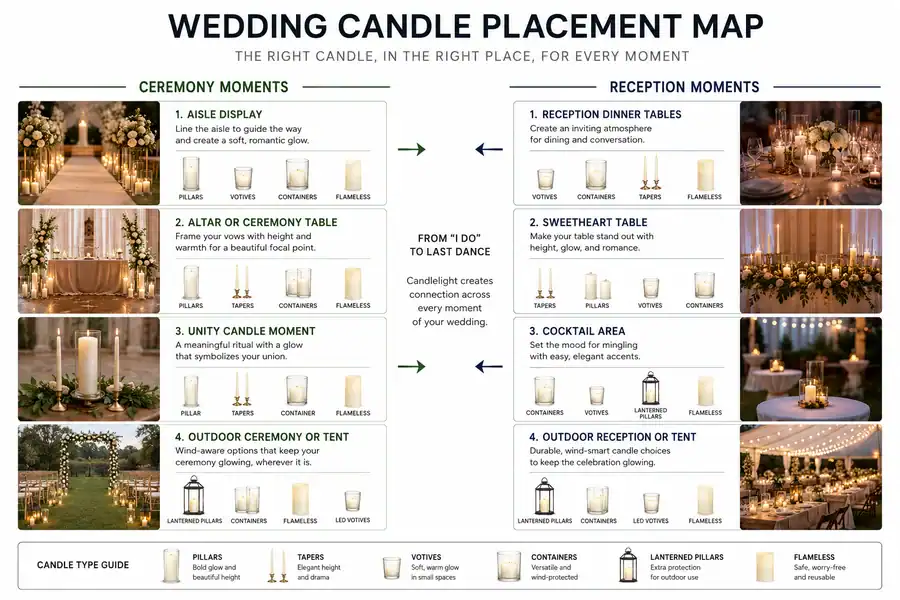
Methods Box: This table is a modeled wedding-use dataset based on wedding moment, guest proximity, display role, and risk of topic drift. It does not interpret venue rules or teach wedding rituals. Product size, open-flame permission, and placement limits should be checked with the venue or supplier before the event.
The main error is using one “wedding candle” choice for every moment. A ceremony aisle may need visibility from a distance, while a reception dinner table needs low disruption. A unity display may use candles symbolically, while guest tables need repeatable, low-mess lighting that does not crowd plates, glasses, menus, flowers, or service paths.
For deeper wedding styling, plan wedding candle centerpieces on the wedding centerpiece page. For symbolic lighting details, understand unity candle use on the unity candle page. For open flames near aisles, linens, guests, or tents, route the decision to Candle Safety for Events rather than treating this section as venue approval.
Choose Candle Types by Formal Table Style
Match the candle format to the table’s visual language before choosing color, scent, or quantity.
Tapers create classic height, votives create romantic repetition, container candles suit clean modern settings, and flameless candles give the most controlled uniform look. “Formal” here means a polished table presentation with clear proportion, repeated rhythm, stable placement, and enough space for guests to eat and talk comfortably.
A candle type should make the table look intentional without turning the meal into a decor display. The Candle Holders guide is the better place for holder aesthetics beyond fit, while Wedding Candle Centerpieces should carry full centerpiece-building ideas.
| Formal table style | Best candle type fit | Visual effect | Use carefully when | Avoid when |
|---|---|---|---|---|
| Classic formal dinner | Taper candles | Tall, traditional, structured | The table is wide enough for holders and place settings | Guests need clear sightlines across a narrow table |
| Romantic wedding reception | Votives, tea lights, low tapers | Soft repeated glow | The table has flowers, menus, glassware, and favors | The setup depends on too many tiny flames |
| Minimalist modern table | Container candles, slim tapers, flameless candles | Clean lines and low clutter | Containers match the table palette and vessel shape | Mixed jars or uneven holders make the table look casual |
| Banquet or long table | Tapers plus votives | Repeated rhythm down the table | Holder spacing is consistent | Tall candles fight with large floral pieces |
| Round guest table | Votives, tea lights, floating candles | Low glow without a hard front-facing side | The centerpiece stays low or transparent | Pillars or tall tapers block conversation |
| Sweetheart table | Tapers, pillars, votives, flameless candles | Stronger focal point for photos | The table has enough depth for layered heights | Candles crowd signage, florals, or fabric |
| Black-tie reception | Tapers, lanterned pillars, restrained votives | Formal, symmetrical, controlled | Flame placement is checked against linens and decor | The table uses mismatched casual jars |
| Outdoor formal dinner | Flameless candles, lanterned pillars, protected containers | More reliable glow under movement or breeze | A real flame is protected inside a vessel | Open tapers sit in wind or near loose fabric |
Tall candles are not always more formal. They look formal when they match the room scale, holder style, and guest sightlines. On a narrow dinner table, a lower votive line can look more refined than tall tapers that interrupt conversation.
Tea lights can look formal when they are repeated with discipline. Use identical cups, consistent spacing, and a limited holder style so they read as planned lighting rather than scattered accents.
If floral arrangements become the main design choice, move that decision to Wedding Candle Centerpieces. This section should only decide which candle format fits the table style.
Match Candle Type to Event Duration
Burn duration means event-window fit, not a guaranteed number of hours.
Choose the candle type and size for the meal, ceremony, cocktail hour, reception, or full evening segment it must cover. Larger pillars and protected container candles often suit longer displays, while tea lights and small votives may need replacement planning if the event runs longer than their practical burn window.
The Candle Burn Time guide should handle deeper burn-time planning. This section keeps the decision at event level so candle type does not get confused with wax chemistry, wick sizing, or lab testing.
| Event window | Better candle type fit | Replacement risk | Why it works | Watch point |
|---|---|---|---|---|
| Short formal dinner | Tapers, votives, tea lights | Low to medium | The candle only needs to cover a limited dining period | Tapers still need stable holders |
| Multi-course dinner | Tapers, votives, container candles | Medium | These formats can balance table style with service time | Small formats may fade before the final course |
| Ceremony moment | Pillars, tapers, container candles | Low | The candle is usually used for a focused display window | Do not oversize candles if the surface is small |
| Cocktail hour | Votives, container candles, flameless candles | Medium | Low or contained formats work around guest movement | Open flames can be bumped in standing areas |
| Wedding reception tables | Votives, larger tea lights, low tapers, flameless candles | Medium to high | Repeated formats give steady glow across many tables | Small candles may need a replacement plan |
| Full evening event | Pillars, protected containers, flameless candles | Low to medium | Larger or battery-powered formats reduce mid-event attention | Large pillars can create sightline and footprint problems |
| Outdoor evening segment | Lanterned pillars, protected containers, flameless candles | Medium | Protected formats handle movement better than open tapers | Wind can shorten or disrupt real-flame use |
| Accent-only display | Tea lights, floating candles, votives | Medium | Small candles work when the display is decorative, not the main lighting | Keep extras ready if the display must last all night |
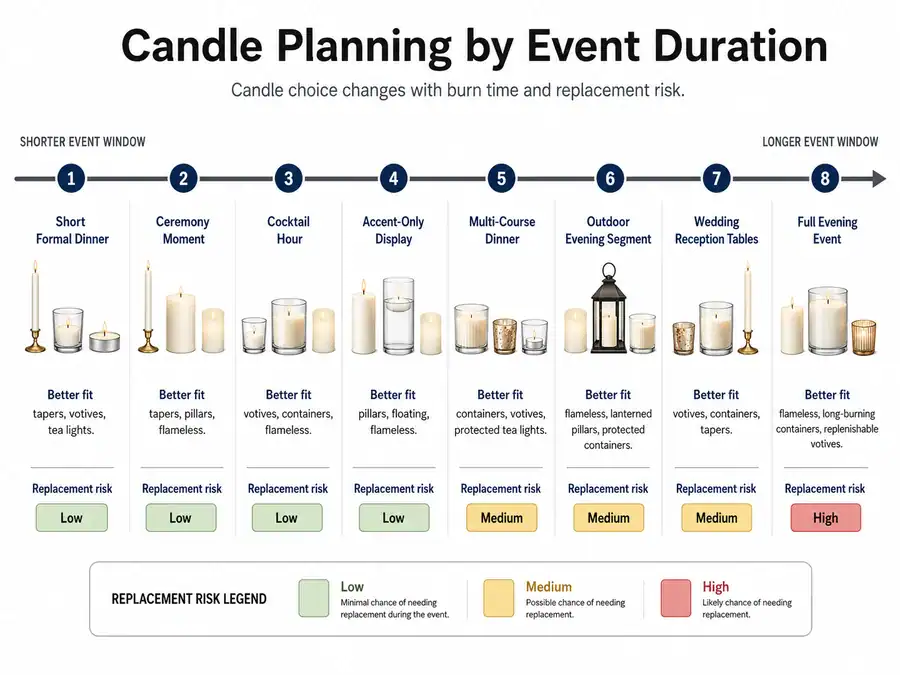
Methods Box: This table uses directional event-window planning, not brand-level burn testing. Exact burn time depends on candle size, wax, wick, container, airflow, and manufacturer specifications. Treat the table as a selection guide, then confirm product burn information before buying for a timed event.
Do not choose the longest-burning candle by default. A large pillar may last longer than a tea light, but it can still be the wrong choice for a narrow dinner table, low floral display, or intimate guest conversation setting.
Tea lights can work for a reception when they are used as short-window accents, replaced between event phases, or paired with longer-lasting formats. Small votives are often more forgiving than loose tea lights because the cup or holder helps the table look planned and contained.
For deeper type-level decisions, route long-display choices to Pillar Candles, small repeated-table choices to Tea Lights, and contained reception glow choices to Votive Candles.
Pick Stable Candles for Crowded or Formal Tables
Stable event candles are candle types and holders that reduce tipping, exposed flame, wax spill, and guest interference.
For crowded dinner tables, wedding receptions, and formal layouts, the lowest-risk choices are usually votives, container candles, lanterned pillars, protected tea lights, and flameless candles. Tapers can still work, but only when the holder grips the base securely and the flame sits away from linens, sleeves, flowers, menus, and service movement.
The deeper Candle Safety for Events page should handle venue permission, open-flame rules, and policy questions. This section only compares practical tabletop stability by candle type, holder fit, and guest proximity.
| Placement condition | Better candle type | Main risk reduced | Required support | Avoid when |
|---|---|---|---|---|
| Narrow dinner table | Votives, tea lights, slim flameless candles | Crowding place settings | Low cups, trays, or small holders | Tall tapers block conversation |
| Long banquet table | Tapers, votives, flameless tapers | Uneven rhythm or unstable spacing | Repeated fitted holders | Holders vary in height or grip |
| Round guest table | Votives, floating candles, low containers | Sightline interruption | Low centerpiece vessels | Pillars dominate the center |
| Fabric-heavy tablescape | Flameless candles, container candles, lanterned pillars | Flame near linen or ribbon | Enclosed or battery-powered format | Open flame sits near fabric |
| Cocktail area | Container candles, votives, flameless candles | Guest movement and bumping | Weighted holders or stable trays | Loose tea lights sit near drinks |
| Outdoor or tented table | Flameless candles, hurricane pillars, protected containers | Wind and flame movement | Lanterns, hurricane glass, or LED format | Open tapers sit in airflow |
| Ceremony aisle | Lanterned pillars, flameless candles | Guest contact and fabric proximity | Weighted lanterns or protected vessels | Loose candles sit at floor level |
| Sweetheart table | Tapers, votives, pillars, flameless candles | Visual clutter near photos and fabric | Matched holders with stable bases | Decor crowds flame or heat zones |
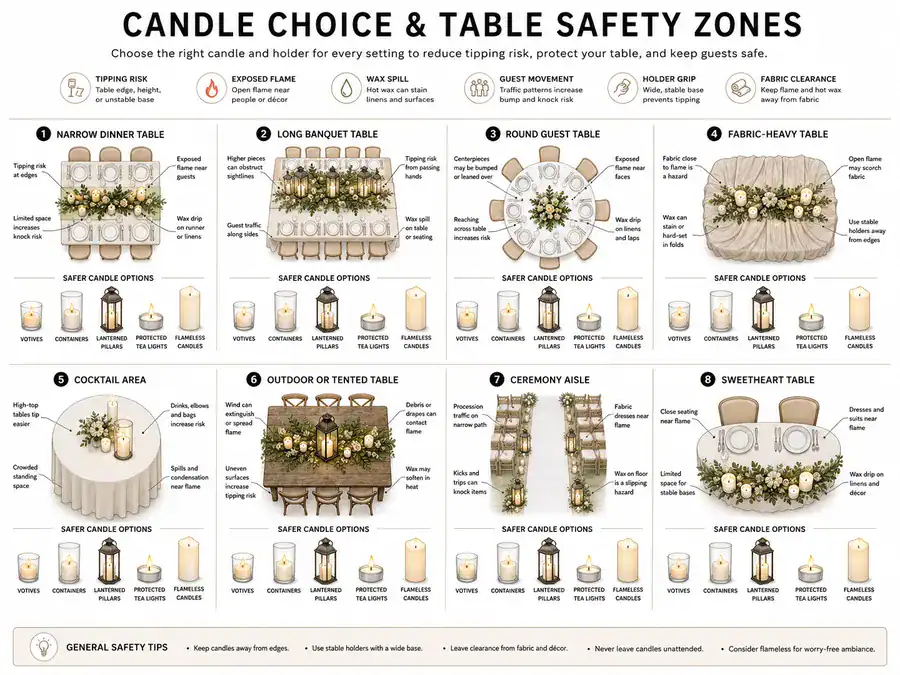
Methods Box: This stability table is a modeled placement-risk guide. It compares candle formats by tip risk, exposed flame, guest interference, holder dependency, and table density. It is not venue approval or legal guidance.
Tapers and pillars both need support that matches the table condition. A fitted taper holder can work on a formal table, while a loose holder, crowded surface, or oversized pillar can create more practical trouble than a row of low votives.
Flameless candles are the easiest safety fallback when the table has children, long fabric, wind, high guest movement, or venue limits. They are not always the most formal option, but they are often the best constraint-fit option.
Use Candle Holders for holder sizing and grip choices. Use Flameless Candles when the event constraint matters more than real flame.
Choose Low-Mess Candles for Dinner and Event Cleanup
Low-mess event candles reduce visible wax, soot perception, container residue, and post-event cleanup.
Container candles, votives in cups, protected tea lights, floating candles in stable vessels, and flameless candles usually create less table cleanup than open, unsupported candles. “Clean” does not mean zero-maintenance; it means the candle type and holder reduce wax contact with linens, rentals, dishes, and table surfaces.
The Candle Holders guide should handle protective trays, cups, and vessel choices. A deeper troubleshooting page should handle soot, wick defects, and wax-stain removal.
| Mess problem | Likely candle source | Lower-mess choice | Prevention note | Route deeper intent to |
|---|---|---|---|---|
| Wax on tablecloth | Unsupported tapers, overfilled holders, exposed pillars | Drip-resistant tapers, votives, containers, flameless candles | Use fitted holders, bobeches, trays, or containers | Dripless Taper Candles |
| Residue in cups | Votives and tea lights | Lined votive cups or disposable inserts | Plan cleanup containers before teardown | Votive Candles |
| Soot marks on glass | Candle too close to airflow or poor burn conditions | Flameless candles, containers, well-spaced votives | Keep flame away from drafts and decor | Candle Care/Troubleshooting |
| Wax in water display | Floating candles | Wider vessels with fewer candles | Leave enough water and surface room | Floating Candles |
| Mess near food | Scented or smoky candles near place settings | Unscented votives, clean containers, flameless candles | Keep candles away from plates and serving zones | Scented vs Unscented Candles |
| Post-event table scraping | Bare pillars or loose tea lights | Containers, cups, trays, flameless candles | Put every flame on a removable surface | Candle Holders |
| Rental decor damage | Open wax near linens, wood, or glass rentals | Flameless candles or fully contained formats | Ask the venue what surfaces need protection | Candle Safety for Events |
| Visual clutter after burnout | Too many small tea lights | Votives or fewer larger contained candles | Use fewer repeated formats with matched holders | Tea Lights |
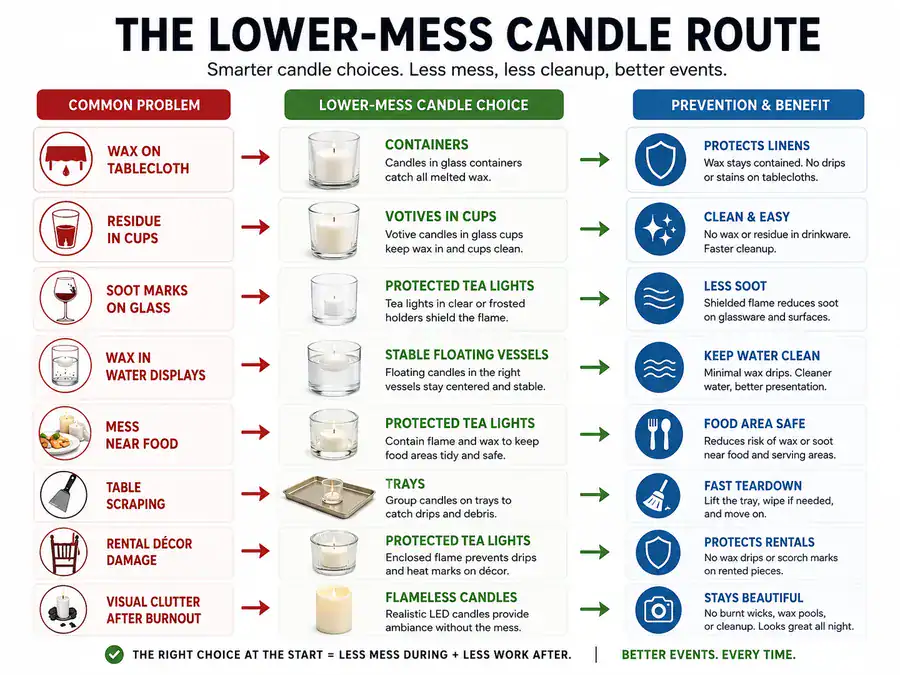
Methods Box: This cleanup table is based on common event-use failure patterns, not wax chemistry or stain-removal testing. Mess risk changes with holder fit, candle size, airflow, extinguishing method, surface material, and teardown timing.
The cleanest real-flame setup is usually a contained candle in a cup, jar, lantern, or tray. It keeps the wax boundary clear and gives the cleanup team a removable object instead of loose wax on the table.
Drip-resistant tapers can still drip if the holder is loose, the candle leans, or airflow changes the flame. Treat “dripless” as a lower-risk product claim, not a promise that wax can never reach the table.
Flameless candles remove wax cleanup and soot concerns, but they add battery, charging, remote, and storage tasks. They work best when cleanup and venue constraints outweigh the need for a real flame.
For formal meals, low mess also includes scent control. A strong scented candle can make the table feel less polished even when it leaves no wax behind.
Scented vs Unscented Candles for Formal Dining
Unscented or very lightly scented candles are usually the best fit for formal dining because fragrance can compete with food, wine, and guest comfort.
Unscented or very lightly scented candles are usually safer for formal dining because fragrance can compete with food and guest comfort. For Candle Types, “best” may mean unscented around food, not strongest fragrance, most distinctive scent, or a luxury scent profile.
Scent suitability means matching scented, lightly scented, or unscented candle types to dinner tables, ceremony spaces, and reception areas without distracting from the meal. A scented candle can feel right at an entry table, but the same candle can feel wrong beside wine, plated courses, cake, or close guest seating.
| Event area | Better scent choice | Candle types that fit | Why it works | Avoid when |
|---|---|---|---|---|
| Formal dinner table | Unscented | Tapers, votives, containers, flameless candles | Keeps food, wine, and table conversation central | The candle fragrance is noticeable before guests sit |
| Wedding reception meal | Unscented or very lightly scented | Votives, tea lights, low containers, flameless candles | Reduces the chance that scent competes with dinner service | Tables are tightly packed or food is served family-style |
| Dessert or cake table | Unscented or mild scent | Votives, containers, flameless candles | Supports the display without fighting sweet food aromas | The scent is stronger than the dessert itself |
| Ceremony aisle | Unscented or lightly scented | Pillars, lanterned candles, flameless candles | Can add atmosphere where food is not present | Guests sit close to the candles for a long ceremony |
| Entry table | Lightly scented or unscented | Containers, pillars, flameless candles | Gives a first impression without affecting the meal | The entry is small, enclosed, or crowded |
| Cocktail area | Lightly scented only when spaced out | Containers, votives, flameless candles | Can work when drinks and conversation are the focus | Hors d’oeuvres, close seating, or heavy guest flow are present |
| Outdoor lounge area | Unscented or lightly scented | Lanterned candles, containers, flameless candles | Keeps the glow without making scent unpredictable | Wind pushes scent toward dining tables |
| Memorial, toast, or quiet display | Unscented | Pillars, containers, flameless candles | Keeps the candle symbolic and simple | The fragrance changes the mood of the moment |
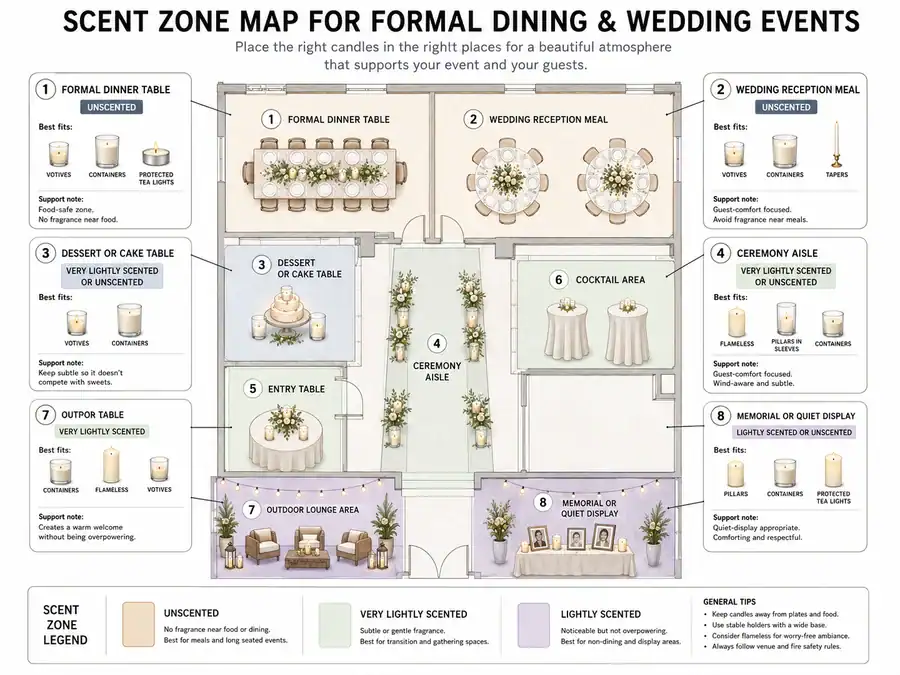
Methods Box: This scent table is a modeled event-decision benchmark. It compares candle scent level by meal presence, guest density, event moment, and risk of fragrance competing with food. It does not make fragrance-ingredient, allergen, aromatherapy, or material-safety claims.
Dinner table candles should usually be unscented. A formal meal already has aromas from food, drinks, flowers, linens, and guests, so the candle should add light before fragrance.
Wedding reception candles should also lean unscented or very light. Reception tables are often dense with place cards, glassware, flowers, favors, menus, and food service, so a strong candle scent can feel less polished even when the candle looks right.
Scented candles work better away from food. Entry tables, lounge corners, ceremony backdrops, and non-dining displays can handle a gentle scent when the space is open and guests are not seated close to the flame or vessel.
For deeper scent comparisons, use Scented vs Unscented Candles. Fragrance recipes, essential-oil blending, aromatherapy, and perfume-style choices belong outside this event candle selection page.
Once scent level is set, match each candle type to the holder or vessel that keeps the display stable and contained.
Match Candle Types to Holders, Vessels, and Centerpieces
A candle type is event-ready only when the holder or vessel makes it stable, contained, proportional, and surface-safe.
Tapers need fitted holders, pillars need heat-safe bases or protective glass, votives need cups, tea lights need cups or trays, floating candles need water vessels, and flameless candles may need decorative covers. The Candle Holders guide should handle detailed holder selection; this section keeps the focus on candle-type support for formal tables.
Holder and vessel compatibility means the candle can stand upright, contain wax, protect the surface, and look intentional in the event setting. A candle type is not a complete choice if it still needs a holder, bowl, lantern, hurricane, tray, or cup to work stably and neatly.
| Candle type | Required holder or vessel | Best event use | Avoid when | Setup check |
|---|---|---|---|---|
| Taper candles | Snug taper holders or candelabras | Classic dinners, long banquet tables, formal wedding tables | The holder socket is loose or the table is narrow | The taper should stand straight without wobble |
| Pillar candles | Heat-safe plate, tray, lantern, or hurricane glass | Altars, entry tables, mantels, large center displays | The surface is bare linen, wood, or crowded place settings | The base should catch wax and separate heat from the table |
| Votive candles | Votive cups or heat-safe holders | Reception tables, romantic clusters, repeated low glow | The votive sits directly on linen or a rental surface | The cup should contain melted wax |
| Tea lights | Tea light cups, small holders, trays, or lanterns | Small accents, bowls, scattered low-profile light | Loose tea lights are placed directly on fabric | The cup or tray should be stable and removable |
| Floating candles | Wide water bowl, glass cylinder, or stable vessel | Water displays, low centerpieces, entry accents | The bowl is shallow, narrow, or easy to bump | The candle should float with space around it |
| Container candles | Built-in glass, tin, ceramic, or jar vessel | Modern dinners, lounge tables, cleaner wax control | The container clashes with the formal table style | The vessel should look intentional, not like leftover home decor |
| Flameless candles | Optional holder, lantern, sleeve, or decorative vessel | Flame-limited venues, long events, outdoor tables | The plastic body looks too casual for the table | The holder should hide the battery look if needed |
| Lanterned candles | Lantern or hurricane-style enclosure | Outdoor dinners, aisles, fabric-heavy settings | The lantern is too large for the table footprint | The enclosure should not crowd plates or flowers |
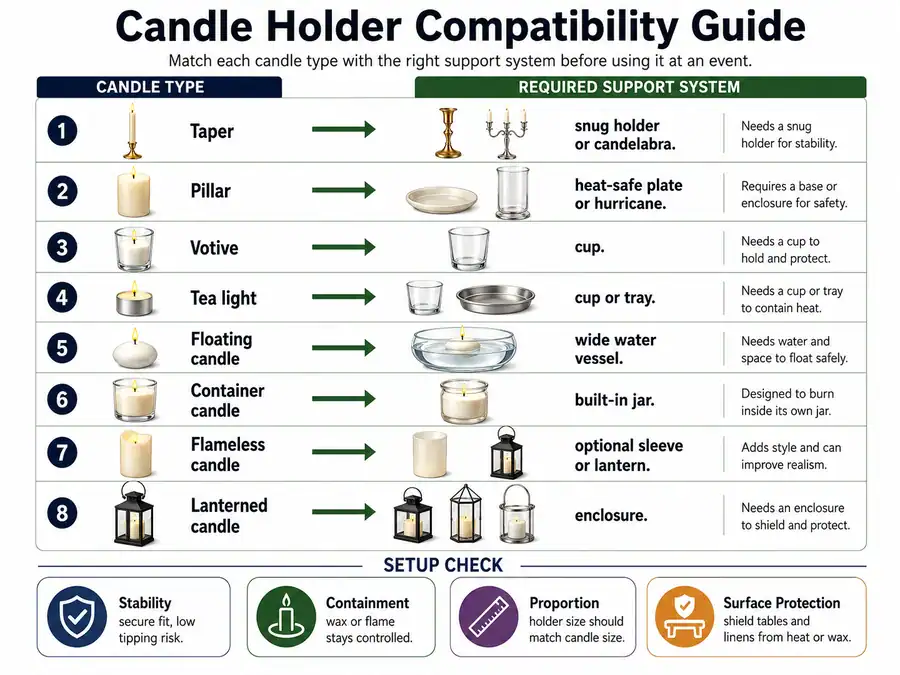
Methods Box: This compatibility matrix is a modeled support-system table. It compares candle types by holder dependency, wax containment, surface protection, formal proportion, and event placement. It does not replace product instructions, venue rules, or heat-safety guidance from a supplier.
Taper candles are the easiest format to misuse because the candle and holder must match. A beautiful taper in a loose holder is a poor event choice because it can lean, drip unevenly, and make the table look unfinished.
Votives and tea lights look simple, but they still need cups, trays, or holders. A votive is designed to pool wax inside a cup, and a tea light still needs a stable surface that can be lifted away during cleanup.
Floating candles are vessel-dependent. They need a bowl or cylinder with enough width, water, and base stability, or the display becomes easier to bump, splash, or crowd.
Container candles solve some holder problems because the vessel is built in, but the container must still match the table. A casual jar can weaken a formal setting even when it controls wax well.
For deeper display design, move centerpiece vessel choices to Wedding Candle Centerpieces. For holder sizing, grip, trays, hurricanes, and surface protection, use Candle Holders rather than turning this event-selection page into a holder catalog.
Next, size the candle type by table space, height, and guest sightlines so the supported candle still fits the room and seating layout.
Fit Candle Height and Space to Guest Sightlines
Fit means the candle type works with table space, candle height, holder height, guest sightlines, and service clearance.
Choose low-profile candles for conversation-heavy tables, repeated votives or tea lights for long tables, and taller formats only where holders and sightlines allow. The best candle type is the one that fits the physical table condition, not the tallest, most dramatic, or most visually dominant option.
Space and height problems usually happen after the candle type is chosen. A taper may look formal in a photo, but it can block conversation on a narrow table. A pillar may feel substantial, but it can crowd place settings. A row of tea lights may feel easy, but too many small flames can create clutter instead of a formal look.
| Table condition | Better candle type fit | Height or footprint note | Main risk avoided | Avoid when |
|---|---|---|---|---|
| Narrow dinner table | Votives, tea lights, slim containers, low flameless candles | Keep the glow low and compact | Crowded plates, glasses, and serving space | Wide pillars or bulky lanterns reduce place-setting room |
| Long banquet table | Tapers, votives, tea lights, flameless tapers | Repeat the same format in a steady rhythm | Uneven visual spacing | Mixed candle heights make the table look busy |
| Round wedding table | Votives, floating candles, low containers | Keep the centerpiece low or transparent | Blocked conversation across the table | Tall pillars or dense taper clusters sit in the center |
| Sweetheart table | Tapers, pillars, votives, flameless candles | Layer height only if the table has enough depth | Photo clutter and fabric crowding | Candles compete with flowers, signage, or draped fabric |
| Buffet or accent table | Pillars, containers, lanterned candles, flameless candles | Taller or wider formats can work away from seated guests | Weak visibility from a distance | Open flames sit near napkins, cards, or serving movement |
| Cocktail table | Small containers, votives, flameless candles | Use a small footprint because guests stand and move | Bumping, drink placement, and bag contact | Loose tea lights or tall tapers sit near guest movement |
| Outdoor formal table | Lanterned pillars, protected containers, flameless candles | Use protected formats instead of exposed height | Wind disruption and flame movement | Open tapers sit in airflow |
| Low lounge table | Containers, flameless candles, votives | Keep candles contained and easy to see from seated positions | Wax on surfaces and casual clutter | Tall holders look out of scale |
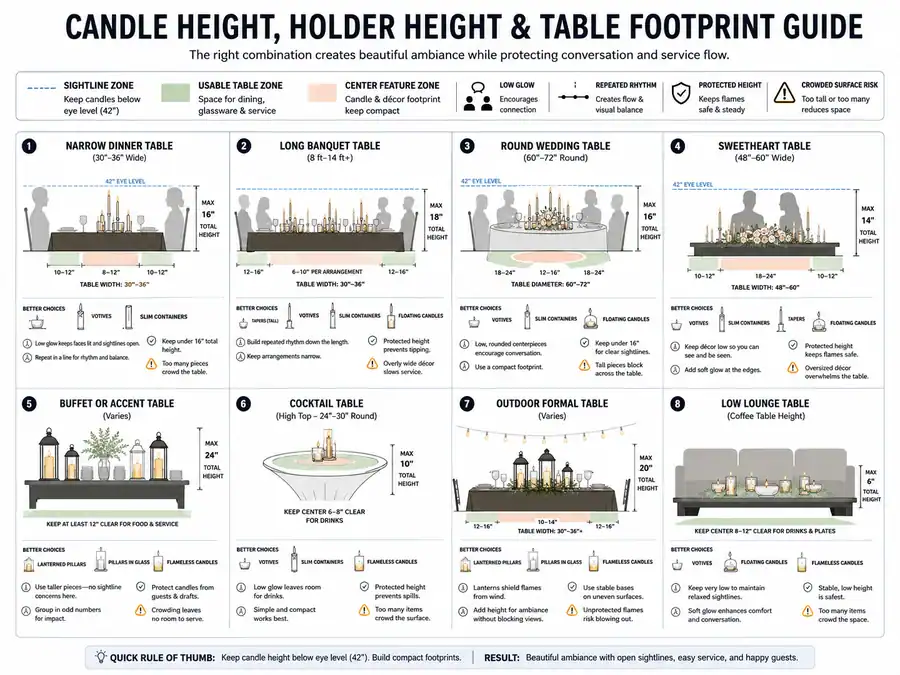
Methods Box: This table is a modeled height and footprint benchmark. It compares candle types by table width, candle height, holder height, conversation visibility, place-setting clearance, and service access. Exact fit depends on the actual holder, table dimensions, centerpiece size, and guest layout.
A dinner table candle should support conversation before it supports drama. For seated meals, low votives, tea lights, floating candles, and slim containers often work better than tall statement pieces.
Tall tapers can still be the right choice when the table is long, the holders are narrow, and the flame sits above or outside the main sightline. They become a problem when the table is narrow or the holders compete with flowers, menus, glassware, and serving dishes.
Pillars fit best on accent tables, altars, mantels, entry tables, and larger center displays. On crowded dining tables, they often create more footprint pressure than glow.
Use Wedding Candle Centerpieces for full centerpiece proportions. Use Candle Holders for holder-height questions. Seating charts, venue floor plans, table rentals, and catering service design are outside this candle-type decision.
Flame vs Flameless Candles for Formal Events
Real flame gives natural ambiance where it is allowed and safely managed; flameless candles fit constraint-heavy events.
For formal event candle types, real flame means wax candles with a live flame, while flameless candles mean LED or rechargeable candle formats that imitate candlelight without burning wax. “Safe” here means lower practical flame risk or better event-constraint fit, not legal approval, venue permission, or proof that flameless candles are always superior.
| Decision factor | Real flame candles | Flameless candles | Better fit when |
|---|---|---|---|
| Ambiance realism | Natural flame, heat, and movement | Simulated flicker, often more uniform | Use real flame when the candlelight itself is central to the mood |
| Formal appearance | Strong with tapers, pillars, votives, and floating candles | Strong when the finish, holder, and flicker quality look realistic | Use either if the holder and table style look intentional |
| Practical flame risk | Requires supervision, stable placement, and flame clearance | Removes open flame from the table setup | Use flameless near fabric, children, crowded tables, or movement |
| Venue constraints | Depends on venue permission and placement rules | Often easier when open flame is limited | Use flameless when permission is uncertain or restricted |
| Wind and airflow | Can flicker, tunnel, drip, or extinguish in poor conditions | More consistent in airflow | Use flameless outdoors, in tents, or near drafts |
| Burn duration | Depends on candle size, wax, wick, and product specs | Depends on battery life or charging plan | Use flameless for long unattended display windows |
| Mess and cleanup | Can create wax, soot perception, and holder residue | No melted wax or soot cleanup | Use flameless when teardown speed matters |
| Setup labor | Needs holders, lighters, replacement plan, and extinguishing | Needs batteries, charging, remotes, and staging | Use the format with the easier logistics for the event team |
| Reuse | Many real candles are single-use or partly used after the event | Many flameless sets can be reused | Use flameless when repeated events or rentals matter |
| Symbolic value | Stronger for rituals, ceremonies, and traditional candle moments | More practical than symbolic | Use real flame when the live flame has meaning |
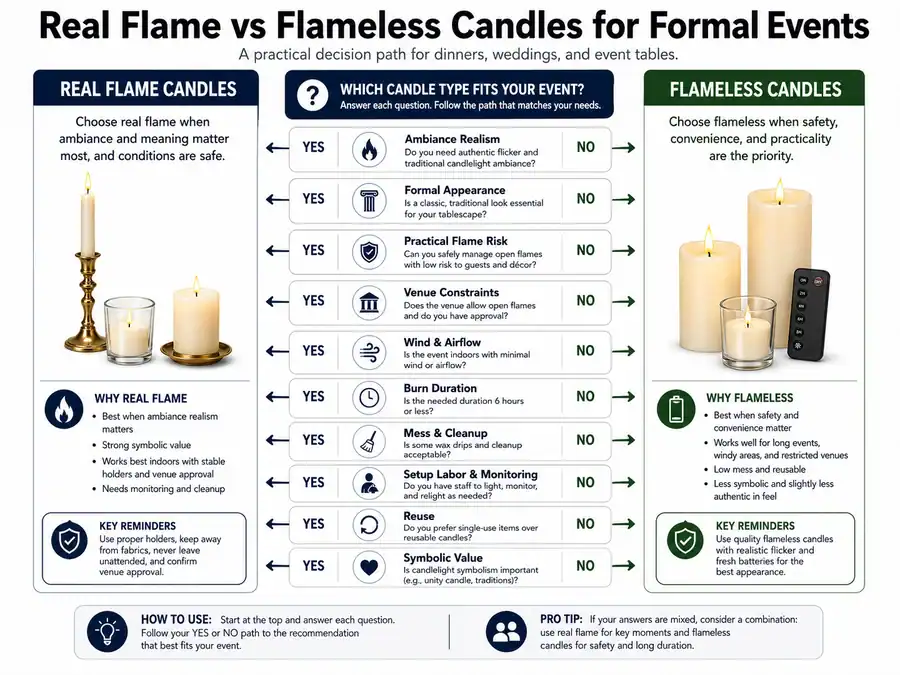
Methods Box: This table is a modeled flame-status benchmark. It compares candle formats by ambiance, practical safety, venue constraints, duration, mess, setup, teardown, and reuse. It does not interpret venue law, fire-code rules, insurance terms, or product battery performance.
Real flame is the better choice when the event wants authentic candlelight, the venue allows it, the placement is stable, and the candles can be monitored. Tapers, pillars, votives, tea lights, floating candles, and container candles all look more natural when the flame is part of the mood.
Flameless candles are the better choice when the event has fabric-heavy tables, children, wind, long display windows, difficult teardown, or open-flame uncertainty. A high-quality flameless taper or pillar can preserve the formal look while removing wax and ignition concerns from the table.
Do not treat flameless candles as automatically casual. Their success depends on finish, flicker realism, holder choice, battery planning, and whether the table hides the electronic look.
Use Flameless Candles for detailed product selection, battery format, and rechargeable options. Use Candle Safety for Events for open-flame permission, placement rules, and venue-specific safety questions.
Indoor vs Outdoor Candle Types for Formal Settings
Indoor and outdoor candle suitability means matching candle types to wind, daylight, ventilation, table stability, and flame protection.
Indoor settings can prioritize delicate formality and table proportion, while outdoor settings often need protected vessels, lanterns, hurricanes, heavier bases, or flameless alternatives. “Best” outdoors means best for the environmental condition while still preserving a formal event look, not pest control, weather planning, landscape lighting, or outdoor entertainment.
| Formal setting | Better candle type fit | Why it fits | Avoid when | Bridge deeper intent to |
|---|---|---|---|---|
| Indoor dining room | Tapers, votives, containers, low pillars | Allows more delicate height and controlled table rhythm | The table is narrow or crowded with place settings | Candle Holders |
| Ballroom reception | Tapers, votives, tea lights, flameless candles | Repeated formats scale across many tables | Mixed holders make the room look inconsistent | Wedding Candle Centerpieces |
| Covered patio | Lanterned pillars, containers, votives, flameless candles | Adds protection while keeping a formal glow | Airflow reaches open tapers or loose tea lights | Outdoor Candles |
| Tented wedding | Flameless candles, lanterned pillars, protected containers | Handles fabric proximity and airflow better than exposed flames | Open flames sit near tent fabric or draping | Candle Safety for Events |
| Open-air garden table | Flameless candles, hurricane pillars, protected votives | Reduces wind problems while keeping table light | Small tea lights disappear in daylight or wind | Lanterns |
| Windy table area | Flameless candles, lanterns, hurricane glass | Keeps the display visually consistent | Exposed tapers lean, drip, or go out | Outdoor Candles |
| Poolside or water display | Floating candles, flameless floating lights, protected containers | Water displays can look formal when the vessel is stable | Bowls are shallow, narrow, or easy to bump | Floating Candles |
| Outdoor cocktail area | Containers, flameless candles, lanterned votives | Works around guest movement and drinks | Loose candles sit near bags, sleeves, or traffic paths | Candle Safety for Events |
Methods Box: This indoor/outdoor table is a modeled environmental-fit dataset. It compares candle types by formality, wind exposure, daylight visibility, flame protection, vessel stability, duration, and guest movement. It is not weather planning, pest-control advice, or venue-rule interpretation.
Tapers usually work best indoors or in protected settings because height and exposed flame can become liabilities outdoors. If the formal look requires tapers outside, use sturdy holders and place them only where airflow, fabric, and guest movement do not create obvious problems.
Pillars can work indoors or outdoors, but outdoor use usually needs a tray, lantern, or hurricane. A bare pillar on an outdoor table may look substantial, yet it can still struggle with wind, heat, wax movement, or unstable surfaces.
Votives and tea lights fit indoor reception tables well because they repeat neatly. Outdoors, they need cups, lantern-style protection, or a placement plan so they do not disappear visually or become difficult to manage.
Floating candles need stable vessels in either setting. Outdoors, shallow bowls, narrow glassware, and bump-prone tables are the main problems, not the candle type alone.
If pest control becomes the reason for choosing a candle, move that decision away from this formal-event candle guide. Citronella, weather contingencies, tent logistics, and landscape lighting belong outside the candle-type selection page.
Plan Candle Quantity and Packs by Table Count
Quantity depends on candle type, table count, spacing, holder needs, replacement risk, and display style.
A formal event with many small candles needs different pack planning than one built around fewer statement pieces. The best value is not the cheapest unit price; it is the candle type that covers the event after holder count, setup time, duration, replacement, cleanup, and reuse needs are considered.
| Event setup | Candle type fit | Quantity logic | Holder or support need | Avoid when |
|---|---|---|---|---|
| One dinner table | Tapers, votives, containers | Use symmetry or a short repeated line | Fitted holders, cups, or a few trays | Bulk packs create mismatched leftovers |
| Two to four formal tables | Votives, tea lights, slim tapers | Repeat the same count per table | Identical cups, trays, or holders | Each table gets a different candle format |
| Long banquet table | Tapers plus votives, or repeated votives | Plan by spacing rhythm down the table | Consistent holder height and finish | Mixed formats make the table look cluttered |
| Round reception tables | Votives, tea lights, floating candles, flameless candles | Multiply candles per table by table count | Cups, bowls, trays, or LED charging plan | Large pillars crowd the centerpiece |
| Sweetheart table | Tapers, pillars, votives, flameless candles | Use fewer candles with stronger visual focus | Stable bases, trays, or decorative holders | Candles compete with flowers, signs, or fabric |
| Ceremony aisle | Lanterned pillars, flameless candles | Plan by aisle points, not table count | Lanterns, hurricanes, or weighted bases | Open flames sit near guests or fabric |
| Entry, bar, or guest-book table | Containers, pillars, flameless candles | Use a small number of statement candles | Heat-safe surfaces or built-in vessels | The area has loose paper, cards, or guest traffic |
| Reception plus cocktail hour | Votives, containers, flameless candles | Separate dining tables from lounge areas | Extra holders or batteries for each zone | One pack plan is used for every event zone |
| Outdoor table setup | Flameless candles, lanterned pillars, protected votives | Plan fewer exposed flames and more protected units | Lanterns, hurricane glass, batteries, or chargers | Bulk real-flame candles sit in wind or unstable areas |
| Large wedding reception | Votives, tea lights, flameless candles | Choose repeatable formats that divide across table count | Cups, trays, storage bins, and teardown plan | Quantity is bought before holder needs are known |
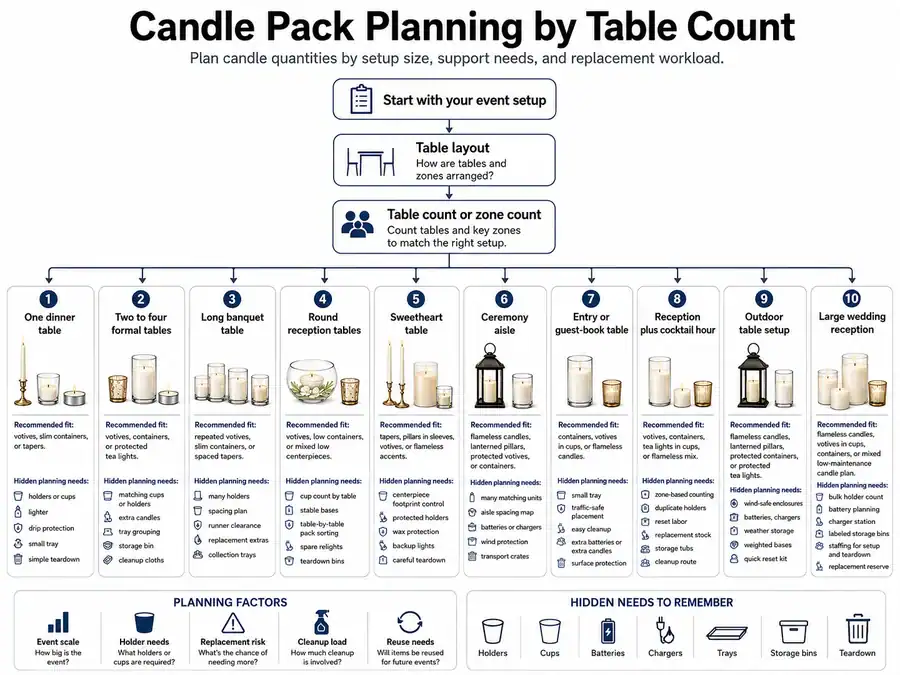
Methods Box: This table is a modeled pack-planning dataset, not live pricing or vendor guidance. It compares candle types by event scale, table count, repeated-light pattern, holder dependency, replacement risk, cleanup load, and reuse potential.
Start with the table layout, then choose the candle count. A narrow table may need fewer, smaller candles than a wide banquet table, even when both events have the same guest count.
Votives and tea lights scale well because they repeat easily, but they can create hidden costs in cups, trays, replacements, and teardown. Tapers scale well when the holder style is consistent. Pillars scale better as focal pieces than high-count guest-table candles.
Flameless candles can reduce wax cleanup, but they shift planning into batteries, charging, remotes, storage, and post-event collection. They are often practical when the event has many tables, long timelines, or flame restrictions.
Use an Event Candle Calculator only when the event needs deeper quantity planning. Full event budgeting, wholesale sourcing, vendor negotiation, live price tracking, and procurement belong outside this candle-type guide.
Event Candle Type Selector
Start with the candle type that matches the event condition, then reject the type that creates the most setup risk.
This selector maps event type, table format, formality, constraints, and cleanup tolerance to a starting candle type. It is a static decision guide, not a calculator, product ranking, or live buying tool.
| Event condition | Start with | Avoid first | Reason |
|---|---|---|---|
| Classic formal dinner on a wide table | Taper candles | Wide pillars | Tapers give formal height without taking over the table when holders fit well |
| Narrow dinner table | Votives or slim containers | Tall taper clusters | Low formats preserve plates, glasses, serving space, and conversation |
| Long banquet table | Tapers plus votives | Random mixed candle styles | Repeated formats create rhythm across the table |
| Round wedding guest table | Votives, tea lights, or floating candles | Tall central pillars | Low or contained formats protect guest sightlines |
| Romantic reception with many tables | Votives | Large statement candles on every table | Votives repeat cleanly and scale better for table count |
| Minimalist modern dinner | Container candles or slim tapers | Ornate mixed holders | Clean forms support a controlled table style |
| Fabric-heavy wedding table | Flameless candles or contained candles | Open exposed flames | Lower flame exposure reduces practical placement risk |
| Outdoor formal dinner | Lanterned pillars, protected containers, or flameless candles | Open tapers | Protected formats handle wind and movement better |
| Ceremony aisle | Lanterned pillars or flameless candles | Loose floor-level candles | Protected formats reduce contact with guests, fabric, and movement |
| Unity or symbolic ceremony display | Tapers plus a central pillar or container candle | Tea lights as the main ritual candle | Larger focal candles better support a staged symbolic moment |
| Cocktail or lounge area | Containers, votives, or flameless candles | Loose tea lights | Guests move drinks, sleeves, bags, and decor around these surfaces |
| Venue with open-flame uncertainty | Flameless candles | Real flame formats | Flameless options preserve ambiance while avoiding permission uncertainty |
| Low-cleanup event | Containers, votives in cups, or flameless candles | Unsupported tapers or bare pillars | Contained formats reduce wax contact with linens and rentals |
| Food-focused dinner | Unscented tapers, votives, containers, or flameless candles | Strong scented candles | Unscented formats protect food aroma and guest comfort |
Scoring logic: Choose the type that solves the strongest event constraint first. If the constraint is formality, start with tapers. If the constraint is scale, start with votives or tea lights. If the constraint is cleanup, start with containers or flameless candles. If the constraint is flame permission, wind, fabric, or children, start with flameless candles or protected vessels.
A candle type can be ideal in one setting and poor in another. Tapers may be best for a formal banquet table, but not for a windy patio. Pillars may suit an altar or entry table, but not a crowded guest table. Tea lights may suit accent lighting, but not a long event without replacement planning.
For a deeper format decision, move from this selector into the relevant page: Taper Candles, Pillar Candles, Votive Candles, Tea Lights, Floating Candles, Flameless Candles, Candle Holders, or Candle Safety for Events. The parent Candle Types guide should carry the broader form-factor definitions.
FAQs About Candles for Dinner Tables, Weddings, and Formal Events
These answers summarize the main candle-type decisions and route deeper safety, centerpiece, scent, and quantity questions to their own pages.
What type of candle is best for a formal dinner table?
Taper candles are best for a classic wide table, while votives, tea lights, and slim containers are better for narrow or conversation-heavy tables.
The right choice depends on table width, holder stability, scent level, and how much room guests need for plates, glasses, menus, flowers, and serving dishes. A formal candle should add light and rhythm without making the table harder to use.
Are scented candles good for dinner tables?
Scented candles are usually not the best choice for dinner tables because fragrance can compete with food and wine.
Unscented or very lightly scented candles fit formal dining better. If scent matters, keep it away from plated meals and use it in entry, lounge, or non-dining display areas.
Are flameless candles acceptable for weddings?
Flameless candles are acceptable for weddings when flame limits, children, wind, fabric, long timelines, or cleanup make real flame harder to manage.
They work best when the finish, holder, and flicker quality match the formality of the event. Use real flame when the live flame has symbolic or visual importance and the venue allows it.
Are taper candles better than pillar candles for formal tables?
Taper candles are usually better for formal dining tables that need height and tradition, while pillar candles are better for larger displays.
Tapers need fitted holders and clear sightlines. Pillars need more surface space and usually fit altars, entry tables, mantels, buffets, and larger centerpieces better than crowded guest tables.
What candles create the least mess for weddings?
Flameless candles create the least wax mess, while container candles, votives in cups, protected tea lights, and floating candles in stable vessels reduce cleanup for real-flame setups.
Low mess still depends on holder fit, surface protection, airflow, extinguishing method, and teardown timing. “Dripless” or “contained” should be treated as lower-risk, not as a promise that no cleanup is needed.
Final Recommendation
The best candle type is the one that solves the event’s main constraint first.
Choose tapers for classic formal height, votives for repeated wedding-table glow, tea lights for small accents, pillars for larger display areas, floating candles for contained water-based centerpieces, container candles for cleaner modern tables, and flameless candles for flame-restricted, outdoor, fabric-heavy, or long-duration events.
For most formal dining tables, start with unscented tapers, votives, or slim containers. For wedding reception tables, start with votives, tea lights, low tapers, or flameless candles. For ceremony displays, start with pillars, lanterned candles, or flameless candles. For outdoor settings, start with protected vessels, lanterns, hurricanes, or flameless formats.
The safest decision path is simple: match the candle type to the event moment, confirm the holder or vessel, check the table footprint, choose unscented around food, plan the burn window, and avoid any format that adds mess, crowding, or flame uncertainty.