
A votive candle is a small candle that burns inside a heat-safe holder because its wax can liquefy as it burns.
Traditional votives are made for contained burning, not freestanding use, so the holder is part of how the candle works.
In this guide, “votive” mainly means the candle format; in religious settings, it can also mean a prayer or offering candle.
This guide explains what makes a candle a votive, why the holder matters, how long votives usually burn, and where they fit best.
Best uses means use-case fit, not a ranking of votive candle brands, scents, or products.
What Is a Votive Candle?
A votive candle is a small candle designed to burn inside a properly sized, heat-safe holder because its wax can liquefy as it burns.
Shape alone does not make a candle a votive. The defining traits are the small format, separate holder use, and melt behavior during burning.
The word “votive” can describe both a candle format and a devotional use. In this guide, the main meaning is the candle format: a small holder-based candle used for contained light, decor, remembrance, or ambiance.
| Definition component | What it means | Why it matters |
|---|---|---|
| Small candle format | Votives are compact candles, usually shorter than pillars. | Their size makes them useful for grouped light, table decor, and small spaces. |
| Separate holder | Traditional votives are placed in a heat-safe cup or vessel before lighting. | The holder supports the candle as wax softens and melts. |
| Wax liquefaction | Votive wax may melt outward into a pool while burning. | This is why a fitted holder is part of normal use. |
| Contained flame | The flame burns within a small holder-based setup. | This helps keep the wax and flame area more controlled than a loose candle. |
| Adjacent candle types | Votives are often confused with tealights and mini pillars. | Tealights usually have built-in cups; votives usually need separate holders. |
| Use context | Votives work for decor, events, gifts, remembrance, and devotional settings. | Their value comes from contained, repeatable, small-flame use. |
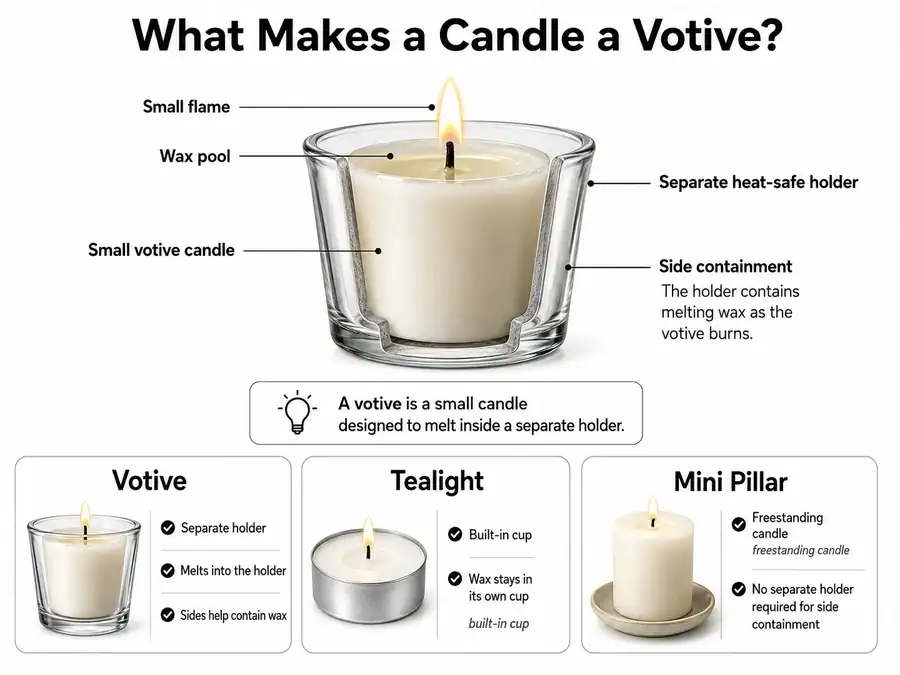
A regular decorative candle may be freestanding, poured into a jar, or shaped for display. A traditional votive is better understood as a holder-burn candle, not just a short cylinder.
For step-by-step pouring, wax, and wick instructions, use the separate how-to guide for making votive candles. The next point is the main reason this distinction matters: votive candles need holders.
Why Do Votive Candles Need Holders?
Votive candles need holders because their wax can melt outward and needs a fitted, heat-safe container for support and containment.
A traditional votive is not designed to behave like a freestanding pillar. As the wax softens, the candle can lose its shape, spread melted wax, or burn unevenly without side support.
Use this holder checklist before lighting a votive candle.
| Holder requirement | What to check | Why it matters |
|---|---|---|
| Heat-safe material | Use a holder made for candle heat, such as suitable glass, ceramic, or metal. | Thin, damaged, or unsuitable containers may crack or overheat. |
| Proper fit | The votive should sit inside the holder without excessive empty space around it. | A closer fit helps contain wax as the candle melts. |
| Stable base | Place the holder on a flat, steady, heat-resistant surface. | A small holder can tip if the surface is uneven or crowded. |
| Side containment | The holder should surround the candle, not just sit underneath it. | A plate does not contain melted wax from the sides. |
| Clear flame area | Keep the flame away from fabric, paper, greenery, and other nearby items. | Votives are small, but they still create an open flame. |
| No visible damage | Do not use cracked, chipped, or weakened holders. | Heat can worsen existing damage during burning. |
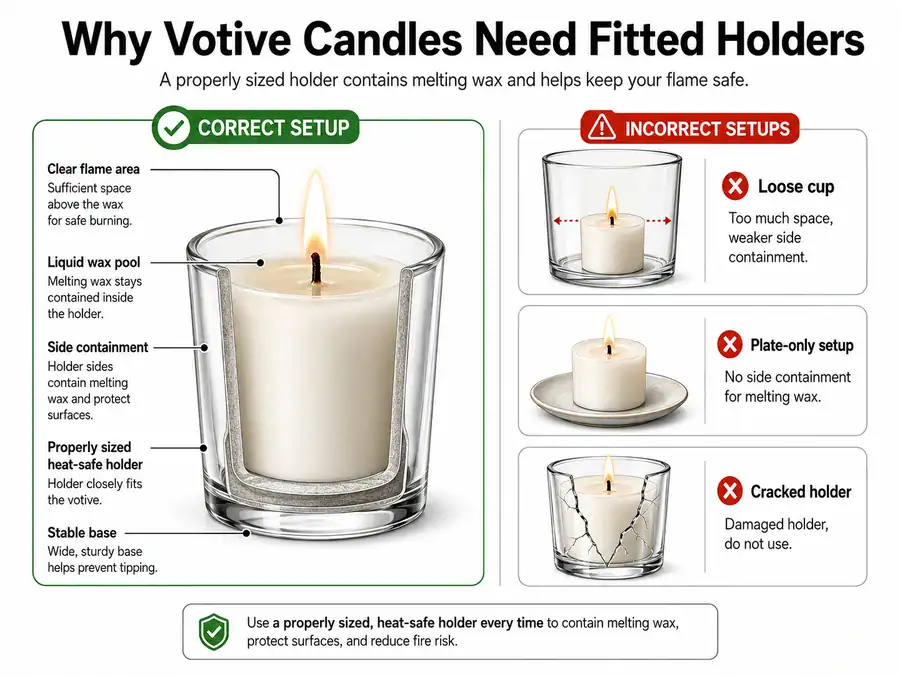
As the flame warms the wax near the wick, the top of the votive softens into liquid wax that can spread toward the holder wall. A full wax pool is normal when the holder contains it, the flame stays steady, and the vessel remains stable.
Heat-safe glass, ceramic, metal, and purpose-made votive cups can work when they are stable, undamaged, and correctly sized. A random glass cup is not automatically a votive holder.
For holder sizes, materials, and product-style comparisons, use the dedicated votive holder guide. For broader setup and fire-safety guidance, use the candle safety guide.
How Long Do Votive Candles Burn?
Most standard votive candles burn about 8–15 hours, while smaller samplers may burn about 4–8 hours.
Actual runtime changes with candle size, wax type, wick choice, holder fit, draft, and whether the candle is burned in one long session or several shorter sessions. A votive that fits its holder well usually burns more predictably than one sitting loose in an oversized cup.
| Votive type or use case | Expected burn range | What can shorten runtime | Planning caveat |
|---|---|---|---|
| Small votive or sampler | About 4–8 hours | Small wax mass, hotter wick, drafty placement | Better for short dinners, bathrooms, or trial scents. |
| Standard votive | About 8–15 hours | Loose holder fit, repeated short burns, high flame | Better for multi-hour decor or repeated home use. |
| Larger votive-style candle | About 15+ hours | Wick mismatch, soft wax, warmer room | Check the maker’s label before planning an event around it. |
| Scented votive | Varies by size and formula | Fragrance load, wax blend, wick behavior | Choose for small-space scent, not guaranteed long runtime. |
| Event votive | Plan by event length, not label alone | Early lighting, drafts, venue heat, poor holders | Have extra votives or replacement holders for long events. |
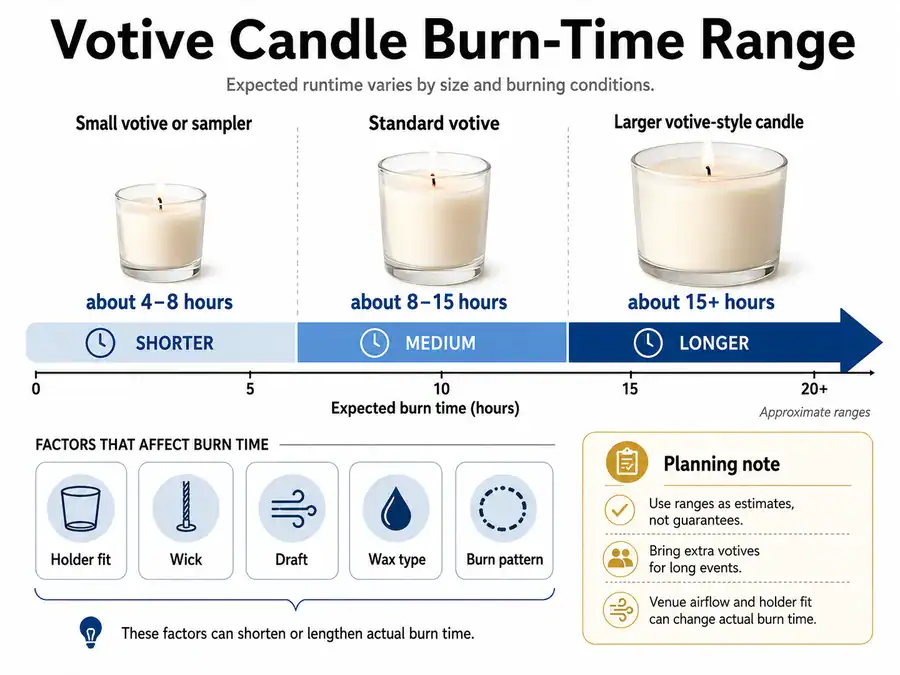
Burn time matters because votives are often used where timing affects the whole setup. A wedding table, remembrance display, dinner party, or gift sampler needs a candle that lasts long enough without implying that every votive will burn for the same number of hours.
The holder can affect burn conditions because it changes heat retention, wax containment, and airflow around the flame. That does not mean the holder alone controls runtime, but a poor fit can make the candle burn less evenly or leave more unused wax.
For a broader comparison across candle types, use the candle burn-time guide.
What Are Votive Candles Best Used For?
Votive candles are best used where a contained small flame, heat-safe holder, and compact multi-hour burn fit the setting.
“Best” means functional fit here. It does not mean the best votive brands, scents, retailers, or product rankings.
| Use case | Why votives fit | Holder requirement | Choose another candle when |
|---|---|---|---|
| Dinner tables | They add low, contained light without taking much space. | Use fitted holders that keep wax contained. | You need strong room lighting rather than mood lighting. |
| Weddings and events | They can be repeated across tables for a unified look. | Plan one holder per votive and check venue candle rules. | You need full event layout or venue-specific planning. |
| Devotional or remembrance use | They work as small symbolic lights for intention or memory. | Use stable holders and unscented options when scent may distract. | You need doctrine, ritual instruction, or prayer-candle comparisons. |
| Small rooms | They provide close-range ambiance in bathrooms, bedrooms, or reading areas. | Keep holders on clear, stable, heat-safe surfaces. | The room is crowded, unattended, or poorly ventilated. |
| Gift sets and samplers | Their size works well for trying scents, colors, or seasonal themes. | Include or recommend compatible holders if the votives are traditional. | The recipient does not already have safe votive holders. |
| Decorative groupings | Several votives can create a stronger visual effect than one small candle. | Space holders so heat and flame clearance stay controlled. | You need tall centerpiece height or a sculptural candle shape. |
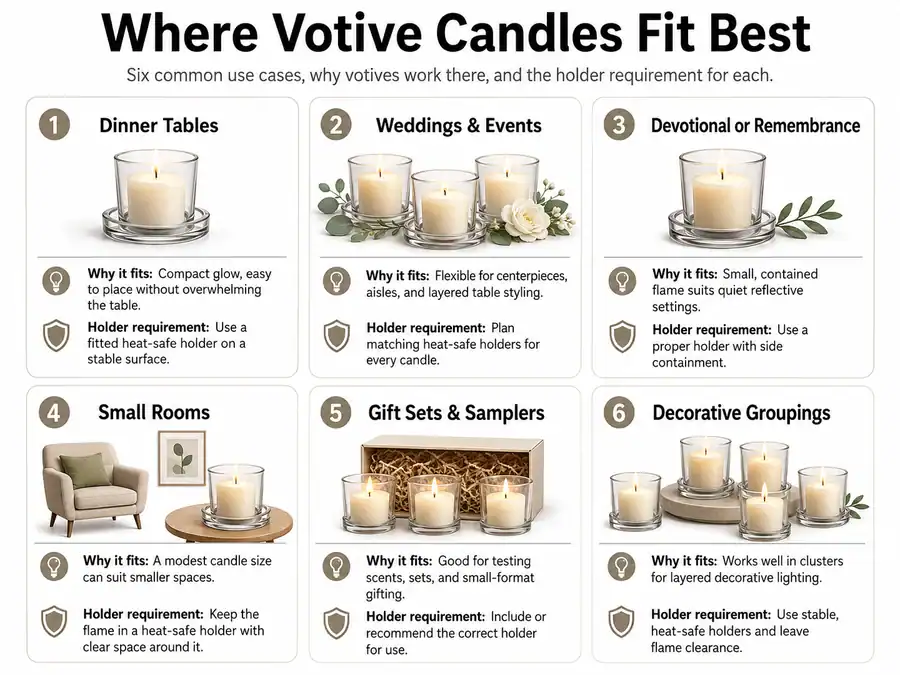
Votives fit best when the goal is small-scale atmosphere, repeatable placement, or contained symbolic light. They are weaker when the goal is strong illumination, dramatic height, no-cleanup convenience, or a candle that stands on its own without a vessel.
For full event layouts, quantities, venue rules, and table-design planning, use the event candle planning guide. For devotional candle meanings or prayer candle comparisons, use the dedicated devotional or prayer candle guide.
Votive Candles vs Tealights
A votive candle is different from a tealight because a tealight usually has its own small cup, while a votive usually needs a separate fitted holder.
Both are small candles, but they are not interchangeable in setup. The key difference is containment: a tealight is commonly sold in a thin metal or plastic cup, while a votive is made to sit inside a heat-safe votive holder.
| Feature | Votive candle | Tealight candle | Boundary note |
|---|---|---|---|
| Container | Usually needs a separate holder. | Usually comes in its own cup. | This is the clearest setup difference. |
| Wax behavior | Can liquefy into the holder. | Melts inside its built-in cup. | Both need safe placement, but the containment design differs. |
| Typical size | Taller and larger than most tealights. | Shorter and flatter. | Sizes vary by maker, so check actual dimensions. |
| Burn time | Often longer than a tealight. | Often shorter than a votive. | Runtime still depends on wax, wick, and conditions. |
| Decor use | Good for repeated holder-based table light. | Good for low-profile accents and warmers. | Choose based on holder setup and desired look. |
| Cleanup | Holder may need wax removal. | Cup may be discarded or recycled where accepted. | Cleanup is one reason users choose one over the other. |
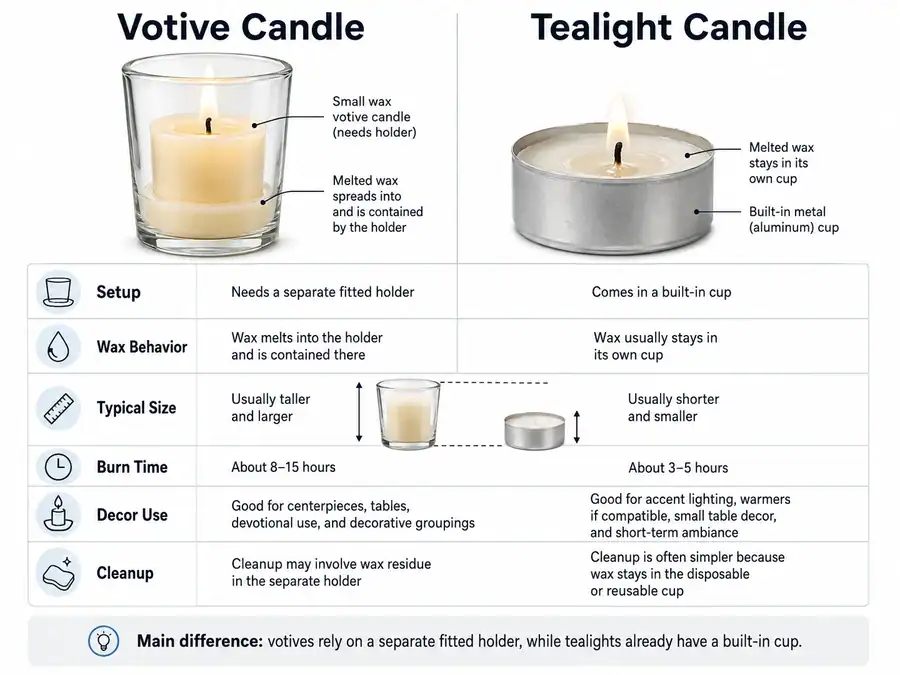
Choose votives when you want a stronger small-candle presence, a reusable holder look, or a longer decorative burn. Choose tealights when you want a lower-profile candle that already has a cup and can fit small lanterns, warmers, or compact decor pieces.
This is only a short comparison for definition clarity. For a full side-by-side decision guide, use the tealight vs votive candles comparison.
Can You Burn Votive Candles Without Holders?
Traditional votive candles should not be burned without holders because they can liquefy and lose shape during use.
A plate, saucer, or decorative sleeve is not the same as a fitted, heat-safe votive holder. “Without holder” means the candle has no side containment for melted wax and no suitable vessel supporting the candle as it burns.
| Situation | Is it acceptable? | Why | Safer alternative |
|---|---|---|---|
| Traditional votive on a plate | No | A plate does not contain wax from the sides. | Put the votive in a fitted, heat-safe holder. |
| Traditional votive directly on a table | No | Wax can melt outward and the candle can lose structure. | Use a stable holder on a heat-resistant surface. |
| Votive inside a loose decorative cup | Not enough by itself | The cup may not be heat-safe or properly sized. | Use a holder made for candle use. |
| Votive in a cracked holder | No | Existing damage can worsen when the holder heats. | Replace the holder before burning. |
| Product labeled as freestanding | Only if explicitly designed that way | Some small candles are made to stand alone, but they are not traditional holder-dependent votives. | Follow the maker’s label and setup directions. |
| Unsure candle type | Treat it as holder-required | Small pillars, tealights, and votives can look similar. | Check the label or use a safe holder before lighting. |
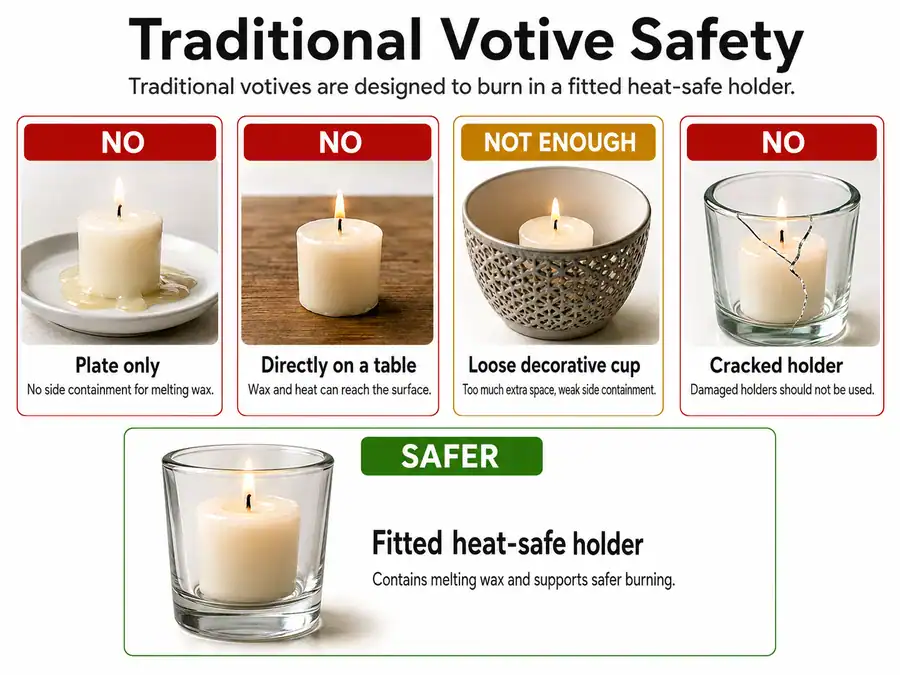
The narrow exception is a product that is clearly made and labeled for freestanding burning. Do not assume a candle is safe to burn loose because it looks firm before lighting.
For broader safe-placement rules, use the candle safety guide. For size, material, and fit decisions, use the votive holder guide.
Votive Candles vs Mini Pillars
A votive may look like a small pillar, but traditional votives are designed for holder-based burning.
Votives and mini pillars can look similar, but they are not automatically the same candle type. A votive is defined by holder-based burn behavior, while a mini pillar is usually made to stand on its own.
| Feature | Votive candle | Mini pillar | Why it matters |
|---|---|---|---|
| Burn design | Made for a fitted holder. | Usually made for freestanding use. | The holder requirement changes setup and safety. |
| Shape | Often short and cylindrical. | Also short and cylindrical. | Shape alone can mislead buyers. |
| Wax behavior | Can liquefy into the holder. | Should keep enough structure to stand during use. | Melt behavior affects placement. |
| Surface setup | Needs side containment. | Usually sits on a heat-safe plate or surface. | A plate is not enough for a traditional votive. |
| Label confusion | May be marketed loosely as a small candle. | May be sold near votives or samplers. | Check holder instructions before lighting. |
| Best choice | Better for contained holder-based glow. | Better when a small freestanding candle is wanted. | The right choice depends on burn design, not appearance. |
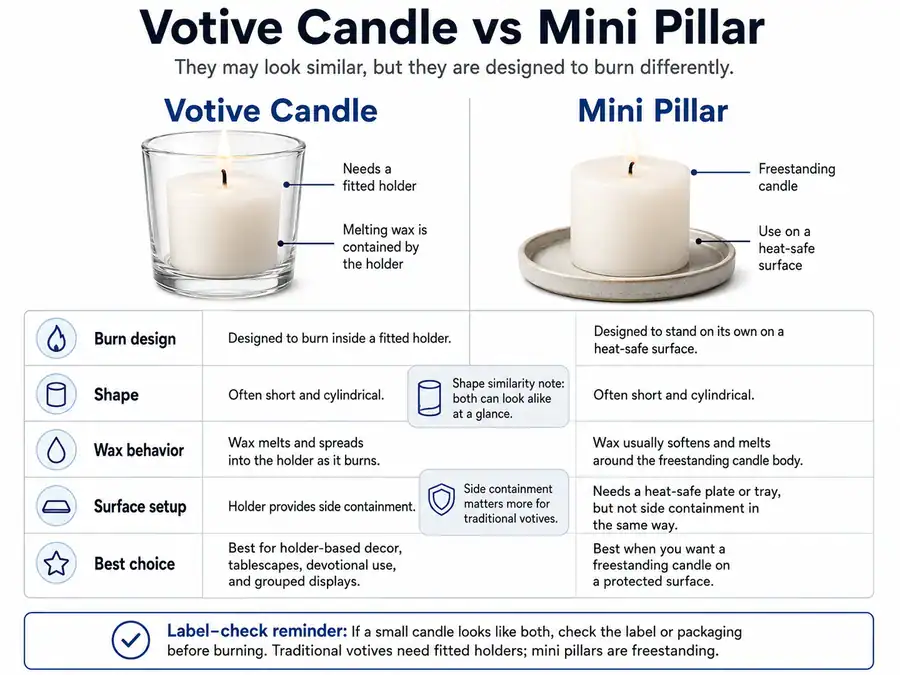
“Pillar-like” means visual resemblance, not proof that the candle can burn without a holder. A small cylindrical candle may still need a vessel if the wax is meant to melt outward during use.
Check the product label, maker instructions, and holder guidance before lighting any small candle that looks like a votive. For a full comparison of freestanding candles, use the pillar vs votive vs taper comparison.
Religious and Devotional Meaning of Votive Candles
A votive candle can refer to a small candle used as a symbolic offering, prayer light, remembrance light, or contained decorative candle depending on the setting.
This is why “votive” is not only a size label. In devotional use, the candle often carries meaning through intention, remembrance, prayer, gratitude, or reflection.
| Use setting | Meaning or function | Holder note | Boundary note |
|---|---|---|---|
| Church or chapel | A small light may mark prayer, offering, or intention. | Use the provided holder or approved candle area. | This guide does not explain religious doctrine. |
| Home remembrance | A votive may mark memory, grief, or reflection. | Use a stable, heat-safe holder away from photos, paper, and fabric. | This is a practical candle-use note, not ritual instruction. |
| Memorial table | Repeated votives can create a quiet visual focus. | Choose holders that stay stable during the full display. | Event rules may restrict open flames. |
| Meditation space | A votive can provide a small point of light. | Keep the candle attended and away from mats, cloth, or loose items. | Do not treat the flame as risk-free because it is small. |
| Gift or sympathy set | Votives can be included as symbolic small candles. | Include holder guidance if the candle is traditional. | Avoid assuming the recipient has a safe holder. |
The devotional meaning of a votive candle should stay separate from product ranking or religious instruction. This article explains how the candle is used and why the term carries symbolic meaning, not what someone should believe or practice.
For a deeper explanation of devotional candles, prayer candles, or memorial candle customs, use the dedicated devotional candle guide or prayer candle comparison.
Scented vs Unscented Votives
Unscented votives fit dining, ceremony, and fragrance-sensitive settings; scented votives fit small rooms where light fragrance is wanted.
Both types still need the same holder-based setup. The choice is about setting fit, not which scent, brand, or product is best.
Scent throw means how much fragrance a candle gives off while cold or burning. In votives, scent strength depends on wax, fragrance, wick behavior, room size, airflow, and how many candles are used together.
| Setting | Better choice | Why it fits | Avoid when |
|---|---|---|---|
| Dinner table | Unscented votive | Light supports the table without competing with food. | Guests are seated close to many scented candles. |
| Wedding table | Usually unscented votive | Repeated candles create visual warmth without adding mixed fragrance. | The venue, couple, or guests prefer a fragrance-free table. |
| Ceremony or remembrance display | Unscented votive | The candle can act as a quiet visual symbol. | Fragrance would distract from the setting. |
| Bathroom or powder room | Scented votive | A small room can carry light fragrance from a small candle. | Ventilation is poor or the scent feels too strong. |
| Bedroom or reading corner | Scented or unscented votive | Scented works for mild ambiance; unscented works for light only. | The candle cannot be attended. |
| Gift set or sampler | Scented votive | Small votives let people try a fragrance without a large candle. | The recipient may not have a safe holder. |
| Shared event space | Unscented votive | Unscented choices reduce fragrance conflicts across many people. | A specific scent is part of the planned experience. |
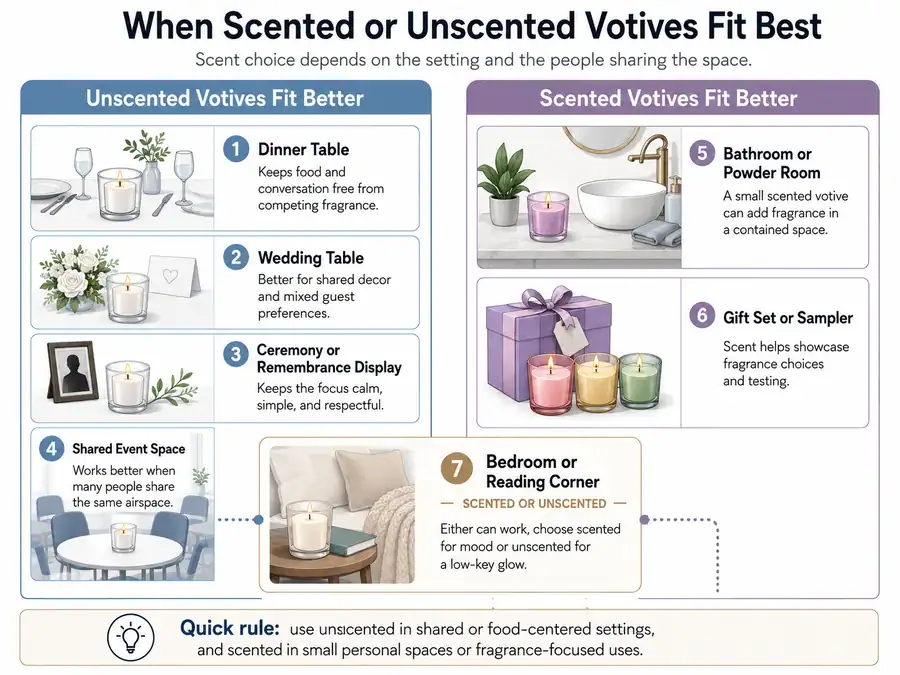
Choose scented votives when the goal is mild fragrance in a small area. Choose unscented votives when the goal is light, symbolism, table decor, or a setting where fragrance could bother people.
This section is not a scent ranking. For broader candle fragrance decisions, use the scented vs unscented candles guide.
Basic Safety Rules for Votive Candles
A votive candle should be burned in a heat-safe holder on a stable, clear surface because its wax and holder can become hot during use.
Safe use means practical setup conditions, not a guarantee that every holder or placement is risk-free. A votive still has an open flame, hot wax, and a hot container during use.
| Common setup error | Likely cause | Safer correction |
|---|---|---|
| Burning a votive without a holder | The candle is mistaken for a mini pillar. | Place traditional votives in a fitted, heat-safe holder before lighting. |
| Using a thin decorative cup | The cup looks suitable but may not be made for candle heat. | Use a holder sold or specified for candle use. |
| Placing the holder near fabric | The flame seems small enough to ignore. | Keep votives away from curtains, napkins, table runners, and clothing. |
| Crowding many votives together | Decor layout focuses on appearance only. | Leave space between holders so heat and flame clearance stay controlled. |
| Moving the holder while hot | The candle looks small and easy to pick up. | Let the wax and holder cool before moving or cleaning. |
| Leaving votives unattended | The candle is treated as background decor. | Extinguish candles before leaving the room or going to sleep. |
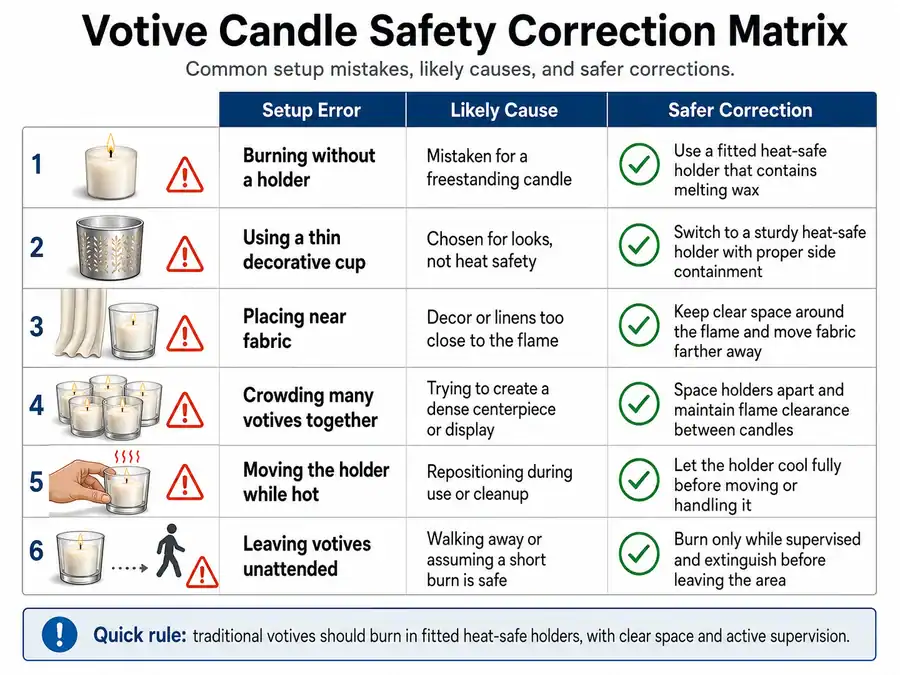
Place votive holders on flat, heat-resistant surfaces where they cannot be knocked over. Keep them away from drafts, pets, children, paper decorations, greenery, and any loose material that can shift toward the flame.
For event tables, test the setup before the actual event. Check that the holders sit flat, the candles fit properly, and the flame is not close to flowers, place cards, favors, linens, or overhead decorations.
For wider candle safety rules, use the candle safety guide. For holder materials, sizes, and heat-safe buying checks, use the votive holder guide.
When Votive Candles Are Not the Best Choice
Votives are not the best choice when you need freestanding candles, long single-burn duration, large-room scent throw, or no separate holder.
A votive works best as a small holder-based candle. When the setting needs height, very long runtime, strong fragrance, or low cleanup, another candle type may fit better.
| Need | Better option to consider | Why votives may not fit | Where to go next |
|---|---|---|---|
| A candle that stands on its own | Mini pillar or pillar candle | Traditional votives need side containment. | Use the pillar candle guide. |
| A very low-profile accent | Tealight | Tealights usually come with their own cup. | Use the tealight vs votive comparison. |
| Strong fragrance in a large room | Larger container candle | One votive may give only mild, close-range scent. | Use the candle fragrance guide. |
| Long single-burn display | Larger pillar or container candle | Votives have limited wax mass and may need replacement. | Use the candle burn-time guide. |
| No wax cleanup | Tealight or contained jar candle | Reusable votive holders may collect wax residue. | Use the candle cleanup guide. |
| Tall centerpiece height | Pillar or taper candle | Votives are short and work more as grouped low light. | Use the candle type comparison guide. |
| No separate holder | Tealight, jar candle, or labeled freestanding candle | Traditional votives are holder-dependent. | Use the votive holder guide before buying. |
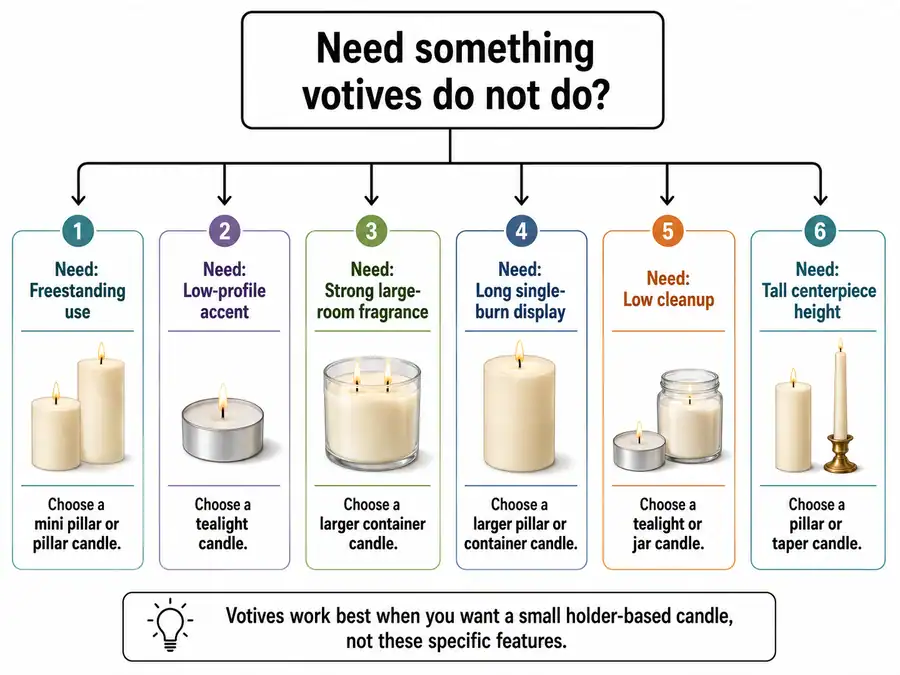
This does not make votives a poor candle type. It means their strongest uses come from contained wax, repeated placement, small-flame ambiance, and holder-based presentation.
Choose a different candle when the main requirement conflicts with that format. For broad candle selection, use the candle types guide instead of turning this votive definition into a full candle-type hub.
Quick Votive Candle FAQ
These quick answers cover only votive definition, holder use, burn time, setup, and nearby candle-type comparisons.
Do votive candles need holders?
Yes, traditional votive candles need properly sized, heat-safe holders because the wax can liquefy and spread during burning.
Can a votive candle stand alone?
A traditional votive should not stand alone while burning. Use a mini pillar or another candle labeled for freestanding use when you do not want a separate holder.
Are votive candles the same as tealights?
No, votives and tealights are different. A tealight usually has its own small cup, while a votive usually needs a separate fitted holder.
How long does a votive candle burn?
A standard votive candle usually burns about 8–15 hours, while small samplers may burn about 4–8 hours. Size, wax, wick, holder fit, drafts, and burn pattern can all change runtime.
What are votive candles used for?
Votive candles are used for small-space ambiance, table decor, events, remembrance, devotional settings, gift sets, and grouped decorative light.
Are scented votives better than unscented votives?
Scented votives are better when mild fragrance fits the setting. Unscented votives are better for dining tables, ceremonies, remembrance displays, and scent-sensitive groups.
Why is wax left in my votive holder?
Wax residue can remain after a votive burns because the candle melts into the holder and the wick may stop before every bit of wax is used.
Can I use any glass cup as a votive holder?
No. A votive holder should be heat-safe, stable, undamaged, and sized for candle use. Do not assume a random glass cup can handle candle heat.
Are votive candles good for weddings?
Yes, votive candles can work well for weddings when the venue allows open flames and each candle has a suitable holder. Use unscented votives near food or shared seating.
Are votives good for large-room fragrance?
Usually not as the main fragrance source. A single votive is small, so it fits close-range or small-room scent better than large-room scent.