
A candle colorant is suitable for a wicked candle only when the exact product is intended for candle wax, used within supplier guidance, and accepted through finished-candle testing.
A candle colorant is any dye, pigment, or other coloring material considered for use in candle wax, including liquid dye, chips, blocks, mica, and natural colorants. A wicked candle uses a wick to draw melted wax toward a flame, so particle behavior, wax compatibility, and wick interaction affect suitability.
Here, “safe” means suitable for that stated candle application under documented conditions; it does not mean edible, cosmetic-safe, universally non-toxic, risk-free, safe at any amount, emissions-safe, or compliant everywhere. Product identity and testing therefore matter more than origin labels or physical format.
What Makes a Candle Dye or Colorant Safe to Use?
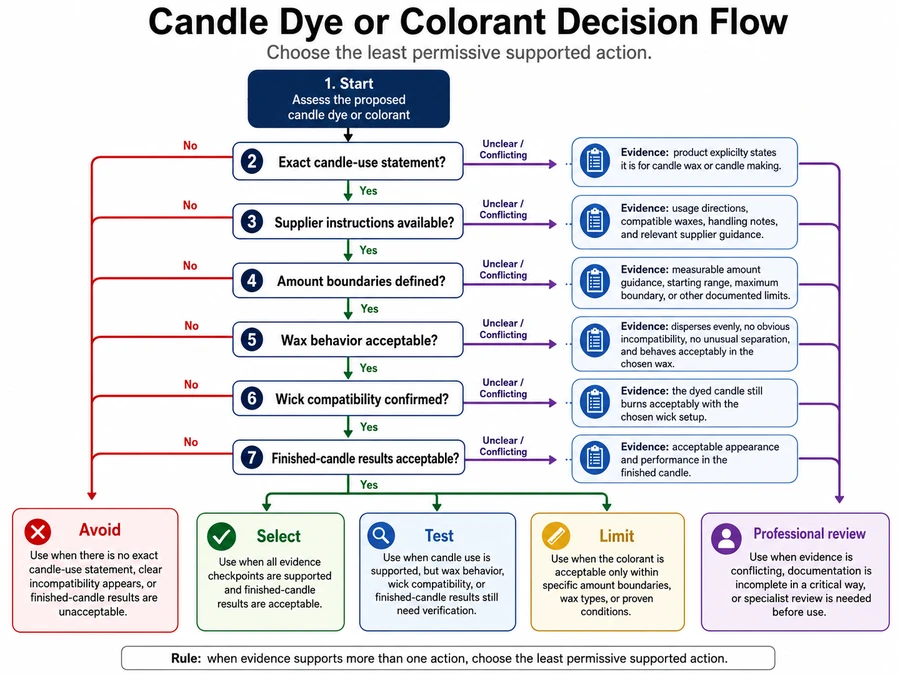
A candle dye or colorant is suitable only when its intended use, amount, wax behavior, wick compatibility, and finished-candle results support use.
This definition treats safety as a conditional candle-use decision rather than a permanent property of the colorant. A documented product can still become unsuitable when it is overloaded, placed in an unsupported application, combined with an incompatible candle system, or accepted without representative testing.
| Decision | Evidence that supports it | Practical action |
|---|---|---|
| Select | The exact product is intended for candles, and the supplier provides instructions for the planned wax application. | Treat the colorant as a candidate for testing. |
| Test | The intended use is clear, but the wax, wick, fragrance, vessel, and colorant combination has not been checked. | Test the finished candle against a valid control. |
| Limit | The product is intended for candles, but its amount is uncertain or near the supplier’s upper boundary. | Reduce the amount and repeat the test. |
| Avoid | The application is unclear, documents conflict, or testing shows unacceptable flame, wick, residue, or soot behavior. | Do not use the colorant in the tested candle system. |
| Professional review | The question concerns toxicology, workplace exposure, seller claims, certification, or regional legal duties. | Obtain qualified technical or regulatory guidance. |
ASTM F2417-24 prescribes minimum fire-safety requirements for candles, while U.S. Consumer Product Safety Commission guidance points candle businesses to ASTM candle and accessory standards. These standards assess finished-product fire behavior; they do not declare a colorant category universally safe. (U.S. Consumer Product Safety Commission)
Method: This benchmark separates product identity, intended application, formulation conditions, and finished-candle behavior. It assigns the least permissive action supported by all four evidence areas and does not treat a marketing label or successful ignition as proof.
What Do “Natural,” “Non-Toxic,” “Candle-Safe,” and “Cosmetic-Safe” Mean?
Natural, non-toxic, candle-safe, and cosmetic-safe describe different claim domains; none alone proves acceptable behavior in a wicked candle.
| Claim | What the claim may establish | What it does not establish |
|---|---|---|
| Natural | The material may come from a plant, mineral, or naturally derived source. | Wick compatibility, low flammability, clean burning, or environmental superiority. |
| Non-toxic | A seller is making a safety claim that requires suitable evidence and qualification. | Acceptable combustion, emissions, or candle performance in every application. |
| Candle-safe | The supplier indicates suitability for a named candle application under stated conditions. | Suitability in every wax, wick, vessel, fragrance, or concentration. |
| Cosmetic-safe | The material may be suitable for an identified cosmetic application. | Suitability near a candle flame or inside a wick-fed fuel system. |
| Food-safe | The material may meet requirements for a stated food application. | Wax solubility, wick behavior, or combustion suitability. |
| Approved | A named body, supplier, or process has accepted the material for a stated purpose. | Universal acceptance unless the claim identifies who approved it and for what use. |
The U.S. Federal Trade Commission says marketers making non-toxic claims need competent and reliable scientific evidence supporting the claim for people and the environment. That evidence domain still does not replace application-specific evidence from a finished candle. (Federal Trade Commission)
How to Verify That a Colorant Is Intended for Candles
Verify candle use by matching the exact product to an explicit candle-use statement, current instructions, technical documents, lot identity, and finished-candle evidence.
- Match the exact product. Record the manufacturer, product name, format, shade, product code, and supplier rather than relying on a generic listing title.
- Find an explicit candle-use statement. The label or manufacturer should name candles, candle wax, wax melts, or another exact application.
- Read the supplier instructions. Check the named wax types, incorporation directions, stated amount range, storage notes, and application limits.
- Review the technical data sheet. A technical data sheet (TDS) describes product properties, intended applications, and manufacturer directions.
- Review the safety data sheet. A safety data sheet (SDS) covers hazard, handling, storage, and emergency information. It does not prove finished-candle performance.
- Record the lot or batch identity. Retain enough information to identify the material when a supplier, formulation, or production batch changes.
- Test the finished candle. Compare the colored candle with an otherwise matching control and observe ignition, flame behavior, wick condition, residue, soot, and end-of-use behavior.
A marketplace title, seller reputation, SDS, or successful first lighting cannot replace exact intended-use evidence and representative finished-candle testing.
A colorant should move from selection to testing only after its identity, application, instructions, and supporting evidence agree.
Candle Dye vs Pigment vs Improvised Colorant: Why the Difference Matters
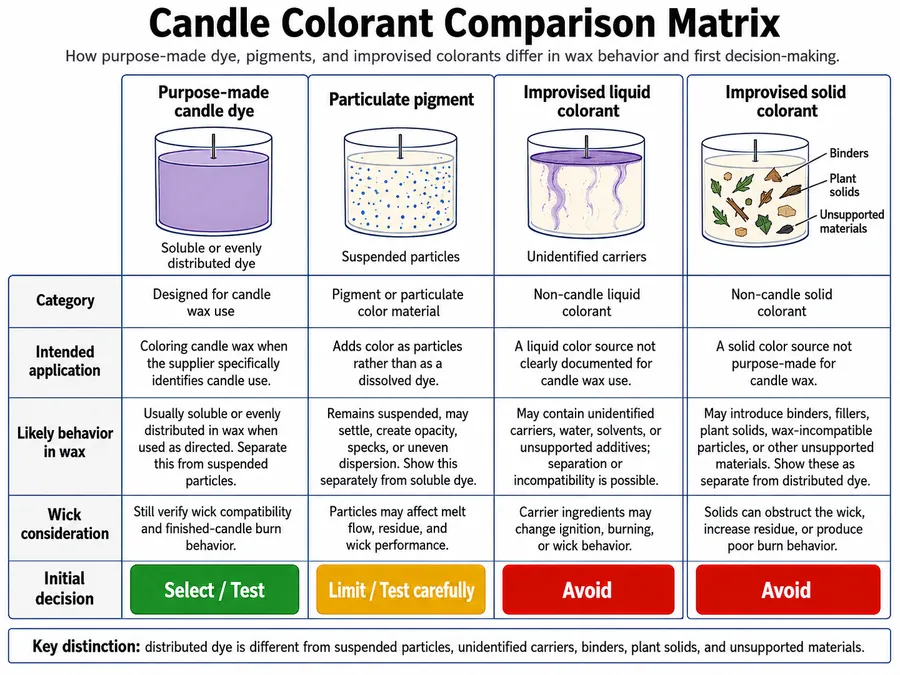
Purpose-made candle dye, particulate pigment, and improvised colorant differ in intended use, particle state, wax behavior, wick interaction, and evidence.
A purpose-made candle dye is manufactured for coloring wax. A pigment remains as solid particles, while an improvised material lacks reliable product-specific evidence for use in a wicked candle.
| Colorant category | Intended application | Likely behavior in wax | Wick consideration | Initial decision |
|---|---|---|---|---|
| Purpose-made candle dye | The exact product names candles or candle wax as an application. | It is formulated to dissolve or disperse according to supplier instructions. | Excessive or incorrect use may still change burn performance. | Select for testing. |
| Particulate pigment | The product may be intended for wax melts, decorative surfaces, cosmetics, soap, or resin. | Solid particles may remain suspended, move through melted wax, or settle. | Particles may interfere with a wick-fed fuel supply. | Test only with explicit application support. |
| Improvised liquid colorant | The product is made for food, soap, crafts, or another non-candle application. | Water, solvents, or unidentified carriers may separate or behave poorly in wax. | Unknown compatibility can produce unreliable wick or burn behavior. | Avoid without candle-use evidence. |
| Improvised solid colorant | The material may be a crayon, unidentified colored wax, spice, herb, or cosmetic product. | Binders, particles, oils, or plant solids may remain in the wax. | Material near the wick may change fuel movement, residue, flame behavior, or soot. | Avoid unless the exact product is supported and tested. |
Supplier guidance illustrates the physical distinction. CandleScience states that mica particles remain suspended in solid wax and settle after the wax melts, while dyes formulated for wax are a better option when uniform melted-wax color is required. (support.candlescience.com)
A crayon is therefore not equivalent to a dye block, and cosmetic mica is not automatically equivalent to candle dye. A shared liquid or solid form does not prove shared chemistry, particle behavior, or candle suitability.
Classify the material before judging safety because intended use and particle behavior determine what the finished candle still needs to prove.
How Safety Checks Differ for Liquid Dye, Chips, Blocks, Mica, and Natural Colorants
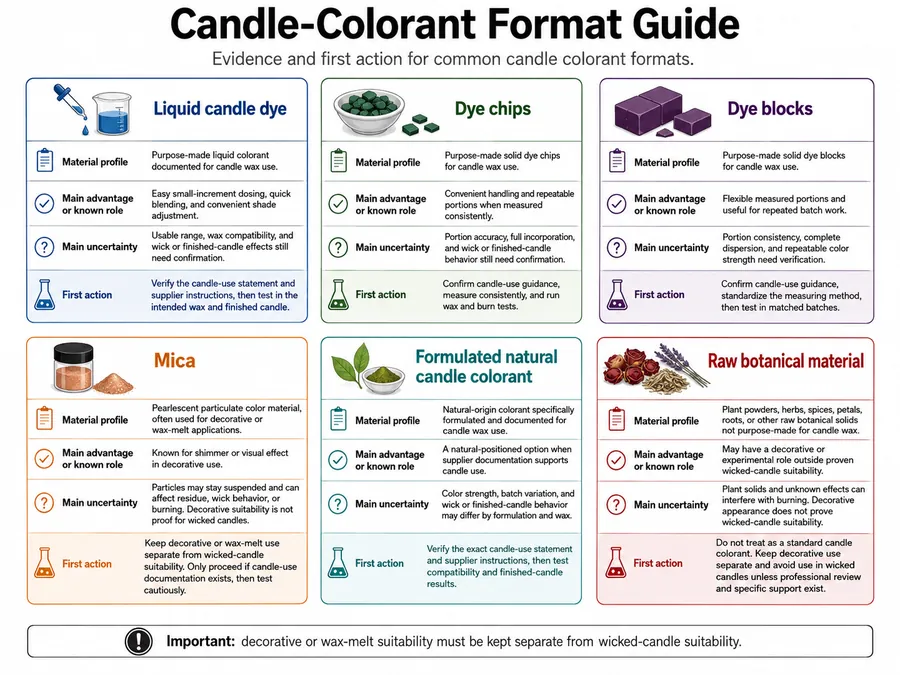
No colorant format is universally safest; choose the documented product that performs acceptably in the exact finished candle.
Judge each format by intended use, supplier evidence, material behavior, amount relative to product instructions, wick interaction, and finished-candle testing. The format identifies what must be checked; it does not provide a final verdict.
| Colorant format | Material and application profile | Main advantage | Main uncertainty | First action |
|---|---|---|---|---|
| Liquid candle dye | A concentrated liquid product formulated for candle wax. | Often easy to measure and incorporate in small adjustments. | Different shades, waxes, and amounts may behave differently. | Follow exact instructions and test. |
| Dye chips | Small portions of purpose-made solid candle dye. | May support repeatable small batches when weight or product instructions are recorded. | One chip is not a universal unit across products or batch sizes. | Measure consistently and test. |
| Dye blocks | Larger portions of concentrated solid candle dye. | May suit repeat production when portions are weighed and recorded. | Informal fractions can vary between batches. | Weigh the portion and test. |
| Mica | A particulate pigment that adds color or shimmer. | May suit named wickless or decorative applications. | Wax-melt suitability does not prove wicked-candle suitability. | Confirm the exact application. |
| Formulated natural candle colorant | A naturally derived product manufactured for candle wax. | Candle-specific formulation offers stronger evidence than origin language. | Natural origin does not prove universal compatibility. | Verify and test like any other colorant. |
| Raw botanical material | A spice, herb, flower, powder, or untreated plant material. | Its source identity may be known. | Food or botanical use does not establish candle suitability. | Do not treat it as candle dye. |
Liquid Candle Dye vs Other Liquid Colorants: When Is It Suitable?
Liquid candle dye is suitable when the exact product is formulated for candle wax, used according to its instructions, and accepted through finished-candle testing.
Food coloring, soap dye, water-based craft color, and unidentified liquid colorants are not interchangeable with liquid candle dye. Their carriers and intended applications may not be compatible with wax or a wick-fed flame.
CandleScience identifies its liquid candle dyes for candles and wax melts and warns that excessive use may alter the finished candle’s burn or smell. This is product-specific supplier guidance rather than a universal amount rule. (support.candlescience.com)
Use liquid candle dye only when:
- the manufacturer names the intended candle application;
- the product instructions identify how it should be incorporated;
- the amount can be recorded consistently;
- no unsupported carrier or ingredient is being introduced;
- the finished candle performs acceptably against a control.
A liquid appearance makes measuring convenient, but it does not establish compatibility by itself.
Dye Chips vs Dye Blocks: Are Solid Candle Dyes Safe?
Purpose-made dye chips and dye blocks can be suitable when they are documented for candle wax, fully incorporated, measured consistently, and tested in the finished candle.
The main difference is portion size and handling rather than an automatic safety ranking. A chip may be convenient for a smaller batch, while a block may be divided or weighed for larger production.
| Solid material | What it is | Main control point | Not equivalent to |
|---|---|---|---|
| Dye chip | A small portion of concentrated candle dye. | Record its weight or exact product-based unit. | A generic chip from another supplier. |
| Dye block | A larger solid portion of concentrated candle dye. | Weigh divided portions rather than relying on visual fractions. | A crayon or arbitrary piece of colored wax. |
| Crayon | A drawing product containing colorants, waxes, and binders for another use. | It lacks candle-dye equivalence unless the manufacturer states otherwise. | A purpose-made dye block. |
| Unidentified colored wax | Wax with unknown colorant type and concentration. | Composition and application evidence are missing. | A documented solid candle dye. |
Supplier troubleshooting guidance notes that undissolved candle dye can leave colored specks and instructs makers to stir until dye blocks or liquid dye have fully dissolved. That guidance supports incorporation checks, not a universal temperature or loading rule. (support.candlescience.com)
A solid colorant is suitable because of its documented formulation and tested behavior, not because it resembles a chip or block.
Mica vs Candle Dye: Is Mica Suitable for a Wicked Candle?
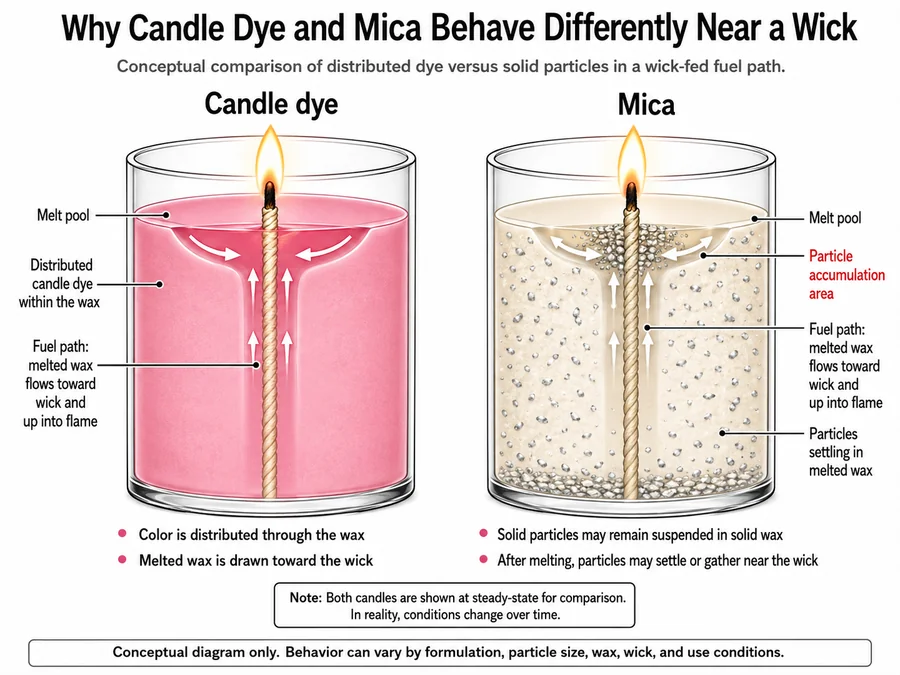
Mica is not equivalent to soluble candle dye; use in a wicked candle depends on application support, particle behavior, wick interaction, and testing.
Mica is a particulate pigment that remains as solid particles in wax. Candle dye is formulated to distribute color through the wax, so cosmetic suitability, visible suspension, or successful wax-melt use does not prove wick-candle suitability.
| Application | Wick status | Main behavior to assess | Evidence required | Decision |
|---|---|---|---|---|
| Wicked candle | A wick draws melted wax toward a flame. | Particles may settle, collect near the wick, or interfere with fuel movement. | Explicit supplier support and acceptable finished-candle tests. | Test only when the exact product supports the application. |
| Wax melt or wickless candle | No wick transports fuel. | Mica may add shimmer while solid and settle after melting. | Instructions for the named wickless application. | Suitable only for that stated use. |
| Decorative exterior use | Mica is not mixed through the candle fuel. | Heat, flame distance, adhesion, and movement into the melt pool still matter. | Instructions for the exact decoration method. | Keep separate from formula suitability. |
| Cosmetic, soap, or resin use | No candle wick is part of the intended application. | The product may work in its named medium but remain untested in candles. | Separate evidence for candle use. | Do not transfer the original claim. |
CandleScience does not recommend mica in candles because the powder can clog the wick. Its guidance is based on its products and wick tests, so it should be treated as a supplier-specific warning rather than proof that every possible mica and wick combination behaves identically. (support.candlescience.com)
The same supplier permits limited mica use in wax melts and wickless candles, where no wick must carry melted fuel to a flame. It notes that the particles may settle after the wax melts. (support.candlescience.com)
Natural Colorants vs Candle Dye: Are Botanical Materials Safer?
Natural origin does not make a candle colorant safer; formulated natural dyes and raw botanical materials require different decisions.
A formulated natural candle colorant is manufactured and documented for use in candle wax. Raw botanical materials include plant powders, spices, herbs, leaves, flowers, and untreated plant matter added directly to wax.
| Material or condition | Evidence problem or failure condition | Decision |
|---|---|---|
| Formulated naturally derived candle colorant | Candle-use documentation may support selection, but the exact wax, wick, amount, and finished candle remain unverified. | Follow the product instructions and test. |
| Raw botanical powder mixed into wax | Food, herbal, or plant identity does not prove candle suitability; particles may remain in the wax or reach the wick. | Avoid unless the exact material is formulated for the application. |
| Dried flowers, leaves, herbs, or wood near the flame | The material can become exposed to heat, melted wax, and flame. | Keep flammable botanical material out of the burn zone. |
| Food-safe spice or plant color | Food-use evidence applies to ingestion, not wax behavior or combustion. | Do not use food safety as candle evidence. |
| A candle that lights successfully once | Initial ignition does not show behavior through repeated or later burns. | Complete representative testing. |
| A product labeled only natural or non-toxic | The claim does not identify the candle application, amount, or burn evidence. | Request candle-specific evidence or use another product. |
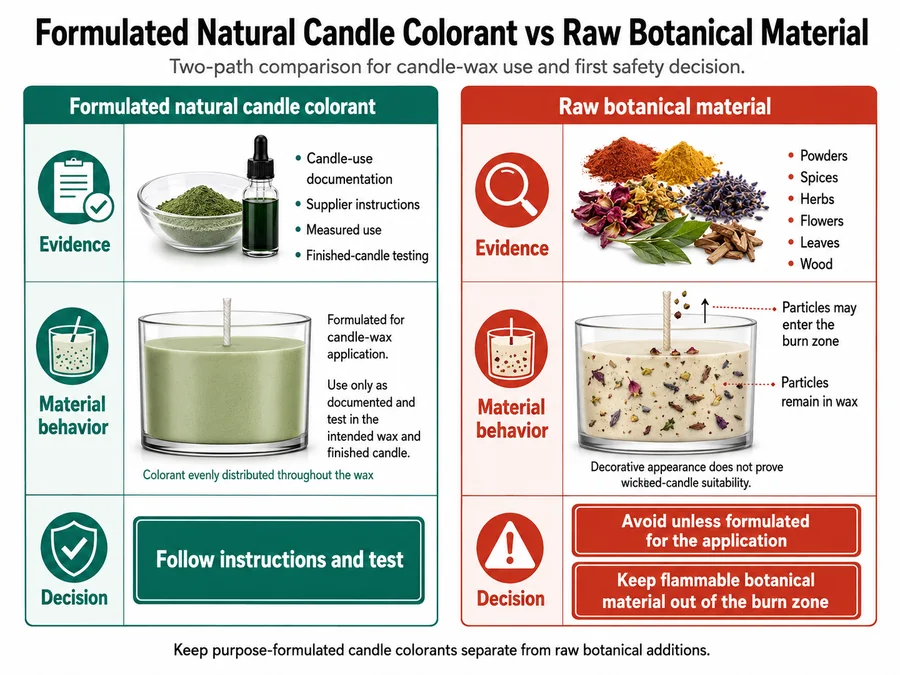
The National Candle Association reported that candles containing dried flowers, leaves, herbs, or wood near the flame can present a fire hazard. Its report addresses embedded flammable materials, not every formulated colorant described as naturally derived. (National Candle Association)
CPSC recalls have documented dried botanical material inside candles catching fire. Those recalls support caution around embedded plant material but do not establish that every formulated natural candle dye has the same hazard. (U.S. Consumer Product Safety Commission)
Choose a formulated, candle-documented natural colorant for testing, and do not treat raw plant matter as an equivalent candle dye.
How to Avoid Overloading a Candle With Dye or Colorant
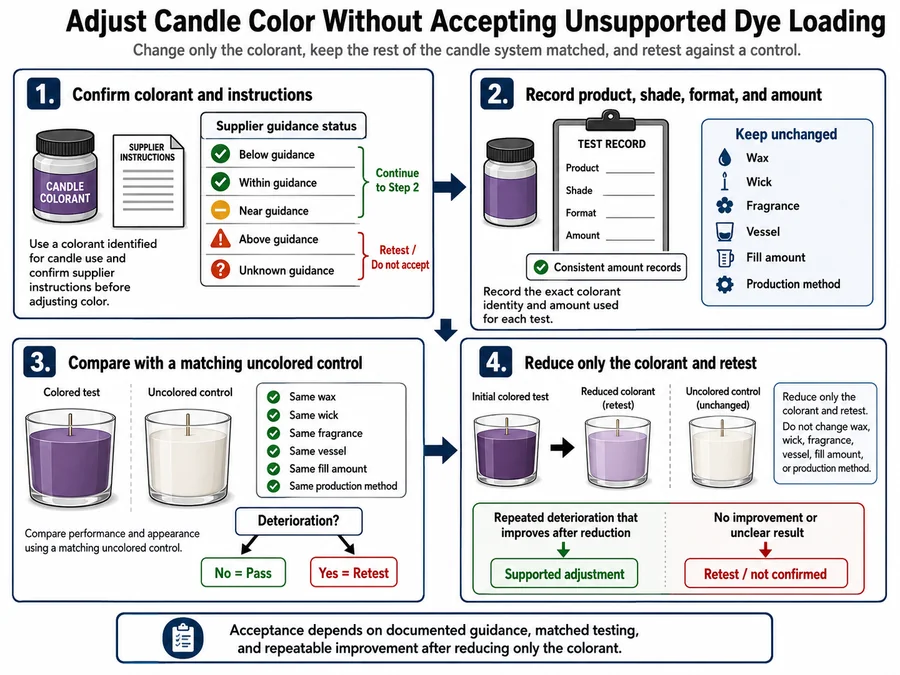
A candle colorant is overloaded when it exceeds the exact product guidance or causes repeatable formulation or burn deterioration against a valid control.
Dark color alone does not prove overload. Judge the amount against the instructions for that exact colorant and compare the colored candle with an otherwise matching uncolored candle.
| Amount relative to supplier guidance | What the position means | Required action |
|---|---|---|
| Below the stated range | The amount is not excessive by the supplier’s measure, though the shade may be lighter than intended. | Test before increasing it. |
| Within the stated range | The amount has product support but still needs finished-candle validation. | Record the amount and test. |
| Near the stated upper range | Small measurement differences may materially change the amount. | Measure carefully and compare with a control. |
| Above the stated range | The formula lacks supplier support at that amount. | Reduce the colorant and retest. |
| Unknown | No reliable comparison with product guidance can be made. | Obtain the instructions or choose another product. |
One supplier warns that excess liquid candle dye may alter the finished candle’s burn or smell and recommends keeping a record of the amount used. That product-specific guidance supports measured adjustment rather than a universal drop, chip, block, or percentage rule. (support.candlescience.com)
Use this sequence when adjusting color:
- Confirm the exact colorant and instructions. Record the manufacturer, product name, shade, format, and stated amount guidance.
- Record the amount consistently. Use a repeatable unit suited to the product rather than an informal description.
- Compare the candle with a matching control. Keep the wax, wick, fragrance, vessel, fill amount, and production method unchanged.
- Reduce only the colorant and retest. Reject the loading when deterioration repeats and improves after the colorant is reduced.
After the amount is placed within a defensible range, determine whether any wick or flame change is actually attributable to the colorant.
How to Tell Whether a Colorant Is Affecting the Wick or Flame
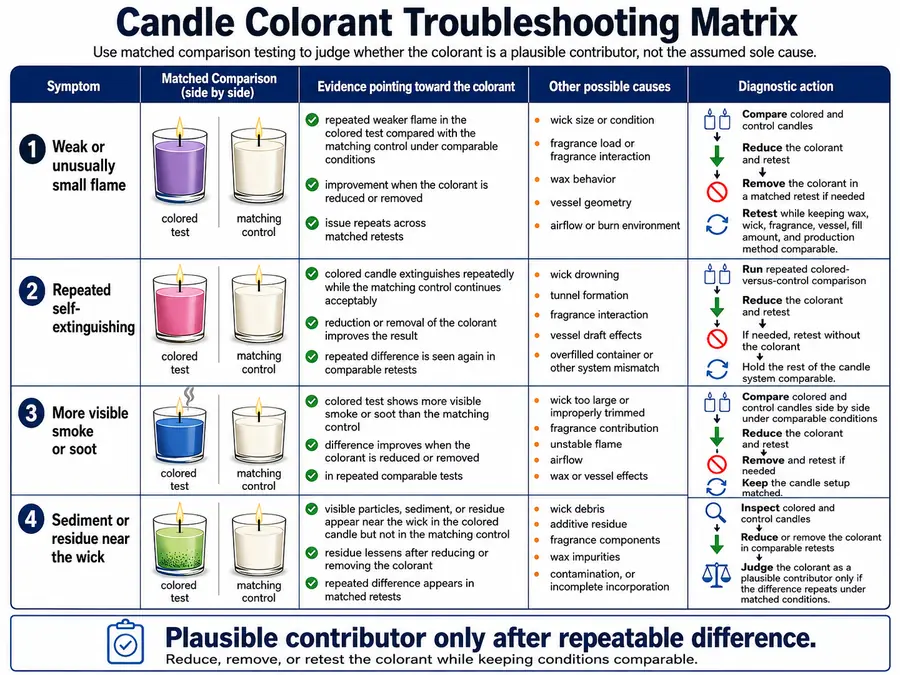
A colorant is a plausible cause only when the colored candle repeatedly differs from a valid control and the colorant is the main changed variable.
One weak flame, soot mark, extinguishing event, or appearance defect does not prove that candle dye caused the problem. Wax, wick, fragrance, vessel, production variation, and burn conditions can produce similar symptoms.
| Observed symptom | Evidence pointing toward the colorant | Other causes that remain possible | Diagnostic action |
|---|---|---|---|
| Weak or unusually small flame | The colored candle repeatedly burns weaker than the matching control. | Wick size, fragrance, wax behavior, wick preparation, or airflow. | Reduce or remove the colorant and repeat the comparison. |
| Repeated self-extinguishing | The colored candle goes out at a similar stage while the control continues. | Wick selection, contamination, melt-pool conditions, or production error. | Repeat the test before assigning cause. |
| More visible smoke or soot | The colored candle repeatedly produces more visible emissions under matched conditions. | Excess wick length, overwicking, fragrance, drafts, or vessel effects. | Standardize conditions and compare again. |
| Sediment or residue near the wick | Particles appear in the colored candle but not in the control. | Incomplete incorporation, pigment use, contamination, or additives. | Confirm the material type and retest without it. |
ASTM F2326-04(2021) provides a procedure for comparing relative smoke and burn behavior during candle-formulation development. Its stated purpose is comparison and reduction of visible smoke, not a universal colorant pass-or-fail limit. (ASTM Store)
Method: This failure log uses control-versus-colored comparison, repeatability, timing, and one-variable retesting. It classifies the colorant as a plausible contributor rather than a proven sole cause.
Once the colorant is a plausible contributor, representative testing can support an accept, adjust, retest, avoid, or professional-review decision.
How to Burn Test a Colored Candle and Decide Whether It Passes
Burn test a colored candle by comparing it with a matching control across representative burn stages, then assign a recorded action.
Here, “tested” means documented finished-candle testing. It does not mean one successful lighting, toxicological proof, legal certification, or proof that every later production batch will behave identically.
- Record the formula and exact colorant identity. Note the wax, wick, fragrance, vessel, fill amount, colorant manufacturer, product name, shade, lot, and amount.
- Prepare an otherwise matching control candle. Remove only the colorant or use a previously accepted amount when testing a controlled change.
- Keep production and burn conditions comparable. Use the same production method, curing conditions, wick preparation, location, burn schedule, and observation method.
- Observe early, middle, and later burn stages. Compare ignition, flame behavior, wick condition, visible emissions, soot, residue, settling, and extinguishing.
- Assign an evidence-based action. Mark the formula as accept, adjust, retest, avoid, or professional review according to repeatable results.
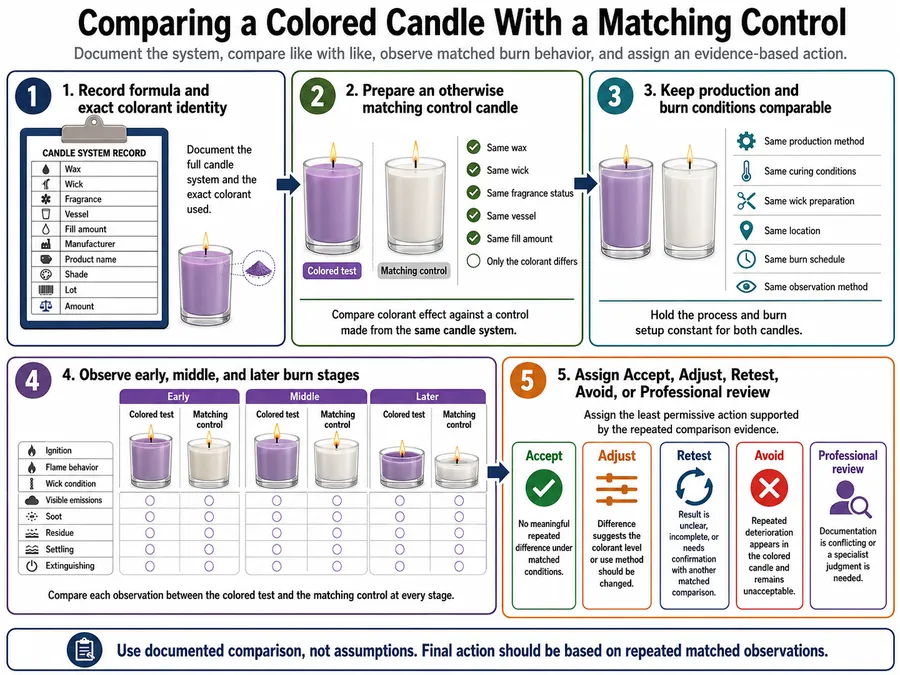
Stop the test if the candle develops uncontrolled secondary ignition, vessel damage, or flame behavior that cannot be monitored safely. ASTM F2417-24 addresses fire-safety requirements for candles under controlled test conditions and states that the specification alone does not cover every factor involved in real-world fire risk. (ASTM International | ASTM)
Colored-Candle Acceptance Matrix
The acceptance matrix converts product documentation and repeatable finished-candle observations into an accept, adjust, retest, avoid, or professional-review action.
| Action | Evidence needed | Meaning |
|---|---|---|
| Accept | The product supports the application, the amount follows its instructions, and representative tests show acceptable behavior against the control. | Use is supported for the tested formula and conditions. |
| Adjust | A repeatable issue appears, and one formulation variable can be changed without rebuilding the entire comparison. | Change the identified variable and test again. |
| Retest | The supplier, lot, shade, amount, wax, wick, fragrance, vessel, process, or production condition changes. | The earlier result does not fully cover the changed candle. |
| Avoid | The application lacks support, the material is improvised, or unacceptable behavior repeats and improves after removal. | Do not use the tested colorant in that candle system. |
| Professional review | The issue concerns formal compliance, toxicology, certification, seller claims, or unexplained hazardous behavior. | Maker testing cannot answer the formal question. |
CPSC business guidance directs candle manufacturers to applicable voluntary candle standards, but maker testing should not be presented as certification or formal compliance review. (U.S. Consumer Product Safety Commission)
A colored candle passes only for the tested formula and conditions; a material change requires a new evidence decision.
When a Candle Colorant Is Suitable
A candle colorant is suitable only when its identity, intended use, product boundaries, material behavior, and finished-candle evidence support the same decision.
- Correctly classify the material as a purpose-made candle dye, particulate pigment, formulated natural colorant, or improvised material.
- Verify that the exact product supports the planned candle application.
- Follow the supplier’s product-specific amount and handling instructions.
- Separate food-safe, cosmetic-safe, natural, and non-toxic claims from candle-use evidence.
- Confirm the finished candle against a matching control across representative burn stages.
Natural origin, marketing language, physical format, or one successful lighting cannot replace application-specific documentation and representative finished-candle testing.