
Color candles naturally with the wax’s inherent color, a strained botanical infusion, or a documented wax-compatible concentrate, then compare cured and burned results with an uncolored control.
Most natural methods produce muted, wax-influenced shades rather than vivid, repeatable colors. A natural candle colorant is a naturally derived material, or the inherent color of a wax or material, used to tint wax in a finished wicked candle. Natural origin does not prove that the material is candle-safe, non-toxic, environmentally preferable, food-grade, wick-compatible, strongly colored, stable, or fade-resistant. This guide helps candle makers compare likely color sources, prepare small tests, separate melted color from cured results, and identify residue or burn changes.
What Counts as a Natural Candle Colorant?
A natural candle colorant is a naturally derived color source, or a material’s inherent color, evaluated for use in wicked candle wax.
Natural describes origin, not finished-candle performance. It does not prove that a material is candle-safe, non-toxic, environmentally preferable, food-grade, wick-compatible, strongly colored, stable, or fade-resistant.
A wicked candle draws melted wax through a wick to sustain a flame. The color source must therefore work with the wax, wick, fragrance, and other formula components rather than provide an acceptable appearance alone.
| Natural-color claim or observation | What it establishes | What it does not establish |
|---|---|---|
| The source comes from a plant, mineral, insect, or naturally colored wax | The source may meet the chosen natural-origin definition | Suitability for a burning candle |
| The source colors melted wax | Color transfers or disperses while the wax is liquid | The shade that will remain after curing |
| The cured candle has an even color | The initial appearance meets the visual target | Resistance to later fading or color drift |
| No sediment is visible | No obvious settling appears under those conditions | Absence of fine residue near the wick |
| One candle burns acceptably | The tested formula produced a usable result | Compatibility with other waxes, wicks, fragrances, or preparation methods |
A material can qualify as natural and still fail as a candle colorant. In contrast, the inherent yellow, cream, or brown tone of a wax can provide a workable natural result without an added coloring material.
Treat “natural” as a sourcing description and approve the colorant only after cured appearance, residue, wick condition, and burn behavior remain acceptable.
Which Natural Candle-Coloring Methods Actually Work?
Naturally colored waxes, strained botanical infusions, and documented wax-compatible concentrates are plausible when cured shade and burn performance remain acceptable; raw powders and mica are poor defaults.
Tint alone is not success. A visually pleasing source can still settle, change color, leave particles, or restrict the wick’s wax supply.
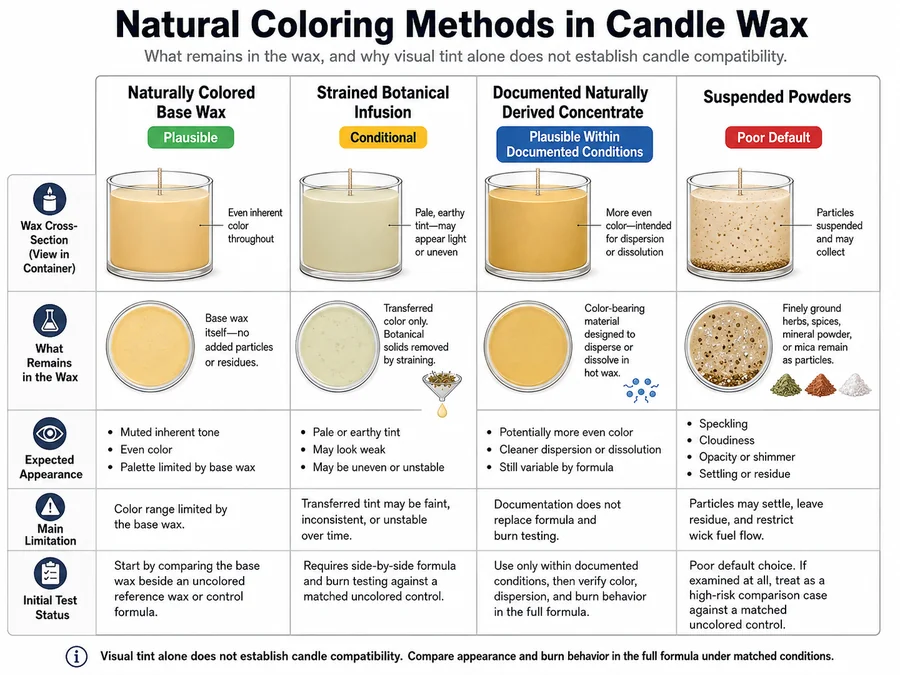
Natural candle-coloring methods can be grouped by what remains in the finished wax: inherent color, transferred color with solids removed, dissolved color, or suspended particles. Suspended particles present the clearest wick concern because they can collect near the wick instead of dissolving through the wax.
The following source-behavior table is a test-priority guide rather than a universal recipe. Record the wax, wick, fragrance, source form, filtration method, cure date, storage conditions, and burn observations for every trial.
| Natural-coloring category | What remains in the wax | Expected visual result | Main limitation | Initial test status |
|---|---|---|---|---|
| Naturally colored base wax | The wax’s inherent color | Muted, wax-led cream, yellow, amber, or brown tones | The base color limits the available palette | Plausible when the natural wax tone matches the goal |
| Strained botanical infusion | Color transferred from the source, with visible solids removed | Usually a pale or earthy tint | Color transfer may be weak, uneven, or unstable | Conditional until cured and stored samples remain acceptable |
| Naturally derived concentrate documented for candle wax | Color-bearing material intended to disperse or dissolve in hot wax | Potentially more even than raw plant powder | Natural origin does not replace formula and burn testing | Plausible only within its documented use conditions |
| Finely ground herbs or spices | Suspended plant particles | Speckled, cloudy, or earthy color | Settling, residue, wick restriction, and color change | Poor default for through-colored wicked candles |
| Mineral or mica-based powder | Suspended pigment particles | Opaque color or shimmer | Particles may collect around the wick and weaken the burn | Usually unsuitable as a through-wax colorant for a burning candle |
Which Natural Sources Are Worth Testing for Muted Candle Colors?
Naturally colored waxes, annatto, madder root, alkanet root, and green botanical sources such as spirulina or peppermint are conditional test candidates for muted candle colors.
Treat each source as a candidate rather than an approved formula because wax color, source form, filtration, curing, storage, and burn behavior can change the result.
| Candidate source | Likely muted color range | What remains in the wax | Main uncertainty | Initial test status |
|---|---|---|---|---|
| Naturally colored base wax | Cream, yellow, amber, or brown | The wax’s inherent color | Source and batch variation limit the available palette | Plausible when the inherent tone matches the visual goal |
| Annatto | Muted yellow to warm orange | Transferred color after the source material is removed | Shade strength and stability can vary with the wax and preparation | Conditional small-batch candidate |
| Madder root | Pale peach or another muted warm tone | Transferred color after filtration | The cured result may be weaker or browner than the prepared source | Conditional small-batch candidate |
| Alkanet root | Muted burgundy or purple-brown | Transferred color after filtration | Wax color, curing, and storage can shift the final tone | Conditional small-batch candidate |
| Spirulina or peppermint | Pale green or gray-green | Transferred color when visible solids are removed | Green tones may be weak, uneven, or unstable | Conditional small-batch candidate |
A strained infusion may perform better than raw powder because filtration removes much of the solid material, but it can still produce a weak or changing shade. A documented naturally derived concentrate may distribute more evenly, yet its origin does not prove compatibility with every candle formula.
Raw powders and pigment-like materials create the largest gap between appearance and function. Materials that remain suspended can collect around the wick and restrict the movement of melted wax into the flame.
Standard water-based food coloring is not a wax-compatible default because it does not dissolve in candle wax and may separate instead of producing an even through-color.
Choose candidates by their cured and burned results, not by how vivid the source looks before it enters the wax.
How Should Natural Colorants Be Prepared and Tested Before a Full Batch?
Prepare natural candle colorants under controlled conditions, then judge the cured candle and burn result rather than the melted wax alone.
An acceptable result meets the declared visual target without an unacceptable increase in residue or decline in wick and burn performance compared with the uncolored control.
Methods note: Set the acceptance criteria before examining the results. Keep the wax, wick, fragrance, vessel, candle size, cure conditions, storage conditions, and burn procedure the same for both samples. Supplier or material documentation governs only the named material and test conditions; it does not create a universal pass threshold.
| Scorecard field | Pass condition | Warning or failure sign | Decision |
|---|---|---|---|
| Cured shade | The cured color meets the planned muted or wax-influenced target | The result is too weak, too dark, or different from the planned tone | Adjust when the gap may be corrected through preparation; route when the goal exceeds the method |
| Uniformity | Color appears acceptably even for the intended finish | Streaks, settling, patches, or concentrated deposits appear | Adjust and repeat the controlled trial |
| Stability | The shade remains acceptable under the planned cure, storage, light, and heat conditions | Fading, hue change, yellowing, or uneven drift exceeds the accepted limit | Adjust the method or reject the source |
| Residue | No unacceptable sediment or particle buildup appears | Solids settle, collect near the wick, or remain visible in the melt pool | Reject or revise the preparation before another trial |
| Wick condition | The wick remains comparable to the uncolored control | Coating, buildup, mushrooming, or restricted wax flow appears only in the colored candle | Reject the current method unless a repeat trial disproves the link |
| Burn behavior | Flame and melt-pool behavior remain acceptable beside the control | The colored candle develops a weaker flame, smoke, soot, instability, or self-extinguishing behavior | Reject when the difference repeats under matched conditions |
| Final classification | All required appearance and performance criteria pass | One or more criteria remain unresolved | Retain, adjust and retest, reject, or route to another coloring method |
The workflow must record preparation, filtration, incorporation, curing, labeling, comparison conditions, and finished-candle performance. A small batch is a limited trial that permits a colored candle to be compared with an otherwise identical uncolored control without committing a full production batch.
- Choose one color source and one wax formula.
Change only the coloring variable during the first comparison. Keep the wax, fragrance, wick, vessel, pour process, and other formula components the same in both samples. - Prepare the natural color source consistently.
Use the same source form, particle condition, infusion method, or concentrate preparation for every sample in the comparison. Do not judge suitability from the dry material’s color strength. - Remove unwanted solids when the method permits filtration.
Strain an infusion before adding it to the candle wax, then inspect the filtered portion for visible particles or sediment. Filtration can reduce solid residue, but it does not prove that the transferred color will remain stable or burn well. - Add the prepared color source under recorded conditions.
Note the wax, colorant form, incorporation stage, mixing method, and any formula component that could affect the result. Follow material-specific technical instructions when a wax or colorant supplier provides them rather than applying a universal method. - Pour a colored sample and an uncolored control.
Use matching vessels, wicks, wax quantities, and cooling conditions. The control shows whether a later color, surface, or burn change comes from the colorant or from the underlying candle formula. - Label both candles before they cool.
Record the preparation method, sample identity, pour date, cure start, storage location, and planned comparison date. Labels prevent similar-looking trials from being confused after the wax becomes opaque. - Allow both samples to cure under the same conditions.
Compare them after the same interval and under the same lighting, background, and viewing angle. The melted appearance is an observation point, not the final shade decision. - Inspect and burn the finished samples.
Record cured shade, uniformity, settling, residue, wick condition, flame behavior, and visible changes during use. Reject or revise the method when appearance improves but residue or burn performance becomes worse than the control.
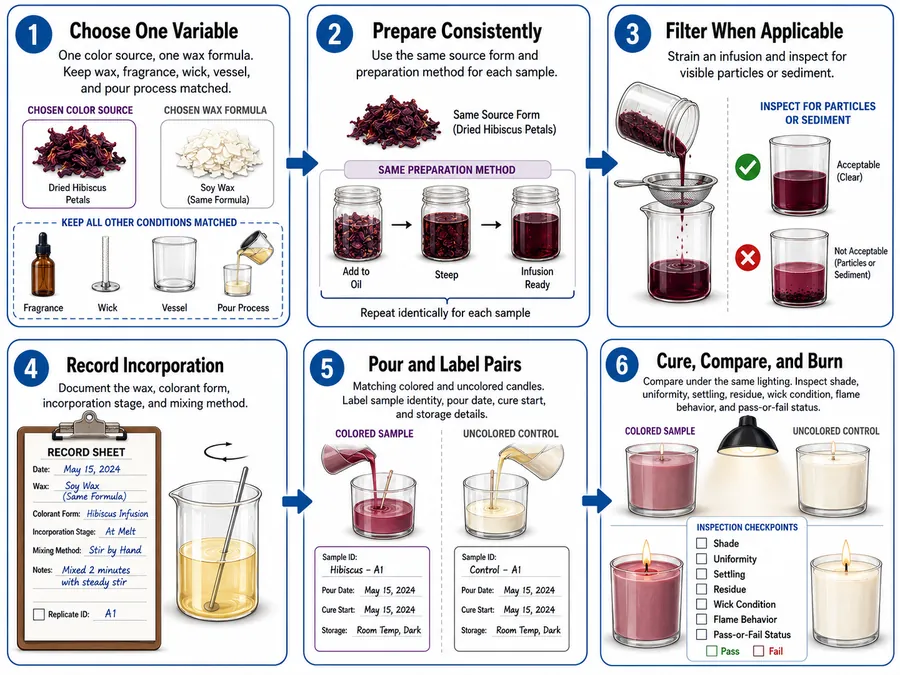
A natural coloring method moves forward only when its preparation is repeatable and its cured appearance and candle performance remain acceptable together.
When Is a Usable Natural Result Still Wrong for the Intended Visual Goal?
A natural candle color can pass technical testing yet still fail the intended visual goal.
Natural methods generally suit muted, earthy, translucent, or wax-influenced shades. Vivid saturation, close color matching, and strong batch repeatability may call for a purpose-made candle dye even when the natural method burns acceptably.
Methods note: Apply the same tested wax, preparation, cure, storage, and viewing conditions behind each decision. Judge technical performance first, then compare the result with the declared color goal. Do not treat a visually unsuitable result as a burn failure when the candle passed the performance scorecard.
| Intended visual goal | Likely fit for a natural method | Decision basis | Recommended decision |
|---|---|---|---|
| Inherent cream, yellow, amber, or brown wax tone | Strong | The wax already supplies the desired restrained color | Retain when the performance scorecard passes |
| Muted botanical or earthy tint | Conditional | A pale or wax-influenced result may match the intended finish | Retain or adjust after stability testing |
| Deliberate variation between candles | Conditional | Natural source variation may be acceptable when variation is part of the design | Retain only when the permitted range is defined |
| Vivid, saturated color | Poor | Most natural methods do not produce strong, dependable saturation in cured candle wax | Route to a purpose-made candle dye |
| Close matching to a fixed brand or event color | Poor | Wax tone, source variation, curing, and storage can shift the result | Route to a more repeatable coloring method |
| Strong repeatability across many batches | Poor to conditional | Natural materials may vary by source, preparation, age, and storage | Route when narrow variation is required |
| Attractive shade with fading, residue, or burn changes | Unsuitable | Visual appeal does not outweigh failed stability or candle-performance criteria | Reject the method |
Choose a natural method when its realistic shade range supports the design, and choose another candle-coloring method when the visual target demands saturation or repeatability the natural source cannot reliably provide.
Why Does Natural Color Look Different in Raw, Melted, and Cured Wax?
Natural color looks different in raw, melted, and cured wax because base-wax color, opacity, cooling structure, particle distribution, and lighting change the visible shade.
The visible result changes as the color source enters the wax, disperses, cools, and is viewed through the solid wax structure. Base-wax color, opacity, particle distribution, surface texture, lighting, and the cure interval can make the finished candle appear lighter, duller, cloudier, browner, or less even than the source or melted mixture.
Use the same wax, natural color source, preparation method, vessel, background, lighting, and viewing position for every stage in the comparison.
| Comparison stage | What to record | Why the appearance can mislead | Decision value |
|---|---|---|---|
| Raw color source | Hue, particle form, moisture, and visible variation | A vivid plant, powder, or concentrate may transfer little usable color into wax | Identifies the starting material, not the finished shade |
| Prepared infusion or concentrate | Clarity, sediment, separation, and transferred hue | The carrier may look darker than the amount of color that remains visible in solid wax | Shows whether preparation transferred color consistently |
| Melted colored wax | Hue, darkness, dispersion, and visible particles | Liquid wax is often more translucent and may make the color look deeper or clearer | Useful for spotting mixing or settling problems |
| Newly cooled candle | Surface color, cloudiness, streaks, and uneven areas | Cooling and crystallization can change opacity and how light passes through the wax | Gives an early result that may still change |
| Cured candle | Final shade, uniformity, surface condition, and contrast with the control | The base wax and resting period can shift the apparent color after the candle has set | Provides the main visual acceptance result |
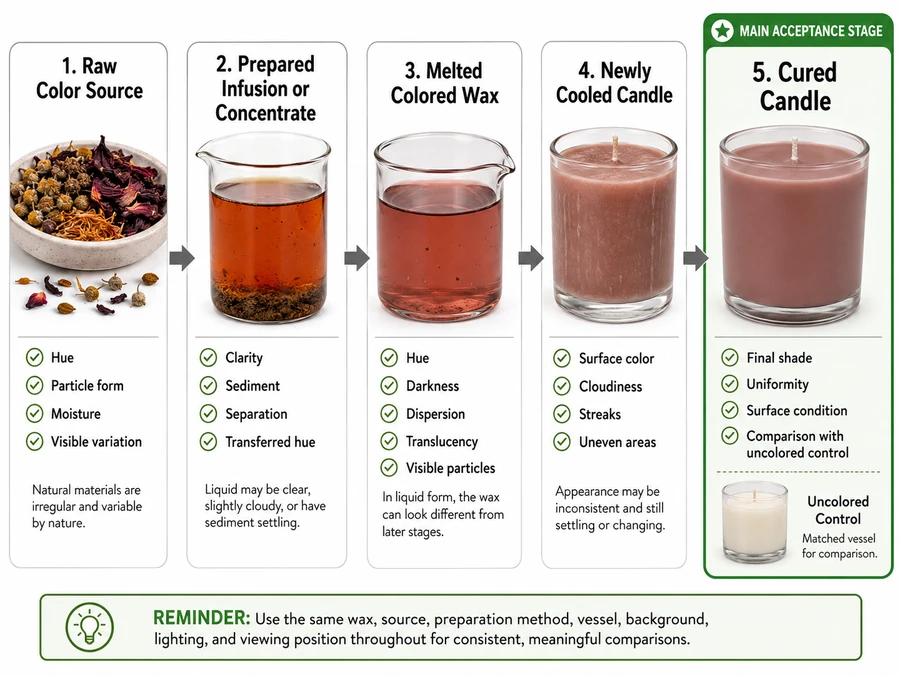
A valid benchmark should identify the wax, source form, preparation method, viewing conditions, and cure interval beside every observation. Without those conditions, two shades cannot be compared reliably because a difference may come from the wax or test setup rather than the natural color source.
Judge the color from the cured candle under repeatable viewing conditions, then keep melted-wax observations only as supporting process evidence.
Why Do Natural Candle Colors Fade, Drift, or Change?
Natural candle colors can change because curing, light, heat, storage, wax discoloration, additives, and color-source instability act through different conditions.
Do not label every color change as fading. Compare each variable separately, using the end of the formula-specific cure interval as the baseline and repeating observations after 7 and 30 days.
Methods note: The 7-day and 30-day checkpoints are working comparison intervals, not universal stability standards. Keep the wax, wick, fragrance, vessel, preparation method, sample size, camera settings, lighting, and background unchanged unless one of those factors is the variable being tested.
| Possible cause | Comparison setup | Observation points | What the result suggests |
|---|---|---|---|
| Curing | Photograph the same candle when newly cooled and at the end of its selected cure interval | Newly cooled and end of cure | A change limited to this period is curing-related rather than later fading |
| Light exposure | Keep one colored sample protected from light and place its pair under the intended light conditions | Baseline, 7 days, and 30 days | Change in the exposed sample but not the protected sample points to light sensitivity |
| Heat exposure | Store matched samples under stable and warmer conditions without changing other variables | Baseline, 7 days, and 30 days | Faster change in the warmer sample suggests heat-related instability |
| Storage variation | Keep one sample under stable conditions and another under the intended storage conditions | Baseline, 7 days, and 30 days | A difference between locations shows that the storage environment affects the shade |
| Base-wax discoloration | Store an uncolored control beside the colored candle | Every color observation | Similar yellowing or darkening in both samples points toward the wax rather than the color source alone |
| Additives or fragrance | Compare matched colored formulas with only the selected additive or fragrance changed | End of cure, 7 days, and 30 days | A difference between the pair suggests an interaction with that formula component |
| Color-source instability | Compare duplicate colored samples with an uncolored control under the same protected conditions | End of cure, 7 days, and 30 days | Change in both colored samples while the control remains stable points toward the source or its interaction with the wax |
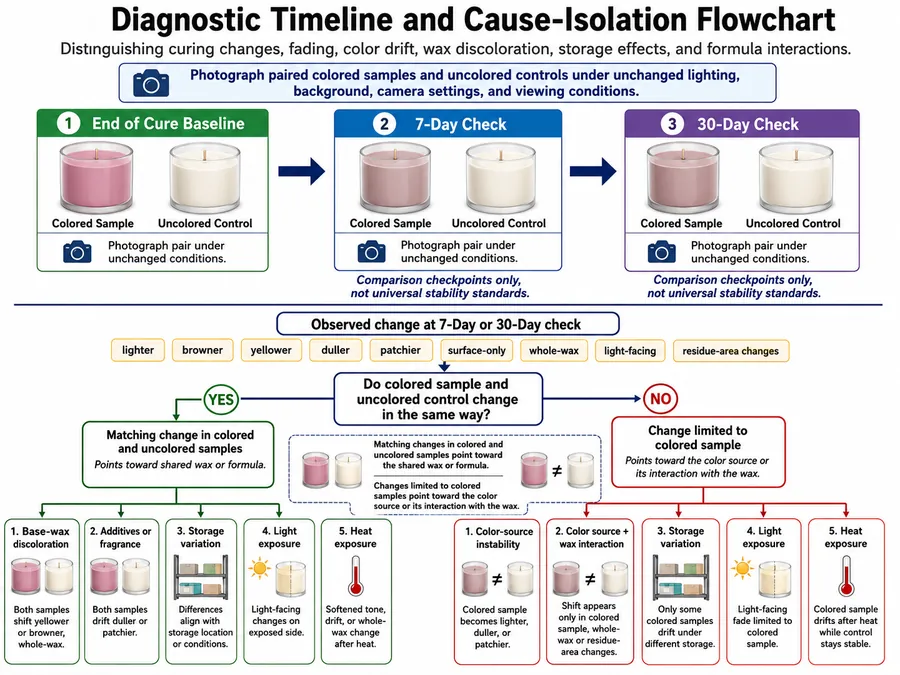
Fading is a loss of color strength, while color drift is a shift in hue, tone, or uniformity. A candle can become browner, yellower, duller, patchier, or lighter, so recording only “faded” hides the actual failure pattern.
Photograph every sample beside its matching control instead of relying on memory. Record whether the change affects the surface, the entire wax body, the side facing the light, or only areas containing visible residue.
Retain the method only when the shade remains acceptable under the conditions in which the finished candle is expected to cure, remain stored, and be used.
Can Natural Colorants Affect the Wick or Burn?
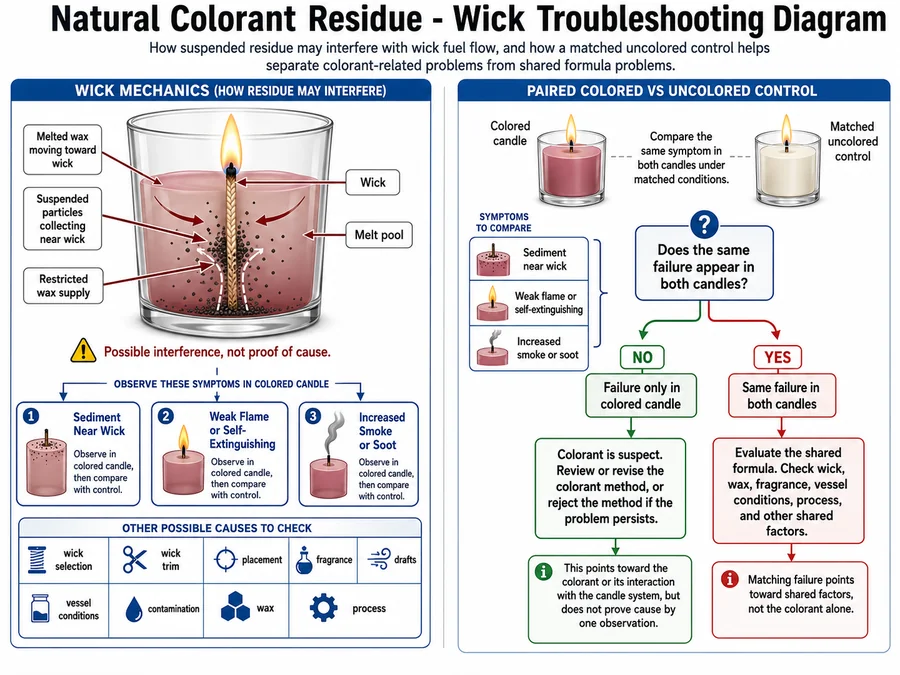
Natural colorants can affect wick and burn performance when suspended residue interferes with the candle’s fuel flow.
Visual tint does not prove compatibility, and a weak flame does not prove that the colorant is the sole cause. Compare the colored candle with an otherwise identical uncolored control before assigning responsibility.
| Symptom | Possible colorant-related cause | Competing non-colorant cause | Control check | Initial decision |
|---|---|---|---|---|
| Sediment or particles collect near the wick | Insoluble or suspended material has separated and moved toward the wick | Contamination or residue from another formula component | Compare the sediment and wick area in both samples after equal burn periods | Reject or revise the method when buildup repeats only in the colored candle |
| The colored candle develops a weak flame or self-extinguishes | Residue may be restricting the wick’s wax supply | Wick selection, trim, placement, fragrance, or vessel conditions may be responsible | Compare both candles under matching conditions and repeat the test | Treat the colorant as suspect when the failure repeats only in the colored candle |
| Smoke or soot increases in the colored sample | The colorant may have changed fuel delivery or left combustible residue | Wick trim, fragrance, drafts, and vessel conditions can increase soot | Compare matched samples in the same location with equal wick preparation | Treat the difference as a warning and reject the method when it repeats |
| Both colored and uncolored candles burn poorly | The problem is unlikely to be caused by the colorant alone | The wick, wax, fragrance, vessel, or process may be unsuitable | Confirm that both samples show the same failure pattern | Stop the colorant diagnosis and evaluate the shared candle formula |
This failure log identifies colorant-related warning signs without replacing a full wick or formula diagnosis. A color source becomes a likely contributor when residue appears in the colored candle and the same burn failure does not appear in the matching control.
Treat the natural colorant as responsible only when paired tests repeatedly separate its effect from the wick, wax, fragrance, vessel, and burn conditions.