

Candle dye settles when unsuitable particles, excessive loading, incomplete dissolution, poor full-pot mixing, wax incompatibility, contamination, old residue, or cooling-related movement leaves colorant concentrated at the pot or jar base.
For candle makers troubleshooting uneven color, candle dye means a wax-compatible colorant made to incorporate under the product’s stated wax, dose, and processing conditions. Settling means visible sediment at the base of the named pot or jar; it does not include sinkholes, frosting, wet spots, rings, streaks, or ordinary shade variation. Verify that the material is physical sediment, identify the colorant class, and record whether it first appeared in the pot or jar. Then test one suspected cause at a time while keeping the other recorded conditions unchanged. <!– META-DESCRIPTION: Learn why candle dye settles in a pouring pot or jar and diagnose pigments, excess dye, low addition heat, poor mixing, cooling effects, or contamination. –>
Start with the residue’s appearance and the earliest stage at which it was documented.
| Observed pattern | First cause branch to check | First controlled check |
|---|---|---|
| Hard colored fragments | Unmelted dye chips, blocks, old residue, or foreign material | Verify the product format and compare its response during a controlled heat-and-hold test. |
| Soft powder-like clumps | Powder clumping, poor pot coverage, contamination, or unsuitable material | Confirm the product identity, inspect the full pot, and run a re-stir persistence test. |
| Reflective or shimmering particles | Mica, pigment, another mineral solid, or contamination | Check the product’s stated use and compare it with a clean undyed control. |
| Residue already present before pouring | Incomplete incorporation, loading, mixing, contamination, or old residue | Inspect the pot base and change one suspected process variable. |
| Residue first documented after cooling | Cooling-related movement, loading, or wax-and-dye compatibility | Compare the hot, held, poured, and fully cooled stages from the same batch. |
| Similar residue in undyed wax | Equipment residue, wax debris, moisture, or contamination | Repeat the blank with clean, dry equipment before testing the dye again. |
How to Tell True Candle-Dye Settling from Other Candle Defects
Candle-dye settling means candle colorant or colorant-containing solids have collected at the base of a pouring pot or finished jar instead of remaining evenly incorporated in the wax.
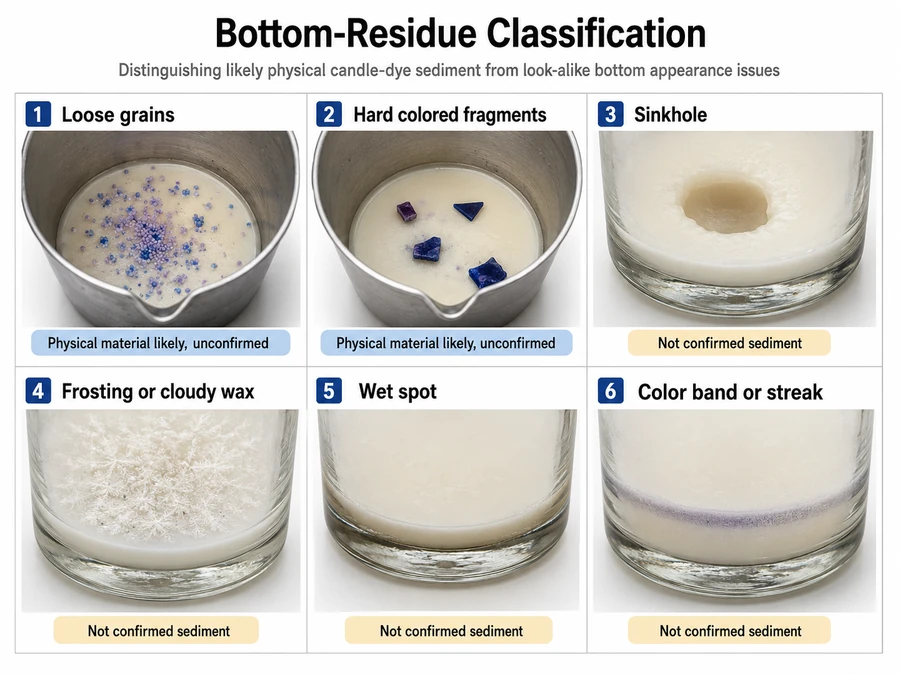
True sediment may appear as loose grains, concentrated bottom color, hard fragments, or soft clumps. Sinkholes, frosting, wet spots, rings, streaks, wax crystals, and fragrance discoloration are different problems, even when they make the jar bottom look darker. <!– IMAGE-PLACEHOLDER –>
ALT TEXT: Candle making candle dye bottom residue classification by vessel and observation stage
FILENAME: candle-making_candle-dye_bottom-residue-classification.webp
VISUAL TYPE: Bottom-Residue Classification Photo Grid
PURPOSE: Distinguish physical bottom sediment from sinkholes, frosting, wet spots, color bands, and old residue without claiming chemical identity. <!– /IMAGE-PLACEHOLDER –>
This photo grid separates physical bottom sediment from similar-looking candle defects while keeping the material’s identity unconfirmed.
Use these visible differences to decide whether the problem is physical sediment.
| Visible sign | Is true settling confirmed? | What to check next |
|---|---|---|
| Loose grains or powder at the pot or jar base | Likely, but not proven | Record the material, location, and stage when it appeared. |
| Hard colored fragments at the base | Likely physical material | Check the colorant format and its response to controlled reheating. |
| Soft or crushable clumps | Likely physical material | Check for powder clumping, old residue, or contamination. |
| A dark bottom with no separate particles | No | Look for a physical layer before calling it sediment. |
| A hollow or depression in the wax | No | Treat it as a sinkhole rather than dye settlement. |
| Pale crystal patterns or cloudy patches | No | Treat them as frosting or wax-crystal changes. |
| A gap-like patch against the glass | No | Treat it as a wet spot or adhesion change. |
| A ring, streak, or color band without loose material | No | Check whether the wax changed shade without forming sediment. |
A smooth surface does not prove the pouring-pot base is free of residue. Material can remain below evenly colored wax and enter the final jar during the last part of the pour.
Record the batch at these four stages:
- Inspect the pouring-pot base after mixing and before pouring.
- Inspect the wax immediately after it enters the jar.
- Watch for new concentration while the wax cools.
- Inspect the fully set candle for loose or wax-bound bottom material.
Not every dark jar bottom means candle dye has settled. A bottom color band is not sediment unless colorant or colorant-containing material is physically concentrated there.
Settling can first become visible after cooling, but timing alone does not identify the cause. Appearance, location, texture, reflectivity, stirring response, and reheating response can rank possible causes without proving the material’s chemical identity.
Methods note: Photograph the same pot and jar under consistent lighting at each stage. Record the wax, material class, vessel, test condition, and residue location. Photographs document appearance but cannot prove dissolution, compatibility, or chemical identity.
Confirm physical sediment first, then test whether it belongs to the current batch before changing the wax, dose, heat, or mixing process.
How to Rule Out Old Residue, Moisture and Equipment Contamination
Colored or solid material at the pot or jar bottom may come from old equipment residue, moisture, debris, or cross-batch contamination rather than the candle dye being tested.
Contamination is any material not intentionally included in the current wax-and-dye formula. Until its source is shown, dye sediment is only an observed bottom material, not confirmed current-batch dye.
Possible sources include old dye trapped at the pot base or seam, residue on a spoon or thermometer, transfer-tool carryover, mold debris, damaged packaging fragments, and moisture. A residue that matches the current color is still only a clue because an earlier batch may have used the same or a similar shade.
Run a clean blank control in this order:
- Inspect the pouring pot, seams, spoon, stirrer, thermometer, mold, and transfer tools.
- Clean and dry the equipment with the established procedure for those materials.
- Melt a small sample of undyed wax in the clean equipment.
- Inspect the pot base and the cooled wax sample for residue.
- Add the suspect candle dye in a separate test only after the undyed control remains clear.
Use the following log to compare clean equipment with previously used equipment.
| Test condition | Equipment state | Suspect dye present? | Pot-base observation | Cooled-sample observation | How to read the result |
|---|---|---|---|---|---|
| Blank control A | Clean and dry | No | Record what appears | Record what appears | Residue here points to equipment, wax, debris, or moisture rather than the suspect dye. |
| Blank control B | Previously used | No | Record what appears | Record what appears | Residue appearing only here raises the chance of old material or cross-color carryover. |
| Dye test A | Clean and dry | Yes | Record what appears | Record what appears | New residue here returns the diagnosis to dye identity, compatibility, dose, heat, or mixing. |
| Dye test B | Previously used | Yes | Record what appears | Record what appears | Compare this result with the clean dye test before blaming the current colorant. |
Contamination becomes more likely when residue appears in undyed wax, matches a previous color, returns only with one tool or pot, or differs from the current dye format. Material that remains after the suspect dye is removed from the test cannot be attributed solely to that dye.
Moisture must be treated separately from incomplete dye dissolution. Do not improvise heating, solvent, disposal, or batch-salvage steps; follow the established handling instructions for the wax, colorant, and equipment.
Methods note: This is a blank test record, not reported batch data. Record the wax, colorant, equipment state, date, observation stage, and residue location. The blank may reveal another source, but it cannot identify the material’s chemistry.
When the clean undyed control remains free of residue, return to the current candle dye’s identity, wax compatibility, measured dose, addition conditions, and mixing process.
What Sediment Color, Texture and Behavior Can Reveal
Sediment color, texture, reflectivity, hardness, smearing, and response to stirring or controlled reheating can narrow the likely cause, but appearance alone cannot identify the material with certainty.
Diagnostic evidence is a clue used to rank possible causes and select the next test, not proof of chemical identity. Similar-looking residue can come from different candle dyes, unsuitable solids, incomplete processing, contamination, or wax changes. <!– IMAGE-PLACEHOLDER –>
ALT TEXT: Candle dye sediment photo matrix showing hard fragments, soft clumps, reflective particles, fine sediment, wax-bound layers, and stained wax
FILENAME: candle-dye_sediment-photo-behavior-matrix.webp
VISUAL TYPE: Labeled Sediment Photo-and-Behavior Matrix
PURPOSE: Connect visible residue patterns with controlled confirmation tests while showing that appearance alone cannot identify the material. <!– /IMAGE-PLACEHOLDER –>
Each sample should identify the wax, known or unresolved colorant, vessel, observation stage, residue location, and test condition.
| Observation | Plausible causes | Confirming test | Uncertainty note |
|---|---|---|---|
| Hard, angular colored fragments | Incompletely melted dye chips or blocks, old solid residue, or foreign material | Verify the product format and run a controlled heat-and-hold test | A hard colored fragment is not automatically a dye chip. |
| Soft or crushable clumps | Powder-dye agglomeration, contamination, or a wax-bound particulate material | Check the product identity and run a re-stir persistence test | Soft clumps may suggest powder aggregation, but texture does not prove it. |
| Reflective or shimmering particles | Mica, reflective pigment, another mineral solid, or contaminated equipment | Confirm the product identity and compare it with an undyed control | Reflective sediment does not always mean mica. |
| Fine, loose sediment | Undissolved colorant, excess loading, incompatible material, or fine debris | Compare a measured control and observe whether sediment returns after stirring | Fine particles may share the same appearance while having different causes. |
| Dense, wax-bound bottom layer | Concentrated colorant, settled particles trapped during cooling, or old residue | Compare pot and jar samples, then repeat under controlled heat and hold conditions | A dark layer without separable particles may be a color change rather than sediment. |
| Stained wax with no discrete solids | Shade variation, thermal change, or color migration rather than physical settling | Inspect under consistent lighting and compare the pot, poured sample, and cooled jar | Discoloration alone does not confirm settled material. |
| Residue in an undyed wax control | Old equipment residue, debris, moisture, or contamination | Repeat with clean, dry equipment | The suspect dye cannot be the sole cause when it was absent from the control. |
| Sediment that returns after stirring | Temporary redistribution, persistent particles, poor pot coverage, or incompatible material | Run a timed re-stir persistence test | Visual mixing does not prove dissolution. |
| Sediment that returns after reheating | Persistent solids, unsuitable material, excessive loading, or product-specific compatibility failure | Run a controlled heat-and-hold retest | Temporary disappearance while hot does not prove permanent incorporation. |
Color should be recorded, but it should not be used as the only identifying feature. Old residue may match the current batch, while one product may produce different shades in different waxes or lighting conditions.
Hardness and shape help select the next test. Hard fragments support checking solid dye formats and controlled heating, while soft clumps support checking powder products and persistence after stirring.
Reflectivity is another clue rather than a final label. Confirm the product name and intended use before calling reflective material mica, pigment, or candle dye.
Photograph each sample under consistent lighting with a visible scale. Record the wax, colorant identity or unresolved material class, vessel, residue location, observation stage, and test condition.
Methods note: Use photographs and behavior observations to select a test, not to declare a chemical identity. End the diagnosis with a controlled product check, blank control, stirring test, heat test, measured-dose comparison, or same-batch pot-versus-jar comparison.
Wax-Soluble Dye vs Pigment, Mica and Other Unsuitable Colorants
Wax-soluble candle dye is made to incorporate into wax, while mica, many pigments, food coloring, soap dye, cosmetic pigment, and botanical powders remain separate material classes.
Here, dye means a wax-compatible candle colorant. Dissolution means no separate visible particles remain, while dispersion or suspension may spread particles only temporarily.
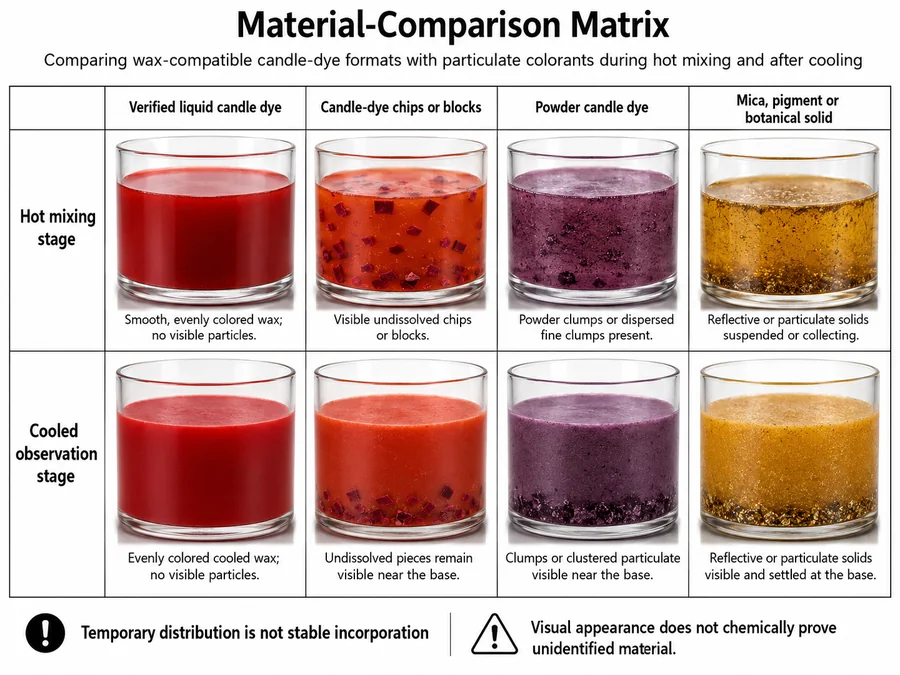
A particulate material may look even while hot wax is moving, then settle when stirring stops or the wax cools. Temporary distribution is not stable incorporation. <!– IMAGE-PLACEHOLDER –>
ALT TEXT: Comparison of wax-compatible candle dye and suspended colorant solids in hot and cooled candle wax
FILENAME: wax-soluble-dye_vs-suspended-solids.webp
VISUAL TYPE: Labeled Material-Comparison Photo Set
PURPOSE: Compare verified candle-dye formats with particulate colorants at the hot-mixing and cooled-observation stages. <!– /IMAGE-PLACEHOLDER –>
Each comparison should name the product identity, intended medium, wax, processing condition, observation stage, and visible result.
| Material class | Expected wax behavior | Diagnostic decision |
|---|---|---|
| Verified liquid candle dye | Should incorporate under the named product and process conditions without separate visible particles | Check wax compatibility, dose, bottle condition, and supplier instructions. |
| Candle-dye chips or blocks | Remain solid until the required melting and mixing conditions are met | Run a controlled heat-and-hold test when hard fragments remain. |
| Powder candle dye | May begin as fine powder or clumps and requires product-specific processing | Check recurring clumps, dose, addition method, and full-pot coverage. |
| Mica, mineral pigment, cosmetic pigment, or botanical powder | Remains particulate even when stirring spreads it through the wax | Stop treating it as dissolved dye and verify its stated candle use. |
| Food coloring or soap dye | Must not be assumed compatible with candle wax | Use only a product supported for the exact wax-and-candle application. |
| Unidentified colored material | Its behavior and intended use are unknown | Isolate the sample and identify the product before further processing. |
Stirring and reheating may redistribute particles, but neither action turns mica, pigment, botanical powder, or another unsuitable solid into wax-soluble dye.
Candle-safe means supported for the named candle use by supplier guidance and required testing; it is not universal approval.
Labels such as “non-toxic,” “natural,” “cosmetic-safe,” “food-safe,” and “heat-resistant” do not establish wick compatibility, burning performance, legal compliance, or suitability for every candle formula.
When persistent or unidentified solids are present, isolate the test, record the product identity and stated use, and replace the material when the planned candle application is unsupported.
This comparison does not prove that a material will clog a wick, create a toxicological hazard, pass a burn test, meet local sale requirements, or qualify for commercial release.
Use material identity and intended use to decide whether process troubleshooting should continue or the colorant should be changed.
Why Wax and Colorant Compatibility Determines Whether Dye Stays Uniform
Wax-and-dye compatibility determines whether a named candle dye remains incorporated in a named wax under the recorded dose, temperature, holding, mixing, and observation conditions.
The wax product, dye format, measured dose, and process must be treated as one matched system. One failed batch does not prove incompatibility because loading, heat, mixing, contamination, or product condition can produce similar sediment.
| Test | Condition | What the result may show |
|---|---|---|
| Current process | Record the exact wax, dye, dose, heat, hold, and mixing method | Establishes the observed starting result. |
| One-variable correction | Keep the materials and remaining process conditions matched | Improvement supports a process cause. |
| Matched wax comparison | Use a second wax supported for the dye while matching the other conditions | A repeatable difference may support a wax-specific pairing issue. |
| Repeat trial | Repeat the selected condition without another change | Shows whether the result recurs under matched conditions. |
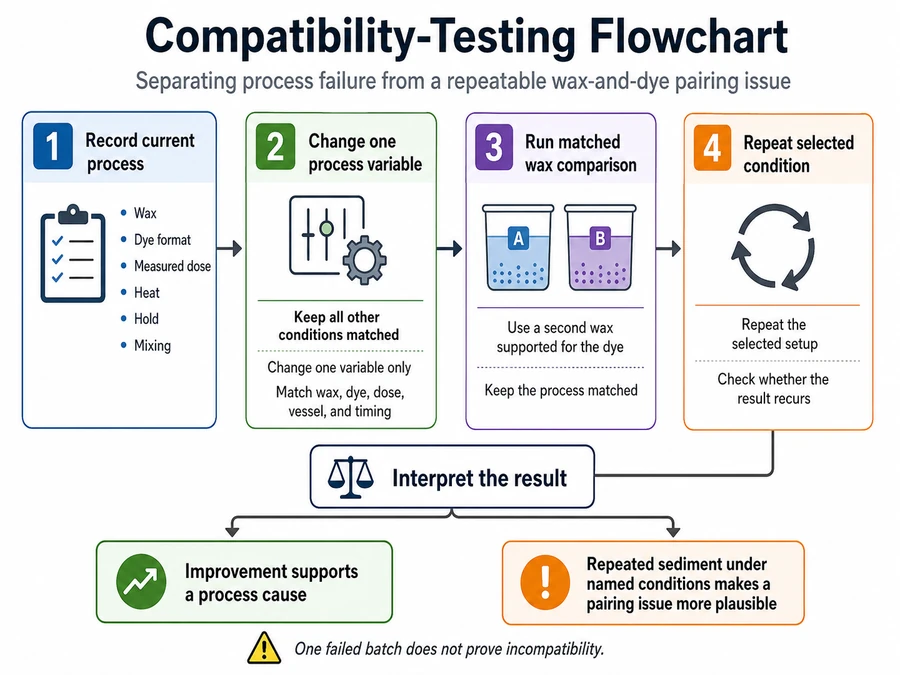
Sediment that decreases after one recorded process correction supports a process failure. Sediment that repeatedly returns under the named product conditions makes a material mismatch more plausible for that exact wax, dye, dose, and procedure.
Inspect liquid candle dye in its closed container before shaking, warming, stirring, or dispensing it. Record layers, sediment, crystals, particles, thickening, or another visible change.
Visible bottle separation does not automatically mean the product is unusable. Follow the supplier’s current storage, remixing, handling, and shelf-life instructions before testing it in wax.
Do not invent warming, solvent, filtration, storage-temperature, or disposal procedures. Stop improvised use when crystals remain unresolved, contamination is suspected, the consistency is abnormal, or the product behaves outside its instructions.
Methods note: Record the product and lot, bottle condition, wax, measured dose, process conditions, and hot, held, and cooled results. This comparison may identify the likely source stage, but it cannot prove chemical identity or a universal shelf life.
Can Too Much Candle Dye Settle at the Bottom?
Excessive candle-dye loading can cause bottom sediment when the measured amount exceeds what the named dye and wax system can incorporate under the tested conditions.
There is no universal loading percentage for every candle-dye format, wax, color strength, and process. Too much dye means too much for the named product, wax, measured dose, and recorded procedure.
| Sample | Dye amount | Conditions held fixed | Required observations |
|---|---|---|---|
| Lower-dose control | Record by mass or a documented drop method | Wax, vessel, heat, mixing, holding, and cooling | Hot result, cooled result, residue score, and color score |
| Baseline dose | Record using the same unit and method | Keep matched | Use the same observations and scoring scale |
| Higher-dose test | Change dose only | Keep every other recorded condition matched | Compare residue and color separately |
| Repeat of selected dose | Repeat the same amount | Repeat the matched process | Check whether the result recurs |
Measured dye loading means recording the candle-dye and wax amounts with stated units and a repeatable method. Mass is easier to compare than drops because dispenser and handling differences can change drop size.
Extra dye is a plausible cause when residue rises with the measured dose, a lower-dose control remains more uniform, and the pattern repeats under matched conditions.
Score residue from 0 for none visible to 3 for heavy visible residue, and score color from 0 for the lightest result to 3 for the darkest. These local scores are not industry standards or production-release criteria.
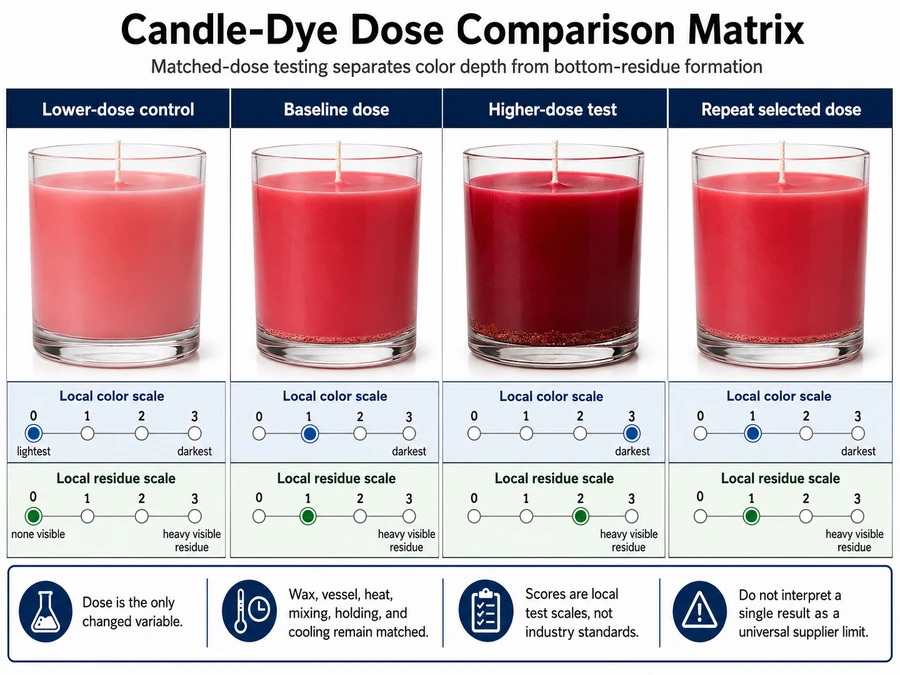
Changing the dose, wax, temperature, stirring method, and vessel together cannot show which change affected the sediment. Change one declared variable and keep the remaining conditions matched.
Adding a measured amount of compatible wax may lower the concentration when a controlled comparison supports overload. Treat dilution as a recovery hypothesis, record the changed formula, and retest it separately.
No named dye, wax, or supplier dosing instruction was supplied, so no product-specific limit is stated here.
Methods note: Record the wax and dye, amounts and units, vessel, temperature procedure, mixing method, observation stages, scoring method, trial count, and limitations.
Treat loading as a plausible cause only when the matched comparison produces a repeatable difference.
Why Addition Temperature Affects Complete Dye Dissolution
Candle dye may remain as bottom residue when the addition temperature or hold condition does not fully incorporate the named dye format into the named wax.
Dye-add temperature is the measured wax temperature when the candle dye is introduced. It is not automatically the same as the wax-melting temperature, fragrance-add temperature, pour temperature, reheating temperature, or room and cooling temperature.
The relevant thermal condition depends on the exact candle dye, its format, the wax, the measured amount, the hold period, and the supplier’s current instructions. “Hot enough” does not mean using the highest possible temperature.
Use this failure log to locate where incomplete incorporation appears.
| Test stage | Actual temperature | Timepoint or duration | Observation | Possible meaning | Next check |
|---|---|---|---|---|---|
| Wax before dye addition | Record | Record | Wax condition and clarity | Confirms the starting condition | Compare with the named wax instructions. |
| Dye addition | Record | Time zero | Immediate fragments, specks, streaks, or clumps | The dye may not be incorporating under the current condition | Verify the dye format and product instructions. |
| End of hold period | Record | Record | Whether visible material remains | More time may not solve an unsuitable material or excessive dose | Inspect the pot base and record the mixing procedure. |
| After full-pot mixing | Record | Record | Surface, sides, and pot-base result | A clear surface may still hide bottom material | Check the base before pouring. |
| Before pouring | Record | Record | Recurring residue or concentrated streaks | Material may have returned during holding | Compare heat, hold, dose, and compatibility. |
| After cooling | Record | Record | Jar-bottom fragments, specks, or sediment | Hot disappearance may have been temporary | Compare the hot, held, and cooled observations. |
Solid dye chips and blocks need sufficient product-specific heat, hold time, and mixing to melt and incorporate. Powder candle dye may form aggregates that persist even when the surrounding wax looks clear.
Liquid dye can introduce crystals, precipitate, or separated material that existed before addition. Additional heat should not be assumed to restore a liquid product whose condition falls outside its handling instructions.
A controlled reheating check may show whether the original thermal condition was insufficient. Keep the wax, dye, dose, vessel, and mixing method matched, then compare the addition condition, held result, and fully cooled result.
Do not keep raising the temperature through repeated uncontrolled attempts. Follow the named dye and wax limits, and stop when the material remains unresolved or the product instructions do not support further heating.
Methods note: Record the wax, dye product and format, addition temperature, measuring tool, hold duration, mixing method, sample mass, dose, observation stages, trial count, date, and limitations. Do not compare one hot sample with a different cooled batch.
Correct the thermal process when a matched retest removes the residue through the hold and cooled stages; investigate identity, loading, mixing, contamination, or compatibility when it does not.
How to Fix Unmelted Dye Chips or Blocks
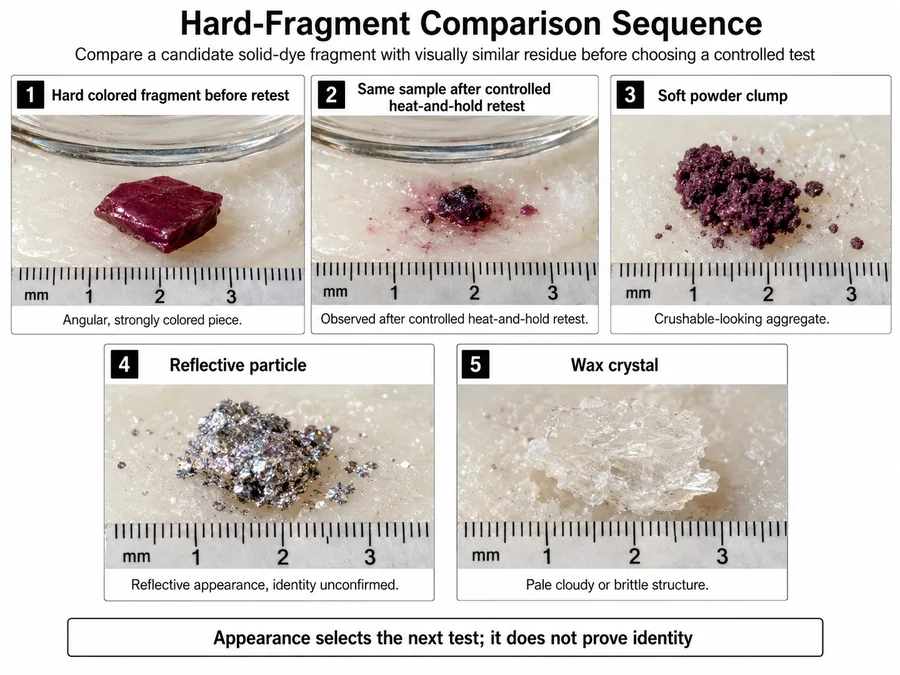
Hard colored fragments may be unmelted dye chips or blocks when the product lacked sufficient product-specific heat, hold time, or full-pot mixing.
A dye fragment is a hard, discrete piece that may come from solid candle dye but still requires comparison with powder clumps, reflective particles, wax crystals, and contamination. <!– IMAGE-PLACEHOLDER –>
ALT TEXT: Close-up comparison of hard candle dye fragments, soft powder clumps, reflective mica particles, and wax crystals
FILENAME: candle-dye_hard-fragment-comparison.webp
VISUAL TYPE: Labeled Hard-Fragment Photo Sequence
PURPOSE: Compare candidate solid-dye fragments with visually similar residue before and after a controlled heat-and-hold retest. <!– /IMAGE-PLACEHOLDER –>
Photograph the same material before and after the controlled retest, using consistent lighting and a visible scale.
| Observation | Possible material | Behavior clue | Next check |
|---|---|---|---|
| Hard, angular, strongly colored fragment | Unmelted dye chip or block | May retain its shape during ordinary stirring | Verify the exact solid-dye product and processing instructions. |
| Soft or crushable colored lump | Powder-dye clump | May break apart under light pressure or stirring | Check the powder format, addition method, and recurrence after resting. |
| Shimmering or reflective particle | Mica or another reflective solid | Reflects light and remains particulate | Verify the product’s intended candle use. |
| Pale, cloudy, or brittle crystal | Wax crystal or another wax structure | May resemble a speck without matching the dye color | Compare it with an undyed wax control. |
| Irregular debris unlike the current dye | Equipment or packaging contamination | May appear in an undyed control | Inspect and clean the equipment before retesting. |
Hardness and color support a provisional diagnosis, but they do not prove that the fragment is a dye chip. A fragment matching the original dye color may still be old residue from an earlier batch.
Ordinary stirring may move a fragment without melting it. A clear wax surface can therefore coexist with solid material at the pot base, and the fragments may enter the jar during the final part of the pour.
Use this bounded correction sequence:
- Stop pouring. Do not transfer more bottom material into the jars.
- Inspect the pot base. Record fragment shape, hardness, color, reflectivity, and location.
- Verify the product instructions. Confirm that the material is solid candle dye and review its named wax, heat, hold, and mixing requirements.
- Apply a controlled heat-and-hold condition. Stay within the documented limits for the dye and wax.
- Mix through the full pot. Reach the base and sides rather than moving only the surface.
- Verify the hot, held, and cooled outcomes. Check whether fragments disappear, remain absent after movement stops, and remain absent after cooling.
| Retest result | Bounded interpretation |
|---|---|
| Fragments remain hard while hot | The thermal condition may still be unsuitable, or the material may not be the expected solid dye. |
| Fragments disappear while hot but return during holding | Temporary distribution or another recurring solid condition remains possible. |
| Fragments disappear while hot but appear after cooling | The batch requires further material, dose, or compatibility diagnosis. |
| Fragments remain absent through holding and cooling | Incomplete melting or pot coverage becomes a stronger explanation. |
| An undyed control produces similar fragments | Equipment, wax, or contamination is more likely than the current dye. |
Do not assign a universal remelt temperature or stirring time. The acceptable condition depends on the named dye, wax, dose, vessel, equipment, and supplier guidance.
Methods note: Record the solid-dye product, wax and lot, dose, temperature, hold duration, mixing method, vessel, observation stages, trial count, date, and limitations. Photograph the fragments before and after the matched retest.
Persistent fragments after a supplier-aligned retest call for investigation of the material identity, dose, wax pairing, or contamination rather than repeated uncontrolled heating.
How to Mix Candle Dye Through the Entire Pouring Pot
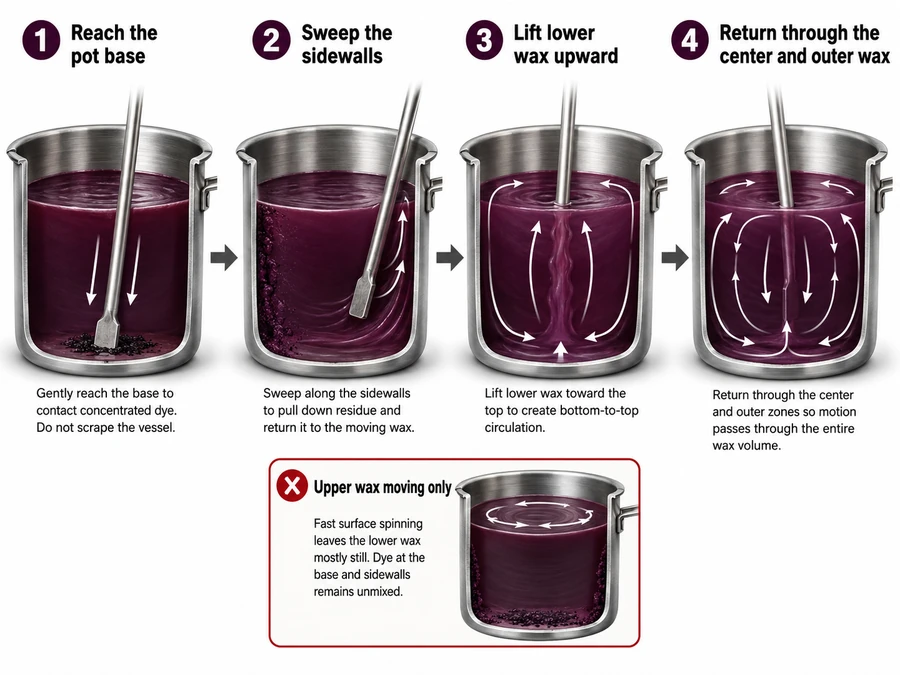
Mix candle dye through the full wax volume with controlled bottom-to-top circulation that reaches the pouring pot’s base, sidewalls, center, and upper wax.
Fast surface movement does not prove full-pot coverage. Mixing time depends on the dye format, wax amount, temperature, vessel shape, tool, and supplier instructions. <!– IMAGE-PLACEHOLDER –>
ALT TEXT: Bottom-to-top candle dye mixing path reaching the base, sidewalls, center, and upper wax in a pouring pot
FILENAME: candle-dye_bottom-to-top-pot-mixing-path.webp
VISUAL TYPE: Labeled Pot-Coverage Diagram
PURPOSE: Show a controlled stirring path through the complete wax volume rather than surface-only circular movement. <!– /IMAGE-PLACEHOLDER –>
The mixing path reaches the pot base, sweeps the sidewalls, lifts wax upward, and returns through the center without aggressive aeration.
- Reach the pot base. Lift concentrated material without scraping or damaging the vessel.
- Sweep the sidewalls. Pull dye, powder, or wax-bound residue back into the moving wax.
- Lift lower wax upward. Do not spin only the upper layer.
- Return through the center and outer wax. Move the complete volume rather than one visible zone.
| Mixing sign | What it shows | What it does not prove |
|---|---|---|
| Fast circular movement at the surface | The upper wax is moving | The base and sidewalls are fully mixed |
| Surface streaks disappear | Upper-layer color has spread | Fragments or clumps have dissolved |
| The tool reaches the base and sweeps the sides | The movement covers more of the vessel | The material is compatible |
| Residue returns after movement stops | Particles, clumps, poor incorporation, or another cause remains | Mixing duration is the only cause |
Mixing moves material through wax. Dissolution or stable incorporation means separate visible material does not return during the recorded hold and cooling observations.
Soft powder clumps may break apart during stirring and return after the wax is left undisturbed. Confirm that the powder is made for the named candle-wax use before changing the process.
Do not add an improvised solvent, carrier, dispersant, or universal pre-mixing formula. Use only handling methods supported for the exact powder and wax.
Run a Re-Stir Persistence Test: Redistribution vs Dissolution
A re-stir persistence test checks whether bottom residue remains incorporated after stirring stops or returns while the wax is left undisturbed.
Mixed back in means visually redistributed under the recorded test conditions; it does not prove chemical dissolution, permanent stability, or suitability for a wicked candle.
- Document the residue before stirring.
- Record the wax temperature and use the same full-pot mixing path.
- Stop all movement and inspect at predefined hold points.
- Inspect the cooled sample when jar-bottom sediment was part of the original failure.
| Result | Bounded interpretation | Next branch |
|---|---|---|
| Residue remains after stirring | The material was not incorporated by the recorded mixing method | Check identity, pot coverage, heat, loading, and contamination. |
| Residue disappears and returns during the hold | The material was redistributed temporarily | Check identity, loading, and compatibility. |
| Residue returns only after cooling | A thermal, loading, or compatibility condition remains | Run a controlled thermal comparison. |
| Residue stays absent through holding and cooling | The recorded mixing correction may have resolved the visible failure | Repeat the result before relying on it. |
Methods note: Keep the wax, dye, dose, vessel, temperature condition, mixing tool, movement path, observation points, and additives unchanged during the test.
Use a thermal retest when residue returns during holding or cooling, a lower-dose comparison when concentration remains suspect, and material replacement when an unsuitable or unresolved solid persists.
Why Holding, Cooling and Reheating History Changes Dye Settlement
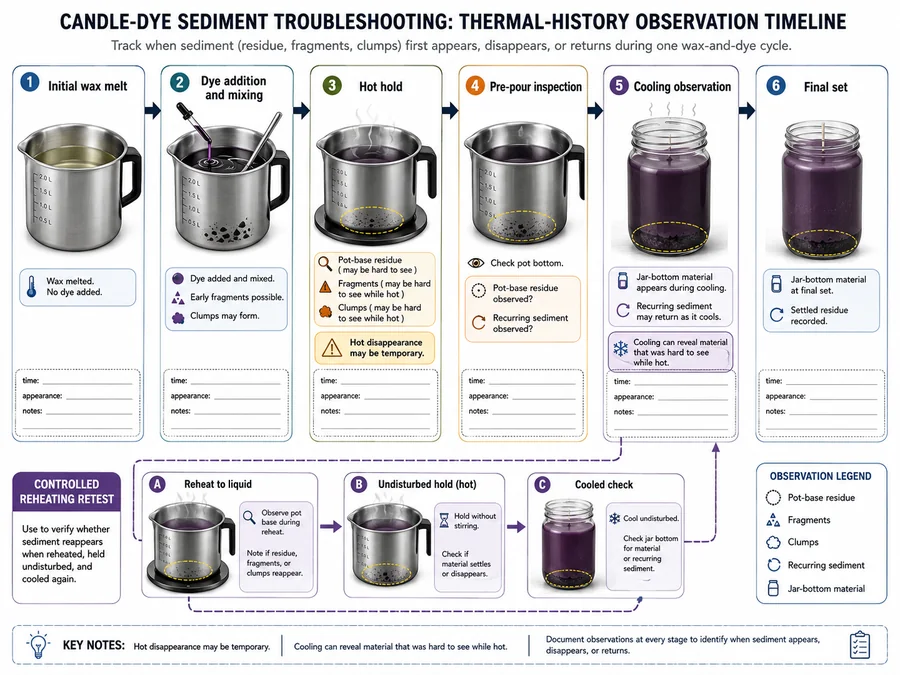
Holding, cooling, reheating, and remixing can change when candle-dye sediment becomes visible, but a temporary disappearance while hot does not prove lasting incorporation.
Thermal history is the recorded sequence of heating, holding, mixing, cooling, reheating, pouring, and setting experienced by one wax-and-dye sample. <!– IMAGE-PLACEHOLDER –>
ALT TEXT: Candle dye thermal history timeline from initial wax melting through dye addition, holding, cooling, reheating, pouring, and final setting
FILENAME: candle-dye_thermal-history-observation-timeline.webp
VISUAL TYPE: Thermal-History Observation Timeline
PURPOSE: Show when candle-dye sediment first appears, disappears, or returns during one recorded wax-and-dye cycle. <!– /IMAGE-PLACEHOLDER –>
The timeline records when sediment first appears, disappears, or returns during one controlled wax-and-dye cycle.
| Stage | What to record | What the result may show |
|---|---|---|
| Initial wax melt | Wax condition, movement, debris, and pot-base residue | Material present before dye addition points away from the current dye. |
| Dye addition | Actual condition, addition method, fragments, clumps, or immediate sediment | Immediate residue may involve the dye format, dose, or addition condition. |
| Hot hold | Temperature, duration, mixing state, and pot-base result | Residue may recur while the wax remains hot but undisturbed. |
| Pre-pour stage | Pot base, sidewalls, and color distribution | Material present here may enter the final portion poured. |
| Cooling | Named observation points and the location of visible material | Cooling may reveal particles or concentration that was difficult to see while hot. |
| Final set | Jar-bottom material and final distribution | The cooled result shows whether the visible correction persisted. |
Wax viscosity changes how quickly unresolved particles can move, but it cannot make a particulate colorant soluble. Faster cooling may trap particles away from the base without removing them from the formula.
Do not treat hot uniformity, slower movement, or a different final distribution as proof of chemical dissolution, wick suitability, permanent stability, or production approval.
Run a Controlled Heat-and-Hold Retest
A controlled heat-and-hold retest changes the thermal condition while keeping the wax, candle dye, measured dose, vessel, sample weight, and mixing method fixed.
Define the target condition, hold duration, and observation points before heating. Stay within the documented limits for the named wax, dye, and equipment.
| Test phase | Required observation | What it shows |
|---|---|---|
| Target hot condition | Record whether sediment remains or disappears | The immediate response to the changed thermal condition |
| Undisturbed hold | Record whether sediment returns after movement stops | Whether the hot result was temporary |
| Fully cooled check | Record bottom residue in the pot or sample | Whether the visible correction survived cooling |
Do not keep raising the temperature through uncontrolled attempts. Stop when the material remains unresolved, the required condition exceeds documented limits, or the product instructions do not support more heating.
A repeated clear result may support correcting the original addition or holding condition. Persistent residue calls for checking loading, compatibility, unsuitable solids, contamination, or the colorant’s condition.
Methods note: Record the wax and dye, dose, sample weight, vessel, temperatures, hold points, mixing events, hot result, held result, cooled result, trial count, and limitations. This test does not prove laboratory solubility or approve burning, production, or sale.
Use the first stage at which sediment remains or returns to select the next cause-specific test.
Pouring-Pot Residue vs Jar-Bottom Sediment: Where Did Settling Begin?
Pouring-pot residue exists before or during transfer, while jar-bottom sediment may have been carried from the pot, concentrated in the final pour, or become visible during pouring or cooling.
The pot bottom is the pouring pot’s base at a named pre-pour stage. The jar bottom is the finished container’s base immediately after pouring or at a named cooling or setting stage.
A clear pot surface does not prove that the pot base is clear.
| First observed stage | Pot and jar pattern | Transfer condition | Likely branch | Required next test |
|---|---|---|---|---|
| Pot after mixing | Pot residue present before transfer | No pouring has occurred | Incomplete dissolution, persistent solids, poor pot coverage, loading, or contamination | Inspect the material and run a stirring or thermal persistence test |
| Pot immediately before pouring | Pot residue appears during holding | Transfer is about to begin | Recurring settlement during the hold | Run a controlled heat-and-hold retest |
| Jar immediately after pouring | Pot and jar both show residue | Base may have been disturbed or scraped | Pot sediment may have transferred into the jar | Compare transfer order and the final wax portion |
| Jar immediately after pouring | Jar residue appears, but the pot base was not inspected | Origin is unresolved | Material may have existed below a clear pot surface | Repeat with deliberate pot-base inspection |
| Jar after cooling | Pot was documented clear at its base and jar residue appears later | No visible pre-pour residue | Cooling, viscosity, loading, or compatibility may affect visibility or movement | Run a same-batch split observation with fixed cooling stages |
| Pot residue remains, but jars appear even | Residue was left behind | Pot base was not scraped into the jars | The transfer avoided visible sediment but did not resolve its cause | Diagnose the retained pot material |
| Final jar alone receives heavy residue | Earlier jars appear clearer | Final concentrated wax portion entered one jar | Pot-bottom concentration likely transferred late | Record jar order and repeat the same-batch comparison |
Compare these four stages:
- Inspect the pot base after mixing.
- Inspect the pot base immediately before pouring.
- Inspect each jar immediately after pouring.
- Inspect each jar at a named cooling or fully set stage.
Transfer technique can change where the sediment is found. Scraping the pot base may move concentrated material into a jar, while leaving the residue behind can produce even-looking candles without correcting the original failure.
Jar order matters. When the final jar contains more residue than the earlier jars, the last portion may have carried material concentrated near the pot base.
Do not say that the dye “formed in the jar” merely because it was first noticed there. That conclusion requires a documented pot-base inspection before transfer and observations tied to named jar stages.
A ring, streak, or color band without physical bottom material is a different defect. Wet spots, adhesion changes, sinkholes, vessel quality, and general container-cooling problems are outside this comparison.
When unsuitable or unidentified solids reach the wax surrounding a wick, stop treating the problem as a cosmetic color defect. Isolate the formula and apply the separate material-suitability and candle-testing procedures before downstream use.
Methods note: Record the wax, dye, dose, pot-base condition, transfer order, base scraping, final-pour jar, immediate jar result, cooling stage, photographs, trial count, and limitations. Name the vessel and observation time in every conclusion.
Use a same-batch pot-versus-jar split when the origin remains uncertain; move to a cause-matched recovery decision only after the first visible stage has been narrowed.
Run a Same-Batch Pot-versus-Jar Split Observation
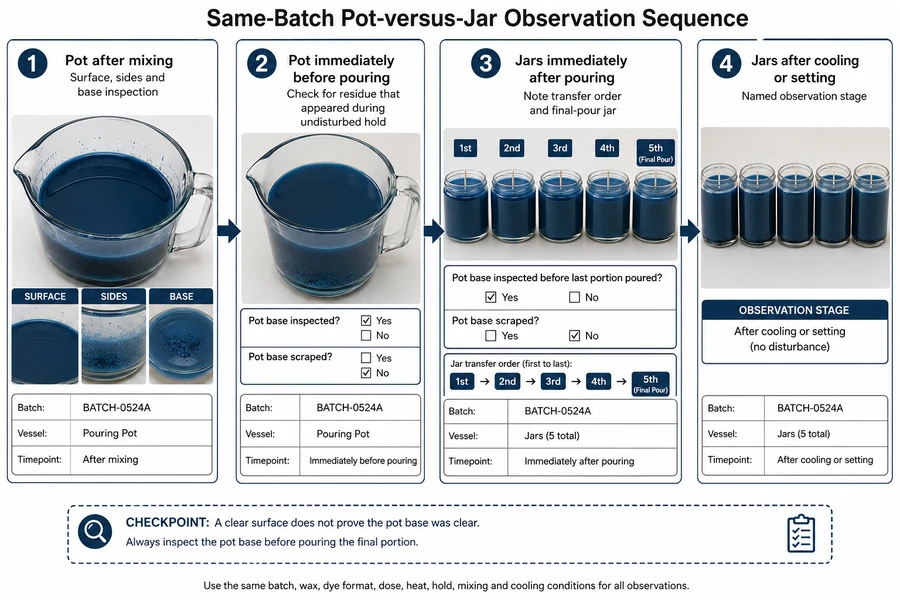
A same-batch pot-versus-jar split compares one controlled wax-and-dye mixture before transfer, immediately after pouring, and after cooling or setting.
Same-batch means one mixed wax-and-dye preparation divided only at the declared observation stage, without adding more wax, dye, fragrance, or another additive. <!– IMAGE-PLACEHOLDER –>
ALT TEXT: Same candle dye batch photographed in the pouring pot after mixing, before pouring, in jars after pouring, and after cooling
FILENAME: candle-dye_same-batch-pot-versus-jar-sequence.webp
VISUAL TYPE: Four-Stage Paired Photo Sequence
PURPOSE: Identify the earliest visible stage of candle-dye sediment without introducing variation from separately prepared batches. <!– /IMAGE-PLACEHOLDER –>
The paired sequence labels every image by batch, vessel, timepoint, transfer order, and whether the pot base was scraped.
Keep these conditions fixed before the split:
- one wax-and-dye mixture;
- one measured candle-dye dose;
- one mixing procedure;
- one thermal history;
- one pouring pot;
- matching jars and cooling conditions where practical.
Run the observation in this order:
- Inspect the pot after mixing. Check the surface, sides, and base for fragments, clumps, or concentrated color.
- Inspect the pot immediately before pouring. Record whether residue appeared during the undisturbed hold.
- Inspect each jar immediately after pouring. Label the transfer order and note which jar received the final wax portion.
- Inspect each jar after cooling or setting. Record the named stage rather than using an undefined “later” observation.
Document whether the pot base was deliberately inspected and whether it was scraped during transfer. A clear surface cannot be used as evidence that the pot base was clear.
| Observation stage | Pot-base result | Transfer condition | Jar result | Supported interpretation | Next diagnostic test |
|---|---|---|---|---|---|
| Pot after mixing | Residue already visible | No transfer yet | Not applicable | The failure existed before pouring | Check material identity, heat, loading, mixing, or contamination |
| Pot before pouring | Residue appears during holding | No transfer yet | Not applicable | Settlement recurred after movement stopped | Run a persistence or heat-and-hold test |
| Jar immediately after pouring | Pot residue was documented | Base or final portion entered the jar | Immediate jar sediment | Pot material may have transferred | Compare jar order and retained pot residue |
| Jar immediately after pouring | Pot base was not inspected | Transfer details incomplete | Immediate jar sediment | The origin remains unresolved | Repeat with deliberate base inspection |
| Jar after cooling | Pot base was documented clear | Matched transfer | Sediment appears only after cooling | Cooling, loading, or compatibility may affect visibility or movement | Compare cooling and material conditions |
| Final jar contains the most residue | Concentration remained near the pot base | Final portion entered one jar | Late jar is heavier | Pot-bottom material likely transferred late | Repeat while recording transfer order and base contact |
Inspect the final concentrated wax portion separately. It may contain more residue than earlier portions even when the main wax volume looks even.
Two separately prepared recipes are not an equivalent comparison. Differences in weighing, heating, stirring, vessels, pouring, or cooling can be mistaken for a pot-versus-jar effect.
Do not attribute jar residue to cooling when the pot base was not inspected. The material may have existed before transfer and become noticeable only after it entered the container.
Methods note: Record the batch, wax, dye, dose, thermal history, mixing method, pot-base condition, transfer order, base scraping, jar order, cooling stage, photographs, date, trial count, and limitations.
Use the earliest documented appearance to select the cause-specific test; do not infer that sediment formed in the vessel where it was first noticed.
Reheat, Dilute, Retest or Reject the Batch?
Some test batches can be reheated, diluted, remixed, or retested, but the action must match the diagnosed cause.
A batch is fixed for the diagnosed settling symptom only when residue does not recur during the controlled retest. That result does not approve burning, production, legal compliance, or sale.
| Observed evidence | Likely cause | Permitted corrective action | Mandatory retest | Stop or separate-validation condition |
|---|---|---|---|---|
| Verified candle-dye fragments remain under an insufficient product-specific thermal condition | Incomplete thermal incorporation | Run a controlled heat-and-hold correction within documented limits | Check the hot, undisturbed-hold, and cooled stages | Stop if fragments persist or the required condition exceeds product or equipment limits |
| A lower measured dose repeatedly produces less residue under matched conditions | Excessive loading | Add a measured amount of compatible wax to a controlled sample or reformulate at a lower dose | Repeat dose, color, holding, and cooling observations | Treat the changed wax-to-dye ratio and shade as a new formula |
| Sediment disappears with complete bottom-to-top mixing and remains absent during the persistence test | Incomplete pot coverage | Apply the documented full-pot mixing procedure | Repeat the undisturbed hold and cooled inspection | Stop blaming mixing when residue returns despite complete coverage |
| Mica, pigment, botanical powder, or another unsuitable solid is confirmed | Unsuitable particulate material | Reject or reformulate with a supported candle colorant | Test the replacement formula separately | Do not salvage the unsuitable material through stirring or reheating |
| Residue appears in an undyed blank or only with previously used equipment | Contamination or old residue | Isolate the sample, clean and dry the equipment, then prepare a new control | Repeat the undyed and dyed controls | Stop when foreign material or contamination remains unresolved |
| Liquid dye has unresolved crystals, layers, particles, or abnormal consistency | Unresolved product condition | Review current supplier guidance or replace the test product | Compare the replacement or approved condition in a controlled sample | Stop improvised use when product identity or condition remains uncertain |
| Sediment repeats across matched trials using supported materials and documented processing | Recurring incompatibility | Replace the dye, wax pairing, or both | Test the revised pairing from measured inputs | Stop reworking the original pairing after controlled corrections repeatedly fail |
| The cause cannot be narrowed | Unknown | Isolate or reject the sample | No recovery attempt until identity and cause are resolved | Do not cosmetically restore unknown material |
Should an overloaded batch be reheated without changing the dose? Not as the sole correction, because heat does not remove excessive colorant from the formula.
Can dilution change the candle formula? Yes. It changes the wax-to-dye ratio, shade, total batch mass, thermal history, and possibly later wick or burn performance.
Should wax containing unsuitable pigment be treated as corrected after stirring? No. Even distribution does not turn a persistent solid into wax-soluble candle dye.
Does an even appearance approve the batch for sale? No. Visual recovery addresses only the observed settling symptom under the stated test.
When should the sample be rejected or isolated? Stop when the material or cause remains unresolved, contamination is present, an unsuitable solid is confirmed, supplier constraints would be exceeded, or controlled corrections repeatedly fail.
Reheating changes the sample’s thermal history. Dilution changes its composition and shade. Remixing changes the process record, while replacing the wax or dye creates a different material pairing.
Each altered sample needs a new record of the diagnosed cause, corrective action, measured changes, recurrence result, date, and limitations. Where the formula has changed, apply the separate downstream testing required for the intended candle use.
Use small retained or controlled samples where practical. Do not expose an entire batch to repeated rework before the action has produced a repeatable result under matched conditions.
Methods note: Record the evidence threshold, diagnosed cause, action, amounts and units, process changes, shade change, hot result, held result, cooled result, trial count, stop condition, date, and limitations.
Choose the action that matches the evidence, and reject or isolate the material when a controlled correction cannot resolve the diagnosed settling failure.
Final diagnostic sequence
The correct fix depends on what the colorant is, when the residue first appeared, whether the material dissolves or only redistributes, and whether dose, temperature, mixing, or compatibility was isolated.
- Stop pouring when visible sediment remains.
- Identify the material and the stage where the residue first appeared.
- Run one controlled test while keeping the other recorded conditions unchanged.
- Apply the correction that matches the supported cause.
- Retest every changed formula before downstream use.
A visually clear batch still requires separate testing before burning, production, commercial release, or sale.