
There is no single stirring time for every candle dye. Liquid dye may need only a quick stir, while chips, flakes, or blocks often need several minutes; stop only when no visible specks, streaks, residue, or sediment remain.
- Stir: Mix through the full wax batch; dye format, wax temperature, melt fluidity, batch size, particle size, and technique determine how long this takes.
- Pause: Stop movement briefly so hidden solids or sediment can settle into view.
- Inspect: Check the wax, utensil, sides, and bottom; “full dissolution” means no visible wax-compatible dye solids or concentrated residue remain.
- Decide: Continue while visible dye remains and mixing is still improving. Stop based on the no-residue endpoint, not maximum color strength, cooled color, mica behavior, or pigment suspension.
How Long Should You Stir Candle Dye?
Stir liquid candle dye briefly; chips, flakes, or blocks may need several minutes. In every case, stop only after the wax, utensil, sides, and bottom show no visible dye residue.
No fixed time applies to every batch because wax temperature, fluidity, batch size, particle size, dye format, and stirring technique change how quickly the dye incorporates.
Count only active stirring after the dye enters fully melted wax under the supplier’s processing conditions. Shaving or breaking a dye block before addition is preparation, not stirring time.
After the first interval, pause and inspect the wax, utensil, sides, and bottom. Continue only while residue remains and is getting smaller; stop when no chips, flakes, particles, concentrated streaks, deposits, or sediment are visible. A uniform surface alone is not proof because movement can hide residue below it or in low-contact areas.
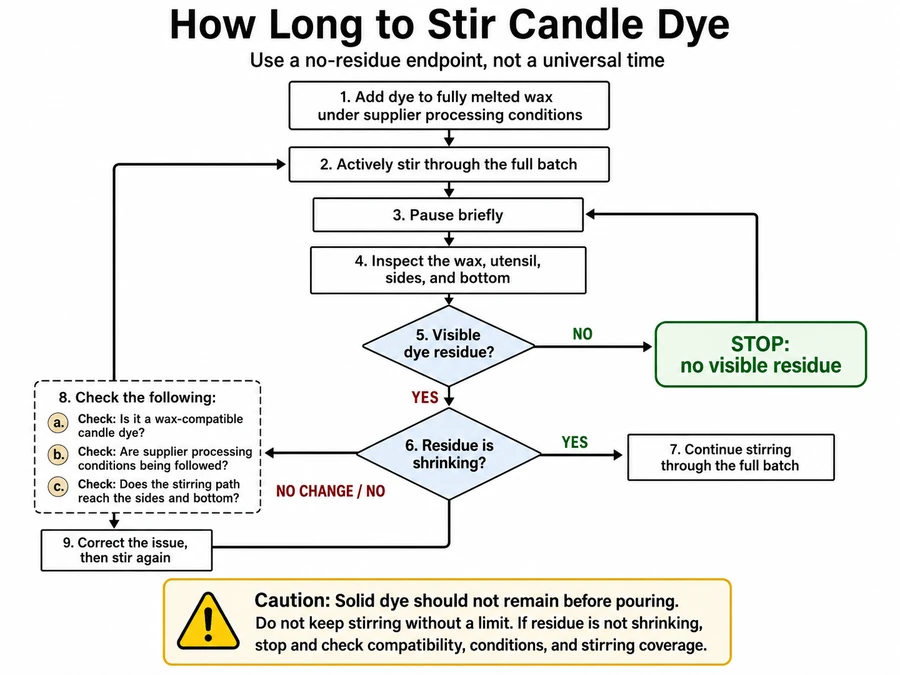
If more stirring produces no visible change, check three conditions: the material is wax-compatible candle dye, the wax follows the supplier’s processing conditions, and the stirring path reaches the sides and bottom. Do not pour with solid dye present or keep stirring without a limit.
Liquid Dye vs. Chips, Flakes, and Blocks: Which Needs More Stirring?
Liquid candle dye commonly needs less visible melting than chips, flakes, or blocks, while solid formats usually need more preparation and stirring before they reach the same no-residue endpoint.
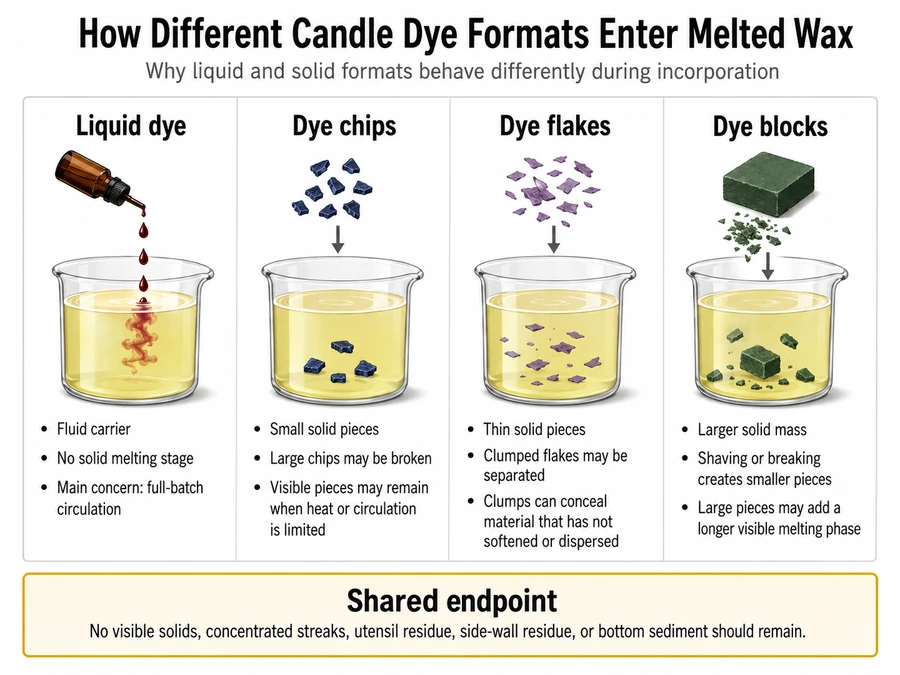
Dye format means the physical delivery form—liquid, chip, flake, or block—not its quality, shade strength, dosage, or compatibility. Liquid dye enters wax in a fluid carrier, whereas solid dye must soften or melt before it can spread evenly through the batch.
For solid formats, smaller pieces expose more material to the melted wax. Shaving blocks, breaking chips, or separating clumped flakes can shorten the visible melting phase, but preparation time does not count as active stirring and does not prove full-batch incorporation.
| Dye format | How it enters melted wax | Preparation effect | Main incorporation concern |
|---|---|---|---|
| Liquid dye | Enters through a fluid carrier | Usually follows the supplier’s addition directions without solid-piece preparation | Complete circulation through the full batch |
| Dye chips | Enter as small solid pieces | Breaking large chips can reduce individual piece size | Visible pieces may remain when heat or circulation is limited |
| Dye flakes | Enter as thin solid pieces | Separating clumped flakes increases wax contact | Clumps can conceal material that has not softened or dispersed |
| Dye blocks | Enter as larger solid masses | Shaving or breaking the block creates smaller pieces | Large pieces can add a longer visible melting phase |
This does not mean one format is always faster. Wax temperature, batch movement, product concentration, preparation, and supplier instructions can change how each format behaves.
Every format must pass the same final check. No visible solids, concentrated streaks, utensil residue, side-wall residue, or bottom sediment should remain before pouring. Faster dispersion does not prove better quality, stronger color, lower dosage needs, or wider compatibility. <!– Suppressed: The controlled dissolution benchmark and Methods mini-box were omitted because no documented measurements, sample size, test date, tools, or source data were supplied. –>
Why Wax Temperature Changes Dye Dissolution Time
Warmer, fully melted wax generally helps solid candle dye soften and disperse, while cooler or more viscous wax can leave particles visible for longer.
Processing temperature is the wax temperature used when dye is added and mixed, based on the wax and dye supplier’s instructions. It affects how quickly solid pieces soften and how freely wax circulates around them.
Temperature has the largest visible effect on chips, flakes, and blocks because they must soften or melt before spreading through the batch. Liquid dye has no solid melting stage, but it still needs enough fluid movement to reach the center, sides, and bottom.
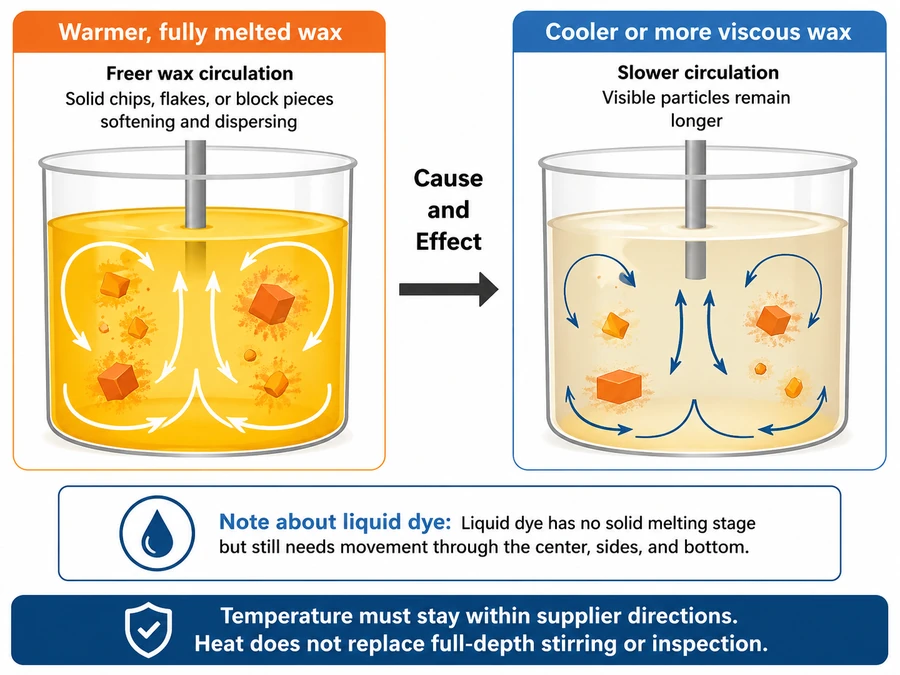
Do not raise the temperature beyond the supplier’s directions. Heat does not replace full-depth stirring, scraping, or inspection, and a warm batch can still hold residue in a poorly mixed area.
If particles remain, confirm that the wax is fully melted and within the supplier-qualified range, then scrape the sides and bottom and stir again. If the residue stops shrinking or disappearing, stop adding heat or stirring and treat it as a separate dissolution problem.
How to Stir Candle Dye Through the Whole Batch
Stir candle dye with a controlled full-depth path that moves wax through the center, around the sides, and across the bottom without relying on surface motion alone.
A full-depth stirring path moves the utensil through the entire wax volume instead of circling near the surface, where color can look even while pieces or concentrated residue remain below.
Move through the center, sweep the pot wall, pass lightly across the bottom, and lift through the upper wax. Keep the motion steady enough to circulate without splashing, scrape visible deposits back into the melt, and change direction to reach low-movement areas.
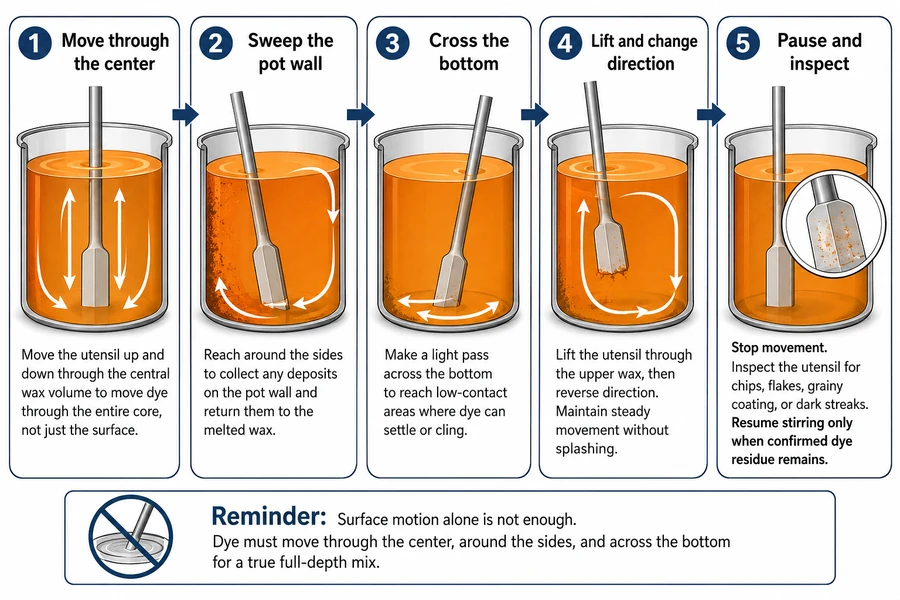
Check the utensil for chips, flakes, grainy coating, or dark streaks. Finish by pausing the wax and resume only when confirmed dye residue remains.
Why Larger or Less-Fluid Batches Need More Deliberate Mixing
Larger or less-fluid wax batches need a more deliberate stirring path because dye must travel farther and thicker wax circulates less freely through the pot.
Wax fluidity describes how easily melted wax flows under the current temperature and batch conditions. Larger batches increase the distance dye must travel, while thicker wax may need slower, broader strokes to reach the sides and bottom.
Do not compensate by stirring only faster near the center. Scrape dye from the utensil or pot surface, move it back through the full volume, and apply the same no-residue endpoint throughout the batch.
What Fully Dissolved Candle Dye Looks Like
Candle dye is fully dissolved when the melted wax shows no visible particles, concentrated streaks, utensil residue, side-wall deposits, or bottom sediment after stirring stops.
Full dissolution means wax-compatible dye has entered the melted wax without visible solid or concentrated residue. It does not confirm final cooled color, maximum strength, dosage, compatibility with every wax, or the behavior of pigments and mica.
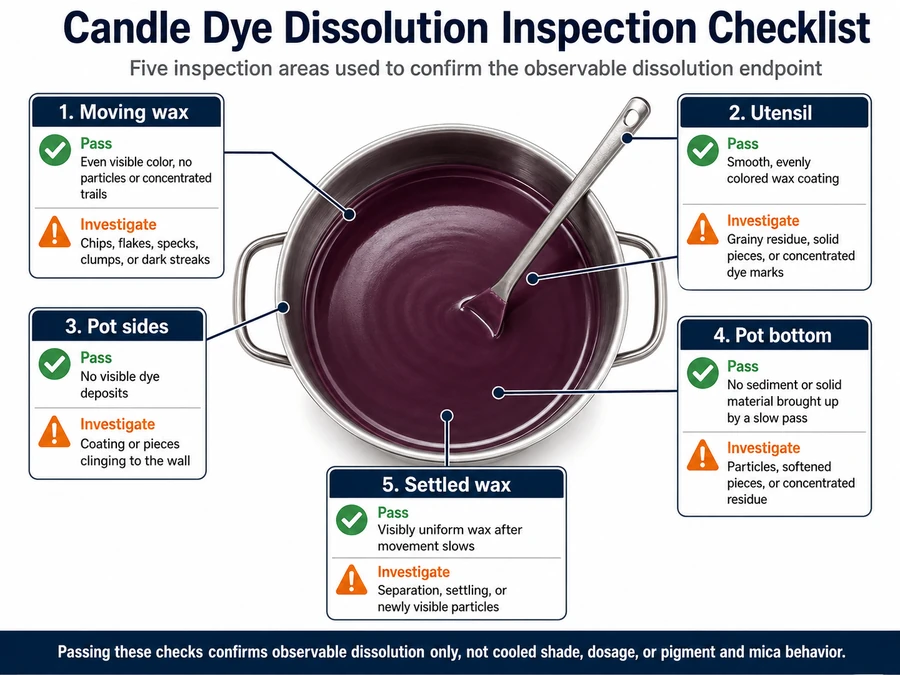
Inspect after movement slows because active stirring can hide particles. Check the visible depth, lift the utensil for grainy or concentrated marks, scrape the pot wall, and make a slow pass across the bottom for sediment or softened pieces.
Use the following pass/fail guide before pouring:
| Inspection area | Pass | Continue stirring or investigate |
|---|---|---|
| Moving wax | Even visible color with no particles or concentrated trails | Chips, flakes, specks, clumps, or dark streaks |
| Utensil | Smooth, evenly colored wax coating | Grainy residue, solid pieces, or concentrated dye marks |
| Pot sides | No visible dye deposits | Dye coating or pieces clinging to the wall |
| Pot bottom | No sediment or solid material brought up by a slow pass | Particles, softened pieces, or concentrated residue |
| Settled wax | Remains visibly uniform after movement slows | Separation, settling, or newly visible particles |
Passing these checks confirms the observable dissolution endpoint. It does not confirm finished-candle shade, dye dosage, or the behavior of pigments and mica, which fall outside this stirring-time decision.