

Solid candle dye chips or blocks leave specks when inadequate heat, oversized pieces, incomplete mixing, excessive local loading, or an incompatible colorant prevents full incorporation before cooling; however, not every visible mark is dye.
Here, “specks” means discrete, usually darker particles of purpose-made solid candle dye that remain visible in finished wax.
The first step is to confirm that the mark is dye residue before changing temperature, particle preparation, mixing, loading, or material choice.
White frosting, reflective bubbles, foreign debris, haze, streaks, rings, and color bands can look similar but come from different problems.
Start by checking what true undissolved candle-dye specks look like, then trace the failed incorporation stage.
What Do True Undissolved Candle-Dye Specks Look Like?
True candle-dye specks are discrete pieces of purpose-made solid dye that remain visibly unincorporated after the wax cools.
They usually match the candle’s color or appear darker because each remaining fragment contains concentrated colorant. They may sit within the wax, near the base or surface, or remain as residue on the pouring pot or stirrer.
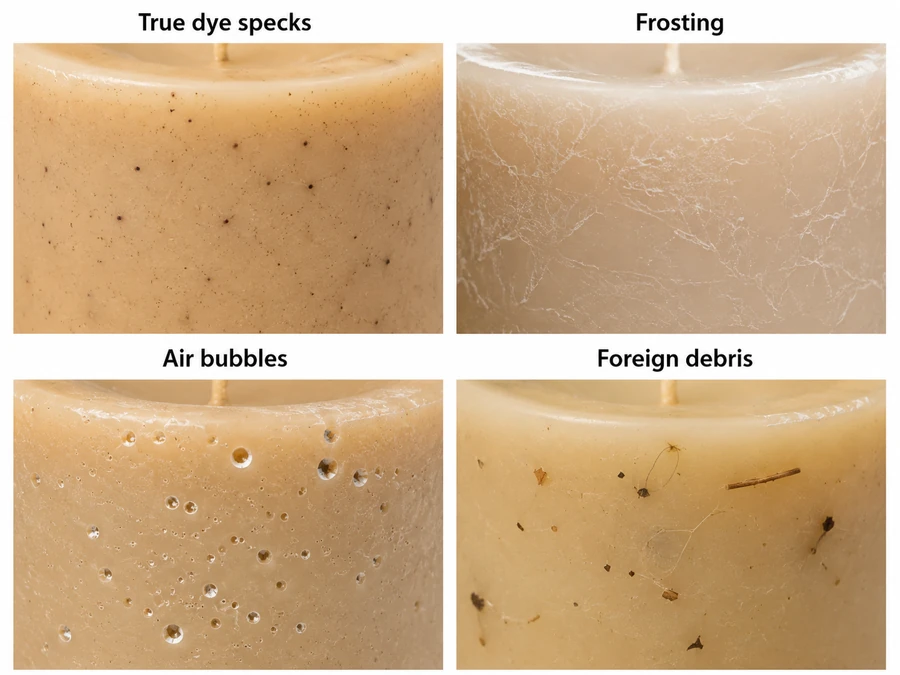
The photo set separates discrete dye-colored particles from crystalline, reflective, and foreign marks.
A mark is more consistent with undissolved solid dye when several signs appear together:
- It has a distinct solid or fleck-like shape rather than a cloudy or branching edge.
- It matches the dye hue or appears as a darker concentration of that hue.
- Similar residue remains on the stirrer, pouring pot base, or sidewalls.
- The same type of speck returns when the same dye and incorporation process are used.
Color alone does not prove that a mark is dye. A white mark in colored wax is less consistent with dye residue unless the product itself is pale and other process evidence supports that conclusion. Location is not decisive either, because dye particles, debris, bubbles, and settled materials can all appear near the candle base.
Once a mark is reasonably consistent with dye residue, compare it with the main look-alike defects before changing the dye process.
How Are Dye Specks Different From Frosting, Bubbles, Debris, and Color Bands?
Undissolved candle-dye specks are discrete colorant particles; they are not a general name for every white spot, bubble, crystal, contaminant, settled layer, ring, streak, or band in candle wax.
Similar candle defects are visible marks that can reasonably be mistaken for undissolved solid dye during an initial inspection. Compare color relationship, location, texture or optical behavior, and pattern together because one clue cannot establish the cause.
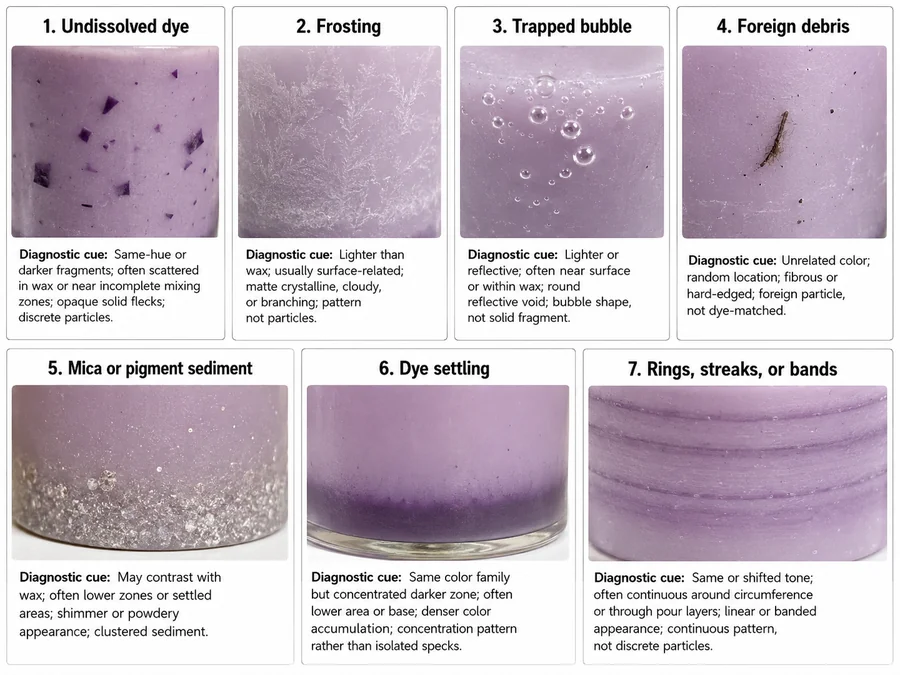
The photo matrix compares visible candle defects by color relationship, location, texture, and pattern.
Methods note: For any photo or process comparison, record the wax, exact dye product and format, batch condition, addition conditions, vessel, batch size, mixing method, temperature conditions, lighting, image scale, and observation point. Matching conditions improve comparison, but photographs and visual process logs cannot prove material identity or chemical compatibility. Follow the dye supplier’s and tool maker’s safety instructions during preparation.
| Defect class | Color relationship | Common location | Texture or optical cue | Pattern | Best confirming clue |
|---|---|---|---|---|---|
| Undissolved solid dye | Usually matches the dye hue or appears darker | Within the wax, near the base or surface, or on the pot and stirrer | Solid, opaque fleck or fragment | Discrete particles | Similar residue remains in the vessel or recurs with the same incorporation process |
| Frosting or crystallization | Often white or pale regardless of the candle color | Surface or container wall | Matte, crystalline, or branching | Cloudy patches or crystal-like growth | The mark forms a pale crystalline pattern rather than a colored solid fragment |
| Trapped air bubble | Clear, silver, or white because it reflects light | Within the wax or against the container wall | Hollow, shiny, or reflective | Round voids or clustered pockets | Its appearance changes with the viewing angle and shows no solid material |
| Foreign debris | May have no relationship to the dye color | Any location | Fibrous, hard-edged, irregular, or unrelated in texture | Usually isolated | The material has fibers, edges, or a color that does not match the colorant |
| Mica or pigment sediment | May match the selected tone but can look metallic or opaque | Commonly near the base or in a layer | Glittering, grainy, or visibly particulate | Scattered particles or a settled layer | The supplier identifies the colorant as mica, pigment, or another particulate material |
| Dye settling | Usually follows the dye hue | Concentrated toward the bottom | Deposit or gradient rather than a retained chip | Layered or downward concentration | The colorant moved during cooling instead of remaining as one distinct solid piece |
| Rings, streaks, or color bands | May match or vary within the candle color | Along the container wall or at a fixed height | Smooth, smeared, or blended | Continuous line, streak, or band | The mark extends across an area instead of appearing as separate particles |
White crystalline marks should not be classified as dye without supporting process evidence. Reflective voids are more consistent with trapped air, while a continuous ring, streak, or band is not a group of discrete specks. Bottom location alone cannot distinguish an undissolved clump from sediment or settling.
Pigment and mica particles may remain visible because they disperse through wax rather than behaving like purpose-made soluble candle dye. More heat or mixing will not make every particulate colorant lose its visible form.
Apply heat, mixing, particle-size, or loading corrections only when the mark remains more consistent with undissolved purpose-made solid dye than with these alternatives.
Why Do Candle Dye Chips or Blocks Leave Specks?
Specks form when solid candle dye does not complete the melting, circulation, and visible-verification stages before the wax cools.
Here, dissolve means losing visible particle form and becoming evenly incorporated in the wax; it does not claim that every colorant is molecularly soluble. Fully liquid wax can still contain a partly melted dye fragment or concentrated residue.
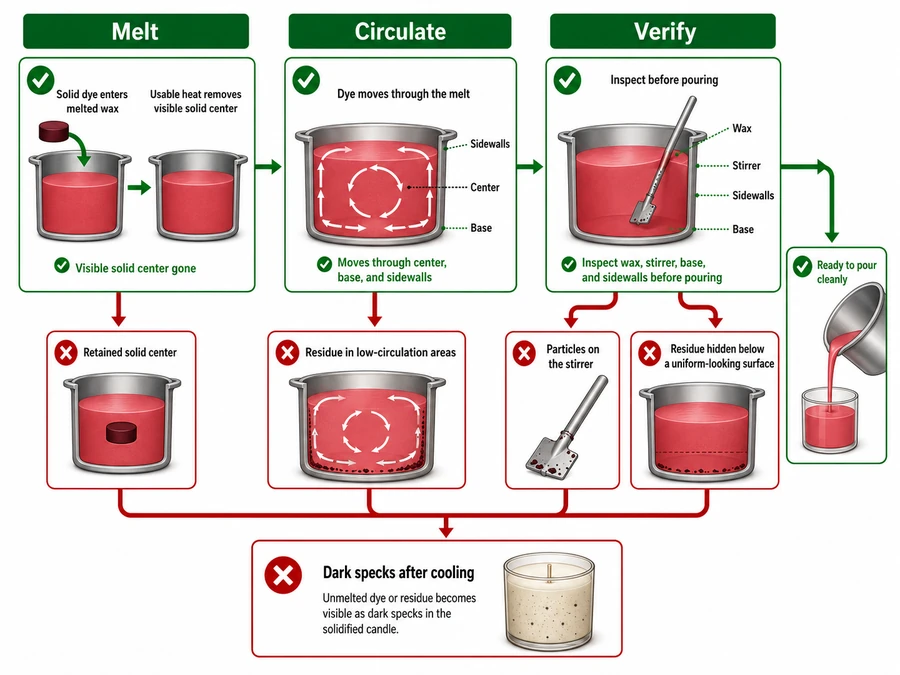
The diagram shows where solid candle dye can remain visible before pouring.
The incorporation process has three linked stages:
- Melt: Heated wax provides usable heat, meaning the dye supplier’s stated incorporation range is maintained until visible solids disappear and no solid center remains.
- Circulate: Mixing moves the softened or melted dye through the whole wax mass, including the pot base and sidewalls.
- Verify: The wax, stirrer, pot base, and sidewalls are checked for remaining particles before pouring.
A failure at any stage can leave concentrated fragments. After cooling, those fragments may appear darker than the surrounding candle because the colorant was never distributed evenly.
Compact failure log for incomplete solid-dye incorporation
| Observation | Likely failure stage | What to check |
|---|---|---|
| A chip softens outside but keeps a solid center | Melt | Heat exposure and piece thickness |
| Dye remains on the pot base or sidewalls | Circulate | Full-pot mixing path and cooler zones |
| Particles remain on the stirrer | Melt or circulate | Usable heat and continued circulation |
| Wax looks uniform from above but residue remains below | Verify | Pot base, corners, and sidewalls |
| Specks return after the same process is repeated | Any stage | Heat, preparation, mixing, load, and material identity in that order |
Check the stages in order rather than changing several variables at once: usable heat, particle preparation, full-pot circulation, dye load and addition point, then material identity.
The practical test is not whether the wax became liquid, but whether every visible dye particle disappeared and the color became uniform throughout the vessel.
If visible solid residue remains before pouring, do not pour that residue into the candle; correct the incorporation step or leave the residue-containing final portion in the vessel.
How Does Wax Temperature Affect Dye-Chip Dissolution?
Solid candle dye needs the wax to remain within the applicable product-specific incorporation range until visible particles disappear; this is not automatically the later pour temperature.
Dye-add temperature is the wax temperature when the solid colorant is introduced. Hot enough means the exact wax-and-dye processing range is maintained long enough to remove visible solids; one temperature does not work for every product.
Measure the temperature in the main wax mass rather than against a cooler pot wall or directly beside the heat source. Maintain the documented range while mixing because small batches can lose usable heat quickly.
Read the exact wax and dye instructions, add the dye within the stated range, circulate it through the whole vessel, and inspect the wax, stirrer, pot base, and sidewalls before pouring. Do not copy a temperature from another wax, dye brand, or colorant format.
Pour temperature may be lower than the temperature needed to incorporate solid dye, and fragrance guidance does not establish the dye-add range. Adequate heat cannot correct a thick retained center, poor circulation, excessive local concentration, or an unsuitable particulate colorant.
How Should Large Dye Blocks Be Prepared Before Addition?
Large or uneven pieces of purpose-made solid candle dye can leave specks because their centers may remain intact after the wax has begun cooling.
Small pieces means consistently divided or shaved portions with more exposed surface, not one guaranteed dimension. They still need the correct measured dose, product-specific heat exposure, complete mixing, and a compatible dye product.
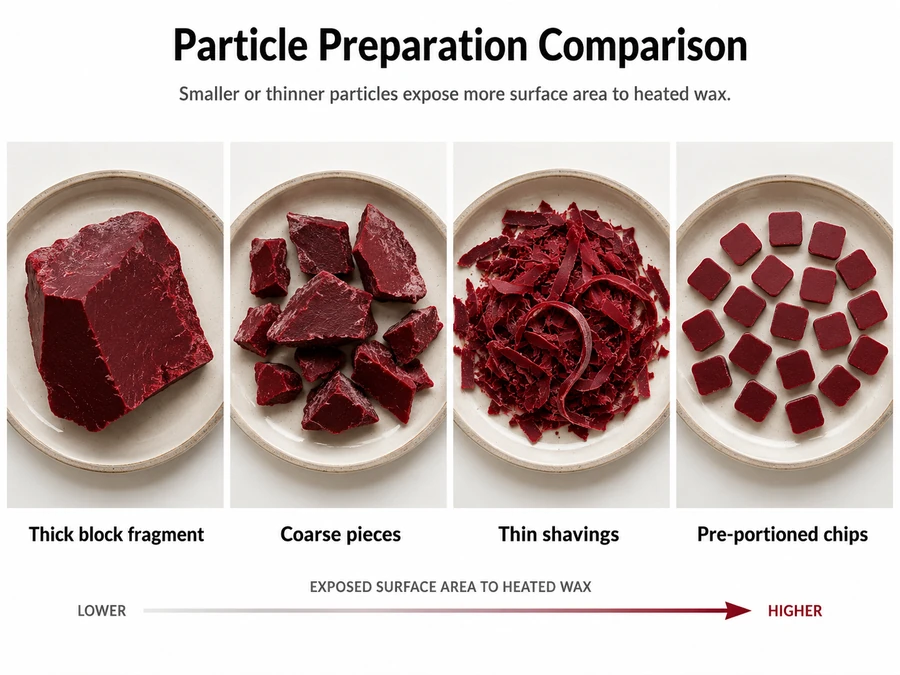
The photo comparison shows how different solid-dye forms expose different amounts of material to heated wax.
A thick fragment exposes less surface relative to its mass than several smaller pieces. Its outside may soften while the center remains solid, especially when the wax loses heat during addition and mixing.
| Dye form | Incorporation concern | Preparation note |
|---|---|---|
| One thick block fragment | A solid center may remain | Divide it while preserving the intended dye mass |
| Several coarse pieces | Uneven pieces may melt at different rates | Prepare pieces as consistently as practical |
| Thin shavings | Greater exposed surface can improve heat contact | Prevent loss of material during preparation |
| Pre-portioned chips | Convenient size does not prove a universal dose | Follow the exact product’s measurement guidance |
A narrow preparation sequence is:
- Confirm that the material is purpose-made solid candle dye.
- Determine the required dye mass from the applicable product guidance.
- Divide or shave a large block into reasonably consistent pieces.
- Add the prepared dye within the documented processing range.
- Maintain heat and circulation until no visible particles remain.
Do not estimate a universal dose by counting chips. Products can differ in size, concentration, and formulation, so equal chip counts do not necessarily contain equal amounts of colorant.
Smaller pieces improve heat contact, but persistent specks after correct preparation point back to heat loss, incomplete circulation, local clumping, or material incompatibility.
What Mixing Steps Prevent Undissolved Dye Specks?
Mixing prevents dye specks when it creates full-pot circulation and continues until no solid residue is visible in the wax, on the stirrer, or along the vessel.
Full-pot circulation means moving wax through the center, base, sidewalls, and upper layer rather than stirring only one area. A uniform surface color does not prove that the bottom and edges are free of dye particles.
Use this five-step mixing check:
- Add the prepared dye within the product-specific processing range.
- Stir through the center of the wax without mixing only at the surface.
- Sweep the stirrer across the base and around the sidewalls.
- Lift and inspect the stirrer for attached particles.
- Inspect the wax and vessel before moving to the pouring stage.
The motion should distribute the dye through the whole wax mass without whipping air into it. Vigorous agitation can create bubbles that may later be mistaken for pale specks or reflective defects.
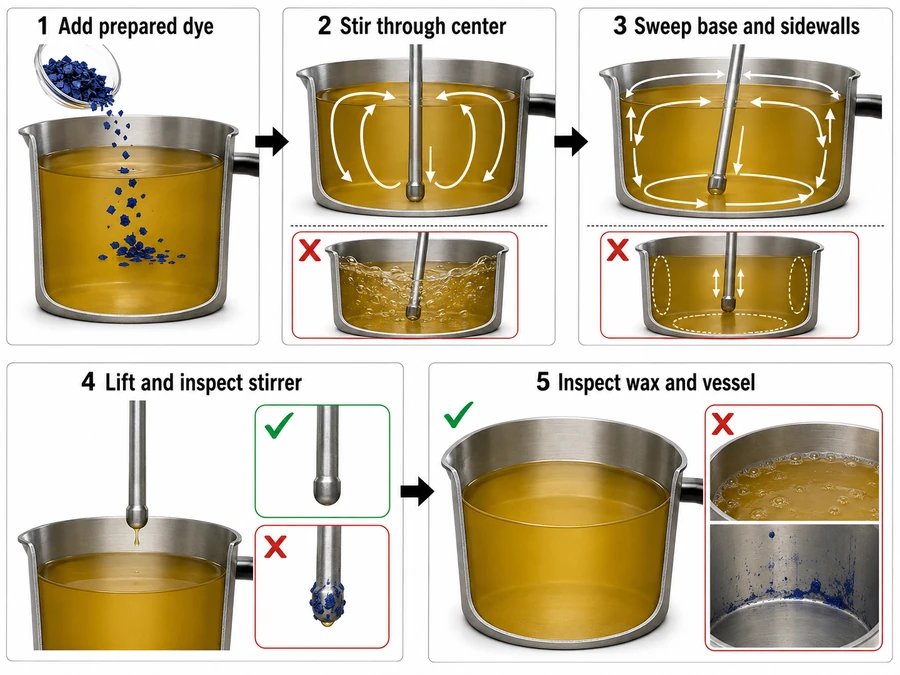
Compact mixing failure log
| Observation | Likely mixing problem | Next process check |
|---|---|---|
| Color is uniform at the surface, but specks appear after pouring | Lower wax was not fully circulated | Sweep the vessel base and inspect below the surface |
| Dye remains on the sidewalls | Mixing path missed the vessel edges | Include the full circumference during stirring |
| Particles cling to the stirrer | Dye has not fully melted or dispersed | Continue within the documented processing conditions |
| Dark fragments collect near the base | Residue remained in a low-circulation area | Check the base before pouring |
| Bubbles appear during or after mixing | Agitation may be too forceful | Use controlled movement while maintaining circulation |
Do not rely on a fixed stirring time unless it comes from documentation for the exact materials and process. The visible endpoint is more useful: no retained particles on the stirrer, pot base, sidewalls, or within the wax.
When specks remain despite full-pot circulation, check whether the dye entered as pieces that were too large, formed a concentrated local clump, or was not a compatible wax colorant.
Why Do Dye Load and Addition Method Create Local Clumps?
Solid candle dye can form a local clump when too much material is concentrated in one part of the wax faster than the available heat and circulation can incorporate it.
Total dye load is the full amount of colorant added to the batch. Local concentration is the amount temporarily gathered in one small area before it spreads through the wax.
A batch can use an acceptable total amount yet still develop specks when the dye is dropped into one place, added as a compact pile, or allowed to collect against a cooler surface. When dye collects in one spot, the surrounding wax must melt the concentrated mass while mixing moves incorporated color away and brings fresh heated wax into contact with the remaining solid.
| Observation | Possible loading or addition issue | What to check |
|---|---|---|
| Several fragments appear close together | Dye entered as one concentrated cluster | Addition point and initial circulation |
| Residue forms beneath the addition point | Material settled before spreading | Heat exposure and immediate mixing path |
| A dark clump remains while the rest of the wax looks uniform | Too much dye collected in one spot for the available heat and mixing to incorporate it evenly | Particle preparation and staged distribution |
| Specks appear only after a darker shade is attempted | Higher total load may have increased process demand | Product guidance, heat, and circulation |
| The candle is dark but contains no particles | High color depth alone is not proof of excess dye | Look for actual retained solids |
A dark candle does not automatically contain too much dye. Shade depth depends on the product, wax, batch size, and intended result, while visible specks show that some material remained locally unincorporated.
Add prepared pieces so they contact heated wax rather than piling against one another. Begin whole-pot circulation promptly, and inspect the addition area, vessel base, and stirrer before pouring.
Do not publish a universal loading percentage for all solid candle dyes. The applicable amount must come from documentation for the exact dye and wax combination, followed by observation of whether the material fully incorporates.
When correct addition and circulation still leave particulate residue, confirm that the product is truly a purpose-made candle dye rather than mica, pigment, crayon, or another incompatible colorant.
Is the Material Candle Dye, Pigment, Mica, or Another Colorant?
A chip or block shape does not prove wax solubility; pigments, mica, crayons, water-based colorants, and incompatible materials may remain particulate despite added heat and mixing.
Material identity means the product’s stated colorant type and intended use, not merely its appearance. Confirm the exact product and supplier, whether it is sold for coloring candles, its compatible waxes, and its addition guidance.
| Material type | Expected behavior in wax | Diagnostic check |
|---|---|---|
| Purpose-made solid candle dye | Should lose visible particle form in compatible candle wax when processed correctly | Rule out heat loss, large pieces, incomplete mixing, and local clumping |
| Pigment or mica | Remains as fine solid or reflective particles dispersed through the wax | Check whether the supplier identifies the product as a pigment, mica, or particulate colorant |
| Crayon or repurposed wax color | May contain wax, pigment, and additives not intended for candles | Check the original product purpose and ingredient information |
| Water-based, unidentified, or incompatible colorant | May separate or remain visibly particulate | Treat unclear documentation as unresolved material identity rather than proof of processing failure |
Persistent specks do not by themselves prove that a purpose-made dye is incompatible. First rule out heat loss, large pieces, incomplete mixing, and local clumping when the product documentation confirms candle-wax use.
Packaging terms such as “color block,” “wax color,” or “candle color” may not explain how the material behaves in wax. The technical description and intended application carry more diagnostic value than the product’s shape.
When a documented candle dye still leaves discrete particles, return to the melt, circulation, loading, and verification stages. When the material is particulate, water-based, unidentified, or unsuitable for the wax, repeated heating and stirring may not remove the visible particles.
Diagnostic and prevention summary
Before changing a future batch, confirm the following:
- The mark is a discrete dye-colored particle rather than frosting, a bubble, debris, sediment, or a continuous band.
- The product is purpose-made solid candle dye for the selected wax application.
- Large or uneven pieces were divided while preserving the intended dose.
- The wax remained within the documented incorporation conditions.
- Mixing reached the center, base, sidewalls, and upper wax.
- No residue remained on the stirrer or vessel before pouring.
- The dye was not added as a concentrated local pile.
- Only one process variable is changed in the next controlled batch.
This sequence separates a failed incorporation step from the use of a material that was never meant to disappear into candle wax.