

Finished-candle color QC compares completed candles with an approved physical reference, peer units, identity records, and customer-facing representations under repeatable conditions to assign a color-only release decision.
This checklist is for candle sellers and fulfillment teams deciding whether finished color quality is ready for sale or shipment. Accept means the color evidence meets the approved requirement; Hold pauses the batch when evidence is incomplete, contradictory, or unresolved; Recheck repeats the inspection after fixing a comparison problem; Reject records a confirmed color failure.
The finished candle and current approved physical reference are primary. “Before selling or shipping” states when the check occurs rather than granting complete safety, legal, labeling, packaging, marketplace, carrier, insurance, or commercial-release approval.
Check the reference, viewing conditions, stable appearance, selected units, visible defects, product identity, and supporting record before applying the first color-only disposition.
Use the Color-Only Release Decision: Accept, Hold, Recheck, or Reject
Finished-candle color QC is a documented comparison used to assign a color-only Accept, Hold, Recheck, or Reject disposition before sale or shipment. It examines the finished candle’s visible color result—not the dye formula, raw colorant, or complete product—through a focused release check.
Before sale or shipment identifies the timing only. A color result does not certify safety, labeling, legality, packaging, marketplace, insurance, or carrier readiness.
Use the following matrix to keep the batch status and required next action separate.
| Disposition | Minimum meaning | Typical trigger | Next action |
|---|---|---|---|
| Accept | The inspected evidence meets the current approved color and identity requirement. Acceptance is color-specific. | Selected units agree with the approved requirement under valid comparison conditions, with no unresolved color evidence. | Record the evidence and remove the color-only hold. Continue every other required release check separately. |
| Hold | The batch is not cleared for color release because the evidence is incomplete, contradictory, mixed, or unresolved. | A reference is uncertain, units disagree, records are missing, or the comparison conditions are not trustworthy. | Isolate the batch, state the unresolved issue, and identify the evidence or repeated check needed. |
| Recheck | A defined inspection must be repeated after correcting a comparison problem. Recheck is an action, not the batch’s present release status. | Lighting, background, viewing angle, timing, reference identity, or another controlled comparison factor was unsuitable. | Keep the batch on Hold, correct the stated condition, repeat the defined check, and then assign Accept, Hold, or Reject. |
| Reject | The batch has a confirmed color or identity failure against the approved requirement. | A valid comparison confirms an off-reference result, wrong variant, or other failed color requirement. | Stop color release, record the confirmed failure, segregate affected units, and investigate the cause only after documenting the observed result. |
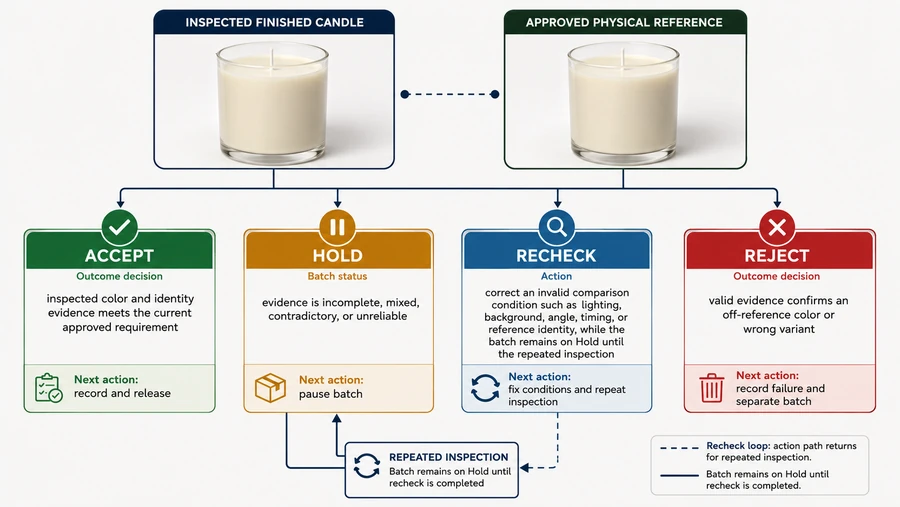
Hold is the batch’s current status when evidence is incomplete, mixed, or unreliable; Recheck is the action used after correcting the comparison problem. Mixed sampled-unit results prevent batch-level Accept, and formal tolerances must come from a controlled product standard.
Record the observed mismatch and disposition before investigating production causes. Accept closes only the color check; burn testing, safety, labeling, legal duties, packaging, marketplace, insurance, carrier, and complete product-release checks remain separate.
Record the Evidence Behind the Color-QC Disposition
A valid color-QC record links the disposition to an identified batch, inspected units, approved reference, observation, date, and inspector. An observation states what the inspector saw, while the disposition states the batch’s current color-release status and required next action.
Use this compact template so another person can reconstruct why the status was assigned.
| Record field | What to enter |
|---|---|
| Product identity | Product name, SKU, shade or variant, finish, and relevant vessel condition. |
| Batch identity | The seller’s batch, pour, or production identifier. |
| Inspection details | Inspection date and inspector name or identifier. |
| Selected units | Each inspected unit ID and, when useful, its batch position or selection point. |
| Approved reference | Reference ID, approved revision, associated SKU, and current condition. |
| Viewing basis | The documented conditions used for the comparison, including any corrected condition that triggered a Recheck. |
| Observation | A factual description of what was seen, including location, extent, peer-unit agreement, and reference agreement when relevant. |
| Disposition | Accept, Hold, Recheck, or Reject. |
| Hold or Recheck reason | The missing, contradictory, mixed, or corrected evidence that prevents an immediate final decision. |
| Required next action | The specific evidence, repeated inspection, segregation step, or other color-QC action required. |
| Optional dye-lot field | Record the dye-lot identifier when it is available and relevant, without turning this sheet into a complete material-genealogy system. |
This record supports reconstruction of the color decision but does not set legal retention periods or replace a supplier, recall, or enterprise record system. Preserve the reference revision, selected unit IDs, unresolved issue, and next action; otherwise, keep the batch on Hold.
Compare the Batch With a Current Approved Color Reference
Compare the stabilized finished batch with a current, identifiable physical reference for the same candle SKU, finish, vessel condition, and approved revision. An approved physical reference is internally accepted, current, identifiable, and linked to the relevant product. Approval does not mean regulatory certification.
The finished physical candle is the governing comparison object for the color-release decision.
| Reference field | What the record must show |
|---|---|
| SKU or product line | The exact product identity controlled by the reference. |
| Shade or variant | The approved commercial color or design variant. |
| Reference ID | A unique identifier that separates the sample from other candles. |
| Approval or revision date | The date associated with the current approved version. |
| Finish and design condition | The approved finish, pattern, vessel, fill depth, or other appearance-related condition. |
| Storage location | Where the reference is kept and retrieved for inspection. |
| Status | Current, retired, damaged, contaminated, or uncertain. |
| Replacement trigger | The condition that requires replacement, review, or reapproval. |
| Approval source | The responsible person, record, or controlled specification that established the reference. |
The reference should be stored and handled so its identity and condition remain clear. A sample becomes unsuitable when its appearance or history can no longer be trusted.
The following comparison separates governing evidence from supporting material.
| Candidate reference | Permitted role | Governing reference? | Main limitation |
|---|---|---|---|
| Current physical finished candle | Primary finished-batch comparison | Yes | It must remain identified, current, and representative. |
| Controlled reference photograph | Supporting identity and condition record | No, except under a documented approved fallback when no physical reference exists | Camera, lighting, screen, and display conditions can change apparent color. |
| Listing image | Customer-representation check | No | It may be edited, compressed, or displayed differently across screens. |
| Raw dye or pigment swatch | Formulation or material reference | No | It does not show the final appearance of colored candle wax. |
| Memory or verbal description | Informal orientation only | No | It is subjective and cannot be repeated reliably. |
| Obsolete or unidentified candle | No valid QC role | No | Its product identity, revision, or condition cannot be confirmed. |
A product photograph cannot silently replace a usable physical reference. When a seller’s approved process permits a photograph because no physical sample exists, the limitation and decision basis must be documented rather than treating the image as equivalent evidence.
A raw dye swatch also cannot serve as the final candle-color reference. Wax type, finish, vessel, opacity, fill depth, and other finished-product conditions may change the visible result, so the comparison must use the approved finished configuration.
General visual-comparison practice supports using controlled observation conditions for side-by-side evaluation. It does not turn an internal reference into a legal certificate or create a universal color tolerance.
A reference requires Hold, replacement, or reapproval when:
- The reference is unidentified or cannot be linked to the inspected SKU.
- The reference belongs to the wrong revision, finish, vessel, or design condition.
- The sample is visibly faded, damaged, contaminated, stained, or altered.
- Its storage history creates reasonable doubt about its present appearance.
- It conflicts with the current approved product record.
- Staff cannot resolve whether it is the governing reference.
When the sample itself may have changed, do not compare the batch with it and guess which one is correct. Keep the batch on Hold until a current reference is retrieved, the sample is reapproved, or another documented governing source resolves the uncertainty.
Reference photo series. Keep a controlled record showing the current reference’s identification, full visible appearance, and condition. When useful, include retired, faded, damaged, or unidentified examples beside it under the same documented viewing setup so staff can see why those samples cannot govern release.
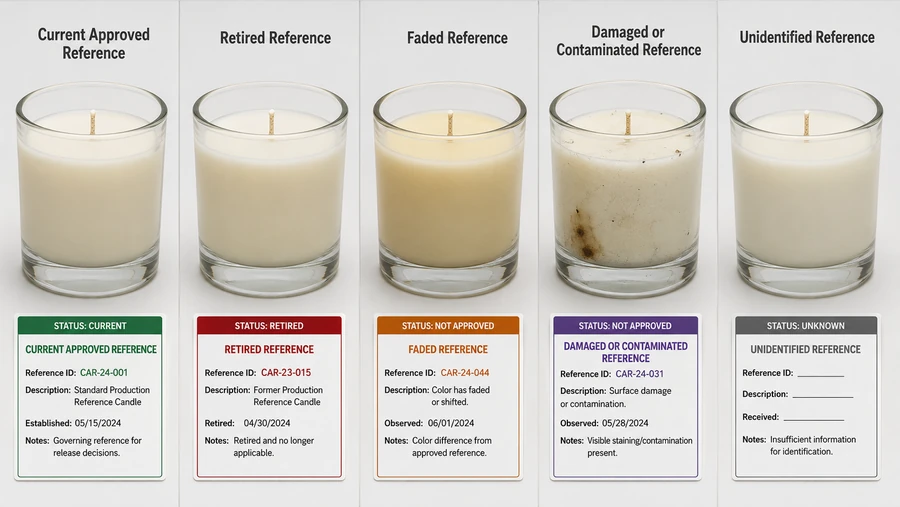
Formal numerical acceptance boundaries must come from a separate controlled tolerance standard. Digital or print color matching, customer-approved samples, and complete reference-library management also require their own procedures. This check only establishes which finished physical reference controls the present batch decision.
Anchor Subjective Shade Names to a Current Physical Reference
A shade name becomes usable for candle color QC only when it points to a current SKU and identifiable physical reference. A subjective shade name is a seller-specific product label, not a universal color definition.
The same word may describe different physical colors across sellers, waxes, vessels, product lines, or revisions.
| Field | Purpose |
|---|---|
| Shade name | Records the current commercial label. |
| Alias | Records a previous, informal, shortened, or alternate label. |
| SKU | Identifies the exact product variant. |
| Physical reference ID | Identifies the finished candle that governs QC. |
| Undertone note | Gives a short seller-specific clarification, such as warm, cool, green-leaning, or gray-leaning. |
| Revision | Identifies the current approved product version. |
| Status | Marks the entry as current, retired, or ambiguous. |
| Listing reference | Identifies the supporting customer-facing representation. |
| Decision hierarchy | States which evidence controls when records or staff descriptions disagree. |
Names such as sage, blush, sand, smoke, cream, ivory, and taupe are not universal standards. “Sage” may mean muted green in one product line and a grayer or warmer green in another, so the word alone cannot answer whether a candle matches.
Staff consistency comes from using the same current SKU, physical reference ID, revision, and undertone note. It does not come from asking each inspector to remember what “ivory” or “blush” looked like last time.
Use the following evidence order when names, records, and images disagree:
- The current approved physical reference controls the finished-candle comparison.
- The exact SKU and approved revision confirm which product the reference represents.
- The controlled product specification and undertone note clarify the intended variant.
- A current controlled reference photograph supports identification and condition records.
- The listing image supports the customer-facing representation check.
- A verbal description, personal memory, or unanchored shade name has the lowest authority.
A screen image may help staff locate the correct record, but it does not override the current physical reference. Screen settings, image processing, ambient light, and display differences can alter the apparent color.
A renamed product must preserve its reference and revision history. Record the former name as an alias, keep the current commercial name attached to the same SKU when the physical product is unchanged, and create a new controlled entry when the governing product identity or approved appearance changes.
A retired reference must not control a current batch. Mark it clearly as retired, retain its history where needed, and prevent staff from selecting it merely because its old name remains familiar.
A label can be linguistically correct while attached to the wrong physical variant. For example, a candle labeled “Ivory” may still be an identity mismatch when its physical color matches the approved “Cream” SKU instead.
Use this failure log when language creates uncertainty.
| Failure | Inference problem | Required action |
|---|---|---|
| A shade name is treated as universal | The word replaces physical evidence. | Verify the SKU, revision, and physical reference. |
| A retired sample is used | The reference status is missing or ignored. | Hold the batch and retrieve the current reference. |
| A listing image overrides the sample | Screen and image variation are treated as finished-product evidence. | Use the physical reference as the governing comparison. |
| One alias points to two SKUs | The product identity is ambiguous. | Hold the batch and correct the glossary before release. |
| The label name is correct, but the candle matches another SKU | The name is trusted without a physical comparison. | Treat the unit as an identity mismatch. |
| Staff disagree about an unanchored name | No shared governing evidence exists. | Hold the batch until the SKU and current reference are verified. |
Methods. This is a modeled identification framework built from the seller’s approved product records and physical references. It does not define universal versions of sage, ivory, blush, or other commercial names, and it does not convert Pantone, Hex, RGB, print, or screen values into candle formulas.
Brand naming, trademark review, digital color conversion, and customer-approved custom shades remain separate tasks. This section only determines which current physical candle reference governs color QC when a commercial shade name is subjective.
Set Up Repeatable Lighting and Viewing Conditions
Judge the finished candle and its approved reference under the same documented light source, background, orientation, distance, and viewing direction. Controlled viewing conditions are repeatable, documented conditions. They are not automatically laboratory-certified.
Changed conditions can alter apparent color without changing the candle, so the comparison is valid only when the observation setup stays consistent.
Matched-condition photo series. Show the same candle under the valid inspection setup, warmer or cooler light, a colored background, vessel glare or tint, and a changed viewing path. The series should demonstrate an appearance change without claiming that the wax itself changed.
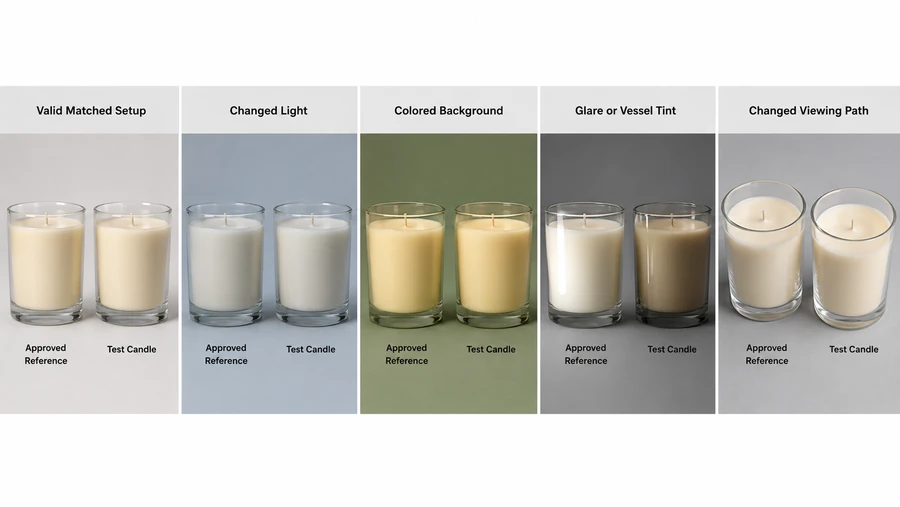
| Setup variable | Required control | When the comparison becomes invalid |
|---|---|---|
| Light source | Identify the artificial light source or document the daylight condition used. | The test units and reference are viewed under different or changing light. |
| Mixed lighting | Avoid mixed light sources unless the approved product requirement specifically uses them. | Daylight, overhead lighting, or another source changes during the comparison. |
| Background | Use the same clean, neutral background behind the reference and test units. | A colored, reflective, dirty, or inconsistent background changes the apparent shade. |
| Viewing angle | View the reference and test units from the same documented angle. | One unit is viewed from above while another is viewed from the side or diagonally. |
| Viewing distance | Keep the observer and products at a consistent distance. | Distance changes make small defects or shade differences appear stronger or weaker. |
| Orientation | Position the reference and test units in the same direction. | Labels, patterns, seams, layers, or vessel features face different directions. |
| Glare management | Rotate or reposition both units together to separate reflection from a fixed defect. | Glare hides the wax, creates false bands, or affects only one unit. |
| Inspection views | Record both a direct-wax view and a final vessel or packaged view when applicable. | One view is assumed to represent the other without being checked. |
| Transparent products | Match material, vessel, fill depth, background, and viewing direction. | Different optical geometry changes the apparent color depth. |
| Changed variables | Record any setup change that could alter the result. | A changed variable is ignored and the original result is treated as reliable. |
A practical seller-controlled station may use daylight or artificial light, but the chosen condition must be repeatable enough for the intended comparison. Do not assign a universal bulb type or color temperature unless the seller’s approved process or supporting documentation requires it.
Warm and cool light can emphasize different parts of the candle’s visible color. A candle that appears warmer, grayer, greener, or less saturated under another light has not necessarily changed. The viewing condition may have changed instead.
Position the approved reference and test candles side by side rather than viewing them at different times or locations. Keep their relevant surfaces aligned so the observer compares equivalent areas.
Glass and polished metal can create glare, false dark bands, bright spots, or reflected background colors. Rotate the reference and test unit through the same controlled movement. A mark that disappears or moves with the reflection should not be recorded as a fixed wax-color defect.
Tinted or transparent vessels require additional control because the vessel and viewing path can change the apparent shade. Match vessel type and fill depth where possible, and record any remaining difference that limits the comparison.
The following conditions require Recheck:
- The light source changed during the inspection.
- The background or viewing position differed between units.
- Glare blocked the relevant surface.
- The approved reference and test units were not aligned consistently.
- Transparent products were compared through different vessels, fill depths, or viewing paths.
- A direct-wax result was confused with a packaged-presentation result.
General visual-color standards support the principle that comparisons need controlled observation conditions. This checklist applies that principle to a practical candle-selling workflow without claiming laboratory color measurement or instrumental certification.
Product-photography lighting, camera white balance, monitor calibration, print conversion, and instrument calibration remain outside this inspection. When visual comparison cannot satisfy the seller’s documented standard, a separately controlled instrumental method may be required.
An invalid setup supports Hold and Recheck, not immediate Reject, because the inspection has not yet shown whether the candle or the viewing condition caused the apparent mismatch.
Compare the Direct Wax View With the Final Packaged View
Evaluate the candle twice: once for the underlying finished-wax color under a neutral view and once in the final vessel or package as the customer will see it. Optical influence is an appearance change created by the viewing path or surrounding materials. It does not automatically prove that the dyed wax changed.
The direct-wax view supports the underlying finished-color decision. The final vessel or package view supports the customer-facing presentation decision, and neither result automatically replaces the other.
| View | Purpose | Variables to control | Possible result |
|---|---|---|---|
| Neutral direct-wax view | Judge the underlying finished-wax color. | Light, neutral background, angle, distance, orientation, and reference position. | Match, uncertain, or mismatch. |
| Final vessel or package view | Judge the presentation the customer receives. | Vessel tint, reflection, label, liner, insert, glare, and surrounding package color. | Acceptable, materially altered, or misleading. |
Tinted glass, reflective tins, liners, labels, inserts, and surrounding package colors can change the apparent shade without changing the wax. Compare the direct wax and final presentation under the same documented light, angle, distance, and orientation.
Record whether a mismatch appears in the wax, through the vessel, inside the package, or across both views. Keep the batch on Hold when glare, tint, packaging, or unequal presentation conditions prevent a reliable decision.
A direct-wax pass does not approve a misleading packaged presentation, and a packaged-view mismatch does not automatically prove a dye failure. Color Accept requires both required views to be resolved under valid conditions.
Match Vessel, Fill Depth, Background, and Viewing Path
Compare transparent, translucent, and gel candles only when the test unit and approved reference are aligned for material, vessel, fill depth, background, and viewing direction. Color depth is the apparent saturation and lightness created as light travels through the finished product. It is not a direct measurement of dye concentration.
Top, side, and diagonal views can produce different results because each view sends light through a different amount of material.
| Comparison variable | Valid benchmark | Why a mismatch changes the result |
|---|---|---|
| Material type | Compare equivalent transparent, translucent, or gel-type materials. | Different materials may transmit or scatter light differently. |
| Vessel | Use the same vessel shape, material, tint, and relevant wall thickness. | Vessel geometry or tint can deepen, mute, warm, or cool the visible color. |
| Fill depth | Align the finished fill depth of the reference and test unit. | A deeper optical path can make the same material look darker or more saturated. |
| Background | Use the same clean background for both units. | Light and dark backgrounds can change apparent contrast and transparency. |
| Viewing direction | Compare equivalent top, side, or documented customer-facing views. | Each direction may create a different optical path through the product. |
| Bubbles and embeds | Record their location and compare equivalent areas where possible. | They can interrupt, reflect, or redirect light without changing the underlying dye level. |
| Reflections | Rotate both units together under controlled lighting. | A moving highlight or dark band may come from the vessel rather than the colored material. |
Top, side, and diagonal views may show different color depth because the light path changes. Compare the test unit and reference with the same material, vessel, fill depth, background, and viewing direction.
Record vessel tint, bubbles, embeds, and reflections separately from the material color. If the viewing setup differs or the compared area is blocked, keep the batch on Hold, align the conditions, and Recheck before deciding whether a color mismatch exists.
Gel formulation, material compatibility, dye dosage, embed design, container safety, and instrument calibration remain separate checks.
Inspect Only After the Candle Reaches Its Documented Stable Appearance
Assign the final color-QC disposition only after the candle reaches the documented cooled and visually stable inspection state for that SKU. Stabilized means the seller’s approved visual inspection state, not a universal cure time, fragrance-performance period, burn-test milestone, or fixed number of hours or days.
Use this timing sequence for the color decision:
- Record an optional preliminary observation without assigning the final disposition.
- Allow the candle to reach the cooled inspection state documented for that SKU.
- Confirm that its expected surface and visible color are stable enough for comparison.
- Perform the approved-reference, viewing-condition, and batch checks.
- Record the final Accept, Hold, Recheck, or Reject disposition.
- Keep the batch on Hold when the appearance continues to change unexpectedly.
A preliminary observation records how the candle looks during production or cooling. It may help show that the appearance changed, but it is not the final color-release result.
The final check begins only when the candle reaches the product-specific inspection state defined in the seller’s approved process record. Relevant wax-supplier documentation may support material-specific cooling or appearance conditions, but it should not be converted into a universal waiting rule for every candle.
| Observation stage | Permitted use | Release limitation |
|---|---|---|
| Warm or recently poured | Note the current appearance and identify areas to inspect later. | Do not assign the final color disposition. |
| Cooled but not confirmed stable | Compare with earlier notes and watch for continuing change. | Keep the batch on Hold when the normal inspection state is uncertain. |
| Documented stable inspection state | Perform the controlled finished-color comparison. | A color decision is permitted when all other color-QC evidence is valid. |
| Continued or unexpected change | Record the visible change, timing, affected units, and current reference. | Hold the batch and investigate the cause separately. |
Warm and cooled wax may present different visible surfaces or apparent shades, so an early result can create false acceptance, rejection, or correction decisions. The required waiting condition must therefore come from the product’s documented process rather than memory or a generic candle-making rule.
Before-versus-final photo sequence. Show the identified unit at the preliminary stage and again at its documented final inspection state under the same reference, background, lighting, orientation, and viewing direction. Label the first image as preliminary so it cannot be mistaken for release evidence.
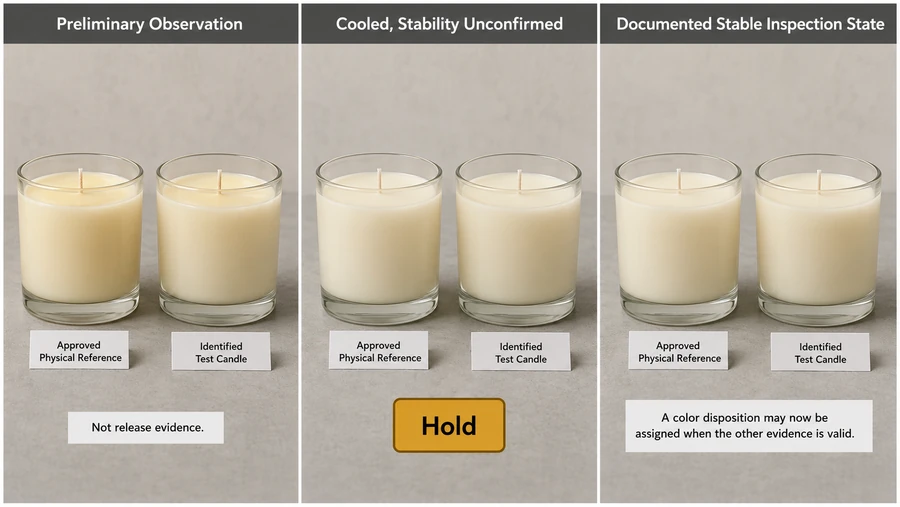
A Recheck is appropriate when the first comparison occurred too early or when the documented inspection condition was not confirmed. Repeat the check only after the correct state is reached, using the same approved reference and controlled viewing conditions.
Keep the batch on Hold when:
- The normal inspection state for the SKU is undocumented or uncertain.
- Selected units are still changing in visible appearance.
- Different units appear to have reached different process states.
- The final check cannot be distinguished from a preliminary observation.
- The timing or process-state evidence is missing.
- The appearance changes again after the supposed final inspection point.
Continued change is first recorded as an observed release problem. Diagnosing wax behavior, production drift, supplier changes, or long-term storage fading is separate from this checklist.
A candle that is ready for color QC may still be unready for burn testing, fragrance evaluation, labeling, packaging, or complete commercial release.
Assign the final color disposition only when the documented stable inspection state and the controlled comparison evidence are both confirmed.
Select Representative Units Across the Candle Batch
Select identifiable finished candles from different relevant positions in the same batch before assigning a batch-level color disposition. Representative means deliberately distributed across the identified batch rather than chosen only because the units are easiest to reach.
This seller method is not automatically statistically certified. It connects the batch population to the later peer-unit and approved-reference comparisons.
| Worksheet field | What to record |
|---|---|
| Batch ID | The identifier for the finished production group being inspected. |
| Production date or sequence | The date, pour sequence, or other recorded order that separates relevant positions. |
| Total batch quantity | The number of finished candles included in the defined batch. |
| Relevant subgroups or positions | Different pours, work periods, vessel groups, cooling locations, or other documented divisions that may affect representation. |
| Selected unit IDs | A traceable identifier for every inspected candle. |
| Reason each position was represented | Why the unit was selected, such as an early, middle, later, edge, center, or subgroup position. |
| Result for each unit | Its observed color result against peer units and the current approved reference. |
| Sample expansion trigger | The mismatch, uncertainty, cluster, or missing evidence that requires more units to be inspected. |
| Batch Hold status | Whether the batch remains blocked from color release while evidence is incomplete or mixed. |
| Reference revision used | The identifier and revision of the approved physical reference used for the comparison. |
Define the batch before selecting candles. Units should come from relevant production positions or subgroups within that same identified batch, not from unrelated stock or a different production run.
Checking the first convenient candle is not enough because it can hide variation elsewhere in the batch. Early, middle, and later positions can illustrate distribution logic, but those three positions are not a universal or automatically sufficient sampling rule.
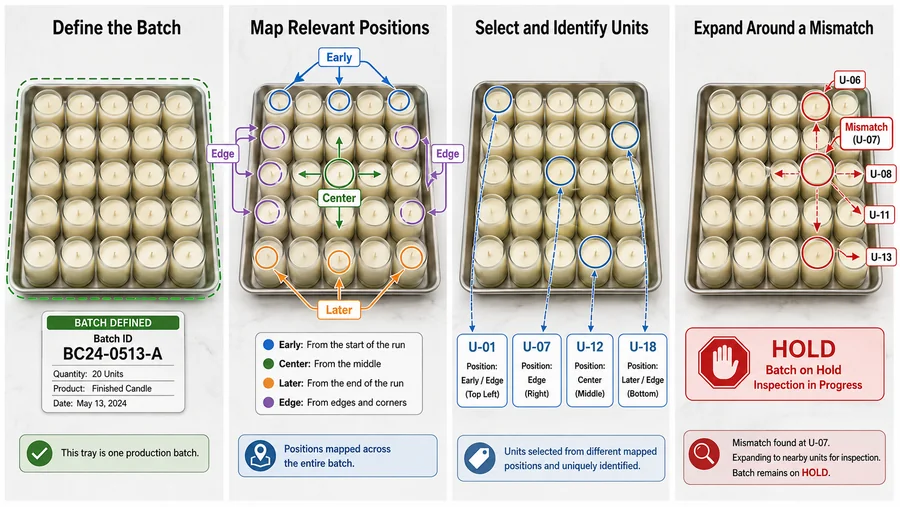
Very small batches may justify inspecting every unit. Larger batches need a documented distributed pattern that covers the positions or subgroups relevant to that production process without pretending that one universal sample count fits every seller.
Record the selected unit IDs so each observation can be traced back to a specific finished candle. When full material genealogy matters, keep the applicable dye-lot and supplier-material records in the seller’s separate controlled lot-tracking system.
A single failed or conflicting sampled unit prevents batch-level Accept. Keep the batch on Hold, inspect units near the suspected position or subgroup, and expand the sample far enough to determine whether the issue is isolated, clustered, mixed, or batch-wide.
Use this comparison to distinguish a practical seller workflow from formal acceptance sampling.
| Seller QC sampling | Formal acceptance sampling |
|---|---|
| Operational and documented. | Statistically designed. |
| Uses distributed units to reduce convenience bias. | Uses a defined lot, sample size, and acceptance and rejection numbers. |
| Suits a simple color-QC workflow when its limitations are stated. | Applies when the seller’s system, customer, contract, or standard demands formal sampling. |
| Does not prove a statistical confidence level. | Is designed to support formal acceptance claims. |
A formal sampling plan is required when a contract, customer requirement, quality system, or governing standard demands defined statistical acceptance rules. This checklist does not reproduce formal sampling tables.
Methods. This non-statistical method uses documented distributed selection to reduce convenience bias and preserve traceability. It does not create a universal sample size, acceptance quality limit, confidence level, or numerical candle-color tolerance.
Mixed or untraceable results require Hold before additional action. Accept becomes possible only after the selected units, selection logic, reference revision, and individual results support a clear batch-level color decision.
Check Unit-to-Unit and Batch-to-Reference Color Consistency
A batch must be acceptably consistent both among its selected finished units and against the current approved reference. Consistent means aligned with the seller’s documented approved appearance. It does not mean perfectly identical or compliant with an unstated universal tolerance.
This is the central comparison step because it tests both internal batch agreement and agreement with the intended product.
Use this two-axis matrix before assigning the color disposition.
| Unit-to-unit result | Batch-to-reference result | Default color-QC interpretation |
|---|---|---|
| Aligned | Aligned | Eligible for Accept if the remaining checks pass. |
| Aligned | Mismatched | Uniformly wrong batch; Hold or Reject according to the approved requirement. |
| Mixed | Aligned overall | Hold; inspect the distribution and affected units. |
| Mixed | Mismatched | Hold or Reject; record both inconsistency types. |
| Uncertain | Any result | Hold and Recheck under valid conditions. |
| Any result | Reference invalid | Hold until a valid reference is available. |
Within-batch consistency compares the selected finished candles with one another. Batch-to-reference consistency compares those candles with the current approved physical reference for the same product identity and revision.
Both comparisons are required because peer-unit agreement alone is insufficient. A batch can be evenly colored and still be uniformly wrong when every selected candle differs from the approved reference.
One attractive unit also cannot validate a mixed batch. When only some selected units differ, record which units and positions are affected, keep the batch on Hold, and expand the inspection according to the sampling trigger.
Acceptable handmade variation must come from the seller’s approved appearance category or a separate controlled tolerance standard. Do not invent a universal visual or measured boundary during the inspection.
Run both comparisons under the same valid light, background, orientation, distance, vessel condition, fill depth, and viewing geometry. A changed light, background, vessel, or optical path invalidates the comparison and requires Hold and Recheck rather than an immediate color-failure conclusion.
Product type changes how the comparison is performed without changing the two-axis rule:
- Pale, white, ivory, and pastel shades may need enhanced viewing to reveal faint undertone or contamination differences.
- Deep shades may need rotation and glare control so reflection is not mistaken for uneven color.
- Intentional patterned variation must be judged against its approved design rules rather than against uniform-color expectations.
- Transparent products require matched vessel, fill depth, background, and viewing path.
A formal numerical tolerance is required when the seller must support a measured acceptance boundary, customer contract, or repeatable instrument-based decision. The tolerance must already exist in a controlled standard. This checklist only applies it.
Record the mismatch before investigating why it occurred. Formulation correction, supplier review, process drift, and other root-cause work begin only after the observed unit-to-unit and batch-to-reference results are preserved.
For customer-specific products, use the approved customer sample or controlled order specification as the governing reference only when the seller’s process identifies it as current and valid. Do not substitute an informal message, memory, or screen image for that controlled evidence.
The batch is eligible for Accept only when selected units are aligned with one another, aligned with the current approved reference, and supported by valid viewing and traceability evidence.
Use an Enhanced Check for White, Ivory, and Pastel Shades
Inspect white, ivory, cream, and pastel candles against the exact approved SKU reference because low-contrast defects and undertone shifts may be invisible when the unit is viewed alone. These shade names describe seller-specific product appearances, not universal colors.
The current physical SKU reference and its recorded undertone provide the governing evidence. Pale shades therefore need an enhanced consistency check for subtle finished-color differences.
| Check | What to compare | Possible failure |
|---|---|---|
| Front view | Overall shade and undertone against the approved reference | Warm, cool, gray, pink, yellow, or green cast |
| Side-light view | Faint bands, specks, haze, or uneven zones | Low-contrast defect hidden by flat front lighting |
| Peer-unit view | Selected batch units beside one another | One unit or subgroup visibly drifts |
| Neighboring-SKU view | White, ivory, cream, beige, or related pastel variants | Variant mix-up or insufficient shade separation |
| Surface-artifact view | The same area from another controlled angle | Shadow, reflection, or wax artifact mistaken for color loss |
Record the intended undertone with the SKU and reference ID. Terms such as warm ivory, cool white, muted blush, or gray-green pastel may clarify the approved appearance, but they cannot replace the physical reference.
A pale candle must not be judged from memory or from its shade name alone. Place the test candle beside the exact approved reference on a clean neutral background and compare both under the same documented front-light condition.
Use side lighting as a secondary inspection view to reveal faint bands, specks, haze, or uneven zones. Side lighting may expose a defect that flat light conceals, but it must not become an undocumented replacement acceptance condition.
Warm and cool light can make a pale candle appear yellow, pink, gray, or green even when the product has not changed. When the undertone difference appears only after the light source changes, restore the approved viewing condition before deciding whether the batch differs from its reference.
Faint bands and specks should remain fixed on the candle as the viewing angle changes. A shadow, reflection, or natural surface feature may move, weaken, or disappear when the test unit and reference are repositioned together.
Compare similar pale variants side by side when the product range includes neighboring shades. A candle may appear acceptably pale when viewed alone yet match the approved cream reference more closely than the intended ivory reference, indicating a possible variant or identity error.
Pale-shade image series. Show the same identified candle under matched and changed lighting, front and side-light views, neighboring pale SKU references, and one faint band or undertone shift. Keep the background, camera position, and reference identity controlled.
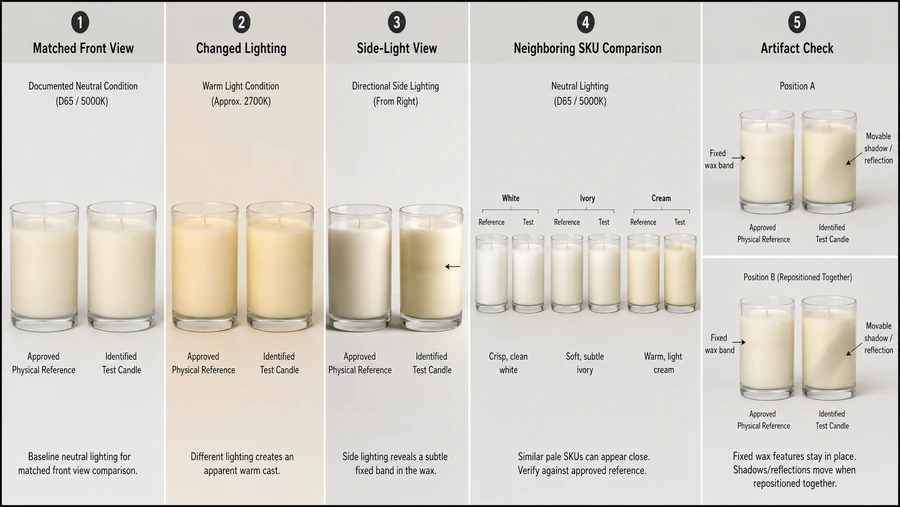
A subtle mismatch is not automatically acceptable because the shade is pale. Keep the batch on Hold and Recheck when:
- The governing pale-shade reference or undertone note is missing.
- Changed lighting may have created the apparent difference.
- Faint marks cannot be separated from shadows or surface behavior.
- Selected units do not agree with one another.
- Two neighboring pale SKUs cannot be distinguished reliably.
- The mismatch remains visible but falls outside any documented acceptance boundary.
Formal measurable acceptance boundaries require a separate controlled tolerance standard. Recurrent confirmed pale-shade drift belongs in batch-drift investigation, while whitening additives, dye-dose changes, surface correction, and formulation decisions remain outside this release inspection.
Add Glare, Rotation, and Transfer Checks for Deep Shades
Inspect deep and saturated candle colors with controlled rotation, glare management, multi-surface viewing, and any approved contact-transfer check required for that SKU. Deep and saturated mean the SKU’s approved dark or high-chroma finished appearance. They do not identify a fixed dye concentration or authorize exceeding supplier guidance.
These shades need additional inspection because one view can hide streaks while emphasizing glare, haze, bloom, pale patches, specks, or transfer.
Use this inspection sequence:
- Compare the unit with its exact approved reference from the standard front view.
- Rotate both units while holding the light, distance, and background constant.
- Inspect the top, sidewalls, base, and back for streaks, bands, specks, pooling, haze, or bloom.
- Change only the angle needed to determine whether a pale patch is glare.
- Perform the documented low-damage transfer check when the SKU or finish requires it.
- Record visual and contact-transfer results separately.
- Assign Hold when the source or permanence of an apparent defect remains uncertain.
Black, navy, burgundy, forest green, and other deep shades can look uniform from the front while showing streaks, bands, pooling, or lighter zones from the side or base. A single front view is therefore insufficient for release.
Glare can appear as a pale patch because the vessel or surface reflects the light source, background, inspector, or nearby objects. Rotate the candle and approved reference through the same movement. A patch that moves or disappears with the reflection requires Recheck under the controlled angle before it is classified as a fixed defect.
| Failure pattern | Common inspection error | Correct QC response |
|---|---|---|
| Pale patch disappears during rotation | Glare is classified as a fixed color defect | Recheck under the controlled viewing angle |
| Dark front view looks uniform | Sidewalls, back, and base are omitted | Complete the multi-surface inspection |
| Batch matches visually but stains an insert | Contact-transfer check is omitted | Hold or Reject under the approved requirement |
| Surface haze appears on some units | An unsupported cause is assigned immediately | Record the appearance and route it for diagnosis |
| Deep shade differs from the reference | The inspector assumes a dye-load problem | Record the mismatch before investigating its cause |
Why do dark candles show pale spots or haze after cooling? Inspection alone cannot establish the cause. First determine whether the appearance is fixed, moves with glare, occurs on selected units, or differs from the approved reference. Keep unresolved units on Hold rather than assigning an unsupported formulation explanation.
How do you check black or deep-colored candles for dye transfer before selling? Use only the documented low-damage contact check approved for that SKU, finish, and contact surface. Record the candle, decoration, label, insert, and packaging results separately so the source of visible color is not assumed.
A visual pass does not override a failed transfer requirement. When a candle matches its reference but leaves visible color on an insert, liner, label, or other approved test surface, keep the affected batch on Hold or Reject it according to the documented product requirement.
Deep color does not prove a particular dye concentration. Burn performance, wick behavior, maximum colorant load, supplier compliance, formula correction, and toxicology remain outside this release section.
Repeated reference mismatch belongs in a separate batch-drift investigation. A changed colorant supplier, lot, or format requires the seller’s controlled retesting process, while formal material or formulation corrections belong to their responsible production procedure.
Judge Designed Variation by Its Approved Pattern Rules
Judge marbled, ombré, layered, and intentionally mottled candles against documented design rules rather than requiring identical pigment placement in every unit. Intentional variation is variation supported by an approved design brief, retained sample, or controlled reference.
Handmade production does not make every uneven result acceptable. For patterned candles, consistency means following the approved design rules rather than matching the exact placement of every line, swirl, or boundary.
| Requirement class | Meaning | Example QC evidence |
|---|---|---|
| Mandatory | Must appear in every approved unit. | Required colors, layer order, gradient direction, or minimum visible motif |
| Flexible | May vary without failing the design. | Exact marble line, swirl placement, or organic boundary position |
| Prohibited | Must not appear. | Wrong color, reversed order, unintended hard band, missing layer, or contamination |
| Uncertain | Is not defined by the current design record. | A new or ambiguous appearance requiring Hold |
Document the required colors, sequence, coverage, transition style, flexible placement, and prohibited features before inspection. Flexibility cannot be added after the batch varies.
Accept when every mandatory feature is present, flexible variation stays within the approved design, and no prohibited feature appears. Hold undefined variation, Recheck differences caused by viewing conditions, and Reject confirmed missing or prohibited features under the approved requirement.
Measured handmade-variation limits, production causes, and collection-level sequence rules require separate controlled procedures.
Inspect for Visible Candle Color Defects
A visible candle-color defect is an unintended speck, streak, band, ring, patch, uneven zone, or contact mark that falls outside the product’s approved finished appearance. A defect is an observed appearance category, not a proven root cause, and the same visual symptom may have several explanations.
This inspection converts finished-surface evidence into a color disposition while keeping diagnosis and corrective action separate.
| Observed appearance | Surface or location | In approved reference? | Repeats across units? | Changes with light, angle, vessel, or background? | Transfer present? | Provisional classification | Color disposition | Further investigation |
|---|---|---|---|---|---|---|---|---|
| Dark speck | Top, side, or base | Yes / No | Yes / No | Yes / No | Yes / No | Expected feature, unintended speck, or uncertain artifact | Accept, Hold, Recheck, or Reject | Diagnose only after recording the result |
| Vertical darker streak | Sidewall or visible wax face | Yes / No | Yes / No | Yes / No | Yes / No | Designed feature, possible distribution defect, or reflection | Accept, Hold, Recheck, or Reject | Batch-drift review when confirmed and repeated |
| Horizontal band or ring | Sidewall, layer boundary, or fill line | Yes / No | Yes / No | Yes / No | Yes / No | Approved layer, unintended band, or uncertain wax artifact | Accept, Hold, Recheck, or Reject | Separate wax or process diagnosis |
| Pale surface patch | Top or side | Yes / No | Yes / No | Yes / No | Yes / No | Glare, approved surface appearance, wax artifact, or unintended patch | Accept, Hold, Recheck, or Reject | Wax-artifact review when unresolved |
| Dark pooled area | Base, edge, recess, or lower vessel | Yes / No | Yes / No | Yes / No | Yes / No | Optical effect, approved design, or possible uneven distribution | Accept, Hold, Recheck, or Reject | Color-drift diagnosis when confirmed |
| Uneven color zone | Any relevant wax surface | Yes / No | Yes / No | Yes / No | Yes / No | Intentional pattern, unintended variation, or invalid comparison | Accept, Hold, Recheck, or Reject | Pattern or batch review |
| Visible color on contact material | Label, liner, insert, tissue, or package | Yes / No | Yes / No | Not applicable / Yes / No | Yes | Transfer, rub-off, or uncertain contact mark | Hold or Reject under the approved requirement | Separate transfer investigation |
Use neutral observational language. Write “dark speck at the base,” not “undissolved dye,” unless evidence confirms that cause. Write “vertical darker band,” not “mixing failure,” and “visible color on the insert,” not “chemical migration.”
The main visible color anomalies include:
- Speck: A small isolated point that differs visibly from the surrounding approved color.
- Streak: A narrow line or elongated area of visibly different color.
- Band: A broader horizontal, vertical, or diagonal zone with a defined color difference.
- Ring: A circular or curved band, often visible near a boundary, fill line, or vessel feature.
- Patch: A localized area with a lighter, darker, warmer, cooler, or otherwise different appearance.
- Pooling: A concentrated-looking area, commonly near an edge, base, recess, or design boundary.
- Uneven zone: A broader area that lacks the approved uniformity or patterned relationship.
- Contact mark: Visible color found on a label, liner, insert, package, or other approved contact surface.
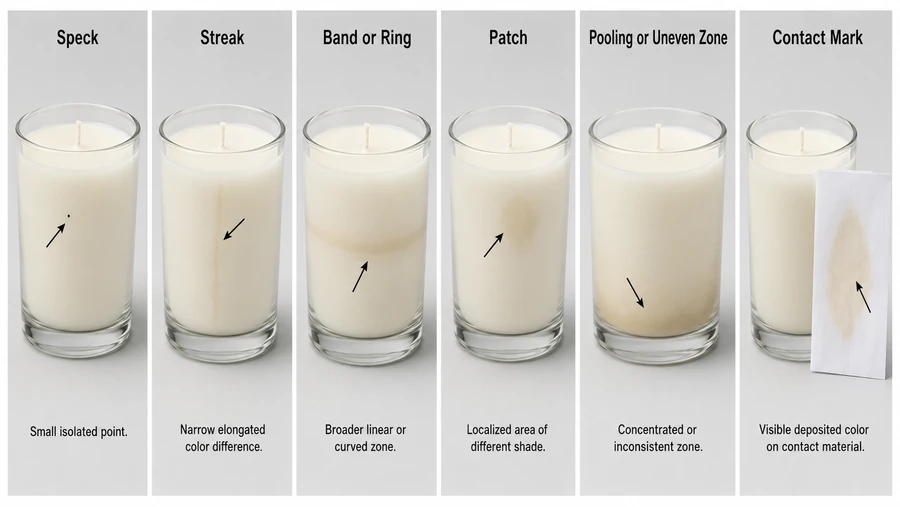
Inspect the top, rim, exposed sidewalls, back, base, patterned boundaries, and any surface visible through the final vessel. Areas covered by a label or package should be checked when the approved procedure allows access without damaging the product.
Compare each observed condition with the approved reference before classifying it. An appearance shown by the governing reference may be an expected product feature, while the same appearance on another SKU may fall outside the approved standard.
Also compare the condition across selected batch units. A mark that occurs in one candle may be isolated, while the same mark appearing in the same location across several units may indicate a repeated batch mismatch requiring separate diagnosis.
Change only one viewing variable at a time when checking a suspected defect. If a pale patch moves or disappears as both the candle and reference rotate, it may be glare rather than a fixed color defect. If the comparison conditions were invalid, assign Recheck.
Use these disposition rules:
| Evidence result | Required response |
|---|---|
| The appearance is expected and shown by the current approved reference. | It may pass as an approved feature. |
| The appearance is confirmed, unintended, and outside the approved standard. | Reject may be appropriate under the documented requirement. |
| The condition may result from invalid lighting, angle, vessel, background, or viewing geometry. | Recheck under controlled conditions. |
| The inspector cannot determine whether the condition is an approved feature, wax artifact, or true color-distribution defect. | Hold the batch. |
| Visible color appears on an approved contact-test material. | Hold or Reject according to the documented transfer requirement. |
| The physical observation is recorded, but the cause remains unknown. | Preserve the disposition and send the issue for separate diagnosis. |
Diagnosis occurs after the visible condition and release status are recorded. Do not prescribe remelting, mixing changes, temperature corrections, formula changes, or supplier action from appearance alone.
A confirmed repeated batch mismatch belongs in a separate color-drift investigation. Changed colorant suppliers, lots, or formats require controlled retesting, while uncertain wax artifacts require their own material-specific troubleshooting.
A visible transfer check only records whether color appears on the approved contact material. It does not establish chemical safety, skin safety, toxicology, or complete packaging compatibility.
Rotate the Candle and Check Every Relevant Surface
Rotate the finished candle under the same controlled light and compare its top, sidewalls, base, back, and any relevant non-destructively visible area with the approved reference. A concealed area is a normally hidden finished surface that can be inspected without cutting, remelting, sectioning, or damaging a saleable unit.
This step closes the location-specific gap left by a front-only inspection and remains part of the visible-defect method.
Use this rotation sequence:
- Check the top from the documented viewing direction.
- Rotate through the sidewalls while keeping the light, distance, and background unchanged.
- Check the back or label-obscured side when it is accessible without damage.
- Inspect the base without removing fixed components or altering the candle.
- Check relevant finished areas normally covered by removable packaging.
- Record the exact surface, orientation, and viewing condition of every anomaly.
A single attractive front view is insufficient. The front can match the approved reference while the back, base, sidewall, or another finished surface contains an unintended streak, patch, ring, speck, or shade difference.
Use this surface record to preserve the evidence.
| Inspection field | What to record |
|---|---|
| Surface | Top, rim, front, sidewall, back, base, or accessible concealed area |
| Customer-visible status | Normally visible, visible during handling, or comparison-only |
| Reference view | The matching approved-reference surface and orientation |
| Observed condition | Neutral description such as pale patch, dark band, speck, or uneven zone |
| Angle response | Fixed, weaker, stronger, moved, or disappeared during rotation |
| Peer-unit result | Absent, isolated, clustered, or repeated across selected units |
| Disposition impact | Accept, Hold, Recheck, or Reject under the approved requirement |
Rotate the test candle and approved reference together. Changing only one unit can introduce a different reflection, shadow, vessel angle, or viewing path and make the comparison unreliable.
A shadow or reflective edge often changes position or intensity as the candle rotates. A fixed color difference remains attached to the same physical area even when glare and orientation are controlled.
Expected geometry effects may be acceptable when they also appear on the current approved reference. A darker-looking base seen through thick glass, for example, should not be classified as a color defect merely because its optical path differs from the front view.
Customer-visible surfaces usually carry the greatest presentation importance, but comparison-only surfaces can still reveal a batch inconsistency. The approved product specification determines which surfaces must satisfy the release requirement.
Normally concealed areas may be inspected when removable packaging, tissue, a loose insert, or another non-fixed component can be moved without damaging the product. Do not remove permanent labels, fixed decorations, wick tabs, bonded components, or vessel parts merely to inspect hidden wax.
When a defect appears only at the base, record it as a base-specific observation before assigning a cause. Check peer units and the corresponding approved-reference area under the same geometry.
Use the dispositions as follows:
| Evidence result | Required response |
|---|---|
| The surface matches the approved reference, and any geometry effect is documented as expected. | Eligible for Accept when the remaining checks pass. |
| The anomaly moves or disappears with glare, angle, or reflection. | Recheck under the documented viewing condition. |
| A confirmed fixed anomaly falls outside the approved appearance. | Reject may be appropriate under the controlled requirement. |
| The result is visible only in one location and its meaning is unresolved. | Hold pending reference, peer-unit, or diagnostic evidence. |
| The same location-specific mismatch repeats across selected units. | Hold or Reject, then route the recorded pattern to separate batch-drift diagnosis. |
Exception note. A base-only or concealed-area observation does not authorize destructive testing. When the visible evidence cannot resolve whether the issue extends inside the wax, preserve the unit and route the problem for separate diagnosis.
The seller’s approved product views determine which surfaces and orientations belong to the accepted finished appearance.
Record the location-specific result before investigating production causes because rotation identifies where the difference appears but does not prove why it occurred.
Separate Wax Artifacts From True Color-Distribution Defects
Classify the visible appearance before assigning a cause. Frosting, bloom, haze, wet-spot optics, and uneven dye distribution can create different—or deceptively similar—color effects.
A wax artifact is a surface or optical condition that changes apparent color without automatically proving uneven dye. A true color-distribution defect is an unintended finished appearance outside the approved reference, confirmed under valid viewing conditions.
Use this comparison before deciding whether the batch has a color failure.
| Observable feature | Possible appearance class | Evidence needed before classification | Default QC action if uncertain |
|---|---|---|---|
| Pale crystalline or cloudy surface area | Possible frosting or bloom | Reference comparison, surface location, and angle-and-light check | Hold |
| Darker contact-looking patch near the vessel wall | Possible wet-spot optical effect | Direct-wax view, vessel comparison, and peer-unit check | Hold or Recheck |
| Repeated streak through visible wax | Possible color-distribution defect | Multi-surface inspection and peer-unit pattern | Hold or Reject under the approved standard |
| Isolated dark or light speck | Unclassified visible anomaly | Location, repeatability, transfer, and reference comparison | Hold |
| Pattern matching the approved design | Expected appearance | Current approved design reference | Eligible for Accept |
| Appearance absent from the approved design | Possible defect | Valid reference and viewing conditions | Hold or Reject |
Visual inspection cannot prove the cause. Describe the visible result before naming frosting, wet spots, mixing, or dye-concentration problems, then compare the area with the approved reference, peer units, and controlled light or rotation.
Keep the batch on Hold when classification remains uncertain. Recheck an effect that moves with glare or viewing conditions; Reject only when valid evidence confirms a fixed appearance outside the approved requirement.
Record the location, peer-unit result, reference comparison, viewing response, and disposition before diagnosis. Frosting remedies, wet-spot corrections, temperature recipes, dye-dissolution guidance, remelting, and formulation changes remain outside this release check.
Check for Color Transfer, Rub-Off, and Contact Staining
A visually acceptable candle may still fail color QC if it leaves visible color on a defined clean contact surface or on the package that touches it. Transfer is visible deposited color observed during the seller’s documented low-damage check.
It is not proof of chemical migration, toxicity, a skin-safety failure, or a particular formulation cause. This focused check records the release-relevant symptom while leaving material, decoration, formulation, and packaging-compatibility diagnosis to separate qualified processes.
Perform only the seller’s documented low-damage contact check with a clean material suited to the finished product and its normal package contact. Record the unit ID, finish, contact material, location, method, visible mark, likely source, peer-unit result, and disposition.
Do not scrape, abrade, or damage a saleable unit. If the material or method is invalid, keep the batch on Hold and Recheck with a clean approved setup.
A valid check with no visible mark may pass. Hold mixed or uncertain results; Reject a confirmed transfer failure under the approved requirement after recording the affected units and package-contact points.
This check records visible transfer, rub-off, or staining. It does not prove toxicity, chemical migration, skin-safety failure, material incompatibility, or a formulation cause.
Verify the Candle, SKU, Label, Package, and Listing Agree
Before packing or releasing the batch, verify that the physical candle, SKU, variant label, package, and current listing all identify the same intended color product. Match means no material or misleading identity conflict. It does not promise exact device-independent color equivalence.
The finished candle and current approved physical reference are the primary evidence, while labels, packaging records, set maps, and listing images support commercial-identity verification.
Use this matrix to verify every representation attached to the inspected color result.
| Check | Governing evidence | Pass condition | Hold or fail condition |
|---|---|---|---|
| Physical candle to SKU | Current approved SKU reference | Physical shade, finish, and design belong to the intended SKU | Variant is wrong, uncertain, or unverified |
| Candle to label | Physical unit, approved SKU record, and attached label | Label identifies the inspected variant accurately | Label is wrong, ambiguous, missing, or assigned to another shade |
| Candle to package | Package specification and final packaged presentation | Package belongs to the same variant and does not create an unresolved misleading appearance | Wrong package, wrong insert, or material optical conflict |
| Candle to listing | Current listing record and approved physical reference | Listing represents the intended product without a material customer-facing mismatch | Listing shows another shade or a materially different appearance |
| Unit to set position | Approved packing map | Unit has the correct membership and sequence position | Shade is missing, duplicated, reversed, or substituted |
The governing evidence follows this order:
- Current approved physical reference.
- Exact SKU and revision record.
- Physical unit and label identity.
- Approved packaging specification or set map.
- Controlled listing reference.
- Individual screen display as variable supporting evidence.
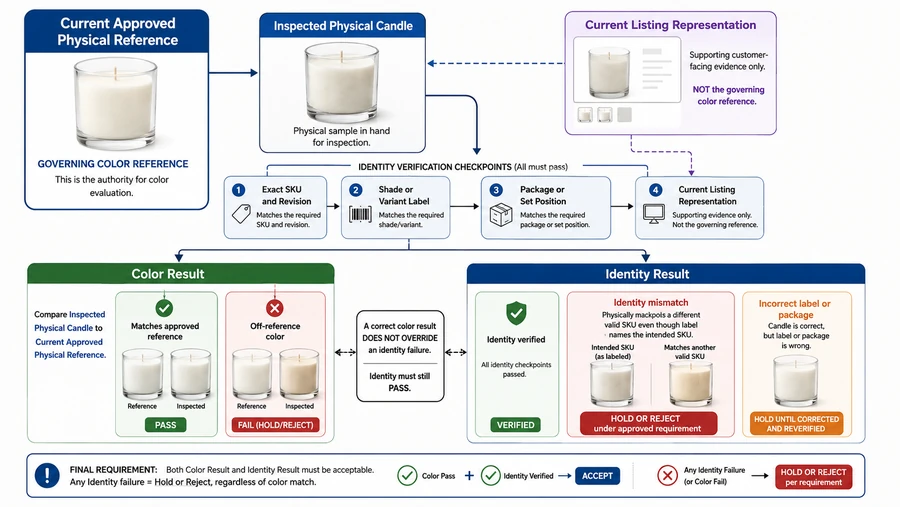
The label is not sufficient evidence by itself. A label can name the expected shade while being attached to a candle that matches another SKU, and a correctly colored candle can still fail identity verification when its label, package, or set position is wrong.
An off-shade candle and a mislabeled candle are different failures. An off-shade candle does not meet the approved physical appearance for its assigned SKU. A mislabeled candle may physically match a valid reference but be assigned to the wrong commercial identity.
Screen variation is expected because displays, brightness settings, ambient light, image processing, and compression can change apparent color. One screen difference does not override the current physical reference.
A listing difference becomes material when it depicts another variant or presents an appearance that could reasonably lead the customer to expect a substantially different candle. Record the physical-reference result and listing-representation result separately.
A correct physical candle may therefore require Hold when its listing materially misrepresents the product. Producing corrected listing images belongs in a separate controlled product-photography process rather than this release inspection.
Packaging can also alter the visible result. Tinted windows, liners, inserts, reflective surfaces, printed surroundings, and colored tissue may make the candle appear warmer, cooler, lighter, darker, or more saturated.
Check the candle outside removable packaging under the approved neutral viewing condition, then inspect the final packaged view. When the neutral candle passes but the package creates an unresolved misleading presentation, place the product on Hold until the presentation is corrected or approved.
Use these disposition rules:
| Evidence result | Required response |
|---|---|
| Candle, SKU, label, package, listing, and applicable set position agree | Eligible for Accept when all other color checks pass |
| A viewing or record problem prevents reliable verification | Hold and Recheck after correcting the defined problem |
| The physical candle matches another valid SKU | Hold or Reject as a commercial-identity failure |
| Label or package is wrong but the candle is correct | Hold until corrected and reverified |
| Listing or package materially misrepresents the correct candle | Hold the affected product representation |
| Identity conflict is confirmed and cannot be corrected within the approved process | Reject the affected unit, batch, or assembled product |
| Any SKU, label, package, listing, or set position remains uncertain | Hold |
Each unit can pass its individual color check while the assembled multipack or gradient still fails because membership and sequence require a separate collection-level decision. A Held unit must not be placed into an Accepted set.
Brand-color development, package design, print matching, Pantone, Hex, and RGB conversion, camera setup, image editing, custom-order approval, and marketplace optimization require separate controlled processes. Identity agreement is also only one part of release and does not replace complete labeling, safety, or legal review.
Separate Similar Shades and Catch Variant Mix-Ups
A candle can have an acceptable color yet still fail release if it belongs to a different SKU or carries the wrong shade label. Shade separation means operationally distinguishing neighboring variants through their exact SKUs and approved physical references. It is not a universal numerical color-distance test.
Compare the physical candle before trusting the label, package, tray, or shade name.
| Comparison field | Recorded evidence |
|---|---|
| Physical unit ID | Traceable identity of the inspected candle |
| Assigned SKU | SKU currently attached to the unit |
| Shade or variant label | Commercial name shown on the candle or package |
| Approved reference ID | Governing reference for the assigned SKU |
| Most-confusable neighboring SKU | The adjacent variant most likely to be mistaken for it |
| Physical comparison result | Matches assigned SKU, matches neighboring SKU, matches neither, or uncertain |
| Label result | Correct, incorrect, ambiguous, or missing |
| Package result | Correct, incorrect, ambiguous, or missing |
| Identity disposition | Accept, Hold, Recheck, or Reject |
Compare ivory, cream, beige, white, blush, sand, sage, and other neighboring shades side by side with their exact current references. Subjective names must resolve to reference IDs rather than being interpreted from language or memory alone.
Use this table to separate color results from identity results.
| Condition | Color result | Identity result | Default disposition |
|---|---|---|---|
| Candle matches the intended reference and label | Pass | Pass | Eligible for Accept |
| Candle matches another valid SKU | Pass for the other SKU | Fail | Hold or Reject as misidentified |
| Candle does not match any current reference | Fail or uncertain | Uncertain | Hold |
| Label is wrong, but the candle is correct | Pass | Fail | Hold until corrected and reverified |
| Similar shades cannot be confidently separated | Uncertain | Uncertain | Hold and Recheck |
How do you keep ivory, cream, and beige candle variants from getting mixed up? Keep each variant tied to its current physical reference and SKU, compare neighboring shades together, preserve unit IDs during handling, and verify the label and package only after the physical comparison.
How should labels be checked against similar candle colors before shipping? Place the physical unit beside the reference for its assigned SKU and the most-confusable neighboring reference, record which one it matches, and then verify that its label and package identify that same variant.
The physical candle and approved reference control when the label and unit disagree. A label cannot make a cream-colored candle an ivory SKU when the physical comparison shows that it belongs to the cream reference.
A candle matching another valid SKU is not necessarily an off-color manufacturing failure. It may be correctly colored for that other SKU but commercially misidentified, which still prevents release under its current label and package.
Mixed trays, bins, or work areas can invalidate otherwise accurate batch records. When units from neighboring variants may have been combined, place the affected group on Hold, preserve the current arrangement where practical, and verify every uncertain unit against the relevant references.
Do not return an ambiguous candle to either variant based on shade-name memory. Keep it on Hold until valid physical-reference evidence supports its identity.
Use the four dispositions as follows:
- Accept: Physical unit, exact SKU reference, label, and package agree.
- Hold: Evidence is ambiguous, units may be mixed, or an identity conflict remains unresolved.
- Recheck: The comparison must be repeated after correcting lighting, reference, label-record, or handling conditions.
- Reject: Valid evidence confirms an uncorrected wrong-identity or off-reference failure under the approved requirement.
Formal numerical separation thresholds require a separate controlled tolerance standard. Shade names and aliases must remain tied to current reference records, while brand, print, and digital matching require their own controlled methods.
Check the Finished Set, Multipack, or Gradient Sequence
Release a set, multipack, or gradient collection only after every unit passes its own color check and the assembled group matches the approved membership and sequence. Sequence means the required units and their order shown by the approved packing map.
Individual-unit acceptance and set acceptance are separate gates because correct candles can still form an incorrect collection.
Verify every candle against its approved SKU reference before assembly, then compare the finished group with the approved packing map for required membership, order, and package view.
A set fails when a required shade is missing, duplicated, substituted, reversed, placed in the wrong position, or still on Hold. Reassemble and Recheck a corrected order or viewing problem; Reject a confirmed unresolved membership, identity, sequence, or packaged-presentation failure.
Do not substitute a visually close variant unless the approved collection specification is formally revised. Record the set ID and affected positions so the Hold applies only to the relevant collection.
Palette creation, merchandising, gift-box construction, package engineering, inventory-system design, and photography styling remain outside this release check.
Compact Pre-Release Candle Color Checklist
Complete every applicable check before assigning the finished batch an Accept, Hold, Recheck, or Reject color disposition.
| Check | Confirm before color release |
|---|---|
| ☐ Approved reference | The physical reference is current, identifiable, in suitable condition, and linked to the correct SKU and revision. |
| ☐ Viewing conditions | The batch and reference were compared under the same documented light, background, distance, angle, orientation, and viewing path. |
| ☐ Stable appearance | The candles reached the documented cooled and visually stable inspection state for that SKU. |
| ☐ Selected units | The inspected units are identified and distributed across the relevant batch positions or subgroups. |
| ☐ Peer-unit consistency | The selected candles agree with one another within the approved product requirement. |
| ☐ Reference agreement | The selected candles agree with the current approved finished-product reference. |
| ☐ Visible defects | Relevant surfaces were checked for unintended specks, streaks, bands, rings, patches, pooling, uneven zones, and contact marks. |
| ☐ Product-specific checks | Applicable pale-shade, deep-shade, patterned, transparent, transfer, multipack, or gradient checks were completed. |
| ☐ Product identity | The physical candle, SKU, shade name, label, package, listing representation, and set position agree. |
| ☐ Evidence record | The batch ID, selected unit IDs, reference revision, viewing basis, observations, inspector, date, disposition, and required next action are recorded. |
Assign the final color status as follows:
- Accept: All applicable color checks pass, and the supporting evidence is complete.
- Hold: Evidence is missing, mixed, contradictory, or unresolved.
- Recheck: A defined inspection must be repeated after correcting an invalid or temporary comparison condition.
- Reject: Valid evidence confirms that the finished color or product identity fails the approved requirement.
Accept is color-specific. It does not replace the seller’s complete safety, labeling, legal, packaging, marketplace, insurance, carrier, or product-release process.