
Neither pre-diluted nor concentrated liquid candle dye is inherently more consistent; the better choice is the named product you can measure repeatably under controlled batch conditions.
Liquid candle dye is a liquid colorant formulation added to candle wax, and its usable dose depends on the specific product rather than the format label alone. Pre-diluted and concentrated describe relative supplier formulations, not fixed or universal strength classes. This comparison helps small-batch and repeat-production makers choose between drops, volume, and weight while keeping product identity and batch conditions in the recipe record. The first step is to separate the two labels from assumptions about potency, because supplier terminology sets the basis for every later measurement.
What Pre-Diluted and Concentrated Liquid Candle Dye Mean
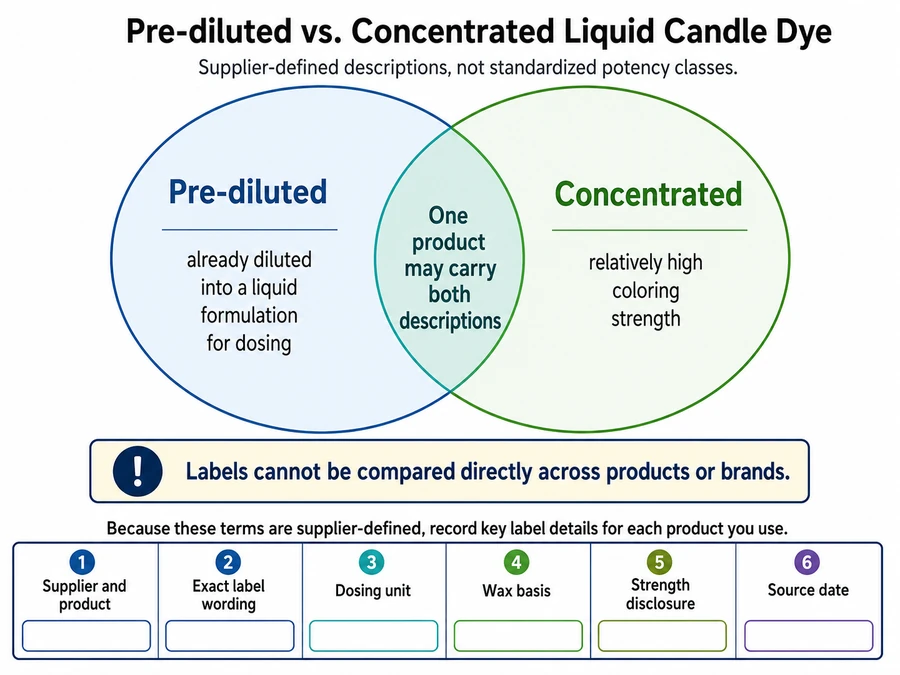
Pre-diluted and concentrated liquid candle dye are supplier-defined descriptions, not standardized or mutually exclusive potency classes, so the labels cannot be compared directly across products or brands.
Pre-diluted liquid candle dye means the supplier describes the colorant as already diluted into a liquid formulation for dosing. Concentrated liquid candle dye means the supplier describes the formulation as having relatively high coloring strength. One product may carry both descriptions.
Formulation strength means the coloring effect of the complete liquid product at a stated dose, not a universal active-dye percentage. On this page, dosing repeatability means dispensing a similar amount under matched conditions, while finished-shade consistency means producing a similar cooled candle color.
| Supplier-label field | What to record | Why it matters |
|---|---|---|
| Supplier and product | Exact company, product line, color, and product code | Keeps every strength claim attached to the named formulation |
| Label wording | Exact use of “pre-diluted,” “concentrated,” or another strength term | Shows how the supplier describes the product |
| Dosing unit | Drops, milliliters, grams, percentage, or another stated unit | Prevents unlike units from being compared as equivalents |
| Wax basis | The wax mass or batch basis used in the guidance | Makes the stated dose interpretable |
| Strength disclosure | Record whether active-dye strength is stated | Shows whether direct potency comparison is supported |
| Source and date | Usage guide or technical sheet and the date recorded | Preserves the version of the guidance used |
Methods note: Copy supplier wording and units without converting them. Mark undisclosed strength as “not stated” rather than estimating it. Record the source date because product wording and instructions can change.
A pre-diluted formulation may permit larger dose changes, which can help when a concentrated product’s target amount is too small for the available dispenser or scale. A concentrated formulation uses less total liquid, but its smaller working dose may be harder to repeat in a small batch.
Bottle size, color name, and drop count do not prove that two liquid candle dyes contain equivalent coloring strength. Product-specific test candles are still needed before treating two formulations as shade equivalents.
Choose the named formulation whose working dose can be recorded and repeated with the equipment you use.
Which Dye Format Is Easier to Measure in Small Batches?
Pre-diluted dye may be easier to adjust when the concentrated formulation’s target dose is smaller than one reliable drop or scale increment. The better option is the one whose dose can be measured repeatably.
Usable resolution is the smallest dose change that a measurement method can repeat under stated conditions. A displayed scale digit shows screen resolution, while a measured usable increment comes from repeated delivery tests.
| Small-batch scenario | Measurement result and evidence | Better measurement decision |
|---|---|---|
| The concentrated target is below one reliable drop or near or below the usable scale increment | Target formulation mass cannot be separated reliably with the current method; increment may be displayed, specified, or measured | A pre-diluted formulation may provide a larger measurable dose for the same intended shade |
| Both formulations produce target doses across several measured usable increments | Repeated doses can be recorded without collapsing into one dispenser or scale step | Either format may work; choose the named product with the better confirmed repeatability |
| Both target doses appear measurable, but five replicate deliveries show different variation | Local measured results show one product and method produces a narrower dose range | Choose the formulation and method with the more repeatable delivered mass |
A concentrated liquid dye is not automatically harder to measure. Its target dose becomes a problem only when the available dropper, volume device, or scale cannot separate that amount from ordinary delivery variation.
A pre-diluted dye is not automatically more consistent. It may provide larger working increments, but the product still requires a supplier-specific baseline and repeated dose checks.
Do not create a universal minimum number of scale increments or an acceptable percentage-error limit. Base the decision on the named product, the target formulation mass, the device evidence, and replicate measurements from the actual method.
Methods note: Label a measurement increment as displayed, manufacturer-specified, locally measured, or illustrative. Use measured repeatability where available, and do not treat display resolution alone as a validated dosing threshold.
Drops vs Weight for Measuring Liquid Candle Dye
Drops are convenient but device-dependent, while weight usually records and scales one named liquid candle dye formulation more repeatably when the target dose exceeds the scale’s usable measurement increment.
Drops, volume, and formulation mass are different units and must not be treated as interchangeable. Formulation mass is the total mass of the supplier’s liquid product; it does not reveal active-dye mass unless the concentration is disclosed.
| Measurement method | What it records | Main advantage | Main limitation | Recipe record |
|---|---|---|---|---|
| Drops | Number of dispensing events | Fast for small test batches | Output changes with the dispenser and technique | Product, bottle or dropper, drop count, and wax mass |
| Volume | Milliliters of formulation | Gives a defined liquid quantity | Small volumes may be difficult to deliver cleanly | Product, device, volume, and wax mass |
| Weight | Grams of formulation | Supports repeatable records and batch scaling | Fails when the target is below the scale’s usable increment | Product, scale, formulation mass, and wax mass |
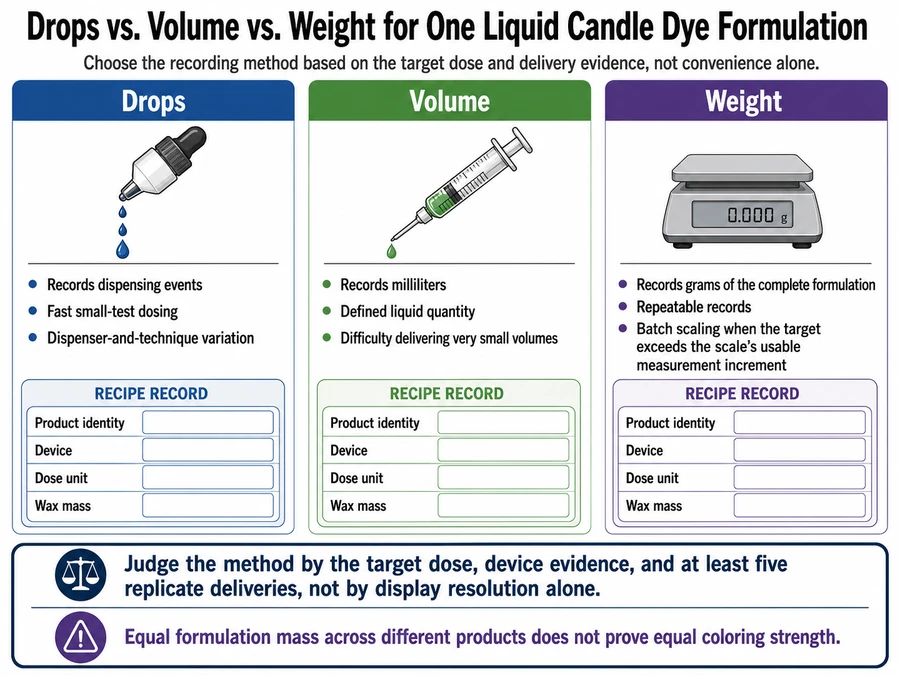
A usable measurement increment is the smallest dose change a scale can reproduce reliably in your setup, not simply the smallest digit shown on its display. Weight is preferable only when the intended formulation dose is large enough for the scale to separate it from ordinary measurement variation.
| Method under test | Named product | Device | Replicates | Mean delivered mass | Range | Variation measure |
|---|---|---|---|---|---|---|
| Drop count | Record product | Record bottle or dropper | At least 5 | Record in grams | Record in grams | State the chosen calculation |
| Metered volume | Record product | Record volume device | At least 5 | Record in grams | Record in grams | State the chosen calculation |
| Direct mass | Record product | Record scale | At least 5 | Record in grams | Record in grams | State the chosen calculation |
Methods note: Use one named formulation, one device per method, one operator, and stable operating conditions. Deliver at least five target doses and record each dose’s formulation mass. Calculate the mean and range, then judge the spread against the needs of the specific recipe rather than a universal pass threshold. A scale’s display increment does not by itself prove repeatable measurement.
Drop-based dosing can remain practical when one bottle and one dispensing method produce acceptably similar doses for the batch. Volume can work when the measuring device can deliver the target amount without a large retained or unreadable fraction. Weight is usually easier to document and scale, but equal formulation mass across two products does not prove equal coloring strength.
Use the unit that reproduces the named product’s dose reliably, and keep that unit, device, product identity, and wax basis together in the recipe.
How to Measure Liquid Candle Dye Consistently
Identify the product, choose one unit, standardize the device and technique, deliver at least five replicate doses, record formulation mass, calculate variation, and save the validated method with the candle recipe.
Repeatability means obtaining similar doses when the same method is repeated under the same conditions. Accuracy means closeness to a verified target, so a repeatable method is not automatically accurate.
- Record the supplier, product line, color, formulation label, and product code.
- Select one dosing unit: drops, volume, or formulation mass.
- Use the same dispenser or scale for every replicate.
- Keep the operator, device position, dispensing technique, and room conditions unchanged.
- Deliver at least five separate doses at the recipe’s target amount.
- Record the mass of each delivered dose in grams.
- Calculate the mean and range using the recorded values.
- Compare the variation with the needs of the named recipe.
- Save the validated unit, device, technique, and conditions with the candle formula.
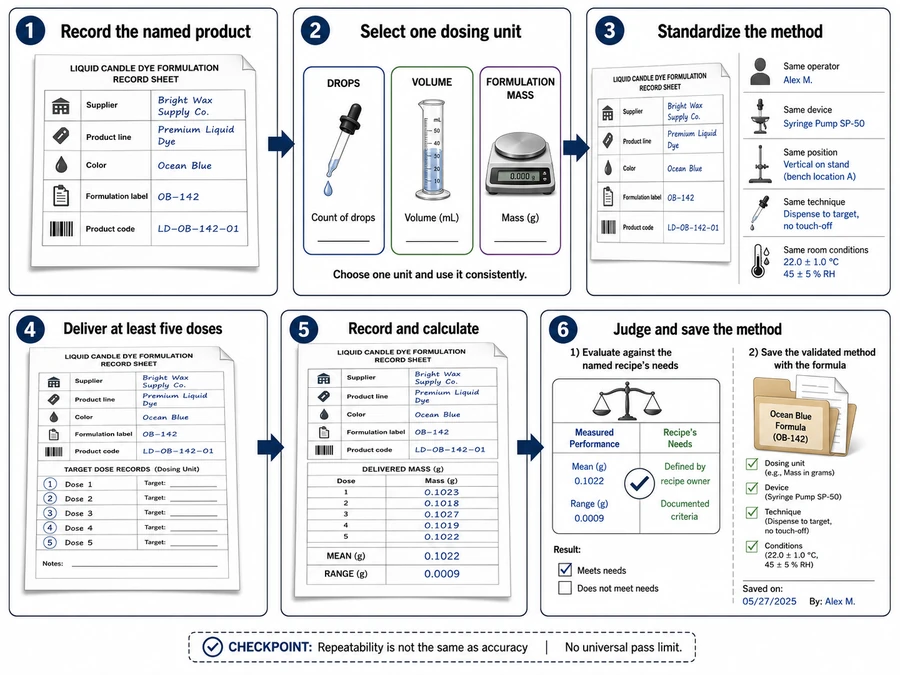
Treat the replicate test as a practical local screening method, not as a universal validation standard. Record each delivered formulation mass, calculate the mean and range, and judge the spread against the needs of the named recipe.
Do not create a universal pass limit from these measurements. The acceptable spread depends on the working dose, the named formulation, the batch size, and how much dose variation changes the finished result.
How to Keep Candle Color Consistent Between Batches
Keep the liquid dye product and measured dose constant, then control wax, fragrance, batch size, mixing, temperatures, cooling, evaluation time, and lighting. Compare fully cooled candles rather than relying on melted-wax color.
Finished-shade consistency means that cooled candles made under matched conditions show a repeatable visible color. A stable dye dose contributes to that result, but it cannot control every material and process variable.
| Variable | What must remain matched | What a change may affect |
|---|---|---|
| Liquid candle dye | Supplier, product, color, and measured dose | Delivered formulation and shade |
| Wax | Type, supplier, and lot when tracked | Background color and finished appearance |
| Fragrance | Product and dose | Wax appearance and perceived shade |
| Batch size | Wax mass and vessel setup | Heating, mixing, and cooling behavior |
| Mixing | Order, duration, and method | Dye distribution |
| Temperatures | Dye-addition and pour temperatures | Process comparability |
| Cooling | Location, airflow, and cooling time | Finished surface and visible shade |
| Evaluation | Candle age, lighting, background, and viewing angle | Visual comparison |
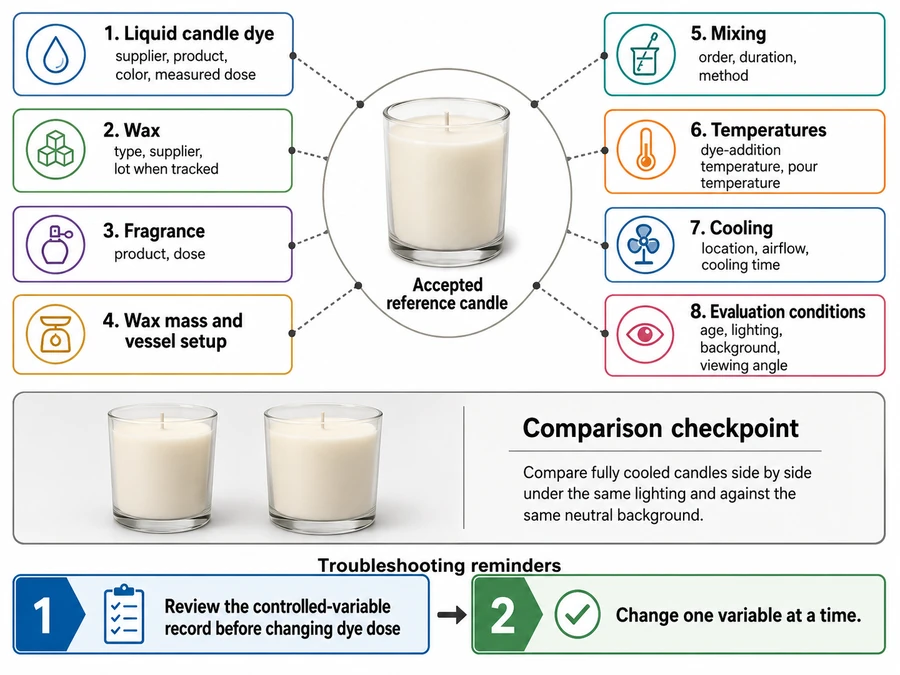
Create a reference candle from the accepted batch and compare later candles only after the same cooling and evaluation period. Place the samples beside each other under the same lighting and against the same neutral background.
When a shade differs, review the controlled-variable record before changing the dye dose. Change one variable at a time, make another test candle, and compare it with the cooled reference.
How to Calculate Liquid Candle Dye Percentage
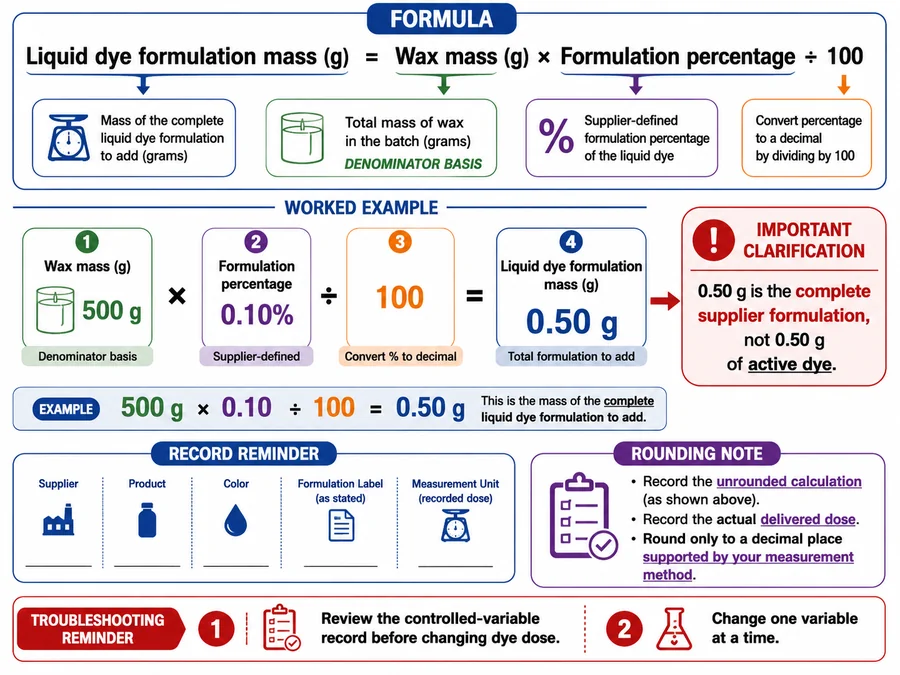
Multiply wax mass by the named liquid dye formulation percentage and divide by 100. The result is total supplier-formulation mass, not active-dye mass, and it applies only to the named product used to establish the recipe.
A formulation percentage expresses the mass of the complete liquid candle dye product relative to the wax mass. It does not state the percentage of active dye unless the supplier separately discloses that concentration.
Target formulation mass formula
Liquid dye formulation mass (g) = Wax mass (g) × Formulation percentage ÷ 100
The denominator is wax mass. Keep the supplier, product, color, formulation label, and measurement unit attached to the result.
Worked example
For an illustrative 500 g wax batch at a 0.10% formulation dose:
500 g × 0.10 ÷ 100 = 0.50 g
The result is 0.50 g of the named product’s complete liquid formulation, not 0.50 g of active dye. Record the unrounded calculation and the delivered dose, then round only to a decimal place supported by the measurement method.