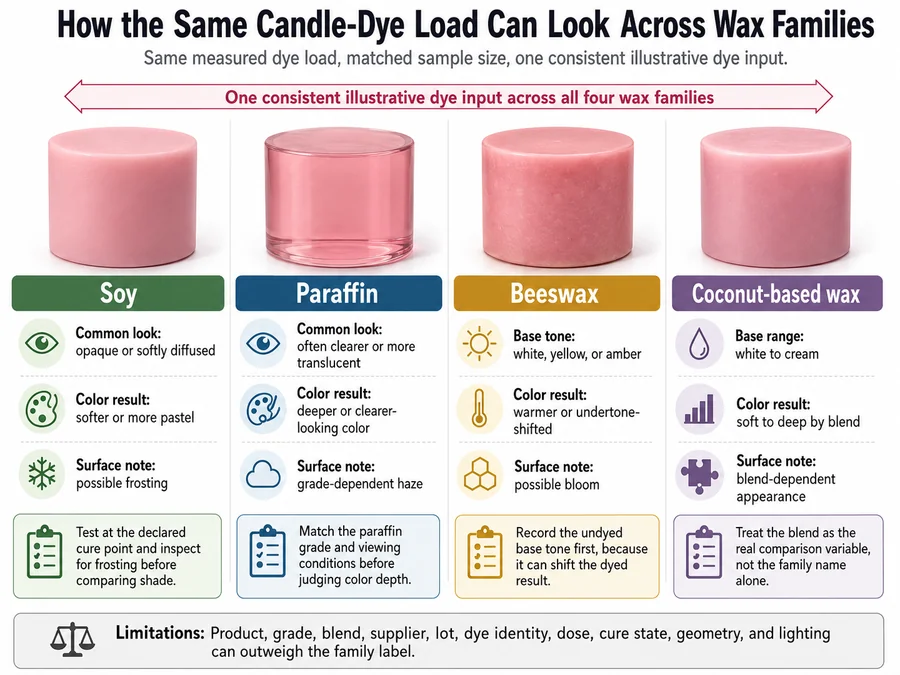

The same candle dye can cure differently in soy, paraffin, beeswax, and coconut wax because each wax changes how color is filtered, scattered, crystallized, and seen.
This page compares the cured visual appearance of one documented candle-dye system in soy, paraffin, beeswax, and coconut-based wax products. A valid “same dye” test keeps the product, format or carrier, concentration, lot, mass-normalized dose, cure interval, sample geometry, and viewing conditions matched. Here, “looks different” means a controlled change in hue, saturation, lightness, opacity, clarity, warmth, surface appearance, or apparent dye strength; it does not cover burn performance, safety, fragrance throw, or sustainability. With those controls fixed, equal input can still look softer in soy, clearer in paraffin, warmer in natural beeswax, or more dependent on the blend in coconut-based wax.
| Comparison point | Soy wax | Paraffin wax | Beeswax | Coconut-based wax |
|---|---|---|---|---|
| Typical undyed base | White to cream | White to off-white, depending on grade | White, yellow, or amber | White to cream, often shaped by the blend |
| Common optical appearance | Often opaque or softly diffused | Often clearer or more translucent | Grade-dependent with a visible natural undertone | Often creamy or opaque, but formula-dependent |
| Likely same-dye result | Softer or more pastel | Deeper or clearer-looking | Warmer or shifted by the base tone | Soft to deep according to the blend |
| Main limit | Exact product, grade, and lot | Exact grade, additives, and thickness | White, yellow, or amber grade and lot | Exact product and disclosed blend |
What Counts as the Same Candle Dye in a Four-Wax Comparison?
“Same candle dye” means the same documented product, format or carrier, concentration, lot, and mass-normalized dose used in matched samples. Matching color names, drops, chip sizes, or visually similar liquids does not prove equivalence.
A mass-normalized dose is the measured dye mass divided by wax mass. Calculate dye load as dye mass ÷ wax mass × 100, using the same mass unit for both values.
| Control | Keep the same or record | Reason |
|---|---|---|
| Dye identity | Supplier, product code, color, format, carrier, concentration when known, and lot | Matching names do not prove matching formulas or strength. |
| Dye input | Measured dye mass relative to wax mass | Drops and fragments can deliver unequal masses. |
| Formula status | Fragrance-free and additive-free, or the same measured additions | Other ingredients can change the cured appearance. |
| Processing | Heating, mixing, pouring, and cooling conditions | Process changes can alter incorporation and wax structure. |
| Cure state | The same elapsed time after pouring | Newly set and later-cured wax may look different. |
| Geometry | Thickness, shape, vessel, and fill depth | Unequal optical path length can change visible depth. |
| Viewing | Light source, background, angle, and camera settings | Unequal viewing can create a false wax difference. |
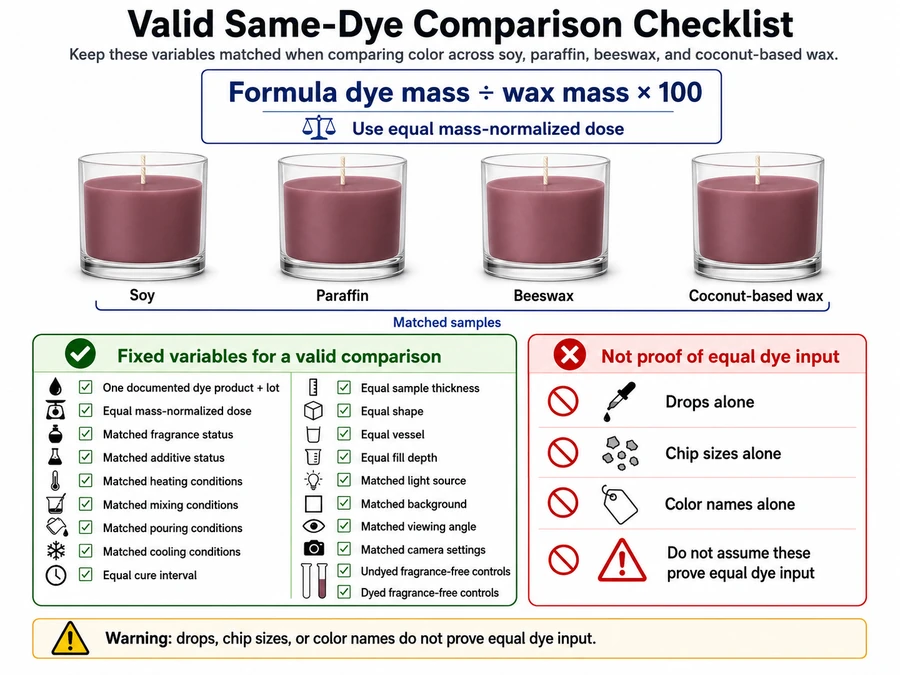
Use an undyed wax blank and a dyed, fragrance-free blank for each wax product. These samples separate the wax’s native color and structure from changes caused by fragrance oil or optional additives.
Specks, settling, streaking, droplets, or separation indicate an incorporation problem, so that sample cannot support a wax-dependent color finding.
Comparison record: Label samples before pouring and record the wax product and lot, dye product and lot, measured dye and wax masses, formula additions, process, cure interval, geometry, and viewing setup.
Material records and mass-based dosing support the phrase “same dye”; names, drop counts, fragment size, and visual similarity do not.
What Does “Looks Different” Mean in Cured Candle Wax?
A wax color looks different when one or more defined dimensions change: hue, saturation, lightness, opacity, clarity, warmth, surface appearance, or apparent dye strength.
Judge each dimension separately. Words such as “better,” “stronger,” or “brighter” are incomplete unless the changed visual property is named.
| Visual dimension | Meaning in cured wax | Recording rule |
|---|---|---|
| Hue | The color family and direction of any shift | Name the observed color and shift. |
| Saturation | How intense or muted the color appears | Use one declared comparison scale. |
| Lightness | How light or dark the sample appears | Compare matched samples under one light. |
| Opacity | How strongly the wax blocks light | Keep thickness and viewing face matched. |
| Clarity | How clear, deep, or clouded the color appears | Record haze separately from hue. |
| Warmth | Whether the result leans more yellow, orange, or red | Compare with the undyed wax base. |
| Surface appearance | Frosting, haze, mottling, streaking, or uneven color | Record the surface and cut interior separately. |
| Apparent dye strength | How strong the color looks under the declared conditions | Do not treat it as measured dye concentration. |
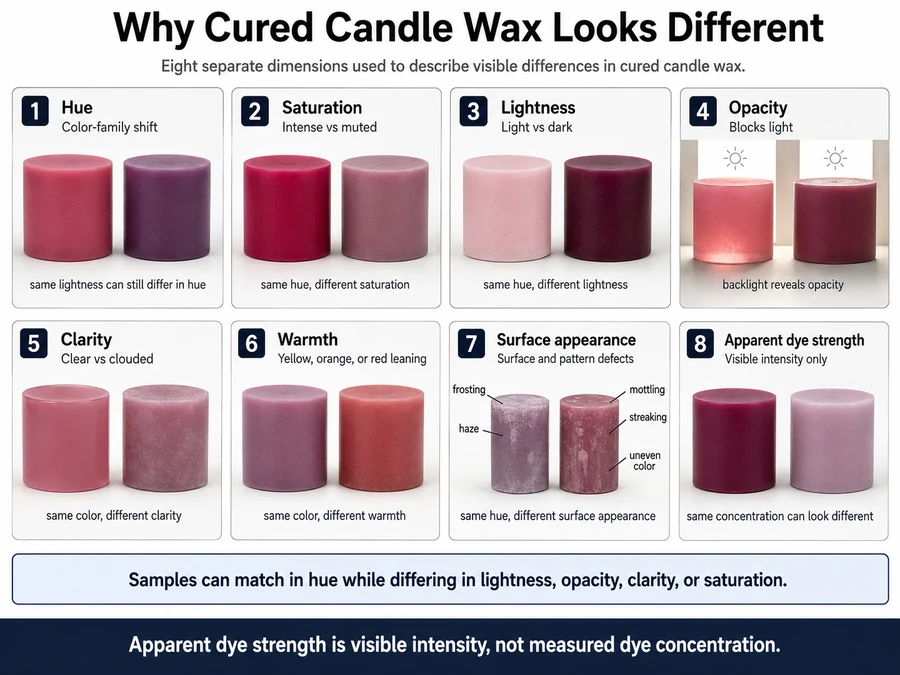
A sample can match another wax in hue while looking lighter, cloudier, more opaque, or less saturated. Apparent dye strength describes the visual result, not how much dye was measured into the formula.
Compare all samples under the same declared light, neutral background, position, viewing angle, and locked camera settings. Record an in-person observation because cameras and displays can reproduce the same sample differently.
Naming the changed dimension turns a vague color judgment into a result that can be compared across the four wax products.
Why Does the Wax’s Natural Color Shift the Same Dye?
Candle dye is viewed through the wax’s existing white, cream, yellow, or amber base. That native tone combines visually with the dye, changing the cured hue, warmth, and lightness even when the dye product and dosage are unchanged.
The undyed wax is part of the final visible color rather than an empty background. A pale dye usually reveals more of that base tone, while a darker or more saturated dye may mask part of it.
| Undyed wax base | Possible effect on the same dye | Colors that may show the effect clearly |
|---|---|---|
| White or near-white | Usually adds little warm undertone, though opacity can still make the result look lighter or softer | Pale colors, cool blues, clean pinks, and neutral shades |
| Cream | Can add warmth and reduce the appearance of a clean or icy tone | Pale blue, lavender, pink, mint, and gray |
| Yellow | Can push cool shades toward greener or warmer results | Blue, turquoise, purple, pale green, and white-tinted colors |
| Amber | Can add warmth, darken the base, and reduce neutrality in pale formulas | Blue, pink, red, purple, and light neutral shades |
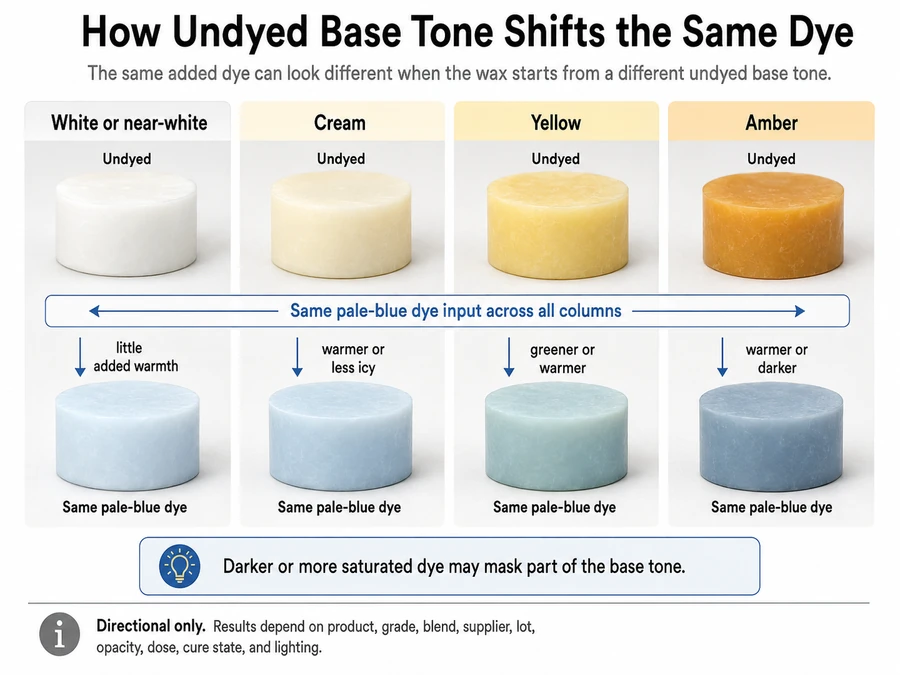
These are directional effects, not fixed wax-family rules. The result depends on the exact product, grade, refining or filtering status, blend, supplier, lot, opacity, dye identity, dose, cure state, and lighting.
An undyed control beside every dyed sample reveals how much of the result began with the wax itself.
| Control pair | What to compare | What the comparison can show |
|---|---|---|
| Undyed soy beside dyed soy | Creaminess, opacity, and surface whitening | Whether the base contributes to a softer or warmer result |
| Undyed paraffin beside dyed paraffin | Whiteness, clarity, and grade-specific haze | Whether the wax base or optical depth changes apparent strength |
| Undyed beeswax beside dyed beeswax | White, yellow, or amber starting tone | Whether a warm base shifts the added hue |
| Undyed coconut-based product beside its dyed sample | Creaminess, opacity, and blend appearance | Whether that named product behaves more like an opaque or clearer blend |
A natural label does not identify one color. Natural beeswax can range from pale yellow to deeper amber, while filtered, refined, or whitened grades may begin from a much lighter base.
The same caution applies to soy, paraffin, and coconut-based products. Refinement, feedstock, additives, blend components, and production lot can change the undyed appearance within one wax family.
Cool and pale shades are often more sensitive to undertone because the wax base remains easy to see. A cream base may make pale blue look less icy, while a yellow base may make the same blue appear greener.
This visible combination does not prove that the dye changed chemically. It shows that the eye receives color from both the added dye and the wax through which that dye is viewed.
Photo-set record: Place each undyed wax beside its dyed match under the same light, against the same background, and at the same thickness. The caption should identify the wax product and grade, blend status, supplier lot, dye product and lot, mass-based dose, cure interval, geometry, and lighting.
When the base tone differs, a formula may need wax-specific swatch testing, but the required adjustment cannot be predicted from the family name alone.
Why Do Opacity and Translucency Change Apparent Color Strength?
Paraffin often appears deeper or clearer because many grades transmit more light, while opaque or crystalline soy scatters more light. This optical difference can change apparent saturation without changing the measured candle-dye concentration.
Opacity is the degree to which solid wax blocks light, while translucency means that some light passes through without forming a clear image. In Candle Dye & Coloring, these properties change how much light reaches the dye and returns to the viewer.
A front-lit and backlit comparison helps separate optical appearance from actual dye quantity:
| Matched sample view | More opaque wax | More translucent wax | What the result means |
|---|---|---|---|
| Front-lit | Often looks lighter, softer, milkier, or more pastel | May look darker, clearer, or deeper | Reflected light and surface scattering affect apparent strength. |
| Backlit | Usually passes little light and may remain visually flat | Often shows more transmitted color and depth | Light transmission can reveal clarity that front lighting hides. |
| Edge view | May remain pale or cloudy from edge to center | Thin edges may look brighter or more saturated | Changing thickness alters the distance light travels through colored wax. |
| Surface view | Haze or crystals may lower apparent saturation | A smooth, clear surface may show greater depth | Surface structure can change appearance without changing dye load. |
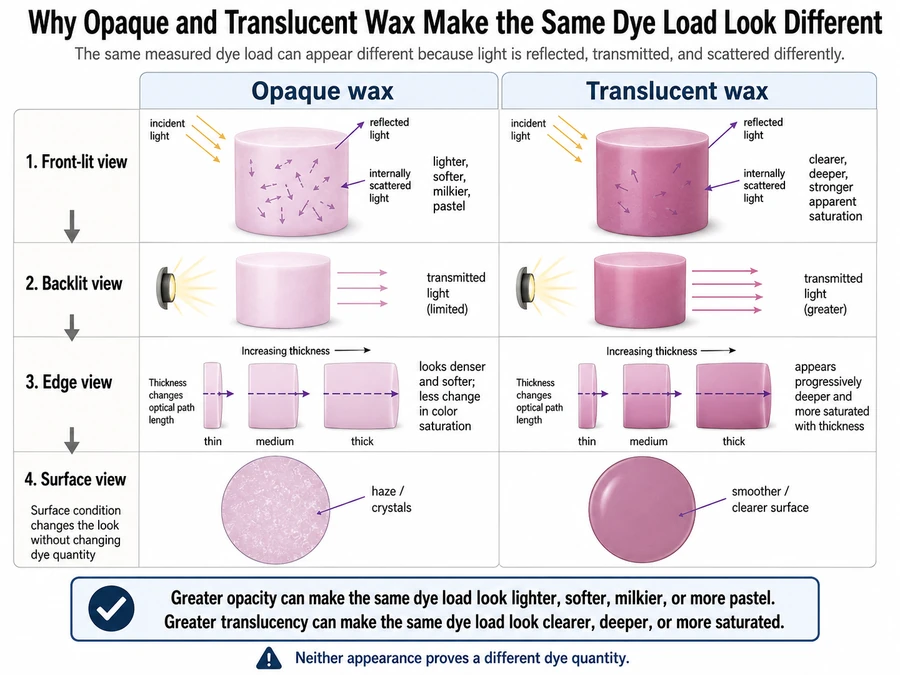
Transmitted light passes into or through the wax before reaching the eye. Reflected light returns from the surface or internal wax structure without passing through the full sample.
Opaque wax scatters more light in many directions. This scattering can raise apparent lightness, reduce clarity, and soften the separation between the dye color and the wax base.
A translucent wax may let light travel farther through the colored material. The longer visible path can make the same dye look deeper or more saturated, especially at thicker points or under backlighting.
| Optical property | Visible effect | What it does not prove |
|---|---|---|
| Greater opacity | Higher lightness, lower clarity, softer or pastel appearance | That less dye was added |
| Greater translucency | More depth, clearer color, stronger apparent saturation | That more dye was added |
| Internal light scattering | Cloudiness, diffusion, or reduced contrast | Poor dye incorporation by itself |
| Surface haze | Pale or muted outer appearance | Bulk dye fading |
| Clearer interior | Darker or richer cut section | A higher active-colorant concentration |
| Uneven optical structure | Mottling or local changes in strength | Uneven dye dosage without further testing |
Apparent saturation is the visual intensity seen under declared conditions, not a measurement of how much dye is present. Depth describes how far the color seems to extend into the wax, while clarity describes how little cloudiness or haze interrupts that view.
An opaque sample can therefore contain the same measured dye percentage as a clearer sample and still look less intense. Adding more dye may darken the formula, but it may not remove a milky or pastel effect caused mainly by light scattering.
The opposite exception also matters. Not every paraffin product is highly translucent, and not every soy, beeswax, or coconut-based product is strongly opaque. Grade, refinement, additives, blend composition, crystal structure, cure state, thickness, and surface finish can change the expected result.
A wax can also look different under front and back lighting without undergoing any material change. Backlighting favors transmitted color, while normal room viewing often depends more heavily on reflected light from the surface and interior structure.
Treat optical strength and dye concentration as separate records: one describes what the sample looks like, while the other describes what was measured into the formula.
Sample thickness, shape, fill depth, vessel color, background, viewing angle, and distance must match because each can change optical path length or contrast and imitate a wax-family or dye-load difference.
Why Does Candle Dye Look Different After the Wax Cools and Crystallizes?
Cooling creates a solid wax structure that scatters and reflects light differently from molten wax. The cured sample may look lighter, cloudier, or mottled without proving that the dye faded or that too little dye was used.
Crystallization is the formation and rearrangement of ordered wax structures as melted wax solidifies and continues to settle. These structures change how light travels through and returns from the wax.
Molten wax often looks darker, clearer, and more saturated because the liquid scatters less light. That appearance is not a reliable preview of the cured candle.
| Observation stage | Possible appearance | What the stage does not prove |
|---|---|---|
| Fully molten | Dark, clear, glossy, or highly saturated | The final cured shade |
| Newly set | Lighter, duller, or uneven | Permanent color loss |
| Declared cured point | More stable surface and interior appearance | Lifetime color stability |
| Fresh cut interior | Darker or more even than the surface | That the surface contains less measured dye |
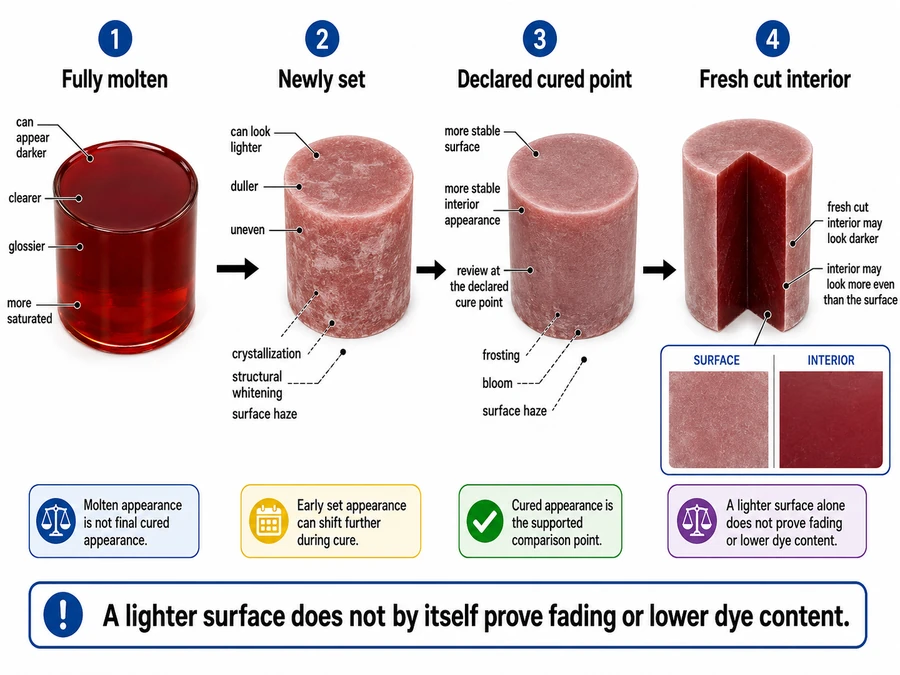
Structural whitening is a pale appearance caused by the solid wax structure or surface crystals scattering more light. It can lower apparent saturation without removing dye from the wax.
Compare every wax at the same elapsed time after pouring and under the same storage and viewing conditions. A newly set sample cannot be ranked against one that has cured longer.
A pale surface with a stronger-colored cut interior is more consistent with frosting, bloom, or surface haze than confirmed bulk fading. Uniform weakening through the surface and interior needs separate evidence before it is described as fading.
Comparison record: Record the wax product and lot, dye product and lot, mass-based dose, fragrance and additive status, cooling conditions, cure interval, geometry, lighting, and surface-to-interior difference.
A lighter cured result can come from the optical structure of solid wax, so surface structure, cure timing, geometry, lighting, and ingredient differences must be checked before dye loss is claimed.
Soy vs Paraffin vs Beeswax vs Coconut Wax: How Does the Same Dye Compare?
Under matched conditions, soy often looks softer, paraffin clearer, beeswax warmer, and coconut wax more dependent on its blend, but product formulation can outweigh the family label.
These are tendencies, not guaranteed outcomes. The exact wax product, grade, blend, lot, native color, opacity, crystal structure, dye identity, dose, cure state, geometry, and lighting can change the result.
| Comparison criterion | Soy wax | Paraffin wax | Beeswax | Coconut-based wax |
|---|---|---|---|---|
| Typical undyed base | White to cream | White to off-white, depending on grade | White, yellow, or amber | White to cream, often shaped by blend components |
| Common optical appearance | Opaque, cloudy, or softly diffused | Often clearer or more translucent | Product-dependent with a visible natural undertone | Often creamy or opaque, but strongly formula-dependent |
| Apparent saturation | Often muted or pastel | Often deeper or stronger-looking | May be reduced or shifted by the native base | Can range from soft to deep according to the blend |
| Hue influence | Creaminess may warm or soften pale shades | A pale neutral base may preserve the dye’s apparent direction | Yellow or amber grades may push colors warmer | Base tone and supporting waxes may alter warmth and clarity |
| Surface effect | Frosting or crystalline whitening may lower surface intensity | Grade-specific haze or crystal structure may affect clarity | Bloom and natural variation may alter the surface | Surface behavior depends strongly on the commercial formula |
| Main testing need | Check softness, opacity, and surface whitening | Check depth, clarity, and thickness effects | Check the undyed base before adjusting dye | Verify the exact product and disclosed blend |
One dye can therefore create four cured appearances at one measured load. The differences can involve hue, saturation, lightness, clarity, opacity, warmth, and surface texture rather than darkness alone.
Why Can Two Products in the Same Wax Family Render Dye Differently?
Two waxes sold under the same family name can differ in refinement, feedstock, additives, blend composition, crystal behavior, base color, and opacity, causing the same dye to cure differently.
Record the supplier, product code, grade, blend status, intended use, and lot. Describe the tested product first, and use a family-level statement only when matched products show the same direction.
Soy vs the Other Waxes: Why Does the Dye Often Look Softer or More Pastel?
Soy wax often makes the same candle dye look softer because many soy products are opaque, creamy, and crystalline, which increases light scattering and lowers apparent saturation.
A softer soy result does not mean less dye is present. The tested soy product may return more scattered light, and frosting or another surface structure can make the outer face look paler than the interior.
Paraffin vs the Other Waxes: Why Can the Dye Look Deeper and Clearer?
Paraffin can make the same candle dye look deeper because many grades are less opaque and transmit more light than creamy or highly crystalline plant-wax products.
The effect depends on the grade. Clear or translucent paraffin may show more depth, while opaque, mottled, modified, or additive-rich paraffin may not follow that pattern.
Beeswax vs the Other Waxes: Why Does the Dye Shift Warmer?
Natural beeswax can shift candle dye warmer because its yellow or amber base remains visible through the added color and changes the final perceived hue.
White, pale yellow, deep yellow, amber, filtered, refined, bleached, and blended beeswax do not share one starting color. Cool and pale dyes usually reveal this undertone most clearly.
Coconut Wax vs the Other Waxes: Why Do Results Vary by Blend?
Coconut wax color varies widely because many retail products are coconut-based blends whose supporting waxes, oils, hardeners, and additives change opacity, warmth, crystal structure, and dye appearance.
A coconut-soy blend may behave more like an opaque plant wax, while a coconut-paraffin blend may show more depth. When the formula is undisclosed, tie the result to the tested product code and lot rather than pure coconut wax.
| Visual goal | Start by testing | Main limit |
|---|---|---|
| Clearer or deeper-looking color | A documented clearer paraffin grade | Not every paraffin is clear, and thickness can increase apparent depth. |
| Soft or pastel color | An opaque soy or coconut-based product | The same scattering can make dark shades look weaker. |
| Naturally warm or earthy color | A yellow or amber beeswax grade | Cool shades may shift away from the target hue. |
| A transferable production formula | Matched swatches from each exact wax product | A family label cannot prove that the formula will transfer. |
Do not increase dye automatically when an opaque wax looks lighter. Check the undyed base, opacity, crystals, surface whitening, geometry, lighting, and incorporation first, because more dye may darken the sample without correcting haze, warmth, or reduced clarity.
Comparison record: Use the same dye product and lot, mass-based load, wax mass, fragrance and additive status, geometry, cooling record, cure interval, viewing light, background, and scoring method. Identify each wax by supplier, product code, grade, blend status, and lot.
Repeated small-batch testing uses extra material and time, but it reduces the risk of correcting a production run after a wax or supplier change alters the cured color.
The four-wax comparison provides a starting expectation; the exact wax product and lot determine whether that expectation survives a matched test.