
There is no universal best candle dye for coconut wax; choose a supplier-documented liquid dye, chip, or block that fits the exact wax, produces the intended cured shade, can be measured consistently, and passes repeat-pour and burn testing.
This guide is for candle makers choosing a wax-compatible dye for wicked candles made with pure coconut wax or a coconut-soy blend. Here, “best” means the strongest fit for your named wax, target cured color, batch size, measurement control, repeatability, and verified burn result—not the darkest or most concentrated option.
You will compare qualified liquid dyes, chips, and blocks, then check supplier concentration, even incorporation, cured appearance, and performance after a formula change. Start by identifying the exact wax product, because pure coconut wax, disclosed coconut-soy ratios, and proprietary blends do not support the same recommendation.
Pure coconut wax vs coconut-soy: how does the wax system change the dye choice?
The exact coconut-based wax changes the dye choice because each wax product can produce a different cured color and may require a different incorporation and testing process.
Record the exact supplier wax and product name before selecting a dye. If its composition is undisclosed, mark it as undisclosed and treat outside recommendations as test candidates rather than transferable formulas.
Recommendation portability means how much advice from one wax product can be reused for another before the second product must be tested separately. Check the wax supplier’s technical data sheet (TDS) for stated composition and processing guidance, and use its safety data sheet (SDS) for product identification and handling information.
| Wax or source system | Disclosure to record | What may transfer | Decision |
|---|---|---|---|
| Supplier-identified pure coconut wax | Exact product name and current supplier information | Guidance written for the same wax and dye product may provide a starting condition | Test the candidate in that named wax before approval |
| Coconut-soy blend with a known ratio | Product name and stated coconut-to-soy ratio | Results from the same named blend have stronger portability | Treat the recommendation as conditional and repeat the test after product changes |
| Partially disclosed coconut-soy blend | Known components and every undisclosed detail | General format or color-goal guidance may transfer | Make weaker claims and rely on product-specific testing |
| Undisclosed proprietary blend | Product name and a clear “composition undisclosed” note | No dose or cured-result assumption should transfer automatically | Build the recommendation from tests in the exact product |
| Soy or paraffin source formula | Source wax, target coconut-based wax, and dye product | The target hue may transfer as an objective | Do not copy the dose or expected cured result |
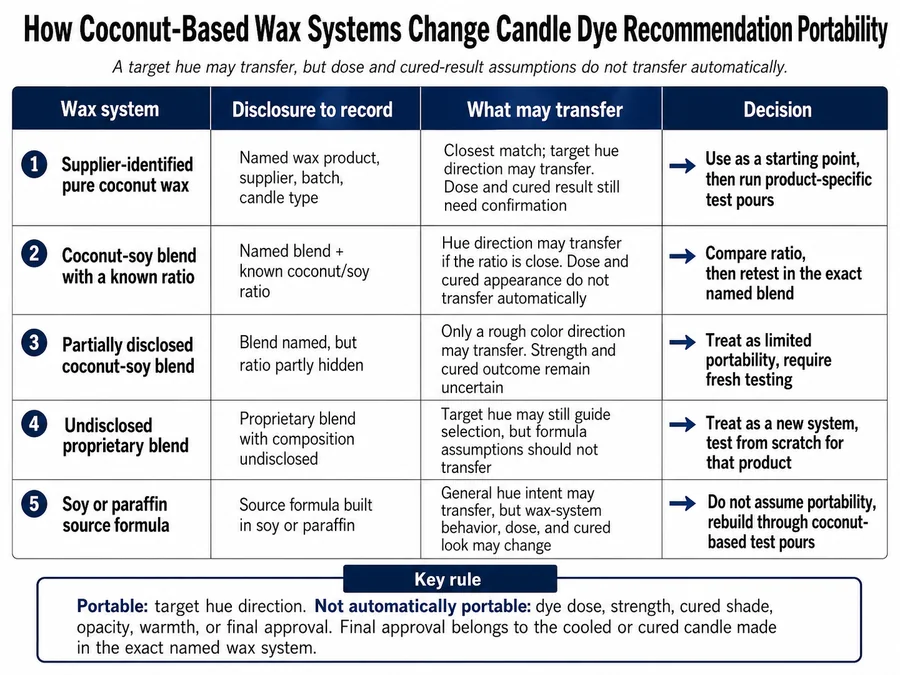
Methods: Build this comparison from the wax supplier’s TDS, product description, and SDS, paired with the dye supplier’s usage instructions. Record only disclosed composition and product-specific directions rather than estimating hidden ratios or additives. Judge portability by how closely the source and target conditions match.
How does coconut-soy blend ratio modify the recommendation?
A known coconut-to-soy ratio improves recommendation portability, but it does not make a dye formula automatically transferable.
When the exact ratio and product are disclosed, results from that same named blend provide a better starting point than results from a generic “coconut-soy” label. Product strength, additives, wax processing, and dye concentration can still differ, so the recommendation remains conditional.
For a partially disclosed blend, retain only broad guidance such as the dye format or intended hue. For an undisclosed proprietary blend, avoid claims about how the soy percentage will affect saturation or cured appearance and require tests in the named wax product.
Methods: Classify the blend by what the supplier states, not by guesses based on texture, melting behavior, or marketing terms. Record the product name, disclosed ratio, and document version before comparing results. A change of supplier or wax product creates a new test condition.
Why do soy or paraffin dye formulas not transfer directly?
A soy- or paraffin-based dye formula does not transfer directly because the source wax, target coconut-based wax, dye strength, and processing conditions can change both the required dose and cured result.
The target hue may carry over as a visual objective, but the original dose and predicted cured shade do not. Even when the dye name is similar, supplier concentration and product instructions may differ.
Use this adaptation sequence:
- Record the source wax and the exact target coconut-based wax.
- Keep the intended hue as the only assumed starting objective.
- Select the dye candidate according to the target wax and dye supplier’s instructions.
- Treat the result as provisional until cured-color repetition and burn validation are complete.
Methods: Compare the source and target records for wax identity, dye product, concentration, addition method, and evaluation point. Mark any uncontrolled difference as a reason not to transfer the dose or expected cured result. This comparison does not create a universal conversion formula.
Carry over the color goal, not the formula, and rebuild the recommendation around the exact coconut-based wax product.
What qualifies a colorant as a candle-safe, wax-compatible dye?
A supplier-documented, wax-compatible colorant qualifies as a candle-dye candidate only when its intended use includes wicked candles made with wax.
Here, candle-safe means documented by the supplier for the intended candle use; it does not mean universally harmless or independently certified. Reject water-based or undocumented craft colorants, and verify multipurpose products whose candle-use instructions are unclear.
For a wicked candle, use a dye intended to color the wax throughout; do not assume mica or another suspended pigment is an equivalent substitute.
Use the following screen before comparing dye formats or products:
- Qualify: The supplier identifies the product for candle use and provides wax-use instructions.
- Qualify provisionally: The product is sold as candle dye, the exact item is identifiable, and its instructions cover the planned wax application.
- Verify: The product is described as oil-soluble or multipurpose, but its suitability for wicked candles is not stated.
- Verify: The label says “non-toxic” or similar wording without documenting candle use.
- Reject: The product is water-based, intended only for crafts, or lacks enough information to identify and assess it.
- Reject: The supplier advises against use in candles or wax.
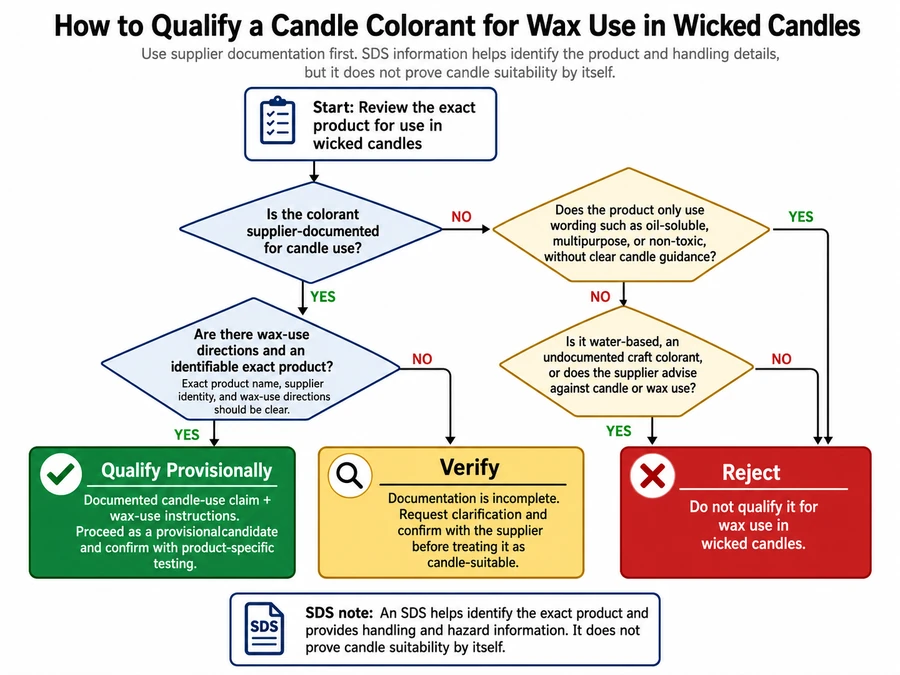
A safety data sheet (SDS) identifies a product and gives handling information, but it does not prove that the product is suitable for wicked candles by itself.
| Candidate evidence | Decision | Reason |
|---|---|---|
| Candle-use instructions plus wax-use directions | Qualify provisionally | The intended use and material application are documented |
| “Oil-soluble” without candle-use instructions | Verify | Oil compatibility alone does not confirm suitability for a wicked candle |
| “Non-toxic” without product-specific candle guidance | Verify | General hazard wording does not establish candle performance or suitability |
| Multipurpose dye with unclear candle wording | Verify | The supplier must confirm the intended candle application |
| Water-based colorant | Reject | It fails the wax-compatibility screen |
| Undocumented craft colorant | Reject | Its intended use and candle suitability cannot be confirmed |
Methods: Check the product label, supplier usage instructions, product description, and SDS for the exact item. Base the decision on direct supplier statements rather than colorant appearance, marketing terms, or assumptions about oil solubility.
Only qualified candidates should move to format comparison or wax-specific testing.
Liquid dye vs chips vs blocks: which format fits coconut-based wax?
No liquid dye, chip, or block is universally best; the suitable format fits the named coconut-based wax, batch scale, handling method, and repeatability requirement.
Liquid dye can fit fine shade adjustments when the product is measurable, chips can fit controlled increments, and blocks can fit accurately weighed repeated batches. Each option remains product-specific because supplier concentration, piece size, and incorporation instructions can differ.
| Dye format | Conditional fit | Measurement and control | Handling and incorporation | Main repeatability risk |
|---|---|---|---|---|
| Liquid dye | Small test pours or gradual shade adjustments | Suitable when the dispenser or scale can reproduce the smallest planned addition | Follow the exact supplier directions rather than assuming every liquid disperses the same way | Drop size and concentration can vary between products |
| Dye chips | Fixed-increment testing when each addition can be recorded consistently | Weigh or otherwise document the amount instead of assuming every chip is equal | The chip must incorporate fully under the supplier’s stated process | Chip size or strength may differ between suppliers |
| Dye blocks | Repeated batches when portions can be weighed accurately | Record the mass of each portion with suitable equipment | Cut, weigh, and incorporate each portion consistently | Visually estimated pieces can create formula variation |
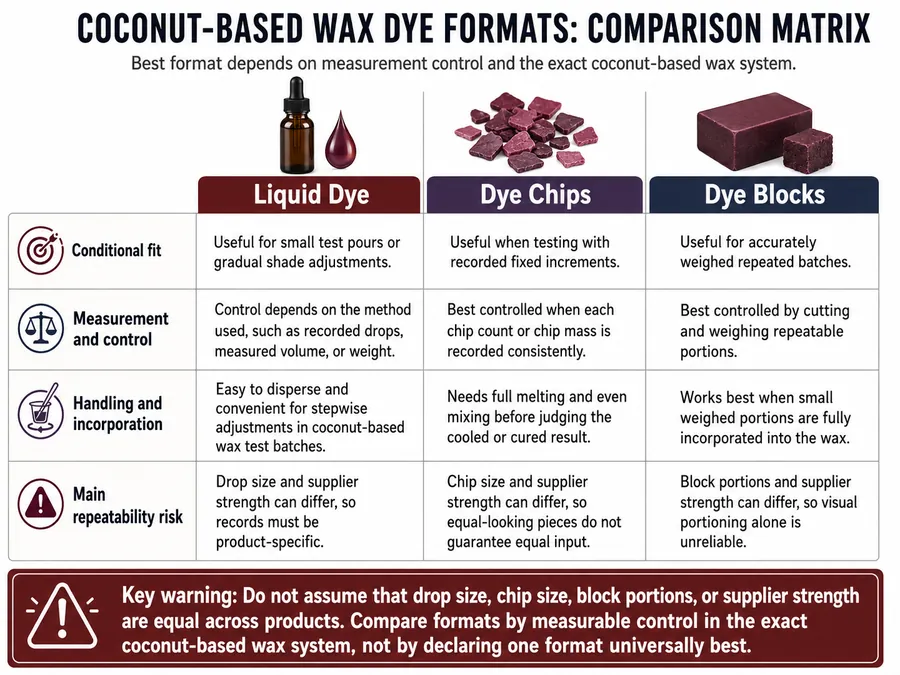
Repeatability means producing the same recorded result under the same wax, dye, process, and cured-evaluation conditions.
A liquid format is not automatically easier to control, and a solid format is not automatically more consistent. The practical comparison is whether the exact supplier product can be measured, incorporated, recorded, and repeated at the intended batch size.
Methods: Compare the exact product instructions, SDS, stated concentration information, measurement method, batch scale, and incorporation directions. Do not treat equal drop counts, chip sizes, or block pieces as equal dye doses across products.
Choose the format that provides measurable control in the exact wax and batch size, then validate the individual product rather than the format category.
How do concentration and measurement control change the format decision?
Supplier-specific concentration and measurement control determine whether a dye addition can be repeated at the intended batch size.
Retain only products whose smallest planned addition can be measured with the available scale or dispenser. Equal drop counts do not prove equal dye dose because product concentration and delivered drop size may differ.
Scale resolution is the smallest mass increment a scale can display reliably for the planned measurement.
Record these fields for each dye candidate before approving its measurement method:
| Measurement-control field | What to record | Pass condition |
|---|---|---|
| Exact supplier product | Product name, identifier, and current instructions | The tested dye can be traced to one documented product |
| Dye format | Liquid, chip, or block | The format matches the recorded handling method |
| Supplier-stated strength | Any supplied concentration or strength description | Strength is not assumed from format alone |
| Measurement device | Scale, dispenser, or another documented tool | The device suits the form of dye being measured |
| Device resolution | Smallest displayed mass or repeatable dispensed amount | The planned addition is large enough to measure consistently |
| Smallest repeatable addition | The lowest addition that can be reproduced and recorded | Repeated measurements return the same recorded amount |
| Intended wax batch size | Wax mass used for the test condition | The measurement method remains usable at that batch scale |
| Decision | Pass, retest, or reject | The product advances only when its addition can be repeated |
Methods: Use the dye supplier’s instructions, product identification documents, and the measurement device specifications. Repeat the same weighing or dispensing action and retain the method only when the recorded addition can be reproduced without estimating by sight.
A highly concentrated dye is not the better choice when the available tools cannot measure its smallest useful addition consistently.
How much candle dye should you use in coconut wax?
Use the exact dye supplier’s starting range for the named coconut-based wax and treat it as a test dose; no universal drop, chip, or block amount transfers reliably across products.
Record the wax mass and dye amount with units. Retain the dose only when it can be measured repeatedly, produces the intended cured shade, and passes burn revalidation.
How do you confirm the dye has incorporated evenly?
A qualified candle dye incorporates evenly only when it passes melt, cooled-sample, and repeat-pour inspection in the exact coconut-based wax.
Visible, even color in the melt is not enough to pass the candidate. Record the supplier wax product and dye format, then inspect the result at all three stages.
- Inspect the melt: Follow the dye supplier’s incorporation instructions and check for visible unresolved material or uneven color.
- Inspect the cooled sample: Examine the same batch after it has cooled fully under consistent lighting and against the same background.
- Inspect a repeat pour: Repeat the recorded wax, dye, amount, and process to check whether the result appears again.
Use these decisions:
- Pass: The melt appears even, the cooled sample shows no visible unresolved material, and the repeat pour matches the first result.
- Retest: The observation is unclear, the process record is incomplete, or only one pour has been inspected.
- Reject pending troubleshooting: Unresolved particles return, uneven areas remain after cooling, or the repeated result differs under the same recorded conditions.
Methods: Follow the supplier’s incorporation instructions for the exact dye and review its safety data sheet for product identification and handling. Keep the wax product, dye product, recorded addition, and test process unchanged between repeat pours. This section identifies pass, retest, or reject signals rather than diagnosing detailed temperature, mixing, sediment, or equipment problems.
| Wax product and composition status | Dye product and format | Melt inspection | Cooled-sample inspection | Repeat-pour inspection | Decision and reason |
|---|---|---|---|---|---|
| Record exact supplier product | Record liquid, chip, or block | Pass, unclear, or unresolved material visible | Pass, uneven area, or unresolved material visible | Match, unclear, or visibly different | Pass, retest, or reject pending troubleshooting |
How do you choose candle dye for the target cured shade in coconut wax?
Choose a candle dye for coconut wax by matching a qualified product to the intended cured shade after accounting for the wax’s opacity and natural base tone.
Do not approve a dye from its molten color or from screen images. Compare labeled cured swatches made with the exact wax, dye, amount, cure checkpoint, lighting, and background.
Wax opacity is the degree to which cured wax blocks light, which can make a shade appear softer or creamier. Base tone is the wax’s natural visible color before dye is added.
A creamy or muted cured shade does not automatically mean the dye failed. Adding more dye is not always the right correction because the wax appearance, supplier product strength, and measurement control still affect the result.
| Intended cured appearance | Wax condition to consider | Candidate-selection rule | Initial decision |
|---|---|---|---|
| Light or pastel shade | Natural base tone may remain visible | Select a qualified dye that allows small, repeatable adjustments | Retain when the cured sample matches the intended soft appearance |
| Medium shade | Opacity may soften the visible color | Select a measurable product that reaches the target without relying on molten appearance | Adjust or retain after cured comparison |
| Deep shade | A creamy base may limit apparent depth | Select a qualified product whose strength and smallest addition can be controlled | Retest rather than assuming more dye will solve the difference |
| Defined reference shade | Screens and supplier images may display color differently | Compare physical swatches under the same recorded conditions | Retain only when the cured sample meets the preselected visual reference |
| Undisclosed proprietary blend | Base composition and additives are unknown | Test only in the exact named wax product | Do not transfer the expected shade from another wax |
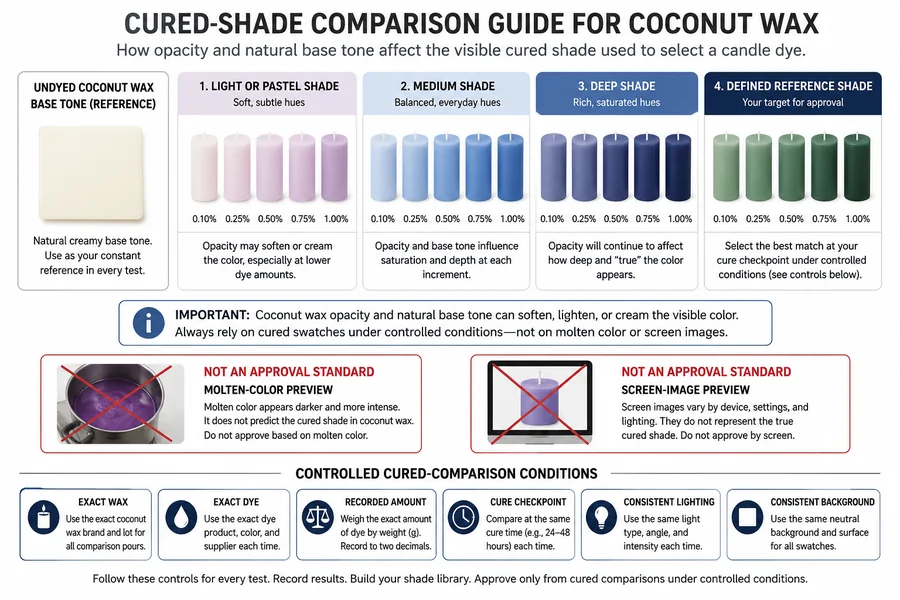
Use the wax supplier’s technical guide and the dye supplier’s color-use instructions to define the starting test condition. Treat supplier images as general references unless they identify the same wax, dye product, amount, cure checkpoint, lighting, and background.
Choose the candidate that reaches the intended cured appearance with measurable control, then treat it as provisional until repeatability and burn validation are complete.
What steps confirm the dye works after curing and burn testing?
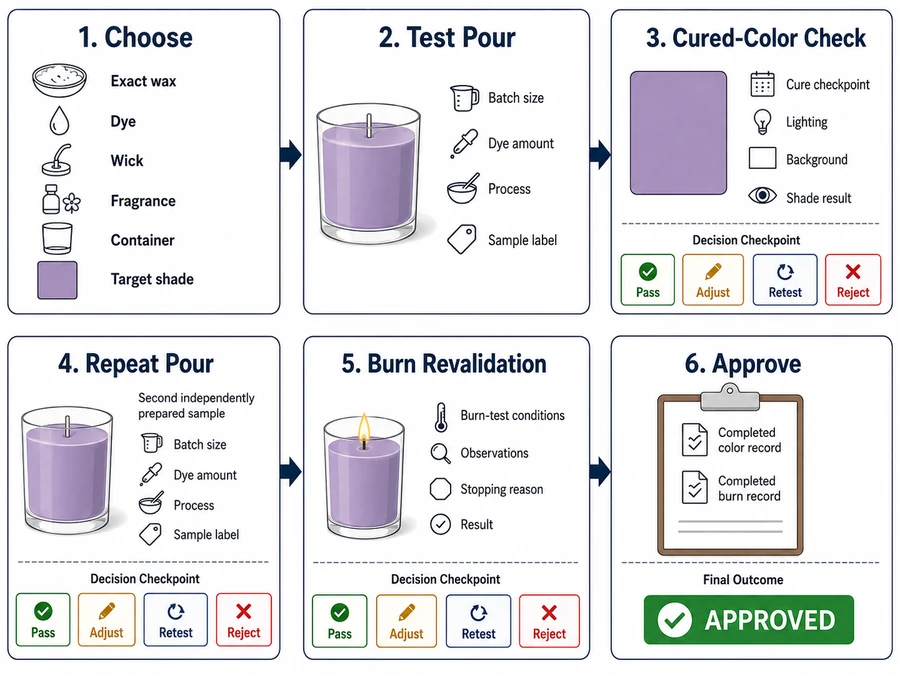
A changed candle formula requires validation through repeated cured-color checks and burn revalidation before the dye can be approved.
Approve the candidate only when controlled test pours repeatedly produce the intended cured shade and the changed formula passes an established burn-test protocol. Adjust or reject it when the color cannot be repeated, visible incorporation problems return, or the burn result falls outside the chosen acceptance criteria.
Repeatability means obtaining the same acceptable result with the same wax, dye, amount, wick, fragrance, container, process, cure checkpoint, and evaluation conditions.
| Validation stage | Evidence to record | Pass condition | Decision when it fails |
|---|---|---|---|
| Choose | Exact wax, dye, wick, fragrance, container, and target shade | Every product and formula variable is identifiable | Complete the record before testing |
| Test pour | Batch size, dye amount, process, and sample label | The test follows the recorded formula | Repeat under controlled conditions |
| Cured-color check | Cure checkpoint, lighting, background, and shade result | The cured sample meets the intended appearance | Adjust the candidate and create a new test condition |
| Repeat pour | A second independently prepared sample using the same record | The repeated sample matches the accepted result | Retest or reject for insufficient repeatability |
| Burn revalidation | Test conditions, observations, stopping reason, and result | The changed formula meets the established acceptance criteria | Reject or revise the formula before approval |
| Approve | Completed color and burn records | Both repeatability and burn requirements pass | Keep the candidate provisional until all evidence is complete |
Burn revalidation means repeating the applicable burn assessment after a dye or dye-dose change to confirm that the finished candle still meets the selected safety and performance criteria.
For candles intended for the U.S. market, use the current active ASTM F2417 edition where applicable, together with instructions from the wax, wick, dye, fragrance, and container suppliers. Keep the burn test supervised on a suitable heat-resistant surface, follow the protocol’s stopping rules, and never leave a burning candle unattended.
Methods: Prepare at least two independently made test pours from the same written formula. Hold the wax, wick, fragrance, container, batch size, process, cure checkpoint, lighting, and evaluation background constant. Record each dye addition with the same measurement method. Evaluate cured color before burn revalidation, then document the burn-test conditions, observations, result, and reason for approval, adjustment, or rejection.
A dye choice becomes approved only when the written record supports both repeatable cured color and an acceptable burn result; product popularity, molten appearance, or one successful pour is not enough.