
Pantone, Hex, and RGB can communicate a target color, but they do not create a universal candle-dye formula or guarantee identical finished wax; reliable matching requires test pours and approval of a cooled or cured candle sample under stated conditions.
This guide focuses on the visible color of dyed candle wax after it has cooled or cured.
Here, color matching means comparing a target reference with a physical candle sample under stated material, process, lighting, background, and viewing conditions.
A code, screenshot, printout, loose dye, or molten wax is not the controlling approval object, and exact, close, acceptable, measured, and approved are separate claims.
The article first explains what each reference specifies, then covers practical limits, result-changing variables, and the physical sampling and approval process.
What Do Pantone, Hex, and RGB Actually Specify for Candle Color Matching?
Hexadecimal (Hex) and red, green, and blue (RGB) values encode digital color within a declared color space, which defines how numbers map to displayed color, while Pantone can name a physical or reproduction reference.
None specifies the wax, dye, concentration, fragrance, process, cure state, or viewing conditions that produce a finished candle’s visible color.
This table compares each reference system’s role and candle-specific limits.
| Reference | What it communicates | What it does not specify for candle wax | Useful role |
|---|---|---|---|
| Pantone | A named physical or reproduction target tied to a stated system or guide | Wax type, dye system, formula, fragrance, processing, cure state, surface, or light | A target for intake and physical comparison, especially when the actual swatch is available |
| Hex | Digital RGB information written as a compact code within an assumed or declared color space | The appearance of printed material or dyed candle wax | A digital starting point for communicating color direction |
| RGB | Numeric red, green, and blue channel values interpreted by a display system | A supplier-independent dye formula or finished physical result | A digital target when the color space and source are recorded |
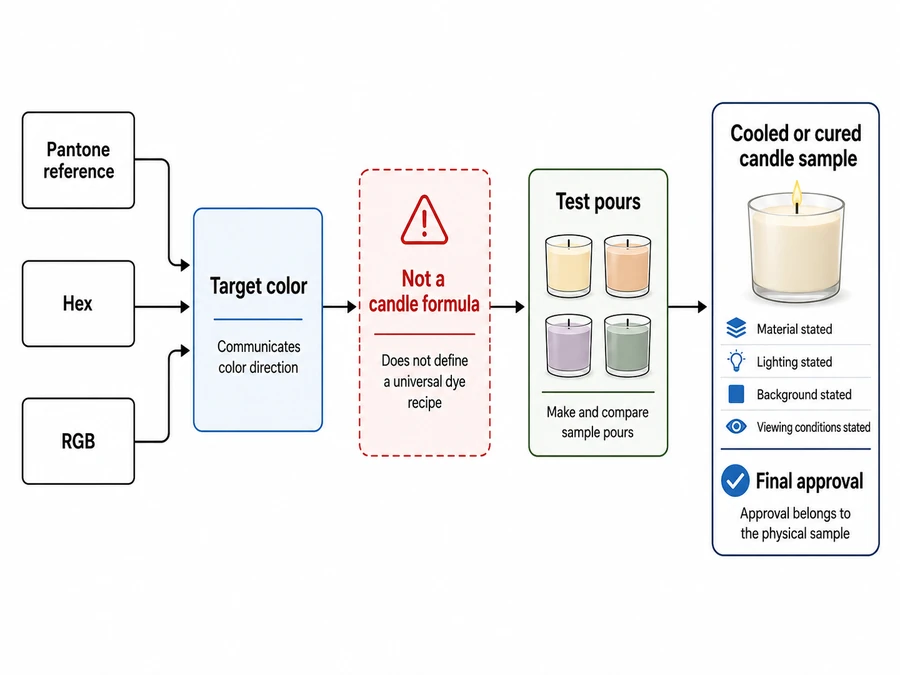
A Pantone reference is not automatically more accurate than Hex for a finished candle. A physical Pantone swatch can reduce uncertainty caused by screens, but it still cannot predict how a wax-and-dye system will reproduce the target.
A screenshot cannot control the approved candle color because its appearance depends on the source file, device, brightness, display settings, ambient light, and viewing angle. The controlling object should be a labeled, cooled or cured physical candle sample reviewed under stated conditions.
Record the following information when accepting a client’s reference:
- Record the exact Pantone, Hex, or RGB value and where it came from.
- Record the digital color space or Pantone guide and edition when known.
- State whether an original physical swatch is available.
- Identify the candle’s intended viewing environment.
- State that final approval will apply to a declared physical candle sample.
Methods for the cross-medium comparison: Record the display and color space, identify the physical guide or swatch, and document the wax, dye system, candle state, light, background, and geometry. Use photographs as labeled records of the setup, while treating the cooled or cured candle sample as the approval object.
Understanding what a reference communicates does not prove that the finished candle can reproduce the same observed appearance.
Why Can the Same Value Look Different on Screens, in Print, and in Candle Wax?
Screens emit light, printed surfaces reflect light through inks and substrates, and finished candle wax has its own material, surface, thickness, and shape.
The same reference value can therefore look different on two screens, in print, and in a cooled or cured candle, even when each medium is working as intended.
This table compares how screens, print, and finished candle wax produce or display color.
| Comparison item | How the color is produced or observed | Conditions that must be recorded | Approval role |
|---|---|---|---|
| Screen A | The display emits colored light | Device, color space, brightness, display mode, ambient light, and viewing angle | Communicates digital direction only |
| Screen B | A different display emits and processes the same digital values | Device, color space, brightness, display mode, ambient light, and viewing angle | Shows whether the digital appearance changes between devices |
| Declared print | Ink and substrate reflect the light falling on them | Printer or proof source, ink process, coating, substrate, light, and viewing angle | Can serve as a physical target only when that print is formally selected |
| Cooled or cured candle | Wax reflects, absorbs, transmits, and scatters light | Wax and dye system, state, thickness, vessel, backing, surface, curvature, light, distance, and angle | Controls approval after the sample and conditions are accepted |
Display brightness, panel behavior, color-space interpretation, and room light can make two screens show different versions of the same Hex or RGB value. A screen image therefore communicates direction rather than a fixed physical appearance.
Print introduces another set of variables. Ink, paper or other substrate, surface coating, and the light used for viewing can shift the apparent hue, lightness, and saturation.
Opacity limits how much light passes through the wax, while translucency allows some light to pass through and scatter. Vessel color, backing, surface texture, sample thickness, and curvature can change the finished candle’s appearance even when the wax formula remains unchanged.
Methods for the one-target comparison: Display one declared target on two named screens, reproduce it through one recorded print condition, and compare both with one labeled cooled or cured candle sample. Record the color space, display settings, print material, candle system, sample state, background, light, distance, and angle. Compare the physical reference and candle in person because photographs can document the setup but cannot prove identical color.
Replace a screenshot with a declared physical reference when small visual differences affect client acceptance or commercial use. The complete matching of packaging, print proofs, cameras, and product photographs needs a separate process.
Use screens and print to communicate direction, but approve the finished candle color from a declared physical sample viewed under declared conditions.
Why Can Pantone, Hex, or RGB Not Guarantee One Exact Candle-Wax Match?
No Pantone, Hex, or RGB value can guarantee one universally exact candle-wax match; a close, measurable, or approved result applies only to the tested candle system and review conditions.
A color reference does not identify the wax, dye chemistry, concentration, fragrance, additives, production process, sample form, cure state, lighting, or approval method. Because these variables affect the finished candle, a supplier-independent code-to-wax conversion cannot prove universal identity.
The supplied reference is the target; a developed sample is an approximation; a close match looks similar under named conditions; an acceptable match falls within the order-specific range; a measured match has a recorded instrumental difference; and an approved match is the accepted cooled or cured physical master. None of these establishes universal identity across changed materials, processes, lights, surfaces, devices, or production runs.
A nearest Pantone, Hex, or RGB conversion only identifies another coded reference. It does not prove that a finished candle will reproduce the same visible color.
Methods for an exactness benchmark: Use one declared target and several labeled candle samples. Keep the wax, dye system, fragrance, additives, sample geometry, cure interval, background, lighting, observer position, and measurement method recorded. Change only the variable named for each comparison.
This table separates exact, close, acceptable, measured, approved, and universal claims.
| Claim | What it means | What supports it | What it cannot prove |
|---|---|---|---|
| Exact or identical | No meaningful difference is claimed | A tightly defined comparison under recorded conditions | Identity across every material, light, process, device, or production run |
| Close | The sample looks similar to the target | Side-by-side visual review under named conditions | Instrumental equality or commercial acceptance |
| Acceptable | The sample falls within the agreed order range | Approval against a stated visual or measured range | A universal candle-industry pass level |
| Measured | An instrument reports a difference between declared specimens | Recorded device, geometry, backing, light, observer setting, and sample state | Automatic visual or commercial acceptance |
| Approved | An authorized person accepts the physical sample | Signed or recorded acceptance of the cooled or cured master | Approval after the candle system or review conditions change |
| Universally equivalent | The result is claimed to remain the same everywhere | No Pantone, Hex, or RGB reference can establish this | A supplier-independent physical identity |
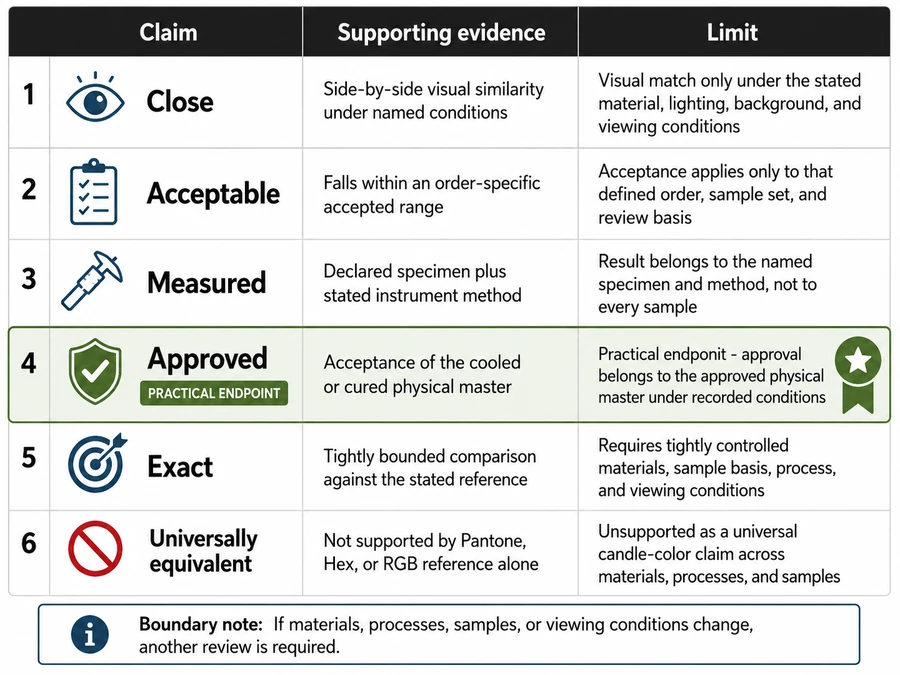
An instrument can report a difference between declared specimens, but the number is tied to the sample form and measurement method. It does not create a universal pass threshold or replace visual and commercial approval.
Approval should be repeated when a material, supplier, lot, dye format, fragrance, additive, process, geometry, cure state, or viewing condition changes enough to affect the result. Full formula development and production tolerance design remain outside this feasibility decision.
The supportable promise is a condition-specific physical approximation approved against a recorded cooled or cured candle sample, not universal equivalence.
Why Can the Same Color Target Produce Different Results in Different Candle Systems?
The same color target can produce different cooled or cured candle colors when the wax, dye, fragrance, additives, process, sample form, supplier, lot, or viewing conditions change.
The assessed result is the complete finished candle system, not the color code or dye amount in isolation.
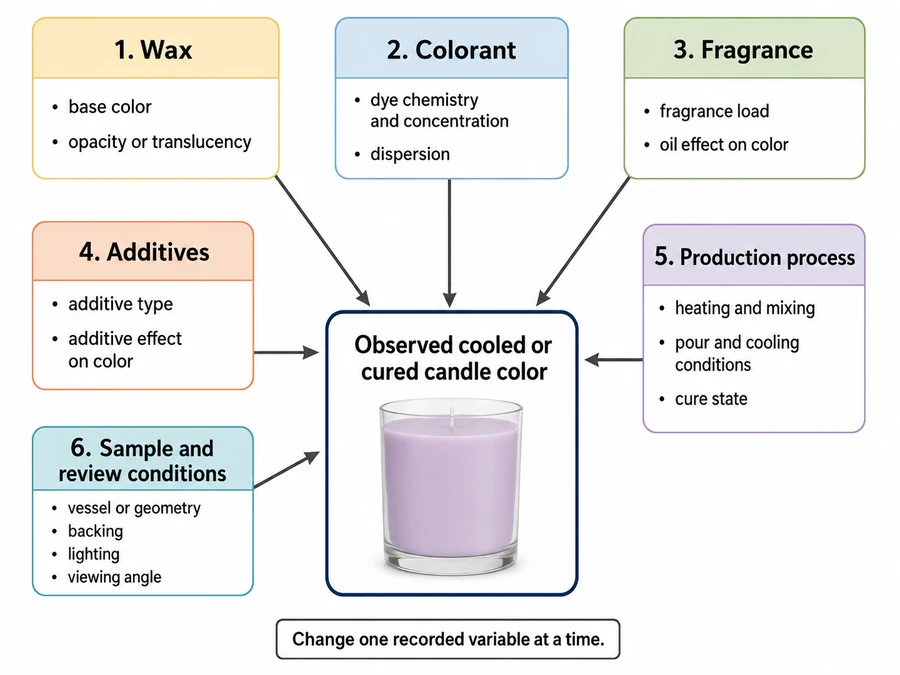
The six variable classes are wax, colorant, fragrance, additives, production process, and sample or review conditions. The detailed matrix below shows how changes within those classes can affect the finished candle.
Opacity describes how strongly wax blocks light, while translucency describes how much light passes through and scatters within it. Dispersion is the distribution of colorant through the wax; uneven distribution can produce streaks, specks, or local color differences.
Methods for variable-control testing: Start with one labeled control sample. Record the target, wax and dye system, concentration basis, fragrance, additives, heating, mixing, pour conditions, cooling, cure interval, sample geometry, surface, background, and lighting. Change one variable at a time and compare each cooled or cured sample with the control.
This table shows which candle-system variables can change the observed result and what must remain fixed.
| Variable changed | Likely visual effect to check | What must remain fixed | Decision |
|---|---|---|---|
| Wax base color | Hue or lightness shift | Dye, concentration, fragrance, process, and sample form | Retest the target in the new wax |
| Wax family or blend | Depth, saturation, or translucency change | Colorant and production conditions | Retest |
| Opacity or translucency | Lighter, deeper, flatter, or more luminous appearance | Thickness, backing, vessel, and light | Compare in the final candle form |
| Crystallization or frosting | Pale, mottled, cloudy, or uneven areas | Formula, cooling conditions, and cure interval | Diagnose the wax state before adding dye |
| Dye chemistry or format | Different hue strength or distribution | Wax, concentration basis, process, and cure state | Rebuild the sample comparison |
| Dye concentration | Darker, lighter, duller, or shifted appearance | All other materials and process steps | Adjust through controlled test pours |
| Dispersion or heat exposure | Specks, streaks, unevenness, or color loss | Formula and sample geometry | Correct the process and retest |
| Fragrance | Yellowing, darkening, muting, or interaction-related change | Wax, dye, additives, and process | Test the scented system |
| Additives | Opacity, texture, crystallization, or surface shift | Wax, dye, fragrance, and process | Retest with the final additive package |
| Heating, mixing, or order of addition | Uneven distribution or changed colorant behavior | Materials, quantities, and sample form | Correct the procedure and repeat |
| Pour temperature or cooling rate | Surface, crystallization, frosting, or depth change | Formula, vessel, geometry, and cure interval | Retest under production conditions |
| Supplier, lot, or sample form | Hue, strength, texture, depth, or apparent lightness change | Every unaffected recorded variable | Treat the change as requiring reapproval |
More dye does not always move a candle closer to the target. Higher concentration can deepen the color, alter the apparent hue, reduce translucency, reveal compatibility problems, or move the sample past the accepted range.
Molten wax is not a dependable approval state because cooling and curing can change opacity, crystallization, surface texture, and apparent depth. The approved comparison must use the declared finished state.
The result should be retested whenever a material or process change breaks the conditions attached to the approved physical master.
Why Does Candle Color Change After Cooling, Curing, or Moving to Different Viewing Conditions?
Molten, cooled, cured, differently backed, and differently lit candle samples are not interchangeable; approve color only in the declared finished state, geometry, surface, background, and lighting.
Cooling and curing can physically change opacity, crystallization, frosting, surface texture, and apparent color depth. Vessel, backing, thickness, geometry, light, and viewing angle can change how the same candle is observed without changing its formula.
This table separates physical candle changes from changes caused only by viewing conditions.
| Condition | What may change | Did the candle physically change? | Approval implication |
|---|---|---|---|
| Molten wax | Transparency, apparent depth, and surface reflection | Yes; the wax is still liquid | Do not approve the final color |
| Cooled sample | Opacity, crystallization, frosting, and surface appearance | Yes; the wax has solidified | Review only if the declared approval state is cooled |
| Cured candle | Surface, crystallization, fragrance-related color, and apparent depth may continue to settle | Possibly | Review after the declared cure interval |
| Thin versus thick sample | Light transmission and apparent color depth | The formula may be unchanged, but the physical form differs | Compare the final candle geometry |
| Clear versus opaque vessel | Backing, reflections, and transmitted light | The wax may be unchanged | Include the production vessel in approval when it affects appearance |
| Light versus dark background | Contrast and apparent lightness or saturation | No | Keep the approved background consistent |
| Matte, glossy, mottled, or textured surface | Reflection, highlights, shadows, and visible uniformity | The surface state differs | Approve the intended finished surface |
| Daylight or daylight simulator | Apparent hue and contrast under the named light | No, unless heat or exposure changes the candle | Use only as a declared viewing condition |
| Warm LED | Warmth, contrast, and separation from the target may appear different | No | Review when the candle will be used in warm indoor light |
| Cool retail or workplace light | Hue relationships and visual contrast may appear different | No | Review when this environment affects commercial acceptance |
Hot wax may look darker or clearer because liquid and solid wax transmit and scatter light differently. The cooled result may become lighter, cloudier, flatter, or less saturated as opacity and crystal structure develop.
A sample is ready for approval only after it reaches the state named in the order or approval record. When cure time may affect the surface or apparent color, use a fixed review interval rather than approving immediately after pouring.
The vessel and backing should be included when they form part of the final product and influence the visible candle color. A loose wax chip, thin test layer, and filled vessel can show different apparent depth even when they contain the same formula.
Methods for the state-and-viewing comparison: Assign each sample an identifier and record its formula, pour date, review date, cure interval, thickness, geometry, vessel, surface, and backing. Photograph or observe the same sample under named lights from a fixed position. Mark whether each difference came from a physical candle change or a changed observation condition.
Another review is needed when the intended environment differs enough from the approved condition to affect acceptance. This does not require testing every possible room; it requires testing the primary intended environment and any secondary environment that matters to the order.
The valid approval claim applies to the declared finished candle state and viewing conditions, not to molten wax or every possible environment.
What Is Metamerism, and Why Can a Match Fail Under Another Light?
Metamerism occurs when a finished candle and its physical target look similar under one declared illuminant but different under another.
An illuminant is the named light condition used to view or measure the two physical samples. Approval under one light cannot automatically be extended to every light source, camera, display, background, geometry, or observer.
The effect can occur because the target material and dyed candle wax reflect and transmit light differently. Wax opacity, translucency, dye chemistry, thickness, surface, backing, and geometry can produce a similar appearance under one light without producing the same response under another.
Metamerism is not the same as a screen-rendering difference, ordinary batch drift, or poor dye dispersion. It does not prove that the target or candle is defective; it shows that their apparent agreement depends on the viewing light.
This table shows how the primary light, a relevant secondary light, and an untested light affect approval.
| Light condition | Approval rule | Permitted claim |
|---|---|---|
| Primary intended light | Use this condition to control the approval decision. | “Approved under the declared primary light” |
| Relevant secondary light | Check it when the candle will be judged or sold under materially different lighting. | “Stable” if acceptable under both, “conditional” if it separates under the secondary light, or “unsuitable” if it fails under a light required by the commercial claim |
| Untested light | Do not extend approval beyond the recorded comparison. | “Not evaluated under this light” |
A candle and its target may be approved under the intended primary light while remaining a conditional match elsewhere. Spectral formulation, universal metamerism indices, lighting design, and formal multi-light production tolerances remain outside this comparison.
How Do You Turn a Pantone, Hex, or RGB Reference into an Approved Physical Candle Sample?
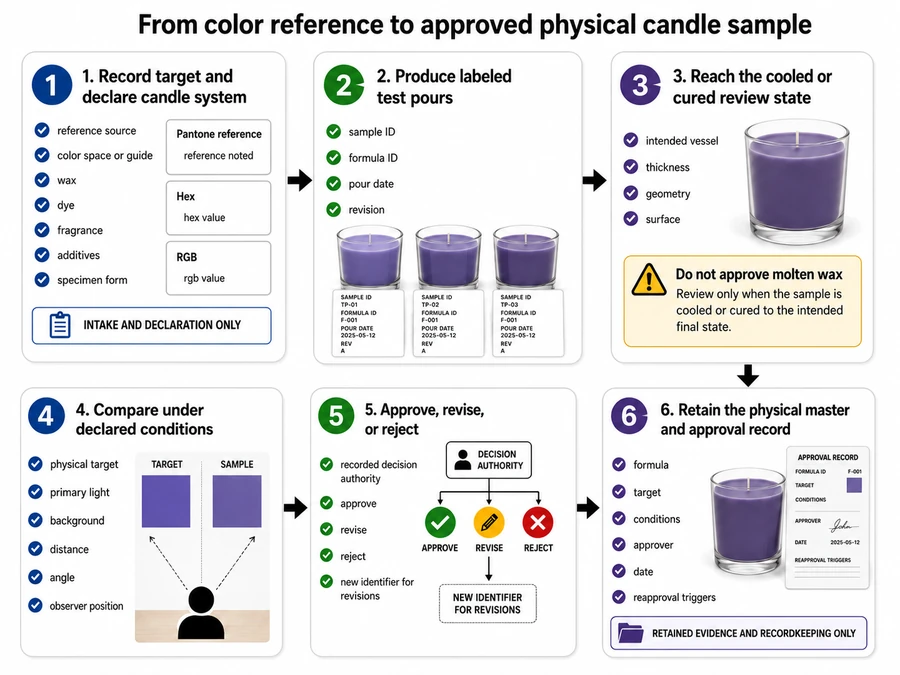
Turn a Pantone, Hex, or RGB reference into an approved candle color by recording the target, declaring the candle system, making labeled test pours, reviewing them under agreed conditions, deciding their status, and retaining the accepted physical master.
The reference begins the process, but the accepted cooled or cured physical candle sample becomes the controlling approval object after sign-off.
- Record the target.
Record the Pantone, Hex, RGB, physical swatch, or combined reference. Include its source, date, color space or Pantone guide where known, intended viewing environment, and the limitation that the reference does not create an exact wax formula. - Declare the candle system.
Record the wax and supplier; dye type, supplier, format, and concentration basis; fragrance; additives; vessel or specimen geometry; intended surface; and required review state. The approved result will apply to this declared system. - Produce labeled test pours.
Give each test a sample ID, formula ID, pour date, and revision number. Use a controlled batch size and change one planned variable at a time so the reason for any color difference remains identifiable. - Reach the agreed review state.
Review the sample only after it is fully cooled or has reached the cure interval stated in the approval plan. Use the intended vessel, thickness, geometry, and surface. Do not approve color from molten wax. - Compare under declared conditions.
Compare the candle with the physical target when one is available. Record the primary light, background, viewing distance, viewing angle, and observer position. Check a secondary light when another environment matters to the order. - Approve, revise, or reject.
The authorized approver must record the decision and its reason. A revised sample receives a new identifier or revision status rather than replacing the earlier record without explanation. - Retain the controlling evidence.
Keep the approved physical master with its formula and material record, original target, viewing conditions, acceptance language, approver, approval date, and conditions that require another review.
The primary intended use environment should control the lighting decision. A secondary environment should be checked when the candle will be judged or sold under materially different light.
The cooling or curing period should be the fixed interval declared for that candle system and order. An immediate post-pour review is not equivalent to approval in the finished state.
This table separates required evidence, optional support, and items that cannot control approval alone.
| Evidence class | Examples | Role in approval |
|---|---|---|
| Required evidence | Original target record, declared candle system, labeled cooled or cured test sample, comparison conditions, decision record, and retained physical master | Establishes what was tested, accepted, and controlled |
| Useful optional evidence | Secondary-light comparison, controlled photographs, instrument readings, signed sample image, and additional observer notes | Supports the record but does not replace the physical master |
| Insufficient as sole evidence | Phone image, screenshot, uncharacterized printout, verbal color description, loose dye, molten wax, or an unlabeled sample | Cannot independently control the approved finished candle color |
A phone image may document a sample, but it is not enough by itself because the camera, processing, display, brightness, and viewing environment can change the image’s appearance.
Another physical sample is required when an approved wax, dye, dye format, supplier, lot, fragrance, additive, process, geometry, cure state, surface, or viewing condition changes enough to affect the result.
The workflow ends with a retained physical master and approval record, not with the original Pantone, Hex, or RGB value.
How Should a Candle Business Define the Target, Tolerance, and Approval?
After sign-off, the approved physical master controls the accepted candle color; the order record must state the target, candle system, review conditions, acceptance method, decision authority, revision, evidence, and reapproval triggers.
A tolerance is the order-specific visual or measured range permitted around the approved physical master under the stated conditions. It is not a universal candle-industry standard.
This table lists the fields needed to define a bounded candle-color approval.
| Approval-record field | Required entry |
|---|---|
| Requested target | Pantone, Hex, RGB, physical swatch, or combined reference |
| Reference details | Source, date, color space, guide, edition, or physical-reference identifier where known |
| Declared candle system | Wax, dye, concentration basis, fragrance, additives, supplier details, and relevant material identifiers |
| Approved physical master | Unique sample or formula ID and revision |
| Review state | Cooled state or declared cure interval |
| Specimen form | Vessel, thickness, geometry, surface, and backing |
| Viewing conditions | Primary light, relevant secondary light, background, distance, angle, and observer position |
| Acceptance method | Order-specific visual comparison, declared measurement method, or both |
| Permitted variation | The agreed visual description or method-bound measured range |
| Decision authority | Named person or role allowed to approve, revise, or reject |
| Decision status | Approved, approved with conditions, revise, or reject |
| Retained evidence | Physical master, target, formula record, photographs, readings, and decision notes where applicable |
| Reapproval triggers | Material, supplier, lot, format, process, specimen, cure-state, or viewing-condition changes |
The requested reference describes the intended direction. Once the physical master is accepted, later production comparisons should be made against that sample under the recorded conditions.
Acceptable visual variation means only the variation permitted by the order-level approval rule. It should state what is being compared, under which conditions, and who makes the final decision.
Delta E (ΔE) is a calculated color-difference value; no single ΔE pass limit applies to every candle form, measurement method, or order. A numerical limit must be tied to the declared specimen, instrument method, and approval purpose.
Only the named decision maker or another person with recorded approval authority should accept a revision. A revised result should receive a new revision identifier and should not silently replace the earlier physical master.
The physical master should remain labeled and stored with its supporting record so later comparisons can identify the accepted sample, formula, revision, and review conditions.
Bounded approval language includes:
- “Developed toward the supplied reference.”
- “Subject to approval of the physical candle sample.”
- “Visually matched to the approved physical master under the stated viewing conditions.”
- “Accepted within the agreed order-specific range.”
- “Approval applies to the recorded candle system, sample form, and review conditions.”
Methods note: The cases below are illustrative wording examples, not measured customer records. They show how claim scope and reapproval conditions should be recorded.
This failure log shows how vague claims create avoidable approval disputes.
| Vague or unsafe claim | Resulting failure | Cause | Safer wording | Reapproval trigger |
|---|---|---|---|---|
| “Exact Pantone candle” | The candle differs from the swatch or appears different under another light | The claim omits wax, process, specimen, and viewing conditions | “Developed toward the supplied Pantone reference and subject to physical sample approval” | A new target, candle system, or viewing environment |
| “Identical to the Hex code” | The client expects a screen value to control a physical wax result | Hex describes digital color rather than one candle formulation | “The Hex value was used as the starting target; the approved physical sample controls” | A changed digital reference or physical sample |
| “Guaranteed under every light” | The candle passes in one room but fails in another | The candle and target respond differently under different illuminants | “Approved under the stated primary light; secondary-light status recorded separately” | A new commercially important lighting environment |
| “Permanent match across every batch” | Later production differs after a material or process change | The approval was tied to earlier declared conditions | “Future samples must remain within the agreed range around the approved physical master” | A material, supplier, lot, process, geometry, cure-state, or viewing-condition change |
A commercially usable approval record limits the promise to the accepted physical candle system, sample, conditions, and order-specific acceptance rule.
What Can Instrumental Measurements Prove About a Candle-Color Match?
A colorimeter or spectrophotometer can quantify a declared physical candle specimen under a declared method, but the result applies only to that specimen, backing, geometry, aperture, surface, illuminant, observer, instrument settings, and procedure.
It cannot independently prove universal visual identity, commercial acceptance, multi-light stability, or future production repeatability.
A colorimeter estimates standard color-response values with filtered sensors, while a spectrophotometer measures spectral response and derives color values. Either result depends on the candle specimen, surface, geometry, backing, instrument settings, and procedure, so curved, translucent, glossy, frosted, or uneven wax may produce less repeatable readings.
Delta E (ΔE) is a calculated difference between two color measurements under a named formula. No universal ΔE pass limit applies to every candle, specimen form, instrument method, viewing condition, or order, and a low value does not replace visual or commercial approval.
Visual approval is usually sufficient when a custom order relies on an agreed physical master and no repeatable numerical requirement exists. Use a formal measurement procedure when several instruments, locations, operators, production batches, or release decisions must follow the same method.
Instrument readings can support a candle-color decision, but they remain method-bound evidence rather than proof of an exact or universally stable match.
Decision: Pantone, Hex, and RGB are target inputs, not universal candle formulas. The approved cooled or cured physical master controls the accepted result under the recorded material, process, specimen, lighting, background, and viewing conditions.
Retesting or reapproval may be needed after a material change involving the wax, dye, fragrance, additives, supplier, lot, dye format, process, geometry, cure state, surface, or viewing conditions. Full formula development, brand-asset matching, formal tolerance design, batch-drift control, supplier-lot tracking, and complete retesting procedures remain separate workflows.