
The best candle dye for paraffin wax produces the intended cured brightness, clarity, and shade with controllable, repeatable dosing in the specific wax formula, candle format, batch size, and measurement method.
A paraffin-compatible candle dye is a wax-soluble colorant made for candle wax and judged in the finished paraffin candle, unlike mica, insoluble pigments, food coloring, soap dye, cosmetic dye, or surface-only colorants. Here, “best” means the product that suits the declared paraffin, candle format, shade target, batch size, measuring method, fragrance, additives, and validation conditions.
The decision sequence is to identify the paraffin base, compare format and concentration, define the cured target, control the dose, verify repeatability, and add burn validation after material formula changes. This article does not name one universal winning brand, dosage, maximum dye load, or wick prescription.
How do you decide which candle dye is best for paraffin wax?
The best candle dye for paraffin wax is the dye that produces the intended cured brightness, clarity, and shade with controllable, repeatable dosing in the specific paraffin formula.
Its suitability depends on the wax, candle format, target appearance, batch size, measuring method, and validation conditions.
Paraffin Dye Candidate Evaluation
Compare each candidate in the same paraffin formula and under the same viewing conditions.
| Evaluation criterion | What to record | Decision value |
|---|---|---|
| Cured appearance | Brightness, clarity, hue, opacity, saturation, and darkness after the declared cooling or curing period | Shows whether the finished sample meets the target rather than judging the concentrate or molten wax |
| Smallest repeatable addition | The lowest dye amount the available method can measure and repeat | Shows whether the shade can be adjusted without jumping past the target |
| Dispersion or dissolution | Visible particles, streaks, concentrated pockets, or incomplete dissolution | Shows whether the appearance can be judged fairly |
| Repeatability | Agreement among matched batches made with the same formula and process | Shows whether the selected shade can be reproduced |
| Retest condition | Changes to the product, supplier lot, wax, fragrance, additives, dose, or candle format | Shows when earlier results may no longer represent the finished candle |
A controllable dose step is the smallest dye addition that can be measured and repeated without jumping past the target shade. Cured repeatability is the ability to reproduce the same finished shade across matched batches.
Complete dispersion matters because visible particles, streaks, or concentrated pockets prevent a fair appearance judgment. The finished candle matters more than the concentrate or molten wax because cooling can change visible shade depth, clarity, and opacity.
Tint strength alone does not identify the best dye. A highly concentrated product may reduce the amount needed in a large batch but make small test additions difficult to measure. Stronger, darker, cheaper, more natural, or more popular does not automatically mean better suited to the declared formula.
Use this five-step sequence to choose a test candidate:
- Declare the paraffin grade or blend and the finished candle format.
- Define the cured brightness, clarity, opacity, and shade target.
- Check the product’s concentration basis and available measuring method.
- Compare compatible candidates by dispersion, dose-step size, and repeatability.
- Verify the leading candidate with matched, fully cooled or cured samples.
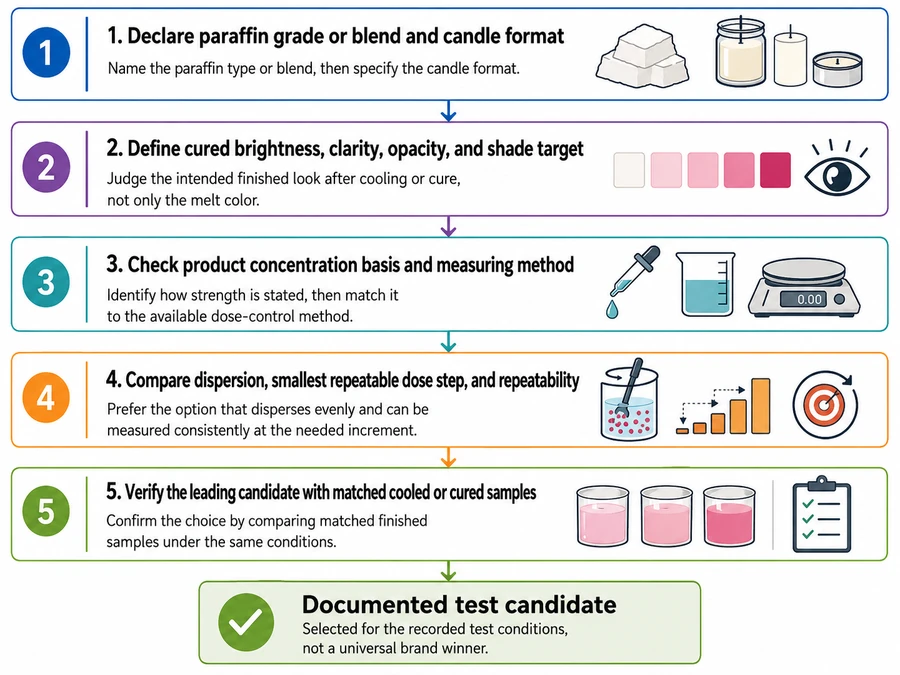
Methods: Compare candidates with the same wax formula, batch basis, sample geometry, cooling conditions, lighting, background, and recording rules. Record each product according to its supplier instructions. Do not treat drops, chips, or block pieces as equal units across products.
The scorecard does not establish a universal brand winner, dosage, maximum dye load, or burn result. A full format comparison and exact test-amount calculations need their own controlled procedures.
The dye decision remains provisional until the paraffin grade, blend, and undyed starting appearance are declared.
Why do paraffin grade and starting appearance change candle-dye results?
The same candle dye can produce a different cured color in different paraffin grades or blends because the wax’s starting color, clarity, refinement, and additives condition what the viewer sees.
Judge a paraffin-compatible dye in a declared paraffin base rather than treating all paraffin as visually uniform. An undyed sample reveals whether the wax itself is warming, muting, clouding, or otherwise shifting the finished appearance.
Paraffin-Base Comparison
Record the undyed starting appearance of the actual paraffin lot before comparing dyed samples.
| Declared paraffin condition | Starting appearance to record | Possible effect on the cured color | Comparison rule |
|---|---|---|---|
| Fully refined paraffin | Color neutrality and clarity | A near-neutral, clear base may add little visible interference | Confirm the result with an undyed control from the actual lot |
| Semi-refined paraffin | Warm tint, cloudiness, and clarity | A cool target may appear warmer, duller, or less clear | Do not assume the supplier category predicts the exact appearance |
| Straight paraffin | The supplied grade and lot without maker-added blend components | The cured result remains tied to that material condition | Record the grade and lot rather than treating all straight paraffin as identical |
| Modified paraffin | Visible haze, opacity, and the supplier-declared formulation | Added components may change perceived clarity or shade depth | Compare the dyed sample with an undyed sample from the same material |
| Paraffin blend | Color, cloudiness, translucency, and opacity | Lower clarity may be mistaken for weak dye performance | Keep the blend composition unchanged during the comparison |
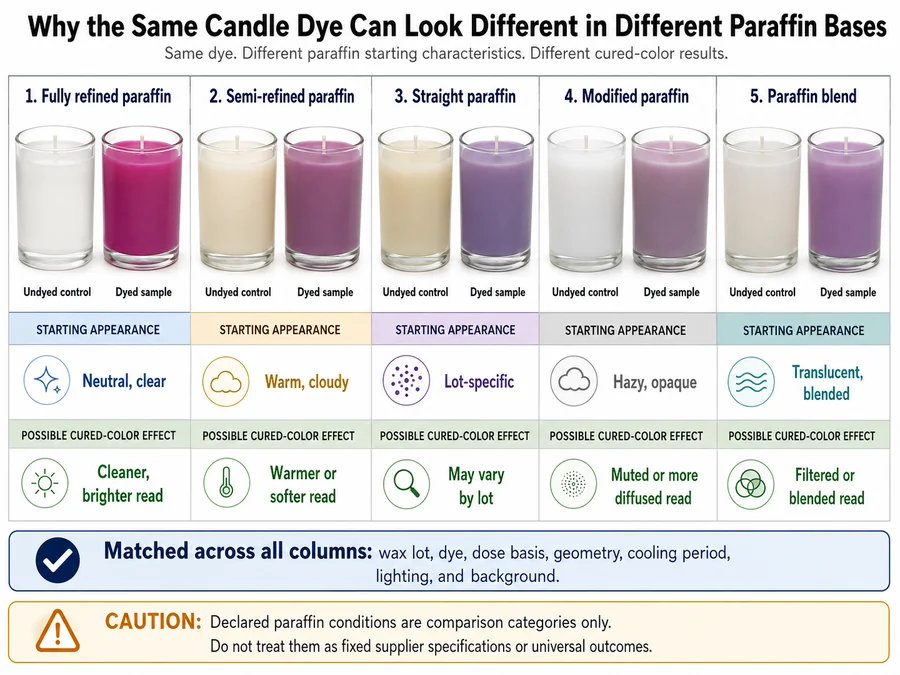
These entries are comparison prompts, not specifications for every wax in each category. Keep the dye, dose basis, sample geometry, cooling period, lighting, background, and viewing angle unchanged, and include an undyed control for every wax condition.
A result from soy, beeswax, coconut wax, or another wax cannot be copied directly into paraffin because the starting material and finished appearance differ. Fragrance and additives may create further shifts, but they require separate controls before the dye is identified as the cause.
Why can fragrance oil and additives change paraffin candle color?
A fragrance oil, additive, or naturally colored paraffin base can change the cured appearance of a dyed candle, so the dye should not be blamed without controlled comparison samples.
The evaluated system is the full dyed paraffin formula: the declared wax, dye, fragrance, additives, mixing process, and cooling conditions. Here, compatible means acceptable, repeatable appearance and dispersion under those declared conditions; it does not prove universal chemical, safety, or burn compatibility.
| Control sample | Contents | What the sample can reveal | What it cannot prove alone |
|---|---|---|---|
| Undyed paraffin control | Wax without dye, fragrance, or added formula components | The wax’s starting color, clarity, translucency, and opacity | How the dye or fragrance will interact with the wax |
| Undyed formula control | Wax plus the tested fragrance or additive, without dye | Color, cloudiness, or opacity contributed by the fragrance or additive | Whether the dye changes the interaction |
| Dyed wax control | Wax plus dye, without the tested fragrance or additive | The dye’s cured appearance in the declared wax base | How the full formula will look |
| Complete formula sample | Wax, dye, fragrance, and additives at the tested amounts | The combined cured result under the declared process | Which ingredient caused a shift when several variables changed together |
A yellow or amber fragrance can warm a blue, white, or pale target. A dark fragrance can mute a light shade, while an opacity-changing additive can make a clear result look cloudy. Several formula changes made at once may leave the cause unresolved.
Control Checks Before Assigning a Cause
- Compare the dyed sample with an undyed sample containing the same fragrance or additive.
- Change only one recorded formula variable at a time.
- Record the fragrance oil’s visible color before testing.
- Match sample geometry, cooling time, lighting, background, and viewing time.
- Do not assign a cause from one photograph or from samples viewed under different conditions.
Methods: Keep the wax lot, wax mass, dye dose, fragrance load, additive amount, mixing process, sample geometry, cooling period, lighting, and background unchanged except for the single variable being tested. Follow the suppliers’ technical instructions for each material.
This section does not cover scent throw, fragrance blending, additive selection, fragrance-load adjustment, or full discoloration remediation.
Retain or reject the dye only after the controls show whether the shift comes from the wax base, another formula component, the dye, or an unresolved interaction.
Liquid dye vs dye chips vs dye blocks: which gives better control in paraffin?
No dye format is universally best for paraffin; control depends on product strength, the smallest repeatable addition, batch size, measuring method, and full dissolution or distribution.
Liquid, chip, and block labels describe delivery format, the physical form supplied, rather than standardized concentration or dose units. Concentration basis states how much colorant a supplier declares per unit, while the minimum controllable increment is the smallest addition that can be measured and repeated.
| Format | Concentration and measurement | Smallest practical addition | Dispersion or dissolution | Likely batch fit | Convenience | Shade-step and repeatability risks |
|---|---|---|---|---|---|---|
| Liquid dye | Use the supplier’s declared basis; measure by mass or a documented volume method | Can be small when the equipment resolves the required amount | Must distribute evenly through the wax | Small tests or repeat batches when the dose can be measured reliably | Fast to add when the dispenser and scale are controlled | A highly concentrated liquid may cause a large shade jump in a small batch; drops differ among products and dispensers |
| Dye chips | Weigh chip material in grams rather than counting pieces as equal doses | Limited by the smallest piece or weighed portion that can be repeated | Chips must dissolve fully before the sample is judged | Small or medium batches when pieces can be weighed and dissolved consistently | Easy to store and portion when pieces are weighed | Unequal pieces can produce different additions; incomplete dissolution can create streaks or false shade readings |
| Dye blocks | Shave, cut, or portion the block and measure the addition by mass | May be too coarse for a small batch unless a repeatable small portion can be prepared | The measured portion must dissolve fully | Larger batches or repeat work with a documented portioning method | Compact for repeated production when shaving and weighing are consistent | Large pieces may overshoot a small test; inconsistent shaving or weighing can increase batch variation |
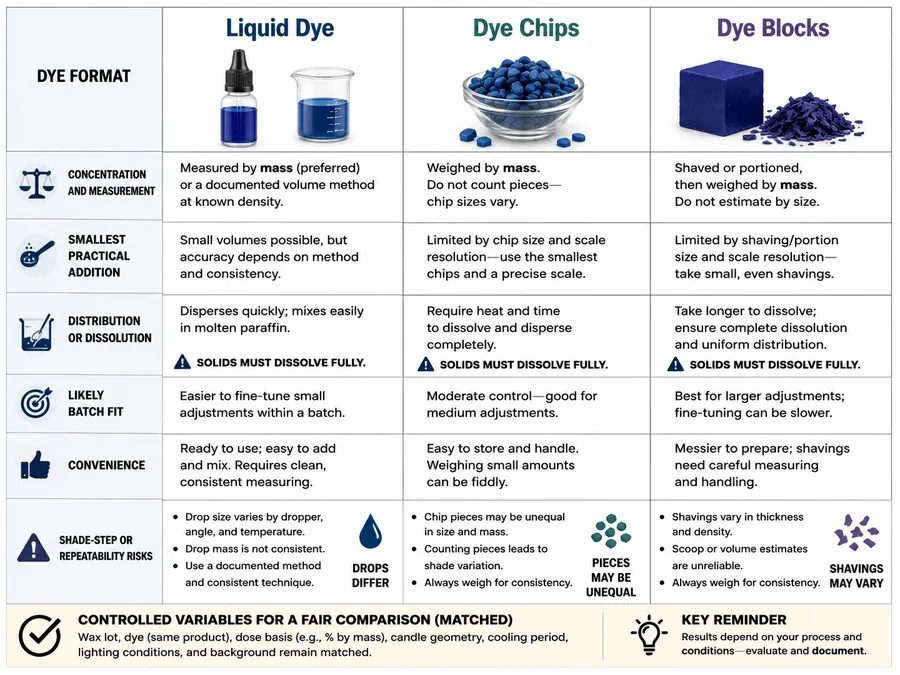
Best fit by situation: No format wins every comparison; favor the format and measuring method that produce the smallest useful, repeatable addition for the declared batch and target.
| Situation | Format or method to favor | Decision reason |
|---|---|---|
| Small test batch | A format whose smallest addition can be measured without jumping past the target | Liquid may fit when the dispenser and scale repeat a small dose; weighed chip or block portions may fit when they can be prepared consistently |
| Large repeat batch | Any format recorded by mass and fully distributed or dissolved | Larger batches may make the same physical addition a smaller share of the wax mass |
| Pale or translucent target | A product and dose step that preserve the required clarity while allowing small adjustments | High tint strength alone does not show whether a light target can be controlled |
| Dark target | A method that records dye mass and confirms the result after cooling or curing | A dark result still requires repeatable measurement and does not prove that one format is better |
| Limited scale or portioning resolution | A larger test batch or a measuring method that can repeat a smaller addition | Guessing at an amount that cannot be repeated increases shade variation |
| Documented repeat production | Liquid, chips, or blocks measured by mass on the supplier’s declared basis | Mass records allow the tested condition to be compared across matched batches |
A dose-step ratio compares the smallest repeatable dye addition with the wax mass in the test batch. A smaller practical step allows closer movement toward the target, but its usefulness still depends on the product’s concentration.
Complete dispersion means the dye is evenly distributed without visible particles, concentrated pockets, or streaks. Liquid dye may appear easier to add, but a very concentrated liquid can overshoot a small batch when the scale or dispensing method cannot repeat a small enough amount.
Chips may look pre-portioned, but chip size and concentration are not standardized among suppliers. Counting chips as equal doses can produce shade variation when their masses differ.
Blocks can suit larger additions, but small tests may require shaving and weighing. A block is not limited to large batches, although its practical control depends on whether a small portion can be prepared and measured consistently.
Use these checks when matching a dye format to the workflow:
- Compare the smallest repeatable addition with the test batch’s wax mass.
- Confirm that the scale or measuring method can resolve that addition.
- Record dye by the supplier’s declared basis instead of relying on drops or pieces alone.
- Confirm full distribution or dissolution before judging the sample.
- Repeat matched batches to check whether the cured shade can be reproduced.
Format-Control Benchmark Method
Record the following fields for liquid dye, chips, and blocks tested in the same paraffin formula:
| Recorded field | Unit or scale | Recording rule |
|---|---|---|
| Dye addition | Grams | Measure each addition with the same verified device |
| Wax mass | Grams | Keep the batch mass unchanged across format comparisons |
| Dissolution or distribution time | Minutes | Use the same start and completion definitions |
| Cured shade step | Named visual category or 1–5 score | Compare fully cooled or cured samples under fixed conditions |
| Replicate variation | 1–5 score | Score at least three matched batches with the same formula and process |
| Measurement failure | Written note | Record irregular pieces, unstable drops, incomplete dissolution, or scale-resolution limits |
This benchmark compares control rather than declaring a universal winner. Community reports often describe unequal chip pieces, inconsistent drops, and incomplete solid-dye dissolution, but supplier instructions and matched samples are needed before judging a product.
This section does not prescribe a final dye amount, universal dosage range, cross-brand drop conversion, or full handling procedure.
A controllable format can deliver repeatable additions, but the correct choice still depends on whether the cured target is bright, clear, opaque, saturated, light, or dark.
What do brightness, clarity, opacity, and saturation mean in a cured paraffin candle?
Brightness, clarity, opacity, saturation, hue, darkness, and tint strength describe separate properties of the cooled or cured paraffin candle and must not be used as synonyms.
The evaluated object is the finished dyed paraffin sample under fixed lighting, background, thickness, and viewing conditions—not liquid dye, molten wax, a supplier swatch, or an uncalibrated photograph. Tint strength describes how strongly a dye changes wax color at a declared dose; it does not define every part of the finished appearance.
| Appearance term | Plain meaning | Important distinction |
|---|---|---|
| Brightness | Perceived light intensity or vividness under stated viewing conditions | A darker candle is not automatically brighter |
| Clarity | How cleanly light and color appear without muddiness or unwanted cloudiness | A clear candle can still be strongly colored |
| Opacity | How much the colored wax blocks light transmission or visibility | An opaque candle is not automatically saturated |
| Saturation | Perceived color purity or intensity compared with a gray or muted result | A saturated color can still look dark or dull |
| Hue | The visible color family, such as red, yellow, blue, or green | Hue does not state how light, dark, clear, or saturated the candle is |
| Darkness or value | How light or dark the cured result appears | A dark candle can be muted rather than vivid |
| Tint strength | How strongly the dye changes wax color at a declared dose | High tint strength does not guarantee clarity or easy dose control |
| Strong or deep color | An informal description that must be tied to a named appearance property | The phrase may mean dark, saturated, opaque, or heavily dosed |
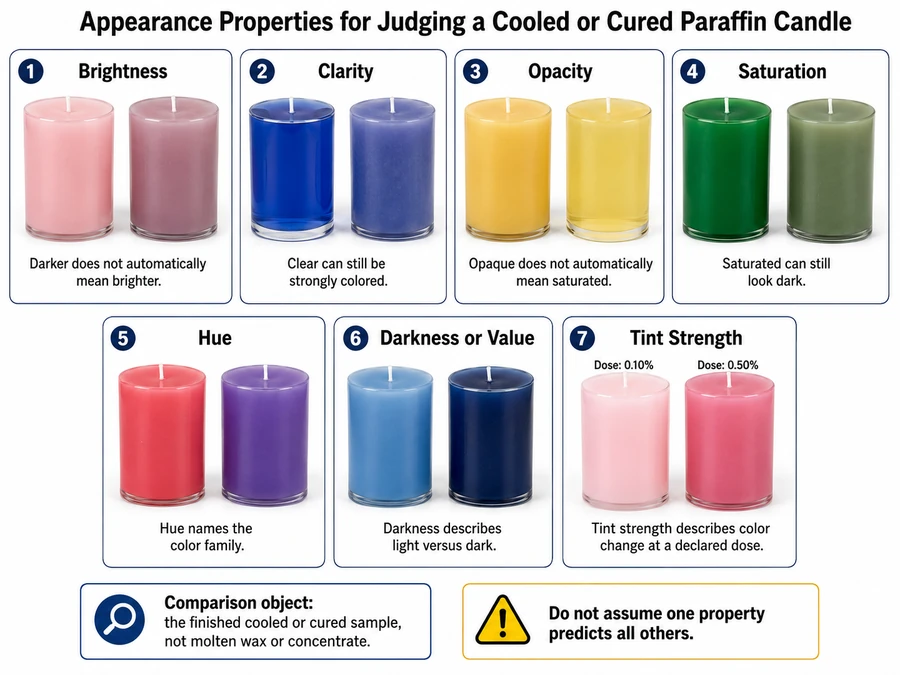
A candle can be dark yet muted when it has low brightness and limited saturation. It can be saturated but not bright when the color is pure yet visually deep. A bright candle may remain translucent, while an opaque candle may still have weak saturation.
Cooling may change visible clarity, opacity, and shade depth, so molten wax is not the final color reference. Supplier color charts and product instructions can guide the first test, but they cannot replace a cured sample made with the intended paraffin formula.
Cured-Sample Comparison Template
Record each appearance property separately after the samples have cooled or cured under the same declared conditions.
| Sample ID | Paraffin condition | Dye product | Dose basis | Brightness | Clarity | Opacity | Saturation | Hue | Darkness |
|---|---|---|---|---|---|---|---|---|---|
| — | — | — | — | — | — | — | — | — | — |
| — | — | — | — | — | — | — | — | — | — |
| — | — | — | — | — | — | — | — | — | — |
Methods: Define the scoring scale before testing and keep the wax lot, dye product, dose basis, sample geometry, cooling interval, lighting, background, and viewing angle unchanged. A visual score is a recorded comparison, not an instrument measurement or product-performance claim.
Define the target by naming the desired hue and the required brightness, clarity, opacity, saturation, and darkness. Do not replace those properties with vague terms such as “strong,” “deep,” or “more intense.”
Container vs pillar paraffin candles: how does format change perceived color?
The same paraffin dye formula can look different in a container, test slab, or pillar because visible wax thickness and finished-candle geometry change perceived color depth.
Container and pillar describe finished-candle formats and qualify the appearance target; they do not create standardized dye amounts. A representative sample should approximate the final candle’s wax depth, surrounding color, viewing direction, geometry, and cooling conditions.
Finished-candle geometry is the shape and arrangement of the wax in the completed candle. Visible wax thickness is the depth of colored wax seen along the viewing direction.
A thick pillar can appear deeper, darker, or more opaque than a thin container layer without containing a higher dye concentration. The viewer sees color through a greater depth of wax, which can increase perceived shade depth.
A thin layer may appear clearer, brighter, or less saturated because less colored wax lies along the viewing path. A clear glass container, colored vessel, mold shape, surrounding background, and viewing angle can change the apparent result further.
A container candle does not automatically require less dye than a pillar. Format changes how the result is viewed and which sample is representative; it does not prove that a different concentration is required.
Clarity should carry more weight when the target is pale, translucent, or intended to show light through the wax. Perceived depth or opacity may carry more weight for a thick pillar, molded decorative candle, or dark target shade.
A representative comparison should keep these conditions matched:
- The wax formula and wax lot must remain the same.
- The dye product and dye mass relative to wax mass must remain the same.
- The mixing, pouring, cooling, and comparison times must remain the same.
- The lighting, background, camera settings, distance, and viewing angle must remain the same.
- The sample geometry must be recorded rather than treated as an unimportant detail.
Methods: Produce the three samples from the same wax, dye, dose basis, mixing process, and cooling schedule. Photograph them with the same lighting, background, camera settings, distance, and viewing angle. Record sample thickness in millimeters when it is measured; otherwise, use declared geometry categories without turning them into dosage rules.
This comparison does not cover wick sizing, mold release, container adhesion, pillar additives, or complete container and pillar construction. Choose the dye result that meets the defined cured appearance target in a sample that represents the final candle.
How do you control candle-dye dose in paraffin without overshooting the shade?
Dose control means adding a declared paraffin-compatible candle dye in repeatable increments relative to a known wax mass and product concentration—not counting universal drops, chips, or blocks.
The smallest repeatable addition is the lowest dye mass that the available measuring method can add consistently. It determines whether the batch can move toward the target without jumping past it.
Tested dose percentage describes the dye mass already present relative to the wax mass. Dose-step percentage describes the smallest practical increase. Overcoloring occurs when the cured result exceeds the target or added dye stops producing a useful visual gain. Overshoot risk rises when the smallest practical step is too large for the batch and shade target.
Paraffin Dye Dose-Step and Test Planner
The planner requires the product basis, wax mass, current dye mass, smallest repeatable addition, cured appearance target, and previous validation status.
| Input | What to record |
|---|---|
| Dye product and format | The exact paraffin-compatible product and whether it is liquid, chip, block, or another supplier-declared format |
| Supplier concentration basis | The basis stated in the supplier’s instructions or technical sheet |
| Wax mass | The test batch’s wax mass in grams |
| Current dye mass | The dye mass already present in grams |
| Smallest repeatable addition | The lowest dye mass the available equipment or portioning method can repeat |
| Cured appearance target | The required hue, brightness, clarity, opacity, saturation, and darkness |
| Previous validation status | Whether the formula remains within a documented condition or a relevant material, dose, or format condition has changed |
The calculated percentages describe only the entered formula and measuring resolution. If one measurable step is too large for the target, increase the test-batch mass or use a method that can repeat a smaller addition instead of guessing at an amount.
The planner uses two conditional calculations:
Tested dose percentage = dye mass ÷ wax mass × 100
Dose-step percentage = smallest repeatable dye addition ÷ wax mass × 100
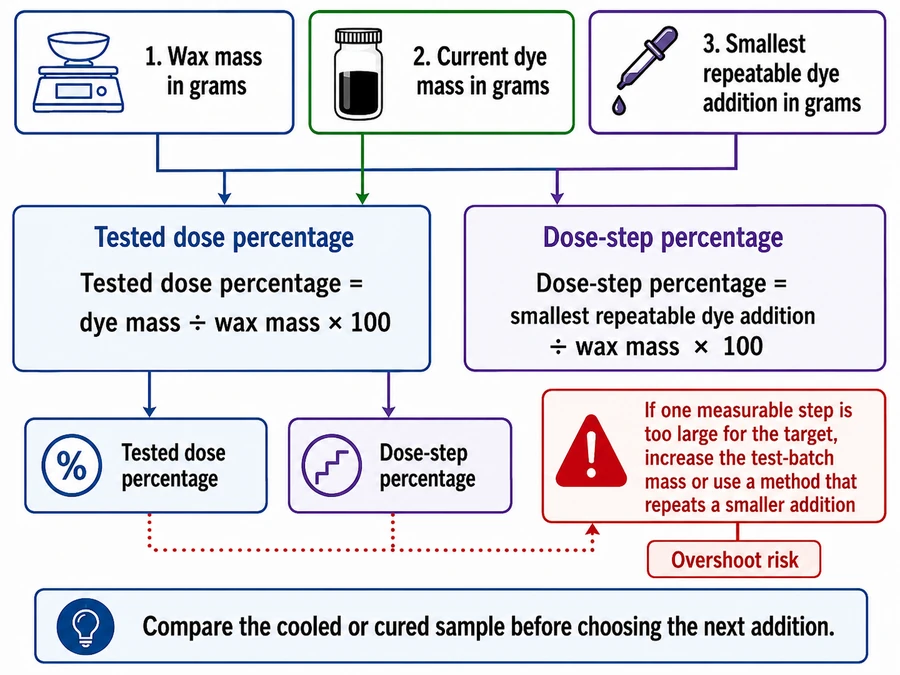
These calculations describe the entered test formula and measuring resolution. They do not turn a supplier range into a universal recommendation.
One drop is not a standard unit because drop size can vary with the dispenser and liquid. Product concentration may differ as well. Chips and block portions are not transferable units unless their masses and supplier bases are known.
A small batch can overshoot quickly because the same physical addition forms a larger percentage of a smaller wax mass. When the available scale or portioning method cannot produce a useful step, increase the test-batch mass rather than guessing at a fraction that cannot be repeated.
Use this staged process:
- Identify the dye product, format, and supplier concentration basis.
- Weigh the wax batch in grams.
- Measure the dye already present in grams.
- Find the smallest dye addition the equipment can repeat.
- Calculate the current dose and dose-step percentages.
- Prepare a labeled sample with one controlled change.
- Cool or cure it under the declared project conditions.
- Compare it with the cured target before selecting the next step.
The sample must cool before the next addition is chosen because molten wax may not show the final brightness, clarity, opacity, saturation, or darkness. Adding more dye from the molten appearance can push the cured result beyond the target.
Signs that the tested formula may be overcolored include:
- The cured shade is darker, more opaque, or more saturated than the declared target.
- Another addition produces little useful visual improvement.
- Clarity falls when a clear result was required.
- Matched batches become harder to reproduce.
- The dye condition moves materially beyond the previously documented formula.
When the step is too large, return to the last controlled sample. Reduce the practical addition when the measuring method permits it, or enlarge the test batch so the same measurable addition forms a smaller percentage. Change only one recorded variable at a time.
Maker discussions sometimes describe one extra drop making a small batch much darker. That report points to a possible concentration or measurement-resolution problem, but the product, dispenser, wax mass, and cured comparison must be known before assigning the cause.
A material dye increase can also mean that previous burn evidence no longer represents the finished candle. It does not prove that dye caused a wick, soot, flame, or melt problem.
Methods: Check the supplier’s dosage instructions, product technical sheet, and the scale specification before entering values. Record wax and dye in grams. The planner assumes the product identity and concentration basis are known. Its outputs describe the tested condition, dose-step size, and need for a cured checkpoint; they do not approve a product-independent dosage or maximum load.
Universal dosage charts, cross-brand drop conversions, exact shade recipes, maximum-load claims, and wick prescriptions are outside this section.
How do you verify cured paraffin color and repeat it across batches?
A paraffin candle dye should be approved from controlled cooled or cured samples and repeat batches—not from molten wax, the concentrate, or one unreplicated test.
Repeatability means sufficiently similar results under the same declared materials, measurements, process, sample geometry, and viewing conditions. Project-specific acceptance tolerance is the allowed variation for the intended candle and use.
Cured-Sample Validation Tracker
Set the evaluation interval from the wax and dye suppliers’ testing instructions or a written project protocol. Use the tracker to define the fields recorded for each candidate condition and replicate without setting a universal production sample count.
| Record category | Required fields |
|---|---|
| Sample identity | Sample ID, batch ID, candidate condition, and replicate number |
| Wax condition | Wax product, lot, grade or blend, and wax mass in grams |
| Dye condition | Dye product, lot, format, concentration basis, and dye mass in grams |
| Formula components | Fragrance and additives at the tested amounts |
| Process conditions | Mixing, pouring, cooling, or curing conditions and evaluation interval |
| Finished sample | Geometry, visible thickness, and candle format |
| Viewing conditions | Lighting, background, distance, angle, and scoring method |
| Decision record | Cured result, replicate variation, acceptance tolerance, and approve, revise, or retest decision |
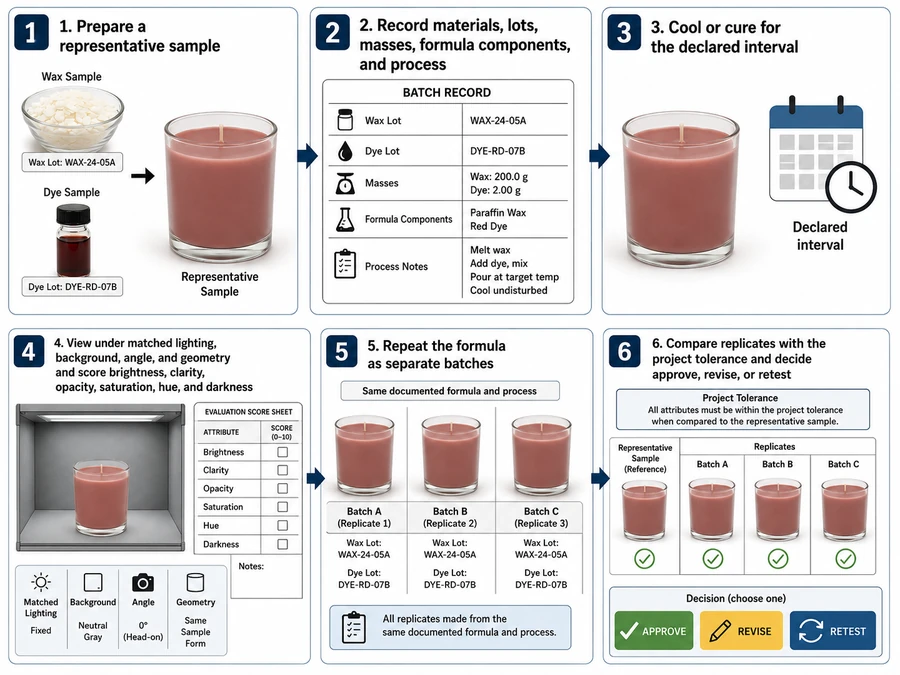
Cured-shade verification compares the finished sample with the declared appearance target after the chosen cooling or curing interval. A controlled sample keeps all non-test variables recorded and unchanged.
A replicate is a separately prepared batch made from the same declared formula and process. Repeatability requires agreement among replicates, not repeated confidence in one sample.
Liquid dye appearance, molten wax, a supplier swatch, one unlabeled sample, an uncalibrated photograph, or one successful batch is not enough for approval. Each can omit the cured state, final geometry, viewing conditions, or batch variation.
Use this verification sequence:
- Prepare a sample that represents the intended paraffin formula and candle format.
- Record the material identities, lots, masses, fragrance, additives, and dose basis.
- Record the mixing and pouring conditions that may affect the comparison.
- Cool or cure the sample for the declared supplier or project interval.
- View it under the same lighting, background, angle, and sample geometry.
- Score the previously defined brightness, clarity, opacity, saturation, hue, and darkness.
- Repeat the formula as separate batches.
- Compare the replicates and approve, revise, or retest the candidate.
Accurate color means the sample matches the declared project target under the stated viewing conditions. Same color means sufficiently similar within the project’s tolerance, not physically identical under every light, wax lot, fragrance, or process condition.
A repeated recipe can still produce a visibly different result when an unrecorded variable changes. Common sources include a new wax or dye lot, a different dye mass, uneven solid-dye portions, changed fragrance or additives, altered mixing, different sample thickness, or unmatched lighting.
A preliminary approval requires all of the following:
- Replicate samples remain within the project’s stated visual tolerance.
- No uncontrolled material or process change occurred.
- The sample represents the intended finished-candle geometry.
- The dye product, concentration basis, wax mass, and dose method remain documented.
- The cured result meets the declared appearance target.
- Any material formula change receives a new validation decision.
Methods: Record masses in grams and times in minutes or hours only when measured. State the evaluation interval, wax and dye formula, fragrance and additives, sample geometry, cooling conditions, viewing conditions, scoring method, replicate count, and acceptance tolerance. A 1–5 visual score may be used when each score is defined, but it must not be presented as instrument measurement. No single curing interval or visual tolerance applies to every paraffin formula.
Approve the candidate only when its cured appearance meets the declared target and controlled replicates remain within the accepted variation.
If the approved visual target requires a material increase from the previously validated dye condition, add renewed burn validation before final approval.
When does a dark paraffin formula need extra burn testing before approval?
A dark paraffin candle needs renewed burn validation when achieving the target shade materially changes the formula from the previously tested or documented condition—not merely because the finished candle looks dark.
A previously validated condition is the documented formula and candle configuration that completed the required tests; a material formula change makes that evidence unreliable for the changed version. A formula-specific high dye load is an increase relative to that baseline, while a burn retest is a controlled comparison completed before approval.
| Check | Existing evidence may still apply | Renew burn validation |
|---|---|---|
| Dye identity and basis | The same product, supplier, format, concentration basis, and recorded dye condition remain in use | The product, supplier, format, concentration basis, or recorded dye condition changed or is unknown |
| Wax formula | The same paraffin grade or blend, fragrance, and additives remain in use | The wax, fragrance, additives, or another formula component changed |
| Candle configuration | The dimensions, container or pillar format, and tested configuration remain unchanged | The dimensions, format, or another tested configuration detail changed |
| Evidence fit | The earlier records still represent the finished candle | The changed formula or configuration is no longer represented by the earlier records |
Darkness, shade name, and visual depth do not prove that a candle contains a high dye load. Black, navy, burgundy, or deep red cannot serve as universal retest thresholds because dye strength, wax mass, concentration, formula, and measuring method vary.
A dark candle does not automatically need a different wick. This section determines whether previous burn evidence still applies; it does not select a wick or diagnose the cause of soot, flame, melt, or burn changes.
Record observable changes in flame behavior, soot, melt behavior, or burn progression without assigning the cause to dye unless controlled evidence supports that conclusion.
Methods: Preserve the wax formula, candle dimensions, dye identity and mass basis, existing wick reference, fragrance, additives, control sample, test conditions, and observation records. Compare the changed candle with the documented condition and follow the supplier instructions and applicable burn-testing procedure.
The controlled decision has four possible outcomes:
- Approve the changed formula after the required validation supports it.
- Revise the color formula and test the revised condition.
- Return to the last validated dye condition.
- Treat unresolved wick, soot, flame, or combustion questions as separate troubleshooting work.
A paraffin candle dye is a suitable final choice only when it meets every condition below:
- It is a wax-soluble candle dye suited to the declared paraffin formula.
- Its smallest repeatable addition can be measured for the selected batch size.
- It produces the defined hue, brightness, clarity, opacity, saturation, and darkness after cooling or curing.
- It disperses fully and produces acceptably similar results in controlled repeat batches.
- Its concentration basis, wax mass, dose method, fragrance, additives, and candle format remain documented.
- It receives renewed burn validation when a material formula change makes previous evidence inapplicable.
There is no universal winning brand, dye format, dose, maximum load, or wick choice for every paraffin candle; the best dye is the candidate that satisfies these conditions in the finished formula.