

Candle dye can contribute to weak hot scent throw, soot, or unstable burning when its dose, dispersion, compatibility, or effect on the wick is wrong, but poor performance does not prove dye is the sole cause.
Candle dye is a wax-compatible colorant made for finished wicked candles, not mica, crayons, food coloring, paint, or other decorative substitutes.
Here, weak scent throw means a repeatable drop against the intended result or an otherwise matched undyed candle, while poor burn performance means soot, clogging, mushrooming, unstable flame, wick-related tunneling, or abnormal residue.
Dye may contribute through excessive load, poor dissolution, wax incompatibility, or wick interference, but wick size, wax, fragrance, additives, cure conditions, and vessel geometry can produce similar symptoms.
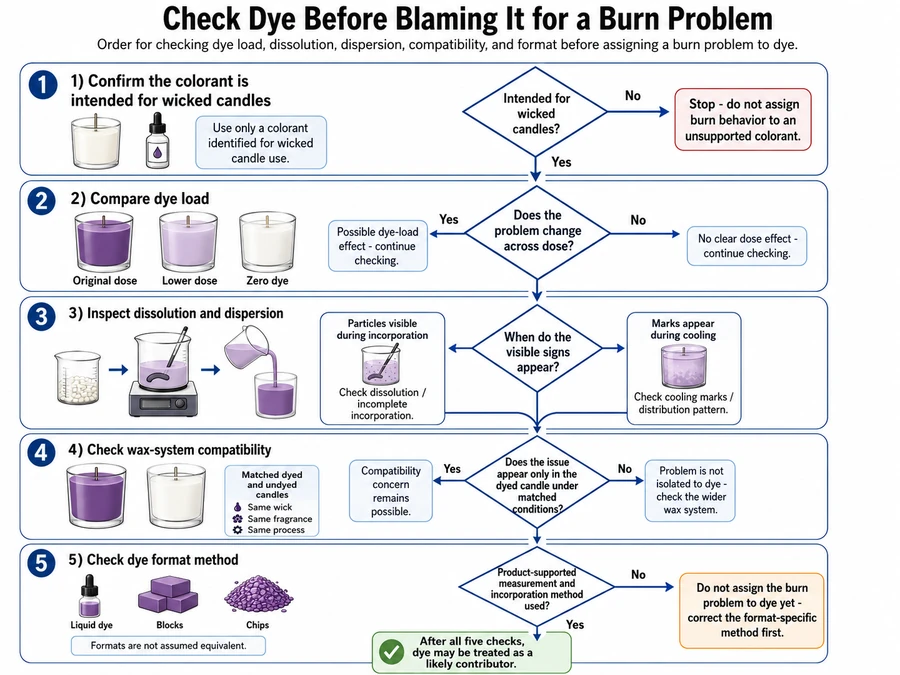
Start by checking dye load and incorporation before using controlled comparisons to decide whether dye is the likely contributor.
The strongest dye evidence is a repeatable performance difference that follows dye dose; color depth, residue, soot, or weak scent viewed alone is weaker evidence.
| Symptom | Pattern that strengthens dye attribution | Pattern that weakens dye attribution | First controlled comparison |
|---|---|---|---|
| Weak flame or tunneling | The original dye dose performs worse and the lower-dose or undyed candles improve | All conditions show similar flame weakness or tunneling | Compare the original dye dose, a lower dose, and no dye |
| Continuous soot | Soot repeats at the original dose and decreases at the lower dose or in the undyed control | Similar soot appears across dyed and undyed candles | Match the wick, trimming, vessel, and burn schedule while changing only dye |
| Weak hot scent throw | Lower hot throw occurs with a smaller flame or melt pool and follows dye dose | Hot throw changes while physical burn behavior remains comparable | Record physical burn measurements and sensory scores together |
| Specks or residue | Colored material appears during incorporation and decreases after the dye process is corrected | Similar material appears in undyed wax or only during cooling | Compare the first process stage at which the material appears |
Check Dye Load, Dissolution, and Compatibility First
Check candle dye load, dissolution, and wax-system compatibility first because each can affect wick fuel delivery and burn performance through a different formulation condition.
When Candle Dye Load Becomes a Burn Problem
Excessive candle dye can disrupt burning when its concentration is too high for the wax, wick, fragrance, and vessel system.
“Too much” means too much for that formulation, not a universal percentage, and dark color alone does not prove dye overload. A concentrated dye may create a dark candle at a low dose, while a weaker product may require more colorant for the same shade.
Dye load is the recorded amount of candle dye added to a defined amount of wax or finished formulation. Record every test in the same unit, using the dye maker’s application directions as the product-specific starting point.
A matched dose ladder separates color depth from burn performance:
| Test condition | Dye dose to record | Variables held unchanged | Diagnostic meaning |
|---|---|---|---|
| Undyed control | Zero dye in the chosen unit | Wax batch, fragrance, wick, vessel, fill mass, cure conditions, and burn schedule | Establishes the formulation’s baseline without dye |
| Lower-dose candle | Exact reduced dose | Same variables as the control | Improvement suggests the original dye load contributed |
| Original-dose candle | Exact dose used in the problem batch | Same variables as the control | Repeated poor performance strengthens the dose association |
| Repeated comparison | Same doses used above | Same conditions and equal repeat counts | Shows whether the result is repeatable rather than accidental |
Method note: Use the same dye product and record the dose, repeat count, materials, and test conditions for every candle. Log flame height and melt-pool width with one measurement unit, then record soot, residue, mushrooming, and hot-throw change with fixed observation labels. This comparison tests one formulation and does not establish a universal ideal dye dose.
An original-dose candle that burns worse than both the lower-dose candle and the undyed control provides stronger evidence than darkness, soot, or a weak flame viewed alone. When every condition performs poorly, the comparison has not isolated dye load, so changing the wick, fragrance, or wax at the same time would make the cause harder to identify.
A repeatable improvement after reducing only the dye load makes overload a plausible contributor; no improvement shifts attention to how the dye entered the wax.
Check Whether the Dye Fully Dissolved and Dispersed
Color specks or sediment may show incomplete dissolution or dispersion, but wax crystals, frosting, debris, and unsuitable pigments can look similar.
ALT TEXT: [Candle Making + Dye Dissolution and Dispersion + Stage-Labeled Evidence]
FILENAME: candle_making_dye_dissolution_stage_evidence.png
VISUAL TYPE: [stage-labeled photo set]
PURPOSE: [Show dye before addition, during incorporation, after cooling, during burning, and after burning to distinguish dye residue from wax or combustion effects.]
Dissolution means the dye entered the molten wax or its carrier without leaving visible solid pieces. Dispersion means the incorporated colorant spread evenly throughout the batch rather than collecting in streaks, layers, or sediment.
The stage when the marks first appear helps separate these possibilities. Colored particles visible during incorporation point more strongly toward a dye problem, while marks appearing only as the candle cools may come from wax crystallization or another surface change.
Use consistent stage labels when inspecting or photographing the batch:
| Process stage | What to record | Cautious interpretation |
|---|---|---|
| Before adding dye | Clumps, crystals, damaged packaging, or settled liquid | The dye may need product-specific preparation before use |
| During incorporation | Floating particles, colored streaks, or material collecting at the bottom | The dye may not have dissolved or spread evenly |
| After pouring and cooling | Isolated colored specks, bottom sediment, pale crystalline patches, or surface haze | Colored residue may involve dye; pale frosting may be a wax effect |
| During the burn | Colored particles, dark residue, or solids near the wick or in the melt pool | Residue supports further testing but does not prove wick restriction |
| After the burn | Deposits remaining in the vessel or attached to the wick | Compare the same area with a matched undyed candle before assigning the cause |
Run these checks before treating every speck as undissolved dye:
- Confirm that the colorant is intended for wicked candles.
- Follow the incorporation directions supplied for that dye product.
- Record the first process stage at which the material became visible.
- Compare cooled samples taken from different parts of the same batch.
- Examine an undyed sample made from the same wax batch.
- Repeat the formulation with a lower dye dose while holding the other variables unchanged.
Visible residue is evidence worth recording, but its appearance alone cannot distinguish incomplete dye incorporation from wax crystals, debris, unsuitable pigment, or material produced during burning.
When colored particles appear before cooling and decrease after the incorporation process is corrected, incomplete dissolution or dispersion becomes more likely than a wax-only defect.
Check Whether the Dye Fits the Wax System
Candle-dye compatibility means the colorant incorporates as intended and the complete wax, wick, fragrance, and vessel formulation passes burn testing at the selected dose. Producing the desired color is not enough.
Compatibility describes how the dye behaves within the complete candle system rather than whether it can make the wax look evenly colored. A dye may appear smooth after cooling yet contribute to residue, uneven fuel delivery, or unstable burning when combined with a particular wax, wick, fragrance, and dose.
| Test area | Compatible indication | Warning sign | Next comparison |
|---|---|---|---|
| Incorporation | Dye enters the molten wax according to its product directions without persistent particles or separation | Specks, sediment, streaks, or separated carrier remain | Compare the same dose in a small test batch prepared as directed |
| Cooled candle | Color remains acceptably distributed without unusual deposits | Concentrated bands, bottom sediment, or particles appear | Compare with an undyed sample from the same wax batch |
| Melt pool | The pool remains free from unusual colored deposits near the wick | Residue collects around the wick or across the pool | Repeat with a lower dye dose while holding the other variables fixed |
| Flame behavior | Flame height and stability remain close to the matched undyed control | Smaller flame, repeated flicker, instability, or early weakening appears only in the dyed candle | Compare dyed and undyed candles under the same burn schedule |
| Wick condition | Carbon buildup and residue remain similar to the control | Dark deposits or mushrooming increase with the dye variable | Repeat before changing wick size or fragrance load |
| Full burn test | The candle maintains acceptable combustion across repeated burns | Performance declines consistently in the dyed version | Retest the formulation and record when the difference begins |
A successful color result proves only that the candle reached the intended appearance. It does not prove that the dye is compatible with the wick’s fuel demand or with the fragrance and wax during combustion.
Check the technical directions for the dye and wax products before testing. Record the dye identity, wax type, dose, wick, fragrance, vessel, and test conditions. Do not compare formulations that differ in any variable other than dye.
Compatibility becomes more plausible when the dyed candle incorporates cleanly and performs close to an otherwise matched undyed control across repeated burns. A repeatable difference that follows the dye variable indicates that the selected product, dose, or incorporation method may not fit that formulation.
Liquid Dye, Blocks, and Chips
No dye format is universally best. Liquid dyes, blocks, and chips differ in active concentration, measuring precision, carrier, and dissolution behavior, so each must be tested in the candle formulation.
The physical format does not reveal how much active colorant enters the wax. One drop of liquid dye cannot be treated as equivalent to one chip or a fixed mass of a dye block unless the manufacturers provide a valid concentration basis.
| Diagnostic factor | Liquid dye | Dye blocks | Dye chips |
|---|---|---|---|
| Measurement | Use the product’s stated mass or controlled-drop method | Shave, cut, or weigh the recorded amount | Count or weigh pieces only when the product directions support that unit |
| Active concentration | Drop count does not establish active dye mass | Block mass does not establish equivalence with another product or format | Chip count does not establish equivalence across products |
| Carrier and incorporation | The liquid carrier becomes part of the formulation and must distribute evenly | The solid dye must melt and distribute without persistent pieces or sediment | The solid portions must melt and distribute without persistent pieces or sediment |
| Diagnostic use | The format is suitable only when it can be measured repeatably, incorporated as directed, and used without degrading the matched candle’s scent or burn behavior | ||
A format is suitable when it can be measured repeatably, incorporated according to its instructions, and used without degrading the finished candle’s scent or burn behavior. The correct choice is formulation-specific rather than liquid, block, or chip by default.
How Dye-Related Residue Can Restrict Wick Fuel Delivery
Excess, incompatible, or undispersed colorant may reduce wick fuel delivery, but a small flame, tunnel, dark wick, or mushroomed tip does not prove dye-related clogging.
Wick fuel delivery is the movement of melted wax through the wick toward the flame. The wick must receive enough liquid fuel to maintain combustion, but the visible wick is only one part of that process.
Dye-related residue becomes a plausible contributor when a dyed candle shows deposits near the wick and burns worse than matched lower-dose and undyed candles. The same symptoms can result from wick size, fragrance load, wax behavior, vessel conditions, or an unsuitable colorant.
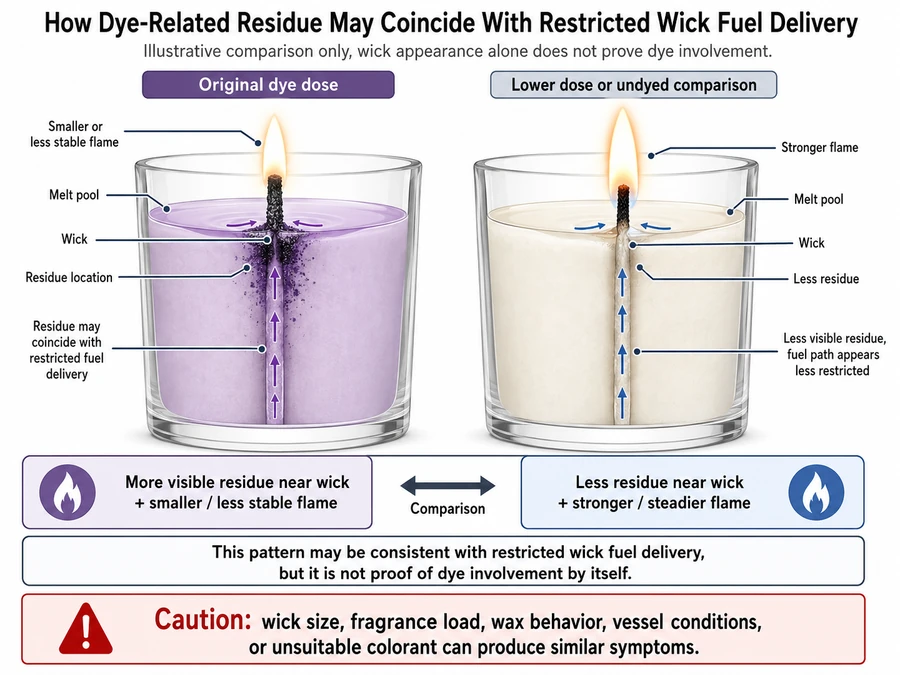
| Comparison result | Wick or flame observation | Residue observation | Diagnostic meaning |
|---|---|---|---|
| Original dye dose performs worse than both comparison candles | Flame becomes smaller or less stable | Colored or dark residue increases near the wick | The original dye dose may be contributing |
| Lower dye dose improves performance | Flame remains stronger for longer | Less residue appears under the same conditions | A dose-related effect becomes more likely |
| Dyed and undyed candles perform alike | Similar flame, melt pool, and burn duration | Similar residue in both candles | Dye is not isolated as the cause |
| Every candle performs poorly | Weak flame, tunneling, or instability appears in all tests | Deposits may or may not differ | Another formulation variable remains unresolved |
| Residue appears without reduced performance | Flame and melt pool remain comparable | Deposits are visible only in the dyed candle | Residue alone does not establish wick restriction |
| Performance weakens during later burns | Early burns appear normal; later burns decline | Deposits increase across burn cycles | Accumulating residue is one possibility, but full-life effects must be compared |
Method note: Compare the original dye dose, a lower dose, and no dye. Record residue location, wick condition, and flame behavior at the same burn stages.
Residue check: Compare material visible during incorporation, after cooling, beside the wick during burning, and after extinguishing. Record whether it is colored, pale, crystalline, oily, loose, or attached to the wick. Appearance supports comparison but does not identify the material or prove a microscopic blockage.
A wick may look dark because carbon forms during burning, and a mushroomed tip may result from the total fuel system rather than dye alone. Do not change wick size while testing the dye variable because that prevents a clean comparison.
Dye-related wick interference becomes more credible when the symptom follows dye dose, repeats across matched candles, and decreases when only the dye dose or incorporation problem is corrected.
Rule Out Unsuitable Colorants
Mica, crayons, food coloring, paint, and other substitutes are not interchangeable with wax-compatible candle dye. Insoluble particles or separated liquids may settle in the fuel system and interfere with wick performance.
Wax-compatible candle dye is a colorant supplied for incorporation into candle wax and use in a finished wicked candle. A material that colors melted wax or the candle surface is not automatically suitable for combustion.
| Material | Why it is not interchangeable with candle dye | Possible diagnostic clue | Corrective test |
|---|---|---|---|
| Candle dye intended for wicked candles | Product suitability still depends on dose, wax, incorporation, and complete burn testing | The candle colors evenly but may still perform differently from an undyed control | Follow the product directions and compare multiple dye doses |
| Mica or decorative pigment | Solid particles may remain suspended or settle rather than behaving like a soluble candle dye | Shimmering particles, sediment, or visible solids appear in the wax or melt pool | Make a matched candle with the particulate material removed |
| Crayon | Crayons contain their own wax, pigments, and additives and are not formulated as a controlled candle-dye dose | Waxy pieces, sediment, uneven color, or altered burning may appear | Replace the crayon with a measured candle dye while holding the other variables fixed |
| Food coloring | Many food colorings use a water-based or otherwise wax-incompatible system | Droplets, separation, streaking, or material collecting at the bottom may appear | Remove the food coloring and retest with a wax-compatible product |
| Paint or craft colorant | These products are not supplied as fuel-system colorants for wicked candles | Separation, particles, residue, or unstable combustion may occur | Do not use the material in the comparison candle |
| Unknown pigment or color powder | Composition, concentration, and candle suitability may be undocumented | Results cannot be attributed reliably because the material is unidentified | Identify the product and its intended application before further testing |
These materials do not all produce the same symptom, and their presence does not prove that a particular deposit caused a wick failure. The useful distinction is whether the material was made for candle wax and whether the finished formulation passes a matched burn comparison.
When an unsuitable substitute was used, test a replacement batch with wax-compatible candle dye at a recorded dose. Keep the wick, wax, fragrance, vessel, and burn conditions unchanged. Improvement after replacing only the colorant supports the material mismatch as a contributor; no improvement leaves other variables unresolved.
Is the Soot Coming From Dye?
Black or dark candle dye does not color smoke black; soot is carbon produced by incomplete combustion, and dye involvement requires a matched comparison.
A darker candle may appear connected to darker smoke, but color alone does not establish causation. Candle dye may contribute indirectly when its dose, compatibility, dispersion, or effect on the wick changes how the candle burns.
The following differential table separates dye-correlated soot from observations that require another explanation:
| Observation | Dye-related interpretation | Competing explanation | Best comparison |
|---|---|---|---|
| The original dyed candle produces continuous soot, while a matched undyed candle does not | Dye dose, incorporation, or compatibility may be contributing | A test difference other than dye may still exist | Verify that wax, fragrance, wick, vessel, fill mass, cure conditions, trimming, and burn schedule match |
| Reducing only the dye dose reduces continuous soot | A dose-related dye effect becomes more likely | Normal variation remains possible when the result appears in only one candle | Repeat the original, reduced, and undyed conditions |
| Dyed and undyed candles produce similar soot | Dye has not been isolated as the cause | Wick behavior, fragrance, wax, or another shared variable may be involved | Compare the shared formulation variables without treating dye as proven |
| Smoke appears only while lighting the candle | This does not show continuous dye-related soot | Ignition behavior may create a brief smoke event | Record it separately from smoke during steady burning |
| Smoke appears only after extinguishing the candle | This does not show that dye caused soot during the burn | The extinguishing method may produce a separate smoke event | Keep extinguishing observations outside the continuous-burn soot record |
| A dark deposit appears on the vessel but the flame remains stable | Dye involvement is possible but unproven | Carbon buildup, handling residue, or another combustion variable may be involved | Compare deposit timing, position, and amount across matched candles |
| Soot increases during later burn cycles only in the dyed candle | Accumulating residue or a changing wick-dye interaction may contribute | Wick carbon buildup or another full-life burn effect may still explain the change | Record the burn stage when soot first appears and repeat the test |
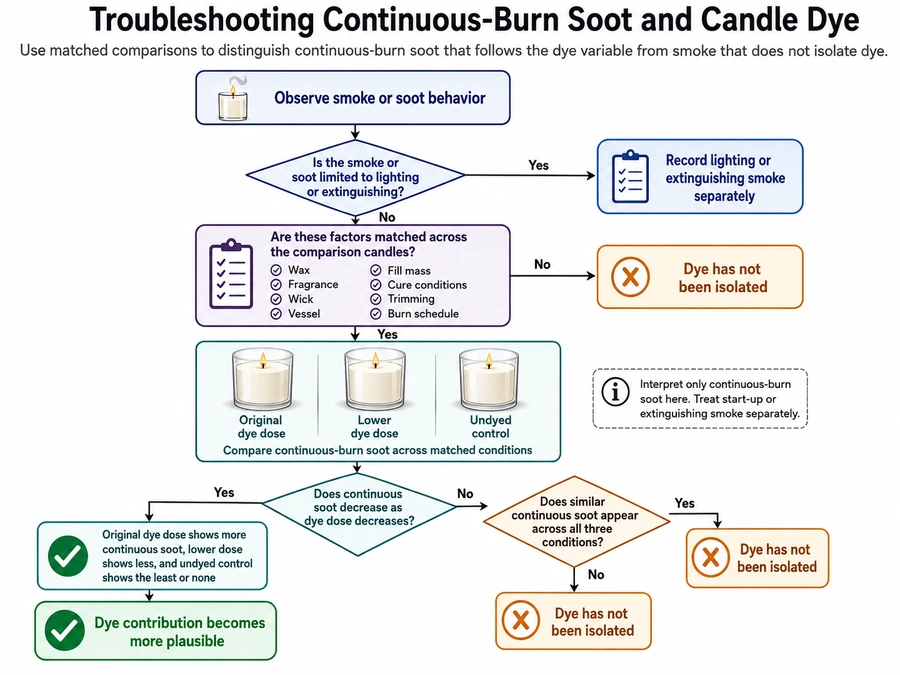
Continuous-burn soot means visible smoke or carbon deposition produced while the candle is burning under the recorded test conditions. Smoke during lighting and extinguishing belongs in separate observation fields because it does not represent the same combustion state.
Method note: Use fixed soot labels, such as none, trace, intermittent, or continuous. Record whether smoke occurs during lighting, steady burning, or extinguishing, plus the burn stage and residue position. Visual labels support comparison but do not measure soot mass or prove a chemical cause.
Photograph the same vessel area under similar lighting after each recorded burn stage. A darker photograph, larger flame, or single smoky event should not be treated as proof unless the result follows the dye variable across repeated matched candles.
Dye becomes a credible soot contributor when continuous-burn soot repeatedly appears at the original dye dose, decreases at a lower dose, and remains absent or lower in the undyed control.
Did the Dye Weaken Hot Scent Throw?
Candle dye may weaken hot scent throw indirectly when it produces a smaller flame or melt pool, but weak scent alone does not prove fragrance suppression.
Hot scent throw is the perceived fragrance released while a candle burns under defined conditions. On this page, “weaker” means a repeatable reduction against the intended result or an otherwise matched undyed control.
Use one shared burn-and-scent benchmark so the sensory result can be compared with physical burn behavior:
| Recorded field | Original dye dose | Lower dye dose | Undyed control | Diagnostic use |
|---|---|---|---|---|
| Flame height, using one unit | Record at the same burn stages | Record at the same burn stages | Record at the same burn stages | A smaller flame that follows dye dose supports an indirect burn pathway |
| Melt-pool width, using one unit | Record at fixed observation points | Record at fixed observation points | Record at fixed observation points | A narrower pool may reduce fragrance release from warmed wax |
| Time until a stable melt pool | Record the test value | Record the test value | Record the test value | A repeated delay in the dyed candle may explain later or weaker perception |
| Hot-throw score | Use the same defined scale | Use the same defined scale | Use the same defined scale | A lower score matters only when the scoring method remains unchanged |
| Assessor position and room conditions | Keep unchanged | Keep unchanged | Keep unchanged | Different locations or airflow make sensory scores less comparable |
| Soot, residue, and flame stability | Record with fixed labels | Record with fixed labels | Record with fixed labels | Physical symptoms help show whether scent loss tracks burn degradation |
| Repeat result | Record each candle separately | Record each candle separately | Record each candle separately | Repetition separates a pattern from one subjective observation |
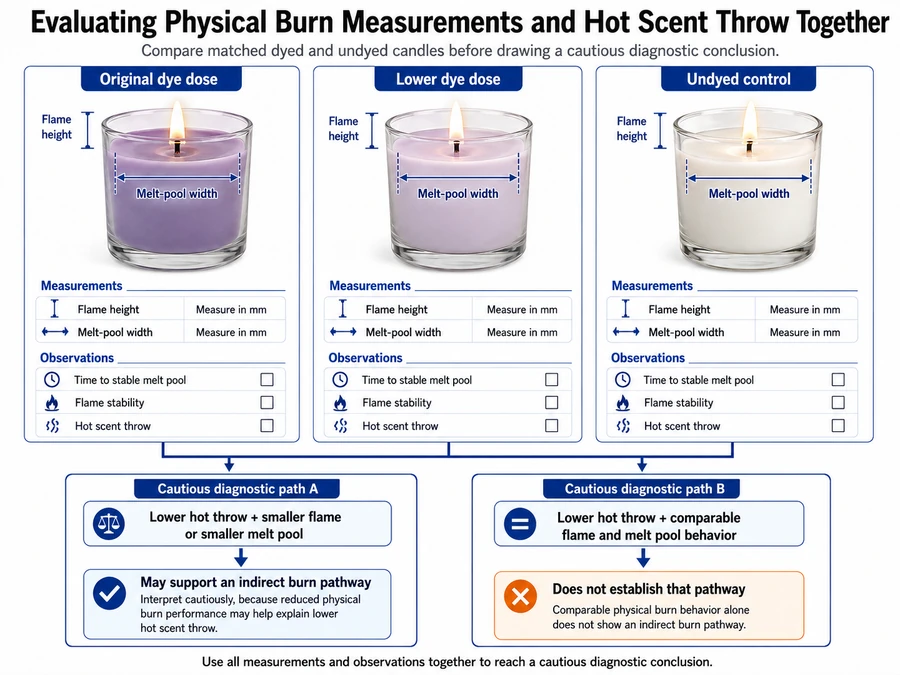
A dyed candle with both a smaller melt pool and lower hot-throw scores supports an indirect explanation: less wax is heated or exposed, so less fragrance reaches the surrounding air. This comparison does not prove that the dye chemically altered the fragrance.
When hot-throw scores decrease but flame height, melt-pool width, and burn stability remain comparable, the test has not established a dye-related burn pathway. Wax, fragrance amount, cure conditions, testing conditions, or normal sensory variation may still explain the result, but those broader topics fall outside this dye-focused diagnosis.
Method note: Define the sensory scale before testing. Keep assessor position, room, ventilation, candle age, burn stage, and evaluation period unchanged. The result applies only to the tested formulation.
Assessors should score candles without being told which one contains dye when the test setup permits it. This reduces expectation bias, especially when the dyed candle is visibly darker than the control.
Dye is a plausible contributor to weak hot scent throw when the reduction repeats, follows the dye dose, and appears with measurable burn changes rather than sensory impressions alone.
Run a Dyed-versus-Undyed Control Test
Make matched dyed and undyed candles, change only the dye variable, record repeated full-life burns, and compare flame, melt pool, soot, residue, stability, and hot scent throw.
A full-life burn test follows each test candle through the same recorded burn stages until the predefined completion point. It reveals problems that may not appear during the first burn.
Record the test design before making the candles:
| Control worksheet field | What to record |
|---|---|
| Test date and batch identity | Pour date, test dates, wax batch, and identifying sample code |
| Test conditions | Room conditions, placement, burn schedule, and trimming procedure |
| Fixed formulation variables | Wax, fragrance, additives, wick, vessel, fill mass, cure conditions, and production process |
| Independent variable | Candle-dye product, format, dose, and measurement unit |
| Comparison conditions | Original dye dose, lower dye dose, and zero-dye control |
| Repeat count | The same predefined number of candles for every condition |
| Measurement tools | Scale, ruler or caliper, timer, camera, and observation sheet used |
| Physical measurements | Flame height and melt-pool width using the same units at fixed burn stages |
| Observation labels | Soot, residue, mushrooming, tunneling, stability, and hot-throw rating |
| Completion criteria | The recorded stage or condition that ends the test |
| Provenance and limitations | Product directions followed, material sources, deviations, and factors the test cannot establish |
Use the worksheet in this order:
- Define the question. State whether the test is checking the original dye dose, a suspected incorporation problem, or the presence of dye itself.
- Prepare matched formulations. Use the same wax batch, fragrance dose, additives, wick, vessel, fill mass, pouring process, and cure conditions for every test candle.
- Create the comparison conditions. Make candles with the original dye dose, a recorded lower dose, and no dye. Do not change the wick or fragrance between conditions.
- Assign samples without changing the method. Give each candle an identifying code and use the same repeat count, observation schedule, trimming practice, and test location.
- Record each burn stage. Measure flame height and melt-pool width in one unit. Record soot, residue, flame stability, wick condition, tunneling, and hot scent throw with predefined labels.
- Continue to the completion point. Do not stop after the first acceptable burn unless the predefined method calls for it. Note the first stage at which each symptom appears.
- Compare patterns rather than isolated events. Check whether the original-dose candles repeatedly perform worse than both the lower-dose and undyed candles.
- Retest the suspected correction. When reducing the dye dose or correcting incorporation improves performance, repeat that condition without altering another variable.
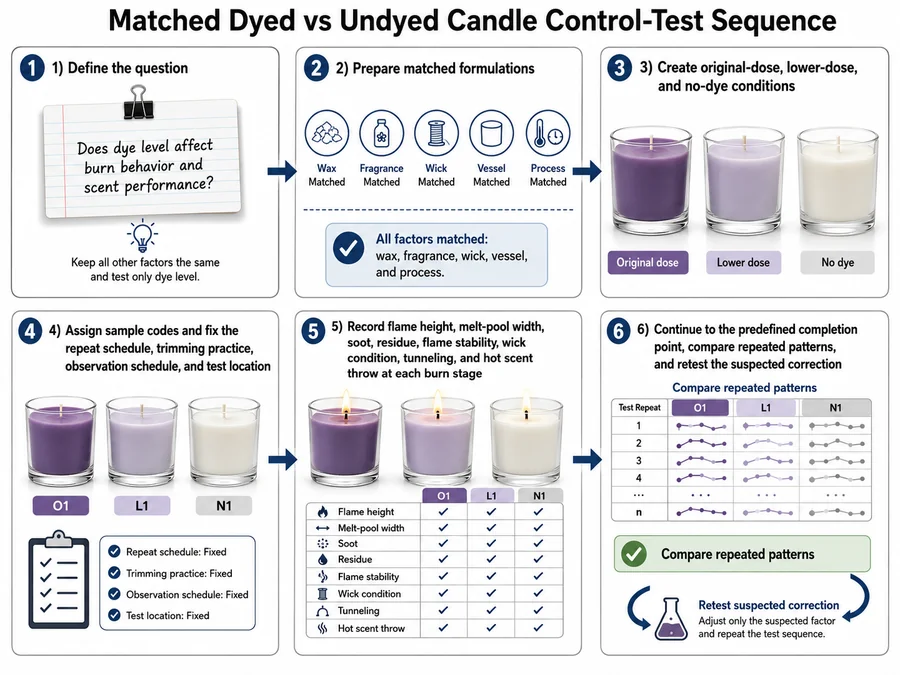
Choose and record the repeat count before testing. One candle in each condition can reveal a possible difference, but it cannot show whether that difference repeats.
The strongest dye-related pattern occurs when the original-dose candles repeatedly develop the symptom, lower-dose candles improve, and undyed controls remain better under the same conditions. When every condition performs poorly, the test has not isolated candle dye as the cause.
This method evaluates the tested formulation only; it does not establish a universal dye dose, wick choice, fragrance limit, or burn-performance rule.
Check Dye and Fragrance Load Together
High dye and fragrance loads can create overlapping performance problems, but changing both together prevents attribution; hold one constant while testing the other.
Here, baseline load means the documented formulation-specific dose selected for comparison, not a universal percentage or guaranteed performance threshold.
| Baseline fragrance load | Selected higher fragrance load | |
|---|---|---|
| Baseline dye load | Reference formulation; establishes performance before either load is increased | Tests the fragrance variable while dye remains unchanged |
| Selected higher dye load | Tests the dye variable while fragrance remains unchanged | Screens for a combined problem but cannot identify which variable caused it |
The four-cell matrix separates single-variable effects from combined effects:
- When only the higher-dye condition performs worse, the dye dose becomes the stronger suspected contributor.
- When only the higher-fragrance condition performs worse, the comparison does not support dye as the primary cause.
- When both single-variable conditions perform acceptably but the combined condition fails, the formulation may have a combined-load problem.
- When all four conditions perform poorly, another fixed variable or test condition remains unresolved.
A poor result in the combined-load candle does not prove that the dye and fragrance reacted chemically. It shows only that the tested combination performed differently under the recorded conditions.
Use the same control-test worksheet for all four conditions. Record the dye and fragrance products, doses, units, formulation, repeat count, physical measurements, sensory method, and limitations. Follow the application guidance supplied for each product rather than applying a universal total-load threshold.
Change one variable at a time when assigning cause, and use the high-dye/high-fragrance condition only to check whether the combination creates a repeatable difference.
Use Symptom Timing to Narrow the Cause
Later weakness may reflect accumulating residue, changing wick behavior, vessel heat, or another full-life effect; compare its first appearance across matched test candles.
“Early” and “late” must refer to numbered, dated burn stages in the test plan rather than an unrecorded impression. For each stage, record the elapsed burn period, flame height and melt-pool width in consistent units, soot, residue, wick condition, flame stability, and hot scent throw.
Use a static burn-cycle timeline to compare the original dye dose, lower dye dose, and undyed control:
| Recorded burn stage | Original dye dose | Lower dye dose | Undyed control | Diagnostic meaning |
|---|---|---|---|---|
| Before the first burn | Record visible particles, sediment, wick appearance, and cooled-candle condition | Record the same fields | Record the same fields | Pre-burn differences may point to incorporation or material variation rather than accumulated burn effects |
| First predefined burn stage | Record flame, melt pool, soot, residue, stability, and hot throw | Record the same fields at the same elapsed period | Record the same fields at the same elapsed period | Immediate differences support an initial dose, dispersion, or compatibility effect |
| Middle recorded stages | Note whether symptoms appear, disappear, or increase | Note the same changes | Note the same changes | A symptom that grows only with the original dye dose may indicate an accumulating dye-correlated effect |
| Final recorded stages | Record the first stage of weakening and the condition at the predefined completion point | Record the same fields | Record the same fields | Later divergence may involve accumulated residue or changing wick behavior, but timing alone does not prove the mechanism |
| Post-burn inspection | Record residue location, wick deposits, vessel deposits, and remaining wax condition | Record the same fields | Record the same fields | Differences may support the observed timeline but cannot identify the residue without further evidence |
The first appearance of a symptom matters more than the general statement that the candle “burned well at first.” Record the numbered stage when the flame weakened, soot became continuous, residue appeared, tunneling developed, or hot scent throw decreased.
| Timing pattern | Cautious interpretation | Corrective decision |
|---|---|---|
| All three conditions weaken at the same stage | Dye has not been isolated as the cause | Review the shared formulation and test conditions before altering the dye |
| Only the original-dose candle weakens early | The selected dye dose, incorporation, or compatibility may be contributing | Repeat the original and lower-dose comparison |
| The original-dose candle weakens later and residue increases across stages | An accumulating dye-correlated effect is plausible | Repeat the test after reducing only the dye dose or correcting incorporation |
| Both dyed conditions weaken while the undyed control remains stable | The presence of dye may be associated with the change | Verify that the dyed candles differ only by dye and repeat the comparison |
| Hot throw falls without a matching physical burn change | Timing does not establish a dye-related burn pathway | Treat the sensory result as unresolved rather than assigning dye as the cause |
| One candle shows a late symptom that does not repeat | The observation may reflect normal variation or an uncontrolled factor | Do not change the formulation until the result repeats |
Method note: Record actual dates and elapsed burn periods. State any interruption, environmental difference, measurement change, or missing observation as a limitation.
Vessel heat can change during later burns, but a complete vessel-heat diagnosis falls outside this dye-focused comparison. Its role here is limited to a possible competing explanation when dyed and undyed candles change at similar stages.
Treat timing as supporting evidence, not proof. Candle dye becomes a stronger suspected contributor when the original-dose candles weaken earlier or more severely, the pattern repeats, and performance improves after changing only the dye variable.