
Different types of candles include containers, pillars, tapers, votives, tealights, floating candles, and emergency candles, each suited to different rooms, décor goals, and burn habits.
Many candles look interchangeable until placement, airflow, or burn time turns the wrong format into smoke, drips, or wasted scent. This guide helps shoppers and makers sort candle types by shape, support, and common use so the choice is easier. Container candles, pillars, tapers, votives, tealights, floating candles, and long-burn glass styles each handle heat, wax, and room conditions differently. Once you know which family fits your goal, you can narrow the choice faster and avoid most setup mistakes.
What Are the Main Candle Types?
The main candle types are grouped by shape and how they are supported, such as free-standing, container-based, or floating, because that determines burn behavior, drip risk, and where they work best.
In candle making, these families appear again and again because each one solves a specific problem, including stable light, neat décor, strong fragrance, or safer use in drafts. The most common types of candles are:
- Container candles (jars or tins): Wax is held by a vessel, so they are cleaner on tables and better for scent in still rooms.
- Pillar candles: Thick, free-standing candles that suit centerpieces; they need a flat, heat-safe plate to catch wax.
- Taper candles: Tall, slim candles designed for candlesticks; they are about elegant light, not long burn time.
- Votive candles: Short candles meant to melt into a holder; they are a classic small-but-bright option.
- Tealights: Compact candles in cups; they are great in multiples for steady ambience and warm accent lighting.
- Floating candles: Shaped to float on water; they are for visual impact and short, supervised burns.
- Prayer or novena candles (glass): Tall candles in glass; they are used for extended burning, but placement and heat management still matter.
- Outdoor or citronella-style candles: Built for patios and airflow; performance depends heavily on wind and container stability.
- Gel and novelty candles: Visual-first styles; they vary widely, so burn quality depends on construction.
- Emergency candles: Long-burn, practical light sources meant for outages and preparedness kits.
| Candle type | Best for | Holder or container | Scent fit | Notes |
|---|---|---|---|---|
| Container candles | Everyday use and tidy setup | Built-in jar or tin | Often strong in still rooms | Easy to place and low-mess |
| Pillar candles | Centerpieces and grouped décor | Heat-safe plate or holder | Usually light scent or unscented | Can drip or slump without a good base |
| Taper candles | Formal dining and height | Candlestick required | Usually subtle or unscented | Best kept upright and away from drafts |
| Votives and tealights | Layered ambience | Holder or cup required | Usually modest scent | Useful in multiples |
| Floating candles | Visual moments and events | Bowl or vessel with water | Décor-first | Short, supervised burns |
| Prayer or emergency candles | Long practical burns | Glass or deep container | Usually unscented | Best on stable, heat-safe surfaces |
Votives and tealights are easy to confuse, but votives are small candles that melt into a holder, while tealights already sit in a cup and stay lower and more compact during use.
Wax still changes how each category behaves, but wax choice is a second-step decision rather than the main classification system here. For a fuller breakdown of shape-based categories, start with our main candle types guide.
How to Choose the Right Candle Type
Choose the right candle type by matching your goal, such as light, scent, décor, or backup power, to your room conditions, including drafts, surface safety, and how long you will supervise the flame.
If you are buying for everyday use, start with a quick reality check. In candle making, most problems come from mismatching form factor to airflow. A taper in a drafty hallway drips. A large jar candle in a tiny bathroom can feel overpowering. A pillar without a proper plate becomes a cleanup project.
Use this simple selection path:
- If you want the cleanest tables and easiest setup: choose a container candle. The vessel does the wax control for you.
- If you want décor-first centerpieces: choose a pillar for volume or tapers for height, then plan for drip protection.
- If you want flexible, layered ambience: choose tealights or votives. Multiples let you scale brightness without relying on one huge flame.
- If you want a statement moment: floating candles win visually, but only when you can supervise closely.
- If you want practical long burn time: look at prayer, novena, or emergency options, then prioritize heat-safe placement and ventilation.
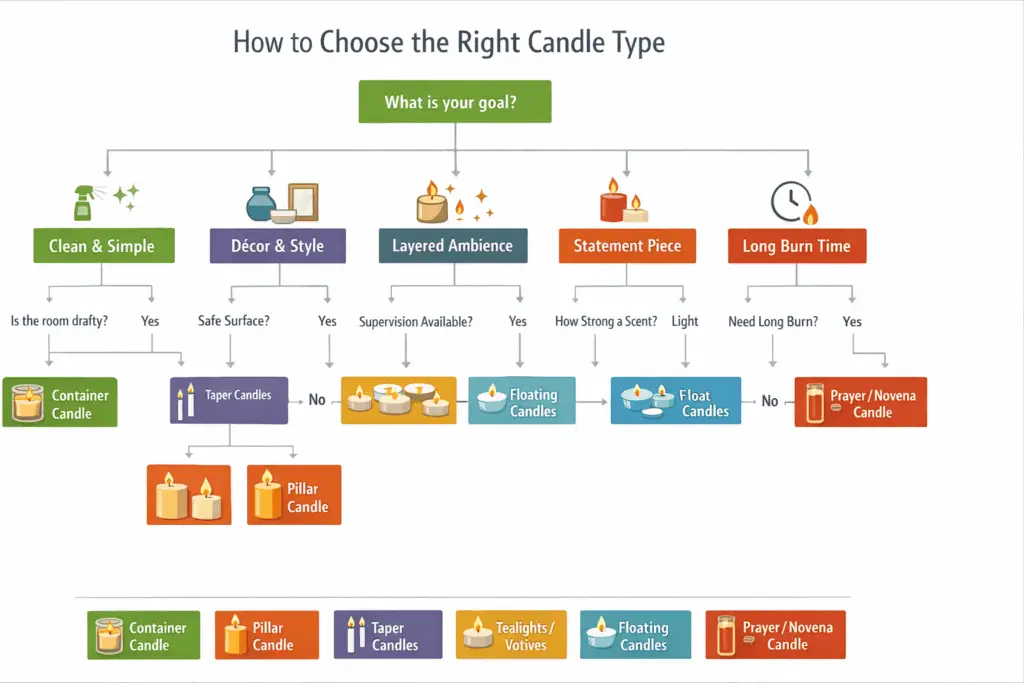
| If you want… | Best candle type | Why it fits |
|---|---|---|
| Clean setup with easy wax control | Container candle | The vessel contains wax and keeps placement simple |
| Height or centerpiece styling | Pillar or taper | They create a décor-first look with different visual profiles |
| Scalable ambient light | Tealights or votives | You can layer several small flames instead of relying on one large candle |
| A visual focal point | Floating candle | It creates a statement effect for events and tablescapes |
| Long, practical burn time | Prayer, novena, or emergency candle | These formats are built for longer supervised sessions |
For a fuller room-by-room decision path, see how to choose the best candle type for your space.
Then refine your choice with two performance filters:
- Drafts and soot sensitivity: In breezy rooms, taller flames and narrower shapes tend to misbehave sooner. Wider, protected flames are usually steadier.
- Wax and fragrance expectations: If scent is the priority, compare wax behavior before you compare brand names. Soy vs beeswax vs paraffin matters because it affects throw, burn rate, and how the candle handles added fragrance.
A final check is to match the candle’s use to your habits. If you will only burn for 30 to 60 minutes at a time, smaller formats are more forgiving. If you will burn for hours, choose a stable base, a roomy melt pool, and a wax profile you actually like from the start, especially when you are comparing different candle wax types.
If the candle still tunnels, smokes, or melts unevenly after basic setup fixes, switch from choosing a type to solving the burn problem with a dedicated walkthrough such as fixing leaking or uneven melting in candles.
Best Candle Types for Aromatherapy, Décor, and Emergencies
The best candle type depends on the job: calming scent for aromatherapy, clean visual light for décor, and stable, practical burn time for emergencies.
If you are already into candle making, think in outcomes: fragrance control, drip control, and reliability. Start by choosing the format that matches the space, then refine with scent level and how long you will actually burn it.
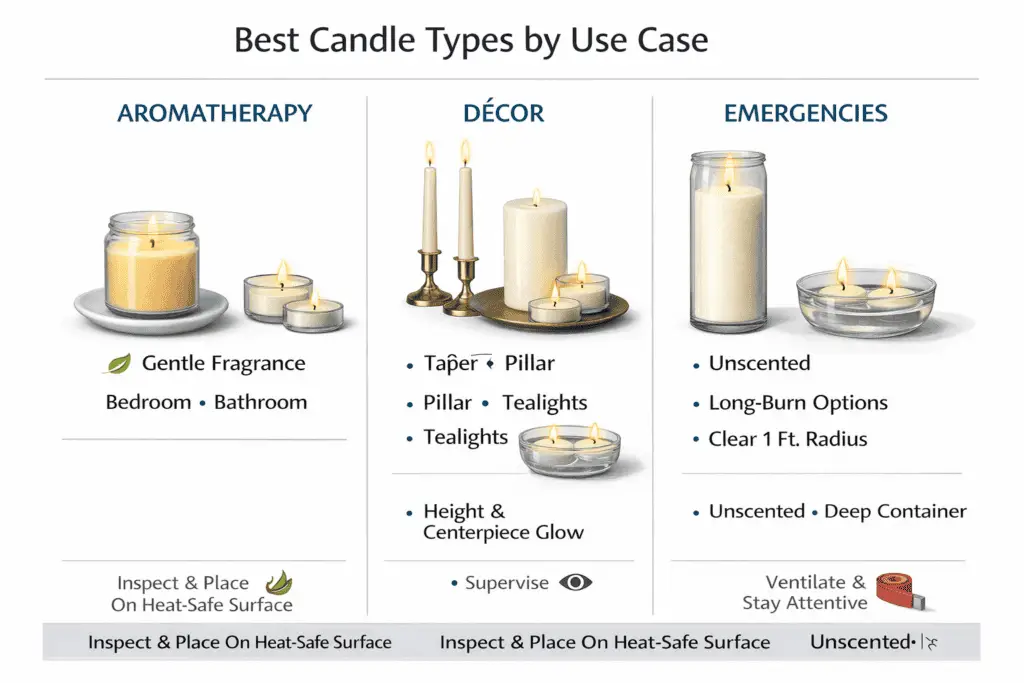
Best Picks by Use Case
Aromatherapy-Style Evenings
Choose a single-wick container candle in a smaller size, or use a few tealights so you can scale the mood up or down. Keep candle fragrance gentle in bedrooms and bathrooms. One candle placed well beats three competing scents.
For most bedrooms, a smaller jar and a modest burn window keep the scent noticeable without turning heavy. Avoid burning candles right next to the bed, curtains, or a vent.
Décor and Hosting
Use tapers for height at the table, pillars for centerpieces, and tealights for layered glow. Keep burns on the shorter side during meals so wax stays controlled and flames do not creep too close to florals or linens.
If you want a stronger visual moment without a cluttered setup, floating candles can work beautifully with a wide bowl, a steady water level, and close supervision. Keep everything away from linens, greenery, and tight arrangements.
Emergencies
Choose unscented, stable formats you can place on a heat-safe surface without dripping surprises, such as deep container candles, prayer or novena-style glass candles placed safely, or purpose-made long-burn options.
Burn them in supervised sessions, keep a clear radius around the candle, and use a ceramic plate or tray underneath even for containers. Avoid tall tapers in outages and drafty rooms, because leaning flames and dripping wax create extra hazards when you are moving around in low light.
A solid one-shelf approach is to keep one scent-forward container candle for relaxation, a set of unscented tapers or pillars for décor, and a dedicated emergency candle stored with matches and a heat-safe base.
Frequently Asked Questions About Candle Types
These questions answer the candle-type choices people usually make after comparing the main families, use cases, and practical setup trade-offs.
What candle type is usually easiest for beginners?
Container candles are usually the easiest starting point because the vessel controls melted wax, placement is simpler, and scent-focused everyday candles are commonly sold in this format.
Which candle type is best for strong scent throw?
Container candles are often the easiest choice when scent is the goal, especially in still rooms where the fragrance can build without drafts pulling the flame and heat off-center.
Are pillar candles or taper candles better for décor?
Pillars are usually better for grouped centerpieces and low, sculptural arrangements, while tapers are better when you want height, formality, and a classic candlestick look.
What candle type makes the most sense for emergencies?
Unscented, stable candles in glass or deep containers are usually the most practical choice for outages because they are easier to place safely and less likely to create dripping surprises in low light.