
Tealights are better for short, flexible, high-quantity setups, while votives are better for longer, holder-based decor presence.
Tealight candles are small-format candles usually sold in their own cups, while votive candles are small-format candles meant to burn in separate holders. This comparison helps you choose by holder setup, burn duration, quantity, cleanup, wax warmer use, and table effect. It does not decide one universal best candle. It also does not cover candle-making methods or every candle category.
Tealight vs Votive Candles: The Quick Difference
Tealight candles are small candles in cups, while votive candles are small candles meant to burn in separate holders.
Both are small-format candle types, but they are not the same candle. Use tealights when you want short, flexible accents; use votives when you want a longer, holder-based glow.
| Comparison point | Tealight candles | Votive candles |
|---|---|---|
| Basic form | Small candle in a built-in cup | Small candle for a separate holder |
| Holder need | Usually already has a cup | Needs a close-fitting holder |
| Session fit | Better for shorter use | Better for longer use |
| Setup style | Easy to place in groups | Better for a fuller table look |
| Replacement | Simple to swap out | Holder can be reused |
| Common fit | Wax warmers, grouped accents, quick decor | Dinner tables, longer decor, stronger candle presence |
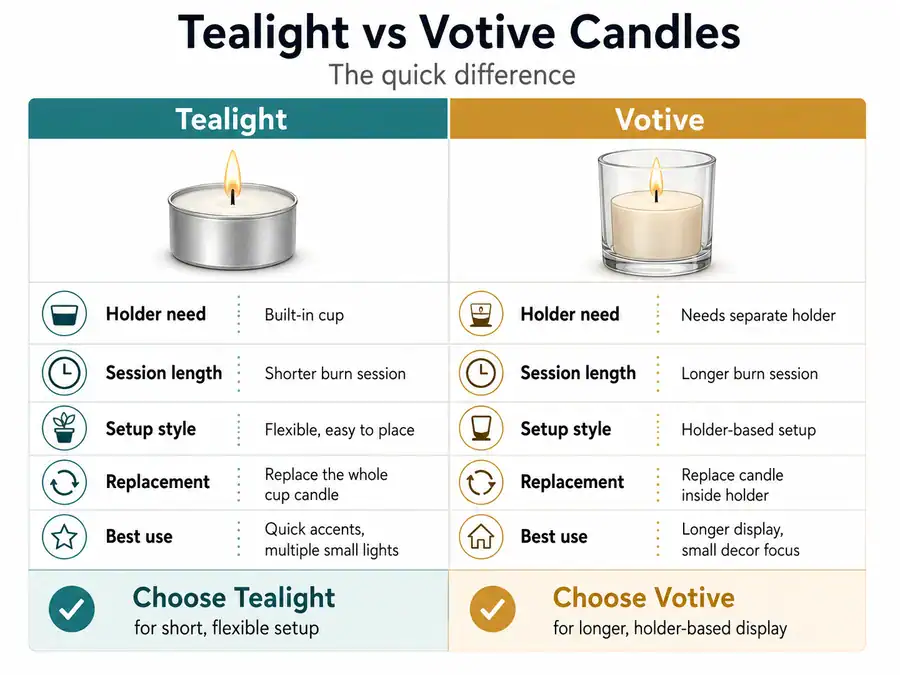
Tealights and votives are not ranked by one universal winner. The better choice depends on holder setup, burn duration, quantity, cleanup, decor effect, and whether the candle is being used for light, fragrance, or a wax warmer.
For a fuller explanation of what tealight candles are, use the dedicated tealight guide. For the separate holder rules, the votive candle guide is the better next step. A broader candle types guide is the right place to compare formats beyond tealights and votives.
Holder Requirements: Tealights Come in Cups, Votives Need Holders
Tealights usually include a cup, while votives need a proper close-fitting holder because they can liquefy as they burn.
Use tealights when you want the simplest built-in-container setup. Use votives when you already have the right holder and want a more substantial candle presence.
| Setup check | Tealight candles | Votive candles |
|---|---|---|
| Built-in container | Usually yes | No |
| Separate holder | Still useful for stability and decor | Required for normal use |
| Wax control | Cup contains the melted wax | Holder contains the melted wax |
| Best surface | Flat, stable, heat-resistant surface | Flat, stable, heat-resistant surface |
| Wrong setup risk | Tipping, heat marks, poor placement | Wax spill, unstable burn, messy holder |
| Best use case | Quick grouped accents | Longer holder-based display |
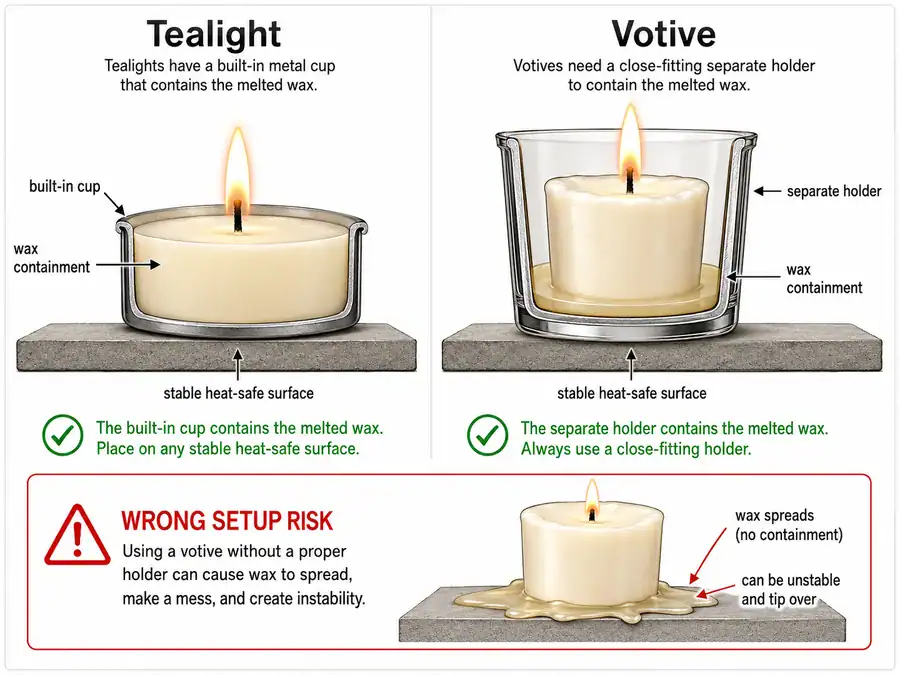
A tealight cup is part of the candle’s normal form. It is not the same as a decorative holder, because the cup’s main job is to contain the wax.
A votive holder is part of the burning setup. Votives are designed to melt into the holder, so a loose, shallow, or mismatched holder can lead to spilled wax or poor burning.
For what votive candles require in more detail, use the votive candle guide. For broad setup rules across candle types, use the candle types guide rather than turning this section into a holder shopping guide.
Burn Time: Which Candle Lasts Longer?
Votive candles usually burn longer than tealights: many tealights burn about 3–5 hours, while many votives burn about 8–15 hours depending on size, wax, wick, holder fit, and burn conditions.
Choose tealights for short sessions such as quick table accents or wax warmer use. Choose votives when the candle needs to stay lit for a longer dinner, reception, or decor window.
| Burn-time factor | Tealight candles | Votive candles |
|---|---|---|
| Typical session role | Short | Medium to longer |
| Wax amount | Lower | Higher |
| Holder effect | Cup limits the candle size | Holder supports a fuller melt pool |
| Best planning use | Short meals, baths, warmers, grouped light | Dinner tables, receptions, longer decor |
| Replacement need | More likely during long events | Less likely during the same event |
| Main caution | May not last through a long setup | Needs the right holder to perform well |
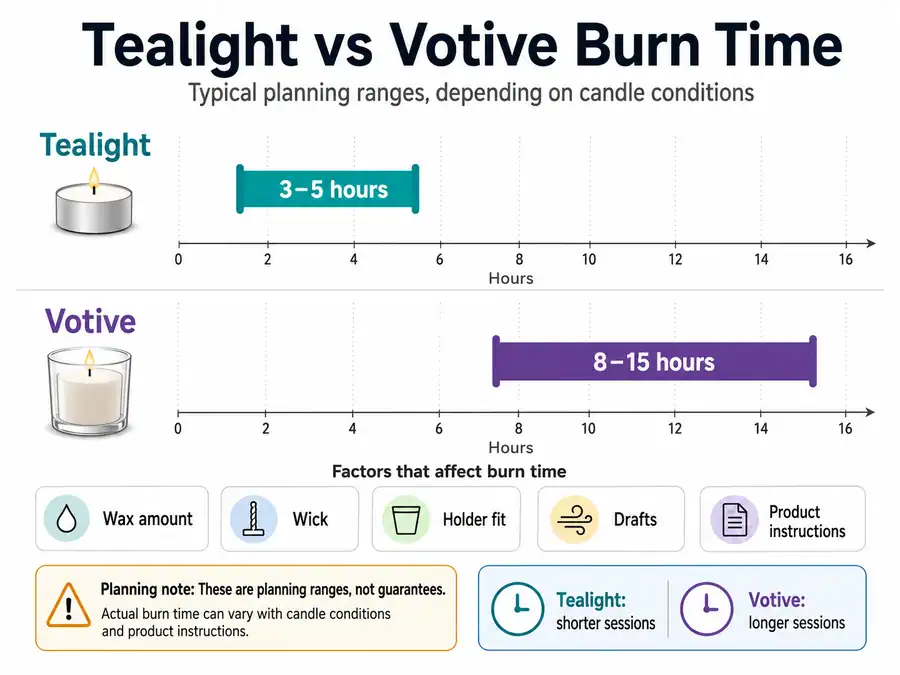
Burn-time note: These are practical planning ranges, not guarantees. Candle size, wax type, wick design, holder fit, drafts, and product instructions can change the actual burn time.
A tealight can work well when the candle only needs to cover a short time window. That makes it practical for wax warmers, small accents, and grouped decor where replacing one candle is not a problem.
A votive is the stronger choice when the candle is expected to last longer and look more substantial. The tradeoff is setup: without a proper votive holder, the longer burn advantage can turn into a wax-control problem.
Simple planning rule: use tealights when the candle is part of a short, replaceable setup; use votives when the candle is part of a longer, holder-based display.
Why Size and Wax Volume Change the Result
Burn time changes because a larger candle usually has more wax available to feed the flame.
Tealights are smaller by design, so their burn time is usually limited by the small cup and lower wax volume. Votives are usually taller and heavier, so they can support a longer session when the wick, wax, and holder match the candle.
Wax volume is not the only variable. A poor wick, drafty room, oversized flame, or wrong votive holder can shorten the burn or make the candle messy. The better comparison is not “tealights are short and votives are long” in every case; it is “tealights are built for shorter, flexible use, while votives are built for longer holder-based use.”
| Scenario | Better choice | Why |
|---|---|---|
| One-hour accent lighting | Tealight | Easy to place, use, and replace |
| Long dinner table setup | Votive | Better fit for a longer burn window |
| Wedding reception tables | Votive | Fewer mid-event replacements |
| Wax warmer session | Tealight | Common format for controlled warmer heat |
| Many small light points | Tealight | Easier to buy and arrange in quantity |
| Fewer candles with stronger presence | Votive | Larger candle and holder create more visual weight |
When to Use Tealights vs Votives at Home
Use tealights for quick, flexible home accents and votives for longer decor moments that need a holder and stronger visual presence.
At home, tealights work best when convenience matters most. Votives work best when the candle is part of the room’s look rather than a temporary accent.
| Home use | Better choice | Reason |
|---|---|---|
| Bath or short relaxation session | Tealight | Short, simple, easy to group |
| Dinner table glow | Votive | Longer burn and fuller presence |
| Wax warmer | Tealight | Common warmer fuel format |
| Shelf or mantel decor | Votive | Holder adds visual weight |
| Quick guest setup | Tealight | Fast to place in several spots |
| Reusable decorative holders | Votive | Holder becomes part of the design |
A tealight is the easier home choice when you want many small points of light without much setup. It suits quick evenings, small apartments, and flexible placement, as long as each candle is on a stable, heat-safe surface.
A votive is the better home choice when the candle should look intentional. The holder frames the flame, contains the wax, and makes the setup feel less temporary than loose groups of tealights.
Cost and Quantity: Which One Is More Practical to Buy?
Tealights are usually more practical for high-quantity setups, while votives are more practical when each candle needs longer use and stronger table presence.
Choose tealights when you need many small flames across several surfaces. Choose votives when you need fewer candles that feel more finished in reusable holders.
| Buying factor | Tealight candles | Votive candles |
|---|---|---|
| Quantity planning | Better for bulk placement | Better for fewer focal points |
| Per-candle setup | Low effort | More holder-dependent |
| Holder reuse | Less central to the choice | More important |
| Long event value | May need replacements | Usually more practical |
| Decor impact per candle | Smaller | Stronger |
| Best buying reason | Many small light points | Longer holder-based display |
Tealights often make sense when the goal is coverage. A pack can fill a bath setup, patio table, mantel, or several small holders without making each candle a design feature.
Votives often make sense when the holder is part of the look. The candle may cost more per piece, but each one can carry more visual weight and reduce the need for mid-event replacement.
A candle types guide is better for comparing tealights and votives with pillars, tapers, jars, and other formats. This page stays on the buying choice between these two small candle types.
Events and Table Decor: Which Looks and Performs Better?
Use tealights for dense, scattered glow and votives for longer table decor with a more finished holder-based look.
For events, the better candle depends on how long the setup must last, how many tables need coverage, and whether the candle holder is part of the design.
| Event need | Better choice | Why it fits |
|---|---|---|
| Many tables on a tight budget | Tealight | Easy to buy and place in bulk |
| Longer dinner or reception | Votive | Better fit for extended burn sessions |
| Minimal table clutter | Votive | Fewer candles can create stronger presence |
| Dense sparkle across a table | Tealight | Many small flames create wider glow |
| Reusable holder design | Votive | Holder becomes part of the table setting |
| Fast setup and teardown | Tealight | Smaller, simpler, easier to swap |
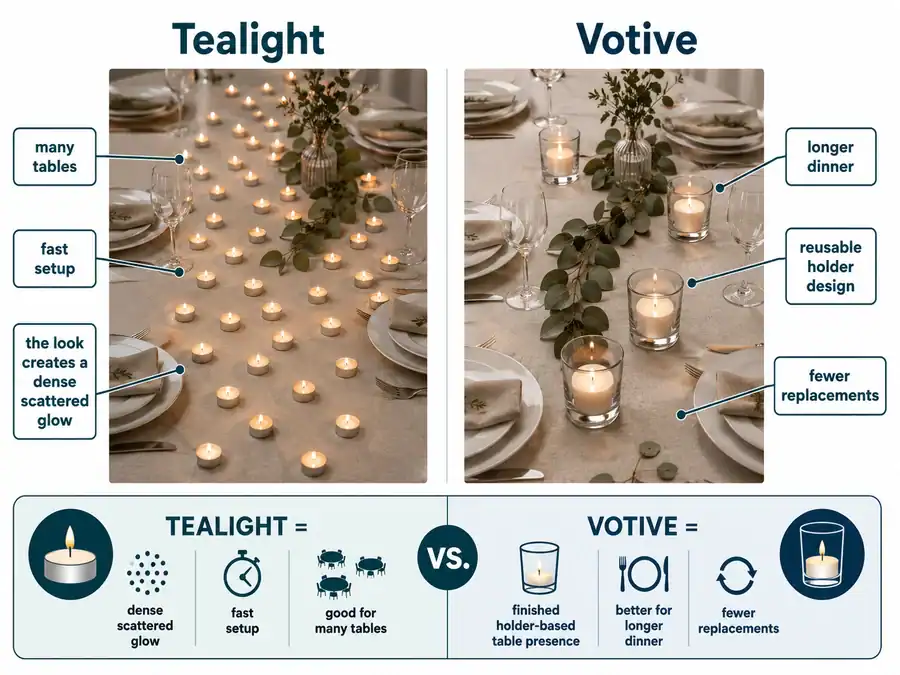
Tealights work well when the design needs many small points of light. They suit scattered arrangements, glass cups, lanterns, and quick event layouts where quantity matters more than each candle’s individual presence.
Votives work better when the table should feel more designed. A close-fitting votive holder gives the candle shape, catches melted wax, and makes each flame feel more anchored in the setting.
For wedding or dinner tables, votives are often the safer planning choice when the candle needs to stay lit through a longer window. Tealights still work well when the event uses many short-burn accents instead of fewer longer-burn candles.
Ambience: Dense Tealight Glow vs Votive Holder Presence
Tealights create ambience through quantity, while votives create ambience through holder shape, flame height, and longer visual presence.
A tealight arrangement can feel soft and scattered because each candle is small. This works well for baths, shelves, low centerpieces, and setups where the glow is meant to spread across a wider area.
A votive arrangement can feel fuller because each candle has more body. The holder catches and shapes the light, so the result feels less temporary than a group of bare tealights.
Use tealights when you want many small sparkles. Use votives when you want fewer candles that look more deliberate.
Wax Warmers and Fragrance: Do Tealights or Votives Work Better?
Tealights are usually the better choice for wax warmers, while votives are better treated as decorative candles unless the warmer is designed for them.
A tealight is commonly used as the heat source under a wax melt dish. A votive is not a direct substitute because it is meant to burn inside a close-fitting holder, not sit loosely under a warmer.
| Use case | Better choice | Reason |
|---|---|---|
| Tealight wax warmer | Tealight | Fits the warmer’s usual heat-source role |
| Scented table candle | Votive | Larger wax body can support a stronger candle presence |
| Short fragrance session | Tealight | Easy to start, stop, and replace |
| Longer fragrance-and-decor setup | Votive | Better for a longer visible burn |
| Holder-based scent display | Votive | Holder controls melted wax and improves the look |
| Quick wax melt use | Tealight | More practical than adapting a votive |
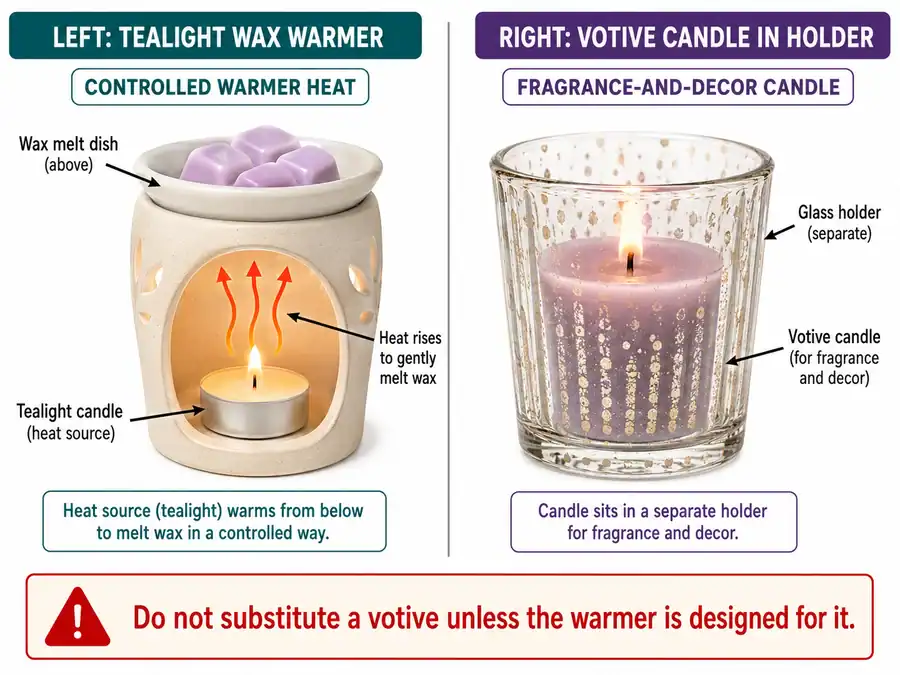
A tealight in a warmer is not chosen mainly for decoration. Its job is to provide controlled heat beneath the wax dish. That makes tealights practical when the scent comes from wax melts rather than from the candle itself.
A votive is better when the candle is both the flame and the fragrance source. It can feel more substantial on a table or shelf, but it still needs the right holder to burn cleanly and contain melted wax.
Use the tealight guide for warmer-specific setup details. Use the votive guide when the fragrance candle itself is the decor feature.
Safety and Placement: Which Setup Is Easier to Control?
Tealights are easier to place in simple groups, while votives are easier to control when they sit in the correct holder.
Both candle types need a stable, heat-resistant surface and enough space away from anything that can catch fire. The safer choice is the one that matches the holder and placement plan.
A good candle setup uses a candleholder made for candle use, a stable heat-resistant surface, clear wax pools, and placement away from drafts or anything flammable.
| Safety factor | Tealight candles | Votive candles |
|---|---|---|
| Wax containment | Built-in cup helps contain wax | Holder must contain wax |
| Tip risk | Small size can make placement careless | Holder adds weight when matched well |
| Heat control | Depends on cup, holder, and surface | Depends heavily on holder fit |
| Draft sensitivity | Can flicker in open placement | Holder may shield the flame better |
| Grouping risk | Many flames can crowd a surface | Fewer candles may be easier to space |
| Main safety error | Placing too many close together | Burning without a proper holder |
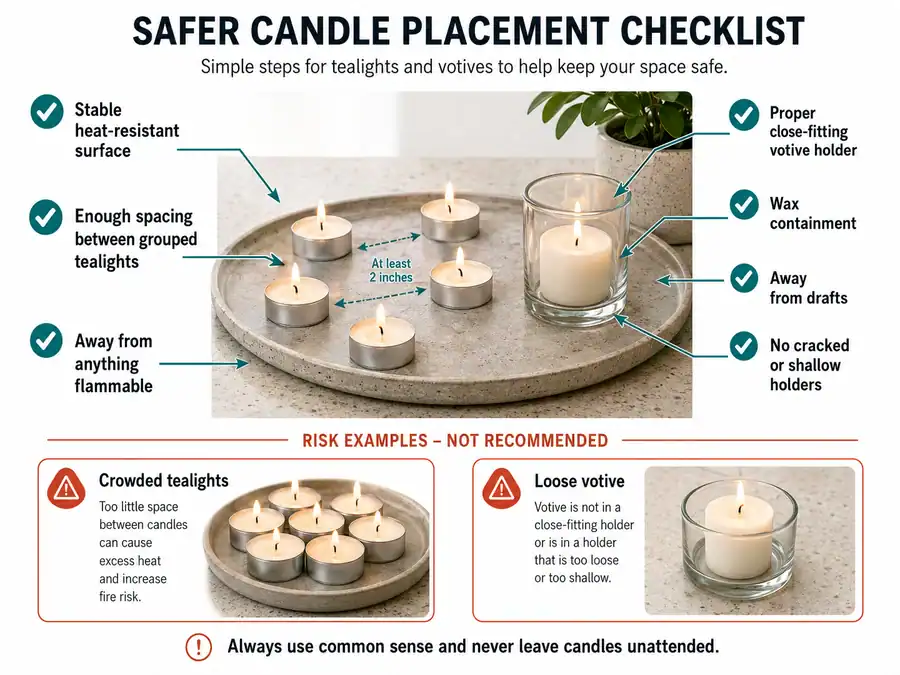
Tealights can feel simple, but simple does not mean careless. A group of tealights still needs spacing, a flat surface, and holders or trays that keep heat away from furniture, fabric, and greenery.
Votives can feel more controlled because the holder adds weight and catches melted wax. That advantage disappears when the holder is too large, too shallow, cracked, or not made for candle heat.
Choose tealights when the setup is short, spaced, and easy to supervise. Choose votives when each candle will sit in a proper holder for a longer table or room display.
Cleanup: Tealight Cups vs Votive Wax Residue
Tealights are usually easier to clean up because the wax stays in the cup, while votives can leave wax residue inside the holder.
A finished tealight is usually removed as one small cup. That makes cleanup simple after short sessions, events, or grouped decor, though the empty cups still need proper disposal.
A finished votive may leave wax at the bottom or sides of the holder. That is normal for a holder-based candle, but it means the holder may need cleaning before reuse.
| Cleanup need | Better choice | Why |
|---|---|---|
| Fast teardown | Tealight | Remove the cup and reset the space |
| Reusable decor holders | Votive | Clean the holder and reuse it |
| Minimal wax handling | Tealight | Melted wax is usually contained in the cup |
| More finished decor look | Votive | Cleanup tradeoff comes with stronger presentation |
Use tealights when cleanup speed matters. Use votives when reusable holders and a more finished display matter more than the extra wax residue.
Tealight vs Votive Candle FAQs
Do votive candles need holders?
Yes. Votive candles need close-fitting, heat-safe holders because the wax can liquefy as they burn.
Do tealight candles need holders?
Tealights usually come in their own cups, but a stable, heat-safe holder or tray is still useful for placement and surface protection.
Do votives burn longer than tealights?
Usually yes. Votives contain more wax and are designed for longer holder-based use, while tealights are smaller and better for shorter sessions.
Can you use votive candles in a wax warmer?
Do not treat a votive as a direct substitute for a tealight unless the warmer is specifically designed for that candle type.
Which is better for events?
Use tealights for many short-burn accents and votives for longer table decor with fewer mid-event replacements.
Final Decision Matrix: Which One Should You Use?
Use tealights for short, flexible, high-quantity setups; use votives for longer, holder-based decor with more visual weight.
The best choice is not universal. It depends on whether you need quick placement, longer burn time, easier cleanup, warmer heat, or a more finished table display.
| Situation | Use tealights | Use votives |
|---|---|---|
| You need many small flames | Yes | No |
| You want the simplest setup | Yes | No |
| You need a wax warmer heat source | Yes | No |
| You want fast cleanup | Yes | No |
| You need a longer candle session | No | Yes |
| You want reusable decorative holders | No | Yes |
| You want stronger table presence | No | Yes |
| You want fewer mid-event replacements | No | Yes |
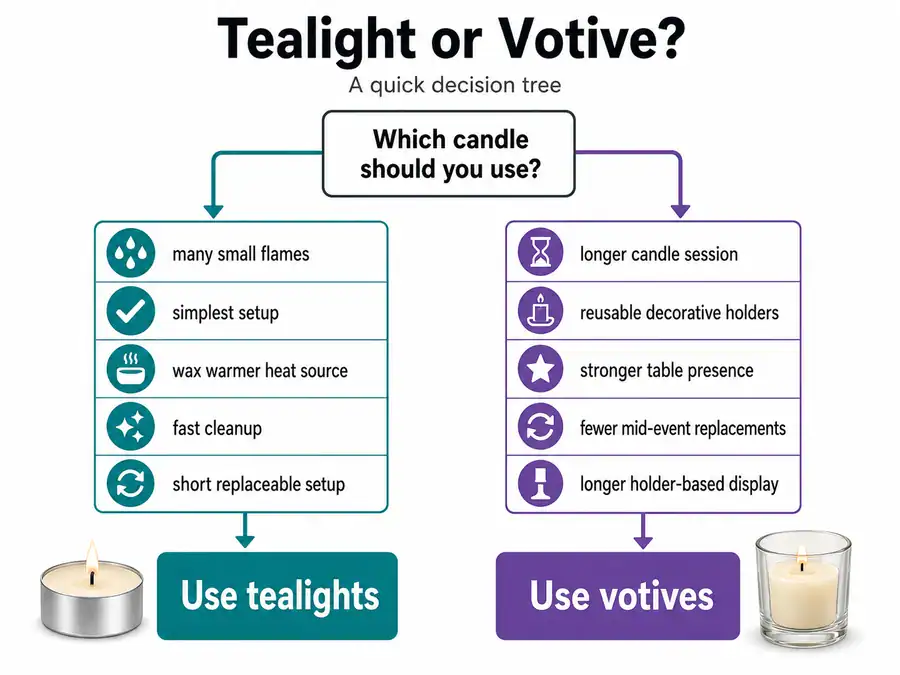
Choose tealights when the candle is part of a short, replaceable setup. They work best for wax warmers, baths, grouped accents, quick guest decor, and event layouts that need many small light points.
Choose votives when the candle is part of a longer display. They work best for dinner tables, receptions, mantels, reusable holders, and rooms where the candle should feel more intentional.
| Final need | Better choice |
|---|---|
| Cheapest-looking mistake to avoid | Using loose votives without holders |
| Easiest candle to place quickly | Tealight |
| Better candle for longer table decor | Votive |
| Better candle for many scattered accents | Tealight |
| Better candle for a finished holder look | Votive |
| Better candle for wax warmers | Tealight |
For most short home uses, tealights are the practical pick. For longer decor uses, votives are the stronger choice.