

Novelty and sculptural candles are form-first candles whose shape, theme, or object-like design affects whether they are displayed, occasionally burned, or kept as decor.
They are wax-candle subtypes, not general sculptures or ordinary function-first candles, and form does not prove burnability.
Decor use means unlit display, styling, or gifting; burn use means supervised lighting that follows the maker’s label and physical setup.
Here, safest means the lower-risk fire/setup choice, not legal compliance, air-quality safety, medical safety, or a certified safety rating.
If fragrance, long burn time, or repeat use matters most, a simpler jar, pillar, taper, or container candle is usually a better fit.
What Are Novelty and Sculptural Candles?
Novelty candles are theme-led or unusual-form candles, while sculptural candles are form-led candles whose shape, silhouette, or texture creates the main visual value.
A novelty candle uses theme, shape, humor, season, character, object form, or gift value to stand apart from a plain candle. It may look like a birthday cake, shell, fruit, flower, animal, holiday figure, or household object.
A sculptural candle is form-led. It is made to look like a figure, torso, knot, bubble cube, column, abstract shape, or art-like object while still belonging to the wider types of candles category.
These candles are real candles when they are made from candle wax with a wick, but that does not mean every one should be lit. Some are made for display first, some can be burned for short periods, and some are practical only when the shape, base, wick, and maker instructions support burn use.
A shaped candle should not be judged by appearance alone. A visible wick can suggest burn use, but it does not prove that the candle is stable, suited for repeated lighting, or meant to melt like a jar, pillar, or taper candle.
Think of these candles in three use groups:
| Use group | What it means | Best action |
|---|---|---|
| Display-only | The candle is meant to be admired, not lit | Keep it unburned and protect the display surface |
| Occasional burn | The maker allows lighting, but the shape may drip or melt unevenly | Burn briefly, supervise it, and use a heat-safe tray |
| Practical burn | The candle is shaped but still designed for more predictable use | Follow the maker’s directions and treat it like a functional candle |
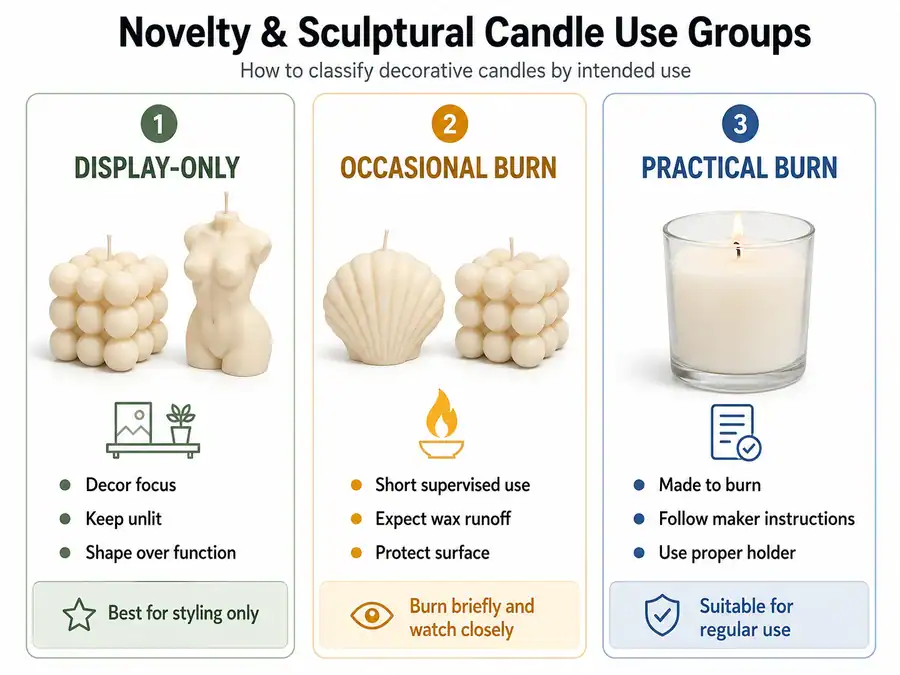
Common novelty and sculptural candle examples include:
| Candle example | Why it fits this category | Usual use expectation |
|---|---|---|
| Bubble cube candle | Shape is the main visual feature | Display or occasional burn |
| Torso candle | Sculptural body form drives the design | Often decor-first |
| Food-shaped candle | Theme or object likeness creates novelty value | Display, gift, or occasional burn |
| Shell candle | Form and texture create visual value | Decor-first or occasional burn |
| Seasonal figure candle | Holiday theme defines the candle | Display, gift, or short burn |
| Abstract art candle | Form matters more than plain function | Mostly decor-first |
Novelty, sculptural, and decorative candles overlap, but they do not mean the same thing.
Novelty vs Sculptural vs Decorative Candles
Novelty candles emphasize theme or unusual form, sculptural candles emphasize art-object shape, and decorative candles emphasize display purpose. These labels can overlap, but none of them automatically proves burnability.
A novelty candle can be playful, seasonal, themed, object-shaped, or giftable without being fake or only a joke candle. A sculptural candle can be a real wax candle, not a general sculpture or museum-style art object. A decorative candle can be chosen for display, but it is not automatically non-burnable.
| Label | What it emphasizes | Common examples | What it does not automatically mean |
|---|---|---|---|
| Novelty candle | Theme, unusual shape, playful form, gift appeal | Food shapes, animals, holiday figures, number candles | Joke-only, fake, unsafe, or low quality |
| Sculptural candle | Form, silhouette, texture, object-like shape | Torso candles, knots, bubble cubes, shells, abstract forms | Display-only, premium, unsafe, or non-burnable |
| Decorative candle | Visual placement and display value | Table candles, shelf candles, styled tray candles | Impossible to burn or only for styling |
| Shaped candle | Any candle with a non-plain form | Stars, flowers, figures, molded objects | Practical burn use without checking instructions |
The safest label to trust is not the category name. It is the maker’s stated use: display-only, occasional burn, or suitable burn use. That distinction matters because a candle can be decorative and still burnable, or it can have a wick and still be better left unlit.
Why Are Novelty and Sculptural Candles Often Used as Decor?
Novelty and sculptural candles are often decor-first because their shape, theme, color, or object-like form can be the main reason someone buys or displays them.
A decor-first candle is not a failed candle or a fake candle. It simply means the candle’s visual role matters more than fragrance strength, long burn time, or everyday lighting use. A torso candle, shell candle, bubble cube, or holiday figure may be bought because it fits a shelf, tray, table setting, gift box, or seasonal display.
Decor-first does not always mean display-only. Some novelty and sculptural candles are meant to be admired first and burned later. Others are better left unlit because the maker’s instructions, shape, fragile details, or sentimental value make burning a poor fit.
| Decor-first use case | What it means | Burn-use expectation |
|---|---|---|
| Shelf or table display | The candle works like a visual object in the room | Burn only if the maker allows it and the setup is suitable |
| Seasonal display | The shape or color matches a holiday or occasion | Often displayed first, sometimes burned briefly |
| Gift or keepsake | The candle has personal, visual, or sentimental value | The recipient may choose not to burn it |
| Photo or styling prop | The candle adds texture, color, or form to a scene | Usually decor-first, not burn-first |
| Bathroom or tray styling | The candle adds softness to a small display area | Move it before burning unless the setup is heat-safe |
This is why “too pretty to burn” is a normal use pattern for shaped candles. Their value can come from being seen, gifted, photographed, collected, or matched to a room, not only from melting wax.
A broader candle decor guide can cover full shelf styling, tablescapes, and room-by-room ideas. Here, the important point is narrower: display value is one reason novelty and sculptural candles exist, but display placement is not always the same as a safe place to light them.
How to Display Them Without Damaging Surfaces
Display novelty and sculptural candles on a stable, protected surface because wax contact, sunlight, dust, and future burn use can all affect where they should sit.
Even when left unlit, a shaped candle can soften in direct sunlight, leave wax marks on porous materials, collect dust in carved details, or transfer color to pale surfaces. If the candle may be burned later, the display spot also needs to be separate from the burn-ready spot unless it already has heat protection and enough clearance.
Use simple surface protection when the candle touches furniture, fabric, stone, or painted shelves. A tray, plate, coaster, holder, or shallow dish can prevent wax residue and make the candle easier to move before lighting.
Before displaying a novelty or sculptural candle, check:
- The base sits flat and does not wobble.
- The surface is protected from wax contact.
- The candle is away from direct sunlight or heat.
- The candle is not resting directly on delicate fabric.
- Dust can be removed without breaking fragile details.
- The display location can be changed before burning.
- A heat-safe tray or holder is available if the candle will be lit.
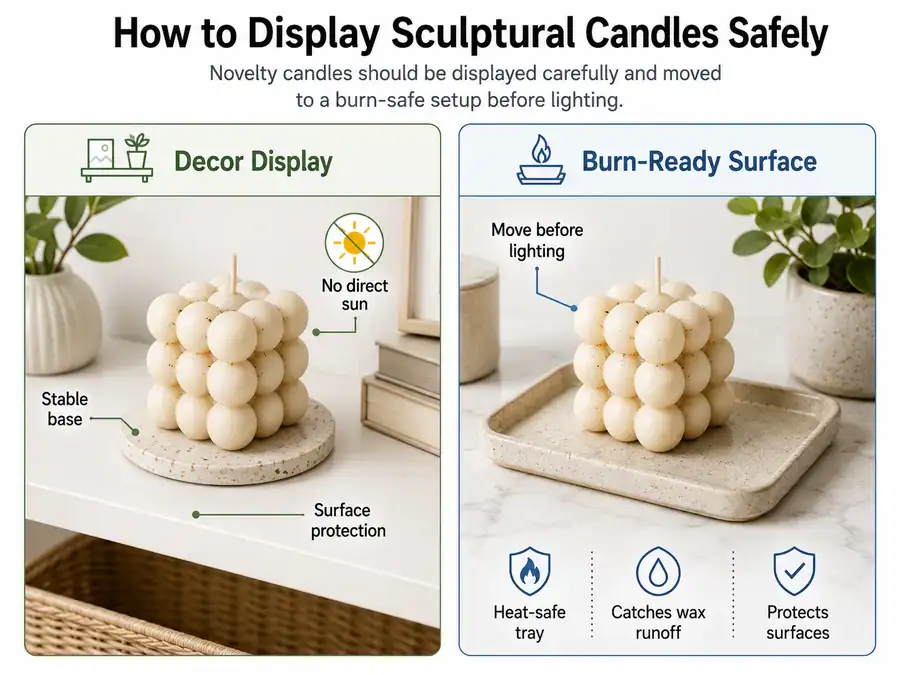
Display placement means “where it looks good.” Burn-ready placement means “where it can be lit with a stable base, a heat-safe surface, space around the flame, and supervision.” A styled shelf, bathroom tray, or gift display may look right for decor but still be wrong for flame use.
For broader styling ideas, use a candle decor guide. For plates, trays, and holders, use a candle holder or tray guide. This section stays focused on the use decision: protect the surface, preserve the candle’s shape, and move it before lighting if the display setup is not burn-ready.
Why These Candles Work as Gifts or Keepsakes
Novelty and sculptural candles often work as gifts or keepsakes because their shape, theme, or artistic form can carry visual or sentimental value before the candle is ever lit.
A shaped candle can match a person’s style, hobby, season, home, or memory better than a plain candle. A shell candle may suit coastal decor. A cake-shaped candle may feel right for a birthday. A torso candle may fit a modern shelf. A holiday figure may become part of a yearly display.
That gift value does not always come from burn time. Many people keep novelty and sculptural candles unlit because the object itself is the appeal. In that case, display use is the intended outcome, not a waste.
Examples include:
- A shell candle used as coastal decor.
- A bubble cube candle added to a styled tray.
- A food-shaped candle given as a playful birthday gift.
- A holiday figure candle kept for seasonal display.
- A handmade sculptural candle saved as a keepsake.
- A torso or knot candle used as an art-like shelf object.
Giftable does not mean practical to burn. Collectible does not mean antique or investment-grade. It simply means the candle has visual, personal, seasonal, or sentimental value that may matter more than fragrance or flame.
When choosing one as a gift, think about how the recipient will use it. If they like objects and shelf styling, decor-first may be the right choice. If they expect scent and repeat burning, a simpler jar, pillar, or container candle may be a better fit.
Can You Burn Novelty and Sculptural Candles?
Some novelty and sculptural candles can be burned, but others should stay as decor because burn use depends on maker instructions, shape stability, wick placement, and safe setup.
A wick is not enough to prove that a shaped candle should be lit. The candle also needs clear burn permission, a stable base, suitable wick placement, enough space around the flame, and a heat-safe surface that can catch melted wax.
General candle-safety guidance from the National Candle Association supports the same setup logic: trim the wick before lighting, use a stable heat-resistant surface, keep the candle away from flammable items, and keep the flame within sight.
Decorative candles can sometimes be burned, but the label, listing, or maker’s instructions should guide the decision. A candle marked “decorative only” or “do not burn” should stay unlit, even if it has a wick.
Sculptural candles also may not burn like regular candles. Complex forms, narrow bases, raised details, off-center wicks, fragile protrusions, or uneven wax mass can make the flame and melt path less predictable. A candle that looks beautiful on a shelf may drip, lean, lose detail, or spill wax when lit.
Common mistakes include:
| Mistake | Why it happens | Better action |
|---|---|---|
| Lighting it because it has a wick | The wick is treated as burn permission | Check the maker’s intended use first |
| Burning it on a styled shelf | Display placement is mistaken for burn-ready placement | Move it to a heat-safe tray or holder |
| Expecting full fragrance performance | The shape is treated like a jar candle | Use a scent-focused candle for fragrance-first use |
| Letting it burn unattended | It is treated like passive decor | Keep it within sight while lit |
| Ignoring early wax spill or leaning | Uneven melting is seen as normal | Stop burning if the candle becomes unstable |
The practical rule is simple: burn only when the maker allows it and the setup can handle wax, heat, flame, and movement. When instructions are missing or the candle feels unstable, treat it as decor.
Check the Label and Maker Instructions First
Before burning a novelty or sculptural candle, check the maker’s label or product instructions because intended use is more reliable than shape, style, or visible wick presence.
A maker’s instructions are the strongest clue because they tell you whether the candle is meant for display, limited occasional burning, or more regular use. A visible wick is only one cue. It does not override a warning, a “decorative only” note, or missing burn directions.
Common wording can mean different things:
| Label or listing phrase | What it usually means | What to do |
|---|---|---|
| Decorative only | The maker intends the candle for display rather than lighting | Keep it unlit unless separate burn instructions say otherwise |
| Do not burn | The candle should not be lit | Treat it as display-only |
| Burn within sight | The candle may be burned, but only with supervision | Use a stable heat-safe surface and stay nearby |
| Burn time listed | The maker expects some burn use | Follow the stated burn directions and stop if the candle becomes unstable |
| Trim wick | The candle is intended to be lit under care instructions | Follow the maker’s trim and burn guidance |
| Use on heat-safe surface | Wax, heat, or dripping may affect the surface below | Use a tray, plate, or holder before lighting |
| No burn instructions | Burn use is unclear | Treat it as decor-first or ask the maker |
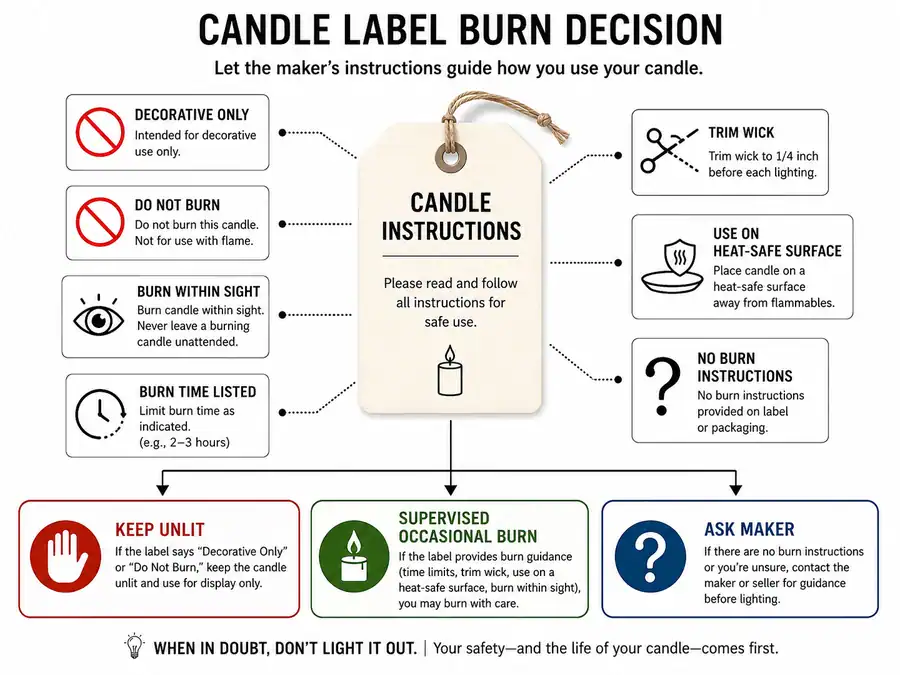
If the instructions are unclear, do not guess from the candle’s appearance. A detailed shape, off-center wick, coating, embedded decoration, soft wax, or unstable base should push the decision toward display unless the maker confirms burn use.
This page uses labels as practical user guidance. Detailed candle warning labels and compliance rules belong in a separate labeling or safety guide.
When to Treat a Candle as Display-Only
Treat a novelty or sculptural candle as display-only when the maker says not to burn it, instructions are unclear, the base is unstable, decorative materials are questionable, or sentimental value matters more than lighting it.
Display-only does not mean fake. A display-only candle can still be made from wax and still have a wick. The difference is that the candle’s intended use, shape, materials, or value makes lighting it a poor choice.
Use display-only treatment when any of these signals apply:
- The label says “decorative only.”
- The label says “do not burn.”
- The product listing gives no burn directions.
- The base wobbles or feels too narrow.
- The wick is off-center or buried in a complex shape.
- The candle has fragile protrusions that may collapse.
- Decorative coatings, glitter, paint, dried materials, or embeds are unclear.
- The candle would be hard to place on a heat-safe tray.
- The shape matters more than the flame.
- The candle is a keepsake, handmade gift, or collectible item.
- The candle has already softened, cracked, leaned, or lost shape.
- Burning it would damage the display surface or surrounding decor.
The goal is not to label all sculptural candles as unsafe. The goal is to separate candles that are meant to be admired from candles that are meant to be lit. Some shaped candles are burnable, but display-only cases should stay unlit.
When a candle falls between the two, choose the safer interpretation: keep it as decor, ask the maker, or use a simpler candle when you want fragrance, light, or repeat burning.
How Shape Changes the Way a Sculptural Candle Burns
The shape of a sculptural candle changes how it burns because wax flow, base stability, wick position, and raised details can make the flame and melt path less predictable than in a simple pillar or container candle.
Shape is not only a visual feature. It can change how melted wax moves, how quickly details disappear, whether the candle stays upright, and whether wax spills outside the candle’s base. That is why two candles made from similar wax can behave differently when one is a simple cylinder and the other is a detailed figure, shell, knot, or bubble cube.
A simpler, wider shape is usually easier to manage than a tall, narrow, or uneven form. Complex sculptural details may look better unburned because the flame can melt away the very shape that made the candle worth buying.
| Shape feature | Possible burn effect | Use guidance |
|---|---|---|
| Wide, flat base | More stable during display or burning | Better candidate for occasional burn if instructions allow |
| Tall narrow figure | Can lean, soften, or become unstable | Often better as decor-first |
| Off-center wick | Melt pool may form unevenly | Burn only if maker instructions support it |
| Raised details | Details may collapse or melt quickly | Expect visual loss if burned |
| Deep ridges or cavities | Wax may pool, channel, or spill | Use a tray or keep as decor |
| Thin protrusions | Small parts may soften or break | Usually better left unlit |
| Irregular or asymmetrical shape | Weight and melt path may shift | Treat as decor-first unless maker guidance is clear |
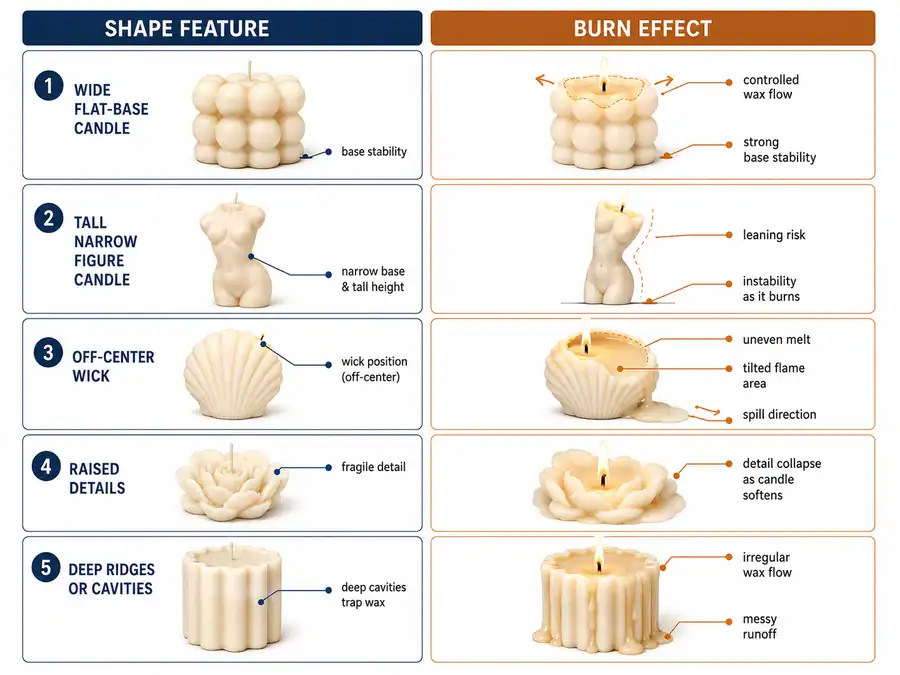
A shaped candle that drips or melts unevenly is not always defective. The form itself can push wax in uneven directions. A sculptural candle may lose detail, change silhouette, or expose the wick differently once the flame starts working through the wax.
Common burn-behavior problems include:
| What happens | Why it can happen | Better action |
|---|---|---|
| Wax spills over one side | Shape or wick position sends the melt pool outward | Stop burning and use a larger heat-safe tray next time |
| Candle leans | Base softens or weight shifts as wax melts | Extinguish it and do not keep burning an unstable candle |
| Details collapse | Raised or thin parts melt faster than the body | Treat detailed candles as decor-first if the form matters |
| Flame sits too close to a detail | The wick path does not match the shape well | Stop if flame behavior looks unusual |
| Candle tunnels or hollows unevenly | Wax mass and wick placement do not support an even melt | Use it as decor or choose a simpler candle for burn use |
This article only explains buyer-facing shape cues. Wick sizing, wax formulas, mold design, and formal burn testing belong in candle-making and burn-testing guides.
Visible Cues That Suggest Decor-First or Burnable Use
Visible construction cues can help you judge a novelty or sculptural candle, but they are only indicators; maker instructions and safe setup still decide whether it should be burned.
Start with the label, then look at the candle itself. A stable base, centered wick, simple form, and clear burn directions point toward possible burn use. A fragile shape, unclear materials, missing instructions, or decorative coatings point toward decor-first use.
| Visible cue | Why it matters | Decision note |
|---|---|---|
| Centered wick | Helps the melt pool stay more balanced | Better sign, but not proof |
| Off-center wick | Can pull melting toward one side | Use more caution or keep as decor |
| Wide base | Reduces tipping risk | Better for display and possible occasional burn |
| Narrow base | Can soften, lean, or tip as wax melts | Often decor-first |
| Fragile protrusions | Small parts can break or melt quickly | Keep unlit if the shape matters |
| Heavy detail or deep texture | Wax may pool in uneven areas | Expect mess or visual loss if burned |
| Glitter, paint, dried botanicals, or unknown embeds | Materials may not be intended for flame exposure | Do not light unless the maker confirms burn use |
| No burn time or care instructions | Intended use is unclear | Treat as decor-first |
| Clear burn directions | Maker expects some lighting use | Follow directions and use a heat-safe tray |
These cues should not be treated as a home burn test. They are practical signals for deciding whether the candle looks decor-first, occasionally burnable, or better replaced by a simpler candle for regular use.
The strongest rule still comes back to intended use. If the maker says the candle is decorative only, the visual cues do not override that instruction. If the maker allows burning, the cues help you decide how careful the setup should be and whether burning is worth losing the candle’s shape.
How to Set Up a Novelty or Sculptural Candle Before Lighting It
Before lighting a novelty or sculptural candle, confirm it is intended to burn, move it to a stable heat-safe surface, keep the area clear, and supervise it because shaped candles can drip, lean, or melt less predictably.
The display spot is not always the burn spot. A candle may look good on a shelf, tray, bathroom counter, book stack, fabric runner, or seasonal display, but those places may not be safe for flame, heat, or dripping wax.
Use this setup before lighting:
- Read the label, listing, or maker instructions.
- Confirm the candle is meant to be burned.
- Move it away from styled decor, fabric, paper, dried flowers, curtains, and shelves.
- Place it on a heat-safe plate, tray, holder, or dish that can catch wax.
- Check that the base sits flat and does not wobble.
- Keep the candle within sight while it is burning.
- Stop burning if wax spills heavily, the shape leans, smoke increases, or the flame looks unusual.
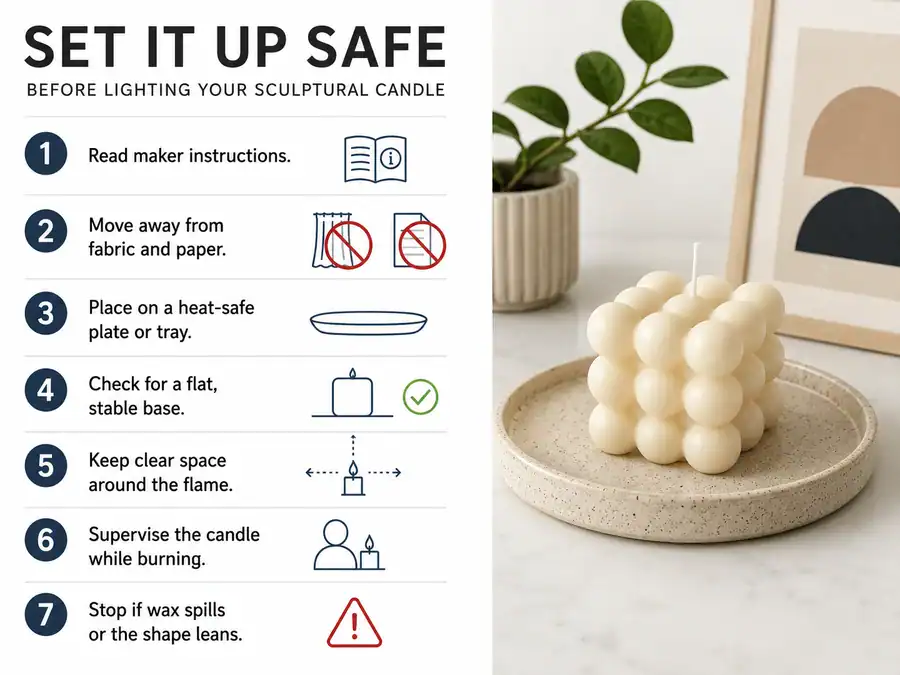
Safe setup means risk-reducing, not risk-free. A shaped candle can still behave differently from a jar or pillar candle because the wax may melt through details, cavities, narrow points, or uneven sides.
Do not light a novelty or sculptural candle when:
- The maker says “decorative only” or “do not burn.”
- Burn instructions are missing or unclear.
- The candle wobbles or cannot sit flat.
- The candle has unknown coatings, glitter, paint, botanicals, or embeds.
- The wick is buried, damaged, or placed awkwardly.
- You do not have a heat-safe tray or holder.
- The candle is placed near flammable decor.
- You want to preserve the shape as a keepsake.
Occasional burning means brief, supervised use. It does not mean the candle is suited for daily fragrance, long burn sessions, or unattended ambiance. When the goal is scent, light, or repeated use, a simpler container, pillar, or taper candle is usually more practical.
Should You Choose One for Decor, Occasional Burning, or Practical Use?
Choose a novelty or sculptural candle based on intended use: display, occasional burning, or practical frequent burning. Here, the best choice means the candle type that fits the actual goal, not the best price, scent strength, quality grade, or safety certification.
A decor-first candle is best when the shape, theme, color, or keepsake value matters most. An occasional-burn candle is best when the maker allows lighting and the shape can sit safely on a protected surface. A practical-use candle is best when fragrance, burn time, and repeat lighting matter more than sculptural detail.
| Your main goal | Better choice | Why |
|---|---|---|
| You want a shelf, tray, or table object | Decor-first novelty or sculptural candle | The visual form is the main value |
| You want a gift that may stay unlit | Giftable or keepsake shaped candle | The recipient can enjoy it without burning it |
| You want to light it once in a while | Maker-approved shaped candle with a stable base | Occasional use is possible with a heat-safe setup |
| You want strong fragrance | Simpler scented jar or container candle | Scent performance matters more than shape |
| You want long, predictable burn time | Pillar, jar, taper, or container candle | Simpler forms usually burn more predictably |
| You want a centerpiece | Decor-first candle plus separate functional candles | You can preserve the shape while still using flame elsewhere |
| Instructions are unclear | Treat it as decor | Unclear use should not be treated as burn permission |
Use this quick decision path:
- If the candle says “do not burn” or “decorative only,” choose decor use.
- If the instructions are unclear, choose decor use or ask the maker.
- If the shape is fragile, narrow, unstable, coated, or heavily detailed, choose decor-first use.
- If the maker allows burning and you have a heat-safe tray, choose occasional burning.
- If you need scent, long burn time, or repeat use, choose a simpler candle style.
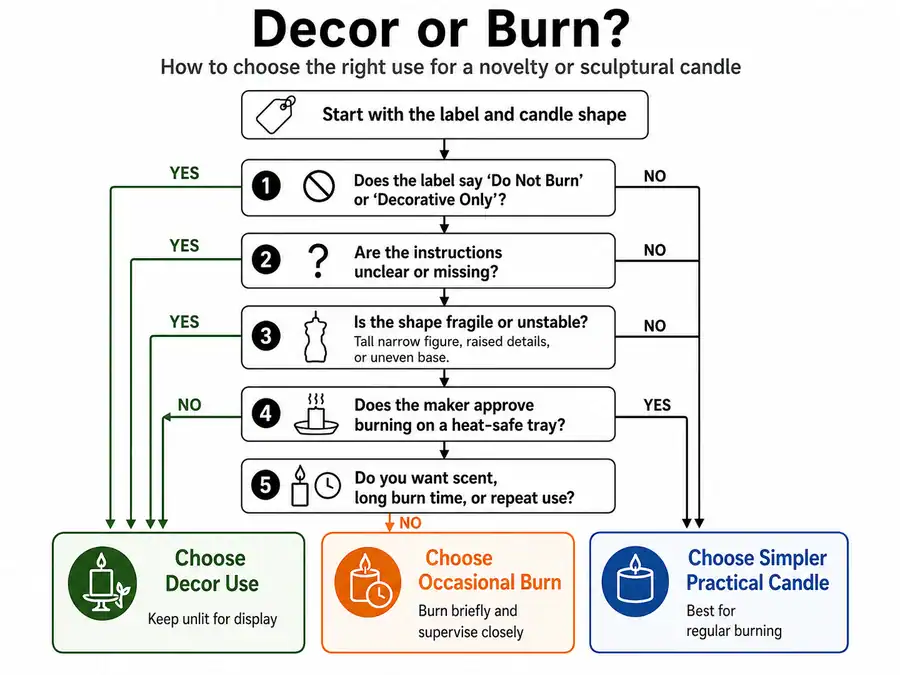
The main tradeoff is simple: sculptural detail gives the candle visual value, but that same detail can make burning messier, shorter, or less predictable. A beautiful shaped candle can be the right choice for display and the wrong choice for everyday burning at the same time.
This is the safest expectation to keep: novelty and sculptural candles are form-first candles. Burn them only when the maker allows it, the setup supports it, and you are comfortable losing the original shape.