

Soy and beeswax are candle wax types compared here by measured burn rate and visible candle quality, not by wax name alone.
Beeswax usually burns slower than soy, but jar size, wick fit, fragrance load, and burn habits can reverse the result.
This guide compares candle wax performance for soy wax and beeswax in real container and shaped-candle use. Here, quality means visible soot, smoke, melt-pool behavior, scent throw, heat tolerance, finish, cost, and fit for the candle type.
The fairest comparison is burn rate in grams per hour, not the wax name alone. Use the sections below to choose a wax, test it with the right wick, and avoid common burn problems.
For most scented jar candles, soy is the easier starting wax. For slower burn, firmer pillars or tapers, and natural beeswax aroma, beeswax is usually the stronger starting wax. In the table, “better choice” means better for that comparison point, not universally superior.
| Comparison point | Soy wax candles | Beeswax candles | Better choice when… |
|---|---|---|---|
| Burn time | Often shorter | Often longer | Choose beeswax when slower burn matters most |
| Upfront cost | Usually lower | Usually higher | Choose soy for lower-cost test batches |
| Scent throw | Often stronger with added fragrance | Natural aroma can compete with added scent | Choose soy for strong scented jars |
| Heat tolerance | Softer in warm conditions | Firmer and more heat-resistant | Choose beeswax for tapers and firmer candles |
| Vegan fit | Usually vegan if the full recipe qualifies | Animal-derived | Choose soy for vegan candle lines |
| Beginner use | Easier for container candles | More expensive to test | Choose soy for first jar-candle batches |
| Natural aroma | Mild or neutral | Honey-like | Choose beeswax when the wax aroma is part of the product |
Burn time: soy vs beeswax
Beeswax usually burns slower than soy in the same jar, but wick size, fragrance load, and burn habits can make soy last longer.
For candle wax, burn time is best compared by burn rate, which means grams of wax consumed per hour. “Hours per ounce” is only useful after you know the candle’s real burn rate, because the same wax weight can burn fast in a wide jar and slowly in a narrower jar.
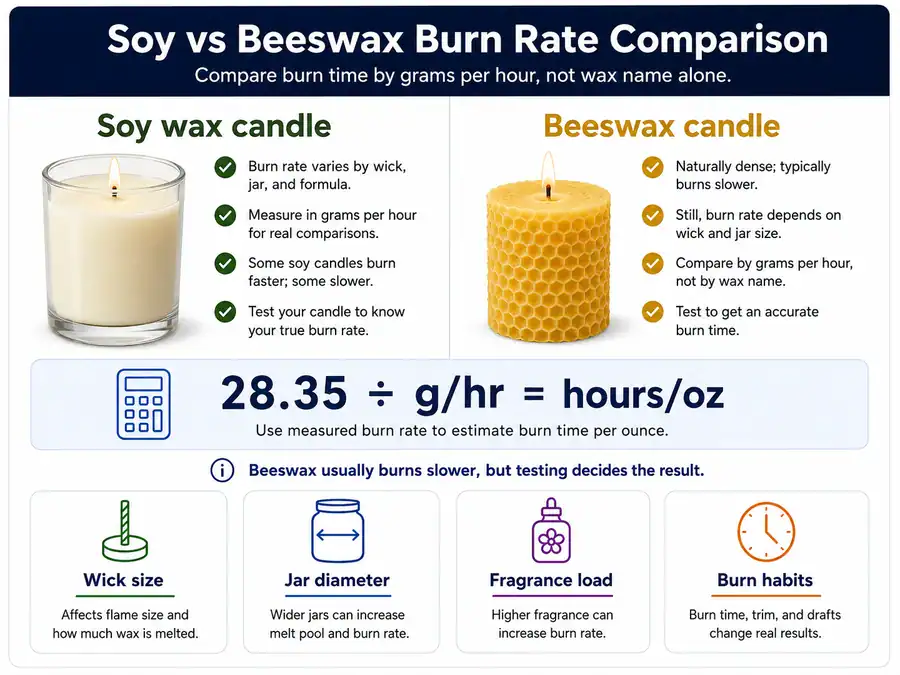
Use the candle burning usage guide for safe burn habits, then run a burn test protocol before trusting label-style hour claims.
| Comparison point | Soy wax candle | Beeswax candle | What can flip the result |
|---|---|---|---|
| Typical direction | Often burns faster | Often burns slower | Wick too large, wide jar, draft, high fragrance load |
| Best fair metric | Grams per hour | Grams per hour | Same wax weight alone is not fair |
| Per-ounce formula | 28.35 ÷ g/hr = hours/oz | 28.35 ÷ g/hr = hours/oz | Your measured g/hr controls the answer |
| Why beeswax can last longer | Softer blends may consume faster | Harder wax can consume more slowly | Container shape and wick heat output |
| Buyer takeaway | Do not compare only jar size | Do not assume every beeswax candle lasts longer | Ask for burn-test data or test your own |
Example burn-log table
Use a burn-log table to compare soy and beeswax only when jar diameter, wick family, fragrance load, and burn schedule stay the same.
| Wax type | Jar diameter | Wick | Fragrance load | Wax used per hour |
|---|---|---|---|---|
| Soy container wax | 3 in | Test wick A | 6% | your measured g/hr |
| Soy container wax | 3 in | Test wick B | 6% | your measured g/hr |
| Beeswax blend | 3 in | Test wick A | 0–3% | your measured g/hr |
| Beeswax blend | 3 in | Test wick B | 0–3% | your measured g/hr |
How to test burn time fairly
Test one variable at a time: same jar diameter, same wick family, same fragrance percentage, same room position, and the same burn-session length. Weigh the candle before and after each session, then divide grams lost by hours burned.
The National Candle Association recommends trimming candle wicks to ¼ inch before burning. Wick length and drafts both affect soot, flame size, and burn speed, so they must stay controlled during the test.
What changes burn time most:
- Wick size controls flame heat and wax consumption.
- Jar diameter controls how wide the melt pool must become.
- Fragrance and additives can change how the wax feeds the wick.
- Drafts can make the flame lean, flicker, soot, and consume wax unevenly.
- Long sessions can overheat the system and speed up consumption.
Cure time matters only because soy, beeswax blends, and fragrance systems can stabilize after pouring. Match the cure window before comparing soy and beeswax, log the pour date, run the same burn schedule, then retest if the first result looks biased by wick or room conditions.
Mini FAQ
Do beeswax candles really burn longer than soy if they are the same jar size?
Often, yes, but not always. A beeswax candle with an oversized wick can burn faster than a soy candle with a tuned wick in the same container.
Why is my soy candle burning faster than the label says?
The common causes are an oversized wick, a wide melt pool, drafts, long burn sessions, or a fragrance load that changes wick behavior. Use the candle burn test log template to replace estimates with measured grams per hour.
For rough planning, the burn-time and cost-per-hour estimators later in this guide can use your measured g/hr instead of a generic wax claim.
Clean burn quality: soot, smoke, jar residue, and mushrooming
Soot on a candle jar usually comes from an oversized wick or drafts, which create an overly large, smoky flame; wax type is secondary.
For soy vs beeswax candles, “cleaner” means less visible soot, less smoke, steadier flame behavior, and less black residue under controlled conditions. It does not mean allergy-safe, medically safer, or free from all emissions.
Use the candle burning usage guide for the safe-use baseline before changing wick size or burn sessions.
Here, safest first fix means the lowest-risk immediate action before changing the formula: trim the wick, remove drafts, shorten the session, or stop burning.
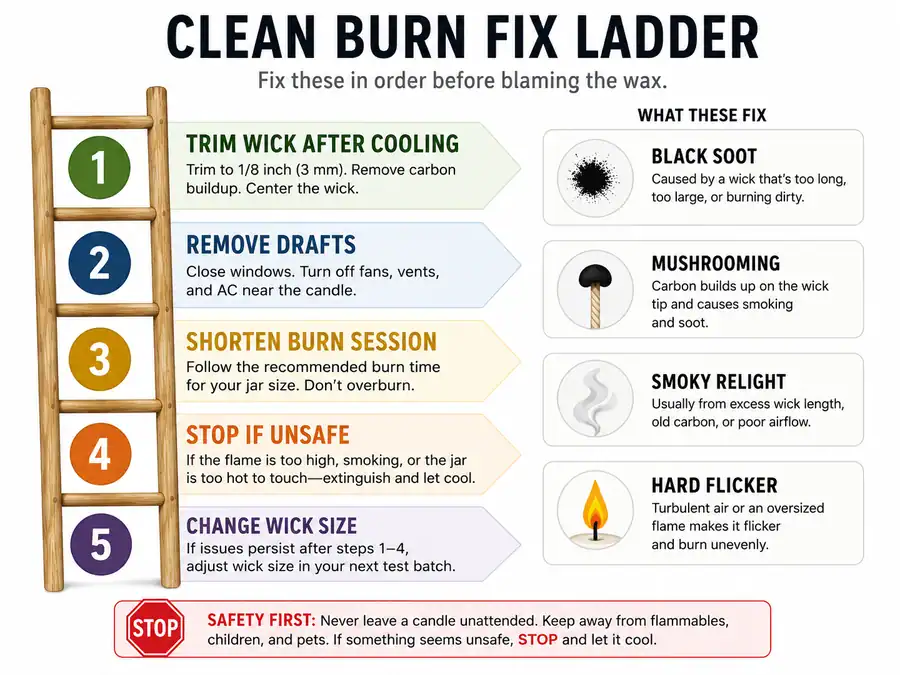
| Symptom | Likely cause | Safest first fix | Next batch fix |
|---|---|---|---|
| Black soot on jar rim | Flame too large, draft, wick too long | Trim wick and move candle away from airflow | Wick down one step |
| Wick mushrooming every burn | Carbon buildup from excess fuel or long sessions | Trim before relighting and shorten the session | Test a different wick series |
| Smoke at relight | Wick ember, long wick, disturbed wax pool | Trim after cooling, then relight cleanly | Log relight behavior in testing |
| Flame flickers hard | Draft or unstable wick | Move away from vents, fans, windows | Retest in a still room |
| Jar darkens near the end | Heat concentration, wick mismatch, low wax level | Stop if flame is unstable or jar looks unsafe | Retest wick near bottom third |
| Soy candle smokes | Usually wick, airflow, or fragrance | Trim, remove draft, reduce session length | Rebuild wick ladder |
30-second clean-burn checklist
Look for a steady flame, no heavy black rim, no repeated mushrooming, no smoky relight, and no aggressive flicker. A small amount of wick darkening is normal. Repeated soot on glass is a problem to fix.
Check soot at the same hour marks in each soy and beeswax test, using the same jar, room position, wick trim, and burn duration. Record flame height behavior, jar rim residue, mushrooming, and smoke at relight. Use National Candle Association safety guidance for wick trimming, draft avoidance, and burn placement before treating the wax as the main cause.
Safe fix ladder
The safe fix ladder starts with user-controlled burn conditions before changing the wax, wick, or formula.
- Trim the wick after the candle cools.
- Move the candle away from drafts, vents, fans, and open windows.
- Keep the session within the candle maker’s stated burn instructions.
- Stop burning if the flame grows unstable or the container seems unsafe.
- Change wick size or wick series in the next test batch.
Do not use foil hacks, pour hot wax out of a burning candle, or scrape molten wax near the flame. Those shortcuts can hide the symptom without fixing the wick, airflow, or burn-session problem.
For a deeper diagnosis, the candle black smoke and soot guide should handle black residue, while wick problem fixes should handle mushrooming, drowning, leaning, and wick-size changes.
Sensitivities and indoor air: reducing smoke and fragrance irritation
For comfort-sensitive users, the practical goal is to reduce visible smoke, strong fragrance exposure, and unstable flame behavior.
Start with the same clean-burn fixes: trim the wick, avoid drafts, use a stable surface, and stop if smoke or flame behavior looks wrong. If fragrance feels too strong, choose lower-scent, lightly scented, or unscented candles rather than assuming soy or beeswax alone solves the issue.
A simple comfort path is: reduce fragrance strength, test a different scent type, then use an unscented candle if discomfort continues. Beeswax has its own natural aroma, so it is not automatically the lower-scent choice.
Stop burning if the candle smokes heavily, the flame becomes unstable, the jar gets unsafe to handle, or the scent feels irritating. Heat tolerance and container safety become the next variable when smoke control does not solve the problem.
Melt pool and defects: tunneling vs overheating
A full melt pool is melted wax reaching nearly edge-to-edge in the container, showing the wick is sized to burn evenly for that jar.
A stable melt pool is the target for both soy and beeswax candles. Tunneling usually means the wick is too small, the burn session is too short, or the candle is losing heat near the edge. Overheating usually means the wick is too large, the session is too long, or the container is holding too much heat.
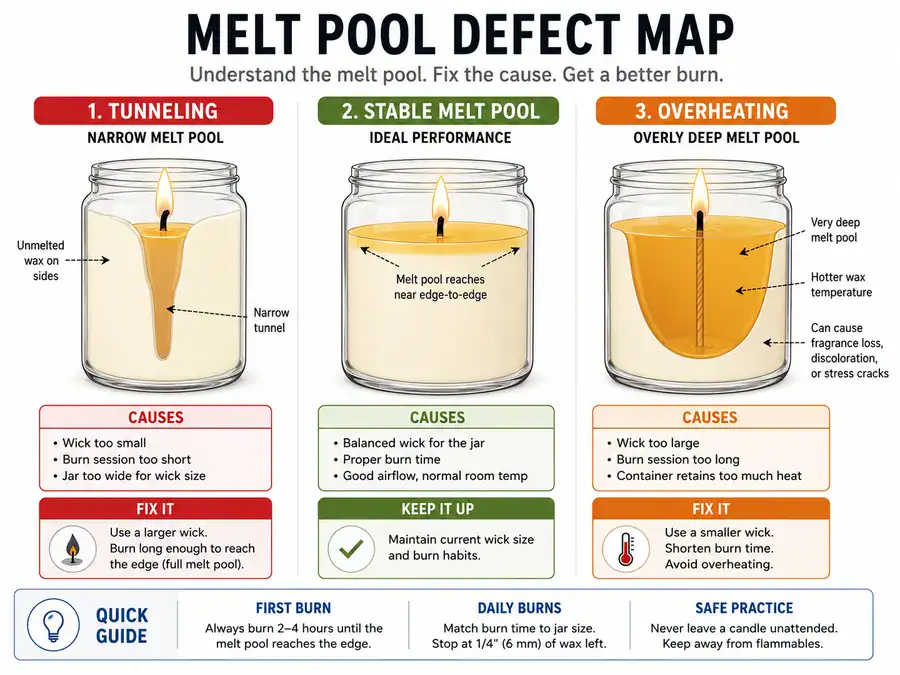
Use the candle burning usage guide as the safety baseline before trying to fix tunneling, glass hang-up, or a fast-growing melt pool.
| Hour check | What to record | What it means in soy | What it means in beeswax |
|---|---|---|---|
| Hour 1 | Melt pool width, flame steadiness, edge wax | Early hang-up may be normal in wider jars | Slower edge reach can be normal because the wax is harder |
| Hour 2 | Edge distance, depth, soot, mushrooming | If the pool is still narrow, test wick size next batch | If the pool stays narrow, the wick may be too cool for the wax |
| Hour 3 | Near-edge reach, container heat, flame behavior | Full edge reach with heavy soot suggests over-wicking | Full edge reach with a tall flame suggests over-wicking |
Test one jar, one wick family, one fragrance load, and one burn schedule at a time. A pass means the candle moves toward an even melt pool without heavy soot, a tall flame, or unsafe container heat. A fail means tunneling, hard hang-up, repeated soot, or overheating appears under the same test rules.
“Glass hang-up” means wax remains stuck around the container wall after the center has melted down. It is not always a defect during the early burn, but a deep wall of unmelted wax after repeated sessions usually points to a weak wick, a short burn schedule, or a container that is too wide for the wick setup.
How to fix tunneling safely
Fix tunneling by improving heat reach gradually, without forcing a longer or hotter burn than the candle can safely handle.
- Let the next session widen the melt pool only within safe burn limits.
- Trim only after cooling; do not cut the wick while wax is hot.
- Move the candle away from drafts so the flame heats the pool evenly.
- If the tunnel remains, test the next wick size or wick series in a new batch.
- Log wax used per hour so the fix does not create a faster, smoky burn.
When a candle tunnels even after long sessions, experienced makers usually look at jar diameter, wick series, and test conditions before blaming soy or beeswax alone. A candle that reaches a full melt pool quickly but soots, mushrooms, or heats the jar aggressively is likely over-wicked, not higher quality.
Use the candle burn test guide for the next controlled batch, and use the wick sizing guide when the melt pool and clean-burn signs point in opposite directions.
Scent throw: when soy wins vs beeswax
Soy often delivers stronger added fragrance than beeswax, but hot throw depends on melt pool size, cure time, and fragrance compatibility, not the wax label alone.
Hot throw means scent released while the candle burns. Cold throw means scent from the unlit candle. Soy often gives makers more room to build a noticeable added fragrance, while beeswax has a natural honey-like aroma that can compete with or soften added scent.
Use the candle fragrance guide when choosing scent materials, then compare scent only after the wick and melt pool are working.
| Rating band | Cold throw | Hot throw | What it usually means |
|---|---|---|---|
| 1 | Barely noticeable | Barely noticeable | Fragrance choice, cure time, or wick heat may be wrong |
| 2 | Light | Light | Acceptable for subtle candles, weak for strong-scent goals |
| 3 | Clear | Clear | Balanced result for many rooms |
| 4 | Strong | Strong | Good result if soot and flame stay controlled |
| 5 | Very strong | Very strong | Retest for soot, headaches, or overpowering room effect |
Compare soy and beeswax with the same fragrance percentage, same cure window, same room, same burn time, same distance from the candle, and the same wick test status. Record cold throw before lighting, then hot throw after the melt pool is stable.
A strong cold throw with weak hot throw usually means the candle smells good in the jar but does not release scent well while burning. The likely causes are a melt pool that is too small, a wick that runs too cool, a fragrance oil that does not suit the wax, or a candle tested before it had enough cure time.
For beeswax, weak added scent does not always mean the maker made an error. Beeswax already has its own aroma, and some blends or fragrance materials will not read as strongly through that base note. For soy, strong scent is easier to plan, but too much fragrance or the wrong wick can trade scent for soot, mushrooming, or unstable burn quality.
Use supplier fragrance guidance and IFRA Standards for safe-use limits, then confirm the result with a burn test rather than a jar smell test.
Appearance and finish: soy frosting vs beeswax bloom
Soy frosting and beeswax bloom are usually cosmetic surface changes; they do not automatically mean the candle burns poorly.
Soy wax is more likely to show frosting, wet spots, or uneven container adhesion. Beeswax can show bloom, natural color variation, small specks, or a textured surface. These finish changes matter for sale photos and buyer expectations, but the burn test decides whether quality is truly affected.
| What you see | More common in | Likely meaning | Low-risk fix |
|---|---|---|---|
| White crystal-like frosting | Soy | Cosmetic crystal pattern | Adjust pour handling and cure conditions next batch |
| Wet spots on glass | Soy containers | Adhesion change between wax and jar | Warm jars gently and reduce temperature swings |
| Cloudy surface film | Beeswax | Bloom or natural wax change | Buff lightly if needed |
| Darker yellow tone | Beeswax | Natural wax color variation | Batch by color if appearance must match |
| Rough top after cooling | Both | Cooling or pour-condition issue | Retest pour conditions before changing additives |
Do not fix appearance by adding heavy dye, extra additives, or a new fragrance load without retesting the burn. A cosmetic change can alter wick behavior, melt pool size, soot, and scent throw.
If the candle looks imperfect but burns evenly, stays clean, and throws scent as intended, the finish issue is cosmetic. If the visual fix changes burn behavior, return to the melt pool and clean-burn checks before treating it as a finished formula.
Heat tolerance and safety: melt point, hot rooms, and summer performance
Beeswax usually handles heat better than soy, but container design, wick heat, and long sessions still decide safety.
Soy can soften faster in warm rooms or summer shipping, especially in soft container blends. Beeswax is harder and often keeps shape better, but it can still overheat, soot, or become unsafe when the wick is too hot for the candle system.
Use the candle safety compliance guide before comparing wax performance in hot rooms.
| Check point | Rim notes | Middle-wall notes | Base notes | Action |
|---|---|---|---|---|
| Hour 1 | Warm, steady, no soot | Even heat spread | Stable surface | Continue only if flame is steady |
| Hour 2 | Watch for soot or tall flame | Watch for hot spots | Confirm stable base | Stop if heat feels unsafe |
| Hour 3+ | Higher risk zone | More stored heat | Near-bottom risk rises | Follow maker burn limits and stop on warning signs |
Test heat behavior only on a stable, heat-safe surface and never leave the candle unattended. Use the same jar, wick family, burn length, and room position for soy and beeswax. Stop the test if the flame grows tall, the jar feels unsafe to handle, the wax pool becomes unusually deep, or soot appears.
ASTM F2417 and ASTM F2058 are candle safety standards used as reference points for fire-safety performance and labeling. Pair them with National Candle Association safe-burning guidance before drawing any wax-performance conclusion.
Hot-weather performance depends on storage, shipping, and the candle type. Soy container candles may sweat, soften, or slump in heat, while beeswax pillars and tapers often hold shape better. In a jar candle, the wax is only one variable; the wick, jar wall, fragrance load, and remaining wax depth can matter more near the bottom.
Mini FAQ
Is a candle jar too hot if I cannot hold it comfortably?
Treat that as a stop signal. Let the candle cool, do not relight until the cause is checked, and retest wick size in a controlled batch.
Does beeswax make a candle safe for long burn sessions?
No. Beeswax can tolerate heat better than soy, but every candle still needs burn-session limits, trimmed wicks, and safe placement.
Use the candle burn test method and wick trimming guide before changing wax, because overheating often comes from wick heat rather than the wax type alone.
How wick choice changes the soy vs beeswax result
Choose wicks by jar diameter and wax behavior, then validate with a wick series test; charts are starting points, not final answers.
A wick series is a family of wicks made in related sizes. Beeswax often needs more heat than soft soy, but “wick up” is not automatic.
Use the candle wick types and sizing guide, then test soy and beeswax with the same jar diameter and burn schedule.
| Test setup | Soy outcome notes | Beeswax outcome notes | What to do next |
|---|---|---|---|
| 3-inch jar + starter wick A | Watch melt pool width and soot | Watch tunneling and flame strength | Keep only if both burn cleanly |
| 3-inch jar + one step down | May reduce soot | May increase tunneling | Use if prior wick was too hot |
| 3-inch jar + one step up | May fix hang-up | May improve melt pool | Reject if soot or tall flame appears |
6-step wick series test plan
A wick series test shows whether the wax difference or the wick choice is causing the soy-vs-beeswax result.
- Pick one jar diameter and one wax formula.
- Choose three nearby wick sizes from one wick family.
- Pour the same wax weight and fragrance load in each candle.
- Cure each test candle for the same length of time.
- Burn each candle on the same schedule and record flame, soot, melt pool, and grams per hour.
- Change only one variable in the next round.
Keep the jar, wax weight, fragrance percentage, room position, and session length the same across the wick ladder. Stop a test when the flame is unstable, soot is heavy, the jar feels unsafe, or the melt pool becomes too deep. Use wick manufacturer charts for starter ranges, but leave exact wick sizing to the wick guide.
Cost and value: price per pound vs cost per burn hour
Soy usually costs less upfront; beeswax can cost less per burn hour only when its slower burn rate offsets the higher wax price.
Price per pound does not decide value by itself. For candle wax, value depends on ingredient cost, measured burn rate, total burn hours, fragrance use, wick changes, and waste from tunneling or soot-prone batches.
Use the candle business sales guide when the comparison affects pricing, then use the burn test log template to replace assumptions with measured burn rate.
Cost-per-hour formula
Cost per burn hour = total candle input cost ÷ measured burn hours
For maker math, “total input cost” can include wax, wick, fragrance, dye, label, and container. For a simple shopper-style comparison, use candle price ÷ expected burn hours, but treat label hours as an estimate unless the maker provides testing details.
| Scenario | Wax cost assumption | Burn-rate assumption | Value reading |
|---|---|---|---|
| Soy is cheaper and burns at a moderate rate | Lower wax cost | Medium g/hr | Usually lowest upfront cost |
| Beeswax costs more but burns slower | Higher wax cost | Lower g/hr | Can narrow or beat cost per hour |
| Wick change speeds up either wax | Same wax price | Higher g/hr | Cost per hour rises even if wax price did not change |
Use your own supplier prices, measured burn hours, and recipe inputs. Round costs consistently, and exclude labor unless this is a business pricing calculation. If a wick change increases grams per hour, recalculate value because the candle may burn faster even when the wax price stays the same.
Beeswax may be worth it for a 40–60 hour target when the candle still burns cleanly, reaches a stable melt pool, and the slower burn rate offsets the higher material cost. Soy may be the better value when scent strength, lower ingredient cost, and easier wick tuning matter more than maximum burn duration.
The burn-time and cost-per-hour estimators are the next step for testing what happens if the wax price, wick, or measured burn rate changes.
Quick formulas for burn time and cost per hour
Use measured burn rate, not wax type alone, to estimate burn hours and cost per hour for soy and beeswax candles.
These formulas compare candle wax by weight, burn speed, and input cost. They work best after a real burn test because soy and beeswax can change performance when the wick, jar diameter, fragrance load, or cure time changes.
Use the burn test log template as the test record, then move the final numbers into the candle pricing calculator only after the candle passes clean-burn checks.
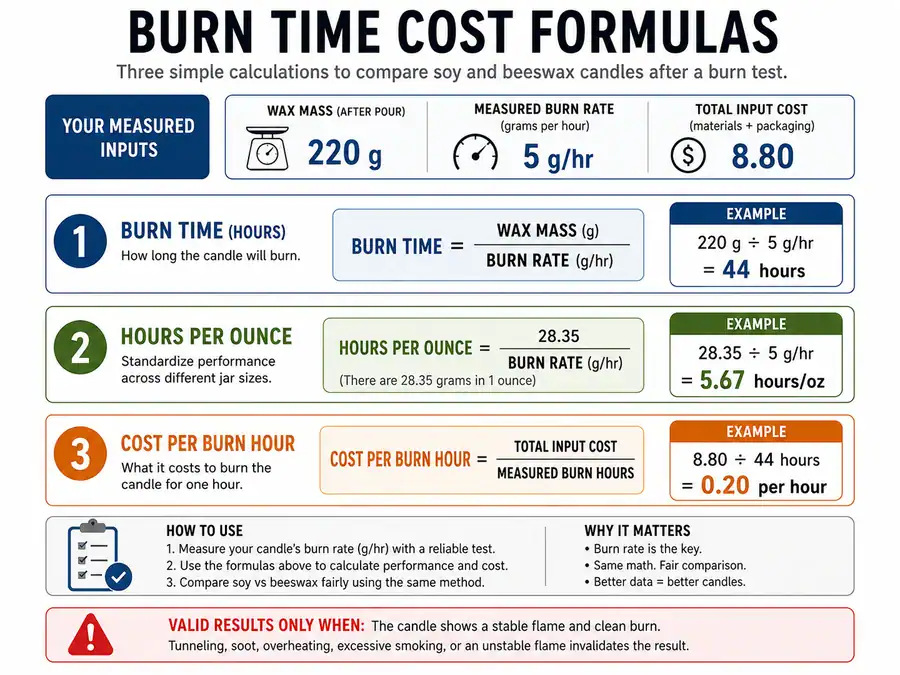
Estimator 1: burn time
Burn time = wax mass ÷ burn rate
Example:
A 220 g candle that burns at 5 g/hr has an estimated burn time of 44 hours.
Estimator 2: hours per ounce
Hours per ounce = 28.35 ÷ burn rate
Example:
If a candle burns at 5 g/hr, one ounce of wax gives about 5.7 hours of burn time.
Estimator 3: cost per burn hour
Cost per burn hour = total input cost ÷ measured burn hours
Example:
If a candle costs 8.80 to make and burns for 44 hours, the input cost is 0.20 per burn hour.
Do not use a cost-per-hour result from a candle that tunnels, soots heavily, overheats, or has an unstable flame. The formula is a decision aid, not a quality score.
A soy candle with a higher cost per hour may still be the better product if it has stronger scent throw and cleaner glass. A beeswax candle with a lower burn rate may still be the better product if the buyer wants a natural beeswax aroma, firmer wax, and longer sessions within safe burn limits.
Sustainability and ethics: sourcing trade-offs
Soy is plant-based and vegan-friendly; beeswax is animal-derived and depends on beekeeping practices, sourcing distance, and supplier transparency.
For soy vs beeswax candles, the sustainability answer is not “one wax is always greener.” Soy depends on crop sourcing, land use, processing, transport, and blend ingredients. Beeswax depends on beekeeping practices, filtering, transport, and whether the buyer accepts animal-derived materials.
Use the candle wax types guide before choosing by values, because wax origin is only one part of the candle system.
| Decision factor | Soy wax | Beeswax | Practical takeaway |
|---|---|---|---|
| Vegan fit | Yes, when the rest of the candle is vegan | No | Choose soy if vegan status is non-negotiable |
| Natural scent | Neutral to mild | Naturally honey-like | Beeswax may need less added fragrance |
| Added fragrance | Often easier to scent strongly | Can compete with beeswax aroma | Test scent before scaling |
| Sourcing clarity | Depends on supplier crop and blend details | Depends on beekeeper and wax handling | Ask suppliers for batch and origin details |
| Shipping footprint | Local or imported | Local or imported | Local sourcing can matter more than wax name |
| Batch variation | Blend-dependent | Color and aroma can vary | Build buyer expectations into product pages |
A values-based choice should match the candle’s purpose. Choose soy when vegan fit, lower material cost, and added fragrance flexibility matter most. Choose beeswax when a firmer wax, natural beeswax aroma, and a slower-burning premium feel matter more than vegan status.
Sourcing questions to ask before buying wax
Sourcing questions belong here only when they change the soy-vs-beeswax decision, not when they expand into a full sustainability audit.
- Is the wax pure, blended, or additive-modified?
- Where is the wax produced or refined?
- Does the supplier provide batch details?
- Does the candle need vegan positioning?
- Will added fragrance or dye change the values claim?
- Does the packaging match the sustainability claim?
Avoid broad claims like “cleanest,” “best for the planet,” or “chemical-free.” Those claims can mislead buyers because both soy and beeswax candles still need wick testing, safe fragrance use, responsible packaging, and honest sourcing notes.
For sales pages, pair the wax claim with a burn-quality result: clean glass, stable flame, measured burn hours, and clear fragrance level. That gives buyers a performance reason and a values reason to choose the candle.
Best use cases: container vs pillar, taper, beginner, and pro candles
Choose soy for beginner-friendly scented container candles; choose beeswax for firmer pillars, tapers, and natural-aroma candles when cost and vegan status fit.
The best wax depends on the candle type first. Soy is easier to position for scented jar candles and budget testing. Beeswax is stronger for candles that need firmness, slower burning, natural color, and a beeswax aroma.
Use the candle making guide as the starting point, then choose wax by candle type instead of treating burn time as the only decision.
| Use case | Better starting choice | Why |
|---|---|---|
| Beginner jar candle | Soy | Lower cost and easier scent testing |
| Strong scented container candle | Soy | Often easier to build added fragrance |
| Natural honey-like aroma candle | Beeswax | The wax itself adds scent character |
| Pillar candle | Beeswax or a suitable hard blend | Better firmness and heat resistance |
| Taper candle | Beeswax | Holds shape well and suits traditional taper use |
| Vegan candle line | Soy | Beeswax is animal-derived |
| Premium long-burn positioning | Beeswax | Slower burn can support the offer if tests pass |
| Lowest material cost test batch | Soy | Lower wax cost helps early formula testing |
Winner by scenario
The winner changes by use case because burn time, scent strength, cost, vegan status, and candle shape reward different wax properties.
- If you want the lowest-cost testing path, start with soy.
- If you want a vegan candle, use soy and check every non-wax ingredient.
- If you want a natural beeswax aroma, use beeswax.
- If you want a scented jar candle, start with soy unless your brand centers on beeswax.
- If you want pillars or tapers, start with beeswax or a hard wax blend.
- If you want the longest burn, compare measured grams per hour before deciding.
The final choice should pass four checks: stable flame, clean glass, even melt pool, and acceptable cost per burn hour. Burn time alone is not enough if the candle tunnels, smokes, overheats, or gives weak scent for its intended buyer.
For makers, the safest order is wax type, jar or mold, wick series, fragrance load, cure time, then burn test. For shoppers, the better question is not “soy or beeswax?” but “which candle gives the scent, burn behavior, values fit, and hour value I actually want?”