

Massage candles are low-melt, skin-safe candles that liquefy into warm oil for body use; they’re generally safe when formulated for skin and used after extinguishing and cooling slightly.
A massage candle looks like a regular candle, but its wax blend is made to melt at a lower temperature and feel like a body oil. That difference is why you can’t treat every scented candle as skin-safe, even if it smells like vanilla and says “natural” on the label. If you’re using one for the first time, the big wins are simple: pick the right ingredients, watch heat, and test for irritation before going all-in. You’ll also want a plan for clean-up, storage, and a few awkward problems like soot, separation, or a pour that comes out hotter than you expected.
What are massage candles?
A massage candle is a low-melt, skin-intended candle that turns into warm oil you can massage in after it’s extinguished.
Unlike regular jar candles, a true massage candle is formulated for skin contact, usually with cosmetic-grade butters and oils that stay slip-friendly as they cool. The goal is “warm and glide-y,” not “hot and watery,” so the melt should feel comfortable when you test it in your hands. If it’s scented, treat it like skincare: use modest scent, avoid “tingly” profiles at first, and don’t assume “natural” equals gentle.
Among the broader types of candles, massage candles usually use skin-intended bases such as soy or coconut wax paired with cosmetic-grade oils or butters so the melt feels more like body oil than regular wax.
Common ways people use massage candles:
- Warm oil for shoulder, hand, and foot massage
- A skin-softening oil step after a shower (once cooled slightly)
- A spa-style routine where you pour into your palm first, then apply
Common benefits people usually want from a massage candle:
- Gentle warmth that can make massage feel more comfortable
- Extra glide compared with dry massage on bare skin
- A simple way to combine body oil and candle ambience in one routine
Are massage candles safe for skin?
Massage candles are generally safe when they’re made for skin contact, used only after the flame is out, and tested on a small area first.
“Skin-safe” usually means cosmetic-grade carrier oils and butters, a clear ingredient list, and a fragrance approach that prioritizes tolerance over intensity. Strong scent doesn’t equal safe scent, and dyes or heavy colorants can raise irritation risk for some people.
A simple pre-use safety checklist:
- Use only candles that explicitly state body/massage use and list ingredients clearly.
- Light it on a stable, heat-safe surface; keep hair, fabric, and bedding away from the flame zone.
- Extinguish fully, then pour a small amount into your palm first (not directly onto skin).
- Rub hands together and check warmth before applying to larger areas.
- Avoid broken/irritated skin, and keep oils away from eyes and other sensitive areas.
- Stop if you feel stinging, itching, or redness building rather than fading.
Fast label-reading rules (so you can decide in 10 seconds):
- Reject if the label only gives “burn instructions” and never mentions body/massage use.
- Reject if there’s no ingredient list (or it’s vague like “proprietary blend” with no details).
- Be cautious with heavily dyed candles, glitter, botanicals, or decorative add-ins—those are for looks, not skin.
- If you know your triggers, scan any allergen statement for your known fragrance allergens and skip if it lists them.
- When unsure, treat it like a new lotion: patch-test first, then use a small amount and keep it cooler.
How do massage candles work (melting points & temperatures)?
Massage candles work by melting a low-temperature blend into a silky oil; after you extinguish the flame and let it cool slightly, you apply a small amount for glide and gentle warmth.
The “warm, not hot” feeling comes from formulation: softer waxes and cosmetic oils thin out as they liquefy, spreading quickly in a thin layer rather than sitting as a thick, heat-holding puddle. Melt point is about when the blend turns to liquid; flash point is about when vapors could ignite under very different conditions, and you’re not using the melted oil as a fuel.
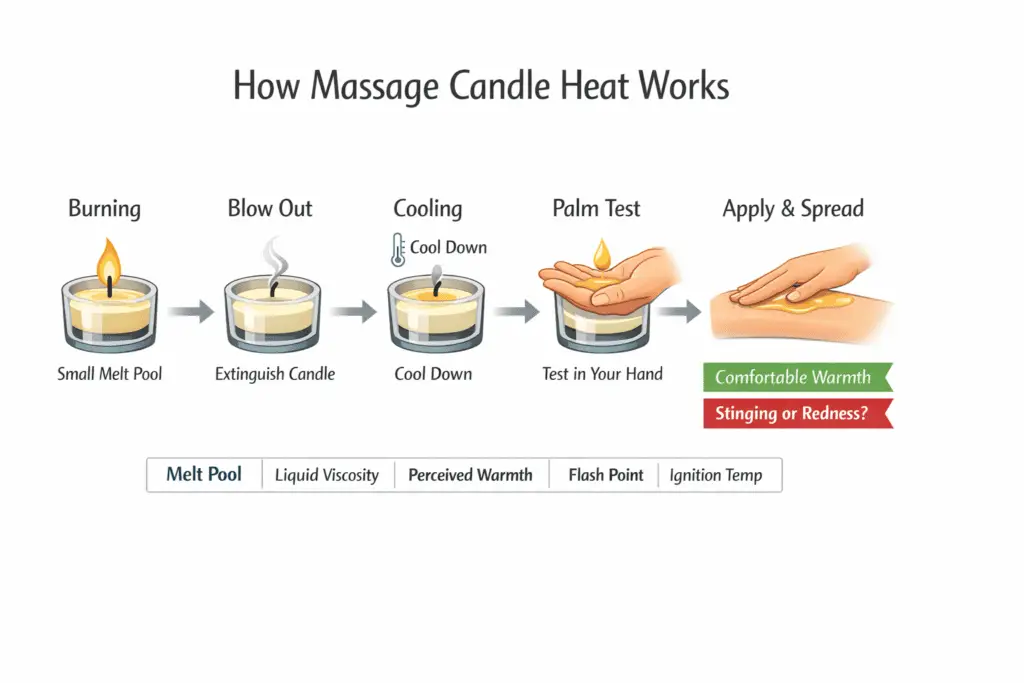
A quick glossary that makes the behavior predictable:
- Melt pool: the liquid layer on top while the candle burns
- Viscosity: how thick or runny the melt feels; warmer usually means runnier and faster-spreading
- Perceived warmth: what your skin senses after the oil thins and spreads, not just what the jar felt like
- Flash point: a safety property for heating/ignition scenarios, not a target for massage use
A simple temperature-control mini-method (no guesswork, no obsession with numbers): burn only until a small melt pool forms, extinguish fully, wait a moment, then test a little in your palm and apply in thin layers only when it feels warm rather than hot.
What’s normal vs. a red flag:
- Normal: warm oil that feels comfortable in your hands, spreads easily, and doesn’t sting.
- Red flag: stinging on contact, redness that grows instead of fading, smoke/soot, or a jar that feels uncomfortably hot to handle.
Massage candle vs regular candle (differences that matter)
Massage candles are made and labeled for skin contact, while regular candles are made for fragrance and ambience and may include additives that aren’t intended for topical use.
Here’s the practical side-by-side that matters when you’re holding a jar in your hand:
| What to compare | Massage candle | Regular candle |
| Intended use | Warm oil for topical massage (after extinguishing) | Room scent and décor |
| Typical formulation goal | Low-melt, smooth slip, comfortable spread | Strong throw, stable burn, appearance |
| Additives & color | Often minimal/skin-minded | May include dyes, pigments, or additives not chosen for dermal use |
| Label signals | Clear ingredient list and body-use directions | Candle-only directions, limited ingredient transparency |
| Application | Pour to palm first, then apply | Not designed for skin contact |
If you’re ever unsure, treat it like skincare: unclear ingredients, unclear directions, or heavy dyes are a reason to keep it off skin. Once you can spot the difference at a glance, following a simple extinguish–cool–test routine becomes the part that actually determines comfort in real use.
Steps to use a massage candle safely
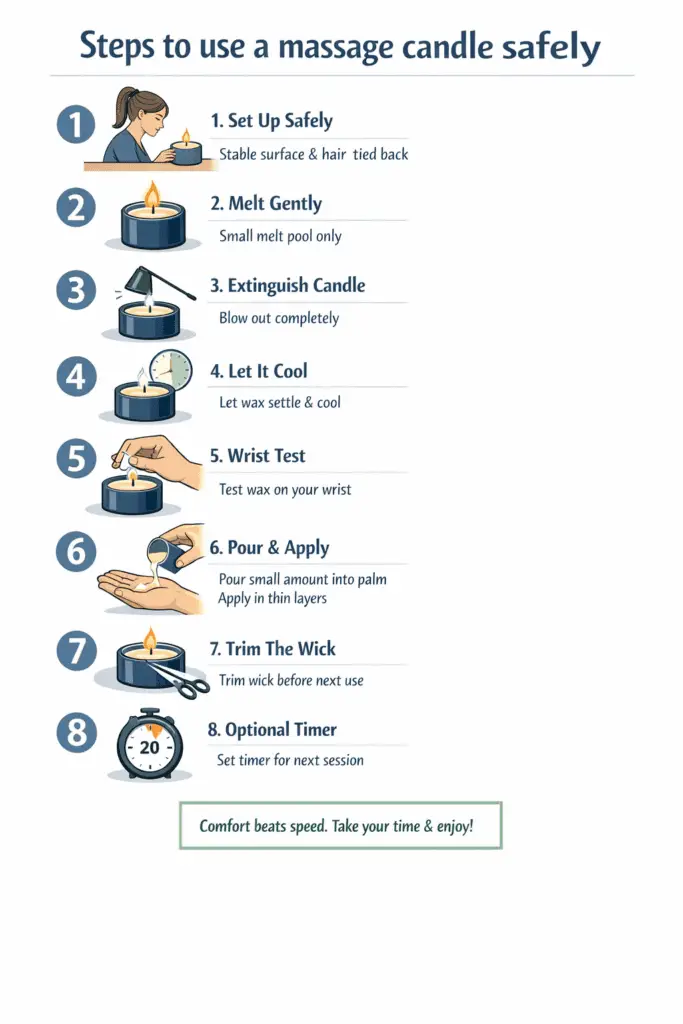
Use a massage candle safely by burning it briefly, extinguishing it, letting it cool, then testing and applying small amounts.
Extinguish the flame, wait 1–3 minutes, test a drop on your inner wrist, then pour a small amount into your palm and massage. Keep basic candle safety in place: never leave a burning candle unattended, and keep it away from hair, fabric, and bedding.
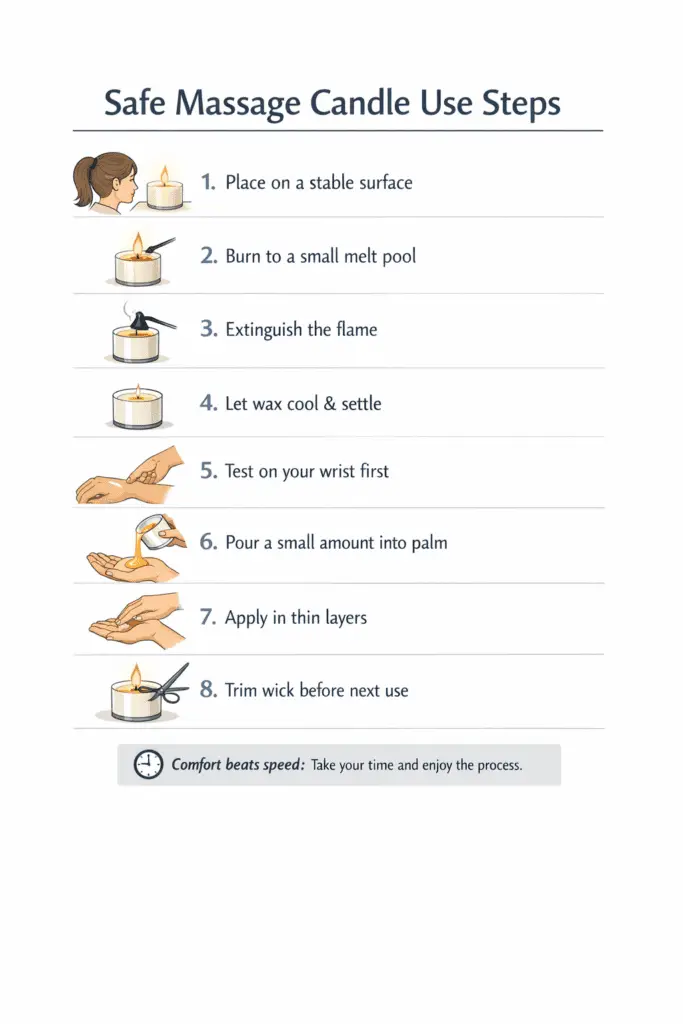
- Set up the area: stable surface, hair tied back, nothing flammable nearby.
- Burn just long enough to create a small melt pool, then extinguish fully.
- Let the melt settle so it thickens slightly—hotter and thinner oil spreads faster and can feel “too warm” all at once.
- Test first, always: a wrist test tells you more than touching the jar.
- Trim the wick before the next burn—an overlong wick can run hotter, smoke more, and make the melt pool harsher.
- For consistency, use a timer so you don’t overheat the jar during longer sessions.
If the test drop still feels hot, wait another minute, rub it between your hands to dissipate heat, and try again—comfort beats speed every time.
How to choose a safe massage candle (waxes, oils, wicks)
Choose a safe massage candle by prioritizing skin-intended ingredients, clear labeling, modest scent, and a wick that won’t overheat the container.
Look for a clear ingredient list and expect skin-intended bases such as soy or coconut wax paired with cosmetic-grade oils or butters; if you’re sensitive, start with an unscented or lightly scented option.
A quick shopping checklist:
- Label clarity: ingredients listed plainly; directions mention body use after extinguishing (not just “home fragrance”).
- Base feel: the melt should be oil-like and not waxy or sticky once it cools slightly.
- Scent approach: lighter scents are often easier for beginners and reactive skin.
- Color/additives: skip heavy dyes, glitter, botanicals, and decorative add-ins.
- Wick behavior: it should burn cleanly without excessive soot or a wildly deep melt pool.
Fast “choose / reject” rules:
- Choose it if it explicitly says it’s for massage/body use and gives ingredients and safe-use directions.
- Reject it if it’s heavily colored, highly decorative, or only marketed for “home fragrance.”
- If it soots quickly in-store demos or reviews mention constant smoke, expect hotter pours and messier use.
- For wider jars, an oversized wick can drive excess heat; for narrow jars, an undersized wick can tunnel—either way, the burn won’t behave predictably for body use.
If you’re unsure between two options, pick the one with simpler ingredients and clearer instructions—then get picky about scent and texture after you know your skin tolerates it.
Ingredients to avoid in massage candles (fragrances, dyes, and essential oils)
The safest massage candles keep formulas simple: skin-friendly base oils/butters, minimal additives, and scent used carefully—because most irritation problems come from “extras,” not the wax itself.
In practice, simple bases such as skin-safe oils and butters are usually easier to tolerate than heavily scented or decorative formulas.
Fragrance is the biggest variable. Some people tolerate scented blends easily, while others react to certain aroma chemicals or essential oils even at low levels. If you have sensitive skin, treat essential oils like skincare: start low, avoid “spicy” blends, and don’t assume “natural” means gentle. Cinnamon, clove, peppermint/menthol, and other “warming/cooling” profiles are common culprits for stinging on contact, especially on thin or recently shaved skin.
Colorants and decorative add-ins are another easy skip. Anything meant to look pretty in a jar can be annoying on skin, on sheets, or in pores, so avoid heavy dyes, mica, glitter, botanicals, and “crystals” in anything you plan to use as body oil.
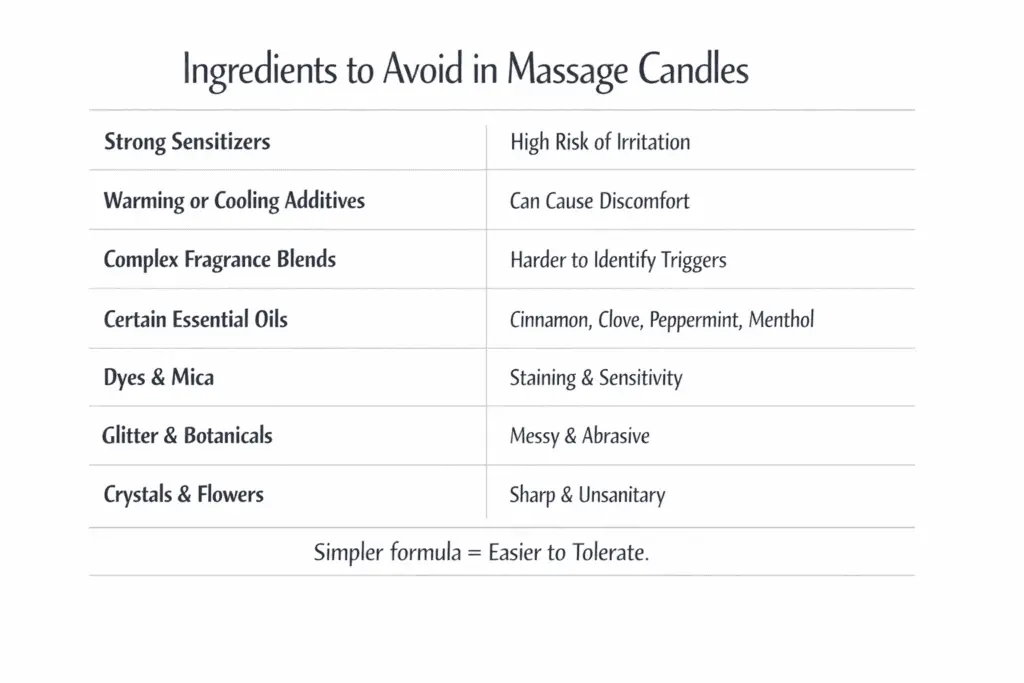
Other ingredients and add-ons that often create avoidable problems:
- Strong sensitizers (can feel fine once, then irritate later with repeat exposure)
- Harsh “tingle” additives (warming/cooling agents can sting or cause redness)
- Very complex fragrance blends if you don’t know what your skin tolerates yet
If you’re unsure, choose the simplest ingredient list you can find. “Boring” is a feature when something is going on your skin warm.
Patch-testing & allergy precautions (when and how)
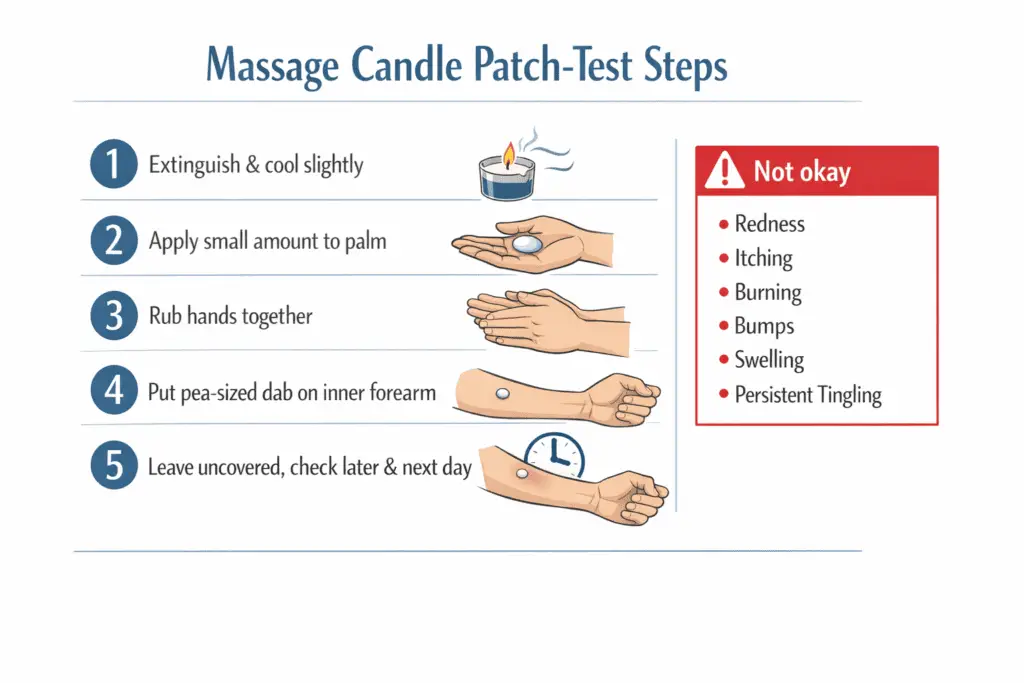
Patch-testing is the fastest way to prevent a full-body “nope”: try a tiny amount first, wait, then decide.
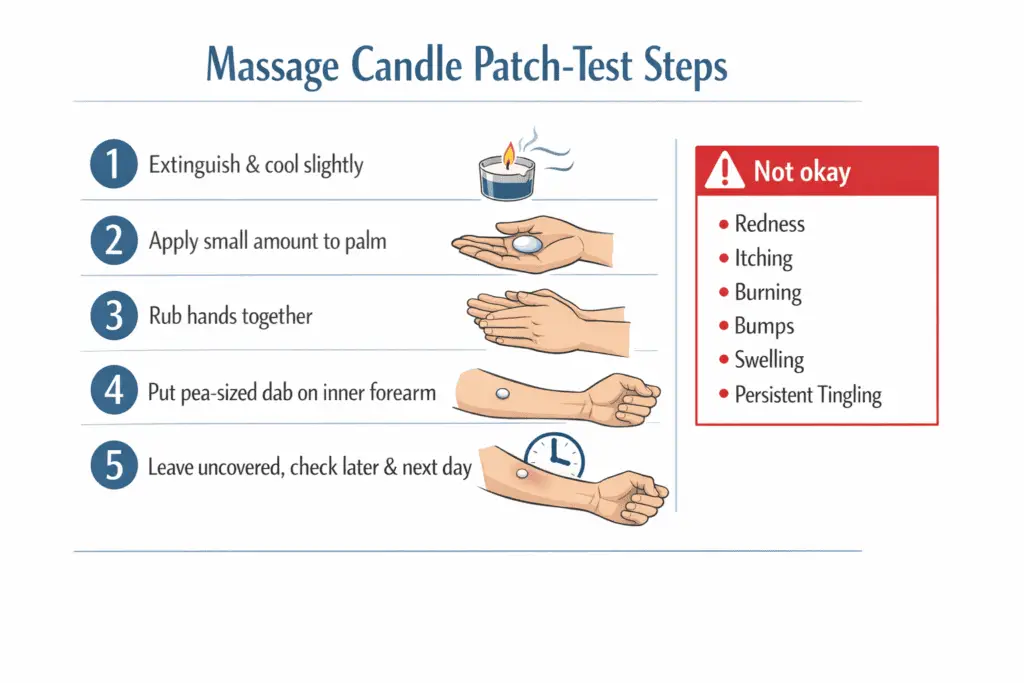
How to do it:
- Extinguish the candle and let the melt cool slightly.
- Put a small amount into your palm, rub hands together, then apply a pea-size smear to the inner forearm.
- Leave it alone—don’t cover it tightly, and don’t reapply repeatedly.
- Check the area later for redness, itching, burning, bumps, or swelling.
For a quick first-use spot test, check the area later the same day and again the next day before wider use. If you want a fuller skincare-style patch test for a new scented product, test a small area repeatedly over several days before broad use.
What “not okay” looks like isn’t always dramatic: persistent itching, spreading redness, tiny bumps, dry patches, or a hot/tingly feeling that doesn’t fade within a few minutes. If that happens, wash the area with gentle soap, stop using that candle on skin, and avoid re-testing the same scented product again on a larger area.
Who should avoid massage candles (pregnancy, skin conditions, meds)
Some people should skip massage candles entirely, or use them only with extra caution and simpler formulas.
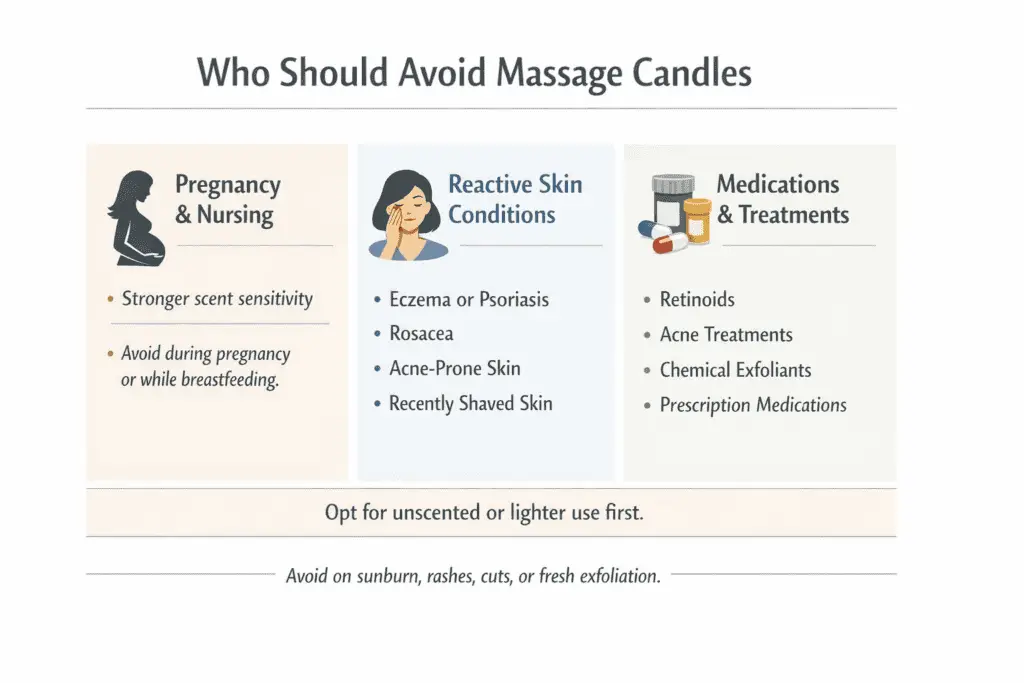
Pregnancy and nursing: fragrance sensitivity can be higher for some people, so a strongly scented candle may feel less comfortable than an unscented or lightly scented one. If you’re unsure how your skin or scent tolerance will react, start with a very small amount or skip it altogether.
Skin conditions and reactive skin: eczema, psoriasis, rosacea, acne-prone areas, or recently irritated/shaved skin can react to fragrance, dyes, and “tingly” additives. If you’re prone to flare-ups, unscented and lightly applied is usually the safest starting point. Avoid using warm oils on sunburn, rashes, cuts, or fresh exfoliation.
Medications and treatments: topical retinoids, acne treatments, chemical exfoliants, and some prescriptions can leave skin more reactive than usual. In that case, keep use minimal or skip warm fragranced oils on those areas, and check with a clinician if you have product-specific concerns.
How to fix common issues (too hot, separation, soot/smoke)
Most massage candle problems are fixable with small technique changes—usually controlling heat, stabilizing the blend, or improving the burn.
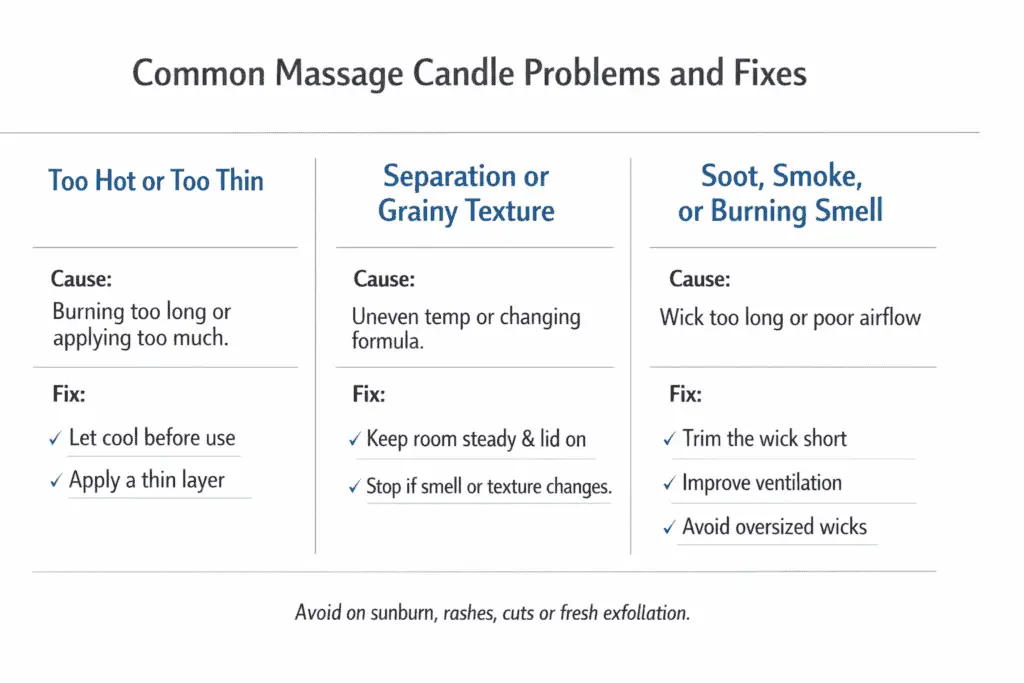
Too hot or too thin:
- Burn for a shorter time so the melt pool doesn’t superheat.
- Let the candle sit after extinguishing until the oil thickens slightly.
- Apply in thin layers; more oil holds warmth longer.
- Keep the jar on a stable surface away from blankets and body heat while it burns.
Separation or “grainy” texture: Temperature swings and repeated overheating can make a candle look or feel less uniform over time. Store it at a steady room temperature, keep the lid on when it’s not in use, and stop using it on skin if the texture or smell keeps changing.
Soot, smoke, or a strong “burning” smell: This usually points to wick length, drafts, or an overloaded formula. Trim the wick before each burn, keep the candle out of airflow, and stop the burn if the flame is dancing or producing visible smoke. If soot keeps happening, the wick may be too large for the container or the blend may be burning too hot.
DIY massage candle: safe method & checklist
If you want to make your own massage candle, keep this page at the consumer-safety level: DIY versions need separate formulation, wick, and burn-testing guidance before they’re ready for skin use. For most readers, the safer move is to start with a clearly labeled body-use candle first, then treat DIY as a separate project once you know the texture, heat, and ingredient profile you’re aiming for.
Cleaning and storage to maintain candle & container
Keep a massage candle fresh by wiping the rim, capping tightly, storing cool and dark, dating the jar, and discarding it if it turns rancid.
Oil-rich blends can oxidize over time, so simple habits reduce dust, odor changes, and messy lids while keeping the pour and scent consistent.
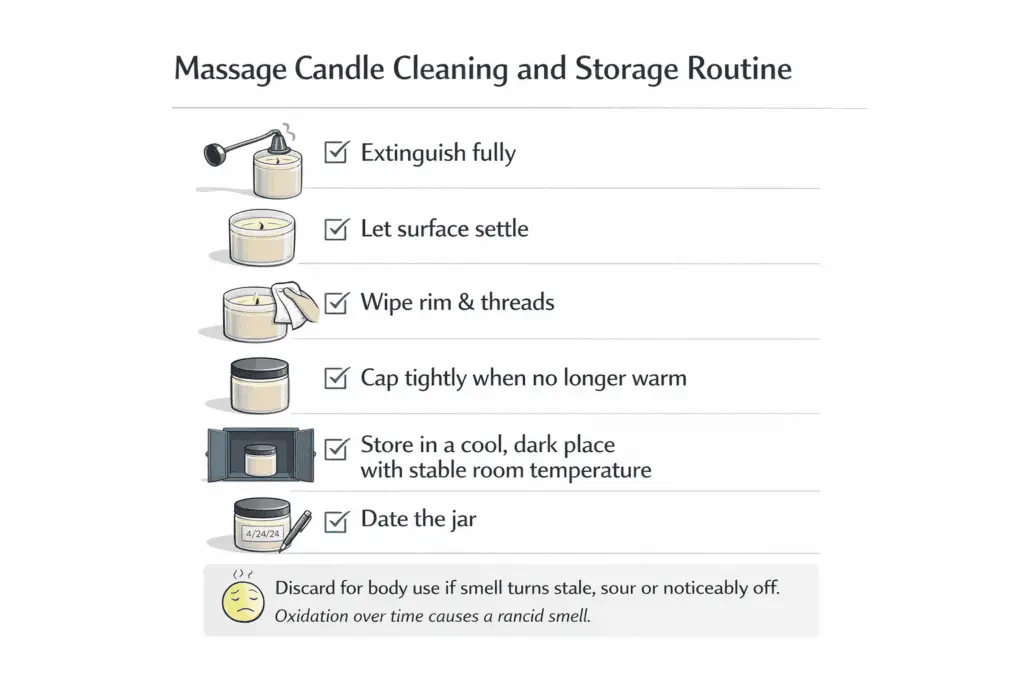
A simple wipe–cap–store routine:
- Extinguish fully, then let the surface settle so you’re not smearing hot oil.
- Wipe the rim and threads with a clean, dry tissue or cloth to prevent sticky buildup.
- Cap tightly once the jar is no longer warm to the touch.
- Store in a cool, dark place with a stable room temperature.
- Date the bottom of the jar so you can track how it’s aging after opening.
Mini-FAQ:
- Why does my candle smell “oily” or different now? Oxidation can dull or shift scent. If the smell turns stale, sour, or noticeably off compared with when it was new, it’s usually safer to stop using it on skin.
- Can I “fix” a candle that seems off? You can clean the jar and lid, but you can’t un-oxidize oils. If it smells rancid or looks unusually cloudy compared to when it was new, discard it for body use.
- Does container choice matter? A tight lid and clean rim matter more than the material. The goal is less air exposure, less dust, and fewer temperature swings.