
Coconut wax is usually better for stronger scent throw and a smoother finish, while soy wax is usually better for lower cost, firmer jars, and easier hot-weather shipping.
These two plant-based container-candle waxes differ most in scent strength, surface finish, heat tolerance, and cost. This guide is for hobby makers, market sellers, and small brands choosing a wax for real jars and real rooms. You will see where coconut feels more premium and where soy is easier to source, store, and ship. The next sections compare the trade-offs so you can choose the wax that fits your budget, climate, and candle style.
| Criteria | Coconut wax | Soy wax | Better choice when… |
| Scent throw | Usually stronger and faster in typical container candles | Usually softer at first, but can be very good after proper cure and wick tuning | You want faster room-filling scent = coconut |
| Burn profile | Reaches a full melt pool sooner in many blends; real burn time depends on wick, jar, and formula | Often feels steadier and more economical when wicked correctly | You want lower-cost, steady everyday burns = soy |
| Surface finish | Creamy, smooth, luxe-looking tops | More prone to frosting, rough resets, and visible texture changes | You want polished shelf appearance = coconut |
| Heat and shipping | Softer and more vulnerable in hot storage or summer transit | Usually firmer and easier to ship in warm weather | You ship in heat = soy |
| Cost and supply | Usually more expensive and less standardized across suppliers | Usually cheaper and easier to source in bulk | You need margin stability = soy |
| Best fit | Premium, scent-forward container candles | Budget-conscious, everyday container candles | Choose based on brand position and climate |
When to choose each
Choose coconut wax if you want a smoother, more premium-looking candle and stronger hot throw matters more than raw material cost. Choose soy wax if you want a lower-cost wax with firmer structure and fewer summer-shipping headaches.
Choose coconut wax for in-person selling when shoppers judge the candle by immediate scent impact and visual finish. Choose soy wax for budget-sensitive lines, wholesale, or warmer climates where storage and transit conditions matter more.
Coconut wax vs soy wax: the key differences
Coconut wax is softer, creamier, and gives a stronger scent impression, while soy wax is firmer, often burns slightly longer, and handles heat and shipping better.
If you already understand the main candle wax types, this comparison zooms in on two of the most popular plant-based options. Coconut wax is usually a softer blend based on hydrogenated coconut oil, formulated for smooth tops, creamy color, and a luxe, spa-like feel. Makers learning how to use soy wax in candle making usually start with a firmer wax that has a higher melt point and a more “matte” look in the jar. Both sit in the bucket of eco-friendly candle wax options, but they perform differently once they hit real-world conditions.
At a high level, coconut wax vs soy wax comes down to trade-offs across four axes: finish, scent strength, burn profile, and climate stability. Coconut blends usually excel at glass-smooth tops, minimal frosting, and rich hot throw at lower temperatures. Soy often wins on burn time per gram, summer stability, and cost per kilo, which matters once you start ordering full cases rather than sample bags.
In the melt pool, coconut wax tends to liquefy faster and stay more fluid, which helps volatile fragrance molecules escape into the room. Soy resists heat for longer, so it can tunnel or under-melt if the wick is undersized, but gives a slow, steady burn when dialed in. For branding, coconut leans “premium spa,” soy leans “natural, minimal, everyday.” When you plan your line, treat coconut as the high-end, scent-forward option and soy as the budget-friendly workhorse that travels and stores more safely.
A quick decision method: If you sell primarily online or ship in hot weather, start testing soy or a soy-rich blend first. If you sell face-to-face at markets where customers judge by scent on the spot, start with coconut-rich blends for that immediate wow factor. Then layer in testing to see how each wax performs in your exact vessels, wicks, and fragrance oils.
Which gives better scent throw?
In many side-by-side container-candle tests, coconut-based waxes give stronger, faster hot throw than straight soy, though well-formulated soy candles can still scent a typical room well.
If you want the best wax for strong scent throw, wax choice sets the ceiling for how much fragrance you can push before you hit performance issues. Coconut blends create a thinner, more mobile melt pool at typical burning temperatures, so fragrance molecules evaporate readily and fill the room faster. Soy’s thicker melt pool can trap some fragrance until the wax is hotter, which is why soy often needs a longer cure and a full melt across the surface before it blooms.
In practical terms, coconut wax often wins early-round sniff tests because it throws hard sooner, even at modest fragrance loads. That is why many indie brands pick coconut for hero scents that must impress within minutes in a shop or market setting. However, well-formulated soy candles with quality fragrance oils, tuned wicks, and proper cure time can still deliver a respectable throw that satisfies most home users. Think of coconut as the higher ceiling and soy as a slightly lower but still usable one.
Candle makers worry about strong hot throw vs cold throw, and the gap behaves differently in each wax. Coconut blends usually give noticeable cold throw in the jar and very strong hot throw once burning, which supports premium pricing. Soy’s cold throw can feel muted, yet hot throw often improves after a proper cure. That lag creates frustration for beginners who test too early and assume the wax is weak.
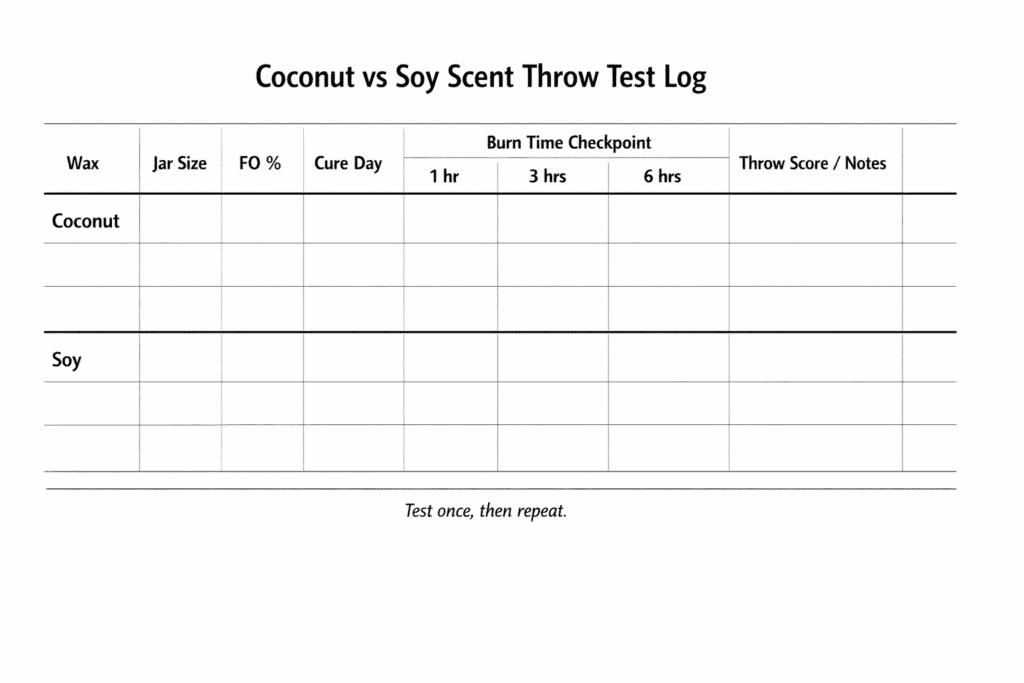
If you already tried both and still need to fix weak smelling candles, the culprit is often outside the wax: low-quality FO, under-wicking, oversized rooms, or testing in drafty spaces. A practical method is to pour the same fragrance at the same load into identical jars, one with coconut and one with soy, then run side-by-side burns at 1, 3, and 6 hours. Note which candle smells stronger, how quickly the room reaches a comfortable level, and how the scent lingers after extinguishing. Use that data, rather than hype, to choose which wax gives your customers the sensory experience you want.
One practical difference is cure speed. Coconut blends often smell closer to their final hot throw sooner, while soy usually needs a longer cure before you judge it fairly. That difference supports the scent-throw comparison, not a separate process section. Keep a cure log by wax and fragrance, then move to a dedicated cure-time guide if you need a deeper workflow.
Fragrance-load tolerance also matters because it affects how hard each wax can push scent before sweating, poor adhesion, or weak burns show up. Coconut blends often handle higher fragrance percentages than soy, but the real limit depends on the wax supplier, the fragrance oil, the wick, and the jar. Check your printed wax guidance, review what fragrance load means, and use a fragrance-load calculator only after you confirm the working range for your materials.
Burn time and burn behavior: which lasts longer?
Soy wax often has the edge when your priority is a slower, steadier everyday burn, while coconut wax often reaches a full melt pool sooner and feels stronger earlier in the burn.
There is no universal winner on total hours because jar size, wick, fragrance load, and the specific wax blend change the result. For most makers, the more useful comparison is this: coconut-heavy formulas usually feel more responsive and premium during the burn, while soy often feels more economical and stable once it is properly wicked.
If your goal is a calm, budget-friendly container candle, soy is usually the safer starting point. If your goal is fast room performance and a polished premium burn, coconut often has the stronger appeal. Soot is a setup issue more than a wax-family verdict, so judge burn time as a formula-and-vessel result, not a claim you can assign to wax alone.
Surface finish & frosting tendencies
Coconut blends usually give creamier, glass-smooth tops, while soy is more prone to frosting, wet spots, and visible texture changes as it cools and ages.
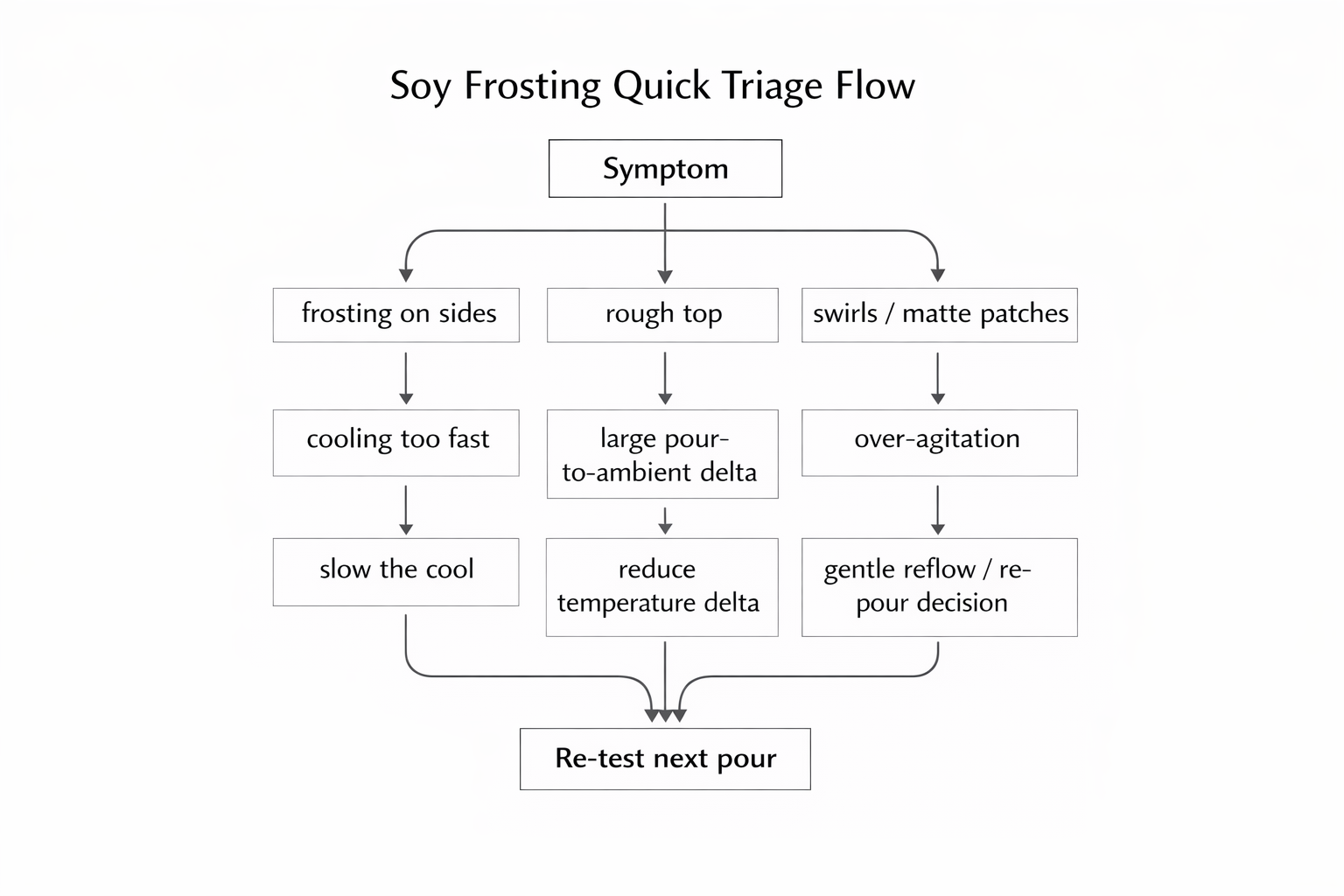
If your branding leans toward luxe, spa-style jars, smooth candle tops matter as much as scent. Coconut wax tends to cool into a satin, almost lotion-like surface with minimal texture, especially in white or pastel jars. Soy, by contrast, is famous for frosting: that white, crystalline haze that shows up on the sides or top of colored candles as the wax naturally re-crystallizes. It does not hurt performance, but it can clash with a polished aesthetic if your line promises perfectly uniform jars.
Temperature swings make cosmetic issues worse, which is why soy-heavy blends often look different in winter than in summer. When you learn how to prevent candle frosting, you discover it is really about managing cooling speed, pour temperature, and storage. Pouring too cool, cooling in a draft, or moving candles before they fully set all encourage frost, jump lines, and small surface ripples. Coconut-heavy blends are more forgiving, but even they can show small sink marks or micro-bubbles if you rush the process.
A practical way to reduce flaws is to treat surface behavior as its own experiment, separate from burn testing. Pour one batch of soy at the low end of the recommended range, one at the high end, and let both cool at room temperature with minimal airflow. Label the bottoms with pour temp and date, then compare tops and jar walls after 24–48 hours. Repeat the same with coconut or a coconut–soy blend and log which combinations give the most reliable, troubleshooting candle surface issues data for your specific workspace.
Over time you may decide that a little frosting is acceptable if your customers care more about clean ingredients than perfect cosmetics. In that case, simple messaging about natural variation helps set expectations, while your production process focuses on avoiding truly problematic flaws like deep sinkholes, severe wet spots, or cracks that suggest poor adhesion or cooling stress.
Sustainability & sourcing differences
Both waxes can be positioned as “eco” choices, but real sustainability depends on crop practices, processing, transport, and the choices you make when picking sustainable candle wax options.
Coconut appeals because it is a high-yield crop; a relatively small area of trees can produce large volumes of oil. However, meaningful coconut vs soy environmental impact comparisons also consider issues like monoculture plantations, worker conditions, and shipping distances from tropical regions to your suppliers. Soy scores points for being widely grown and familiar, but large-scale soy farming can involve heavy pesticide use, GMO varieties, and land-use pressure, especially in regions linked to deforestation.
Instead of assuming one wax is automatically “better,” focus on supplier transparency. Look for documentation on origin country, farming practices, and whether the wax is blended with other materials like paraffin or palm. When possible, choose ethical candle wax suppliers who publish basic ESG information, offer traceability back to mills or co-ops, and are willing to answer detailed questions about additives. Even a short email exchange can reveal a lot about how seriously a supplier takes sustainability.
A simple supplier checklist makes that easier to apply in practice:
- Ask for SDS and TDS plus a short sourcing statement for each wax.
- Confirm whether the wax is pure coconut or soy, or a blend containing paraffin, palm, or other additives.
- Look for any third-party certifications or membership in industry programs, and treat vague or evasive answers as a red flag for “eco” claims.
Finally, sustainability lives in the whole candle, not just the wax. Consider recycled or recyclable containers, minimal packaging, and local sourcing to reduce transport emissions. A carefully sourced soy wax poured into locally made glass can be just as compelling as a boutique coconut blend shipped halfway around the world. Be honest and specific in your product copy—“US-grown soy from X region” or “coconut blend from certified plantations”—so eco-conscious buyers can see how your material choices align with their values.
Cost & availability (supply reliability)
Coconut wax usually costs more and has lumpier supply, while soy is cheaper and easier to source. Real cost per candle depends on FO, shipping, and MOQs, not wax alone.
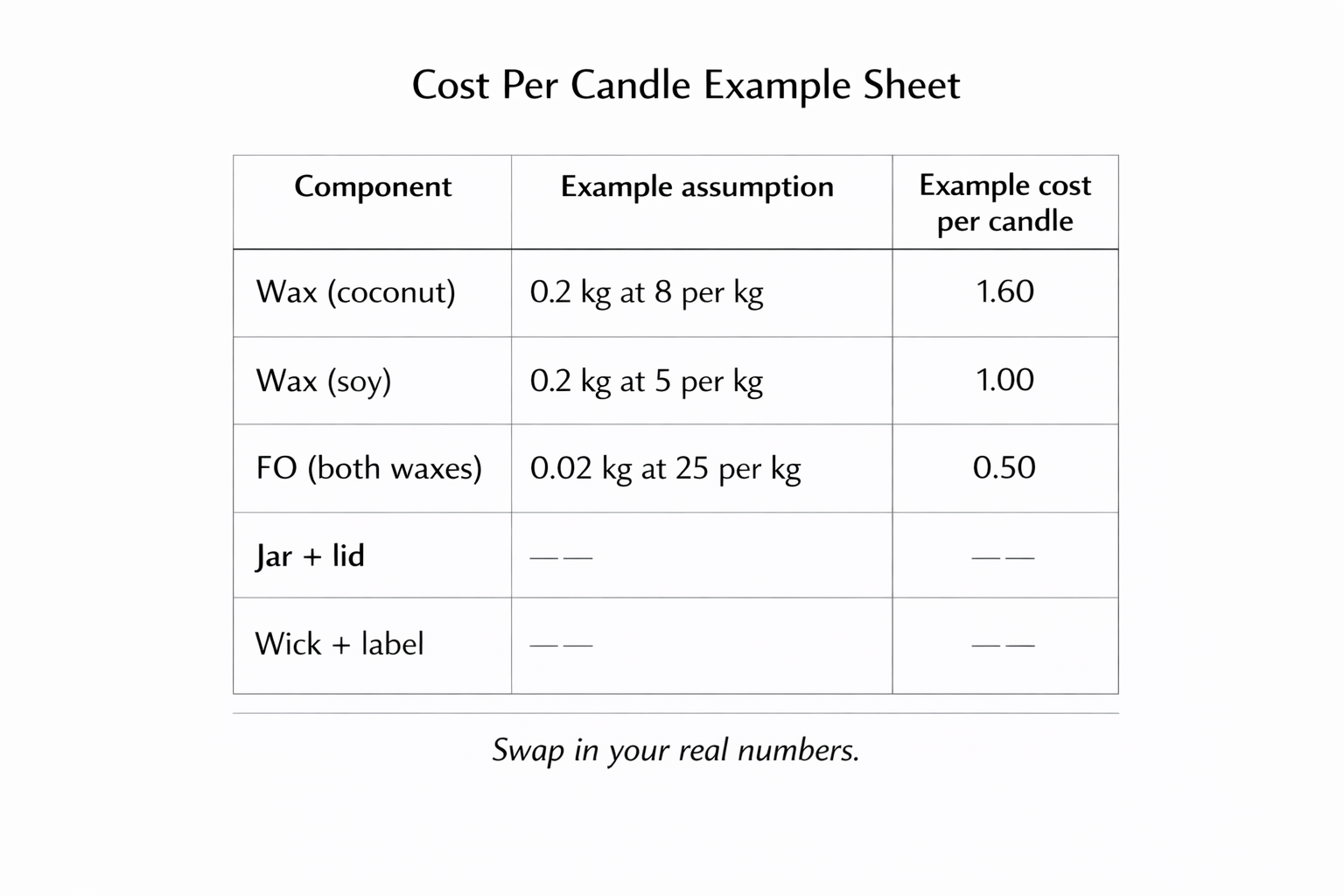
When you want to know how much does candle wax cost, wax price per kilo is only one slice of the pie. Fragrance, jars, lids, wicks, labels, and packaging all stack on top, and shipping can quietly rival the wax bill. Coconut blends often carry a price premium and fewer bulk suppliers, while soy is widely produced and stocked in multiple regions. That makes soy easier to grab locally and less sensitive to short-term stockouts, even if seasonal sales and currency shifts still nudge prices.
A simple way to sanity-check costs is to build one example and then swap in your real numbers. Imagine you pour a 200 g candle at 10% FO:
| Component | Example assumption | Example cost per candle |
| Wax (coconut) | 0.2 kg at 8 per kg | 1.60 |
| Wax (soy) | 0.2 kg at 5 per kg | 1.00 |
| FO (both waxes) | 0.02 kg at 25 per kg | 0.50 |
| Jar + lid | per-piece price | 1.50 |
| Wick + label | per-piece price | 0.30 |
| Packaging + filler | per-unit estimate | 0.40 |
In this worked example, coconut comes out at 4.30 and soy at 3.70, so wax choice shifts cost by about 0.60 while FO and packaging dominate the total. Numbers will differ in your market, but the method stays the same: wax_mass_g ÷ 1000 × wax_price_per_kg plus FO_mass_g ÷ 1000 × FO_price_per_kg, then add vessel, wick, labels, and packaging to see the true baseline.
A habit borrowed from pricing handmade candles is to treat this baseline as your “hard floor,” then layer in labor, overhead, and profit margin on top. Coconut’s higher price can be worth it if stronger in-person scent throw moves you into a higher price band, but you only see that clearly when your sheet separates materials, labor, and margin. Soy’s lower unit cost and broader availability might make more sense for wholesale or subscription lines where predictable restocking and stable margins matter more than ultra-luxe finish.
If you are deciding between ordering loose supplies or all-in-one kits, remember that DIY vs pre-made kits trade a higher apparent wax price for built-in convenience, lower MOQs, and bundled shipping. Kits can be smart for early testing or very small batches, but once you know your favorite jars, wicks, and waxes, moving to case-lot buying usually drops your cost per candle and makes it easier to fund better packaging for hot-weather shipping. As soon as you understand how each cent is allocated, you can decide when paying extra for summer insulation and route planning actually protects your margins rather than just shaving them down.
Heat tolerance and shipping stability
Soy wax is usually the safer choice for warm-weather storage and shipping because it is firmer and less likely to soften in transit. Coconut-heavy waxes usually give a smoother finish and a more premium look, but that softness can become a liability in hot warehouses, delivery vans, and summer market setups.
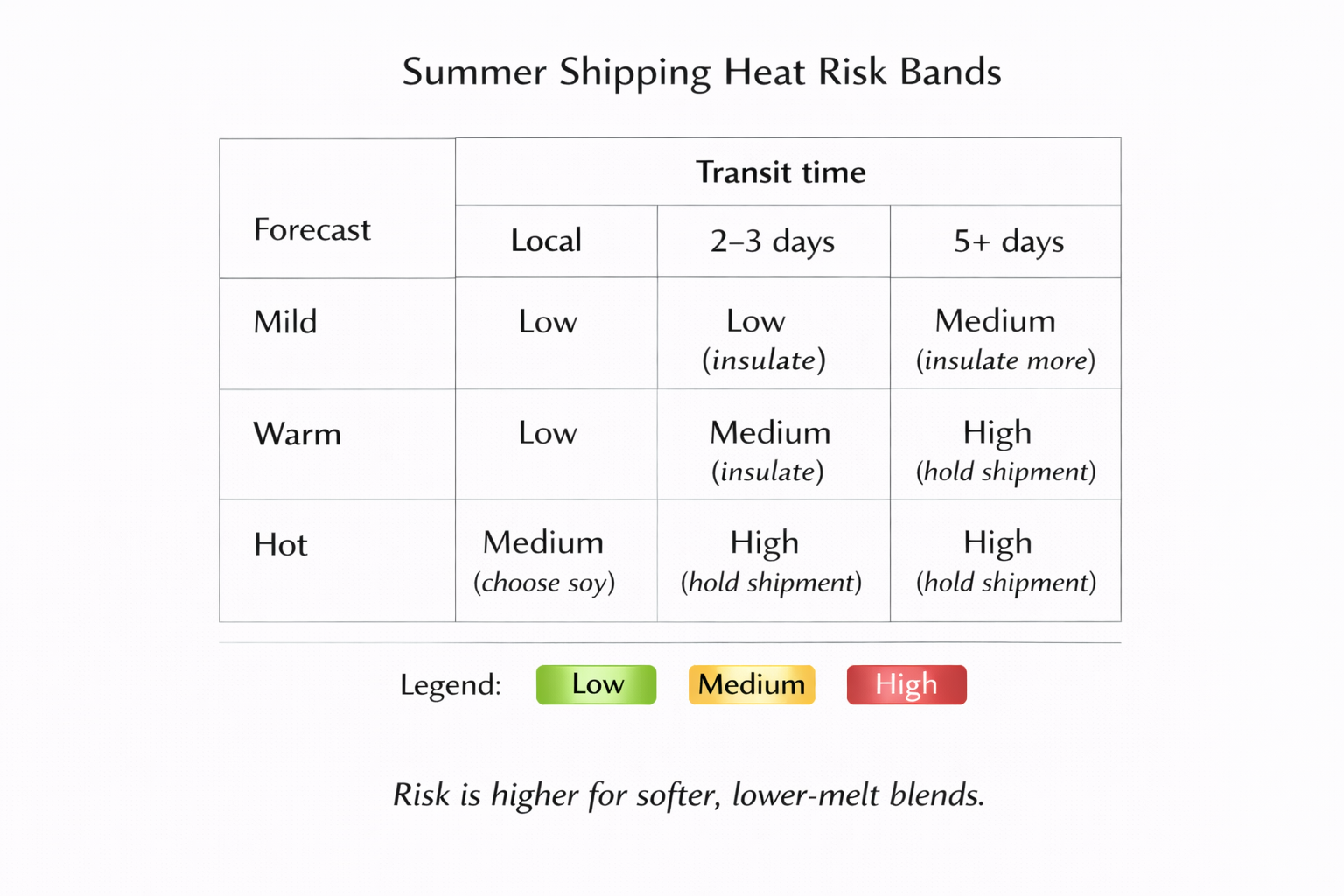
The main reason is heat tolerance. Coconut-heavy blends usually have lower melt points, so they soften sooner in storage and transit. Soy container waxes are usually firmer, which gives you a wider margin before jars slump, sweat, or arrive looking distorted.
For local, climate-controlled, or premium lines, coconut can still make sense when scent throw and appearance matter most. For wholesale, ecommerce, or hot-region selling, soy or a soy-rich blend usually reduces risk and packaging cost.
Use this criterion as a tiebreaker, not the whole decision. If your brand wins on luxury finish and strong fragrance, coconut may still be worth the trade-off. If your brand wins on margin, repeatability, and easier fulfillment, soy is usually the better operational fit.
Bottom line: coconut or soy?
Choose coconut wax if your priority is stronger scent throw, smoother tops, and a more premium-looking container candle.
Choose soy wax if your priority is lower cost, firmer structure, and easier storage or shipping in warm weather. It is usually the better fit for everyday lines, wholesale, and makers who want stable sourcing and simpler margins.
If you want a middle ground, a coconut-soy blend is often the most practical compromise. But in a straight coconut vs soy decision, the real tiebreakers are scent goals, finish standards, climate, and cost control.