

Coconut wax is a soft, plant-based candle wax that is usually used in containers and valued for good scent throw, slow burns, and smooth finishes.
Many makers pick it for jar candles because it looks creamy, burns steadily, and can carry fragrance well. The catch is that coconut wax is often sold as a blend, so results change from one product to another. This page explains what coconut wax is, how it compares with other waxes, and what usually changes its burn, finish, and scent throw. It stays at the overview level and points deeper setup questions to separate pages.
Coconut wax is a refined, plant-based candle wax made from coconut oil that produces slow, clean burns, good scent throw, and smooth container candle finishes when correctly wicked and poured.
Many candle makers choose coconut wax for smooth tops, strong scent potential, and clean-looking container candles. It is a soft, plant-based wax refined from coconut oil and usually sold for jars rather than pillars. Real performance depends on the blend, wick, fragrance load, pour temperature, and cure time. This guide explains what coconut wax is, how it compares, and what to expect from burn behavior, finish, and scent throw.
Coconut wax at a glance
Coconut wax is usually a soft container-focused wax or blend with very good scent potential, smooth finishes, and weaker free-standing structure than harder candle waxes.
| Attribute | Coconut wax | What that means in practice |
|---|---|---|
| Composition | Usually a coconut-based wax or blend | Check whether soy, paraffin, palm, or additives are included before assuming “pure” coconut |
| Best use | Mostly container candles | Soft, creamy behavior is usually easier to manage in jars than in free-standing pillars |
| Scent throw | Often very good when wicked and cured well | Strong throw is possible, but wick, fragrance, cure time, and room size still decide the result |
| Burn behavior | Slow, even, wide melt pool | A wick that is too large can still overheat the jar and shorten burn time |
| Finish | Smooth tops and strong glass adhesion | Cooling speed and jar temperature still control wet spots, sinkholes, and surface marks |
| Main trade-offs | Softer, pricier, and more blend-variable than many common waxes | It can look more premium, but it is less forgiving than copying a simple paraffin recipe |
Coconut wax vs other common candle waxes
| Wax | Scent throw | Burn behavior | Finish | Best use | Main trade-off |
|---|---|---|---|---|---|
| Coconut wax | Often very good when wicked and cured well | Usually slow, even, and comfortable in containers | Smooth, creamy, premium-looking | Container candles, scent-led lines | Soft, blend-variable, usually pricier |
| Soy wax | Good, but can feel lighter depending on formula | Usually steady and clean | Can frost and look more matte | Container candles, plant-based lines | Can need more troubleshooting for finish |
| Paraffin wax | Often very strong | Can burn hotter and faster depending on wick and formula | Consistent and easy to color | Pillars, votives, strong-throw candles | Fossil-derived and often less preferred by “natural” shoppers |
| Beeswax | Naturally light scent throw unless fragranced carefully | Long-lasting and firm | Dense, natural, less creamy | Pillars, tapers, natural premium products | Expensive, naturally scented, less neutral for added fragrance |
Quick takeaway: Coconut wax is usually the best fit when you want a smooth-looking, premium-feeling container candle with very good scent potential. It is less ideal when your top priority is rigid structure, lowest cost, or a wax that tolerates heat and handling like harder systems. For a closer head-to-head, see coconut wax vs soy wax.
If you mainly want rigid molded candles, start by looking at harder pillar-ready wax systems rather than assuming a coconut-heavy blend will do every job equally well.
What is coconut wax? (definition & composition)
Coconut wax is a vegetable-based candle wax made by hydrogenating refined coconut oil into a soft, creamy solid used mainly for container candles.
In candle making, “coconut wax” often means a coconut-based blend rather than a single-ingredient wax, so checking the technical sheet matters before you assume purity or performance.
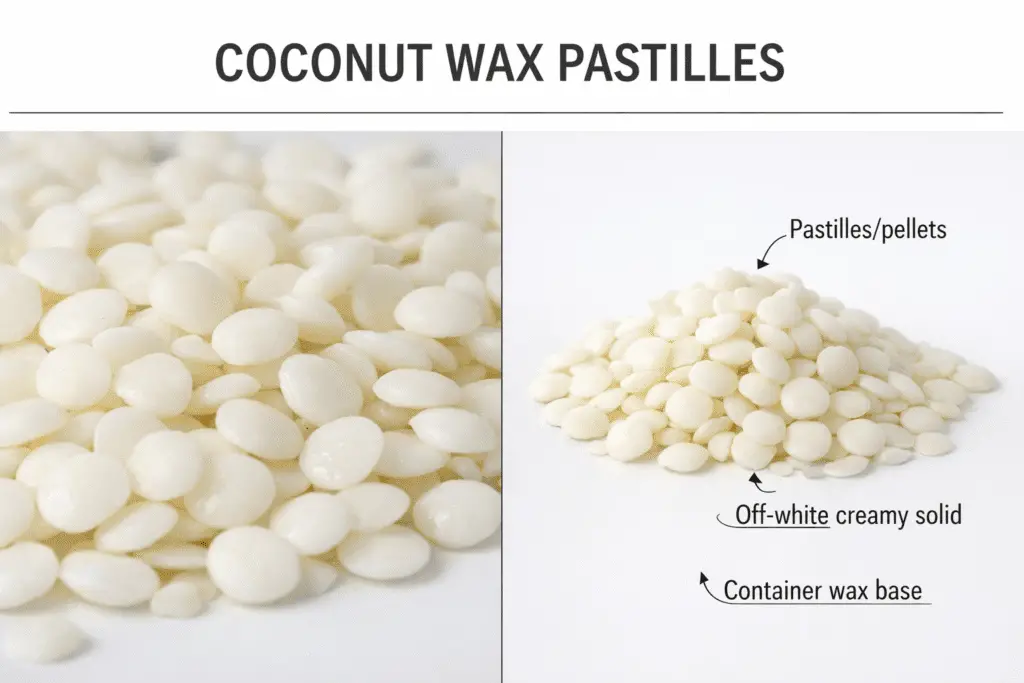
Candle makers meet coconut wax first as a smooth, off-white wax that sits in the same family as soy, palm, and other plant-derived waxes, not paraffin. Early on, it helps to explore candle wax types so you can see where coconut fits on the spectrum of burn speed, hardness, and scent potential. In manufacturing, coconut oil is refined and then hydrogenated so its fatty acids solidify at room temperature; that change in triglyceride structure raises the melt point and reduces natural odor, which is why well-refined coconut wax often looks clean and smells neutral according to many supplier safety data sheets (SDS). Suppliers still publish composition bands and melt-point ranges so makers can compare one coconut wax to another.
In practice, “coconut wax” on a label may describe anything from nearly 100% coconut to a performance blend that includes soy, small amounts of paraffin, or microcrystalline additives for adhesion and throw. To keep your mental model simple, treat coconut wax as the primary vegetable base and think of the extras as tuning knobs for hardness, glass adhesion, and scent diffusion. Makers who already know what soy wax is often picture coconut as a softer, creamier cousin that usually needs less heat to melt and can carry fragrance very well when paired with the right wick and cure time. That natural-origin story appeals to beginners, but serious testers still lean on supplier SDS and National Candle Association guidance when they compare blend labels or minimum testing requirements.
For a quick snapshot, you can think about coconut wax in three parts:
- Source & processing: Derived from coconut oil, then refined and hydrogenated to become a solid wax.
- Purity range: Sold as “pure” coconut or as blends where coconut is one component in a multi-wax system.
- Typical use: Best suited to container candles; pillar-ready blends usually add harder waxes or structuring additives.
Because marketing sometimes races ahead of lab work, brand owners also need to understand label claims before printing “100% coconut,” “natural,” or “vegan” on packaging; those words should match the actual blend and the documentation you keep on file, not just supplier sales copy. Thinking in terms of a simple entity–attribute–value trio—coconut wax (entity), composition (attribute), and blend ratio (value)—makes it easier to compare products from different suppliers and decide which one fits your testing plan.
How does coconut wax perform in candles? (burn, adhesion, aesthetics)
Coconut wax generally burns slowly and cleanly with a creamy finish, but its performance relies heavily on vessel size, wicking, fragrance load, cooling, and curing.
If you want to compare wax types for scent throw, coconut wax usually sits closer to soy than to paraffin: it can deliver rich hot throw, but only when the melt pool, wick capillarity, and fragrance formula are working together. Its relatively low melt point and soft texture encourage a wide, even melt pool, which helps scent diffusion, yet that same softness means poor wick choice can cause drowning, tunneling, or sooting more quickly than in harder paraffin blends.
From an adhesion and finish perspective, coconut wax is naturally good at wetting glass, which is why many makers love the smooth, “lotion-like” look in clear jars. However, that strong glass contact also makes it sensitive to temperature differences between melted wax and container, so rapid cooling or cold jars can create wet spots, micro-bubbles, or partial pull-away rings. Surface aesthetics are a trade-off: when cooled gently, coconut wax can give mirror-smooth tops; when poured too hot or cooled too fast, you may see faint swirl marks, small sinkholes, or frosting, especially in blends that borrow structural waxes from soy or other vegetable sources. Supplier SDS sheets and technical notes often recommend conservative pour-temperature and reheating ranges to preserve finish and minimize thermal stress.
Because so much of coconut wax performance depends on the system rather than the wax alone, testing routines matter as much as the choice of brand. Instead of guessing, start with a basic grid where you choose the right wick size for your jar diameter and fragrance load, log burn rate and flame height, and adjust one variable at a time. Getting cure-time basics right—often several days for simple blends and longer for heavy fragrance loads—prevents that common scenario where cold throw smells strong in the tin but hot throw is disappointing on the first burn. A simple notes table that tracks melt pool width, tunneling, soot, and surface changes across test burns helps you see whether a performance issue is rooted in the wick, the pour temperature, the fragrance oil, or the environment rather than blaming “bad wax.”
For a quick mental checklist, you can summarize coconut wax performance like this:
- Burn behavior: Typically slower, with shallow but wide melt pools that reward correct wick sizing.
- Scent potential: High, but strongly dependent on fragrance chemistry, load %, cure time, and room conditions.
- Finish & adhesion: Naturally creamy with strong glass adhesion; sensitive to cooling curve and jar temperature.
Pros and cons of coconut wax
Coconut wax gives smooth, clean-burning candles with strong scent potential, but it can be soft, pricey, and a bit fussy about handling.
For many makers, the biggest pros are the creamy appearance, easy glass adhesion, and the way coconut blends can carry fragrance without sooting when wicked correctly. On the downside, low melt points can cause sweating in warm rooms, formulas are often proprietary blends, and costs usually sit above classic soy or paraffin. If you sell candles, you also need to factor in supply variability and how “natural” claims will be interpreted by customers and retailers.
A quick way to think about coconut wax is that it behaves like a premium, softer container wax that rewards careful testing. When you wick and pour it well, you get glossy tops, quiet flames, and a pleasant hot throw; if you rush your testing, you can see tunneling, sweating, or rough tops that surprise newcomers. The choice often comes down to whether the aesthetic and customer perception justify the extra work and material cost in your own setup.
Main pros of coconut wax
- Smooth, creamy finish that often adheres nicely to glass and feels “luxury” in the hand.
- Generally clean burn with low visible soot when wick, jar, and fragrance are matched properly.
- Can carry a wide range of fragrance oils, especially in blends with soy or small amounts of harder waxes.
- Marketed as a plant-based option, which can support a more eco-conscious brand positioning.
Main cons of coconut wax
- Softer structure and lower melt point make it more sensitive to hot storage rooms and summer shipping.
- Usually more expensive per kilogram than soy; freight and import costs can swing prices noticeably.
- Many “coconut” products are blends with soy, palm, or paraffin, so performance varies brand to brand.
- Requires deliberate testing for wick size, fragrance load, and curing, rather than copying paraffin or soy recipes.
If these trade-offs feel acceptable, the next step is learning how to manage working temperature and cure time so your batches behave predictably rather than feeling like guesswork.
What actually changes coconut wax performance?
Coconut wax performance depends more on the full candle system than on the wax name alone.
Blend composition, wick choice, fragrance load, cure time, and pour conditions decide how the candle throws, burns, and finishes. That is why two “coconut wax” products can behave very differently in the same jar.
- Blend composition: “Coconut wax” may be mostly coconut or a coconut-heavy blend, so firmness, adhesion, and burn speed can vary by supplier.
- Wick and vessel match: A wick that is too small can mute throw and tunnel; a wick that is too large can overheat the jar and shorten burn time.
- Fragrance load and cure time: Good throw depends on the oil, the load %, and enough time for the candle to settle before testing.
- Pour and cooling conditions: Jar temperature, pour temperature, and room conditions strongly affect wet spots, sinkholes, and top smoothness.
This page only needs the performance takeaway. For setup details, move to the dedicated pages on wick sizing, cure time, and pour temperatures.
Is coconut wax good for scent throw?
Coconut wax can deliver strong, pleasant scent throw, but it only performs at its best when fragrance load, wick, and curing time are dialed in for the specific jar.
If you’re trying to compare wax types for scent throw, think of coconut as sitting between classic paraffin (often very strong) and under-tested soy blends (can be great, can be muted). On paper, coconut’s creamy texture and lower melt point help fragrance diffuse into the air quickly, but in the jar the real performance depends on melt-pool depth, room size, and how efficiently your wick pulls scented wax into the flame. In a small office or bedroom, a well-tested coconut blend can easily fill the space; in a big, open-plan living room, you may need larger jars, dual wicks, or multiple candles to get that same “wow” feeling.
Cold throw is how the candle smells before lighting, while hot throw is how it smells while burning; coconut wax can smell quiet cold and still perform well hot, or the reverse if the system is off.
Because scent throw is a system, wick choice is just as important as the wax itself. Makers who carefully choose the right wick size for each jar and fragrance see a huge improvement over those who copy a size from a paraffin or soy recipe. Under-wicking gives weak hot throw and tunneling; over-wicking can smell strong but burn too hot, soot, or finish the candle in half the time you expected. A simple method is to test at least three adjacent wick sizes in the same wax–jar–fragrance combo, then compare melt pool width, flame height, and scent strength after several hours.
Time is the other big lever. Many beginners pour a candle in the morning and light it that night, then assume the wax is “weak” when the hot throw disappoints. In reality, cure-time basics matter a lot: coconut blends often improve dramatically after several days as the wax structure relaxes and fragrance binds more evenly. A handy working rule is to cure light or citrus scents for at least a few days, and heavy, complex blends (gourmands, woods) for a week or more before judging them. Keeping a test log with pour date, first-burn date, and scent notes makes it easy to see how cure time changes results.
Practically, you can expect coconut wax to be “good for scent throw” when you: keep fragrance within your supplier’s recommended range, choose an efficient wick for your vessel, allow a proper cure, and test in the kind of room your customers will actually use the candle in.
Burn time & melt point (what to expect)
Coconut wax typically has a relatively low melt point and can burn for a long time compared with many paraffin candles of the same size, but real burn time depends heavily on wick, vessel, and usage habits.
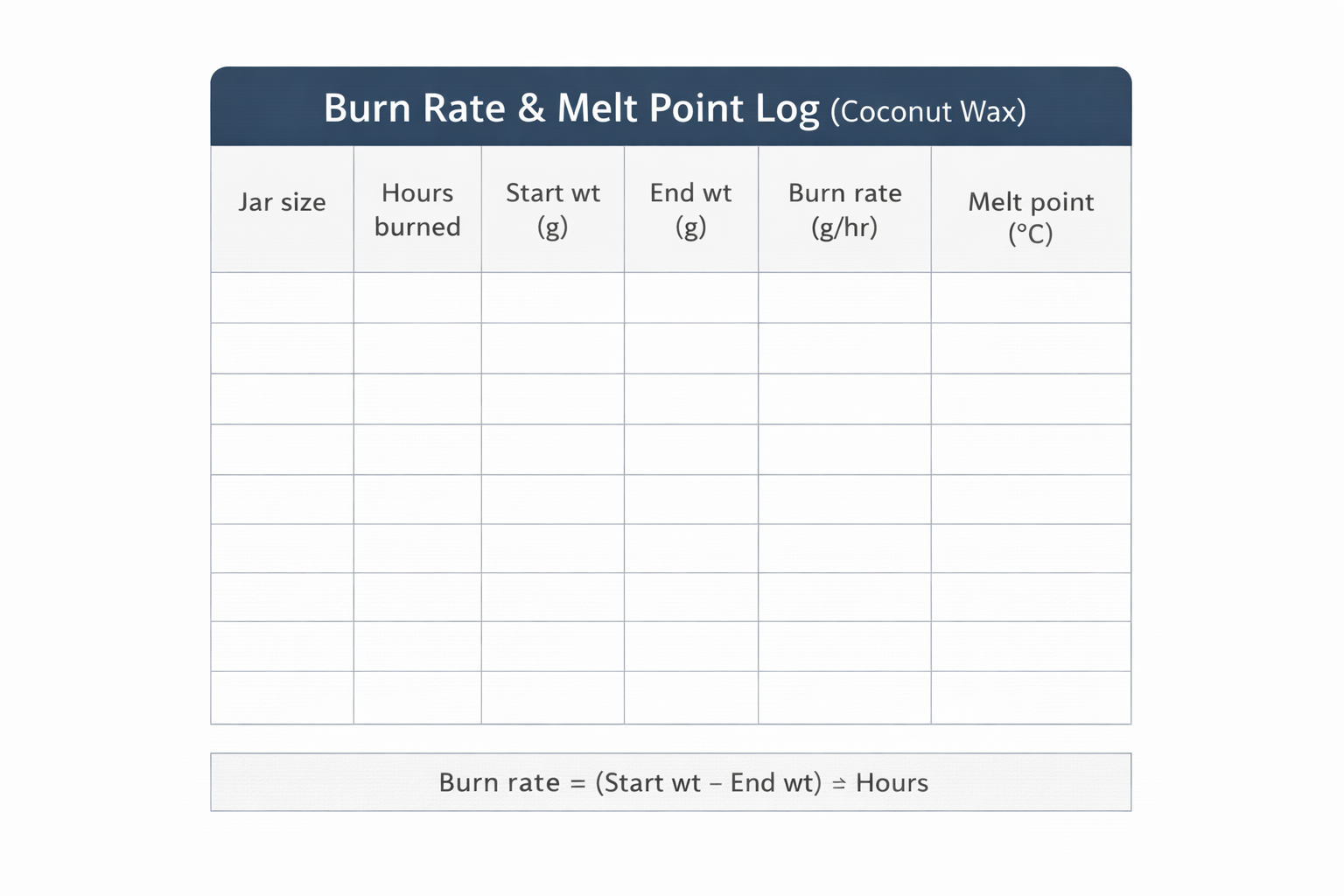
To get oriented, it helps to see wax melt-point ranges across common candle waxes. Published melt-point bands vary by blend, so melt point alone does not predict burn time. Coconut blends often melt at lower temperatures than many pillar-ready paraffins, which is why they feel soft and creamy in the container. That lower melt point means the wax forms a melt pool more easily, so if the wick is too large the candle can burn faster than you expect; if the wick is appropriately sized, the same property lets you achieve a full melt pool at a modest flame height and comfortable jar temperature. Makers who log hours burned against remaining wax quickly discover that wick and jar geometry matter more for burn time than the published melt point alone.
When you compare melt points by wax, you’ll notice that “pure” coconut, coconut–soy, and coconut–paraffin blends each behave a bit differently. Coconut–soy mixes may feel slightly firmer with similar or slightly higher melt points, while coconut–paraffin blends may burn hotter and faster. In a straight-sided container with a well-matched wick, many coconut-based candles burn more slowly than their paraffin counterparts but somewhat faster than very hard vegetable pillars. A simple test is to weigh your candle before the first burn, track total burn hours over several sessions, and weigh it again near the end; dividing grams used by hours gives you a burn rate you can compare across waxes and wick choices.
Safety and handling also tie into thermal properties, which is why makers are encouraged to understand flash points when working with fragrance oils. The flash point of a fragrance is the temperature at which its vapors can ignite in the presence of a flame or spark; it doesn’t mean the oil suddenly bursts into flames at that number, but it does warn you not to overheat materials or work near open flames when melting wax and blending fragrance. Using a thermometer, heating wax gently, and staying well below any listed flash points keeps both your pour temps and your testing routine inside a safer envelope.
In everyday terms, expect coconut wax to produce steady, comfortable burn times when you: choose sensible jar sizes, wick for a full but not overly deep melt pool, avoid drafts, and trim wicks between burns. The melt point tells you how easily the wax liquefies; real burn time depends on your wick, vessel, and burn habits.
Finish & surface behavior (smooth tops, wet spots, frosting)
Coconut wax can give very smooth candle surfaces but is prone to wet spots and frosting if temperatures and cooling curves are not controlled.
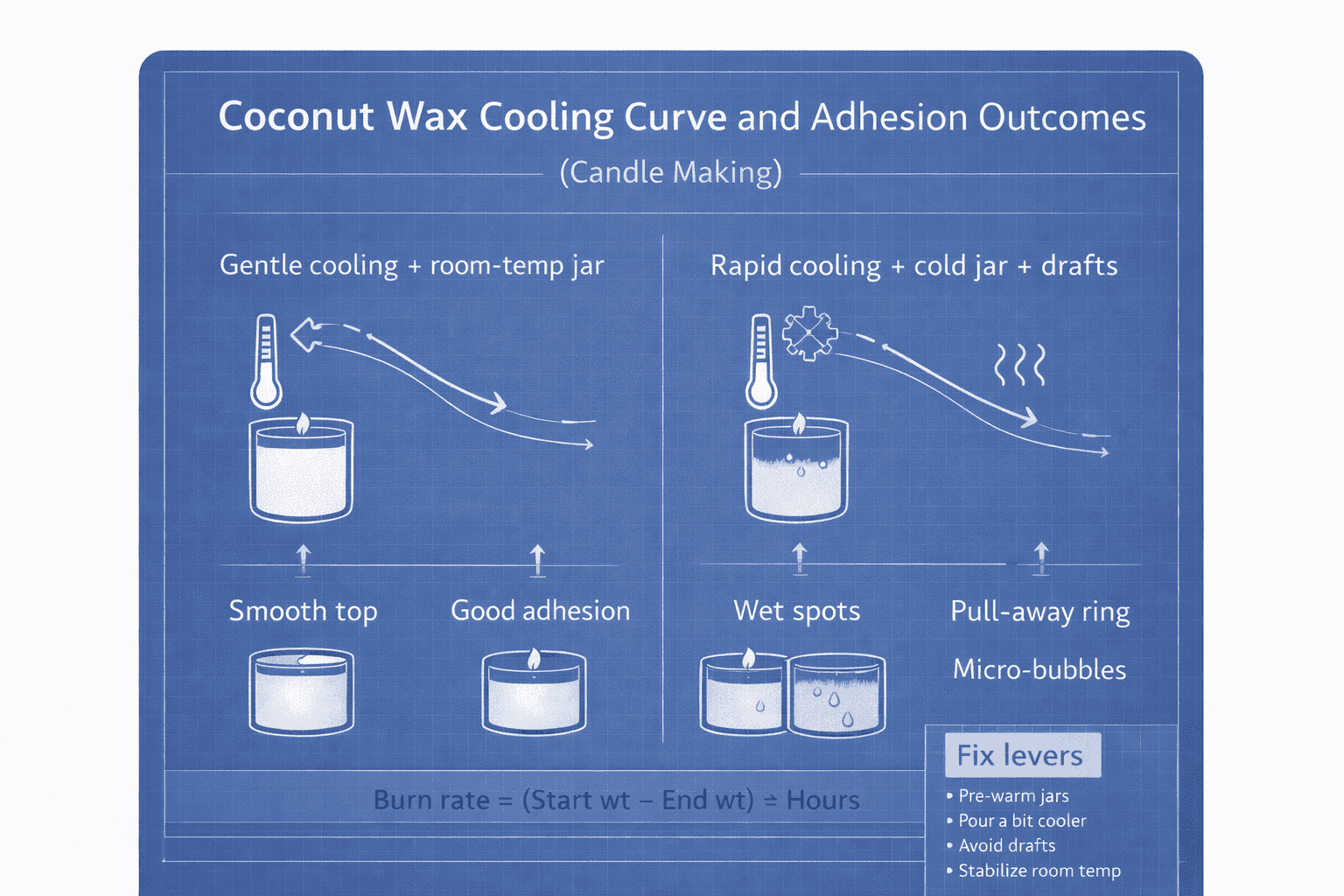
Many makers love coconut wax because it can produce smooth candle tops with a creamy, almost lotion-like appearance when everything goes right. That polished finish comes from good adhesion and gentle cooling: the wax shrinks only slightly as it sets, so it stays in close contact with the glass instead of pulling away. When the jar is at a comfortable room temperature, the pour is steady, and the cooling environment is stable, you often end up with a mirror-like surface that needs no heat-gunning or second pour.
Problems start when temperature differences creep in. If a hot batch goes into cold jars or a cool room, the wax contracts unevenly and you’ll see rings, small craters, or translucent patches along the glass. Many beginners search for ways to fix candle wet spots, but these marks are often just visual: they rarely affect burn safety or scent throw. You can reduce them by pre-warming containers slightly, pouring a bit cooler, and letting finished jars rest on a flat, room-temperature surface away from fans, open windows, or cold countertops.
Frosting is a separate quirk, especially in coconut blends that include soy or other vegetable waxes. Tiny crystalline structures form and scatter light, so you see white, cloudy patterns on the surface or sides of the candle. Learning to troubleshoot candle frosting means first accepting that some level of it is normal with high-vegetable formulas and then experimenting with slower cooling, modest fragrance loads, and avoiding sudden temperature swings in storage. A practical workflow is to pour test jars at two or three different temperatures, cool them in different spots (on a rack, in a box, under a loose towel), and check surfaces every 24 hours for a week.
From a brand point of view, the key is matching expectations: a luxury line might justify tighter climate control and more frequent repours to keep surfaces flawless, while a rustic or handmade aesthetic can treat minor frosting and wet spots as part of the charm—as long as burn quality stays consistent.
Who coconut wax is best for
Coconut wax is usually best for premium-looking container candles with strong scent potential, and it is less suited to rigid, low-cost formats. Many makers use it for container candles because the jar supports the softer wax.
It fits makers who want smooth jar finishes and are willing to test wick, fragrance, and cure variables carefully. It is a weaker fit when heat tolerance, pillar structure, or the lowest material cost matter most.
Coconut wax is usually a strong fit if you want:
- smooth, premium-looking container candles
- very good scent potential
- a softer plant-based wax system for jars
- a wax you are willing to test carefully
Coconut wax is usually not the best fit if you want:
- rigid free-standing pillars without blend support
- the lowest-cost wax option
- a wax that handles hot storage and shipping with minimal fuss
- one universal recipe that behaves the same across all brands
If you are still comparing materials across your line, the next step is to choose the right wax using the broader wax-selection page.
Use-case fit: containers vs pillars
Coconut wax excels in container candles but usually needs blending or structural support for reliable pillar performance.
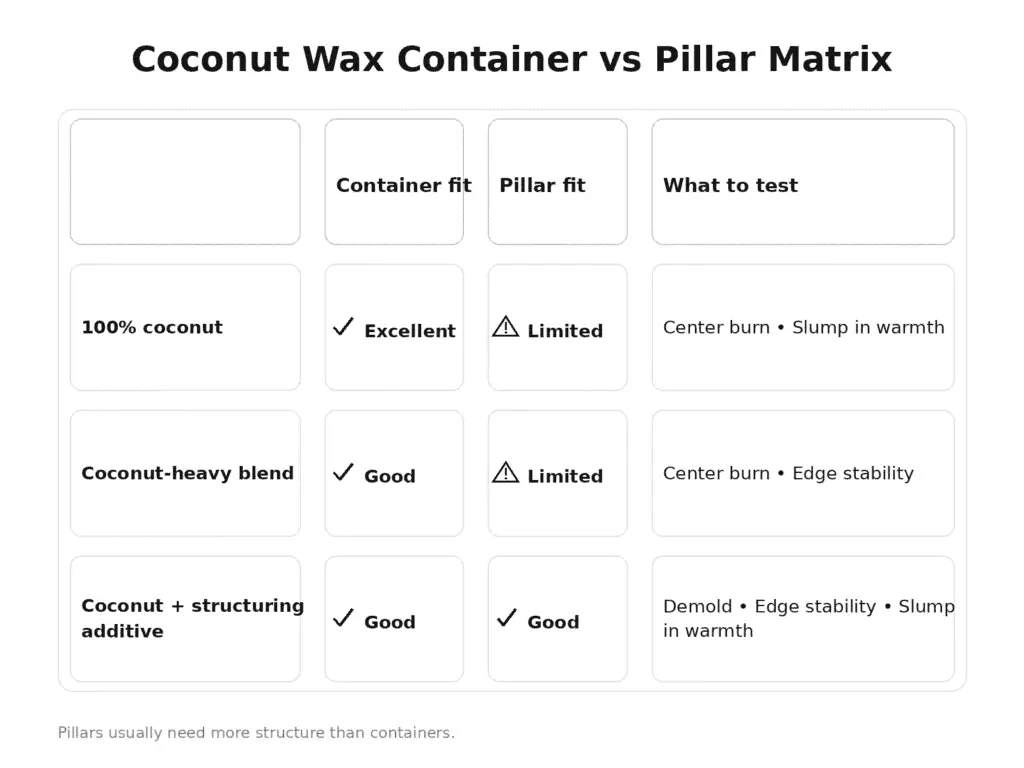
If your goal is to make everyday jar candles, coconut often feels like one of the best wax for container candles because of its adhesion, creamy look, and scent potential. The jar gives mechanical support, so the wax can stay relatively soft while still burning safely and neatly. This is where most coconut-based blends are designed to shine: straight-sided tumblers, tins, and other vessels where you can tune wick size, pour temperature, and cure time without worrying about the candle standing on its own. For many small brands, that makes coconut an attractive base for premium lines with smooth finishes and strong aroma.
Once you move into pillars and other free-standing shapes, structure becomes more important than creaminess. Pure coconut wax is usually too soft to hold complex molds or tall pillars without cracking, warping, or sagging, especially in warm climates. When evaluating coconut wax pillar performance, look for blends specifically advertised as pillar-ready or intentionally add harder waxes (like certain vegetable or paraffin components) in your own tests. Even then, you’ll need to test demolding, edge stability, and how the pillar burns down the center versus spilling over the sides.
For a broader side-by-side format choice, see best wax for pillar candles vs container candles.
Choosing the right base ultimately comes down to how you plan to choose wax for pillar vs container within your product range. A common strategy is to reserve coconut-heavy blends for containers where aesthetics and scent are the main selling points, while using separate, harder wax systems for pillars, votives, or melts. That way you can price and market each product honestly—highlighting the creamy, luxurious jar candles as a premium option—without fighting the structural limits of soft coconut in every format. For makers who want a single “house blend,” a coconut–soy or coconut–paraffin mix with enough hardness for simple molds can strike a workable compromise, but it will still require patient testing before you scale.
Quick answers about coconut wax
These short answers cover the most common follow-up questions about coconut wax, especially purity, scent, pillar use, and cure time.
Does coconut wax smell like coconut?
Usually no. Well-refined coconut wax is generally neutral, which is why it works well with added fragrance.
Is coconut wax usually pure?
Not always. Many products sold as coconut wax are blends, so check the technical sheet before making performance or label claims.
Is coconut wax better than soy for scent throw?
It can be, but not automatically. In real candles, wick choice, fragrance chemistry, jar size, and cure time matter as much as the wax base.
Can you use coconut wax for pillar candles?
Sometimes, but usually only in pillar-ready blends. Most coconut-heavy formulas are easier to manage in containers than as free-standing candles.
How long should coconut wax cure before testing?
Start with several days, then compare results across a few cure points in your own jar and fragrance system instead of assuming one universal number.
Sustainability & sourcing (what to know)
Coconut wax can support a more plant-based positioning, but the real sustainability story depends on the exact blend, sourcing, processing, and shipping footprint.
A “coconut wax” product is not automatically pure coconut or automatically low-impact. For this page, the practical rule is simple: check what is actually in the blend before making claims about being natural, vegan, or sustainable.
If a supplier cannot verify the blend or support the wording with documentation, treat the claim as uncertain rather than as packaging fact. That keeps this page focused on performance while deeper sourcing, labeling, and compliance guidance can live on dedicated pages.
Short safety note when working with coconut wax
The practical safety rule is simple: melt gently, track temperature with a thermometer, ventilate the workspace, and keep fragrance oils away from open flames and overheated equipment.
Coconut wax does not need a full compliance-style detour on this page, so deeper standards and labeling guidance belong on candle safety compliance.