

Soy wax is a candle-making wax made from processed soybean oil and used most often for container candles, scented jar candles, tins, and other vessel-supported candle formats.
It helps candle makers decide whether a plant-based wax fits their candle format, scent goals, finish expectations, and beginner skill level.
Soy wax can be a good choice for simple container candles, but plant-based does not automatically mean non-toxic, organic, fully sustainable, or best for every candle type.
This guide explains what soy wax is, how it performs, its main pros and cons, and when another wax or blend may fit better. Detailed wick sizing, frosting prevention, cure-time schedules, fragrance formulas, and full wax comparisons belong in separate guides.
What Is Soy Wax?
Soy wax is a candle-making wax made from processed soybean oil.
It is commonly used for container candles, scented jar candles, tins, and other vessel-supported candles because it is softer than many waxes and works well when a jar or tin supports the candle. In Candle Wax Types, soy wax sits in the plant-derived wax group, but plant-based only describes its source material.
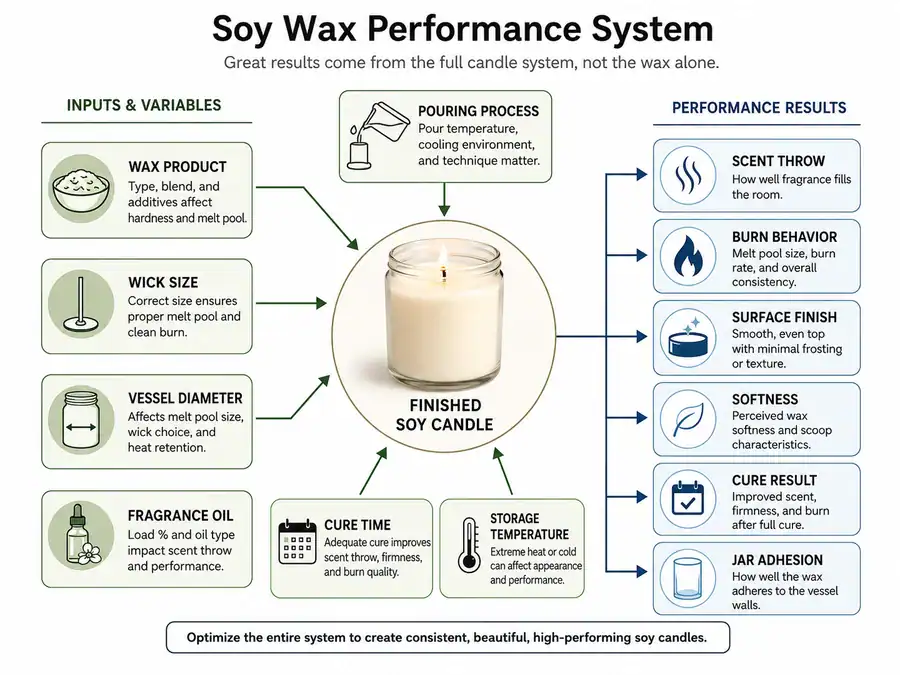
Soy wax is not the same as liquid soybean oil. Soybean oil is processed into a wax form that can melt, hold fragrance, set inside a container, and burn with a wick when the full candle system is made correctly.
Soy wax is usually made by hydrogenating soybean oil, which changes liquid oil into a solid wax; exact hardness and melting behavior vary by supplier product and blend.
| Term | What it means | Why the difference matters |
|---|---|---|
| Soy wax | A candle-making wax made from processed soybean oil | This is the raw wax material candle makers choose before making a candle |
| Soybean oil | Liquid oil from soybeans | This is not the same as ready-to-use candle wax |
| Soy candle | A finished candle made with soy wax or a soy-containing blend | The finished candle’s performance depends on wax, wick, fragrance, vessel, and curing |
| Soy blend | Soy wax mixed with another wax or additive | A blend may change scent throw, hardness, finish, or mold performance |
Soy wax differs from paraffin, beeswax, and soy blends by source material and performance profile. A full soy-versus-paraffin or soy-versus-blend decision needs a separate comparison because scent throw, burn behavior, sustainability language, and candle format can all change the answer.
When choosing a wax, treat soy wax as the material, not the finished result. The final candle still depends on the fragrance oil, wick, jar, pouring process, and cure time.
What Is Soy Wax Used For in Candle Making?
Soy wax is used most often for container candles, scented jar candles, tins, and other vessel-supported candle formats.
It fits these formats because the container supports the softer wax while the candle burns. “Best use” means format fit, not that soy wax is the best wax for every candle type.
Soy wax is a strong match for many home-fragrance candles because it can hold fragrance and set in jars when the wick, vessel, fragrance oil, and cure time are matched. For wick questions, it is better to choose a wick for soy candles with a dedicated wick guide rather than guessing from the wax type alone.
| Candle format | Soy wax fit | Reason | Better route if it is a poor fit |
|---|---|---|---|
| Container candles | Strong fit | The vessel supports the softer wax | Choose a wick for soy candles |
| Scented jar candles | Strong fit with testing | Common home-fragrance use, but scent depends on the full formula | Check fragrance and cure guidance |
| Tin candles | Strong fit | Vessel-supported and beginner-friendly | Compare candle wax types if heat or travel use matters |
| Wax melts | Conditional | Soy wax can work, but firmness and melt behavior vary | Compare wax types or blends |
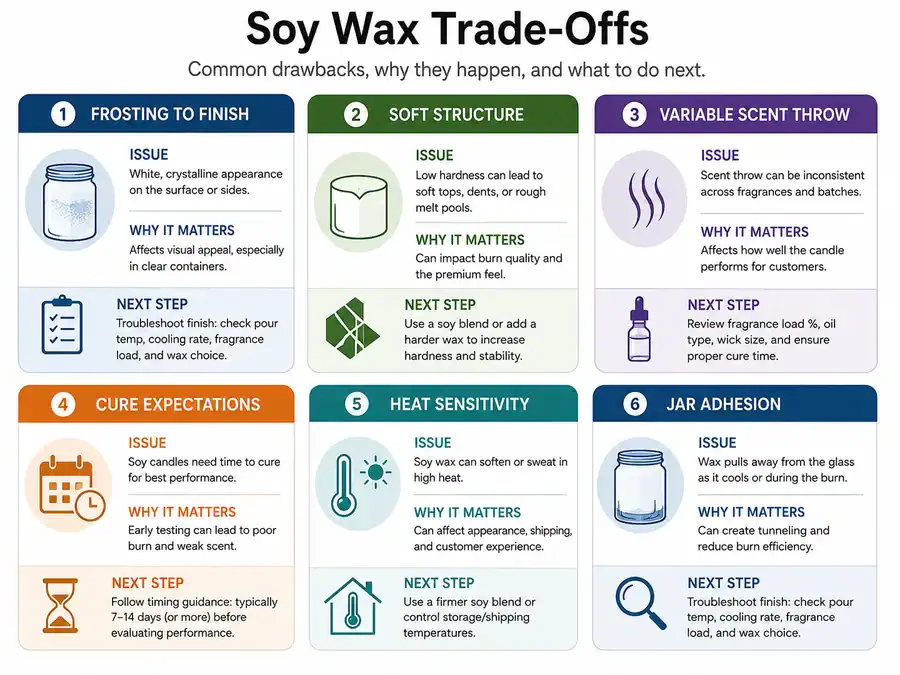
| Pillar candles | Usually poor fit unless blended | Pure soy wax can be too soft without a container | Compare soy wax and soy blend for scented candles |
| Complex molded candles | Conditional to poor fit | Mold release and structure may need a harder wax | Compare candle wax types |
Soy wax can be used for wax melts, but the expected texture, snap, and melt behavior may differ from harder waxes or blends. That makes wax melts a conditional use, not a guaranteed best fit.
Soy wax is usually a poor choice for unsupported pillars unless it is blended or formulated for that purpose. For molded candles, outdoor candles, or candles that need higher structure, another wax or soy blend may be a better match.
How Does Soy Wax Perform in Candles?
Soy wax can perform well in container candles, but scent throw, burn behavior, surface finish, and cure results depend on the full candle system.
Performance means how the finished soy candle burns, smells, sets, adheres to the jar, and holds up after curing. Soy wax has material tendencies, but the wick, vessel, fragrance oil, pouring process, wax type, and cure time control the final result.
| Performance area | Typical soy wax tendency | What affects it | When to use a deeper guide |
|---|---|---|---|
| Scent throw | Can be good but variable | Fragrance oil, fragrance amount, wick, vessel, and cure | What Happens If You Add Too Much Fragrance To Soy Wax? |
| Burn behavior | Often steady in containers | Wick size, vessel diameter, wax formula, and burn testing | Best Wicks for Soy Candles |
| Surface finish | May frost, texture, or look uneven | Cooling rate, storage, wax type, and temperature changes | Soy Wax Frosting: Causes and Prevention |
| Softness | Softer than some candle waxes | Wax type, blend choice, room temperature, and candle format | Soy Wax vs Soy Blend: Which Is Better for Scented Candles? |
| Cure expectations | Often benefits from curing before use | Wax, fragrance oil, vessel, and testing goal | How Long Should Soy Candles Cure Before Burning? |
| Jar adhesion | Can vary from batch to batch | Vessel temperature, wax contraction, cooling, and jar surface | Use troubleshooting only if adhesion becomes a repeated defect |
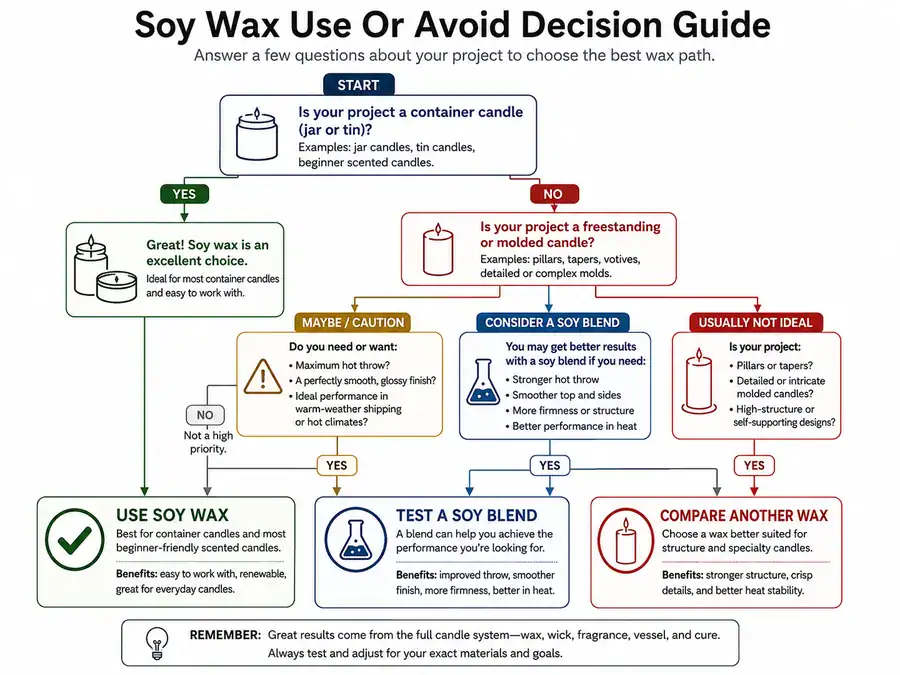
Soy wax is often described as slow-burning or good for fragrance, but those results are not guaranteed by soy wax alone. A well-matched soy candle can burn evenly and smell pleasant, while a poorly matched candle may tunnel, smell weak, frost, or separate from the jar.
Frosting is usually an appearance issue, not automatic candle failure. If frosting becomes the main problem, treat it as a finish troubleshooting topic rather than a reason to rewrite the whole wax choice.
For candle makers comparing materials, this performance profile places soy wax near the container-friendly side of Candle Wax Types. It is less ideal when the candle needs a hard unsupported structure, extreme scent strength, or a perfect glossy finish without testing.
What Are the Pros of Soy Wax?
The pros of soy wax are practical candle-making advantages and consumer-positioning benefits, not proof that every soy candle is safer or better.
Soy wax is popular because it is plant-based, widely available, familiar to buyers, and well suited to many beginner container candles. Those strengths matter most when the candle goal is a scented jar, tin, gift candle, or home-fragrance product.
| Claimed pro | What it means in practice | Useful when | Caveat |
|---|---|---|---|
| Plant-based origin | Soy wax is made from soybean-derived material | You want a vegetable-source candle wax | Plant-based does not prove non-toxic, organic, or impact-free |
| Good for containers | The softer wax works well with vessel support | You are making jars, tins, or other container candles | It is not automatically ideal for pillars |
| Beginner-accessible | Soy wax is common and approachable for simple projects | You are making a first container candle | It still needs wick, fragrance, and cure testing |
| Consumer-friendly positioning | Many shoppers recognize “soy candle” as a familiar label | You are making gifts or home-fragrance candles | Clean, natural, and eco claims must stay accurate |
| Scented candle use | Soy wax is commonly used in scented jars | You want moderate home-fragrance performance | Strong scent depends on the full formula |
| Wide availability | Many candle suppliers sell soy wax or soy blends | You want easy material access for small batches | Supplier products can perform differently |
Soy wax works especially well when the candle maker wants a clear material story without moving into heavy technical claims. A label can say the candle uses soy wax when that is accurate, but it should not imply medical safety, legal compliance, or full environmental neutrality without proof.
The biggest practical benefit is container fit. Soy wax’s softer nature can be a drawback for pillars, but it works in jars and tins because the vessel supports the wax during burning.
Soy wax can be compared with paraffin or beeswax, but this section should not become a full wax-versus-wax debate. For safety, soot, scent, or natural-wax comparisons, use Soy vs Paraffin: Safety, Soot, and Performance Compared or Soy vs Beeswax Candles: Which Burns Better?
What Are the Cons of Soy Wax?
The cons of soy wax are material trade-offs that affect finish, scent, structure, curing, and container performance.
These drawbacks do not mean soy wax is a bad candle wax. They mean soy wax needs the right candle format, realistic scent expectations, and testing before it is used for finished candles or sold as a product.
| Soy wax trade-off | What it means | Why it matters | Better next step |
|---|---|---|---|
| Frosting | White or crystal-like marks can appear on the candle surface | It can make the candle look less smooth, even when the candle still burns | Use a frosting-specific troubleshooting page |
| Softer structure | Pure soy wax is often too soft for unsupported candles | Pillars and molded shapes may slump, crack, or release poorly | Compare soy wax with soy blends |
| Variable scent throw | Fragrance strength can change by wax, oil, wick, jar, and cure | A soy candle may smell weaker than expected if the system is mismatched | Use fragrance-load and cure guidance |
| Cure expectations | Soy candles often need time before best scent testing | Burning too soon can make scent results misleading | Use a cure-time page when timing is the main issue |
| Heat sensitivity | Soy wax can soften in warm storage or shipping conditions | This matters for summer markets, delivery, and hot rooms | Consider a firmer wax or blend |
| Jar adhesion issues | Wet spots or separation can appear near the glass | The candle may look uneven in clear jars | Treat it as a finish issue if it repeats |
Frosting is the most common appearance complaint with soy wax. It does not always mean the candle is unsafe or unusable, but it can matter for gifts, retail shelves, or brands that need a smooth visual finish.
Scent throw is another common concern. Soy wax can make pleasant scented candles, but strong fragrance depends on the fragrance oil, wick, vessel, cure time, and wax formula. Adding more fragrance is not always the fix and can create new burn or sweating problems.
Soy wax is not the best choice when the candle needs a firm freestanding shape. A pillar candle, taper, or detailed molded candle often needs a harder wax, a soy blend, or another candle wax type built for structure.
When Should You Use Soy Wax — and When Should You Avoid It?
Use soy wax when you are making container candles and want a plant-based wax with beginner-friendly handling and familiar consumer appeal.
Avoid pure soy wax when the candle needs a hard freestanding structure, a flawless glossy finish, extreme scent strength, or strong heat resistance without blending. “Best” means best use-case fit, not best wax in every situation.
| Candle-making goal | Use soy wax? | Why |
|---|---|---|
| Beginner jar candles | Yes | The container supports the softer wax, and the format is easier to learn |
| Scented home-fragrance jars | Yes, with testing | Soy wax is common for scented candles, but scent still depends on the full candle system |
| Gift candles in tins | Yes | Tins support the wax and hide some sidewall appearance issues |
| Eco-positioned product line | Yes, with careful wording | Soy wax has a plant-based source, but claims must stay accurate |
| Pillar candles | Usually no | Pure soy wax is often too soft without a container |
| Detailed molded candles | Usually no | Structure and mold release may need a harder wax or blend |
| Maximum hot throw | Maybe | A soy blend or another wax may perform better depending on the fragrance and wick |
| Perfect smooth finish | Maybe | Frosting and texture can occur, especially with temperature changes |
| Warm-weather shipping | Maybe | Softer wax may need a firmer blend or packaging controls |
Soy wax is a strong match for candle makers who want to start with jars, tins, and small-batch scented candles. It gives a clear starting point without forcing a maker into advanced wax blending.
Soy wax is a weaker match when the candle has to stand on its own. If the design needs sharp details, high firmness, or less heat sensitivity, a soy blend or another wax may be a safer material choice.
Soy wax has a comparison boundary. If the main question is whether soy wax beats paraffin, beeswax, or a soy blend, that decision needs a dedicated comparison because the answer changes by scent, soot, structure, cost, and product goal.
For broader material selection, compare Candle Wax Types. For scent-focused jar candles, compare soy wax and soy blend before choosing a wax.
Is Soy Wax the Same as Soy Blend?
Soy wax and soy blend are not always the same candle-making material.
Pure soy wax is based on soy-derived wax, while a soy blend mixes soy wax with another wax or additive to change performance. A blend may improve hardness, scent throw, smoothness, mold release, or heat resistance, depending on what is added.
| Material | What it means | Common reason to choose it |
|---|---|---|
| Soy wax | Wax made from processed soybean oil | Simple container candles and plant-based positioning |
| Soy blend | Soy wax mixed with another wax or additive | Better structure, scent, finish, or heat behavior |
| Non-soy wax | Wax type that does not rely on soy as the main material | Pillars, specific finish goals, or different burn traits |
Do not assume every “soy candle” is made from pure soy wax. Product labels and supplier descriptions may use soy language even when the wax is a blend.
For scented candles, soy blend questions deserve a separate comparison because the blend formula can change the result more than the word “soy” suggests.
Is Soy Wax Natural, Eco-Friendly, or Non-Toxic?
Soy wax is plant-based, but that does not automatically make every soy candle natural, eco-friendly, or non-toxic.
On this page, those terms describe claim wording and candle-making use, not medical safety proof, emissions certification, or full supply-chain sustainability.
Plant-based means soy wax comes from soybean-derived material. It does not prove how the soy was farmed, how the wax was processed, what additives were used, which fragrance oil was added, or how the finished candle burns.
| Claim | Safe meaning | What it does not prove |
|---|---|---|
| Plant-based | The wax source is tied to soybeans | The finished candle is impact-free |
| Natural | The wax is often marketed as a natural-source material | Every ingredient in the candle is natural |
| Eco-friendly | The candle may fit an eco-positioned product line | The whole supply chain has low impact |
| Clean-burning | The candle may be positioned against soot-heavy options | The candle cannot soot, smoke, or burn poorly |
| Non-toxic | A brand may be making a safety claim | Soy wax alone proves the finished candle is non-toxic |
| Safe | The finished candle may be designed and tested for normal use | Soy wax origin alone proves every finished candle is safe |
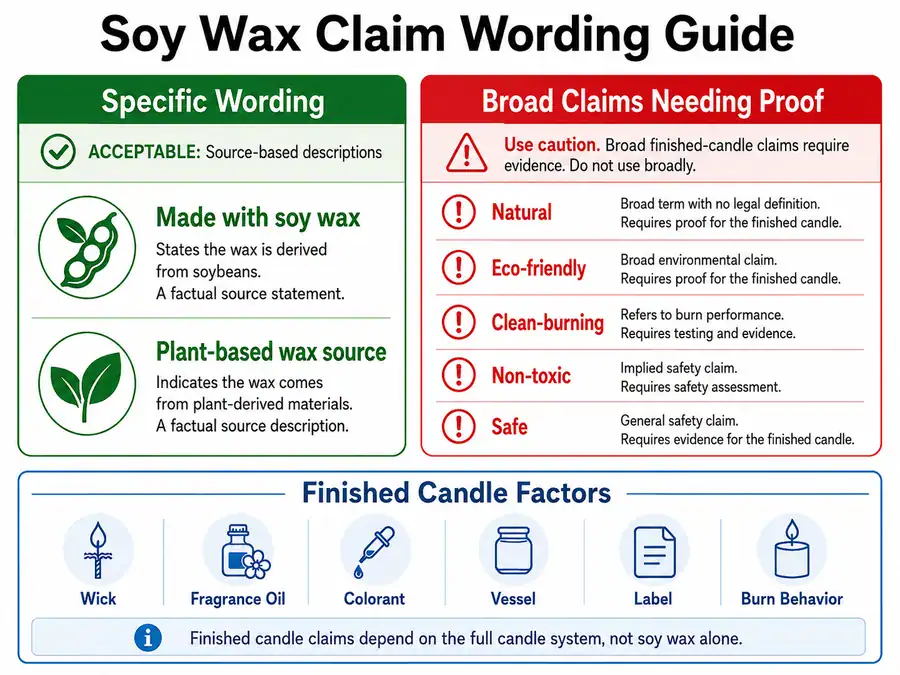
A finished soy candle is more than soy wax. It includes a wick, fragrance oil, colorant if used, vessel, label, and burn behavior. Any broad safety or environmental claim should match the full candle, not only the wax source.
For candle makers, the safest wording is specific. “Made with soy wax” is clearer than saying the candle is automatically clean, safe, or eco-friendly. If the main question is safety, soot, or wax comparison, use Soy vs Paraffin: Safety, Soot, and Performance Compared instead of treating soy wax alone as the full answer.
Soy wax can support an eco-positioned candle line, especially when buyers want plant-based wax. It still needs careful claim language because “plant-based” is a source description, not proof of total sustainability or safety.
Is Soy Wax a Good Choice for Beginners?
Soy wax is a good beginner wax when the first project is a simple container candle.
It is less beginner-friendly when the goal is a pillar, detailed mold, high-gloss finish, or maximum scent strength without testing. Beginner-friendly means easier to start with in jars and tins, not failure-proof.
| Beginner situation | Soy wax fit | Why |
|---|---|---|
| First jar candle | Good fit | The jar supports the softer wax |
| First tin candle | Good fit | Tins hide some sidewall finish issues |
| First scented candle | Good fit with testing | Soy wax is common for scented containers |
| First pillar candle | Poor fit | Pure soy wax may be too soft without support |
| First product line | Conditional | It works well if finish, scent, labeling, and storage are tested |
| First market batch | Conditional | Heat, shipping, scent, and appearance need trial burns and checks |
Use this beginner checklist before choosing soy wax for a first candle project:
- Choose soy wax for a jar, tin, or other container candle.
- Avoid pure soy wax for a first pillar or detailed molded candle.
- Keep the first test narrow: one wax, one container, one fragrance, and one wick path.
- Judge the candle by burn quality, scent, finish, and appearance, not by the word “soy” alone.
- Use a separate guide to choose a wick for soy candles.
- Use a separate guide to understand soy candle cure time.
- Compare soy wax and soy blend if scent strength, smooth finish, or heat resistance becomes the main goal.
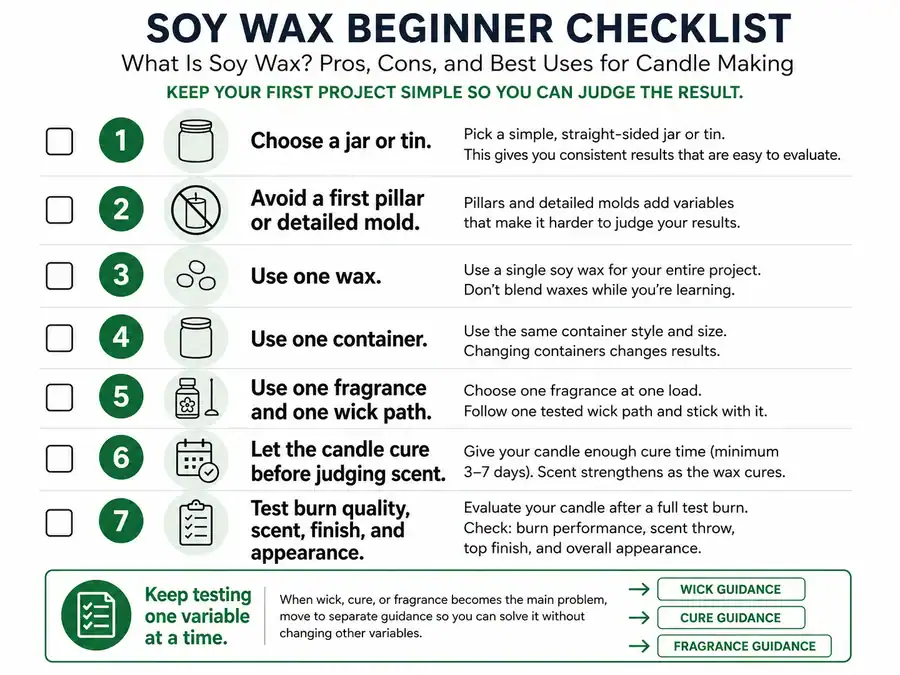
A beginner should choose soy wax when the project is narrow: one container style, one fragrance, one wick series, and a clear cure plan. Changing too many parts at once makes it harder to know whether the wax, wick, fragrance, or vessel caused the result.
Soy wax is forgiving for learning container candles because it is common, easy to find, and familiar to buyers. It still needs testing before gifting, selling, or scaling a batch.
If the main question becomes “which wick,” “how long to cure,” or “how much fragrance,” move to a specific guide. Those questions depend on the full candle system and should not be solved by the wax name alone.
FAQs About Soy Wax for Candle Making
These FAQs answer short soy-wax explainer questions; detailed wick, cure, frosting, fragrance, and comparison questions should stay in their dedicated guides.
What is soy wax made from?
Soy wax is made from processed soybean oil that has been turned into a wax suitable for candle making. It is not the same as raw liquid soybean oil. In candles, soy wax is chosen as a solid or flake wax that can melt, set in a vessel, hold fragrance, and burn with a wick.
Is soy wax better for jars or pillars?
Soy wax is usually better for jars than pillars. Jars, tins, and containers support the softer wax while it burns. Pure soy wax is often a poor fit for freestanding pillars because those candles need more structure. A soy blend or harder candle wax may work better for pillars.
Does soy wax hold fragrance well?
Soy wax can hold fragrance well, but fragrance strength depends on the full candle system. The fragrance oil, wax product, wick, vessel, cure time, and burn test all affect scent throw. If scent is weak, do not assume adding more fragrance is the fix without checking the full formula.
Why does soy wax frost?
Soy wax can frost when white or crystal-like marks appear on the candle surface. Frosting is usually an appearance issue, not automatic candle failure. It can matter for retail finish or gifting, but prevention steps belong in a dedicated soy wax frosting guide rather than a general wax explainer.
Is soy wax natural?
Soy wax is often described as natural because it comes from soybean-derived material. That wording still needs care. Soy wax origin does not prove that every ingredient in the finished candle is natural, organic, impact-free, or safer than every alternative. “Made with soy wax” is usually clearer than a broad natural claim.
Is soy wax the same as soy blend?
Soy wax and soy blend are not always the same. Pure soy wax is based on soy-derived wax. A soy blend combines soy wax with another wax or additive to change scent throw, firmness, smoothness, heat behavior, or mold performance. For scented jars, blend choice can change the finished candle result.
Is soy wax good for beginners?
Soy wax is good for beginners when they start with container candles. It is familiar, widely available, and well suited to jars and tins. It is not mistake-proof. Wick choice, fragrance, vessel size, cure time, and testing still affect whether the finished candle burns well and smells strong enough.
Final Verdict: Should You Use Soy Wax for Candles?
Use soy wax when you want a plant-based candle wax for container candles, scented jars, tins, or beginner-friendly home-fragrance projects.
Choose another wax or a soy blend when the candle needs a freestanding shape, stronger structure, higher heat resistance, a smoother retail finish, or a different scent-performance profile. Soy wax is a strong material fit for many container candles, but it is not a universal upgrade over every other candle wax.
For most beginners, soy wax is a sensible first wax for jar candles. Start with one container, one fragrance, one wick path, and one wax product, then judge the candle by burn quality, scent, finish, and appearance rather than the word “soy” alone.