
Candle waxes can be safe for home use when the wax, wick, vessel, fragrance, additives, room conditions, and burn test all work together.
Candle wax types are the fuels used in candles, including soy, paraffin, beeswax, coconut wax, and blends. On this page, “safe” means practical candle-use safety, not zero emissions, chemical-free wax, or medical safety for every person or pet.
Candle-grade wax means wax sold or documented for candle making, with supplier guidance for melting, fragrance use, and burning behavior.
A finished candle system includes wax, wick, vessel, fragrance, additives, burn time, room conditions, and user behavior. The best safety choice is the wax that burns cleanly in its final setup, has supplier documentation, and passes a careful burn test.
What “Safe Candle Wax” Means
Safe candle wax means practical candle-use safety in the finished candle, not a guarantee that one raw wax type is risk-free.
Candle wax types include soy, paraffin, beeswax, coconut wax, and blends. A safe candle wax is judged by how the wax behaves with its wick, vessel, fragrance, additives, burn time, room conditions, and handling.
A wax label alone does not prove a candle is safe. The safer question is whether the finished candle burns with a steady flame, low visible smoke, controlled vessel heat, suitable scent load, clear supplier information, and repeatable burn-test results.
| Safety question | What it checks | Better decision |
|---|---|---|
| Is this wax type suitable for candles? | The wax is made and sold for candle use. | Use candle-grade wax from a supplier that gives handling notes. |
| Is the wax “non-toxic”? | The claim is often too broad. | Look for clear ingredients, safe-use notes, and burn behavior instead of a single label claim. |
| Is it natural? | Natural wax can still smoke, overheat, or carry scent and additive issues. | Treat “natural” as a material description, not a safety guarantee. |
| Is it clean burning? | The phrase can hide wick, fragrance, and room-condition problems. | Watch the flame, soot, smoke, odor, and vessel heat during testing. |
| Is it chemical-free? | All waxes are made of chemicals, including natural waxes. | Ask what is in the wax and whether it is suited to candle burning. |
| Is it safe indoors? | Indoor use depends on flame quality, ventilation, burn time, and sensitivity. | Burn candles in a ventilated room and stop using candles that smoke or smell harsh. |
| Is it safe for every person or pet? | Sensitive users and animals may need stricter limits. | Use a cautious boundary and route health or pet-specific concerns to the proper guide. |
| Is it safe to sell? | Finished-product safety needs repeatable testing and documentation. | Keep burn logs, supplier documents, and claim language conservative. |
“Safe” on this page means the wax is suitable for candle use, handled at proper temperatures, matched with the right wick, used in a fitting vessel, scented within supplier guidance, and tested before regular use.
It does not mean zero emissions, medical safety, allergy safety, pet safety, legal certification, or proof that one wax type is always safer than another.
Cleveland Clinic treats candle-related exposure as a combined question because wax type, wax quality, fragrance, ventilation, and burn behavior can all affect emissions and user comfort.
Wax safety also does not replace finished-candle fire-safety testing, medical guidance, pet guidance, legal compliance, or product-sale approval.
For wick, fragrance, container, medical, pet, or legal safety questions, this page gives only the wax-level answer. The deeper decision belongs in a wick sizing guide, fragrance oil safety guide, container safety guide, pet-safe candle guide, sensitive-user guide, or supplier documentation checklist.
Is Soy Wax Safe for Candles?
Soy wax can be suitable for candles when it is properly formulated, wicked, scented, used in a fitting vessel, and burn-tested.
Soy wax is a vegetable-based candle wax usually made from processed soybean oil. For candle wax types, soy is often chosen for container candles, but “soy” may mean pure soy wax or a soy blend with other waxes or additives.
Soy wax is not automatically safer because it is plant-based. A poorly wicked soy candle can smoke, tunnel, overheat the vessel, or give off a harsh odor if the fragrance load is wrong.
A well-made soy candle should burn with a stable flame, an even melt pool for its design, low visible soot, and no strong fuel-like or scorched smell.
Use soy wax when the supplier states that the wax is made for candles, gives melting and fragrance-use guidance, and identifies whether the product is pure soy or a blend. If the wax is sold as “natural” or “non-toxic,” treat that as marketing language until the finished candle passes a burn test.
Soy wax is often a good beginner choice because many container-wax products come with supplier guidance and maker support. The safety limit is that soy can be sensitive to wick choice, fragrance amount, dye use, and vessel shape.
A soy candle that looks safe in raw form can still fail when the flame, scent, and glass are added.
Soy wax is a stronger safety choice when it meets these conditions:
| Soy wax condition | Why it matters |
|---|---|
| Candle-grade product | Reduces the risk of using wax not made for burning. |
| Clear blend disclosure | Helps avoid false assumptions about “100% soy” or mixed wax behavior. |
| Supplier fragrance guidance | Keeps scent load from overwhelming the wax system. |
| Matched wick | Reduces smoking, mushrooming, tunneling, and overheating. |
| Controlled vessel heat | Helps catch container stress before regular use. |
| Repeatable burn test | Confirms the wax works in the finished candle, not just on paper. |
Soy wax should be avoided or retested when the candle smokes after trimming, leaves heavy soot on the vessel, smells scorched, creates unstable flame movement, overheats the container, or changes behavior across repeated burns.
These are finished-candle warning signs, not proof that soy wax itself is unsafe in every candle.
For product selection, treat soy wax safety as the first screen, not the full buying decision. A wax comparison guide can compare scent throw, finish, price, cure behavior, and blend performance without turning this safety section into a wax shopping guide.
Is Paraffin Wax Safe or Toxic?
Paraffin wax is not judged safe or unsafe by petroleum origin alone; the finished candle’s formulation and burn behavior matter.
Paraffin wax is a petroleum-derived candle wax used in containers, pillars, votives, tealights, and scented candles. The useful safety question is not “Is paraffin toxic?” by itself.
The better question is whether the paraffin candle uses candle-grade wax, a matched wick, a suitable fragrance load, controlled burn time, steady flame behavior, and enough room ventilation.
Paraffin has higher safety controversy because it is petroleum-derived and can be linked in public discussion with soot and indoor-air concerns. That origin does not prove every paraffin candle is unsafe.
A poorly made soy, beeswax, or coconut candle can smoke, soot, or overheat too.
| Paraffin safety claim | Better candle-use question |
|---|---|
| Paraffin is toxic. | Does this paraffin candle burn cleanly in its finished setup? |
| Petroleum-derived means unsafe. | Is the wax candle-grade, documented, and burn-tested? |
| Soy is always safer than paraffin. | Which finished candle shows less soot, odor, overheating, and flame instability? |
| Paraffin always produces soot. | Is the wick too large, the flame too high, the burn too long, or the fragrance load too heavy? |
| Clean-burning means no emissions. | Does the candle show low visible smoke under real room-use conditions? |
Paraffin can perform well in scented candles because it often carries fragrance strongly and works across many candle formats. That performance advantage does not remove the need for testing.
Strong scent throw can become a safety problem when fragrance load, wick size, or vessel shape pushes the candle into smoke, soot, or overheating.
Paraffin is less reassuring when the supplier gives weak documentation, the candle leaves black residue, the flame grows too tall, the vessel runs hot, or the candle smells sharp during normal use.
Those signs should trigger a burn-test review before blaming the wax type alone.
For indoor-air exposure research, use the indoor candle air quality guide; this page only explains how paraffin safety should be evaluated at the candle-use level.
Is Beeswax Safe for Candles?
Beeswax can be safe for candles, but its natural origin does not make it universally safe for every user or use case.
Beeswax is an animal-derived candle wax produced by honeybees. It is common in tapers, pillars, sheets, rolled candles, and wax blends.
Its safety depends on sourcing, filtration, candle format, wick fit, residue level, natural scent, and burn behavior.
Beeswax can feel safer to many buyers because it is a traditional natural wax and is often used unscented. That does not make every beeswax candle non-toxic, hypoallergenic, or better for every household.
A beeswax candle can still smoke, drip, overheat, or bother a sensitive person if the wax, wick, additives, scent, or room-use conditions are wrong.
| Beeswax condition | Safety meaning | What to check |
|---|---|---|
| Well-filtered beeswax | Fewer visible impurities in the wax. | Look for supplier notes on filtering, color, and intended candle use. |
| Strong honey scent | Natural scent may be noticeable even without fragrance oil. | Test whether the scent bothers the user before long burns. |
| Residue or specks | Natural wax can carry particles or processing variation. | Retest candles that smoke, sputter, or burn unevenly. |
| Beeswax blend | The label may not mean pure beeswax. | Check whether soy, paraffin, coconut, or additives are present. |
| Unscented beeswax candle | Less fragrance complexity than scented candles. | Still test wick fit, flame height, dripping, and vessel heat. |
| “Hypoallergenic” claim | Too broad for a candle safety decision. | Treat sensitivity claims as personal-use cautions, not proof. |
Beeswax is often a strong choice for people who want a simple wax profile, especially in unscented formats. It is not automatically safer than soy, paraffin, or coconut wax in every design.
A finished beeswax candle still needs a stable flame, controlled melting, low smoke, and clear supplier information.
Allergy and Sensitivity Triggers
A reaction to a candle does not prove the wax type is the trigger because fragrance, additives, residues, soot, smoke, and ventilation can also be involved.
Beeswax is the first wax to check because natural scent, pollen traces, propolis residue, filtration level, and blend status may matter for sensitive users.
Soy, paraffin, coconut wax, and blends can raise different questions, but the candle wax type should be separated from the finished candle system before drawing a safety conclusion.
For allergy testing, treatment, disease-specific exposure concerns, or health symptoms, use qualified health guidance. This page only separates possible candle wax and finished-candle triggers.
Is Coconut Wax Safe for Candles?
Coconut wax can be safe for candles, but most coconut candle wax is a blend and must be evaluated by its actual formulation.
Coconut wax is a candle wax category, not the same thing as kitchen coconut oil. Many coconut candle waxes are coconut-based blends made to improve scent throw, texture, adhesion, melt behavior, or burn performance.
The main safety risk with coconut wax is label confusion. “Coconut wax” may mean coconut-soy, coconut-apricot, coconut-paraffin, or a proprietary blend.
Premium branding does not prove that the wax is pure, safer, additive-free, or better for indoor use.
| Coconut wax label or claim | What it may mean | What to check | Safety takeaway |
|---|---|---|---|
| Coconut wax | A coconut-based candle wax or blend | Supplier description and ingredient notes | Do not assume it is pure coconut wax. |
| Coconut-soy blend | Coconut wax mixed with soy wax | Blend purpose, scent guidance, wick notes | Judge the finished candle, not the base name. |
| Coconut-apricot wax | A soft premium blend for containers | Vessel fit, melt behavior, and burn-test results | Good feel does not replace testing. |
| Coconut-paraffin blend | Coconut wax mixed with paraffin | Blend disclosure and performance notes | Petroleum content should be evaluated, not hidden. |
| Proprietary coconut blend | Supplier-owned formula | SDS, use notes, and fragrance limits | Ask for documentation before making strong safety claims. |
| Natural coconut wax | Marketing language around origin | Whether additives, other waxes, or fragrance are present | Natural does not mean risk-free. |
| Non-toxic coconut wax | Broad safety claim | Exact use case and supplier evidence | Treat as a claim, not proof. |
Coconut wax can be a strong option for scented container candles when the supplier gives clear use notes and the maker burn-tests the finished candle.
It can be less reassuring when the label hides the blend, gives no documentation, or relies only on words like “premium,” “clean,” or “natural.”
Compared with soy wax, coconut wax is often marketed as softer and more premium, but that does not make it safer by default.
Compared with paraffin, coconut blends may feel more appealing to buyers who prefer plant-based waxes, but a coconut-paraffin blend still needs plain disclosure.
Compared with beeswax, coconut wax is usually less tied to natural scent or animal origin, but it may have more blend-label uncertainty.
Is coconut wax non-toxic? The safer answer is that coconut wax must be judged by formulation, supplier notes, fragrance load, wick fit, and burn behavior.
Is coconut wax pure? Many coconut candle waxes are blends, so the label should be checked before assuming purity.
Is coconut wax safer than soy? It can be safer in one finished candle and worse in another if the wick, vessel, scent load, or blend formula is poorly matched.
Are coconut wax blends safe? They can be suitable for candles when the blend is candle-grade, documented, and tested in the final candle design.
For blend performance, scent throw, texture, and product choice, use a coconut wax blend guide or wax blend selection guide. This page only covers coconut wax safety as a candle wax type.
How Additives and Blends Change Wax Safety
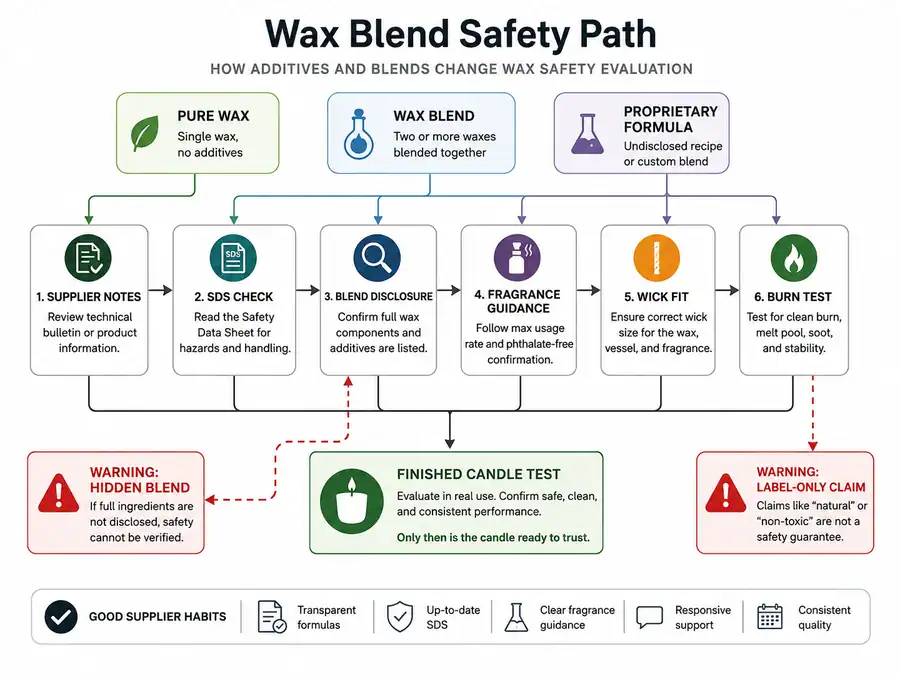
Additives and blends change candle wax safety because the finished wax product may behave differently from the named base wax.
For soy, paraffin, beeswax, coconut wax, and blends, the wax name is only the starting point. Additives and blend ingredients can change hardness, opacity, scent throw, adhesion, color stability, melt behavior, and burn behavior.
An additive is not automatically unsafe. Additive-free wax is not automatically safer.
The better test is whether the wax product is candle-grade, documented by the supplier, compatible with the wick and fragrance, and stable during repeated burn tests.
| Ingredient or function type | Why it is used | Safety question it raises | What to check | Bridge if deeper |
|---|---|---|---|---|
| Hardening ingredient | Makes soft wax firmer or improves pillar strength | Does it change melt behavior or wick demand? | Supplier use guidance and burn-test flame size | Additive safety guide |
| Opacity or finish modifier | Changes color, surface look, or creamy appearance | Does it affect burn quality or residue? | Smoke, soot, surface changes, and wax pool behavior | Candle dye/additive safety guide |
| Adhesion modifier | Helps container wax stick to glass | Does it affect vessel heat or wax pull-away? | Jar temperature, cracks, wet spots, and burn consistency | Container safety guide |
| Scent-performance ingredient | Helps fragrance hold or throw better | Does it encourage too much fragrance use? | Fragrance limit, sweating, smoke, odor, and flame behavior | Fragrance oil safety guide |
| Color-stability ingredient | Helps dye or wax resist discoloration | Does it add a new variable to testing? | Supplier notes and finished-candle burn behavior | Dye/additive safety guide |
| Blend wax | Combines waxes for texture, scent, burn, or appearance | Is the product name hiding the real mix? | SDS, supplier description, and blend disclosure | Wax blend selection guide |
| Proprietary formula | Protects the supplier’s exact formulation | Is there enough evidence to make safety claims? | SDS, candle-use notes, and test results | Supplier documentation checklist |
Wax additives should be judged by function and evidence, not fear. A small formulation change can help one candle burn better and make another candle smoke, tunnel, or run too hot.
That is why wax safety is a finished-candle result, not a label-only decision.
Are wax additives unsafe? Not by default. They become a concern when the supplier gives poor use guidance, the maker uses them outside recommended conditions, or the finished candle shows smoke, soot, overheating, sweating, or unstable flame behavior.
Does additive-free mean safer? Not by default. A plain wax can still fail if the wick is wrong, the vessel traps too much heat, the fragrance load is too high, or the candle is burned too long.
What is a wax blend? A wax blend is a candle wax product made from more than one wax or performance ingredient, such as soy-paraffin, coconut-soy, coconut-apricot, beeswax-soy, or a proprietary supplier formula.
For detailed dye, UV inhibitor, stearic acid, or additive-specific safety, use the additive safety guide; this section only explains how formulation affects wax-level safety.
Pure Wax vs Wax Blends
A candle wax blend is not automatically less safe than a pure wax, but the actual formulation must be known before making safety claims.
A pure wax is sold as one main wax type, such as pure soy wax or pure beeswax. A wax blend combines waxes or formulation ingredients to change hardness, scent throw, adhesion, burn quality, appearance, melt point, or stability.
Pure and blended are not the same as safe and unsafe. A pure soy candle can smoke if it is over-wicked.
A coconut-soy blend can burn well if it is documented, wicked correctly, scented within guidance, and tested in the final vessel.
| Wax label | What the name may imply | What it actually tells you | Safety question | Best next check |
|---|---|---|---|---|
| Pure soy | One plant-based wax | Soy is the main wax, but additive status still needs checking | Does the finished candle burn cleanly with its wick and vessel? | Supplier notes and burn test |
| Soy blend | Soy plus another wax or modifier | The second component may affect hardness, scent, or burn behavior | What is blended with the soy? | Blend disclosure or SDS |
| Coconut-soy | A plant-based blend | It is not pure coconut wax or pure soy wax | Does the blend need different wick sizing? | Supplier wick and fragrance guidance |
| Coconut-apricot | A premium container-wax blend | Premium texture does not prove safer burning | Does the soft blend overheat, sweat, or smoke? | Vessel test and repeated burns |
| Paraffin-containing blend | A mix that includes paraffin | It may be labeled around another wax for buyer appeal | Is the paraffin disclosed clearly? | SDS and plain supplier description |
| Proprietary blend | Supplier-owned formula | The exact recipe may not be public | Is there enough documentation for safety claims? | SDS, use notes, and test log |
Are wax blends safe? They can be, when the blend is made for candles, used within supplier guidance, and tested as a finished candle.
Is pure soy safer than a soy blend? Not automatically. Pure soy may appeal to buyers who want a simpler label, while a soy blend may burn better in a specific vessel if the formulation is clear and tested.
Is coconut wax usually pure? Many coconut candle waxes are blends, so the word “coconut” should be treated as a label clue, not proof of purity.
A good label-reading rule is simple: name the wax type, identify whether it is pure or blended, check supplier documentation, then judge the finished candle by flame stability, soot, smoke, scent behavior, and vessel heat.
For choosing between wax blends for performance, scent throw, or product formulation, use the wax blend selection guide; this section only explains why blend identity affects safety evaluation.
Melt Point, Container Heat, and Wax Safety Boundaries
A candle wax’s melt point helps shape safety, but container safety depends on the full wax, wick, vessel, fragrance, and burn-time system.
Melt point is the temperature range where wax changes from solid to liquid. It helps explain how a wax forms a melt pool, responds to heat, and behaves in a container candle, but it does not prove the finished candle is safe.
Melt point is not the same as flash point, pour temperature, or container temperature. These terms answer different safety questions, so treating one number as the whole answer can hide risk.
| Term | What it means in candle use | Safety mistake to avoid |
|---|---|---|
| Melt point | When wax softens or liquefies. | Assuming a higher or lower melt point proves the candle is safer. |
| Flash point | A fragrance or material safety term tied to vapor ignition risk. | Using it as a finished-candle container safety score. |
| Pour temperature | The temperature used when pouring melted wax into a vessel. | Treating maker handling temperature as burn-use safety. |
| Container temperature | How hot the outside vessel gets during burning. | Ignoring vessel heat because the wax itself seems normal. |
| Melt pool depth | How much liquid wax forms during the burn. | Letting a deep melt pool, large flame, or hot jar continue untested. |
| Burn duration | How long the candle burns in one session. | Testing a short burn, then assuming longer burns are safe. |
Wax behavior affects the heat boundary because different candle wax types and blends melt, pool, cling, cool, and feed the wick differently.
A soft coconut blend, a hard beeswax candle, a soy container wax, and a paraffin blend can each place different heat demands on the wick and vessel.
Warning signs include a very hot container, deep melt pool, unstable flame, visible soot, harsh smoke, cracking risk, and wax overheating.
These signs do not prove the wax type is always unsafe, but they do mean the finished candle setup needs to be stopped, cooled, and retested.
Follow supplier temperature guidance, test the full burn duration, monitor vessel heat, and avoid containers not made for candle use.
For vessel selection, glass heat tolerance, and container-specific testing, use the container safety guide; this section only explains how wax behavior affects the boundary.
How Fragrance Load Affects Wax Safety
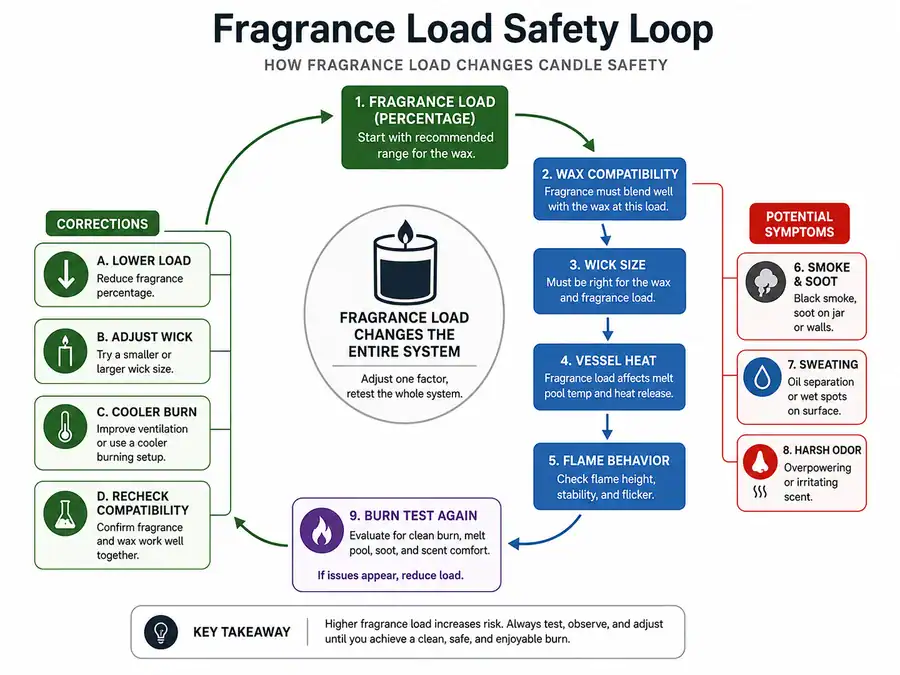
Fragrance load can change whether a candle wax behaves safely because the wax is no longer being judged by itself.
Fragrance load is the amount of fragrance used in wax, usually described as a percentage of the wax weight. A scented candle is a wax, fragrance, wick, vessel, and burn-behavior system, not wax alone.
A wax that burns well unscented can behave differently after fragrance is added. Too much fragrance, the wrong fragrance type, or poor wax compatibility may contribute to smoke, poor combustion, sweating, weak structure, harsh odor, or user irritation.
Essential oils are not automatically safer than fragrance oils in candles. A natural scent source can still burn poorly, overload the wax, or bother a sensitive user.
Supplier use limits and fragrance-safety guidance can support the review, but they do not replace a finished-candle burn test.
| Symptom | Likely cause | First fix | When to bridge |
|---|---|---|---|
| Wax sweating or oily surface | Fragrance load may be too high for the wax. | Lower the fragrance load and retest. | Use the fragrance oil safety guide for scent-specific limits. |
| Harsh odor while burning | Fragrance, wick, heat, or wax blend may be mismatched. | Test the same wax with less fragrance or no fragrance. | Use the sensitive-user guide if symptoms occur. |
| Tall or unstable flame | Wick may be too large for the scented wax system. | Try a smaller wick and retest the same wax. | Use the wick sizing guide for wick series choice. |
| Visible smoke | Fragrance overload, poor combustion, draft, or wick mismatch may be involved. | Trim the wick, reduce scent load, and retest. | Use the burn-test guide for a repeatable log. |
| Weak candle structure | Soft wax or excess fragrance may reduce stability. | Use supplier limits and test the blend again. | Use the wax blend guide for formulation choices. |
| Poor scent throw after lowering load | The wax may not suit that fragrance or candle format. | Test a compatible wax or supplier-recommended range. | Use the fragrance load guide for scent-performance decisions. |
Fragrance changes wax safety because it changes how the finished candle burns.
The safer candle is not the one with the strongest scent. It is the one that holds fragrance within supplier guidance and still burns with a stable flame, low visible smoke, controlled vessel heat, and no harsh odor.
For fragrance-specific safety, fragrance standards, essential oil use, and sensitive-user scent questions, use the fragrance safety guide. This page only explains how fragrance load can make a candle wax look safer or less safe during real burning.
What Soot, Smoke, and Odor Say About Wax Safety
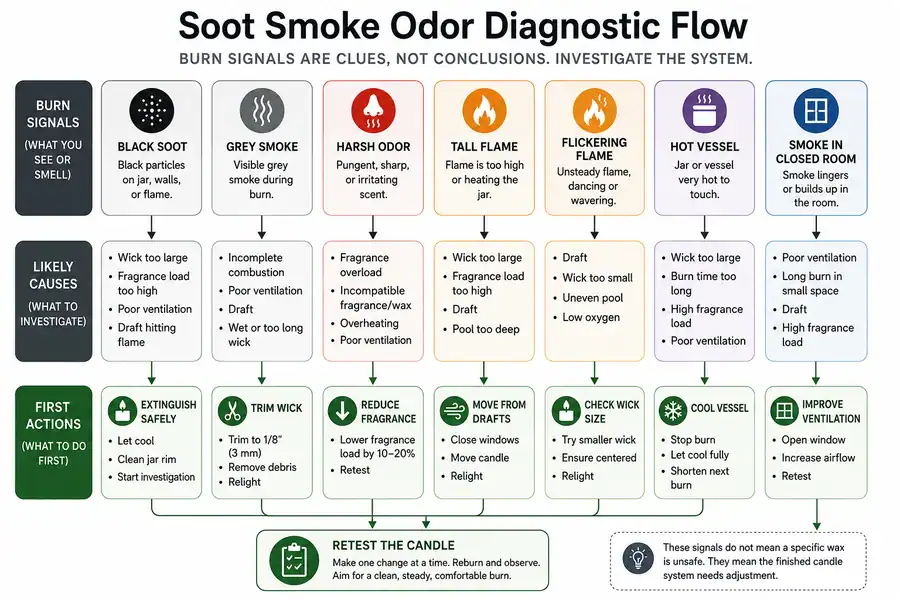
Soot, smoke, and odor are warning signals to investigate, but they do not automatically mean the wax type is unsafe.
Candle wax types, wick fit, fragrance load, ventilation, and burn duration can all change what you see while a candle burns.
Clean-burning means observable low-soot behavior under a tested setup, not a promise of no emissions or universal indoor safety.
A smoky soy candle may be over-wicked. A sooty paraffin candle may have too much fragrance or a flame that is too large.
A beeswax candle may smell strong because of its natural scent. A coconut wax blend may smoke because the blend, scent, wick, and vessel are not matched.
Use visible signals as a diagnostic tool, not as proof that one wax family is unsafe.
| Burn signal | Likely cause | Immediate action | Better next guide |
|---|---|---|---|
| Black soot on the jar | Wick too large, long burn, fragrance overload, or draft | Extinguish, trim the wick, and retest | Wick sizing guide |
| Grey smoke after lighting | Wick, draft, wax pool, or fragrance issue | Move away from drafts and watch flame behavior | Burn test checklist |
| Harsh or fuel-like odor | Overheated wax, fragrance mismatch, or poor combustion | Stop the burn and test unscented or lower scent load | Fragrance safety guide |
| Very tall flame | Oversized wick or too much fuel reaching the flame | Extinguish and test a smaller wick | Wick sizing guide |
| Flickering flame | Drafts, vessel shape, room airflow, or wick instability | Remove drafts and retest in a steady room | Candle use safety guide |
| Deep melt pool with hot vessel | Wick, wax blend, vessel, or burn-time mismatch | Stop the test and let the candle cool | Container safety guide |
| Smoke only in a closed room | Room-use conditions may be worsening the signal | Ventilate and reduce burn time or candle count | Indoor candle air quality guide |
| Odor only with scented versions | Fragrance, not raw wax, may be the main variable | Compare with an unscented test candle | Fragrance load guide |
Which wax produces less soot? No wax type is always the lowest-soot choice. Soy, paraffin, beeswax, coconut wax, and blends can all burn with low visible soot when the finished candle is correctly matched and tested.
Why is my candle smoking? The cause may be the wax, but it may also be the wick, fragrance load, vessel heat, room airflow, burn duration, or user handling.
Are candle fumes harmful? Visible smoke, harsh odor, or discomfort should be treated as a reason to stop the burn, ventilate, and review the candle setup.
For indoor-air science or health-specific exposure concerns, use the indoor air or sensitive-user guide; this section covers observable candle safety signals only.
When the Wick, Not the Wax, Causes the Safety Signal
If a candle smokes, soots, overheats, or burns unevenly, the problem may be the wick-to-wax match rather than the wax type alone.
A safe wax still needs a matched wick. Soy, paraffin, beeswax, coconut wax, and blends can all look unsafe when the wick is too large, too small, poorly centered, or incompatible with the wax, fragrance, and vessel.
Wick-to-wax compatibility affects flame height, soot, smoke, melt pool shape, vessel heat, scent behavior, and burn stability.
That means wax safety cannot be judged from raw wax alone.
| Symptom | Likely wick/wax cause | First action | When to bridge |
|---|---|---|---|
| Flame is too tall | Wick may be too large for the wax and vessel | Extinguish, cool, trim, and test a smaller wick | Use the wick sizing guide |
| Candle tunnels badly | Wick may be too small for the wax or vessel width | Retest with a wick that can form a better melt pool | Use the burn test checklist |
| Jar gets too hot | Wick may be feeding too much fuel to the flame | Stop the burn and test a smaller wick or safer vessel setup | Use the container safety guide |
| Soot appears after scent is added | Wick may not match the scented wax system | Test the same wax unscented, then adjust wick or scent load | Use the fragrance load guide |
| Flame flickers without a draft | Wick may be unstable in that wax blend | Retest with a different wick style or size | Use the wick sizing guide |
| Wax looks fine until later burns | Wick, melt pool, and vessel heat may compound over time | Repeat burn testing before regular use | Use the burn test checklist |
Can the wick make wax unsafe? It can make a suitable candle wax behave unsafely in a finished candle by feeding the flame too much or too little fuel.
Is soot always caused by wax? No. Soot can come from wick size, flame height, fragrance load, drafts, burn duration, vessel heat, or a wax blend that needs a different wick.
For exact wick sizing, wick series choice, and container-diameter wick charts, use the wick sizing guide; this section only explains how wick mismatch can make a wax look unsafe.
Ventilation and Room Conditions
Indoor candle wax safety is condition-dependent, so ventilation and room use matter even when the wax itself is suitable for candles.
Ventilation and room-use conditions describe the airflow, room size, burn duration, candle count, and user sensitivity around candle wax use.
No candle wax should be treated as universally safe in every indoor room or burn condition.
Small closed rooms, several candles burning at once, strong fragrance, drafts, and long burn sessions can all change how a wax system behaves.
Use candles in ventilated rooms, reduce candle count when smoke or odor appears, and stop the burn if the flame grows, the jar gets too hot, or the wax pool deepens.
For health-specific indoor-air concerns, use the sensitive-user or indoor air quality guide; this section covers practical room-use boundaries only.
Pet-Sensitive Homes
No candle wax type is universally pet-safe because pet risk depends on species, fragrance, smoke, ventilation, ingestion, and the finished candle setup.
Soy wax, paraffin wax, beeswax, coconut wax, and blends should all be treated cautiously around pets. The wax label alone cannot prove safety because fragrance, smoke, soot, flame access, spilled wax, vessel heat, and ingestion risk can matter more than the base wax name.
Use a conservative wax-level boundary: burn briefly, ventilate the room, avoid strong fragrances around pets, keep candles and melted wax out of reach, and extinguish any candle that smokes.
For pet toxicology, bird-specific caution, ingestion, symptoms, or emergency concerns, use a pet-safe candle guide or veterinary guidance. This section only explains why candle wax types should not be called universally pet-safe.
Pregnancy, Babies, and Sensitive Users
For pregnancy, babies, and sensitive users, no candle wax type should be treated as medically safe for everyone.
Soy, paraffin, beeswax, coconut wax, and blends should not be labeled medically safe or unsafe for pregnancy, infants, young children, asthma, migraine, allergies, or chemical sensitivity from wax type alone.
Fragrance, soot, smoke, ventilation, burn duration, room size, and personal sensitivity can matter as much as the wax name. A fragrance-free, low-smoke, well-tested candle may reduce variables, but it does not replace health-specific guidance.
For pregnancy, infant, asthma, migraine, allergy, or health-specific concerns, use qualified medical guidance; this page only gives candle-use caution boundaries.
Natural vs Synthetic Candle Wax: Which Is Safer?
Natural and synthetic wax labels do not prove candle safety; the finished candle’s formulation and burn behavior matter more.
Natural candle wax claims usually refer to soy, beeswax, coconut wax, plant-based wax, or minimally processed material.
Synthetic or petroleum-derived claims usually point to paraffin, modified waxes, proprietary blends, or additive-containing formulas.
Those origin labels can help you understand what a candle wax type is, but they do not prove how the candle will burn.
A natural wax can smoke, overheat, or carry fragrance problems. A petroleum-derived or modified wax can burn acceptably when it is candle-grade, properly wicked, scented within guidance, used with ventilation, and tested.
| Safety shortcut | What it gets right | What it misses |
|---|---|---|
| Natural wax is safer. | Origin can matter to buyer preference. | Natural wax can still smoke, overheat, or bother sensitive users. |
| Synthetic wax is unsafe. | Petroleum-derived waxes may raise more concern for some users. | Origin alone does not prove the finished candle is unsafe. |
| Plant-based means non-toxic. | Soy and coconut labels may appeal to cautious buyers. | Plant-based wax can still include blends, additives, scent, and wick issues. |
| Beeswax is always safest. | Beeswax can be simple and often unscented. | Natural scent, residue, filtration, wick fit, and user sensitivity still matter. |
| Coconut wax is premium. | Some coconut blends can perform well in containers. | Premium branding does not prove purity or safer burning. |
| Additive-free means risk-free. | Fewer formulation variables can help evaluation. | Wick, vessel, scent, ventilation, and burn time still affect safety. |
Toxic and non-toxic candle wax claims are usually too broad unless they name the wax quality, formulation, wick, fragrance, ventilation, and burn-test conditions.
| Claim | Why it is incomplete | Better safety question | What to check | Bridge if needed |
|---|---|---|---|---|
| “Paraffin is toxic” | It judges by origin instead of finished-candle behavior. | Does this paraffin candle burn cleanly in its tested setup? | Wax grade, wick fit, fragrance load, soot, smoke, and ventilation | Paraffin vs soy guide |
| “Soy is non-toxic” | It can ignore blends, additives, scent, and wick mismatch. | Is this soy candle documented and burn-tested? | Blend status, supplier notes, soot, smoke, and vessel heat | Soy wax buying guide |
| “Beeswax is always safest” | It turns natural origin into a universal safety promise. | Does this beeswax candle suit this user and room? | Filtration, scent, residue, wick fit, and sensitivity signs | Fragrance-free candle guide |
| “Coconut wax is pure” | Many coconut candle waxes are blends. | What is actually in the coconut wax product? | Supplier description, SDS, blend notes, and burn-test results | Wax blend guide |
| “Natural wax is chemical-free” | Natural materials are still made of chemicals. | What ingredients and burn variables affect this candle? | Wax type, additives, fragrance, wick, and vessel | Supplier documentation checklist |
| “Clean-burning means no emissions” | Clean-burning is often an observable low-soot claim, not a zero-emission proof. | Does the candle show low smoke and low soot under real use? | Flame height, visible smoke, soot, odor, ventilation, and burn time | Indoor candle air quality guide |
Is natural candle wax safer? Natural wax may be preferable for some buyers, but it is not automatically safer than paraffin or a blend in every finished candle.
Is paraffin unsafe because it is synthetic? Paraffin is petroleum-derived, but the safety review should still look at candle grade, wick size, fragrance load, ventilation, soot, and burn testing.
Does plant-based wax mean non-toxic? No. Plant-based wax describes origin, not a full safety result.
For environmental claims, green-marketing compliance, or sourcing ethics, use the dedicated sustainability or legal guide; this section only evaluates whether claim language helps judge wax safety.
How to Burn-Test Candle Wax Safety at Home
Burn testing is the practical way to check whether a wax behaves safely in the finished candle system.
A burn test checks the candle wax type after the wick, vessel, fragrance, additives, and room conditions are included.
Soy, paraffin, beeswax, coconut wax, and blends should all be tested in the final candle setup.
A basic wax-safety check is not lab emissions testing, sale-readiness approval, legal certification, or a full fire-safety protocol.
Use this compact wax-safety checklist during a controlled home burn test:
| Burn-test item | Pass signal | Retest signal |
|---|---|---|
| Flame height | The flame stays steady and controlled. | The flame grows tall, waves hard, or flickers without a draft. |
| Melt pool | The wax melts evenly for the candle design. | The melt pool gets too deep, too hot, or uneven. |
| Vessel heat | The container stays within a cautious touch boundary. | The jar or tin feels too hot, stressed, or unsafe to keep burning. |
| Soot and smoke | Little to no visible residue or smoke appears. | Black residue or smoke appears after trimming, scenting, or longer burning. |
| Odor | The scent or natural wax smell stays normal. | The candle smells scorched, fuel-like, sour, or irritating. |
| Repeat behavior | The candle behaves similarly across repeated burns. | Later burns get hotter, smokier, or less stable. |
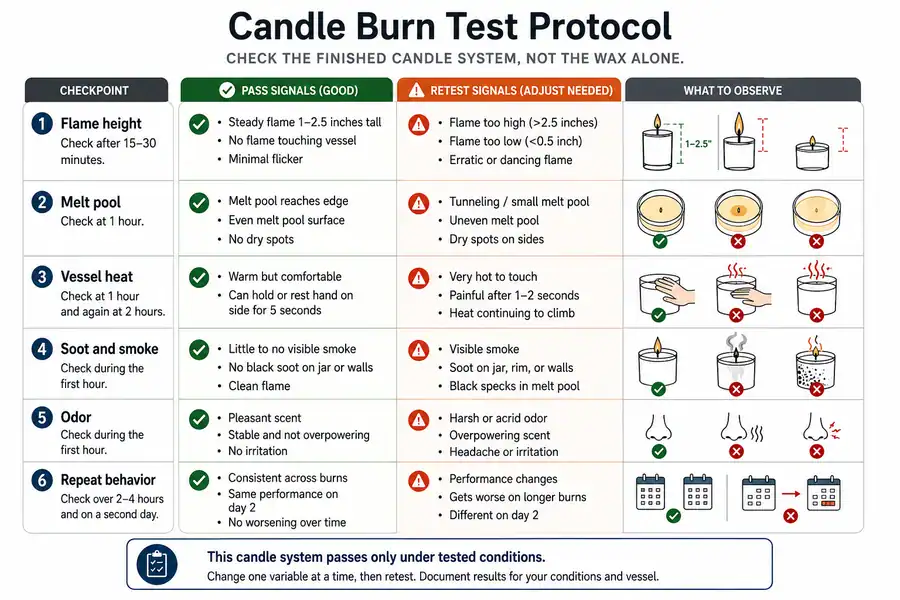
A burn test does not prove that every candle made with that wax is safe. It shows whether this wax, in this candle system, behaves acceptably under the tested conditions.
For full burn logs, sale-readiness review, product certification, or lab testing, use specialist guidance. This section only turns candle wax safety claims into observable home testing.
Is Melted Candle Wax Safe to Handle?
Melted candle wax can be handled safely, but only when heat is controlled and the maker follows wax-specific temperature guidance.
Melted-wax handling applies to soy, paraffin, beeswax, coconut wax, and blends during candle making.
“Safe to handle” means controlled heat, suitable equipment, careful monitoring, and prevention of burns, spills, overheating, and fragrance mistakes.
Hot wax handling is a making-process safety topic, not proof that a finished candle wax is safe to burn.
Use this short handling boundary for wax-level safety:
| Handling point | Safer action |
|---|---|
| Heat control | Use a thermometer and follow the wax supplier’s temperature guidance. |
| Melting method | Use controlled heating instead of direct uncontrolled heat. |
| Fragrance timing | Add fragrance only within the supplier’s recommended temperature range. |
| Monitoring | Never leave melting wax unattended. |
| Overheating signs | Stop heating if wax smokes, smells harsh, or looks unstable. |
For full candle-making steps, use the beginner candle-making guide; for burns or injuries, seek appropriate medical guidance because this page only covers prevention.
What Documentation Proves a Candle Wax Is Safer to Use?
Supplier documents can support candle wax safety decisions, but they do not certify that every finished candle made with that wax is safe.
Safety Data Sheet (SDS) means a supplier document that lists handling, hazard, storage, and material safety information.
For candle wax types, an SDS can help confirm what the raw wax product is and how it should be handled.
Supplier documents are evidence inputs. They can support a safer choice, but they cannot prove that your finished soy, paraffin, beeswax, coconut, or blended candle will burn safely after wick, vessel, fragrance, additive, and room-use variables are added.
| Supplier evidence | What it can verify | What it cannot verify |
|---|---|---|
| SDS | Handling notes, hazards, storage, and material identity | Finished-candle burn safety |
| Technical data sheet | Melt range, pour guidance, use notes, and wax behavior | Final wick match or container heat |
| Blend disclosure | Whether the wax is pure or blended | Whether the blend performs safely in your vessel |
| Candle-use statement | Whether the product is intended for candle making | Whether your formula is correctly built |
| Fragrance compatibility notes | Suggested fragrance ranges or compatibility limits | Actual scent behavior in your finished candle |
| Temperature guidance | Melting, adding fragrance, and pouring conditions | Safe handling if overheated or misused |
| Certification or claim support | Supplier-backed quality or sourcing claim | Universal safety, medical safety, or legal compliance everywhere |
| Batch or lot information | Traceability for a wax purchase | A safe burn result without testing |
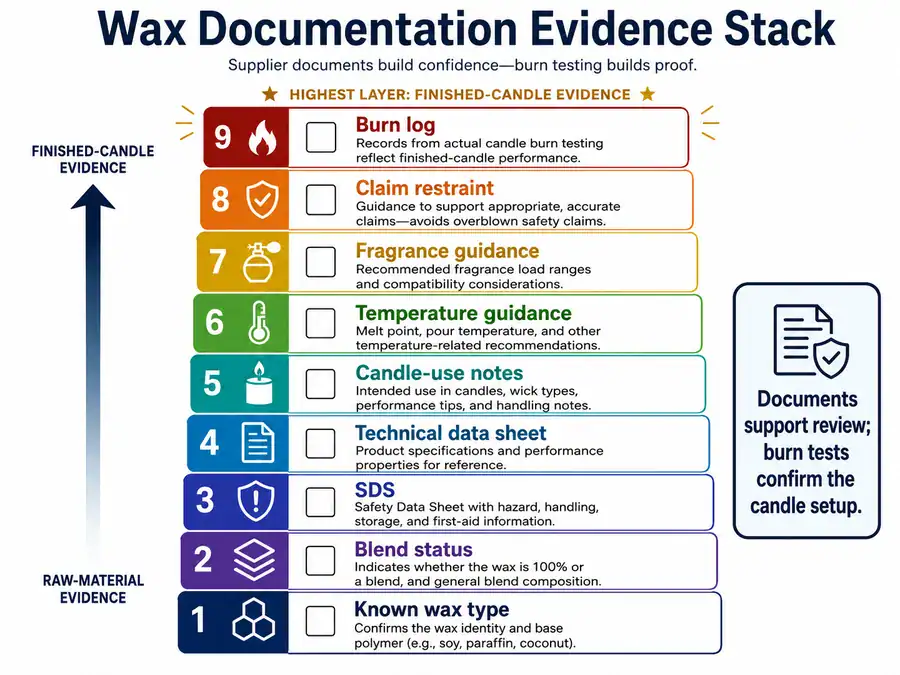
A certificate, SDS, or “non-toxic” supplier claim should not be treated as a finished-candle safety pass.
The final candle still needs a matched wick, suitable vessel, controlled fragrance load, clean burn behavior, and repeatable testing.
Use this supplier evidence checklist before trusting a wax safety claim:
| Checklist item | Pass signal |
|---|---|
| Known wax type | The supplier clearly states soy, paraffin, beeswax, coconut, blend, or proprietary wax type. |
| Blend status | The product page or documents explain whether the wax is pure or blended. |
| SDS available | The supplier provides an SDS or equivalent handling document. |
| Candle-use notes | The wax is clearly sold or documented for candle making. |
| Temperature guidance | Melt, fragrance-addition, and pour guidance are available. |
| Fragrance guidance | The supplier gives a scent-load range or compatibility warning. |
| Additive notes | Important modifiers, dyes, or performance ingredients are disclosed when relevant. |
| Claim restraint | “Natural,” “clean,” “premium,” or “non-toxic” claims are supported without overpromising. |
| Test record | The finished candle has a burn log, not just supplier paperwork. |
Does an SDS prove candle wax is safe? No. An SDS supports raw-material review and handling, but it does not prove the finished candle is safe to burn.
Do certifications make wax safer? They can support supplier trust, sourcing, or material quality, but they should not be turned into a universal safety promise.
For line-by-line SDS review, blend-disclosure review, supplier-claim review, legal labeling, finished-product compliance, or fragrance-standard interpretation, use a supplier documentation checklist or specialist guidance. This section only explains how supplier documents support wax-level safety decisions.
Which Candle Wax Is Safest Overall?
The safest candle wax is not one universal material; it is the documented wax that works safely in the finished candle system.
Soy, paraffin, beeswax, coconut wax, and blends can all be suitable for candles. Each wax type has benefits, limits, and claim risks.
The safer choice depends on wax quality, formulation, wick fit, vessel heat, fragrance load, ventilation, user sensitivity, supplier documents, and burn-test results.
| Wax type | Best safety use case | Main caution | Best proof |
|---|---|---|---|
| Soy wax | Beginner-friendly container candles with clear supplier guidance | “Natural” does not mean additive-free, smoke-free, or always safer | Blend status, fragrance guidance, and burn test |
| Paraffin wax | Scented candles where performance and wick match are controlled | Petroleum origin should not be treated as the only safety factor | Candle-grade product, clean burn behavior, and documentation |
| Beeswax | Simple or unscented candles where natural scent is acceptable | Natural origin does not mean universally tolerated or vegan | Filtration notes, residue check, and sensitivity boundary |
| Coconut wax | Premium container candles when formulation is transparent | Coconut wax is often a blend, not pure coconut | Blend disclosure, SDS, and repeated burn testing |
| Wax blends | Formulas built for scent throw, adhesion, texture, or burn performance | A blend name can hide important formulation details | Supplier notes, clear label reading, and finished-candle testing |
For most beginners, the safer starting point is a candle-grade wax with clear supplier notes, a simple formula, a matched wick, and a burn-test record. Use the wax-type guides for performance choices such as scent throw, cost, finish, and format.
This makes “safest” a finished-candle result, not a universal material ranking. A wax that looks safer by origin can still fail if the wick, scent load, vessel, or room conditions are wrong.
Use this final safety checklist before calling any candle wax safer:
| Final check | Safer answer |
|---|---|
| Known wax type and blend status | You know what wax category or blend you are using. |
| Supplier SDS or use notes available | The wax has handling and candle-use documentation. |
| Fragrance load within supplier guidance | The wax is not overloaded with scent. |
| Wick matched to wax and vessel | The flame stays controlled and stable. |
| Burn test completed | The candle passed repeated observation, not just one short burn. |
| Low soot and smoke in use | The candle does not leave heavy residue or visible smoke. |
| Vessel heat controlled | The container does not become dangerously hot. |
| Appropriate ventilation | The candle is used in a suitable room, not a closed or overloaded space. |
| Sensitive users and pets considered | The household setting is not ignored. |
| No unsupported safety claims | The candle is not marketed as risk-free, chemical-free, medically safe, or universally non-toxic. |
The best answer is not “soy is safest” or “paraffin is unsafe.”
The best answer is: choose a documented candle-grade wax, avoid broad safety claims, build the candle as a full system, and test the finished candle before trusting it.
FAQs About Candle Wax Safety
Are candle waxes safe?
Candle waxes can be safe when they are candle-grade, documented, properly wicked, scented within guidance, ventilated, and burn-tested.
Soy, paraffin, beeswax, coconut wax, and blends should be judged as finished candles, not raw wax names.
The wax, wick, vessel, fragrance, additives, room conditions, and burn habits all affect practical safety.
What is the safest candle wax?
The safest candle wax is the one that performs safely in the finished candle, not one universal wax type.
Soy is often beginner-friendly, beeswax can be simple and unscented, coconut wax can work well in documented blends, and paraffin can perform well when candle-grade and tested.
The safer choice is the wax that has clear supplier guidance and passes burn testing in its final candle setup.
Is soy wax safer than paraffin?
Soy wax is not automatically safer than paraffin because both waxes depend on formulation, wick fit, scent load, ventilation, and burn behavior.
Soy may appeal to makers who prefer plant-based wax, while paraffin may appeal to makers who want strong scent performance.
The better safety comparison is the finished soy candle versus the finished paraffin candle under the same use conditions.
Is paraffin wax toxic in candles?
Paraffin wax should not be labeled toxic from petroleum origin alone.
A paraffin candle should be evaluated by wax grade, supplier information, wick match, fragrance load, soot, smoke, odor, ventilation, and burn-test results.
Avoid both extremes: “paraffin is always toxic” and “paraffin is always harmless.”
Is beeswax the safest candle wax?
Beeswax can be a safe candle wax, but it is not automatically the safest for every person or room.
Its natural origin, traditional use, and often-unscented format can reduce some variables.
It can still smoke, drip, carry natural scent, contain residue, or bother sensitive users if the candle system is not suitable.
Is coconut wax safe?
Coconut wax can be safe when the actual blend is known and the finished candle burns cleanly.
Many coconut candle waxes are blends, so “coconut wax” does not always mean pure coconut wax.
Check supplier notes, blend status, fragrance guidance, and burn-test results before making safety claims.
Does non-toxic candle wax mean risk-free?
Non-toxic candle wax does not mean risk-free, emission-free, allergy-safe, pet-safe, or medically safe.
“Non-toxic” is often used as broad marketing language.
A safer evaluation checks the wax type, blend ingredients, supplier documents, fragrance load, wick fit, soot, smoke, vessel heat, and user sensitivity.
Does clean-burning wax mean no soot or emissions?
Clean-burning wax usually means low visible soot under good burn conditions, not zero emissions.
A candle can still smoke or soot if the wick is too large, the fragrance load is too high, the room is drafty, the candle burns too long, or the vessel traps too much heat.
Are natural candle waxes safer?
Natural candle waxes are not automatically safer than synthetic or petroleum-derived waxes.
Natural waxes such as soy, beeswax, and coconut can still involve blends, additives, fragrance, smoke, overheating, or sensitivity concerns.
Synthetic or petroleum-derived waxes still need documentation, proper use, and finished-candle testing.
Are scented candles less safe than unscented candles?
Scented candles add more variables than unscented candles because fragrance changes the finished candle system.
A scented candle can still be suitable when the fragrance load follows supplier guidance and the candle passes burn testing.
Unscented candles reduce the fragrance variable but still need a matched wick, suitable vessel, ventilation, and safe burn behavior.
Does soot mean the wax is unsafe?
Soot means the candle needs review, but it does not prove the wax type is unsafe.
Soot can come from wick size, flame height, fragrance load, draft, burn duration, vessel heat, or the wax blend.
Extinguish the candle, correct the likely variable, and retest before blaming the wax alone.
How do I know if a candle wax is safe to use?
Choose candle-grade wax, review supplier documents, check blend status, follow temperature and fragrance guidance, match the wick, and burn-test the finished candle.
A wax safety claim is stronger when the candle shows a stable flame, low visible soot, low smoke, no harsh odor, controlled vessel heat, and repeatable behavior across burns.