

Candle wax cost is wax-only material cost, not total candle cost, and wax cost per candle = (wax oz ÷ 16) × wax price per lb.
Candle wax is the main material that forms the candle body and fuel. To estimate cost, start with the wax price per pound, convert the wax used in one candle into pounds, then multiply the two numbers together.
This article covers wax-only cost. It does not include fragrance oil, wick, container, label, packaging, labor, overhead, profit margin, or retail price.
If you need total candle cost, calculate that on a full candle COGS or candle pricing page; this page only calculates the wax line item.
How Much Does Candle Wax Cost per Pound?
Candle wax commonly costs about $2 to $15+ per pound, depending on wax type, purchase quantity, supplier, and whether shipping is included.
Treat this range as a planning range, not a guaranteed quote. Actual wax cost depends on wax family, pack size, supplier, and delivered price per pound.
Lower-cost candle waxes usually include paraffin blends, some soy waxes, and larger bulk packs. Higher-cost waxes often include beeswax, specialty blends, organic waxes, and small retail packs.
For a quick supplier comparison, use product price per pound.
Product price per lb = wax product price ÷ pounds purchased
For a real buying estimate, use delivered or landed price per pound.
Landed price per lb = (wax product price + shipping + tax − discount) ÷ pounds purchased
| Wax type | Common cost tier | Planning range per lb | Cost note |
|---|---|---|---|
| Paraffin wax or paraffin blend | Low to mid | $2–$5 | Often one of the cheaper candle wax options |
| Soy wax | Low to mid | $3–$8 | Small bags usually cost more per lb than cases |
| Coconut-soy blend | Mid | $4–$9 | Blend formula and pack size affect price |
| Beeswax | High | $7–$15+ | Usually costs more than soy or paraffin |
| Organic or specialty wax | High | $10–$20+ | Ingredient claims and specialty sourcing raise cost |
A single “average wax price” can mislead beginners because the same wax may cost far more in a 1 lb bag than in a 45 lb or 50 lb case.
Why Do Soy, Paraffin, Beeswax, Coconut, and Blends Cost Different Amounts?
Wax types cost different amounts because raw material source, processing, formula, pack size, and supplier pricing all change the wax-only price per pound.
“Cheaper” in this article means lower material price per pound. It does not mean better burn quality, stronger scent throw, cleaner ingredients, or easier candle making.
| Wax type | Why the price differs | Price-only buying note |
|---|---|---|
| Paraffin wax | Petroleum-based wax is widely available and often sold in large quantities | Compare by unit price, not total bag price |
| Soy wax | Soy wax is common for container candles and sold by many suppliers | Beginner packs may cost much more per lb |
| Coconut-soy blend | Blend formulas can cost more than basic soy wax | Check small-pack and case pricing separately |
| Beeswax | Beeswax is produced by bees and usually has a higher raw material cost | Treat it as a higher-price wax tier |
| Specialty blends | Additives, processing, or ingredient claims can raise cost | Use only when the blend fits your candle plan |
If you are choosing wax for performance, scent throw, appearance, or beginner use, compare wax types separately. This page stays focused on wax price and wax-only cost per candle.
Is Candle Wax Cheaper in Bulk?
Candle wax is usually cheaper per pound when bought in larger quantities, but bulk is not always cheaper after shipping, storage, or unused wax is counted.
The total order price may be higher even when the unit price is lower. That is why the useful comparison is price per pound, not the checkout subtotal alone.
| Purchase size | Common result | Best use case |
|---|---|---|
| 1 lb bag | Highest unit price | Testing a new wax |
| 5 lb to 10 lb bag | Moderate unit price | Beginner or hobby batches |
| 25 lb to 50 lb case | Lower unit price | Repeated use of the same wax |
| Pallet or commercial order | Lowest unit price | Large-scale production |
Bulk buying works best when you already know the wax fits your candles. If you are still testing, a smaller pack can be cheaper in practice because it reduces the risk of buying too much of the wrong wax.
How Much Wax Do You Need per Candle?
Wax needed per candle is the finished wax fill weight, usually measured in ounces or grams.
Use weight, not the container label size alone. An “8 oz jar” does not always hold exactly 8 oz of wax by weight because jar shape, fill line, wax density, and fragrance load can change the final amount.
If your target candle weight includes fragrance oil, subtract the fragrance amount before using this wax-only formula. For example, a finished 8 oz scented candle may use less than 8 oz of wax.
Wax lb per candle = wax oz per candle ÷ 16
| Candle size example | Wax weight assumption | Wax in pounds | How to use it |
|---|---|---|---|
| Small tin | 4 oz wax | 0.25 lb | Multiply wax price per lb by 0.25 |
| Medium jar | 8 oz wax | 0.50 lb | Multiply wax price per lb by 0.50 |
| Larger jar | 12 oz wax | 0.75 lb | Multiply wax price per lb by 0.75 |
| Large candle | 16 oz wax | 1.00 lb | Wax cost equals the price per lb |
This keeps the “per candle” unit clear. A candle made with 4 oz of wax uses one quarter of a pound. A candle made with 8 oz uses half a pound. A 16 oz wax fill uses one full pound.
Example Wax Costs for Small, Medium, and Large Candles
Wax cost per candle changes with both candle size and wax price per pound.
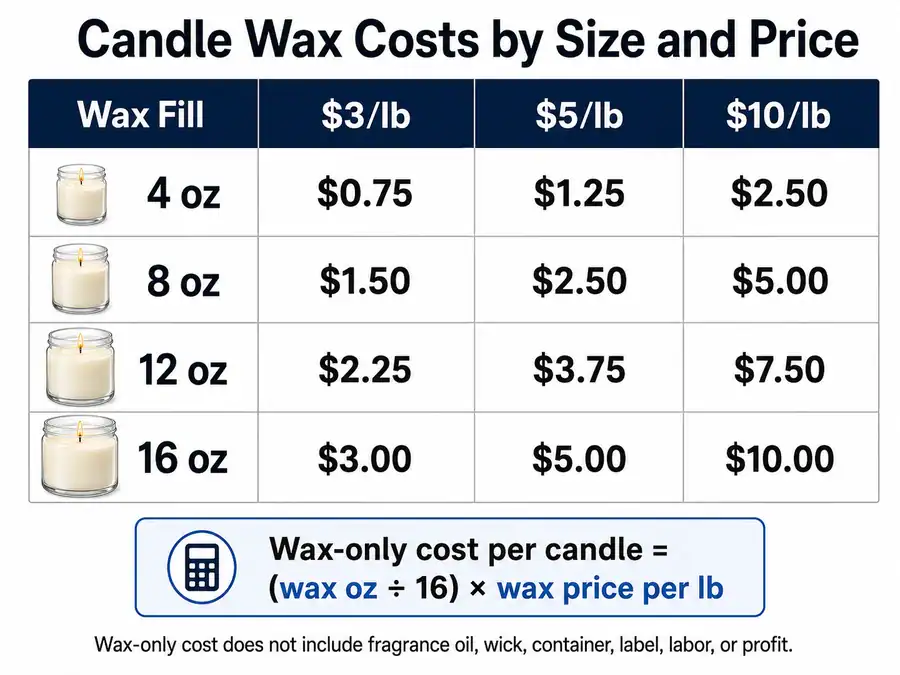
The examples below use three planning prices: $3 per lb, $5 per lb, and $10 per lb. Use your own supplier price when making your final estimate.
| Wax fill per candle | Wax in pounds | At $3/lb wax | At $5/lb wax | At $10/lb wax |
|---|---|---|---|---|
| 4 oz candle | 0.25 lb | $0.75 | $1.25 | $2.50 |
| 6 oz candle | 0.375 lb | $1.13 | $1.88 | $3.75 |
| 8 oz candle | 0.50 lb | $1.50 | $2.50 | $5.00 |
| 10 oz candle | 0.625 lb | $1.88 | $3.13 | $6.25 |
| 12 oz candle | 0.75 lb | $2.25 | $3.75 | $7.50 |
| 16 oz candle | 1.00 lb | $3.00 | $5.00 | $10.00 |
An 8 oz candle does not have one fixed wax cost. At $3 per lb, the wax-only cost is $1.50. At $10 per lb, the same 8 oz wax fill costs $5.00 before fragrance oil, wick, jar, label, labor, or profit margin.
Should You Add Extra Wax for Waste, Testing, or Overage?
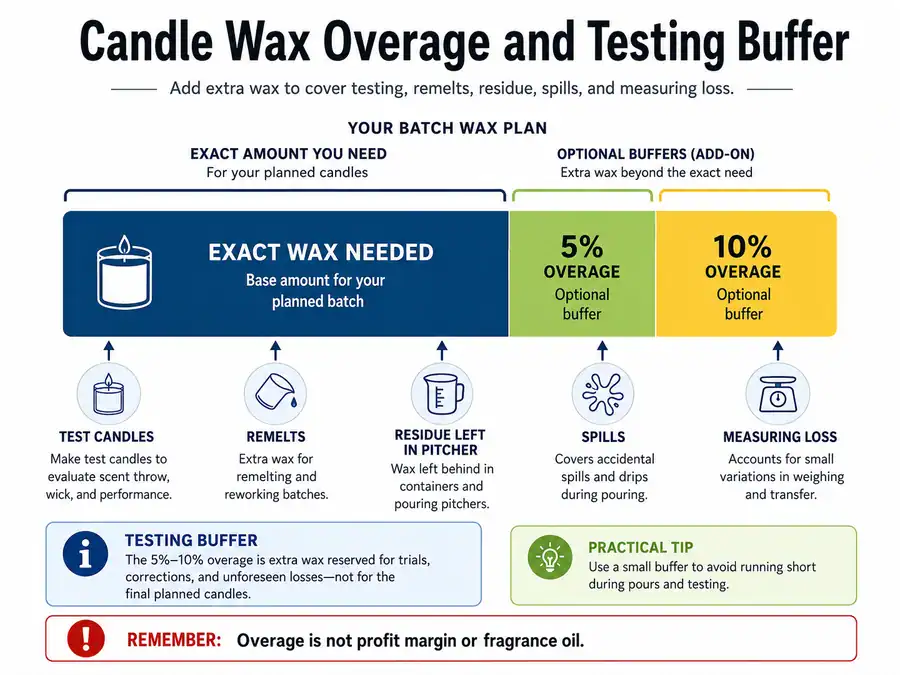
You should buy extra wax when you need test candles, remelts, residue allowance, or a buffer for spills and measuring loss.
Overage means wax purchased beyond the exact finished-candle weight. It is not profit margin, overhead, or extra fragrance. It is a practical buying cushion so your batch does not fall short.
A simple beginner allowance is 5% to 10% extra wax. Use the lower end for a familiar batch and the higher end when testing a new wax, jar, fragrance load, color, or pouring process.
| Batch plan | Exact wax needed | 5% overage | 10% overage | Practical wax to buy |
|---|---|---|---|---|
| 10 candles × 4 oz | 40 oz | 42 oz | 44 oz | About 2.75 lb |
| 12 candles × 8 oz | 96 oz | 100.8 oz | 105.6 oz | About 6.5–6.75 lb |
| 24 candles × 8 oz | 192 oz | 201.6 oz | 211.2 oz | About 12.75–13.25 lb |
| 24 candles × 12 oz | 288 oz | 302.4 oz | 316.8 oz | About 19–19.75 lb |
Extra wax helps with testing and batch loss, but it does not turn this into a full candle production-cost calculation.
How Do You Calculate Wax Cost per Candle?
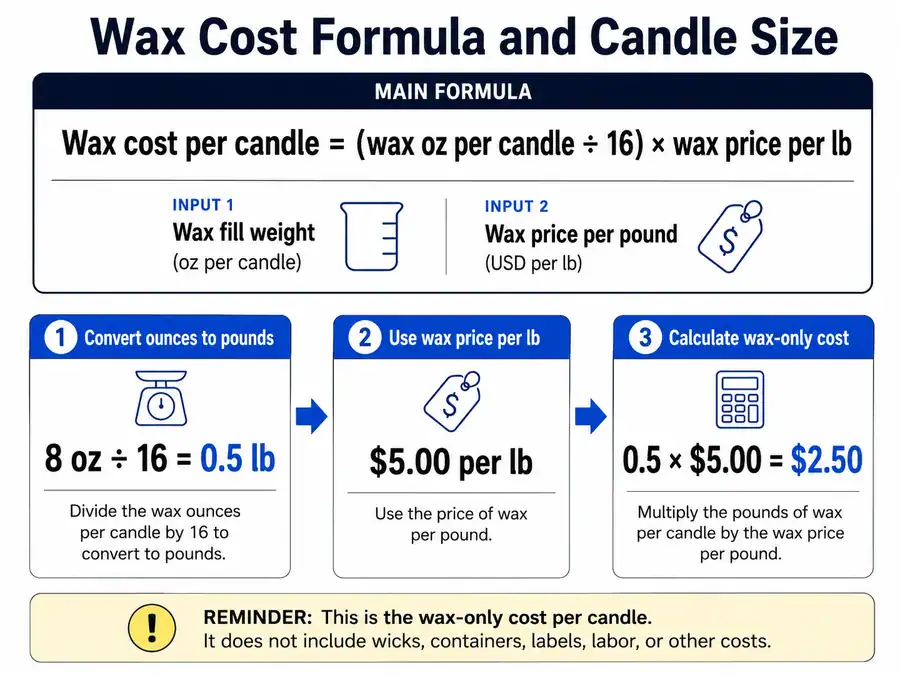
Wax cost per candle is calculated by converting the wax fill weight into pounds, then multiplying by the wax price per pound.
Wax cost per candle = (wax oz per candle ÷ 16) × wax price per lb
| Step | Example value | Calculation |
|---|---|---|
| Wax fill per candle | 8 oz | 8 ÷ 16 = 0.5 lb |
| Wax price per lb | $5.00 | 0.5 × $5.00 |
| Wax-only cost per candle | — | $2.50 |
An 8 oz wax fill at $5 per lb costs $2.50 in wax per candle. If the same candle uses $10 per lb wax, the wax-only cost rises to $5.00.
Use the same formula for any candle size.
| Wax fill | Formula at $5/lb | Wax-only cost |
|---|---|---|
| 4 oz | 4 ÷ 16 × $5 | $1.25 |
| 6 oz | 6 ÷ 16 × $5 | $1.88 |
| 8 oz | 8 ÷ 16 × $5 | $2.50 |
| 12 oz | 12 ÷ 16 × $5 | $3.75 |
| 16 oz | 16 ÷ 16 × $5 | $5.00 |
The formula stays the same when the candle size changes. Only two inputs change: wax weight per candle and wax price per pound.
Should Shipping and Taxes Be Included in Wax Cost?
Shipping and taxes should be included when you want the true delivered wax cost per pound.
Product-only price is useful for comparing shelf prices. Landed price is better for real budgeting because it includes what you paid to get the wax delivered.
A cheaper wax can become more expensive after shipping. A higher product price can become cheaper if the order ships free or includes a case discount.
Landed wax price per lb = (wax price + shipping + tax − discount) ÷ pounds purchased
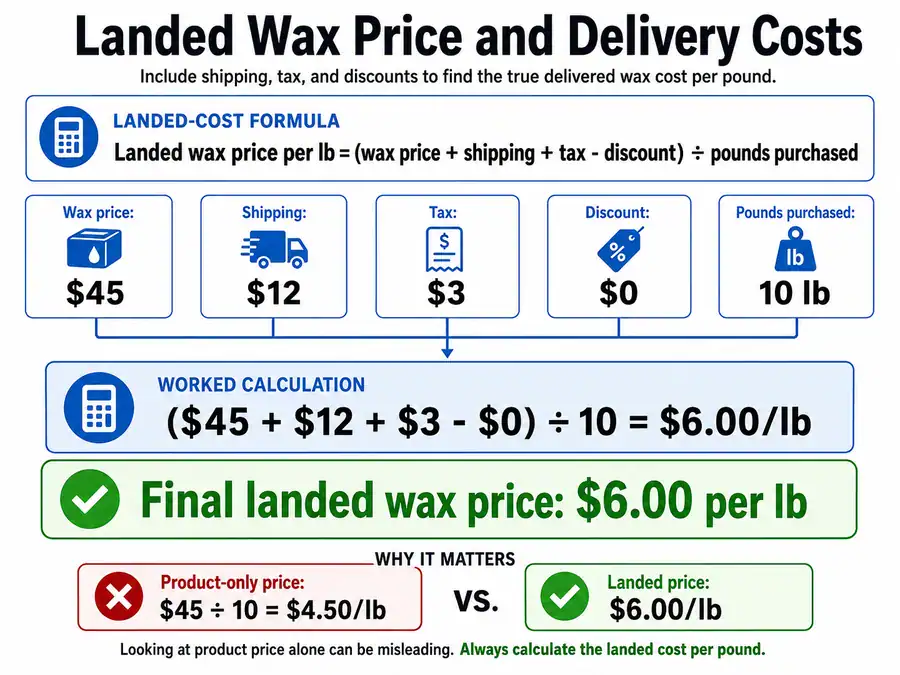
| Order detail | Example |
|---|---|
| Wax product price | $45.00 |
| Shipping | $12.00 |
| Tax | $3.00 |
| Discount | $0.00 |
| Pounds purchased | 10 lb |
| Landed price per lb | ($45 + $12 + $3) ÷ 10 = $6.00/lb |
That same wax may look like $4.50 per lb from product price alone, but the delivered cost is $6.00 per lb.
| Wax fill | Product-only at $4.50/lb | Landed at $6.00/lb |
|---|---|---|
| 4 oz | $1.13 | $1.50 |
| 8 oz | $2.25 | $3.00 |
| 12 oz | $3.38 | $4.50 |
| 16 oz | $4.50 | $6.00 |
For hobby batches, product-only cost may be enough for quick planning. For repeated batches or selling candles, landed wax cost gives a cleaner buying number before you move into full candle pricing.
What Should Beginners and Small-Batch Makers Assume?
Beginners and small-batch makers should assume a higher wax price per pound than large commercial buyers because they usually buy smaller bags, pay retail shipping, and test more wax.
That does not mean small batches are wrong. It means the wax cost per candle should be based on the pack size you will actually buy, not the lowest bulk price shown by a supplier.
| Maker type | Common buying pattern | Cost assumption |
|---|---|---|
| Beginner | 1 lb to 10 lb bags | Higher product price per lb and more testing waste |
| Hobby maker | Small repeat orders | Moderate price per lb, still affected by shipping |
| Small-batch seller | Cases or repeated supplier orders | Lower unit price may be possible, but landed cost still matters |
| Commercial maker | Large cases, pallets, or negotiated supply | Outside this beginner wax-only estimate |
A beginner making a few test candles should not build a budget around pallet pricing. A small-batch maker who repeats the same wax, jar, and candle size can use case pricing once the formula and testing results are stable.
Use this order:
- Pick the wax type you plan to test.
- Find the pack size you are likely to buy.
- Calculate product price per lb.
- Add shipping and tax if you want landed price per lb.
- Multiply by the wax fill weight per candle.
- Add 5% to 10% extra wax for testing or overage when needed.
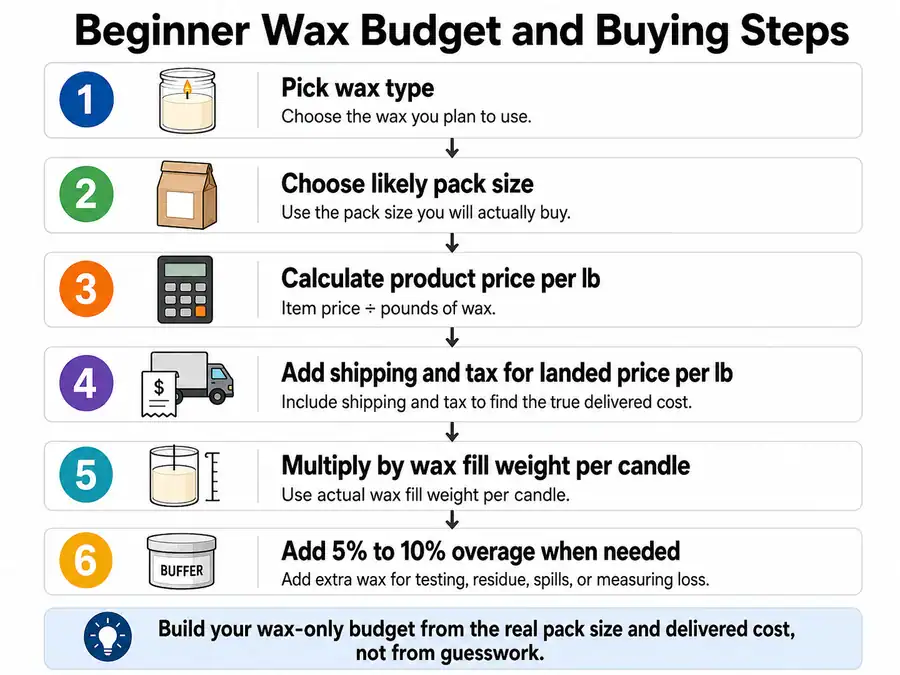
This keeps wax budgeting realistic without turning the estimate into a full candle business cost model.
Wax-Only Cost Recap
Candle wax cost is easiest to estimate when you separate wax price per pound from total candle production cost.
Use the product price per lb for a quick supplier comparison. Use landed price per lb when shipping, tax, and discounts change what the wax actually costs after delivery. Then multiply that number by the wax weight used in one candle.
Wax cost per candle = (wax oz per candle ÷ 16) × wax price per lb
For a fast planning estimate:
| Candle wax input | What to use |
|---|---|
| Wax price | Product price per lb for quick comparison, landed price per lb for real budgeting |
| Candle size | Wax fill weight, not container label size alone |
| Small candle example | 4 oz wax = 0.25 lb |
| Medium candle example | 8 oz wax = 0.50 lb |
| Large candle example | 16 oz wax = 1.00 lb |
| Practical buying buffer | Add 5% to 10% for testing, residue, spills, and overage |
If wax costs $5 per lb, a 4 oz candle uses about $1.25 of wax, an 8 oz candle uses about $2.50 of wax, and a 16 oz candle uses about $5.00 of wax.
These are wax-only numbers. They do not include fragrance oil, wick, container, label, packaging, labor, fees, profit margin, or retail price.
For the cleanest estimate, choose the wax type, use the pack size you are likely to buy, calculate the delivered price per pound, and apply the formula to your actual wax fill weight. That gives you a realistic wax cost per candle without turning the page into a full candle pricing model.