
What Is Beeswax? Pros, Cons, and Best Uses for Candle Making
Beeswax is a bee-derived candle wax valued for firm structure, light honey aroma, and candle formats such as rolled sheets, tapers, pillars, and molds.
This page explains beeswax as a candle-making wax material, not as a cosmetic ingredient, food-wrap ingredient, or beekeeping product. For candle makers, “best” means the right fit for a candle format, scent goal, handling level, cost tolerance, and project purpose.
Natural does not mean vegan, automatically safer, automatically more sustainable, or free from burn-condition limits. Use this guide to weigh beeswax pros, cons, forms, beginner fit, and cases where another candle wax may be easier or more suitable.
What Is Beeswax in Candle Making?
Beeswax is a bee-derived natural wax used in candle making as a firm, subtly honey-scented, premium candle material.
In candle making, beeswax is the raw wax material, not the finished candle itself. Candle makers use it because it holds shape well, carries a natural honey-like aroma, and suits projects where structure matters more than maximum fragrance throw.
Beeswax belongs inside the wider candle wax category, alongside soy, paraffin, coconut, palm, and blended waxes. To compare beeswax with other candle wax types, treat this page as the beeswax-specific explainer and use a separate candle wax types guide for the full wax-category comparison.
| Definition point | What it means for candle making |
|---|---|
| Material | Beeswax is a natural wax material made by honeybees. |
| Source | It comes from honeycomb wax, then may be cleaned, filtered, whitened, molded, pelletized, or rolled into sheets. |
| Candle traits | It is firm, structured, lightly aromatic, and often positioned as a premium wax. |
| Best-fit formats | It often works well for rolled sheets, tapers, pillars, molded candles, and some votives. |
| Not covered here | This page does not cover cosmetic beeswax, food-wrap beeswax, beekeeping production, supplier roundups, full tutorials, or wick charts. |
“Natural” means bee-derived candle wax in this article. It does not mean vegan, automatically safer, automatically sustainable, zero-emission, or better than every other wax for every project.
The main decision is whether beeswax matches the candle you want to make. If you need instructions, follow a step-by-step beeswax candle tutorial. If your candle burns poorly, choose the right wick for beeswax candles rather than assuming the wax alone is the problem.
Beeswax starts with honeycomb origin, but candle-making quality depends on how that wax is cleaned, filtered, shaped, and prepared for use.
Where Beeswax Comes From and How It Is Processed
Beeswax comes from honeycomb wax produced by bees and is usually cleaned, filtered, shaped, or sold in forms suitable for candle making.
For candle makers, beeswax origin and beeswax processing are different things. Bee-derived origin explains why beeswax is called natural, while cleaning, filtering, whitening, and shaping explain why two beeswax products can look, smell, and handle differently.
| Term | What it means | What it does not prove |
|---|---|---|
| Origin | Beeswax starts as wax produced by bees in honeycomb. | It does not prove the wax is unprocessed, vegan, or ethically sourced. |
| Processing | The wax may be cleaned, filtered, refined, or whitened before sale. | It does not automatically make the wax synthetic or unsuitable for candles. |
| Form | Beeswax may be sold as blocks, pellets, pastilles, or sheets. | It does not prove one form is always better than another. |
| Quality | Candle makers look for clean, usable wax with predictable handling. | It does not come only from color, scent strength, or marketing terms. |
Filtered beeswax can still be natural because natural describes its bee-derived source, not a total absence of preparation. Unfiltered beeswax may feel closer to the raw material, but it can contain more debris or variation, which matters when melting, pouring, or trying to keep a candle consistent.
White beeswax does not automatically mean synthetic, and yellow beeswax does not automatically mean higher quality. The practical difference is usually tied to appearance, scent expectation, and how much the wax has been filtered or treated for a specific candle-making use.
This origin step leads into the buying and handling question: which beeswax form is easiest for the candle project you want to make?
Blocks, Pellets, Pastilles, and Sheets: Which Form Is Easiest?
Beeswax sheets are easiest for rolled candles, while pellets or pastilles are usually easiest for melted beeswax candle projects.
The best beeswax form depends on the candle format, not on a universal quality ranking. Sheets remove the melting step for rolled candles, while pellets and pastilles melt more evenly than large blocks because their small pieces heat faster and are easier to measure.
| Beeswax form | Best candle use | Handling difficulty | Main tradeoff |
|---|---|---|---|
| Sheets | Rolled beeswax candles | Low | Limited to rolled or decorative sheet-based projects |
| Pellets | Melting, pouring, blending, small batches | Low | May cost more than bulk blocks |
| Pastilles | Melting, pouring, measuring by weight | Low | Similar to pellets; naming varies by seller |
| Blocks | Bulk melting and larger batches | Medium | Must be chopped or shaved before melting |
| Pre-cut chunks | Medium batches and molds | Medium | Less precise than pellets or pastilles |
For beginners, sheets are the simplest form because the candle structure already exists in the wax sheet. You roll the sheet around a wick, so the project tests neatness and placement more than melting, pouring, or temperature handling.
Pellets and pastilles are better when you want to melt beeswax for molded candles, votives, or experimental batches. They help avoid uneven heating caused by large wax pieces, but they still require proper melting tools and a suitable wick choice.
Blocks make sense when you need more wax and are comfortable cutting it down before melting. A block is not worse beeswax; it is less convenient for small-batch handling.
Use this form logic before buying. If the project is a first rolled candle, buy sheets. If the project needs a mold or pour, choose pellets or pastilles. If cost per amount matters more than ease, consider blocks.
White vs Yellow Beeswax for Candles
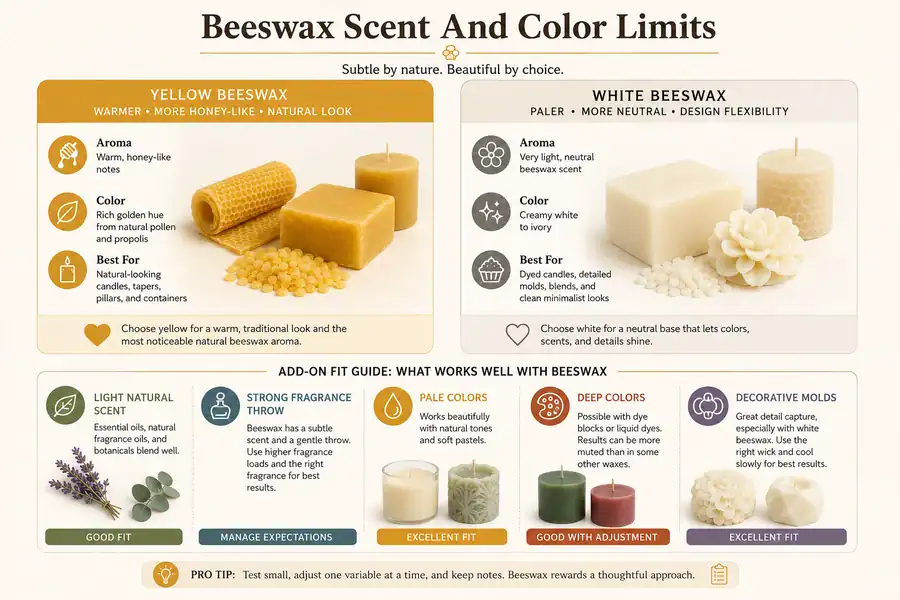
Yellow beeswax usually keeps more natural color and aroma, while white beeswax gives a cleaner visual base for pale or colored candles.
White and yellow beeswax are not different candle wax categories. They are beeswax variants that differ mainly in appearance, scent expectation, and processing level.
| Choice | What it usually offers | Best fit | Watch for |
|---|---|---|---|
| Yellow beeswax | Warm yellow color and more noticeable honey-like character | Natural-looking tapers, pillars, rolled candles, rustic candles | Can affect final candle color |
| White beeswax | Pale color and a more neutral visual base | Dyed candles, lighter designs, cleaner-looking molded candles | May have less natural aroma |
| Unfiltered beeswax | Stronger natural variation | Rustic or traditional projects | More debris or inconsistency risk |
| Highly filtered beeswax | Cleaner appearance and more predictable handling | Finished candles where consistency matters | Less raw-wax character |
Yellow beeswax is often chosen when the natural look is part of the candle’s appeal. Its color can make even an unscented candle feel warmer and more traditional, but that same color can limit pastel dye results.
White beeswax is useful when the finished candle needs a cleaner or lighter appearance. It can be a better base for decorative candles, but “white” does not automatically mean synthetic, unsafe, or lower quality.
Choose yellow beeswax when natural tone and honey-like character matter. Choose white beeswax when visual control matters more than natural color.
Why Beeswax Is Firm and What That Means for Candles
Beeswax is firm and structurally strong, which makes it useful for candles that need to hold their shape.
That firmness is one reason beeswax works well for freestanding candle formats such as tapers, pillars, rolled sheets, and molded candles. Compared with softer waxes, beeswax gives more structure, but that same hardness can make cutting, melting, blending, and container performance less forgiving.
Use beeswax when the candle format benefits from rigidity, not when you need the easiest wax for every possible candle type.
| Candle format | How beeswax firmness helps | Possible constraint |
|---|---|---|
| Rolled sheets | Holds the rolled shape without melting and pouring | Limited design range compared with poured candles |
| Tapers | Supports a slim freestanding candle shape | Wick choice and diameter still matter |
| Pillars | Helps the candle stand without a container | May need careful mold release and burn testing |
| Molded candles | Captures firm decorative shapes | Hard wax can crack or pull if the setup is wrong |
| Votives | Can work when the size and wick match | Small diameter changes can affect burn quality |
| Containers | Adds firmness, especially in blends | Pure beeswax may be less beginner-friendly than softer container waxes |
Beeswax is generally harder than soy wax, which is why soy is often easier for containers while beeswax is often stronger for freestanding candles. That comparison should stay high-level here; a full wax-type guide is the better place to compare beeswax with soy, paraffin, coconut, and palm across every candle category.
Hardness becomes a problem when the candle project needs flexibility, easy cutting, smooth container adhesion, or simple beginner handling. If a beeswax candle cracks, pulls from a mold, tunnels, or burns unevenly, the cause may be the mold setup, wick, diameter, or cooling conditions rather than the wax alone.
For project instructions, follow a beeswax candle tutorial. For wick-specific burn behavior, use a beeswax wick guide instead of treating firmness as the only performance variable.
Beeswax Melt Point and Heat-Handling Expectations
Beeswax has a relatively high melt point for candle making, which affects handling, melting time, and project difficulty.
Beeswax commonly melts around 62–65°C (144–149°F), but exact handling temperatures should follow the supplier’s wax data.
A higher melt point means beeswax usually takes more patience and heat control than softer candle waxes. This matters when choosing wax because the melt behavior affects cutting, measuring, melting, pouring, cleanup, and beginner comfort.
Higher melt point is a handling property. It does not automatically make a beeswax candle safer, cleaner, longer-lasting, or higher quality than candles made with other waxes.
| Heat-handling factor | What it means for beeswax candle making |
|---|---|
| Melting time | Beeswax may take longer to melt than softer waxes. |
| Heat control | Gentle, steady heating matters because overheating can affect color, scent, or handling. |
| Cutting and measuring | Blocks can be harder to divide than pellets or pastilles. |
| Pouring difficulty | Melted beeswax may feel less forgiving for beginners than softer container waxes. |
| Project fit | Sheets avoid melting, while pellets and pastilles make melted projects easier. |
| Safety meaning | Melt point is not the same as a fire-safety guarantee. |
Beginners who want the least heat-handling should start with rolled beeswax sheets. Beginners who want poured or molded candles should use pellets or pastilles because they reduce cutting work and melt more evenly than large blocks.
“How to melt beeswax” belongs in a tutorial because equipment, batch size, and project format change the workflow. For this page, the decision rule is simple: choose sheets when you want no-melt handling, and choose pellets or pastilles when you want easier melting for molds or pours.
Heat behavior leads directly into burn behavior because the finished candle still depends on wick choice, diameter, trimming, and format.
How Beeswax Candles Burn: Strengths, Limits, and Conditions
Beeswax candles can burn steadily and for a long time, but burn quality depends on wick fit, candle size, and use conditions.
Beeswax is often praised for clean-looking performance, firm structure, and long burn potential. Those strengths are real candle-making reasons to choose it, but they should not be treated as health claims or proof that beeswax always burns better than every other wax.
A beeswax candle performs well when the wax, wick, diameter, and candle format work together. If one part is wrong, the candle can tunnel, smoke, drip, drown the wick, or leave wax behind.
| Burn factor | What beeswax can do well | What can still go wrong |
|---|---|---|
| Burn time | Dense, firm wax may support a slower burn | Poor wick fit can waste wax |
| Flame behavior | Can produce a steady flame in a matched setup | Oversized wicks can smoke or flare |
| Dripping | Tapers can burn neatly when sized well | Drafts, angle, and wick choice can cause dripping |
| Soot or smoke | May burn cleanly in good conditions | Any candle can smoke when the wick, airflow, or trimming is wrong |
| Wax pool | Holds shape well in pillars and tapers | Too-small wicks can cause tunneling |
| Scent behavior | Natural aroma may stay gentle | It may not throw added fragrance as strongly as some other waxes |
“Clean-burning” should mean low visible smoke or soot under proper candle conditions. It should not mean beeswax is risk-free, medically safer, or guaranteed to produce no emissions.
Use beeswax when you want a premium, naturally aromatic candle with structure and slower-burn potential. Choose another wax, or a blend, when you need easier container performance, stronger added fragrance, lower material cost, or simpler beginner testing.
Poor burn performance should be diagnosed before blaming the wax. Trim length, wick type, candle diameter, drafts, container shape, and burn time can change the result.
Why Beeswax Is Sensitive to Wick Choice
Beeswax is sensitive to wick choice because its firmness and burn behavior require a wick that can match the candle’s diameter and wax pool.
The wick is the fuel-delivery path in a candle. In beeswax candles, the wick must create enough heat to melt the right amount of firm wax without making the flame too large, smoky, or unstable.
| Symptom | Likely wick-related issue | What it means |
|---|---|---|
| Tunneling | Wick may be too small for the candle diameter | The flame cannot melt wax across the candle surface |
| Smoking | Wick may be too large, too long, or exposed to drafts | The flame is burning too aggressively |
| Weak flame | Wick may be too small or clogged | The candle cannot sustain a strong melt pool |
| Wax left on sides | Wick and diameter may be mismatched | The candle is not consuming wax evenly |
| Fast burn | Wick may be too large | The candle uses wax faster than intended |
| Flame drowning | Wick may not suit the wax pool depth | Melted wax overwhelms the flame |
Wick problems are not proof that beeswax is a bad candle wax. They usually mean the candle format needs a better wick match, a different diameter, or more burn testing.
This page keeps wick coverage at the selection level. A full wick chart belongs in a beeswax wick guide because wick sizing depends on candle diameter, wick material, braid type, additives, mold shape, and test burns.
For a simple decision, rolled sheet candles are usually easier to wick than poured pillars or molded beeswax candles. The more the project depends on melting, pouring, and diameter control, the more wick testing matters.
Does Beeswax Smell Like Honey? Natural Aroma and Scent Limits
Beeswax usually has a subtle honey-like aroma, but it is not a strong fragrance wax by default.
The scent comes from the wax’s bee-derived origin and can vary by filtration, color, batch, and supplier. Yellow beeswax often smells warmer or more noticeable than white beeswax, while heavily filtered beeswax may smell milder.
| Scent factor | What it means for candle making |
|---|---|
| Natural aroma | Beeswax may smell lightly sweet, warm, or honey-like before scent is added. |
| Batch variation | Two beeswax batches can smell different because source and processing vary. |
| White beeswax | Often gives a more neutral scent base than yellow beeswax. |
| Yellow beeswax | Often keeps more natural aroma and color character. |
| Finished candle scent | The final scent depends on wax, additives, wick, candle size, and burn conditions. |
Beeswax is a good choice when you want a candle with a gentle natural aroma. It is not the best fit when your main goal is a strong fragrance throw, a very neutral wax base, or a highly controlled perfume-style scent.
Natural aroma can be a benefit or a limit. It gives unscented candles more character, but it can compete with delicate fragrance oils or change how a scent blend smells in the finished candle.
Use beeswax for subtle, premium, low-additive candles. Consider soy, paraffin, coconut wax, or a blend when the project depends on strong added fragrance.
Can You Add Fragrance or Dye to Beeswax Candles?
You can add fragrance or dye to beeswax candles, but beeswax is less neutral than many fragrance-focused candle waxes.
The main issue is compatibility, not possibility. Beeswax already has firmness, natural color, and a light aroma, so added fragrance and dye may behave differently than they would in a softer or more neutral wax.
Fragrance load should follow the wax and fragrance supplier limits because excess oil can pool, clog the wick, smoke, or weaken burn quality.
| Additive goal | Beeswax fit | Practical limit |
|---|---|---|
| Light natural scent | Strong fit | Added fragrance may be unnecessary |
| Strong fragrance throw | Mixed fit | Beeswax may not carry scent as strongly as fragrance-focused waxes |
| Pale candle colors | Better with white beeswax | Yellow beeswax can warm or change the final color |
| Deep candle colors | Possible | Testing matters because wax color affects the result |
| Natural-looking candles | Strong fit | Heavy dye can work against the natural look |
| Decorative molded candles | Good fit | Dye and mold detail still need testing |
Fragrance load percentages and dye formulas belong in separate guides because they depend on the wax product, fragrance oil, dye type, candle size, and testing method. This page only answers whether beeswax is a good material fit.
Choose beeswax for candles where the natural wax character matters. Choose another wax or a blend when the candle needs a stronger scent throw, cleaner color control, or easier additive testing.
Color, Finish, and Decorative Expectations
Beeswax color affects the finished candle’s look, so the best choice depends on whether you want natural warmth or visual control.
Yellow beeswax gives candles a warm, traditional appearance. White beeswax gives a paler base for cleaner designs, softer colors, and decorative molds where the candle shape or dye needs more attention than the wax’s natural tone.
| Visual goal | Better beeswax choice | Why it fits |
|---|---|---|
| Natural-looking candle | Yellow beeswax | Keeps the warm beeswax tone and rustic character |
| Pale candle | White beeswax | Gives a lighter base color |
| Dyed candle | White beeswax | Reduces color interference from yellow wax |
| Rolled sheet candle | Colored or natural sheets | Shape and texture come from the sheet itself |
| Decorative molded candle | White or filtered beeswax | Helps details look cleaner |
| Rustic candle | Yellow or less-filtered beeswax | Natural variation becomes part of the design |
Color should not be used as the only quality test. A darker yellow beeswax may suit a natural taper, while a pale filtered beeswax may suit a shaped decorative candle better.
Finish depends on wax form, mold choice, cooling, additives, and handling. Beeswax can look smooth and premium, but it can also show surface texture, bloom, tiny cracks, or color variation when the setup is not matched to the project.
Use yellow beeswax when the wax’s natural identity should be visible. Use white beeswax when the finished candle needs a cleaner base for dye, shape, or display.
Best Uses for Beeswax in Candle Making
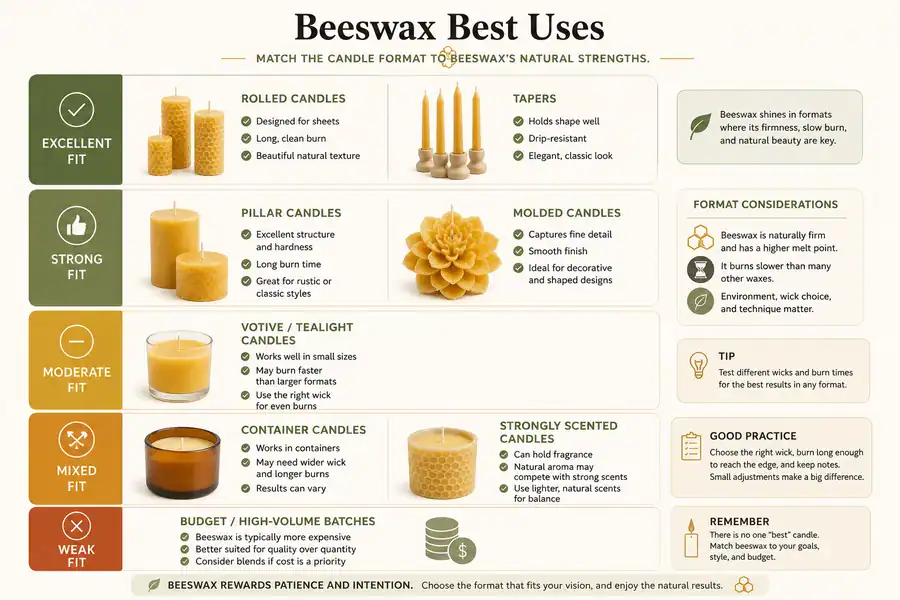
Beeswax is best for candles that benefit from firm structure, natural aroma, and a premium handmade feel.
The best beeswax uses are not the same as the easiest candle projects overall. Beeswax performs well when the candle format needs strength, shape, or natural character, but it can be less convenient for strong fragrance throw, low-cost batches, or beginner container candles.
| Candle use | Beeswax fit | Why it works |
|---|---|---|
| Rolled candles | Excellent | Sheets make the project simple and keep the natural wax look |
| Tapers | Excellent | Firm wax supports a slim freestanding shape |
| Pillars | Strong | Rigidity helps the candle stand without a container |
| Molded candles | Strong | Hard wax can hold decorative shapes well |
| Votives | Moderate to strong | Works when size and wick match |
| Containers | Mixed | Pure beeswax can be less forgiving than softer container waxes |
| Strongly scented candles | Mixed to weak | Natural aroma and wax behavior can limit fragrance goals |
| Budget candle batches | Weak | Beeswax is often positioned as a higher-cost wax |
Choose beeswax when the candle should feel natural, firm, lightly aromatic, and gift-worthy. Choose another wax when the project depends on low cost, strong added scent, easy container adhesion, or simple large-batch production.
A good use case does not remove the need for testing. Wick choice, candle width, mold shape, room drafts, and burn time still decide whether a beeswax candle performs well.
For a first project, rolled sheets are the simplest fit because they show beeswax’s strengths without requiring melting or pouring. For more advanced work, tapers, pillars, and molded candles make better use of beeswax structure.
Is Beeswax Beginner-Friendly? Start With the Right Project
Beeswax is beginner-friendly for simple rolled sheet candles, but melted beeswax projects can be more demanding because of heat handling, rigidity, and wick sensitivity.
Beginner-friendly means the first project is manageable, not that every beeswax candle format is easy. The wax form, candle shape, wick setup, and amount of testing decide whether beeswax feels simple or frustrating.
| Beginner project | Best beeswax form | Difficulty | Main risk | Next-step route |
|---|---|---|---|---|
| Rolled beeswax sheets | Sheets | Easy | Uneven rolling or poor wick placement | Follow a step-by-step beeswax candle tutorial |
| Simple tapers | Sheets or melted beeswax | Medium | Wick and diameter mismatch | Choose the right wick for beeswax candles |
| Beeswax pillars | Pellets, pastilles, or blocks | Medium to hard | Tunneling, cracking, or uneven burn | Learn pillar testing before scaling |
| Molded beeswax candles | Pellets or pastilles | Medium | Mold release, cracking, or weak burn | Start with small molds first |
| Beeswax containers | Pellets or pastilles | Hard | Poor container burn or adhesion issues | Choose beginner-friendly candle wax |
| Beeswax blends | Pellets or pastilles | Medium to hard | Ratio and performance uncertainty | Use a blend-specific guide |
Rolled sheets are usually the easiest starting point because they avoid melting, pouring, and mold handling. They still need care, but the project teaches beeswax handling without adding heat control.
Melted beeswax projects become harder because the wax is firm, heat-sensitive, and often less forgiving than softer container waxes. Beginners can still use pellets or pastilles, but they should expect more testing than with a no-melt rolled candle.
Choose beeswax as a first wax when you want a simple rolled candle or a natural-looking handmade project. Choose another beginner wax when the goal is easy containers, strong fragrance, low cost, or fewer burn-test variables.
Pros of Beeswax for Candle Making
The main pros of beeswax for candle making are firmness, subtle natural aroma, premium appeal, freestanding format fit, and burn-performance potential when properly wicked and used.
These are candle-making advantages, not universal health, sustainability, or performance guarantees. Beeswax is useful because its physical traits match certain candle goals, especially structure, natural presentation, and premium handmade positioning.
| Beeswax benefit | When it matters | When it is overstated |
|---|---|---|
| Firm structure | Tapers, pillars, rolled sheets, and molded candles need shape support | It does not make every candle format easier |
| Subtle honey-like aroma | The candle should smell naturally warm without heavy fragrance | It is not the same as strong fragrance throw |
| Premium feel | The candle is positioned as handmade, natural-looking, or gift-worthy | Premium does not mean best for every budget |
| Freestanding format fit | The candle needs to stand without a container | Containers may be easier with softer waxes |
| Burn-performance potential | Wick, diameter, and use conditions are matched well | Poor wick fit can still cause smoke, tunneling, or wasted wax |
| Natural color and finish | Yellow or white beeswax supports a specific candle look | Color alone does not prove purity, safety, or quality |
Beeswax is a good choice when the wax’s firmness is part of the design. Rolled candles, tapers, pillars, and molded shapes benefit more from that structure than fragrance-heavy container candles do.
The natural aroma is another benefit when the candle does not need a loud scent. A lightly honey-like smell can make an unscented candle feel finished, but it can interfere with delicate fragrance blends.
The burn advantage is conditional. For burn details, return to the beeswax burn conditions section rather than treating “clean burn” as a health or air-quality claim.
The sustainability advantage is conditional too. Sourcing and ethical preferences decide whether beeswax fits that goal, so environmental claims belong in the sustainability and ethical sourcing section.
For full material choice, compare beeswax with other candle wax types instead of reading the pros as proof that beeswax is always the better wax.
Cons of Beeswax for Candle Making
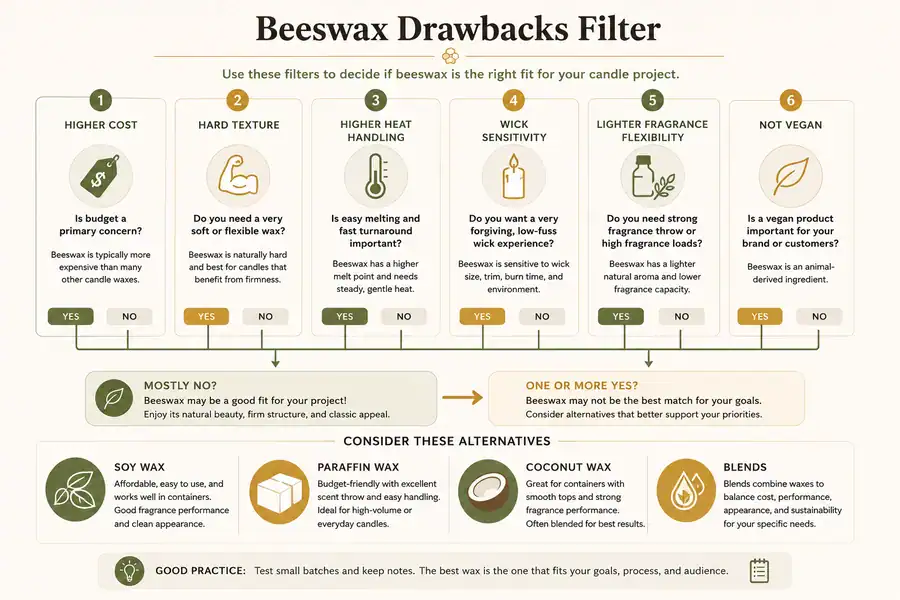
The main cons of beeswax are higher cost, harder handling, lighter fragrance flexibility, wick sensitivity, and weaker fit for some container candles.
These drawbacks do not make beeswax a poor candle wax. They show where beeswax needs the right project, form, wick, and budget to perform well.
| Beeswax drawback | Why it matters | Better choice when this is the priority |
|---|---|---|
| Higher cost | Beeswax is often positioned as a premium wax, so mistakes can cost more | Soy, paraffin, or blended wax for lower-cost batches |
| Firm texture | Blocks can be hard to cut, melt, and measure | Pellets, pastilles, or a softer wax |
| Higher heat handling | Melted projects can feel less forgiving for beginners | Rolled sheets or beginner container wax |
| Wick sensitivity | Poor wick fit can cause tunneling, smoking, weak flame, or wasted wax | Use a beeswax wick guide before scaling |
| Lighter fragrance flexibility | Natural aroma can compete with added fragrance | Soy, paraffin, coconut, or a fragrance-focused blend |
| Color limits | Yellow beeswax can affect pale or dyed candles | White beeswax or a more neutral wax |
| Not vegan | Beeswax is produced by bees | Plant-based waxes such as soy, coconut, or some plant blends |
| Sourcing questions | Ethics and sustainability depend on supplier practices | Supplier-specific sourcing checks |
Beeswax is least ideal when the candle project depends on low cost, strong scent throw, easy container performance, or vegan positioning. Those goals do not match beeswax’s strongest material traits.
The most common mistake is treating beeswax as a universal upgrade. Beeswax is better for certain candle goals, especially firm freestanding shapes and natural presentation, but it is not automatically better for every candle format.
For a wider material decision, compare beeswax inside a full candle wax types guide. For poor burn results, check wick sizing before switching waxes because the wick may be the real problem.
Is Beeswax Worth the Higher Cost?
Beeswax is worth the higher cost when its firmness, natural aroma, and premium positioning match the candle you want to make.
The price only makes sense when beeswax traits create a better outcome. If the project needs a firm taper, rolled candle, natural-looking pillar, or gift-ready handmade candle, beeswax can justify its cost. If the project needs cheap testing, strong added fragrance, or easy containers, another wax may be the better value.
| Project goal | Is beeswax worth it? | Reason |
|---|---|---|
| Rolled natural candles | Yes | Sheets make the project simple and visually distinctive |
| Tapers | Often yes | Firm wax supports the narrow shape |
| Pillars | Often yes | Structure and premium feel matter |
| Molded decorative candles | Often yes | Hard wax can hold shape well |
| Strongly scented containers | Usually not the first choice | Fragrance and container behavior may matter more |
| Large low-cost batches | Usually not | Material cost can outweigh the benefit |
| Vegan candles | No | Beeswax is bee-derived |
| Natural-looking gifts | Often yes | Appearance, aroma, and positioning support the use case |
Cost should be judged by fit, not by wax reputation. A more expensive wax is wasteful when it works against the candle goal, and a cheaper wax is the better choice when it gives the required scent, container behavior, or batch economy.
Buy pellets or pastilles for small melted projects when ease matters more than bulk savings. Buy blocks only when you are ready to cut, melt, and handle larger amounts. Buy sheets when the goal is rolled candles without melting.
Beeswax is a premium choice, not a default choice. It earns its cost when the finished candle benefits from structure, natural character, and a handmade feel.
Is Beeswax Sustainable, Ethical, or Vegan?
Beeswax is not vegan, and its sustainability or ethical fit depends on sourcing, beekeeping practices, processing, and buyer values.
Beeswax comes from bees, so it does not fit vegan candle positioning. It may still fit natural, traditional, handmade, or low-additive candle goals, but those are different claims from vegan or automatically sustainable.
| Claim | Safe candle-making meaning | What not to assume |
|---|---|---|
| Natural | Bee-derived wax used for candles | Automatically safer or better than every other wax |
| Sustainable | Depends on sourcing, beekeeping, transport, and processing | Guaranteed eco-friendly because bees made it |
| Ethical | Depends on supplier practices and buyer standards | Automatically ethical without sourcing checks |
| Vegan | Not vegan because beeswax is animal-derived | Plant-based just because it is natural |
| Premium | Higher-value material positioning | Proof of better performance in every candle |
Choose beeswax when your candle brand or project values traditional material origin, natural aroma, and firm candle structure. Choose soy, coconut, or another plant-based wax when vegan positioning matters more than beeswax’s structure or honey-like character.
Ethical sourcing is a supplier-level question. A candle maker should check how the wax is sourced, cleaned, labeled, and sold rather than relying on color, scent, or the word “natural” alone.
Sustainability should be stated with care. Beeswax can be a strong fit for some natural-product buyers, but it should not be presented as the safest, cleanest, or most sustainable candle wax in every case.
Beeswax vs Soy, Paraffin, Coconut, and Other Candle Waxes
Beeswax is firmer and more naturally aromatic than many candle waxes, but it is not the best wax for every candle type.
The right comparison depends on the candle goal. Beeswax often wins for structure, rolled candles, tapers, and natural presentation. Other waxes may win for cost, container candles, strong fragrance, vegan positioning, or easier large-batch production.
| Wax type | Where it often fits better than beeswax | Where beeswax often fits better |
|---|---|---|
| Soy wax | Vegan candles, container candles, softer handling, fragrance-focused projects | Tapers, rolled candles, firm pillars, natural honey-like aroma |
| Paraffin wax | Strong scent throw, bright colors, low-cost batches, broad commercial use | Natural-material positioning and premium handmade appeal |
| Coconut wax | Soft container candles, creamy finish, blend-friendly candles | Freestanding structure and rolled sheet formats |
| Palm wax | Harder decorative candles, crystalline visual effects | Bee-derived origin and honey-like natural aroma |
| Wax blends | Balanced performance across scent, cost, hardness, and burn behavior | Projects where pure beeswax identity matters |
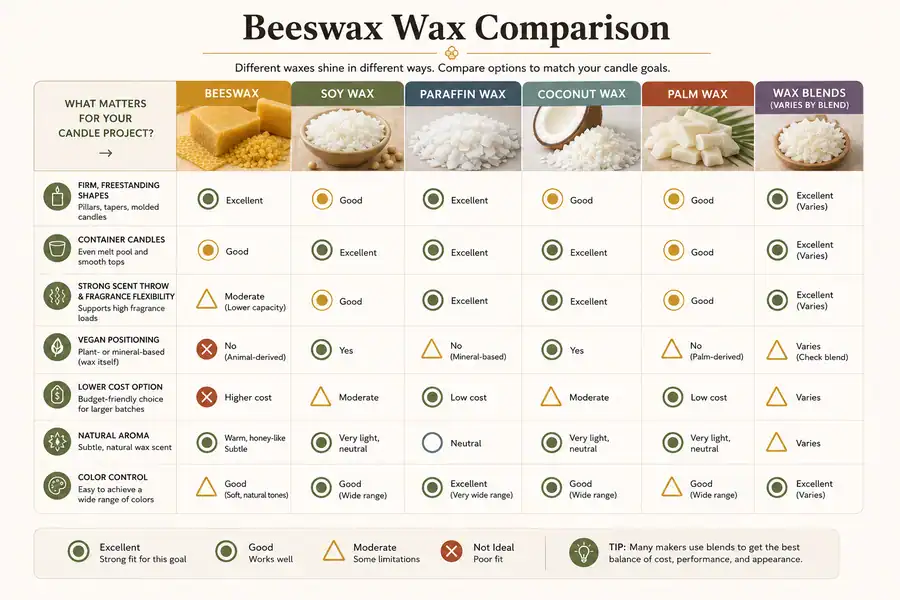
Beeswax is usually the better choice when the candle needs a firm body and a natural wax character. Soy or coconut wax may be easier when the candle is a container candle with added fragrance. Paraffin may suit makers who prioritize scent throw, color control, or lower cost over natural-material positioning.
This comparison should stay beeswax-centered. A full candle wax types guide is the better place to compare every wax across cost, burn, scent, sustainability, container fit, and beginner difficulty.
When Beeswax Is Blended With Soy or Other Waxes
Beeswax can be blended with other candle waxes to change firmness, burn behavior, scent performance, cost, or handling.
Blending does not mean beeswax is incomplete. It means the maker wants some beeswax traits without making the whole candle behave like pure beeswax.
| Blend goal | Why beeswax may be added | What needs testing |
|---|---|---|
| Firmer container wax | Beeswax can add structure to softer waxes | Adhesion, cracking, and burn pool |
| More natural positioning | Beeswax can support a premium or traditional material story | Whether the blend still fits the brand claim |
| Better shape support | Beeswax can help molded or freestanding formats | Wick size and mold release |
| Cost control | A blend may reduce pure beeswax cost | Whether the final candle still performs well |
| Scent balance | Other waxes may carry fragrance better than pure beeswax | Hot throw, cold throw, and wick behavior |
Blending should stay goal-based. Use beeswax in a blend when you want more firmness, natural aroma, or premium material character. Use another wax as the base when you need stronger fragrance throw, easier containers, vegan positioning, or lower cost.
Exact soy-beeswax ratios belong in a dedicated blending guide because ratios depend on wax products, fragrance, vessel size, wick choice, and testing.
How to Store Beeswax for Candle Making
Store beeswax in a cool, dry, clean place away from dust, heat, strong odors, and direct sunlight.
Good storage protects the wax’s scent, color, cleanliness, and handling quality. Beeswax can store well, but it can still collect dust, absorb odors, soften in heat, or pick up debris that affects finished candles.
| Storage factor | Best practice | Why it matters |
|---|---|---|
| Heat | Keep beeswax away from high heat and direct sun | Heat can soften or deform the wax |
| Dust | Use sealed bags, bins, or wrap | Debris can show up in melted wax or finished candles |
| Odors | Store away from fragrance oils, smoke, and strong smells | Beeswax can pick up unwanted odors |
| Moisture | Keep storage dry | Moisture can interfere with clean handling |
| Form | Keep sheets flat and pellets sealed | Prevents warping, sticking, and contamination |
| Labels | Mark wax type, color, and purchase batch | Helps compare future results |
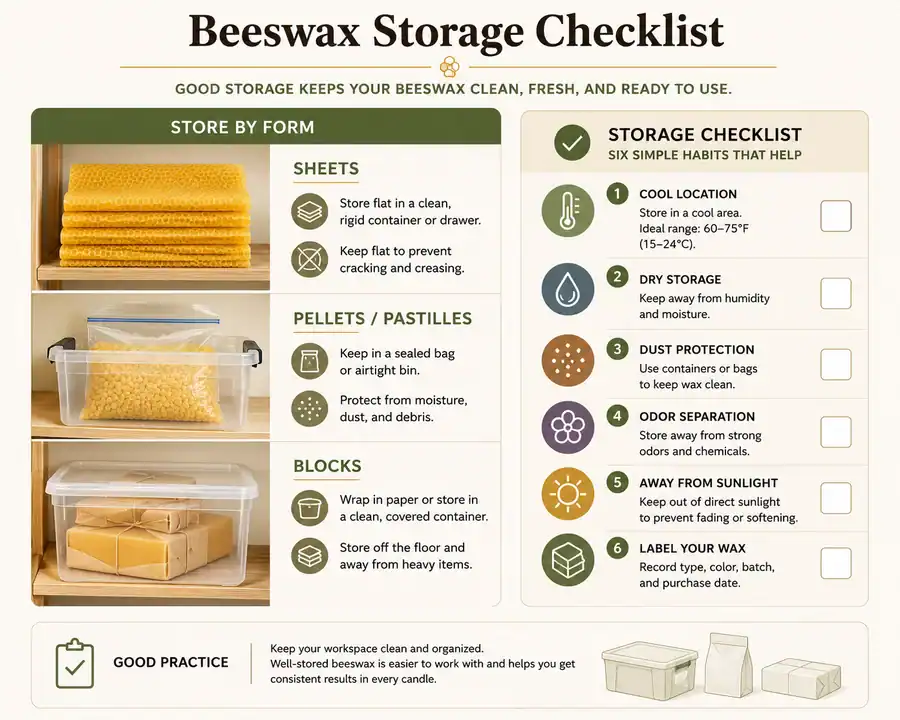
Beeswax bloom or surface haze can appear during storage. It is usually a surface change rather than proof that the wax has gone bad, but dirty, moldy, foul-smelling, or contaminated wax should not be used for candles.
For small batches, keep pellets or pastilles sealed until use. For sheets, store them flat so they do not warp before rolling. For blocks, wrap them or keep them in a clean container before cutting or melting.
Beeswax is easiest to use when it stays clean, dry, and clearly labeled. Good storage makes later candle testing more reliable because fewer unknowns enter the wax, wick, and burn setup.