

Candle additives are formula ingredients added to wax to change hardness, burn behavior, scent retention, appearance, or stability, and they are worth using only when a named result, a compatible wax system, and controlled testing support the choice.
This page explains common candle additives, the jobs they are used for, and when to use, test, skip, or remove them as one branch of candle making and candle formulation choices. Safe on this page means formulation-safe screening with supplier paperwork and controlled testing, not a universal toxicology, fire-safety, or legal answer. Best means best-fit for the named result in the current wax and candle format. Cost-effective means the working dose earns its place in the formula, not that the cheapest package wins.
What are the most common candle additives and what does each one do?
Common candle additives include named materials such as stearic acid, Vybar, and UV inhibitors, along with broader additive families sold for structure, finish, scent retention, or burn control.
This seed page should answer one question first: what job is the additive supposed to do? Once that job is clear, the next move is to match the formula to the right additive family or to no additive at all.
| Additive or additive family | Main job | Best-fit use case | Common caution | Go deeper |
| Stearic acid | Builds structure and can support hardness or release | Pillar or freestanding candles that need a firmer body | Extra structure can create new burn or adhesion tradeoffs | Common additive profiles |
| Vybar | Can support scent hold and formula structure | Paraffin or blend formulas that need better scent hold or a firmer body | It can shift wick balance, finish, or burn behavior | Vybar in candles |
| UV inhibitor | Supports stability under light exposure | Candles that face repeated light or warm display conditions | Use it only when the storage or display problem is real | UV inhibitor rates and use |
| Scent-retention additive family | Helps fragrance sit in the wax or release more evenly | Formulas where scent hold is the named result | A scent gain can still open a new burn tradeoff | Scent additive choices |
| Appearance-focused additive family | Targets smoother tops, finish, or visual stability | Formulas where the visual result is clearly defined first | A cleaner look does not outweigh a worse burn | Common additive profiles |
| No additive yet | Keeps the baseline clean | Pre-blended wax or formulas that already meet the target | Adding variables can blur diagnosis | When no additive is better |
Which additive category fits the result you want?
Pick an additive category by the result you need, your wax system, and your candle format, not by the ingredient name alone.
A candle additive is a formulation ingredient added to wax to change burn behavior, appearance, hardness, scent retention, or stability. On this page, best means best-fit for the named result under the current wax and candle format, not a universal winner. Common examples include stearic acid, Vybar, and UV inhibitors, but the first decision is still the job the additive is meant to do.
Start by naming the exact result you want in plain language. “I want a cleaner release from a freestanding candle” is usable. “I want a better candle” is not. A clear result keeps you from buying an additive for the wrong problem, and it keeps testing narrow enough that you can still tell what changed.
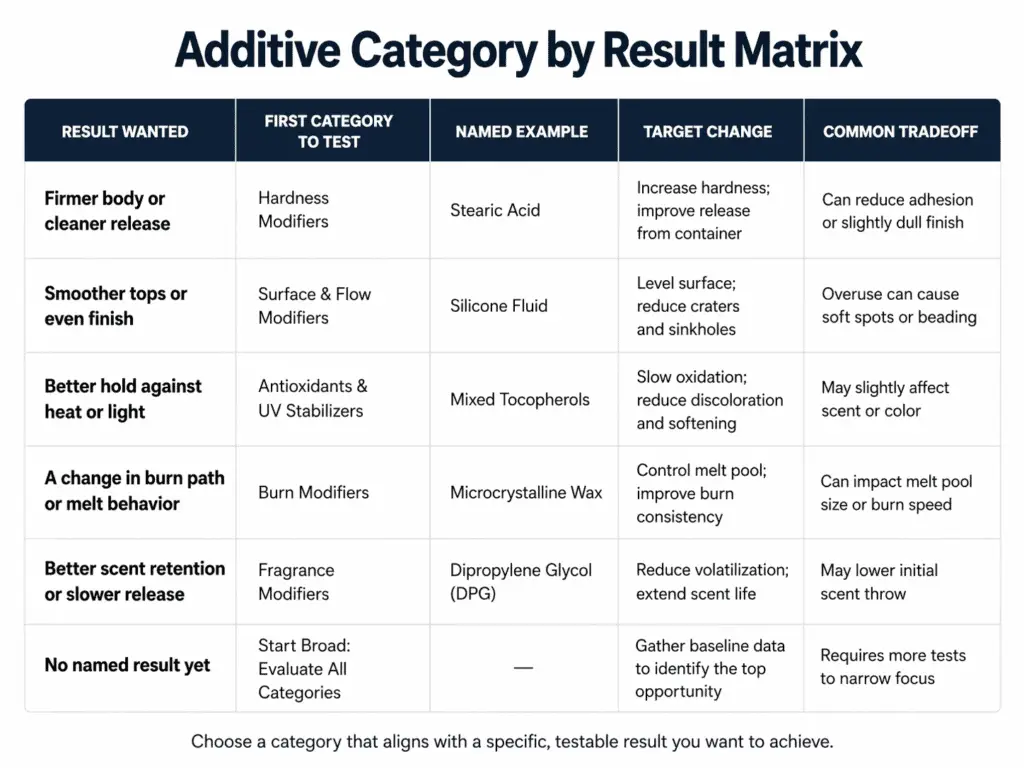
This matrix keeps the choice tied to the result you want.
| Result you want | First category to test | Named example | What that category is trying to change | Common tradeoff |
| Firmer candle body or cleaner release | Structure-building additive category | Stearic acid | Hardness, release, or shape hold | More rigidity can create new burn or adhesion tradeoffs |
| Smoother tops or a more even finish | Surface-smoothing additive category | Appearance-focused additive family | Top appearance, finish, or visual consistency | A cleaner look can come with a fresh wick or burn check |
| Better hold against heat or light | Stability-focused additive category | UV inhibitor | Resistance to heat, light, or storage stress | Added cost may bring little gain in mild conditions |
| A change in burn path or melt behavior | Burn-modifying additive category | Burn-control additive family | Melt behavior, burn speed, or structure during burn | One burn fix can shift wick balance |
| Better scent retention or slower release | Scent-retention additive category | Vybar or scent-retention additive family | How fragrance sits in the wax and releases in use | A longer hold can change how scent shows up during burn |
| No named result yet | No additive yet | Control batch first | Nothing should change yet | Buying by ingredient name creates weak testing logic |
The key question is not “Which additive is popular?” The key question is “Which category matches the result I can test?” That small change in wording lowers waste, because you stop shopping by label language and start shopping by function.
If the goal is still fuzzy, when no additive is the better choice is often the stronger next move. If the category makes sense but the exact product rule depends on product notes or product-level thresholds, see additive-specific profiles only after the goal, wax family, and format are fixed.
When no additive is the better choice
Skip the additive when the formula already meets the goal, the problem is misread, or the baseline has not been tested cleanly.
To choose the right additive category, first confirm that a new ingredient is solving a real gap. Pre-blended wax is wax sold with built-in performance choices already mixed in, so it is often smarter to test pre-blended wax as-is before stacking another enhancer. A control batch is the unchanged formula used as the comparison sample, so run a control batch first when the issue may come from wick, fragrance, pour conditions, or a pre-formulated blend.
A no-additive decision is not a weak decision. It is often the cleanest one. If the candle already burns well, holds its shape, and meets the visual goal, adding another variable can make diagnosis worse instead of making performance better.
This decision table shows when adding nothing new gives the cleaner answer.
| Situation | Best next move | Why |
| Current formula already hits the target | Skip additive | A new variable can blur a result that already works |
| Wax is sold as a pre-formulated blend | Test first | The blend may already contain the needed performance logic |
| Problem is not clearly tied to additives | Test first | Diagnosis is still weak |
| A named result is missing and the baseline is clear | Use additive | There is a defined reason to introduce one variable |
| Several formula variables changed at once | Reset first | An additive would add noise to an already mixed result |
| The last fix only masked a symptom | Skip additive for now | The real problem may sit in the base formula |
A leaner formula cuts cost and keeps diagnosis cleaner. Once the no-additive branch is ruled in or out, screen the candidate for safe use before you buy or mix anything.
Which additives fit your wax and candle format?
Compatibility means conditional fit inside a wax system, not a promise that one additive will work everywhere.
Works here means a reasonable fit for the named wax family and candle format, followed by testing. Soy, paraffin, and blends can react differently to the same additive idea, and container vs pillar constraints can change whether the same gain is helpful or harmful. Before you copy a result across waxes, test pre-blended wax as-is and see additive-specific compatibility notes only when the product question is narrower than this page.
Compatibility is where many false assumptions start. A result that looked useful in one wax can weaken, disappear, or create a new tradeoff in another. The same happens across formats. A jar candle and a freestanding candle ask the wax to do different jobs, so an additive that helps one may work against the other.
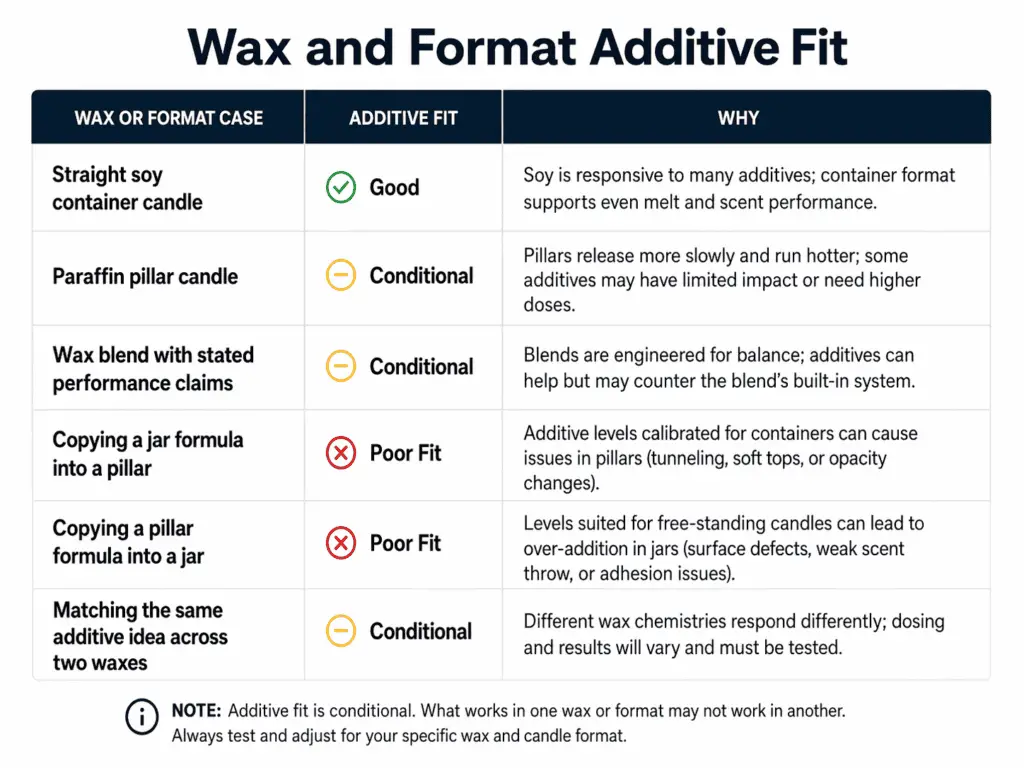
This comparison keeps fit conditional instead of absolute.
| Wax or format case | Additive fit | Why |
| Straight soy container candle | Test first | Surface and burn tradeoffs can shift fast |
| Paraffin pillar candle | Often easier to judge by structure goal | Freestanding candles may need firmness and release help |
| Wax blend with stated performance claims | Test first as sold | Built-in blend logic may already cover the job |
| Copying a jar formula into a pillar | Avoid copying as-is | Format needs change the result target |
| Copying a pillar formula into a jar | Avoid copying as-is | Extra hardness can work against container burn behavior |
| Matching the same additive idea across two waxes | Retest, do not assume | Wax family changes how the formula behaves |
What works in paraffin does not automatically work in soy, and what helps a pillar may not help a jar. Treat wax family, blend status, and format as part of the additive decision, not as small details to sort out later.
Test pre-blended wax as-is before stacking another additive
Some waxes are sold with built-in choices for hardness, appearance, or burn behavior, so they are not blank slates.
In that case, wax and formula compatibility starts with the base blend itself, not with a new enhancer, and when no additive is the better choice may be the cleanest answer until you read which supplier documents actually matter and run the wax alone first.
A pre-blended wax should earn your trust by performance, not by label wording. If the blend is sold as ready-to-use or already tuned for a result you want, the first real question is whether it already does the job. If it does, stacking another additive may solve nothing and may create a new failure you now have to untangle.
A fast check helps here.
| Label or note says | Best next move |
| Ready-to-use, enhanced, or performance blend | Run the wax alone first |
| Built for smooth tops, release, or hot throw | Confirm the claim before stacking another additive |
| No clear performance note | Treat it as test-first, not assumption-first |
| Blend plus additive recommendation | Confirm whether the recommendation is required or optional |
Why container and pillar candles need different additive logic
Container and pillar candles ask the wax to do different jobs, so the same additive plan should not be copied across both.
That is why wax and formula compatibility must stay visible during testing. Pillars need the body to stand and release cleanly, while containers can punish extra hardness with a worse burn path or weaker melt behavior. Keep which appearance changes are worth the tradeoff in view as you compare the formats, and see additive-specific profiles only after the format goal is clear.
A pillar candle must hold itself up. A container candle does not. That one difference changes what “better” means. In a pillar, added structure can support release and shape hold. In a container, the same change can make melt behavior less forgiving. That does not make the additive good or bad. It makes the fit conditional.
This format table keeps the decision tied to the job the candle has to do.
| Format | Main need | Additive risk |
| Container candle | Stable burn path and melt behavior in a jar | Too much structure can work against the burn |
| Pillar or freestanding candle | Body, release, and shape hold | Too little structure can hurt release or shape |
| Same additive in both | Different goal, same ingredient | Same category does not mean same dose or same result |
Format is not a side note. A result that looks useful in one format can miss the target in the other because the candle is being asked to perform in a different way.
How do you screen a candle additive for safe use?
A candle additive is safe to screen in use only when its intended role, burn-path fit, paperwork, and test plan line up.
Safe on this page means formulation-safe use in candle making. It does not mean universal toxicology clearance, home-use fire advice, or a final legal answer. Decorative materials placed in the burn path are not the same thing as formulation additives, so start with the material identity, handling notes, and the supplier’s stated use before you decide whether the additive deserves a trial.
A safe-use screen starts with four checks. First, confirm the material is sold for candle formulation rather than decoration. Second, confirm the supplier gives enough identity and handling information to justify a test. Third, check that the material fits the wax and candle type you are working with. Fourth, make sure you can compare it against a control instead of guessing from memory.
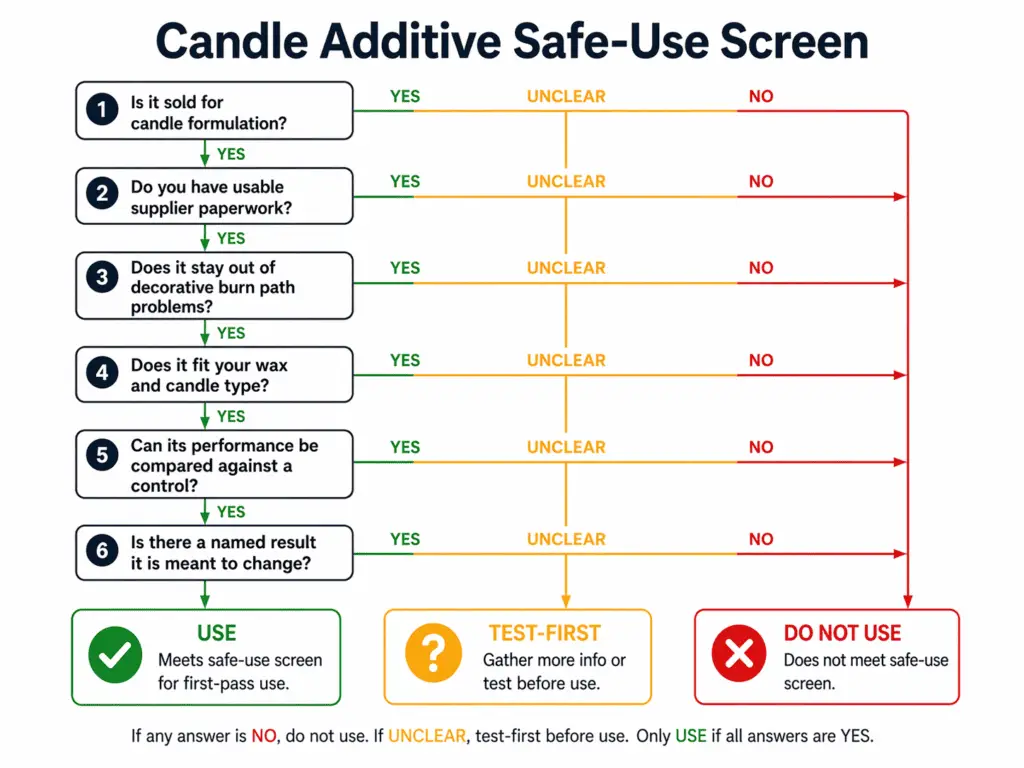
Use this first-pass screen before any purchase or mixing decision.
| Screening question | Use | Test-first | Do not use |
| Is it sold for candle formulation? | Yes | Unclear | No |
| Is there usable supplier paperwork? | Yes | Partial or vague | None |
| Does it stay out of the decorative burn path problem? | Yes | Unclear | No |
| Do the use notes fit the wax and candle type? | Yes | Needs more checking | No |
| Can you compare it against a control? | Yes | Later | No |
| Can you explain what result it is meant to change? | Yes | Partly | No |
Use this page for the first-pass screen only. For supplier-document and compliance depth, go to are candle additives safe?. For defect diagnosis after the test phase, use candle additives fix.
How much additive should you use before it becomes too much?
Dose is the amount of additive used as a percentage of wax weight, and too much means the formula starts trading one gain for a new problem.
Too much on this page is a formula-performance threshold, not a legal threshold and not one universal percentage for every wax. Start from a modest test rate from the supplier note, not the supplier maximum, keep one variable changed at a time, and use mix candle additives or UV inhibitor rates and best practices when the product itself needs tighter rules than this page should carry.
For this overview page, the working rule is simple: start low, keep the wax, wick, fragrance, and format fixed, and keep the minimum effective dose instead of climbing toward a maximum by habit.
How do you test additives with a control batch?
Test one additive variable against a matching control batch, keep the rest of the formula fixed, then judge the result after cure and repeated burn checks.
An additive test batch is a candle batch where the additive variable changes on purpose while the rest of the formula stays controlled. Use this seed page for the control-batch rule only. Use mix candle additives for deeper process detail and candle additives fix when the change opens a defect.
The test standard on this page is simple: keep wax, wick, fragrance, dye, and format fixed, change one additive variable, compare against the control after cure and burn checks, then keep, retest, or reject the change.
Is the additive worth the cost per batch?
An additive is worth the cost only when its working-dose cost buys a clear gain, lower waste, or better repeatability.
Additive cost here means the real per-batch or per-candle cost at the working dose, not the package sticker price alone. Cost-effective on this page means the added cost is justified because the additive gives a measurable gain or lowers failures or waste at that dose, not because the smallest package looks cheap on its own.
Use this overview page to decide whether the additive earns a place at all. Work out deeper production math only after the dose is stable and the result repeats cleanly. If the formula would not miss the additive after you remove it, the additive is not earning its cost.
What problems can additives cause and how do you isolate them?
An additive-caused failure is a candle problem that still points back to the additive after wax, wick, fragrance, and process confounders are checked.
That does not mean every defect that appears after adding something is the additive’s fault. Use this page for the rule only: compare the changed batch against the control, check nearby variables, and isolate one cause at a time. Use candle additives fix for the full symptom-by-symptom troubleshooting path.
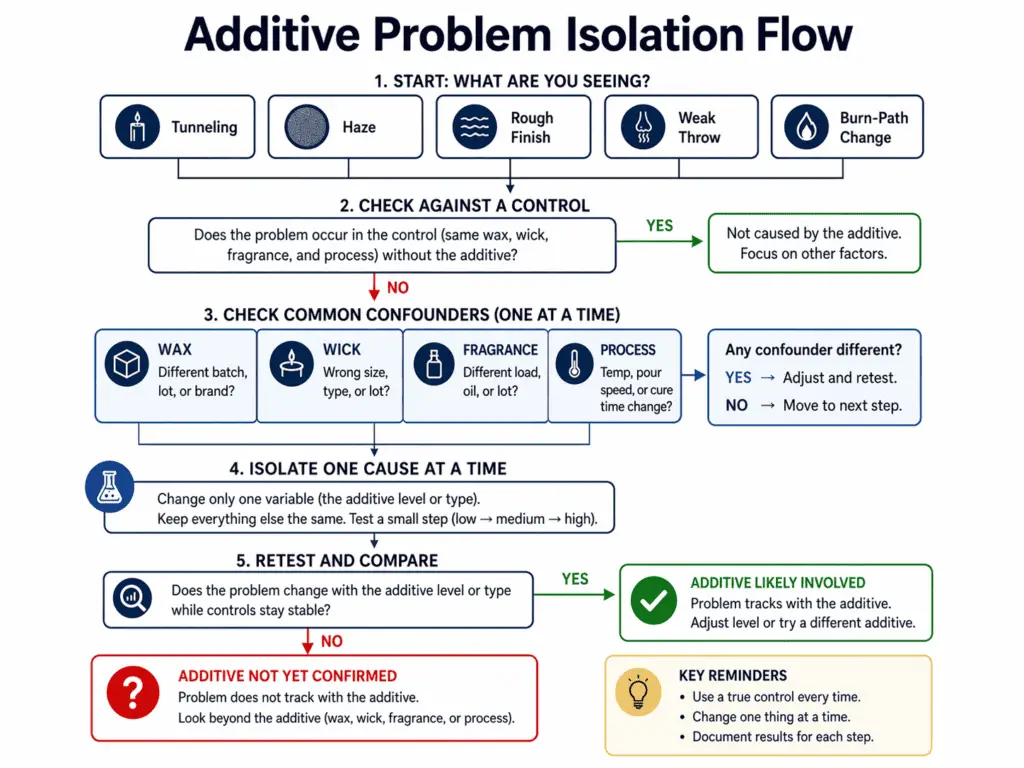
Common warning signs include tunneling, haze, rough finish, weak throw, or a new burn-path change after the additive. Those signs still need a control, a fixed sequence, and a retest before the additive earns blame.
Which appearance changes are worth the tradeoff?
Appearance stability means how the candle surface, opacity, and finish hold up after an additive is added, cured, and burned.
Improves look on this page means a better tested visual outcome without a worse burn or stability tradeoff. Keep appearance logic short on this seed page: the visual change must survive cure and burn checks, and a cleaner look does not beat a worse candle. Use common additive profiles or additive choice guidance when the product question gets narrower than this page.
A smoother top, less visible frosting, or a cleaner finish counts only when the burn stays acceptable and the gain does not depend on an uneconomical dose.