

Candle Molds and Shape Customization
Candle mold shape customization means choosing, adapting, or commissioning a mold to create a specific candle silhouette, size, surface detail, cavity layout, or repeatable physical form.
Candle molds are reusable forms that set the candle body shape before decoration choices matter. They decide whether the candle becomes a pillar, taper, cube, sphere, arch, relief pattern, novelty figure, or other molded form.
In this guide, customization means mold-controlled shape and detail. It does not mean fragrance blends, dye recipes, label design, jars, packaging, or full product-line planning. Those choices may change how a candle looks, smells, or sells, but they do not change the mold-driven wax body itself.
What Candle Mold Shape Customization Means
A candle mold can customize the candle’s physical form: silhouette, height, width, relief detail, cavity layout, surface texture, embed space, and repeatability.
The mold is the shape source. It creates the form the wax takes as it cools. That makes mold choice one of the earliest design decisions for any shaped candle.
| Mold-controlled element | What it changes | In scope here? |
|---|---|---|
| Silhouette | The candle’s outer outline | Yes |
| Height and width | The finished candle’s proportions | Yes |
| Relief detail | Raised, carved, or patterned surfaces | Yes |
| Cavity layout | One cavity, multi-cavity, or repeated forms | Yes |
| Surface texture | Smooth, faceted, fluted, ribbed, or patterned finish | Yes |
| Embed space | Whether the shape leaves room for safe, stable inserts | Yes |
| Repeatability | Whether the same shape can be poured again with similar results | Yes |
| Fragrance, dye, labels, jars, packaging, branding | Non-mold design choices | No |
Embed space means the mold leaves enough physical room for a stable insert without weakening the candle body.
The key limit is simple: candle molds shape wax into a physical body. Other candle choices may affect scent, color, style, or presentation, but they do not change the mold’s role.
For mold shape planning, start with one question: what physical candle form should come out of the mold? Once that answer is clear, the rest of the candle design becomes easier to separate.
How to Choose a Candle Mold Shape in Order
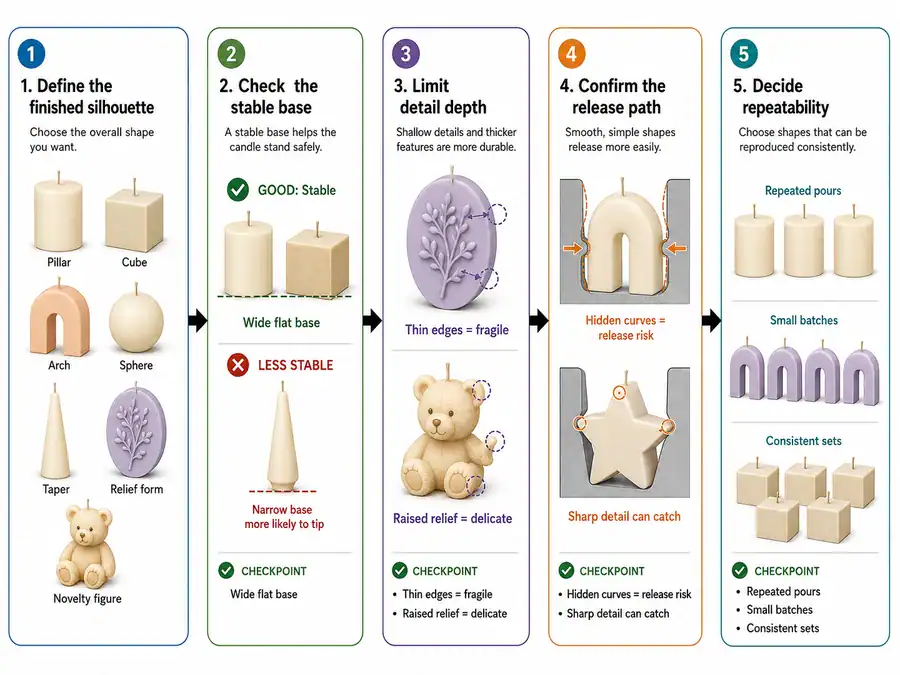
Choose a candle mold shape by deciding the finished physical form first, then checking stability, detail depth, release path, and repeatability needs.
- Define the finished silhouette, such as a pillar, cube, arch, sphere, taper, relief form, or novelty figure.
- Check whether the base is wide and flat enough for the candle to sit consistently after release.
- Limit detail depth when thin edges, raised relief, or narrow projections would make the candle fragile.
- Confirm that the release path lets the cooled candle leave the cavity without catching behind hidden curves or sharp detail.
- Decide whether the mold must repeat the same shape across several pours, sets, or small batches.
Main Candle Mold Shape Categories and What They Create
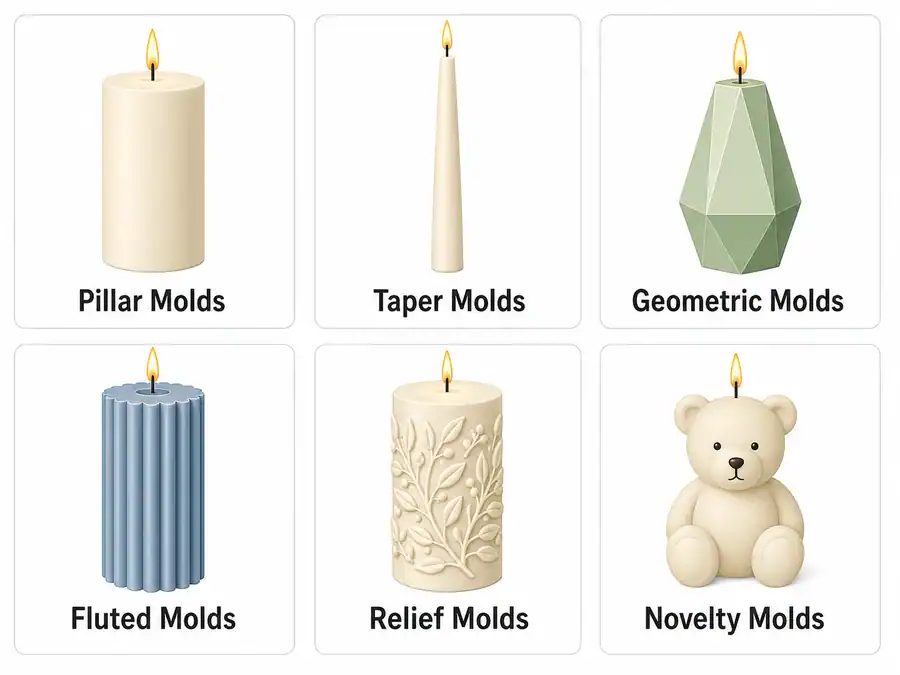
Candle molds can make pillars, tapers, cubes, spheres, arches, cones, fluted forms, relief designs, novelty shapes, and sculptural candles.
The mold category decides the finished candle form before material, wick, fragrance, or decoration choices enter the project. A shape category is not a product recommendation. It is a way to match the candle idea to a mold form that can produce it.
| Shape family | Common finished shape | Best use in shape planning | Main limit |
|---|---|---|---|
| Pillar molds | Cylinders, blocks, tall freestanding forms | Clean, classic molded candles | Detail is usually limited unless the mold surface is patterned |
| Taper molds | Long narrow candles | Slim vertical forms | Thin shapes need careful release and handling |
| Geometric molds | Cubes, spheres, arches, cones, faceted candles | Modern custom-looking candles with simple form rules | Sharp edges may chip if the wax or release path is poor |
| Fluted molds | Ribbed pillars or grooved forms | Texture without very fragile detail | Grooves can catch if the mold is stiff or the wax grips |
| Relief molds | Raised patterns, panels, floral surfaces | Surface detail on a stable body | Raised detail can break during demolding |
| Novelty molds | Seasonal, object-like, sculptural, or irregular shapes | Decorative or theme-driven candles | Irregular shapes raise release and stability risk |
| Multi-cavity molds | Matching small shapes | Sets, samples, or repeated small forms | Cavities must fill and release evenly |
A simple cylinder and a sculptural animal shape are both mold-driven candles, but they do not carry the same release risk. Shape planning works best when the maker judges the cavity before thinking about decoration.
Use a mold buyer guide only when you are ready to compare product choices. This section only classifies shape families, so it should not become a product grid, price list, or brand comparison.
How Shape Detail Affects Candle Release
Detailed candle molds can break during demolding when thin edges, undercuts, raised relief, sharp corners, or narrow cavities hold the wax too tightly for the finished shape to release intact.
The candle mold does more than create the visible pattern. Its cavity shape decides how the cooled wax moves, flexes, and exits. A custom shape is only practical when the detail can release without tearing, snapping, or trapping wax inside the mold.
| Detail feature | Why it raises release risk | Better shape choice |
|---|---|---|
| Thin edges | They cool fragile and can chip under pressure | Thicker edges or rounded rims |
| Undercuts | Wax catches behind the detail | Shallower relief or a flexible mold |
| Raised relief | High points can break during removal | Lower relief with wider detail |
| Sharp corners | Corners can grip or crack | Rounded or softened corners |
| Narrow cavities | Wax has less room to move during release | Wider cavities or simpler forms |
| Deep texture | Texture increases surface contact | Lighter texture on early projects |
Quick Release-Feasibility Check
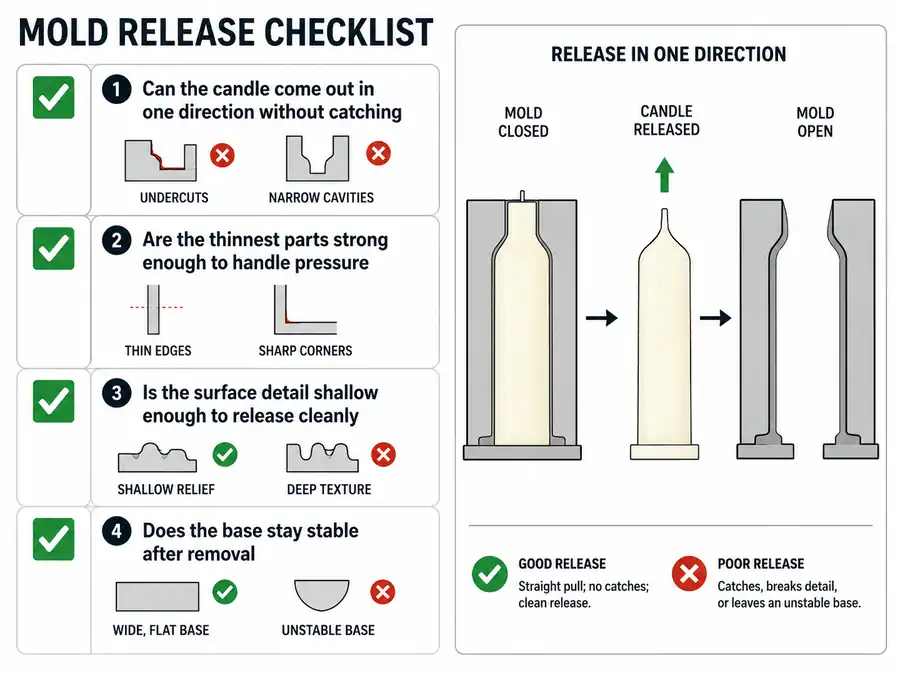
A release-feasibility check shows whether the mold cavity can release the candle without catching, breaking fragile detail, or leaving an unstable base.
Use these four questions before choosing a detailed mold shape:
- Can the candle come out in one direction without catching?
- Are the thinnest parts strong enough to handle pressure?
- Is the surface detail shallow enough to release cleanly?
- Does the base stay stable after the candle is removed?
If the answer is no, the shape may still be possible, but it belongs closer to mold troubleshooting or advanced shape planning. Repeated sticking, tearing, cracking, or broken details should be handled through a mold-release troubleshooting guide instead of turning this shape guide into a repair workflow.
Which Mold Materials Fit Different Shape Goals
Silicone molds often work better for detailed or irregular shapes because they flex during release, but they are not always the best mold choice.
Rigid molds can give cleaner edges, straighter sides, and more repeatable simple forms. The material choice should follow the shape goal, not a blanket rule that one mold material is always better.
| Shape goal | Material fit | Why it helps | Limit |
|---|---|---|---|
| Fine relief or irregular detail | Flexible silicone | Flex can help release raised or uneven surfaces | Too much flex can distort fine alignment |
| Clean cylinders or pillars | Rigid metal or hard plastic-style molds | Firm walls help hold straight sides | Less forgiving with undercuts |
| Geometric edges | Rigid or semi-rigid molds | Holds corners and flat faces better | Sharp corners may still chip |
| Novelty shapes | Often flexible molds | Helps release unusual forms | Fragile parts can still break |
| Matching repeated shapes | Stable mold material with consistent cavity form | Keeps dimensions closer across pours | Wear or warping can change output |
| Beginner custom shapes | Simple flexible or simple rigid molds | Reduces shape and release difficulty | Material does not replace good shape choice |
Pick the material after choosing the shape. A flexible mold can help release detail, while a rigid mold can help hold clean lines. A full silicone-versus-metal comparison belongs on a separate mold material guide.
Beginner-Friendly Custom Candle Shapes to Start With
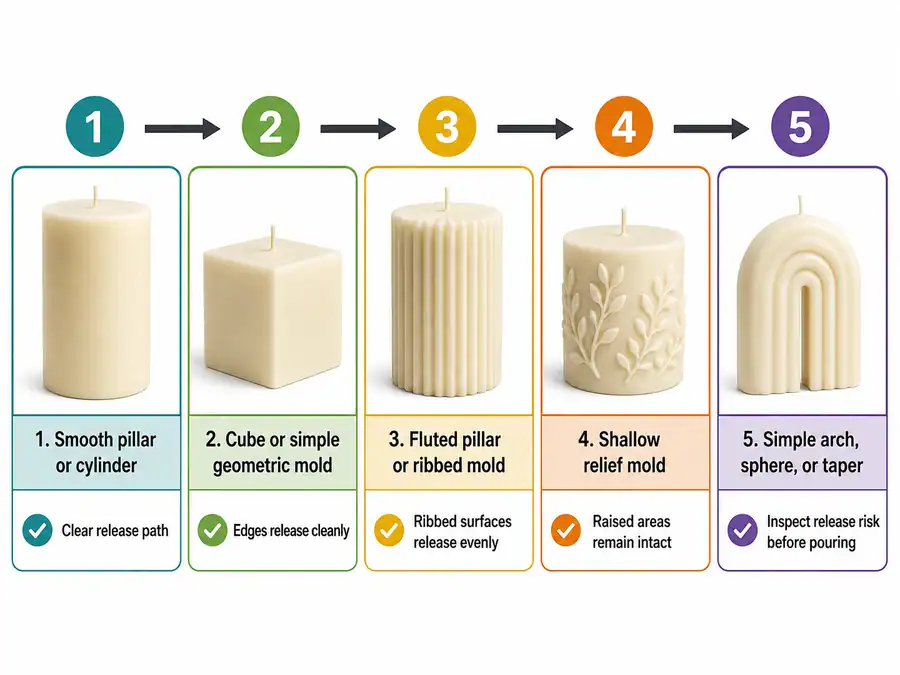
Beginner-friendly custom candle shapes are molded forms with simple geometry, low release risk, a clear fill path, and few fragile details.
Beginners should start with shapes that release cleanly and show visible results without advanced demolding control. This section is about mold-shape choice, not the full candle-making process.
| Beginner shape progression | Why it works | Customization limit | Move up when |
|---|---|---|---|
| Smooth pillar or cylinder | Simple walls and a clear release path | Limited surface detail | You can demold without dents or chips |
| Cube or simple geometric mold | Custom-looking without heavy detail | Corners may still chip | Edges release cleanly |
| Fluted pillar or ribbed mold | Adds texture while keeping a stable body | Grooves can catch | Ribbed surfaces release evenly |
| Shallow relief mold | Adds pattern without deep locking points | Detail must stay low | Raised areas remain intact |
| Simple arch, sphere, or taper | Adds form variety after basic practice | Shape may be less stable or harder to handle | You can inspect release risk before pouring |
Beginner-friendly does not mean cheap, low-quality, child-safe, or visually plain. It means the mold shape is forgiving enough to pour, release, inspect, and repeat while you learn how molded wax behaves.
Avoid highly detailed flowers, thin sculptural figures, deep relief panels, narrow projections, and irregular novelty molds at first. They can look appealing, but they often fail because the candle shape asks too much from the mold and the wax during release.
For the full beginner candle-making process, including wax melting, wick sizing, pouring temperature, and curing, use a beginner candle-making guide. This section only helps you choose a mold shape that is realistic to start with.
Why Complex and Novelty Candle Shapes Are Harder to Customize
Complex and novelty candle molds are harder to customize because irregular cavities create more release, fragility, stability, and handling risks.
A sculptural candle shape may look like a simple mold choice, but the wax still has to fill the full cavity, cool evenly enough to hold the design, and leave the mold without breaking. The more the shape depends on thin parts, uneven weight, deep texture, or hidden curves, the less forgiving it becomes.
| Shape issue | What can go wrong | Safer mold-shape decision |
|---|---|---|
| Thin projections | Arms, petals, points, or narrow edges can snap | Use thicker design features |
| Deep undercuts | Wax catches behind the shape | Choose shallower detail |
| Uneven weight | The candle may sit poorly or feel fragile | Choose a wider base or simpler silhouette |
| Very deep texture | Texture grips the mold wall | Use lighter surface pattern |
| Narrow fill areas | Wax may not reach or release cleanly | Avoid overly tight cavities |
| Tall irregular forms | The candle may bend, crack, or break during handling | Start with shorter versions |
Novelty does not automatically mean unsafe or unsuitable. The risk rises when the mold shape asks the wax to behave like a hard sculpture with fine unsupported parts. Seasonal, object-shaped, floral, anatomical, and highly irregular molds need more shape judgment than basic pillars, tapers, cubes, or fluted forms.
For novelty mold safety, use a separate safety guide. This section only explains why the physical form is harder to make repeatably.
Ready-Made vs Custom Candle Molds
A ready-made candle mold is best when an existing shape matches your idea closely; a custom mold is better when the exact silhouette, size, or repeatable detail matters.
The decision should follow the shape requirement, not the desire to make the candle feel original. Many custom-looking candles can come from standard molds when the shape family, finish, and scale are chosen well.
| Option | Best for | Main advantage | Main limit |
|---|---|---|---|
| Ready-made mold | Common pillars, tapers, cubes, spheres, arches, fluted forms, and popular novelty shapes | Faster and easier to source | Shape may not be exact |
| Adapted ready-made mold | Small changes in finished look, such as surface finish or presentation | Keeps the mold simple | Does not change the cavity’s core form |
| Commissioned custom mold | Exact silhouette, brand-specific form, matching set, or unusual scale | Matches a defined shape goal | Higher effort and less room for guessing |
| DIY custom mold | Experimental one-off shapes or maker-led prototypes | Gives direct control over form | Can fail if the master shape or release path is poor |
Ready-Made vs Custom Decision Check
Choose a ready-made mold when the closest existing shape is good enough, the candle is for practice, or repeat accuracy is not strict.
Choose a custom mold when the shape itself is the product requirement, the design must repeat across batches, or an existing mold would force too many compromises.
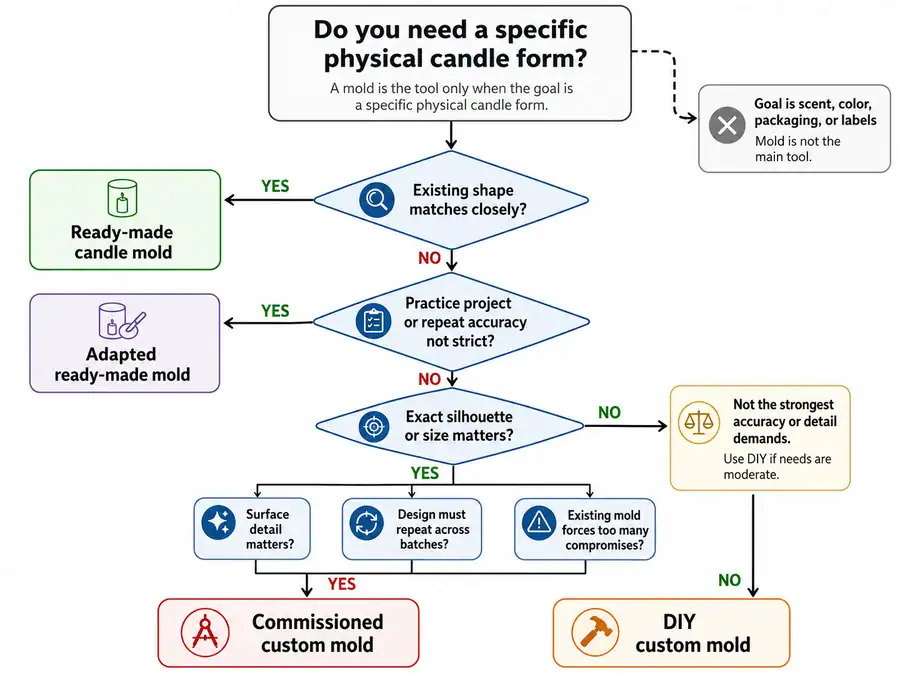
Do not treat a custom mold as the answer to every custom candle idea. If the goal is scent, color, packaging, or labels, the mold is not the main tool. If the goal is a specific physical candle form, the mold is the source of that shape.
For step-by-step silicone mold fabrication or custom supplier comparison, use a DIY mold-making or custom mold supplier guide instead.
How Mold Choice Affects Repeatable Custom Shapes
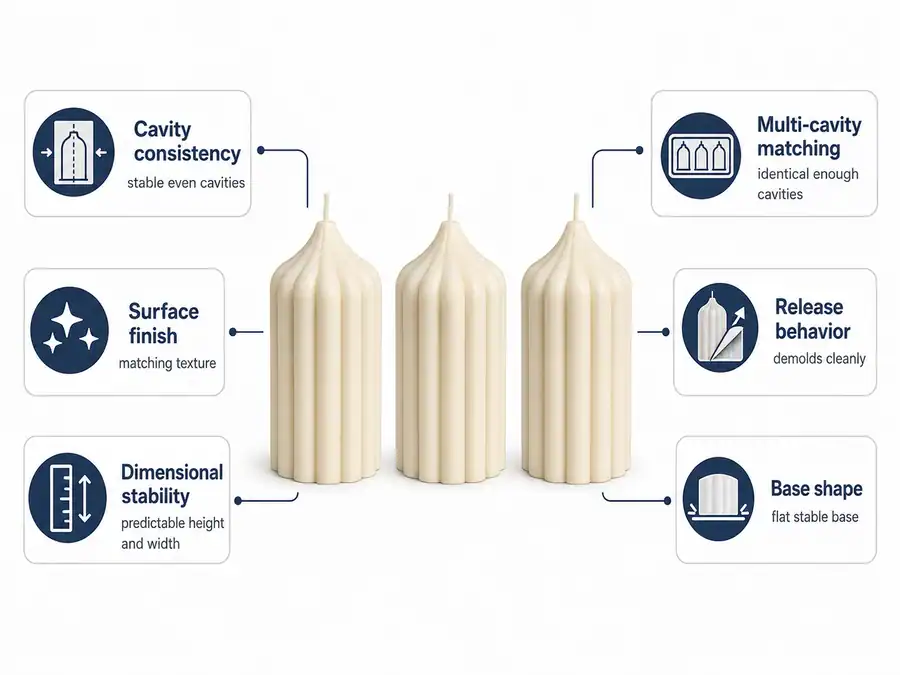
Mold choice affects repeatability by controlling cavity consistency, surface finish, dimensions, release behavior, and how closely each pour matches the last.
A one-off shape can tolerate small flaws. A repeated custom shape needs a mold that produces the same body form again and again without losing detail, warping, or changing the finished dimensions.
| Repeatability factor | Why it matters | Better mold choice |
|---|---|---|
| Cavity consistency | Each candle needs the same form | Use a mold with stable, even cavities |
| Surface finish | Texture or shine should match across pours | Avoid surfaces that change quickly with wear |
| Dimensional stability | Height, width, and base shape should stay predictable | Choose a mold that holds its shape during filling and release |
| Multi-cavity matching | Sets need similar results from each cavity | Check that cavities are identical enough |
| Release behavior | Repeated sticking damages finished detail | Use shapes that demold cleanly |
| Base shape | Candles must sit consistently | Favor flat, stable bases for repeated pieces |
Repeatability matters most for gifts, sets, small batches, and candles made for selling. It is still a shape issue first: the mold must create a consistent physical form before pricing, labeling, or production planning matters.
A mold that releases cleanly once may still be a poor repeat mold if it bends, warps, traps wax, or creates uneven bases. A stronger repeatable shape usually has a stable cavity, enough wax thickness, and a base that sits flat after release.
FAQ
Can candle molds create any custom candle shape?
No. Candle molds can create many custom shapes, but the shape must still release from the cavity without breaking, catching, or losing detail.
A practical custom candle shape needs a clear release path, enough wax thickness, stable proportions, and detail that can survive demolding. If the idea depends on thin points, deep undercuts, or fragile raised areas, the mold may need to be simplified.
What parts of a candle can be customized with a mold?
A candle mold can customize the candle’s silhouette, height, diameter, texture, relief detail, cavity layout, and repeatable form.
It does not customize scent, dye blend, jar style, label design, packaging, or brand identity. Those choices can change how the candle looks or sells, but the mold controls the wax body itself.
Are silicone molds better for custom candle shapes?
Silicone molds are often better for detailed or irregular shapes because they flex during release.
They are not always better for every candle. Rigid molds may work better for clean pillars, straight sides, crisp geometry, and repeated simple shapes. The best mold material depends on the shape goal.
What is the easiest custom candle shape for beginners?
The easiest custom candle shapes are smooth pillars, cubes, simple geometric molds, fluted pillars, and shallow relief designs.
These shapes look more personal than a plain container candle but still have a manageable release path. Beginners should avoid very thin, deep, or sculptural shapes until they can demold simple forms cleanly.
When should I use a custom candle mold instead of a ready-made mold?
Use a custom candle mold when the exact shape, size, surface detail, or repeated form matters and no ready-made mold matches closely enough.
Use a ready-made mold when the shape family is common, the project is for practice, or small differences in form are acceptable. A custom mold is most useful when the physical candle shape is the main requirement.
Why do detailed candle shapes break when removed from the mold?
Detailed candle shapes break when thin parts, raised patterns, sharp corners, or hidden curves grip the mold wall during release.
The wax may be solid enough to hold its shape but still too fragile to handle pressure at narrow points. A safer design uses thicker detail, softer corners, shallower relief, and a clearer release direction.
How do candle molds help with repeatable custom shapes?
Candle molds help repeat custom shapes by giving each pour the same cavity, surface pattern, proportions, and base form.
Repeatability matters for sets, gifts, small batches, and selling. A good mold does not just create one attractive candle; it creates the same mold-driven shape again with fewer surprises.