
Rapeseed wax is a plant-based candle wax material made from rapeseed-based feedstock and sold as a candle wax or wax-blend component, not as raw rapeseed oil. Candle makers use it for containers, blends, and plant-based candle lines when they want an alternative to soy, paraffin, or beeswax.
For candle making, rapeseed wax is worth considering if you are willing to test the wax with your fragrance oil, wick, jar, cure time, and burn setup before selling or scaling. It can suit small-batch container candles, regional UK or European product positioning, and blended wax formulas, but it is not automatically better than soy wax or every other candle wax.
In this article, “best uses” means the candle formats and making conditions where rapeseed wax is most likely to fit well. It does not mean rapeseed wax is the universal best candle wax, the cheapest wax, the safest wax, or the most sustainable wax in every supply chain. Food oil, cosmetics, industrial processing, live supplier roundups, and full wax-versus-wax guides are outside this page’s scope.
What Is Rapeseed Wax for Candles?
Rapeseed wax is a plant-based candle wax material made from rapeseed-based feedstock and used as candle wax, not raw rapeseed oil. It may be sold as a standalone wax, a rapeseed-based wax, or part of a vegetable wax blend.
In candle-supply terms, rapeseed wax usually refers to rapeseed oil or rapeseed-based feedstock that has been processed into a solid wax material. The exact formula still depends on the supplier, so the product sheet matters more than the crop name alone.
Rapeseed wax sits within the wider group of candle wax types because it melts, holds shape after cooling, and works with wick, container, fragrance, and curing variables. That makes the label important: two products that mention rapeseed may not perform the same if one is pure wax and the other is a blend.
| Term on a wax label | What it usually means for candle makers | Do not confuse it with |
|---|---|---|
| Rapeseed wax | A candle wax material based on rapeseed feedstock | Bottled rapeseed oil for food |
| Canola wax | A related naming style in some markets | A guaranteed identical product from every supplier |
| Rapeseed blend | A wax blend that includes rapeseed wax | Pure rapeseed wax |
| Vegetable wax blend | A plant-based or partly plant-based wax blend | A clear statement of exact composition |
| Hydrogenated vegetable wax | A hardened vegetable-derived wax material | Raw vegetable oil |
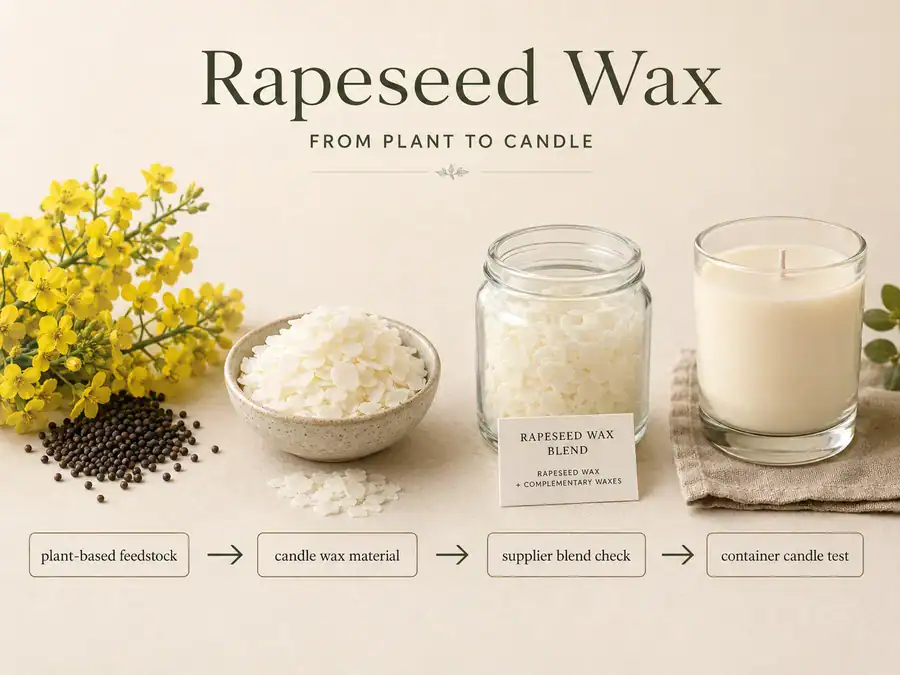
No, rapeseed wax is not the same as rapeseed oil. Rapeseed oil is liquid oil, while rapeseed wax is the candle-making material being evaluated here.
Is Rapeseed Wax Usually Pure or Blended?
Rapeseed wax may be pure, rapeseed-based, or blended, so the supplier’s label and technical sheet matter before testing. A blend is not automatically worse, but it changes what you can assume.
If the label says “rapeseed wax blend,” treat it as its own candle wax product rather than a universal rapeseed wax formula. For supplier-specific details, how to read candle wax blend labels is the safer next check than guessing hidden percentages.
| Label clue | What to check before making candles |
|---|---|
| “Pure rapeseed wax” | Intended candle type, melt behavior, fragrance guidance, and cure guidance |
| “Rapeseed wax blend” | Other waxes or additives listed, supplier use notes, and testing guidance |
| “Vegetable wax blend” | Whether rapeseed is actually named and whether the blend suits candles |
| No composition notes | Ask the supplier or choose a sample size before production |
Is Rapeseed Wax Good for Candle Making?
Yes, rapeseed wax can be good for candle making when matched to the candle format and tested with the chosen wick, fragrance, container, and supplier blend. “Good” means suitable for a tested candle system, not universally best, easiest, cheapest, or safest.
Rapeseed wax is often worth testing first for container candles and rapeseed-containing blends. A full best wax for candles decision belongs in a broader wax guide, but rapeseed wax can be a valid option when the project fits its limits.
| Candle use case | Fit for rapeseed wax | Test first |
|---|---|---|
| Container candles | Often a sensible first test | Adhesion, melt pool, scent throw, wick size |
| Pillars | Check supplier guidance carefully | Hardness, release, burn structure |
| Wax melts | Depends on the blend and finish goal | Snap, scent release, surface finish |
| Strongly scented candles | Possible, not guaranteed | Fragrance load, hot throw, cure time |
| Beginner batches | Suitable only as a small test | One jar size, one wick series, one fragrance |
How Does Rapeseed Wax Handle Fragrance and Scent Throw?
Rapeseed wax can carry fragrance, but cold throw and hot throw depend on wax blend, fragrance oil, load, wick, cure time, container, and testing. Cold throw means scent from an unlit candle; hot throw means scent while burning.
Adding more fragrance oil does not automatically make a rapeseed wax candle smell stronger. For percentage-level guidance, a candle fragrance load guide is the better place to handle formula limits.
| Fragrance variable | What it can change in rapeseed wax candles |
|---|---|
| Wax or blend type | How fragrance binds, releases, and sets |
| Fragrance oil | Strength, compatibility, discoloration, and burn behavior |
| Wick | Melt pool size and fragrance release during burning |
| Cure time | How the wax and fragrance settle before testing |
| Container | Heat pattern, melt pool, and scent release |
How Does Rapeseed Wax Burn, and How Should You Wick It?
There is no universal wick for rapeseed wax; wick choice must be tested with the exact wax product, container, fragrance load, and burn schedule. Burn quality depends on the complete candle, not the wax name alone.
For rapeseed wax, “clean burn” should mean observed burn behavior such as stable flame, proper melt pool, limited soot, and no tunneling in the tested candle. Exact wick sizing belongs in a wick testing guide, because one jar, blend, or fragrance can change the result.
| Test observation | What it may mean |
|---|---|
| Tunneling | Wick may be too small, or the burn test was too short for the container |
| Large flame | Wick may be too large for the wax, fragrance, or jar |
| Weak scent while burning | Wick, cure time, fragrance oil, or wax blend may need testing |
| Poor sidewall adhesion | Cooling, container, wax blend, or pour conditions may be involved |
| Uneven melt pool | Wick series, jar shape, or wax behavior may need adjustment |
What Finish Does Rapeseed Wax Create?
Rapeseed wax can create a creamy, opaque, smooth-looking finish, but results depend on the wax product, blend, pouring, cooling, container, and cure conditions. A smooth surface is possible, not promised.
Finish matters because a rapeseed wax candle may be chosen for a soft plant-wax look as much as for performance. When surface defects become the main issue, that topic belongs in candle surface troubleshooting rather than this wax explainer.
What Should Beginners Test Before Using Rapeseed Wax?
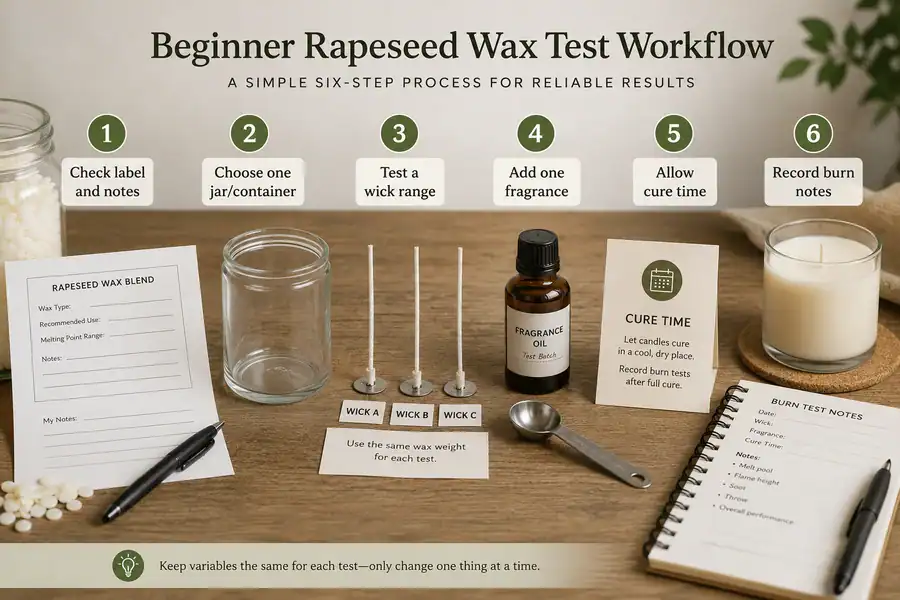
Beginners should test rapeseed wax in small batches before using it for sellable candles. The first test should use one wax product, one container size, one fragrance oil, and a controlled wick range.
A basic starter test should check these points:
| Beginner test item | Why it matters |
|---|---|
| Supplier label | Confirms whether the product is pure wax, rapeseed-based, or blended |
| Container fit | Shows adhesion, heat pattern, and melt pool behavior |
| Wick series | Shows whether the flame and melt pool are balanced |
| Fragrance choice | Shows cold throw, hot throw, and compatibility |
| Cure time | Gives the candle a fair test before judging scent or finish |
| Burn notes | Helps compare results before changing more variables |
What Are the Pros of Rapeseed Wax Candles?
Rapeseed wax has candle-making advantages when the wax product fits the jar, fragrance, wick, and maker’s sourcing goals. Its main strengths are plant-based positioning, regional appeal, creamy appearance, and blend potential.
| Rapeseed wax pro | What it means for candle makers | Practical limit |
|---|---|---|
| Plant-based origin | Fits makers who want a vegetable-derived candle wax | Plant-based does not prove every supply chain claim |
| Regional sourcing appeal | Can suit UK or European brands that want a local-feeling wax story | Availability varies by supplier and market |
| Creamy appearance | Can support an opaque, soft, premium-looking container candle | Finish still depends on cooling, jar, and blend |
| Blend potential | Can be used in formulas where rapeseed improves texture or positioning | Blends must be tested as their own wax |
| Alternative to soy or paraffin | Gives makers another wax type to compare | It is not automatically better than either wax |
The strongest reason to test rapeseed wax is fit, not novelty. A maker who wants a plant-based container wax with a smooth look may find rapeseed wax useful, while a maker who needs the cheapest, most available, or most documented wax may prefer a different candle wax type.
Rapeseed wax can also help candle makers separate their product line from soy-heavy or paraffin-heavy ranges. That benefit is strongest when the label claim is honest: “made with rapeseed wax” or “rapeseed wax blend” should match the actual supplier specification.
What Are the Cons of Rapeseed Wax Candles?
Rapeseed wax has practical drawbacks, especially availability, formulation learning curve, supplier variation, and testing burden. These cons do not make rapeseed wax unsuitable, but they make sample testing important before production.
| Rapeseed wax con | Why it matters | What to do before scaling |
|---|---|---|
| Less familiar than soy or paraffin | Fewer beginner assumptions may transfer cleanly | Start with supplier guidance and small batches |
| Supplier variation | Pure wax, rapeseed-based wax, and blends can behave differently | Treat each product as a separate wax |
| Availability gaps | It may be easier to source in some UK or European markets than elsewhere | Check repeat supply before building a product line |
| Wick learning curve | Wick size depends on the exact wax, jar, and fragrance | Run burn tests before selling |
| Possible adhesion or surface issues | Plant waxes and blends can react to cooling and container conditions | Test pour temperature, room temperature, and jar type |
| Fragrance uncertainty | Scent throw depends on more than wax name | Test cold throw, hot throw, and cure time |
Rapeseed wax may disappoint makers who expect a plug-and-play replacement for soy wax. A candle wax can share a plant-based category and still need different wicks, fragrance testing, cure notes, and finish adjustments.
The safest buying approach is to sample first, document each variable, and avoid changing several inputs at once. When the main problem becomes tunneling, frosting, wet spots, or scent weakness, that is a candle troubleshooting topic rather than a reason to judge every rapeseed wax product the same way.
What Is Rapeseed Wax Best Used For?
Rapeseed wax is best considered for container candles, plant-based or regional product lines, blends, small-batch tests, and wax-comparison experiments. Here, “best” means best-fit use cases, not the best candle wax overall.
Method note: This grid treats each use case as a testing fit, not a production guarantee. The right next step is to test rapeseed wax with the chosen jar, wick, fragrance, cure time, and burn schedule before scaling.
| Best-fit use case | Fit for rapeseed wax | Why it can work | Test requirement | Bridge |
|---|---|---|---|---|
| Container candles | Strong first test | Rapeseed wax can suit jar-based candles where adhesion, finish, and melt pool can be checked in one vessel | Test jar adhesion, melt pool, wick, and hot throw | A broader best wax for candles guide should compare all wax categories |
| Plant-based candle lines | Good fit when the label is clear | Rapeseed wax gives makers a vegetable-derived wax story | Verify whether the wax is pure rapeseed or a blend | Sustainability claims need proof, not plant-based wording alone |
| UK or European-positioned ranges | Good fit when sourcing is documented | Rapeseed may support a regional supply story in the right market | Check supplier origin notes and repeat availability | Buying checks matter before building a product line |
| Rapeseed wax blends | Good fit for formula testing | Blends may balance finish, burn, hardness, or scent behavior | Treat each blend as its own wax product | A wax blend guide is better for additive-level detail |
| Rapeseed-coconut wax blends | Useful sibling check | These blends combine rapeseed with another wax, so they should not be treated as pure rapeseed wax | Check the supplier sheet, wick guidance, and intended candle format | Blend-specific testing belongs outside this rapeseed wax overview |
| Small-batch testing | Strong fit | A sample batch limits waste while the maker learns wick and fragrance behavior | Test one jar, one fragrance, and a narrow wick range first | A candle testing guide should handle the full test record |
| Soy-alternative experiments | Useful fit | Rapeseed wax can be compared with familiar vegetable waxes without assuming superiority | Compare the same jar, fragrance, cure time, and burn schedule | A rapeseed wax vs soy wax page should handle the full head-to-head |
Rapeseed wax is not the right section to rank every wax type. If the decision is “which candle wax should I use overall,” the better route is a best wax for candles guide because that decision needs candle type, budget, sourcing, scent goals, and skill level.
Rapeseed wax is most useful when the maker has a narrow project and a test plan. It is weakest when treated as a drop-in replacement for soy, paraffin, or beeswax without checking how the exact product behaves.
Is Rapeseed Wax Sustainable or Plant-Based?
Rapeseed wax is plant-based, but sustainability claims depend on sourcing, processing, blend composition, transport, documentation, and wording. “Plant-based” describes origin; it does not automatically prove local, low-impact, natural, safe, or eco-friendly.
Method note: The table below separates candle-label language from the proof a maker should have before using that claim. Supplier documentation is the main proof source for rapeseed wax composition and sourcing.
| Claim wording | What it can mean for rapeseed wax candles | Proof or condition needed | What not to claim from this alone |
|---|---|---|---|
| Plant-based | The wax comes from plant-derived feedstock | Supplier description or technical sheet | That the candle is automatically sustainable |
| Vegetable wax | The wax is from vegetable-derived material or a vegetable wax blend | Composition notes from the supplier | That it is pure rapeseed wax |
| Natural wax | Marketing wording that may vary by supplier and market | Clear supplier language and cautious label wording | That no processing, additives, or blends are involved |
| Sustainable wax | A broader claim about sourcing and impact | Sourcing, processing, transport, and blend details | That plant-based origin is enough proof |
| Local or regional wax | The wax may come from a nearer supply chain | Origin and supply-chain documentation | That every rapeseed wax is local |
| Eco-friendly candle | A broad environmental claim | Stronger proof than wax origin alone | That the whole candle has a lower footprint |
| Clean-burning candle | Observed burn behavior in the tested candle | Burn testing with the final wick, jar, and fragrance | That the candle is toxin-free or certified safe |
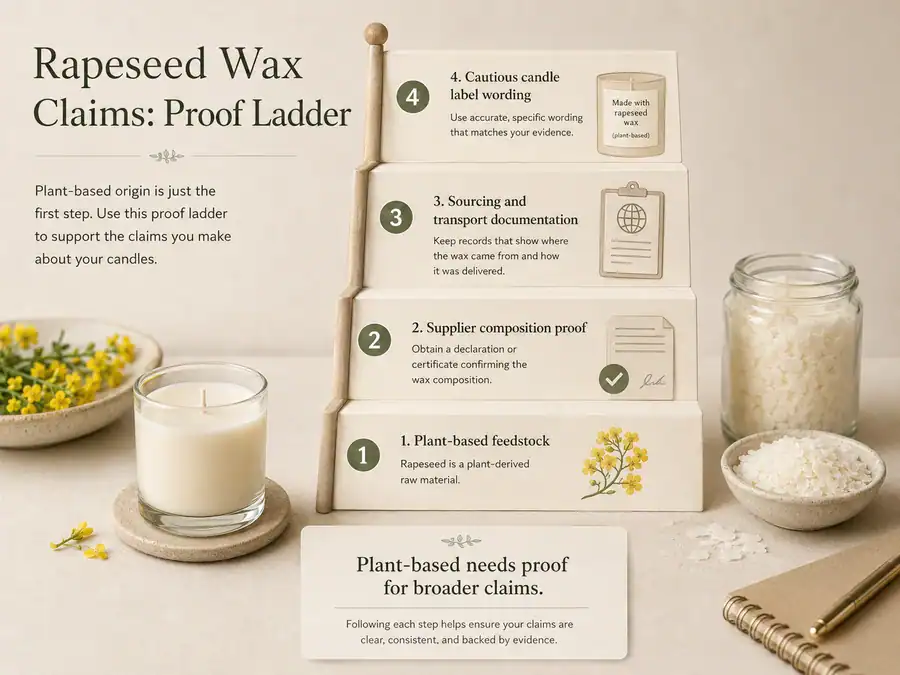
Rapeseed wax can support a plant-based candle position when the wording stays narrow and documented. A safer claim is “made with rapeseed wax” or “made with a rapeseed wax blend” when that matches the supplier’s specification.
For deeper environmental claims, route the decision to a candle wax sustainability guide. A full legal claim review, lifecycle assessment, carbon calculation, or agriculture-policy discussion sits outside this rapeseed wax explainer.
Why Rapeseed Wax May Appeal to UK and European Candle Makers
Rapeseed wax may appeal to UK and European candle makers when supplier documentation supports regional sourcing claims. The appeal comes from fit with local-market positioning, not from an automatic proof of lower impact.
| Regional claim | Safer wording | Check before using it |
|---|---|---|
| “Made with European rapeseed wax” | Use only if the supplier confirms European origin | Origin statement or technical sheet |
| “Locally sourced wax” | Use only when the wax source is local to the selling market | Supplier location and feedstock origin |
| “Lower transport impact” | Avoid unless backed by supply-chain data | Transport and sourcing documentation |
| “UK/EU-friendly plant wax” | Keep the claim general unless origin is documented | Supplier notes and repeat availability |
For UK and European makers, rapeseed wax can be part of a clear product story when the claim matches the paperwork. For live supplier choice, repeat supply, pack sizes, and shipping checks belong in a candle wax buying guide.
How Does Rapeseed Wax Compare With Soy, Beeswax, and Paraffin?
This is a short positioning comparison, not a full candle wax ranking. Rapeseed wax overlaps most with vegetable waxes such as soy, but differs in sourcing, availability, blends, finish, and testing requirements.
Method note: This benchmark compares wax categories only enough to place rapeseed wax within common candle wax types. Final wax choice still depends on the candle format, supplier material, fragrance, wick, and test results.
| Wax type | Source or material type | Typical candle use | Testing need | Finish expectation | Main caution |
|---|---|---|---|---|---|
| Rapeseed wax | Plant-based wax from rapeseed-based feedstock or blend | Containers, blends, plant-based lines, regional-positioned candles | Test each supplier wax or blend | Often chosen for creamy, opaque finishes | Do not assume pure wax or universal performance |
| Soy wax | Vegetable wax from soy-based feedstock | Containers, melts, beginner wax testing | Still needs wick, fragrance, and cure testing | Often creamy and opaque | Familiarity does not remove testing |
| Beeswax | Animal-derived wax made by bees | Pillars, tapers, blends, specialty candles | Test wick and format carefully | Often firmer, with a natural wax character | Not plant-based or vegan |
| Paraffin wax | Petroleum-derived wax | Containers, pillars, votives, high-performance blends | Test by wax grade and format | Often predictable across known grades | Not plant-based |
| Rapeseed blends | Rapeseed-containing blend | Containers or supplier-defined candle formats | Treat each blend as its own wax | Depends on blend design | Hidden blend composition can change results |
Rapeseed wax is not better than soy wax in every candle. It may be the better test candidate when the maker wants a rapeseed-based or regional-positioned wax story, while soy may be easier to source or learn from in some markets.
For a full rapeseed wax vs soy wax decision, use a dedicated comparison because scent throw, cure time, cost context, supplier availability, and beginner handling need more detail than this bridge allows. For all-wax ranking, a best wax for candles guide is the better place to compare soy, rapeseed, beeswax, paraffin, coconut blends, and other candle waxes.
What Should You Check Before Buying Rapeseed Wax for Candles?
Before buying rapeseed wax, check label clarity, intended candle type, composition notes, technical sheet, pack size, region, shipping, and sample quantity. Cost should mean the full testing cost, not only the listed wax price.
Method note: This checklist avoids live pricing because wax prices, pack sizes, suppliers, and shipping terms change. Use supplier documents and a small test order before treating rapeseed wax as a production material.
| Buying check | What to look for | Why it matters |
|---|---|---|
| Label clarity | “Rapeseed wax,” “rapeseed blend,” or “vegetable wax blend” | The label affects performance expectations |
| Intended candle type | Container, pillar, melt, votive, or blend use | A wax sold for one format may not suit another |
| Composition notes | Pure wax, rapeseed-based wax, or proprietary blend | Hidden blend differences change testing results |
| Technical sheet or SDS | Melt point, use notes, safety data, or supplier guidance | Documentation gives a starting point for testing |
| Sample size | Small pack before bulk order | Reduces waste during wick and fragrance tests |
| Region and availability | Supplier location, origin notes, repeat stock | A candle line needs repeatable supply |
| Shipping and storage | Delivery cost, heat exposure, storage guidance | Buying cost includes delivery and handling risk |
| Fragrance guidance | Suggested use range or compatibility notes | Prevents assuming every oil works the same |
| Wick guidance | Supplier starting points, not final answers | Wick choice still needs burn testing |
| Test record | Jar, wick, fragrance, pour notes, cure time, burn notes | Keeps changes measurable before scaling |
Do not choose rapeseed wax from price alone. A low pack price can still become expensive if shipping, poor fit, repeated wick failures, or wasted fragrance oil make testing inefficient.
For live supplier choice, pack-size comparison, and current product availability, use a candle wax buying guide. For performance checks after purchase, use a candle testing guide before moving from sample batches to sellable candles.
Rapeseed Wax FAQs
Rapeseed wax questions usually come down to identity, candle fit, scent throw, sustainability wording, and testing. The safest answers depend on the exact wax product, not the word “rapeseed” alone.
Is rapeseed wax the same as canola wax?
Rapeseed wax and canola wax may be closely related naming terms, but candle makers should follow the supplier’s product sheet. The exact wax, blend, and candle-use guidance matter more than the crop name.
Is rapeseed wax better than soy wax?
Rapeseed wax is not automatically better than soy wax. It may be a better fit for a rapeseed-based, regional, or specific container candle project, while soy may be easier to source or test in some markets.
Can you use rapeseed wax for container candles?
Yes, rapeseed wax can be used for container candles when the supplier product is intended for that use and the candle passes wick, melt pool, scent, adhesion, and burn testing.
Does rapeseed wax have good scent throw?
Rapeseed wax can have good scent throw, but it is not guaranteed. Hot throw and cold throw depend on the wax blend, fragrance oil, fragrance load, wick, cure time, and jar.
Is rapeseed wax vegan?
Rapeseed wax is plant-based, so it can fit vegan-positioned candle lines when the full formula also avoids animal-derived ingredients. Check additives, blends, dyes, and fragrance materials before making a vegan claim.
Is rapeseed wax natural?
Rapeseed wax is plant-derived, but “natural” is a broad marketing term. Use narrower wording, such as “made with rapeseed wax,” unless the supplier documentation supports stronger label language.
Is rapeseed wax safe to burn?
Rapeseed wax can be used for candles when the supplier sells the wax for candle use and the finished candle passes burn testing. Do not treat “plant-based” as proof that a candle is toxin-free, certified safe, or better for indoor air without supporting test evidence.
Is rapeseed wax good for beginners?
Rapeseed wax can work for beginners who start with small test batches. It is less beginner-friendly if the maker expects one wick, one cure time, or one fragrance load to work without testing.
Can rapeseed wax be blended with other waxes?
Yes, rapeseed wax may appear in wax blends or be tested with other candle waxes when the materials are compatible. Treat every blend as a new wax system and test before selling.
Should You Try Rapeseed Wax?
You should try rapeseed wax if you want a plant-based candle wax option for container candles, blends, regional product positioning, or small-batch wax testing. It is a poor choice if you need a no-testing shortcut or a universal best wax.
Rapeseed wax makes the most sense when the project is narrow: one jar, one fragrance oil, one wick range, one supplier wax, and one clear reason for choosing rapeseed. That reason might be plant-based labeling, a creamy finish, a UK or European sourcing story, or a comparison against soy wax.
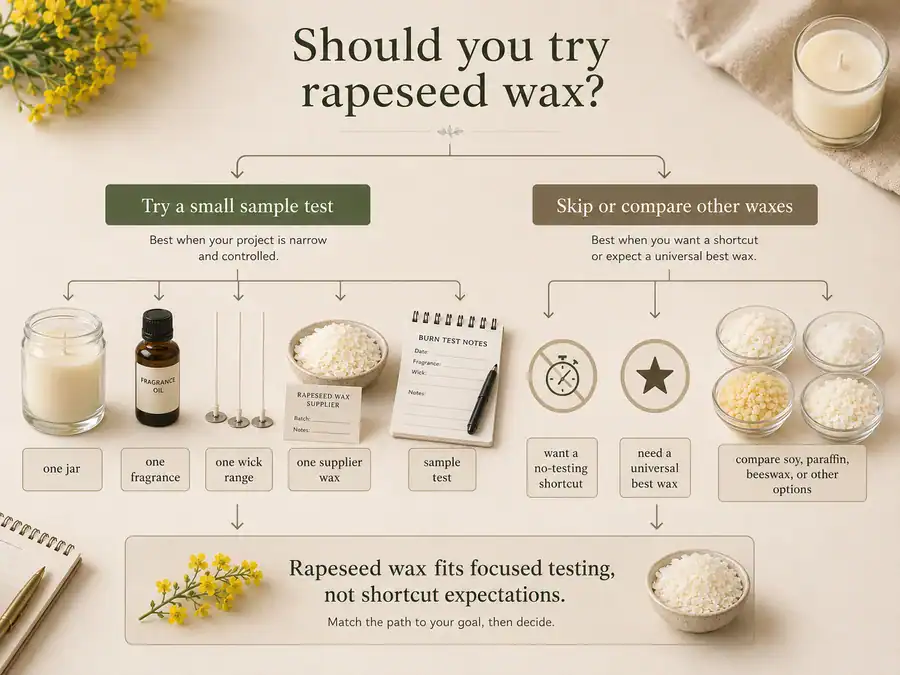
Do not treat rapeseed wax as a guaranteed upgrade from soy, beeswax, or paraffin. Treat it as a candle wax candidate that must earn its place through burn tests, scent checks, finish checks, and repeat supply checks.
For most candle makers, the best first step is a small sample order and a controlled container candle test. If the wax gives stable burn behavior, acceptable scent throw, a finish you like, and reliable sourcing, rapeseed wax can become a useful part of a candle line.