
Picking between rapeseed and soy gets messy when scent throw, burn, finish, and sourcing pull in different directions. The better wax depends on the result you want and the conditions you keep the same during testing. A fair comparison separates wax behavior from wick size, fragrance load, cure time, and jar setup. Start with scent throw first, because that is where most makers notice the gap fastest.
For wider wax context, start with Candle Wax Types before you narrow the choice to rapeseed and soy.
This quick table gives the at-a-glance comparison before the detailed sections.
| Criteria | Rapeseed often fits better when | Soy often fits better when |
|---|---|---|
| Scent throw | The recipe is already close and the burn stays steady. | The wick, load, and jar are already dialed in for the soy blend. |
| Burn behavior | The wick is already matched to the blend and the melt pool stays even. | The soy setup is proven and the load stays moderate. |
| Finish in clear jars | A cleaner-looking top and better glass appearance matter. | The cooling routine and jar prep already suit the soy recipe. |
| Sourcing story | EU-local positioning or regional sourcing language matters to the brand. | Documentation, price, and broader availability matter more than local fit. |
| Supply risk | A repeatable local source is available and close enough to keep retesting low. | Backup suppliers run deeper in your market and switch risk is lower. |
| Best fit | You want a narrow regional story with matched scent and burn proof. | You want a stable, easier-to-source option with clear documentation. |
These winner-by-scenario lines keep the decision practical.
- If you want an EU-local sourcing story and the wax still passes matched throw and burn tests, choose rapeseed.
- If you want broader supplier depth and easier repeat buying, choose soy.
- If scent throw is split, choose the wax that keeps the cleaner burn under the same wick and load.
- If price looks lower on paper but retesting risk is higher, choose the wax with the steadier supply path.
Which Wax Gives Better Scent Throw?
For scented jars, rapeseed can beat soy on throw, but soy often matches it when wick, load, cure, and jar size are aligned.
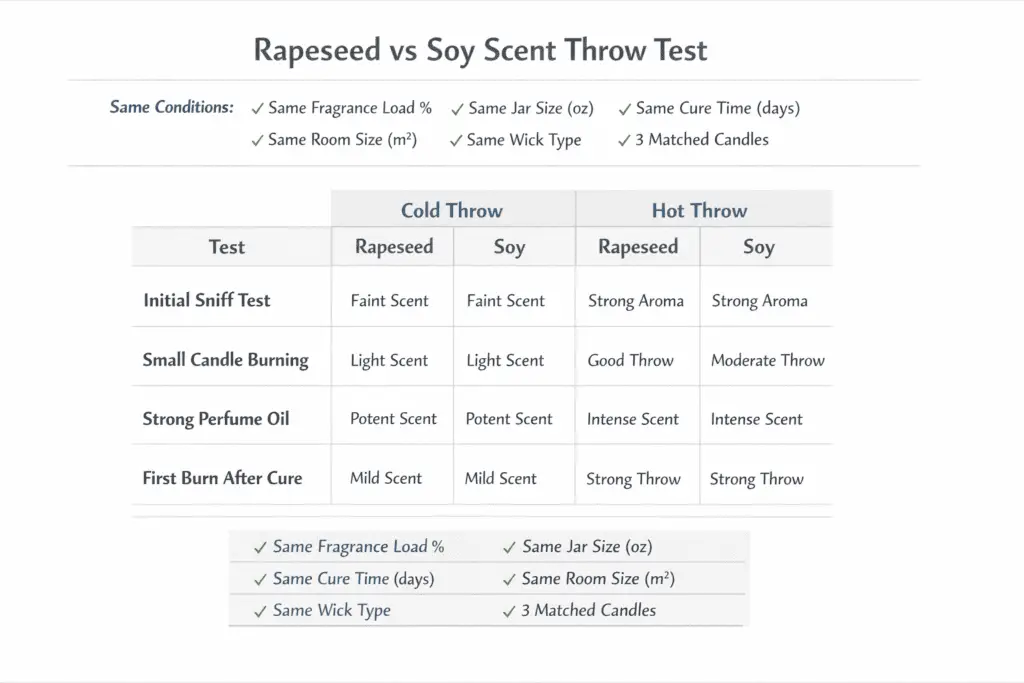
Name a winner only after at least 3 matched candles use the same fragrance load %, jar size oz, cure time in days, and room size m². Cold throw is the scent from an unlit candle, and hot throw is the scent released while the candle burns, so the same recipe can look stronger cold and finish nearly tied when lit.
In maker forums, the disagreement usually starts when one side-by-side test changes cure time or wick size at the same time as the wax.
For wider wax context, use the parent wax comparison before you let one batch decide the whole choice.
| Use case | Rapeseed tends to lead when | Soy tends to lead when | What the result really means |
|---|---|---|---|
| Early side-by-side sniff test | the recipe is already close and the cure is complete | the blend and wick are already well dialed in | early cold scent alone is not the final verdict |
| Small scented container candle | the wax and wick are tuned together | the wick family already suits the jar well | recipe fit can matter more than wax label |
| Heavier perfume-style oil | the blend stays stable without surface issues | the oil behaves cleanly in the soy blend | load tolerance and throw are not the same thing |
| First burn after cure | the melt pool forms cleanly and the flame stays steady | the soy recipe has already been redialed | hot throw depends on burn behavior, not just oil load |
Most throw failures blamed on wax start in fragrance load for container candles, where stability matters more than any headline claim about how much oil a wax can hold.
A matched test works better than a hunch. Keep the same oil family, the same vessel, and the same wick family for both waxes. Then log cold scent, first-burn scent, and whether the result still holds after the candle has settled.
These steps keep the throw test honest.
- Pour both waxes into the same jar size with the same fragrance oil.
- Cure both for the same number of days.
- Burn them in the same room size and note first impression, mid-burn scent, and end-of-burn scent.
- Retest only after you confirm the wick family stayed the same.
- Change one variable next, not three.
Methods note: Supplier technical data sheet limits are starting points, not proof of stronger scent. This comparison method assumes matched fragrance load %, jar size oz, cure days, and room size m² across at least 3 candles, so it shows test logic rather than a universal winner.
Keep your wick choice plain at first and record it in the same test log so the wax comparison does not drift. Then compare the same jars against the burn result, because weak hot throw often starts as a burn problem.
Fragrance Load and Oil Compatibility
A stable load beats a high load, and the better wax is the one that keeps scent, surface, and burn working together.
Test load changes across at least 3 matched pours instead of making one large jump in %. More oil can raise scent in one blend and weaken the candle in another, so “holds more oil” does not always mean “performs better.”
| Test round | Wax | Oil family | Load % | Surface stability | Hot throw after cure |
|---|---|---|---|---|---|
| 1 | Rapeseed | same oil | baseline | log it | log it |
| 1 | Soy | same oil | baseline | log it | log it |
| 2 | Rapeseed | same oil | higher step | log it | log it |
| 2 | Soy | same oil | higher step | log it | log it |
| 3 | Keep only the better performer | same oil | confirm step | log it | log it |
Treat fragrance load as a stability question before it becomes a scent question. Keep the oil family the same, raise the load in one small step, and stop when surface or burn quality slips.
When the scent verdict still feels split, the next thing to judge is how each wax behaves once flame, heat, and melt pool enter the picture.
Which Wax Burns Better in Real Use?
For real-use burn performance, the better wax is the one that reaches a steady melt pool with low soot under the same wick and jar.
Use at least 3 matched candles, keep jar diameter in cm and fragrance load % the same, and compare repeated burn intervals in hours before naming a winner. Melt pool is the liquid wax layer across the candle surface, and that surface tells you more about real use than a single long burn ever will.
In maker forums, tunneling after a wax swap often points to wick family or burn cycle before it points to the wax itself.
The wider wax comparison matters here because burn behavior never stands alone from the rest of the wax choice.
| Burn factor | Rapeseed tends to look better when | Soy tends to look better when | What distorts the verdict |
|---|---|---|---|
| Melt pool timing | the wick is already matched to the blend | the soy wick setup is already settled | changing wick family between tests |
| Visible soot | flame size stays controlled | the oil load is moderate and the wick is right | chasing stronger scent with too much heat |
| Flame stability | the recipe is balanced and cured | the jar and wick pairing are proven | comparing one calm flame to one oversized flame |
| Practical burn time | the candle stays even across repeated burns | the soy recipe is not underwicked or overloaded | judging from one long session |
Use the same wick family before you blame either wax for soot or tunneling. Then recheck fragrance load for container candles, because overload can make a fair burn comparison impossible.
These notes keep the burn test useful.
- Burn matched candles for the same interval in hours.
- Let them rest for the same period between burns.
- Log melt pool spread, flame height, and any soot event each round.
- Change the wick before you change the whole recipe if the flame clearly runs too small or too large.
- Repeat the same cycle across at least 3 candles.
Methods note: This burn view follows supplier technical data sheet setup advice and general candle-use context from the National Candle Association. Keep jar diameter in cm, fragrance load %, wick family, and burn interval in hours fixed across at least 3 matched candles so the result reflects wax behavior instead of test drift.
A wax can smell strong and still burn badly. That is why a fixed comparison method matters before you switch wax again.
Visual Finish: Adhesion, Smooth Tops, and Defects
For clear jars, rapeseed often gives the cleaner-looking finish, while soy may show more visible texture, though cooling speed and jar prep can flip that result.
Wet spots are patches where wax pulls away from the glass, and they often come from cooling and adhesion rather than from wax identity alone. A pretty top does not excuse a weak flame, so keep finish notes beside the burn check instead of treating looks as a separate decision.
If rough tops, wet spots, sinkholes, or uneven surfaces pile up, check cooling, jar warmth, pour pattern, and oil handling before you change the whole wax choice. A clean-looking jar still needs the same burn proof as the stronger performer.
When the flame result stays mixed after these checks, a fixed side-by-side method is the next step instead of another round of guesswork.
How to Compare Rapeseed and Soy Wax Fairly
Compare rapeseed and soy fairly by keeping jar, wick family, fragrance oil, and cure time constant before judging throw, burn, or finish.
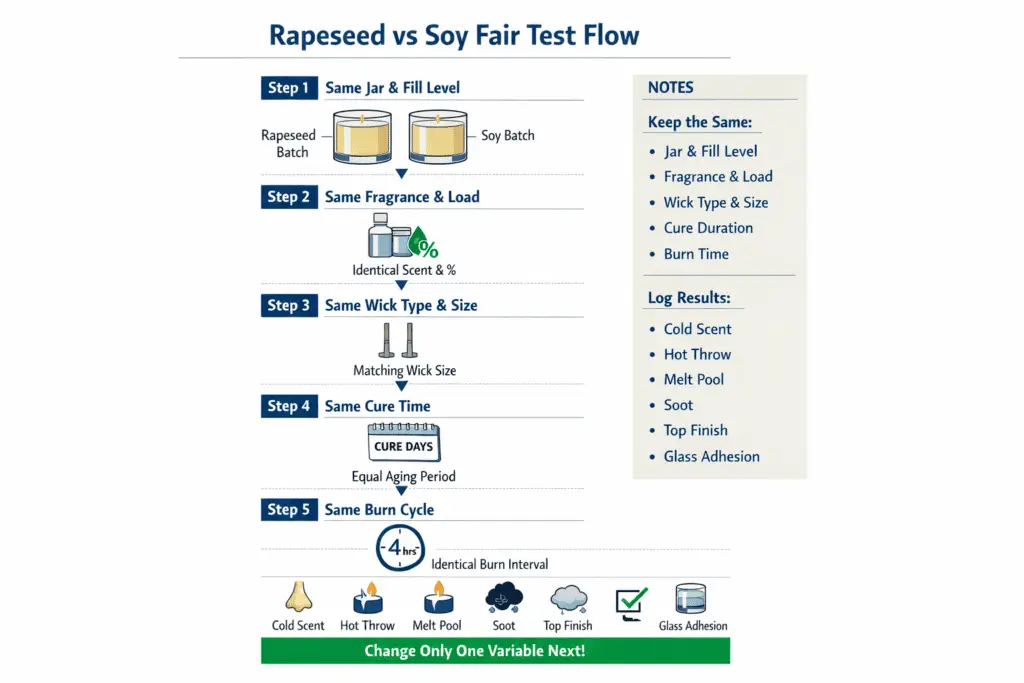
A fair wax test changes one variable at a time and keeps the rest fixed across at least 3 matched candles. Start from the wider wax picture when you want context, but use one tight method before you call either wax better.
| Test field | Keep this the same | What to log | Change later only if needed |
|---|---|---|---|
| Jar format | same vessel and fill level | jar diameter in cm | no |
| Wax batch | one rapeseed batch and one soy batch | wax name and lot | only after the first full round |
| Fragrance oil | same oil and same load % | cold scent and hot scent | no |
| Wick setup | same wick family and starting size bracket | flame, melt pool, soot | size only, after round one |
| Cure window | same number of days | cold throw score before burn | no |
| Burn cycle | same burn interval in hours | melt pool timing and visible soot | no |
| Finish check | same room and cooling routine | top smoothness and glass pull-away | only after performance is logged |
Run the first round with one jar size, one fragrance oil, and one wick family. Keep the starting wick bracket narrow, because a broad matrix wastes wax and hides the real cause when results split.
Use this order.
- Pour both waxes into the same jar format with the same fragrance load.
- Let both cure for the same number of days.
- Score cold scent before lighting.
- Burn both for the same interval and log melt pool, soot, and hot throw.
- Let them cool and log top finish and glass adhesion.
- Change only one thing next: wick size, load %, or cure time.
The fastest way to ruin the comparison is to change wax, oil, and wick together. Keep a short log that shows what changed and what stayed fixed.
For wick setup, keep a simple note beside your test log: starting size, result, next move. The better wax is not the one that wins one lucky pour. It is the one that repeats the same result when the setup stays the same.
Sustainability and Brand Fit: Which Wax Makes More Sense?
For sustainability and brand fit, rapeseed often suits EU-local positioning better, while soy can still make sense when documentation, price, and supply stability are stronger.
That verdict only holds when you compare documented origin, transport context, supplier transparency, traceability, and market fit side by side. Traceability means you can verify where the wax came from and which supplier documents support that claim.
Use the wider wax decision first, then narrow the sourcing question with evidence instead of a vague eco label.
| Decision point | Rapeseed makes more sense when | Soy makes more sense when | Copy-safe wording |
|---|---|---|---|
| Origin story | origin is declared clearly and fits your market story | origin documents are clearer and easier to maintain | “sourced from supplier-documented plant wax” |
| Transport context | the supply path is shorter for your market | the soy supply chain is steadier for your region | “selected for documented sourcing fit” |
| Brand fit | regional farming or EU sourcing matters to your buyers | broader availability matters more than regional closeness | “chosen for our current sourcing priorities” |
| Claim strength | supplier paperwork supports narrow statements | paperwork is stronger than the rapeseed option you found | “based on supplier-provided origin information” |
| Repeatability | the same rapeseed source stays available | soy has deeper backup supply and less switch risk | “kept under review as supply changes” |
Check your sourcing notes before you write product copy, and compare seller claims against regional sourcing evidence when distance is part of the brand story. Then tighten your wording, because “natural,” “local,” and “better” are not the same claim.
What you can say depends on the proof you have. You can usually say the wax is plant based or supplier documented when that is true and recorded. You should not claim one wax is simply better for the planet unless the scope, data, and comparison boundary are clear.
Price, Availability, and Supply Resilience
For cost, the better wax is the one that stays available and repeatable with less forced reformulation, not the one with the lowest listed price.
Judge the choice by pack size, MOQ means minimum order quantity, or the smallest order a supplier will sell, lead time, backup suppliers, and the retest cost after a forced switch.
| Cost factor | Rapeseed can make more sense when | Soy can make more sense when | What to watch |
|---|---|---|---|
| €/kg | price is close enough that shorter delivery or easier fit matters more | listed price stays lower across reliable suppliers | low price can hide higher rework cost |
| MOQ | entry order size fits your batch plan | suppliers offer more flexible order sizes | large MOQ can trap cash |
| Lead time | local stock or shorter delivery is stable | supply runs deeper in your market | long lead time raises stockout risk |
| Backup suppliers | you have at least one approved second source | soy has broader second-source depth | one-source buying is fragile |
| Switch penalty | substitute waxes stay close enough to retest quickly | soy substitutes are easier to source and verify | every forced switch can reset testing |
A cheaper wax can still create a more expensive candle line when it causes retesting, failed pours, or gaps in stock. Any sourcing choice still has to hold up on scent throw and burn performance, because a supplier change can wipe out earlier test wins.
Keep a short shortlist before you commit.
- Record price per kg, pack size, and lead time.
- Name one backup supplier before the first bulk order.
- Mark whether a substitute would need a full retest or a short retest.
- Recheck the choice against your regional sourcing notes if distance or regional stock changes the real cost.
EU Local-Sourcing Advantage
For EU-based makers or region-led brands, rapeseed often has the stronger local-market story, but only when declared origin is clear and the wording stays narrow.
This is a regional layer, not a universal win over soy. Local fit should not overrule scent throw or burn behavior for scented container candles.
| Regional question | Rapeseed tends to lead when | Soy can still lead when | Copy-safe angle |
|---|---|---|---|
| Seller region | supplier and delivery path fit your target market | soy stock is easier to buy and restock locally | “purchased through an EU supplier” |
| Declared origin | raw-material origin is stated clearly | soy origin records are clearer than the rapeseed option | “origin declared by supplier” |
| Distance band | the travel story is shorter and easier to explain | distance is not meaningfully different in your buying route | “shorter sourcing path for our market” |
| Brand geography | your buyers value regional sourcing language | buyers care more about price or consistency | “aligned with our market position” |
| Claim safety | your proof supports narrow regional wording | broader soy documentation gives safer wording | “based on current supplier documents” |
Keep this boundary in view: local and more sustainable are not synonyms unless the scope and documents say exactly why. Seller location, processing location, and raw-material origin are three different facts, and they should not be merged into one claim.
Use this check before regional wording goes on a label or product page.
- Confirm seller location.
- Confirm declared raw-material origin.
- Save the supplier page or spec that supports the claim.
- Decide whether proximity changes the wax choice enough to matter.
- Recheck throw and burn before a final switch to a new regional source.