

A pillar candle is a freestanding molded candle that holds its shape without a jar or container. It is usually burned on a stable, heat-safe holder, plate, tray, or lantern base because melted wax can move outside the candle body.
Unlike container candles, pillar candles are defined by the wax body itself rather than by a vessel. Their shape gives them visual height, display value, and flexible placement, but it also means the surface under the candle matters.
Pillar candles are commonly used for centerpieces, home décor, ceremonies, memorial displays, seasonal arrangements, lanterns, and ambient lighting. They fit settings where their freestanding shape, visible wax body, and slower visual presence support the display.
This guide explains what pillar candles are, how they burn, where they work well, and how to place them correctly. It does not cover full pillar-candle making, wick sizing charts, wax formulas, exact burn-time calculators, legal fire rules, or product rankings.
Definition box:
A pillar candle is a molded, container-free candle designed to stand upright on its own body. “Freestanding” means it holds its shape without a jar, not that it should be burned without a heat-safe base.
What Is a Pillar Candle?
A pillar candle is a freestanding molded candle that holds its shape without a jar or container. It is made to stand as its own wax body, but it still needs a stable, heat-safe holder, plate, tray, or lantern base when burned.
This makes a pillar candle different from a container candle, which is poured and burned inside a vessel. A pillar also differs from a taper because it has a wider wax body, and from a votive because it is not normally meant to liquefy inside a close-fitting cup.
| Candle type | Defining feature | Support needed | Clarifying note |
|---|---|---|---|
| Pillar candle | Freestanding molded wax body | Heat-safe holder, tray, plate, or lantern base | No jar, but still needs support |
| Container candle | Wax burns inside a jar, tin, glass, or vessel | Built-in container | Better wax containment |
| Votive candle | Small candle usually burned in a votive holder | Votive holder | Not usually treated as freestanding for the full burn |
| Taper candle | Tall, narrow candle made for upright display | Candlestick holder | Designed for a fitted holder |
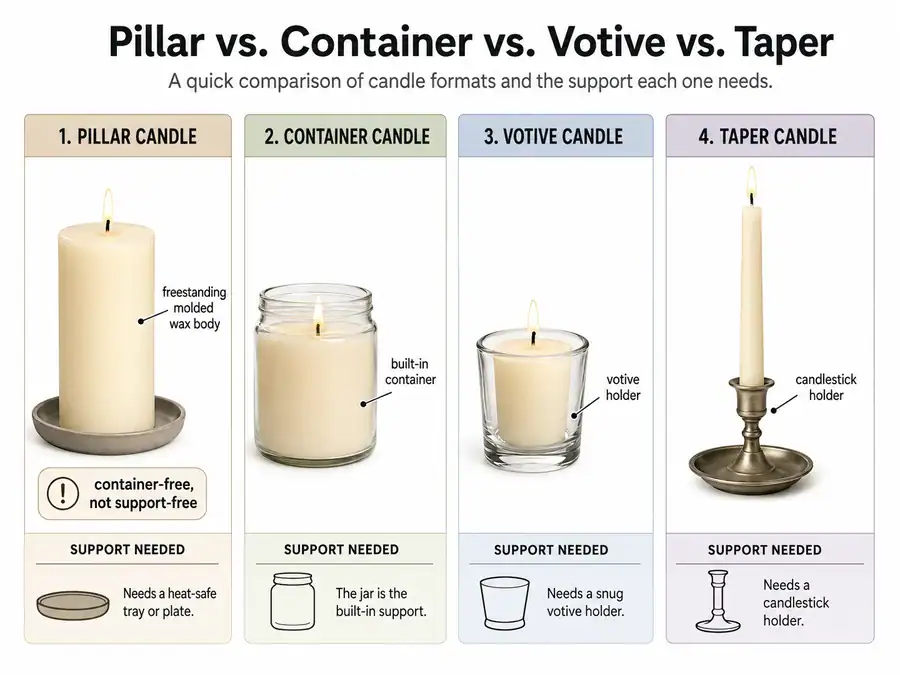
The key idea is that pillar candles are container-free, not support-free. Their shape gives them display value, but the wax body can soften, drip, or leave melted wax on the surface below.
For a deeper format decision, the full container vs pillar candles guide can compare cleanup, scent use, décor style, and support needs. The burn pattern matters too, so the section on how pillar candles burn explains why the wax wall, wick, and melt pool change how a pillar behaves.
What Makes Pillar Candles Free-Standing?
Pillar candles are free-standing because their molded wax body supports itself without a jar, tin, or glass container. The wax blend and shape are firm enough to stay upright before burning, unlike a candle that depends on a container for its form.
“Free-standing” describes the candle’s structure, not a safe-use shortcut. A pillar candle should not be burned directly on wood, fabric, paper, plastic, or any surface that cannot handle heat or melted wax.
A good support setup includes a flat base, heat-safe material, wax-catching space, clear air around the flame, and supervised burning.
This structure is why pillar candles work well for visible displays, layered décor, lanterns, and ceremonial focal points. The same structure creates trade-offs: more visible wax, more surface responsibility, and less built-in containment than a jar candle.
For setup details, use a pillar candle holders and trays guide when choosing the right base. For broader flame-use rules, candle safety basics should cover clearance, supervision, and placement in more depth.
What Are Pillar Candles Used For?
Pillar candles are used for home décor, centerpieces, ambiance, ceremonies, memorial displays, seasonal arrangements, and lantern displays because their freestanding wax body creates height, visual weight, and a clear focal point.
Their main use is not only light. A pillar candle works as an object in the room before it is lit, which is why people place them on trays, mantels, dining tables, shelves, hearths, and inside lanterns.
| Use | Why pillar candles fit | Support needed | Alternative when |
|---|---|---|---|
| Centerpieces | They add height and visual weight. | Tray, plate, or holder | Tapers may fit narrow table settings better. |
| Mantels and shelves | They work as sculptural display pieces. | Heat-safe base and open space | Flameless candles may fit unattended décor better. |
| Ceremonies | They create a steady symbolic focal point. | Stable support and supervision | Flameless pillars may fit flame-restricted venues better. |
| Memorial displays | They give a visible, calm focal point. | Safe placement and flame allowance | LED pillars may fit long unattended displays better. |
| Lanterns | They fill the lantern space with a broad wax body. | Lantern or hurricane-style holder | Outdoor-rated or flameless options may fit wind exposure better. |
| Seasonal décor | They can be grouped by color, size, and shape. | Tray, spacing, and wax containment | Votives may fit small arrangements better. |
Pillar candles are strongest when the candle itself needs to be seen. A jar candle can hide much of the wax body inside the vessel, while a pillar candle shows its shape, color, texture, and height.
Ceremony and memorial uses depend on the setting. Pillar candles can suit unity displays, remembrance tables, prayer spaces, and symbolic focal points, but they are not required for any belief or practice. Venue rules, faith-specific customs, and long unattended displays belong in dedicated ceremony or memorial guidance.
For full styling layouts, a pillar candle centerpiece guide should handle table shapes, groupings, colors, and seasonal displays. This page only uses décor examples to explain why the pillar format fits those situations.
Indoor Décor, Centerpieces, and Displays
Pillar candles work well indoors when a display needs height, shape, and a visible wax body. They are common on dining tables, mantels, shelves, trays, lanterns, hearths, and entryway displays because they can stand as decorative objects.
Grouping pillar candles by height can make a display look more balanced. A tall pillar can anchor the arrangement, while shorter pillars add layers without needing several different candle types.
| Indoor display | Why pillars fit | Placement note |
|---|---|---|
| Dining centerpiece | Broad shape creates a focal point. | Use unscented pillars when food aromas matter. |
| Mantel display | Height and wax texture add visual structure. | Keep clear space above and around each flame. |
| Tray arrangement | Multiple sizes can sit together as one display. | Use a tray that catches wax and resists heat. |
| Lantern display | The candle body fills vertical space well. | Check that the lantern is stable and vented. |
| Shelf décor | Pillars add shape even when unlit. | Use flameless pillars when the candle will not be watched. |
Pillar candles differ from tapers and votives in visual weight. Tapers look narrow and formal, votives look small and clustered, and pillar candles create a wider, heavier focal point.
The trade-off is placement responsibility. Since a pillar candle does not have a built-in jar, the display still needs a heat-safe base, wax containment, open space, and supervision when the candle is lit.
How Do Pillar Candles Burn?
Pillar candles burn by forming a melt pool around the wick inside a freestanding wax body. As the flame melts the center wax, the outer wax may remain as a wall, soften slowly, or drip depending on the candle’s size, wax, wick, and burn session.
A melt pool is the liquid wax area around the burning wick. In a pillar candle, that pool forms inside the candle body instead of inside a jar, so the wax wall and support surface both affect how cleanly the candle burns.
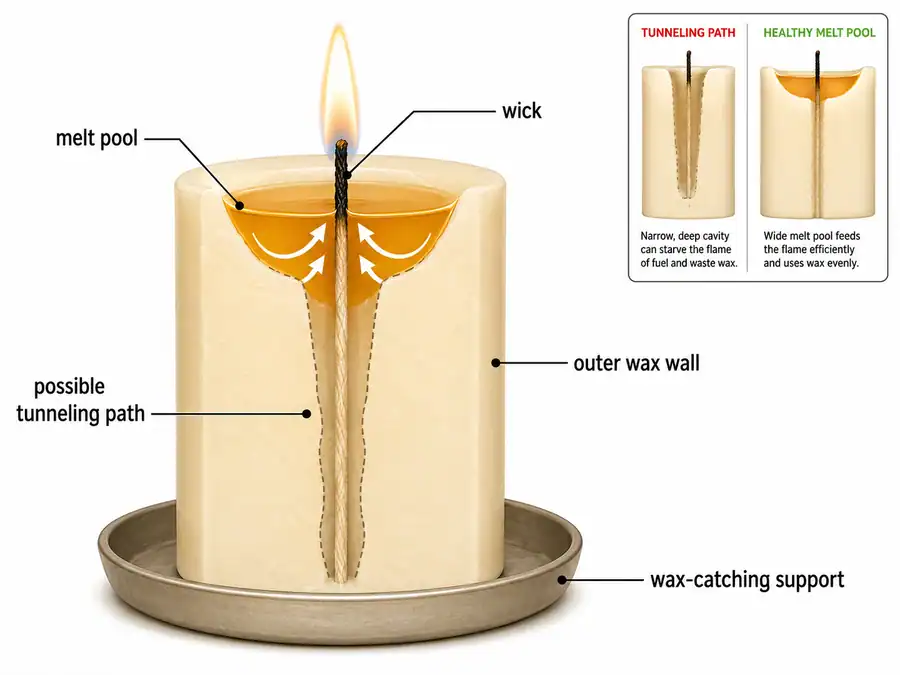
Some side wax is normal on a pillar candle. A thin outer wall can help the candle hold its shape while it burns, but a deep narrow hole down the center can signal tunneling.
| Burn sign | Normal or problem? | What it means | Route if deeper help is needed |
|---|---|---|---|
| Shallow melt pool near the wick | Normal early in a burn session | The wax has started melting around the flame. | Use a burn-time or first-burn guide if the pool never widens. |
| Thin outer wax wall | Often normal | The candle is keeping its freestanding shape. | Use a care guide if the wall becomes uneven or unstable. |
| Deep center hole | Possible problem | The candle may be tunneling. | Use a candle tunneling fixes guide. |
| Wax dripping down the side | Conditional problem | The wall may have softened, split, or overflowed. | Use a drip and containment guide. |
| Large or uneven flame | Possible problem | Wick length, drafts, or candle quality may be affecting the burn. | Use candle safety basics or wick care guidance. |
| Wax left after the wick is finished | Can happen | The wick, wax, and diameter may not have consumed the full body. | Use a wick sizing or burn behavior guide. |
This guidance is based on observable candle-use conditions, not a lab burn test. Exact burn performance can change with diameter, wax blend, wick choice, room airflow, burn session length, and how the candle is supported.
Pillar wax needs enough firmness to hold its shape outside a container. That is why wax choice matters for pillar candles, but full wax formulas, additives, and pour methods belong in a dedicated best wax for pillar candles guide.
Wick and Melt Pool Basics
The wick controls how the melt pool forms in a pillar candle. A good burn usually melts enough wax around the wick to feed the flame without cutting a narrow tunnel straight down the center.
The wick is the material that draws melted wax to the flame. The melt pool is the liquid wax around that flame. In pillar candles, the relationship between these two parts affects the wax wall, flame size, dripping, and leftover wax.
| What you see | What it may mean | What to do next |
|---|---|---|
| Melt pool grows slowly and evenly | The candle may be burning normally. | Keep the candle on a heat-safe base and watch the wax wall. |
| Melt pool stays very narrow | The wick may not be creating enough heat for the candle diameter. | Route to a tunneling or wick-sizing guide. |
| Flame gets too large | The wick may be too long, the candle may be in a draft, or the wax pool may be overheated. | Extinguish safely and use wick-care guidance. |
| Wax wall collapses or spills | The outer wall may have softened too much. | Use a tray, plate, or holder that catches wax. |
| Multiple flames create a wide pool | A multi-wick pillar can melt more wax at once. | Use extra care with support, spacing, and supervision. |
Multi-wick pillar candles are larger pillar variants with more than one wick. They can create a wider melt pool and a stronger visual flame effect, but more wicks do not automatically make the candle better, safer, cleaner, or longer-lasting.
This section explains the visible relationship between wick and wax. Exact wick sizes, diameter formulas, test burns, and wick layout choices belong in a pillar candle wick sizing guide.
Normal Wax Wall vs Tunneling
A normal wax wall is a thin outer shell that helps a pillar candle keep its shape while the center melts. Tunneling is a deeper, narrow burn path that leaves too much unused wax around the sides.
The difference matters because pillar candles are designed to burn without a jar. Some side wax can be part of the format, but a deep center hole usually means the melt pool is not reaching enough of the candle body.
| What you see | Likely meaning | What to do |
|---|---|---|
| A thin, even outer wall | Often normal for pillar candles | Let the candle burn only while watched and keep it on a wax-catching base. |
| A wide pool with stable side walls | Usually a healthy burn pattern | Keep the candle away from drafts and nearby objects. |
| A narrow hole down the center | Possible tunneling | Use a tunneling fix guide instead of guessing. |
| Thick unused wax on every side | The melt pool may be too small for the candle width | Route to wick sizing or burn behavior guidance. |
| Side wall breaks and wax spills | The candle may be overheating, uneven, or unsupported | Extinguish safely and check the holder, tray, and surface. |
| Flame leans or flickers hard | Drafts or wick issues may be affecting the burn | Move the candle away from airflow and use candle care guidance. |
Pillar candles can last longer or shorter depending on diameter, wax mass, wick behavior, room airflow, and burn session length. “Long-lasting” is a relative description, not a promise of exact hours.
Exact burn-time estimates belong in a pillar candle burn time chart or calculator. This page only explains the visible signs that help you understand whether the candle is burning in a normal pillar pattern or needs deeper troubleshooting.
When Are Pillar Candles the Best Choice?
Pillar candles are the best choice when their freestanding shape, visible wax body, height, and display presence fit the setting. “Best” means best fit for the situation, not universally safest, cheapest, easiest, longest-lasting, or highest quality.
They work well when the candle needs to be seen as part of the display. They are a weaker fit when built-in wax containment, unattended décor, narrow table space, strong convenience, or flame restrictions matter more.
| Situation | Why pillar candles fit | Watch-out | Better alternative |
|---|---|---|---|
| Centerpieces and table displays | They add height, shape, and visual weight. | They need a tray or holder that catches wax. | Tapers for narrow formal tables. |
| Mantels, shelves, and layered décor | They look finished even before being lit. | They need clearance above and around the flame. | Flameless pillars for unattended décor. |
| Ceremonies and symbolic displays | They create a steady visual focal point. | Venue rules and supervision still matter. | LED pillars for flame-restricted spaces. |
| Lanterns and hurricane holders | Their broad body fills the lantern space well. | Outdoor use needs wind protection and stable placement. | Outdoor-rated flameless candles in windy areas. |
| Longer visual sessions | Larger pillars can offer more wax mass. | Burn time is not guaranteed by size alone. | Container candles when wax containment matters more. |
| Scent-sensitive settings | Unscented pillars can provide the look without fragrance. | Scented pillars may compete with food or ceremony settings. | Unscented tapers, votives, or flameless décor. |
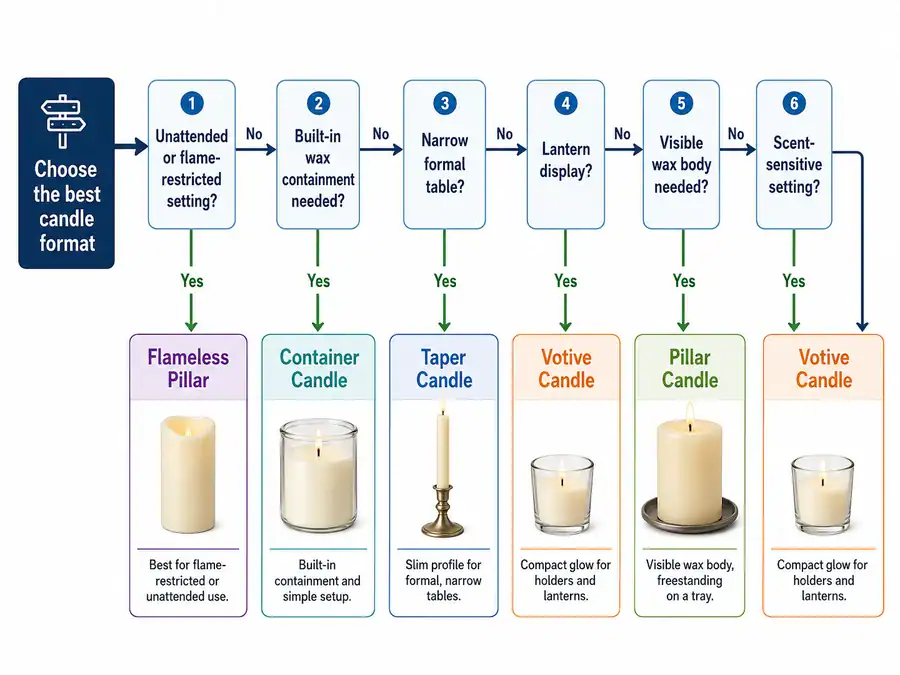
Pillar candles are not automatically better than jar candles. A container candle may be a better choice when you want built-in wax containment, easier cleanup, and less need for a separate tray or holder.
Flameless pillar candles can be better when the setting needs the pillar shape without real flame, heat, smoke, or wax movement. They imitate the look of a pillar candle, but they do not share real pillar-candle burn behavior.
How Size and Shape Affect Fit
A pillar candle’s size, shape, and diameter affect where it fits, how stable it feels, and how its melt pool behaves. Size is a planning cue, not a guarantee of exact burn time or perfect performance.
For pillar candles, diameter means the width across the candle body. A wider pillar usually creates a broader wax area, while a taller pillar adds more visual height and needs a stable base that matches its footprint.
| Size or shape cue | Use implication | Burn implication | Holder or surface implication |
|---|---|---|---|
| Short pillar | Works well in low table displays and small trays. | May feel easier to monitor because the flame sits lower. | Needs a flat heat-safe plate or holder. |
| Tall pillar | Adds height to mantels, lanterns, and ceremony displays. | Can become less stable if the base is narrow or uneven. | Needs a wide, stable support surface. |
| Wide pillar | Creates a strong focal point and visual weight. | Needs a melt pool that matches the candle width well. | Needs a holder or tray with enough wax-catching area. |
| Narrow pillar | Fits smaller displays and tighter spaces. | May burn differently than wide pillars because there is less wax mass. | Needs support that prevents tipping. |
| Round pillar | Common for trays, lanterns, and grouped displays. | Wax wall behavior is usually easy to observe. | Needs a holder that supports the full base. |
| Square or shaped pillar | Works as a decorative object even when unlit. | Corners and edges may melt differently from the center. | Needs a tray that catches uneven wax flow. |
This table is a practical planning guide based on visible candle-use conditions, not a lab measurement. Exact results can change with wax, wick, airflow, candle quality, and burn session length.
A larger pillar may look longer-lasting because it contains more wax, but “long-lasting” is relative. It does not promise a specific number of hours unless the candle has measured burn-time data from the maker.
For exact duration planning, use a pillar candle burn time chart or calculator. For exact wick-to-diameter pairing, use a pillar candle wick sizing guide instead of guessing from size alone.
Pillar Candles vs Container Candles
Pillar candles are freestanding candles burned on an external support surface, while container candles are poured and burned inside a jar, tin, glass, or vessel. Neither type is universally better because each fits different containment, cleanup, display, and supervision needs.
The main difference is where the wax goes as it melts. A container candle has built-in walls around the wax, while a pillar candle depends on its own wax wall plus a separate tray, holder, plate, or lantern base.
| Feature | Pillar candles | Container candles | Best fit clue |
|---|---|---|---|
| Structure | Molded wax body stands without a jar. | Wax sits inside a vessel. | Choose pillars for visible wax shape. |
| Support | Needs an external heat-safe base. | Container provides built-in support. | Choose containers when built-in containment matters. |
| Wax containment | Melted wax can move outside the candle body. | Wax usually stays inside the vessel. | Choose containers for easier cleanup. |
| Display style | Shows height, color, texture, and shape. | Shows the vessel as part of the design. | Choose pillars when the candle body should be the focal point. |
| Burn behavior | Wax wall, melt pool, and dripping are easier to see. | Vessel hides or contains much of the wax behavior. | Choose pillars when visible burn character matters. |
| Setup needs | Needs a holder, tray, plate, or lantern base. | Needs heat-safe placement but not a separate wax-catching base. | Choose containers for simpler setup. |
Pillar candles may be the better fit for centerpieces, ceremonies, lantern displays, and layered décor because their wax body is part of the visual design. Container candles may be the better fit when cleanup, built-in containment, and simple placement matter more.
Scent changes the decision too. Unscented pillar candles often fit dining tables, ceremonies, and memorial displays because they provide the look without competing fragrance. Scented pillars may fit living rooms, bedrooms, and seasonal décor when fragrance is part of the purpose.
Flameless pillars are another situation-based alternative. They imitate the shape of pillar candles, but they do not create a melt pool, wax wall, flame, heat, smoke, or dripping. They can be a better fit for unattended décor, restricted venues, rentals, pets, children, or wind-prone displays.
For a fuller format decision, use a container vs pillar candles comparison page. This section only compares the two formats enough to show when pillar candles fit the situation better.
How Should You Place and Support Pillar Candles?
Pillar candles should be burned on a stable, heat-resistant holder, plate, tray, or lantern base that supports the candle and catches wax. “Safe placement” means risk-reduced placement with supervision, not risk-free use.
A pillar candle can hold its own shape, but it does not provide its own wax containment. The surface below the candle matters because heat, softened wax, dripping, and tipping can damage the area around it.
Place and support a pillar candle with these steps:
- Choose a holder, tray, plate, or lantern base made from heat-resistant material.
- Check that the base is wider than the candle and sits flat.
- Leave space around the candle so the flame is not close to fabric, paper, greenery, curtains, shelves, or wall décor.
- Keep the candle away from drafts that can push the flame toward one side.
- Stop burning if the wax wall breaks, the flame becomes unstable, or wax begins moving beyond the support area.
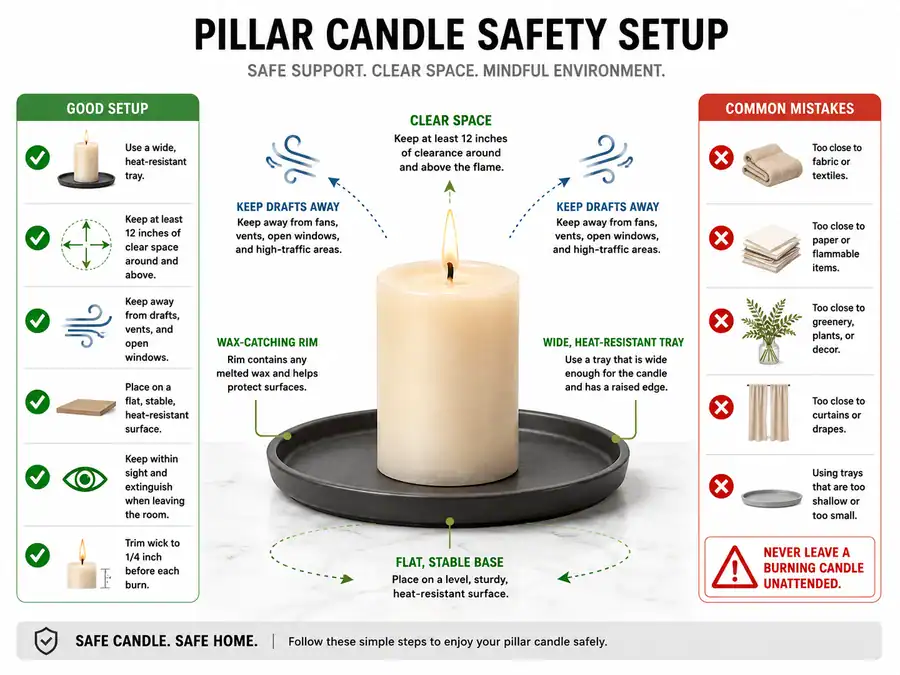
The same placement logic applies across most pillar displays: use a stable base, heat-resistant material, wax containment, open space around the flame, and supervision during the burn.
Common placement mistakes usually come from treating “freestanding” as “burn anywhere.” A pillar candle can stand outside a jar, but it should still be placed like an open flame with moving wax.
| Mistake | What can happen | Better setup |
|---|---|---|
| Placing a pillar directly on furniture | Heat marks or wax stains can appear. | Use a heat-safe tray or plate. |
| Using a narrow base | The candle may feel unstable. | Use a support wider than the candle. |
| Burning near fabric or greenery | Heat or flame movement can reach nearby items. | Leave open clearance around the candle. |
| Using a shallow display tray | Wax may overflow if the candle drips. | Choose a tray with enough wax-catching area. |
| Leaving a lit pillar unattended | The wax wall or flame can change without notice. | Extinguish the candle before leaving the room. |
This placement guidance is based on visible use conditions, not a legal fire-code review. For broader flame-use rules, use a candle safety basics guide. For choosing a base, use a pillar candle holders and trays guide.
How to Prevent Drips and Wax Mess
You prevent pillar candle drips and wax mess by using a wax-catching base, avoiding drafts, trimming the wick as directed by the candle maker, and stopping the burn if the wax wall starts to fail.
A pillar candle has no jar to contain melted wax, so “dripless” should be treated as conditional. It can mean reduced dripping under suitable conditions, not a guarantee that wax will never run down the candle.
The most useful prevention step is matching the candle to its support. A wide pillar needs a support area that catches wax beyond the candle’s base, while a tall pillar needs a base that keeps it steady as the body softens.
| Wax mess trigger | Why it happens | Prevention step |
|---|---|---|
| Drafts | Moving air can push heat to one side. | Place the candle away from vents, fans, windows, and walkways. |
| Poor support | Wax has nowhere to go if the wall leaks. | Use a tray, plate, holder, or lantern base that catches overflow. |
| Long burn sessions | The wax wall can soften more over time. | Follow the candle maker’s burn-time guidance. |
| Uneven surface | The melt pool may lean to one side. | Set the candle on a level, stable base. |
| Overheated wax wall | The side can thin, split, or spill. | Extinguish the candle if the wall looks weak. |
| Wrong display location | Nearby heat or airflow can affect the burn. | Move the candle to a calmer, clearer spot. |
A small amount of wax near the base does not always mean the candle is defective. The concern is uncontrolled wax movement beyond the holder, tray, or protected surface.
Use a deeper tunneling or wick guide when the candle keeps burning down the center, leaves thick unused wax, or produces a flame that looks too large or uneven. This page only covers the placement and containment side of wax mess.
Outdoor and Lantern Situations
Pillar candles work outdoors only when the flame is protected from wind, unstable surfaces, and nearby materials. “Outdoor” means protected outdoor use, not an exposed flame placed anywhere outside.
Lanterns, hurricane holders, and deep heat-safe bases can make pillar candles more practical outside because they add structure around the flame and wax. They do not remove the need for supervision.
| Outdoor situation | Pillar candle fit | Watch-out | Better choice when |
|---|---|---|---|
| Covered patio table | Can add height and warm light. | Wind can still tilt the flame or affect wax. | Use a lantern or flameless pillar when airflow is strong. |
| Outdoor lantern | Often a good format fit. | The lantern must be stable, vented, and heat-suitable. | Use an outdoor-rated flameless candle for long displays. |
| Garden path display | Can look striking in groups. | Open flames near plants, fabric, or foot traffic add risk. | Use LED pillars for unattended or crowded areas. |
| Event entrance | Creates a visible focal point. | Venue rules and supervision matter. | Use flameless pillars when flame rules are unclear. |
| Windy balcony | Usually a poor fit for real flame. | Wind can move the flame and soften one side unevenly. | Use flameless pillars instead. |
| Hot direct sun before lighting | Can soften wax before the burn starts. | Shape and surface stability can change. | Keep real pillars shaded until setup is controlled. |
A pillar candle in a lantern still needs a level base and enough space around the wax body. If the candle touches the lantern wall, melts unevenly, or leans, it is not placed well for that setup.
Outdoor pillar candle use should stay simple: protected flame, stable base, heat-safe support, wax containment, and supervision. Fire rules, venue policy, and local restrictions belong in a dedicated outdoor candle safety page.
What Should You Look For When Buying Pillar Candles?
Look for pillar candles with a stable base, centered wick, smooth body, suitable size, clear label, and a shape that matches the holder or display. Quality means observable build and use suitability, not luxury branding or high price.
A good pillar candle should make the intended use easier. For a centerpiece, that may mean an unscented, stable, clean-looking pillar. For a lantern, it may mean a size that fits with space around the candle body.
| Buying cue | Why it matters for pillar candles | Avoid when |
|---|---|---|
| Flat, even base | Helps the candle sit steadily on a holder or tray. | The base rocks, leans, or looks warped. |
| Centered wick | Supports a more balanced melt pool. | The wick is visibly off-center. |
| Smooth, firm wax body | Helps the candle hold its shape before burning. | The candle has cracks, dents, or soft spots before use. |
| Suitable diameter | Affects holder fit, stability, and melt-pool behavior. | The candle is wider than the support area. |
| Clear burn guidance | Helps set realistic use expectations. | The candle has no basic use or warning information. |
| Scent choice fits the setting | Keeps the candle aligned with the purpose. | Strong fragrance would compete with food, ceremony, or quiet display. |
| Color and finish match the use | Supports décor, seasonal, or symbolic display. | The finish matters more than placement or burn suitability. |
| Holder compatibility | Reduces mess and tipping risk. | You do not have a heat-safe base that fits. |
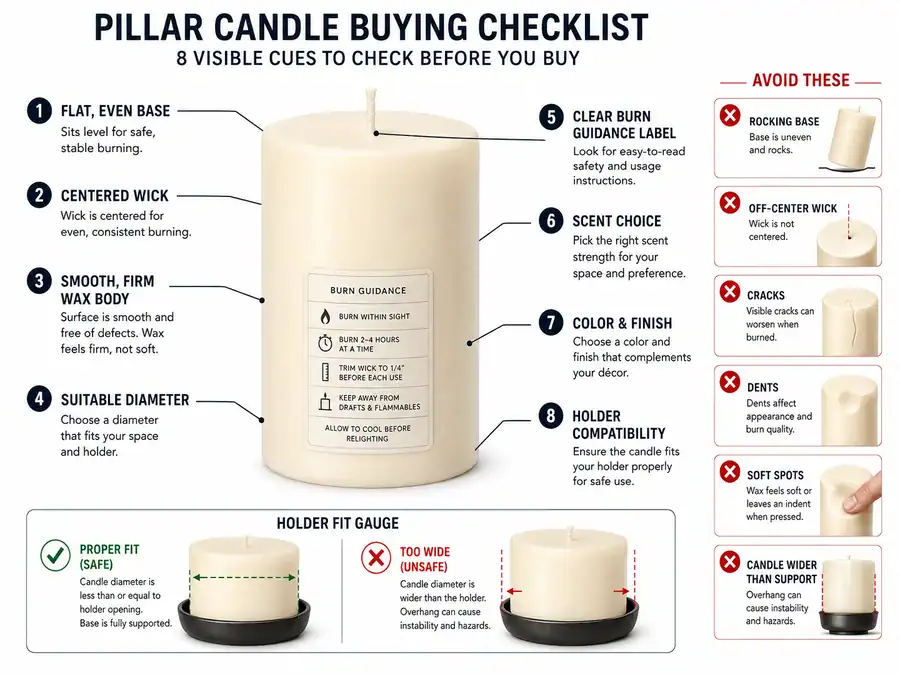
For a first purchase, choose the situation before choosing the candle. A dining table, lantern, memorial display, mantel, and outdoor setting each need different size, scent, support, and flame-control decisions.
Do not judge pillar candles by brand, price, or scent strength alone. A cheaper pillar that fits the holder and use case can be a better choice than a premium-looking candle that is too wide, too scented, unstable, or poorly labeled.
For product comparisons, use a dedicated best pillar candles guide. This article explains the buying signs that matter for the pillar format, not which brand or model to buy.