
Beeswax candles are candles made from wax produced by honey bees.
They are sold as either 100% beeswax or as beeswax blends mixed with other waxes. People often look at beeswax candles when they want a simpler, more natural-feeling option before comparing different wax types or buying a candle for regular use. Beeswax has its own look, texture, and mild natural aroma, but not every beeswax candle performs the same way. Once those basics are clear, it becomes much easier to judge performance, price, and whether a beeswax candle suits your needs.
Where Beeswax Candles Come From and What Counts as Beeswax
Beeswax candles sit within the broader category of candle wax types, but what makes them distinct is that the wax itself is created by honey bees. That wax is collected, cleaned, and turned into finished candles such as tapers, pillars, votives, or rolled candles.
The important part is this: not every candle labeled as beeswax is the same. Some are made from pure beeswax, while others are blends designed to lower cost or change how the candle burns. That is why the label matters. A candle can be called beeswax even when beeswax is only part of the formula.
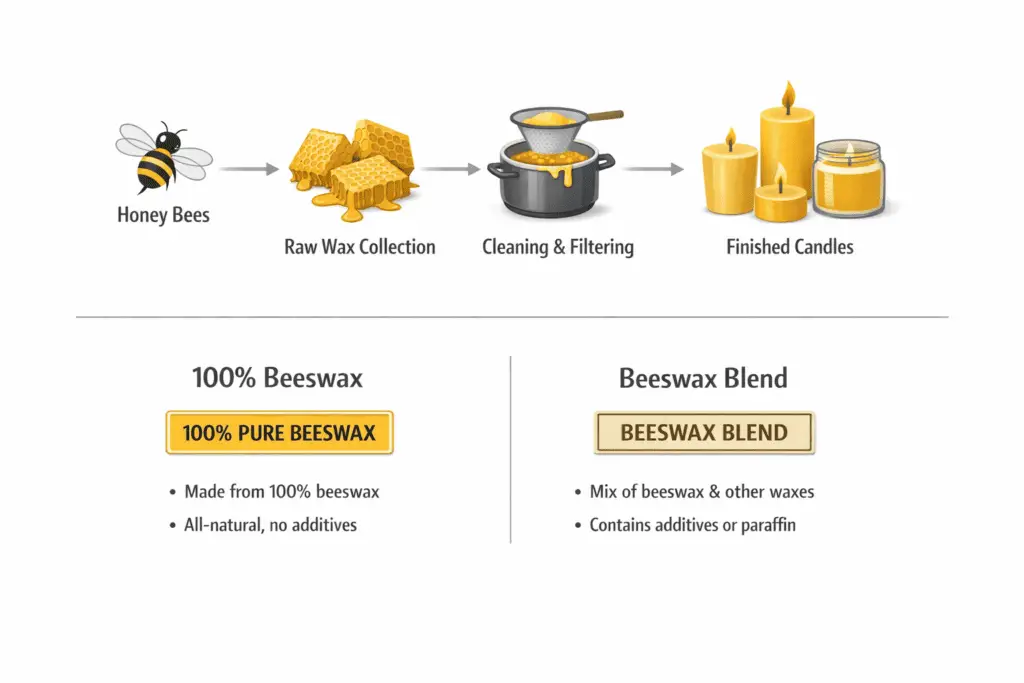
A useful way to think about beeswax candles is to separate the source from the finish. The source tells you the wax comes from bees rather than petroleum or plant oils. The finish tells you how that wax was filtered, colored, scented, shaped, and wicked before it was sold. Two beeswax candles can therefore feel very different in actual use, even if both carry the same wax label.
How Beeswax Looks, Feels, and Smells
Most beeswax candles have a warm appearance, a firmer feel, and a mild natural aroma rather than a strong fragrance throw. Natural beeswax often ranges from soft yellow to ivory, while more heavily filtered beeswax may look pale cream or nearly white.
The surface usually feels harder and less slick than many softer vegetable-wax candles. A light honey-like scent is common, but it is usually subtle. It is not the kind of scent that fills a room like a heavily fragranced candle.
Color alone is not a reliable quality test. A deeper yellow candle is not automatically purer, and a pale candle is not automatically fake. Filtering changes appearance, and added fragrance can change what you notice first. In practice, the most useful clues are label wording, scent disclosure, format, and overall build quality.
Types of Beeswax Candles and Best Uses
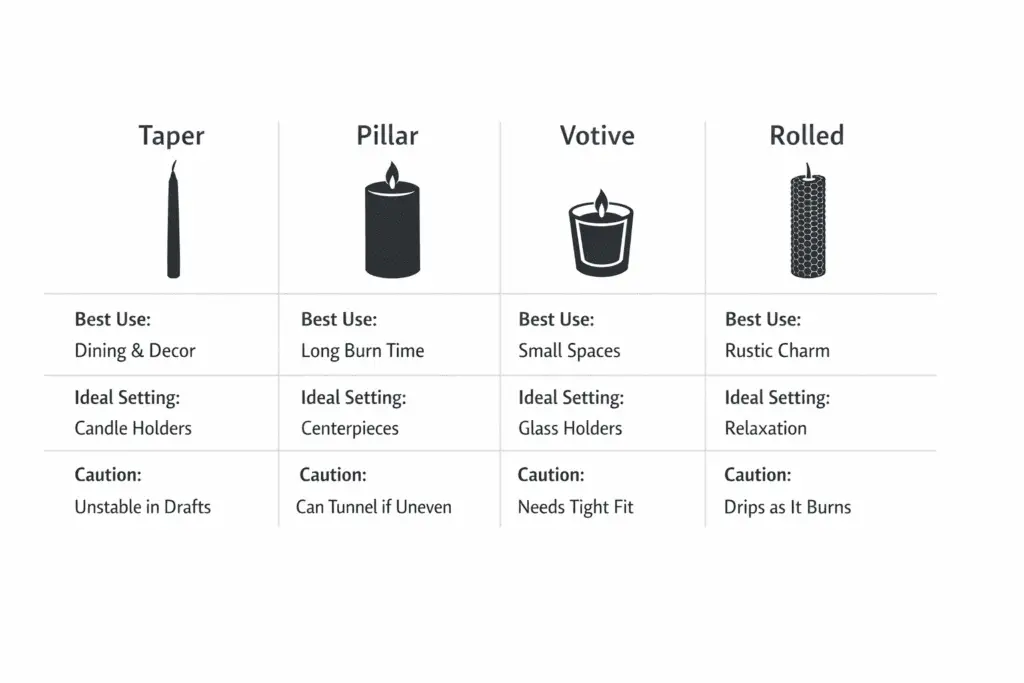
Beeswax candles come in several common formats, and the best option depends on where and how you want to use them. Shape matters more than many people realize. A good wax in the wrong format can still be disappointing.
Taper Beeswax Candles
Tapers are best for dining tables, formal settings, and candle holders designed to fit their base properly. They look elegant and take up very little space.
Their weakness is that they are less forgiving when the holder is loose or the candle sits in a drafty area. If the setup is wrong, the burn can quickly become uneven.
Pillar Beeswax Candles
Pillars work well on shelves, mantels, and table centerpieces where the candle itself is part of the decor. They tend to feel more substantial and can offer a long-lasting burn when used properly.
They do, however, need a heat-safe surface and enough burn time to melt evenly across the top. Without that, they can tunnel.
Votive Beeswax Candles
Votives are a practical choice for smaller rooms, grouped lighting, or shorter burn sessions. They are easy to place and often useful when you want a simpler candle setup.
The catch is that they usually perform best in a proper holder. Treating a votive like a free-standing mini pillar is a mistake.
Rolled Beeswax Candles
Rolled beeswax candles are often chosen for gifts, seasonal decor, or handmade appeal. They have a distinct look and feel more artisanal than highly polished factory-made candles.
They are a good fit when charm matters, but they are not always the best choice for someone who wants the most refined finish or the longest possible burn.
Best Way to Choose
The best choice still comes down to the job you need the candle to do. If you want broader selection guidance beyond beeswax alone, read how to choose candle wax instead of treating this page as a full buying guide.
How Beeswax Candles Burn
Beeswax candles can burn steadily and for a long time, but that depends on wick fit, wick trimming, airflow, and how long each burn session lasts. Premium wax does not magically remove the need for proper use.
A well-made beeswax candle often gives a stable flame and gradual melt. A poorly built one, or one used carelessly, can tunnel, smoke, flicker, or drown its own wick.
Common Burn Patterns
A small, steady flame and even melt usually point to normal performance. If a candle tunnels, smokes, or floods its wick, the problem usually comes down to wick match, airflow, or burn habits rather than the wax name alone.
What to Expect From the Natural Scent
Most beeswax candles have a light natural aroma, not a bold fragrance throw. The scent may seem warmer or milder depending on filtering, fragrance additives, and room size.
Someone expecting a room-filling scented candle may find pure beeswax too subtle. Someone who wants a softer background aroma may see that as a major advantage. Realistic expectations matter. Beeswax usually offers a gentle scent as part of the experience, not the entire point of it.
How to Improve Burn Quality
Trim the wick before lighting, keep the candle away from strong airflow, and give wider formats enough time to melt properly across the top. If you need deeper troubleshooting than that, it belongs in a separate candle-care guide rather than in a basic definition page.
Benefits and Tradeoffs of Beeswax Candles
Beeswax candles appeal to buyers who want a natural wax, a subtle native aroma, and a more premium feel than many everyday candles. At the same time, they usually cost more and still need proper handling.
That is the real picture. Beeswax has strengths, but it is not perfect, and pretending otherwise is marketing fluff.
Main Benefits
Beeswax feels distinctive because of its origin, appearance, and mild natural scent. Many buyers like that it feels more material-driven than fragrance-driven. It can also give a warmer, more traditional candle experience than heavily processed alternatives.
For people who want ambiance without overpowering scent, beeswax can be a very strong fit.
Main Tradeoffs
The most obvious downside is price. Beeswax candles often cost more than other candle types, and a higher price does not guarantee perfect performance.
They are also less ideal for shoppers who want the strongest possible scent throw or the cheapest candle available. If your top priority is low price or heavy fragrance, beeswax may simply be the wrong fit.
When Beeswax Is Worth It
Beeswax often makes sense when the goal is calm ambient lighting, subtle aroma, natural appeal, or decorative use.
It is easier to skip when budget matters most or when the main goal is filling a room with strong fragrance at the lowest cost.
Are Beeswax Candles Better for Indoor Air?
Beeswax candles are still candles. That means indoor air quality depends far more on combustion conditions and safe use than on magical claims.
The safest way to read this topic is to ignore sweeping promises. Claims about air purification, negative ions, or perfectly soot-free burning are not a sound reason to choose any candle.
What Matters More Than the Wax Claim
In normal household use, burn behavior depends more on wick trimming, airflow, holder fit, and overall candle construction than on a single marketing claim about wax alone.
Common Claims to Treat Carefully
Treat phrases like air-purifying, negative-ion, and soot-free with caution. Beeswax may appeal for material and scent reasons, but it should not be framed as an air-cleaning device.
Practical Indoor Use Advice
Trim the wick before lighting. Keep the flame away from strong drafts. Use the correct holder. Stop using a candle that keeps smoking heavily instead of forcing it to burn to the end.
The practical goal is simple: choose a well-made candle, use it properly, ventilate your space reasonably, and keep expectations realistic.
How to Buy a Good Beeswax Candle
A good beeswax candle has clear label wording, realistic claims, an appropriate format, and a price that makes sense for the material and size.
If you are comparing waxes or trying to decide what to buy, focus first on exact label wording, format, and realistic claims rather than marketing language. For broader selection help, use how to choose candle wax instead of treating this page as a full buying guide.
Frequently Asked Questions
What are beeswax candles made from?
Beeswax candles are made from wax produced by honey bees, then cleaned and formed into finished candles such as tapers, pillars, votives, or rolled candles.
What is the difference between 100% beeswax and a beeswax blend?
A 100% beeswax candle uses beeswax as the wax base, while a beeswax blend mixes beeswax with one or more other waxes. That difference can affect price, texture, scent, and burn behavior.
Do beeswax candles smell strong?
Usually not. Most beeswax candles have a mild natural aroma rather than a strong fragrance throw, so they tend to feel subtler than heavily scented candles.
Do beeswax candles purify the air?
That claim should be treated cautiously. Beeswax candles are still candles, so burn conditions, wick trimming, airflow, and overall construction matter more than marketing promises about air-cleaning effects.
Final Take
Beeswax candles are candles made from wax produced by honey bees, sold either as pure beeswax or as blends. Their appeal comes from their natural origin, firm feel, warm appearance, and subtle aroma.
They can be an excellent choice when you want a more material-focused candle with a premium feel. But they are not automatically the best option for every room, every budget, or every buyer. The smart move is to judge them by format, wick fit, label clarity, and realistic performance, not by hype.