
Heat-resistant glass for candles means a candle jar sold or screened for filled candle use, with lower crack risk from residual stress and abrupt temperature change.
A jar can look solid and still fail when hidden stress or a fast temperature shift pushes the glass past its limit. On this page, qualified means screened for candle use rather than assumed safe from thickness, weight, or a broad heat label. Annealing lowers built-in stress, while thermal shock explains why cracks often appear during pouring, cooling, or burning.
This page covers candle-glass qualification, annealing, and thermal-shock risk for filled candle jars. Mason jars, recycled jars, and full jar-testing procedures belong on separate pages.
Which Glass Types Are Safe for Candle Jars?
On this page, safe means better supported for candle use, not guaranteed failure-free, so qualified annealed candle glass is the baseline choice while borosilicate and decorative glass need closer screening.
For the broader vessel overview, start with Candle Containers & Jars.
A candle jar is safest when the vessel is sold and described for container-candle use, not when it simply looks thick or carries a broad heat claim. A clear container review starts with intended use, then checks the glass family, then checks what the seller can actually document.
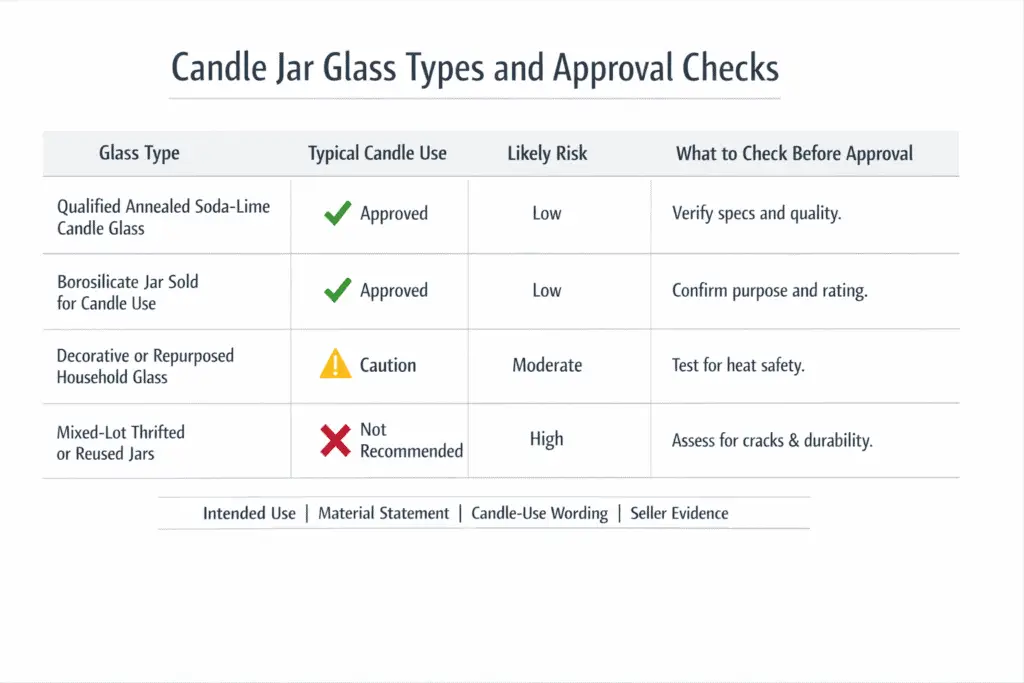
Thick glass alone does not prove candle suitability.
In practice, many common candle jars are made from annealed soda-lime glass. Borosilicate can work in some product lines, but it still needs candle-specific review for jar shape, burn pattern, and stated use limits. Decorative glass, giftware, and repurposed household vessels should be treated as unknown until the seller gives clear candle-use information.
| Glass type | Typical candle-use status | Likely risk | What to check before approval |
| Qualified annealed soda-lime candle glass | Common baseline choice | Lower when the jar line is sold for candle use | Material statement, candle-use wording, burn guidance, batch consistency |
| Borosilicate jar sold for candle use | Possible option | Lower to medium, depends on vessel design and stated limits | Candle-use wording, jar geometry notes, supplier testing language |
| Decorative or repurposed household glass | Do not assume safe | Medium to high | Treat as unqualified unless the seller gives candle-use evidence |
| Mixed-lot thrifted or reused jars | Poor choice for routine production | High | Unknown composition, unknown stress history, unknown quality control |
That table matters because a jar can look heavy and still fail. Thick glass and a premium look do not show whether the vessel was screened for flame exposure, hot wax, or repeated burn sessions.
For repeated burn failures tied to heat buildup, see How to Prevent Overheating and Shattering Containers.
Use this screening order before you buy:
- Check whether the listing says candle container, not just tumbler, vase, or heat-resistant glass.
- Look for a clear material statement and a clear use statement in the same listing.
- Slow down when the seller relies on adjectives but gives no jar-family guidance.
- Treat marketplace glassware and giftware as separate from candle vessels until proven otherwise.
- Reject any jar choice that depends on guessing.
Questions about secondhand or decorative vessels belong in Are Recycled Jars Safe for Making Candles? and Can You Use Mason Jars for Candles? (Are They Safe?) because reused glass adds unknown batch history, unknown stress history, and unknown screening. When seller language feels vague, use the checklist in this page instead of trying to read safety from marketing words.
Why Annealed Glass Matters for Candle Safety
Annealed glass matters because it lowers built-in stress, so a candle jar reacts more predictably during pouring, cooling, and burning.
In plain terms, annealed glass is glass cooled in a controlled way so hidden stress stays lower inside the jar. Residual stress is that trapped internal strain, and when too much of it remains, crack risk rises even when the wax, wick, and room setup seem normal. That is the core of basic candle-container screening.
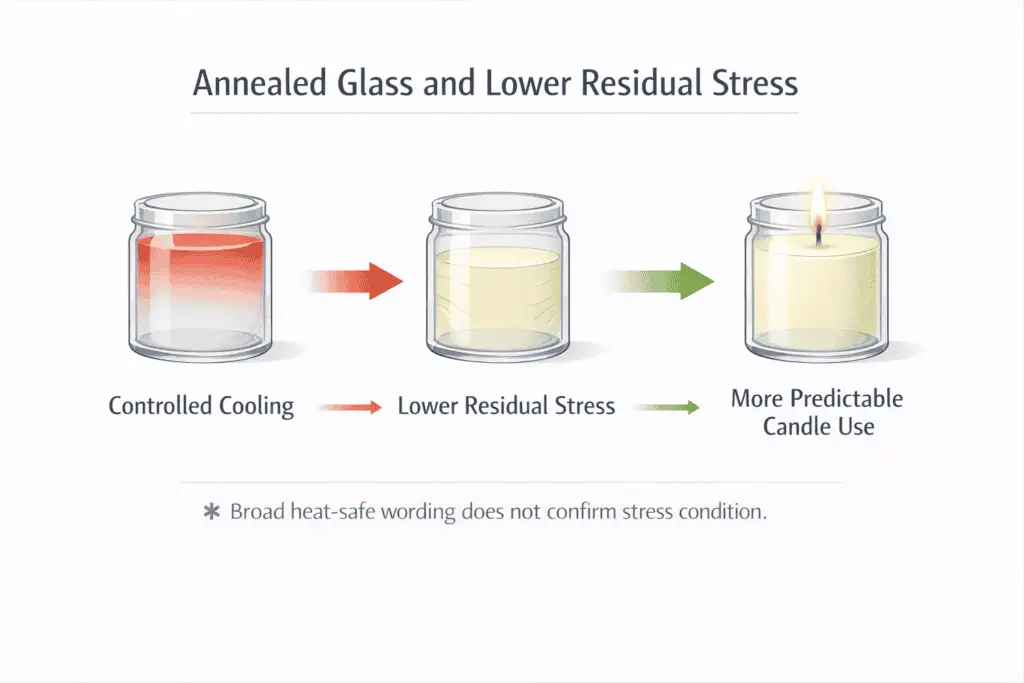
A jar can fail because of stress history, not just because it got hot. For candle makers, annealing matters because the vessel has to handle warm fill, cooldown, and repeated burn sessions without starting from a stressed state. The useful question is not which label sounds tougher. The useful question is whether the jar line was processed and screened for candle use in a way that keeps hidden stress lower before you ever pour wax into it.
| Supplier wording or evidence | Residual-stress read | Evidence depth | Practical candle reliability |
| Jar line clearly sold for candle use and described as annealed | Lower built-in stress is more likely | Stronger | Better starting point |
| “Heat-safe” or “heat-resistant” with no production detail | Stress condition unknown | Weak | Uncertain |
| No annealing detail, no use-case detail | Stress condition unknown | Minimal | Treat as unqualified |
| Mixed lots or shifting supplier language across the same jar family | Batch consistency is unclear | Weak | Higher approval risk |
Poor annealing raises risk in a plain chain. Stress stays trapped in the glass. A warm fill, a cold room, or repeated burn heat adds more strain. The weak point gives way first, so one jar family may crack while another survives under a similar wax and wick setup.
That problem sits behind the difference between tempered labels, “heat-safe” labels, and “heat-resistant” labels for candles. Those labels can describe a real property, but they still do not tell a candle maker whether the vessel was screened for candle use. A jar may resist one kind of heat and still fail in candle use because the geometry is poor, the stress history is unknown, or the burn setup creates uneven loading.
When a seller gives only broad adjectives, ask for proof that matches the vessel and the use case. Ask what the jar was sold for, whether the same jar family is used for container candles, and whether the supplier can describe the line with more than decorative language. If the answers stay vague, use the checklist in this page. If failures continue after sourcing questions are answered, move to direct jar testing so the decision rests on burn behavior instead of guesswork.
How Thermal Shock Cracks Candle Jars
Candle jars crack from thermal shock when one part of the glass changes temperature faster than another and the stress exceeds the jar’s limit.
Thermal shock is a crack trigger caused by uneven temperature change across the same piece of glass. In candle work, that often means hot wax meeting a cold jar, a hot jar touching a cold surface, or one side cooling much faster than the other during burn or cooldown. A simple container crack prevention guide starts with the failure pattern, not the label on the jar.
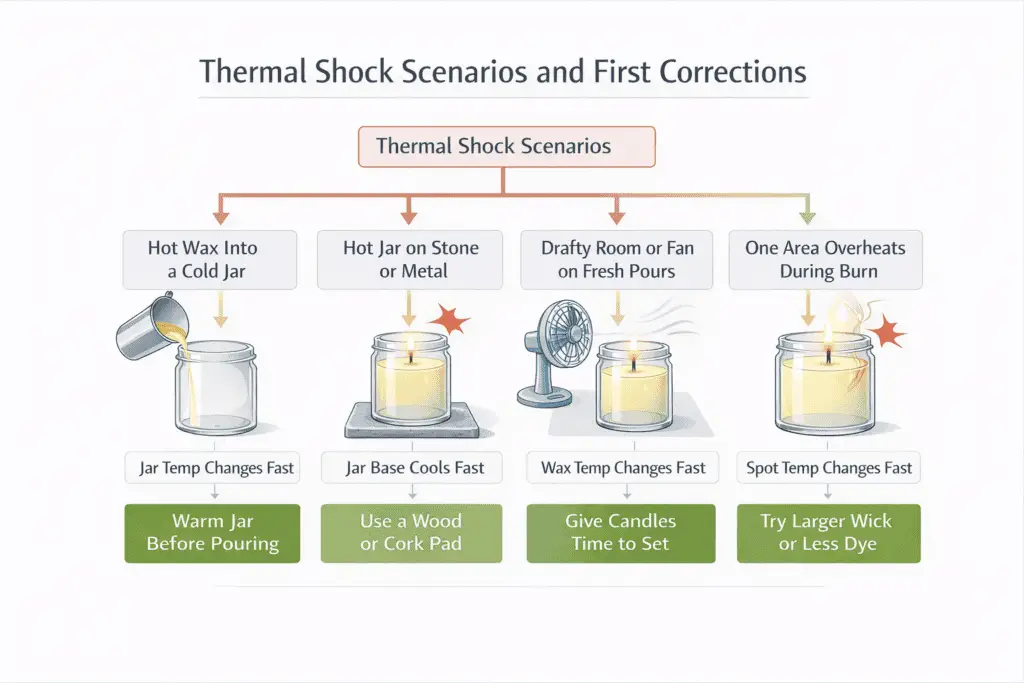
| Scenario | What changes fast | Likely crack risk | First correction |
| Hot wax into a cold jar | Inside warms faster than outside | High | Bring jars closer to room warmth before pouring |
| Hot jar on stone or metal | Base cools faster than sidewall | High | Cool on a stable, less conductive surface |
| Drafty room or fan on fresh pours | One side cools faster than the rest | Medium to high | Keep early cooldown steady and protected |
| One area overheats during burn | Local wall area takes more heat | Medium | Recheck vessel fit, burn pattern, and flame behavior |
A jar can survive one kind of heat and still crack when the temperature shift is abrupt or uneven. That is why the checklist in this page belongs near every sourcing decision, and why direct jar testing matters when the same vessel family keeps failing under real burn conditions.
How Jar Shape, Thickness, and Seams Change Stress
Jar shape and construction change how stress spreads, so thickness alone is a weak safety shortcut.
Thicker glass can help, but it does not outrank annealing quality or jar geometry.
That is the point of How Jar Shape, Thickness, and Seams Change Stress. A straight-sided jar with even walls often spreads stress more evenly than a vessel with sharp shoulders, uneven thickness, decorative ridges, or a seam line that lands in a stress-prone area. Two jars can feel equally solid in the hand and still behave very differently once heat moves through the base, sidewall, and rim.
| Jar feature | Stress pattern | Beginner read |
| Straight sides, even wall | More even stress spread | Better starting point |
| Abrupt shoulder or narrow neck | Stress can gather near the curve | Needs more caution |
| Uneven base or visible wall variation | Heat can move unevenly | Higher screening risk |
| Decorative seams or molded features | Local weak points may form | Test or reject, not guess |
Use this inspection pass before approval. Look at the base for visible unevenness. Check whether the sidewalls match from one side to the other. Slow down when a jar shape narrows, flares, or changes direction sharply. Treat heavy glass as only one clue, never the answer.
Handling Steps That Reduce Thermal Shock
Thermal-shock prevention depends on gradual temperature transitions before, during, and after the pour.
That is the job of Handling Steps That Reduce Thermal Shock. Many random-looking cracks follow the same pattern: the jar fails where the temperature jump is most abrupt, not where the jar merely feels hottest. A suitable jar can still fail when preheating, pouring, cooling, and surface contact are handled poorly.
These steps show the safest order:
- Condition jars so they are not starting from a cold-soak state.
- Keep the pour area steady instead of drafty.
- Avoid setting fresh pours on cold stone, metal, or a window-side ledge.
- Let cooldown stay gradual before moving jars to a colder room.
- Stop using the same risky surface or airflow pattern if cracks repeat.
The first changes to make are simple. Stop pouring into cold jars. Stop placing hot jars on cold counters. When cracks continue after those fixes, move from process review to direct jar testing so the issue can be separated from supplier quality or vessel design.
Candle Jar Qualification Checklist
A candle jar qualifies faster when supplier claims are screened with a pass, follow-up, or fail checklist instead of trust in broad heat labels.
This section turns vague seller language into a decision path. It does not replace burn testing, legal review, or internal quality checks, but it does help a maker sort strong evidence from weak wording before buying or approving a jar line. A useful sourcing review starts with what the seller can prove, not what the label seems to promise.
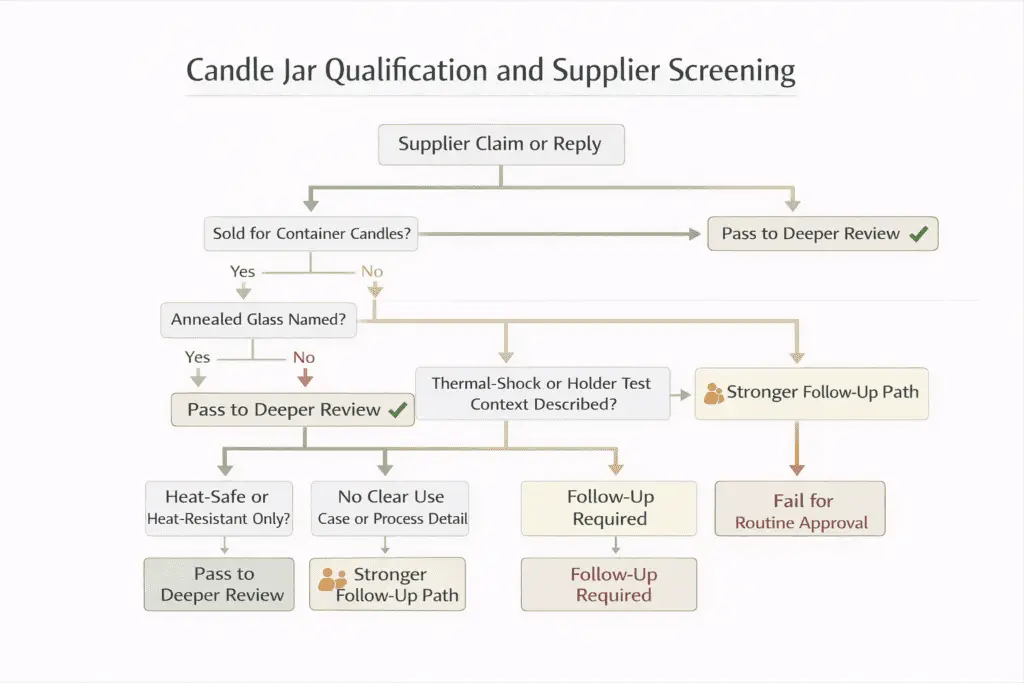
Start with the same basics covered in Which Glass Types Are Safe for Candle Jars? and Why Annealed Glass Matters for Candle Safety, then move each supplier claim through a simple pass, follow-up, or fail screen.
| Supplier claim or reply | Evidence type | Decision |
| “This jar line is sold for container candles” plus clear use notes | Direct candle-use statement | Follow up with burn limits and handling notes |
| Annealed glass is named and jar family is identified | Material and process clue | Stronger follow-up path |
| Thermal-shock, holder, or candle-use test context is described | Test-related support | Pass to deeper review |
| “Heat-safe” or “heat-resistant” only | Marketing wording only | Follow-up required |
| No clear use case, no process detail, no test note | No approval evidence | Fail for routine approval |
That table keeps weak claims from slipping through. A good claim tells you what jar family the statement applies to, what use case was screened, and what limits still matter. A weak claim stays broad, skips the vessel family, or leans on words that sound safe without naming any candle-use proof.
How to Verify Candle-Glass Claims and Standards
Screen candle-glass claims by asking what was tested, for which jar family, and with what candle-use limits.
A meaningful claim should tell you more than “premium,” “heat-safe,” or “resistant.” It should point to the vessel line, mention candle use or holder use, and give some sign that annealing, thermal behavior, or related screening was part of approval. Supplier language can inform screening, but it cannot approve a jar by itself.
“Heat-safe” or “heat-resistant” wording alone does not prove candle suitability. For annealed soda-lime-silicate glass candle containers, a stronger supplier answer can point to ASTM F2179 or related candle-container documentation tied to the same jar family. For other glass families, the supplier still needs jar-specific candle-use evidence instead of a broad standards claim.
Use this request order when a supplier answer feels thin:
- Ask whether the jar family is sold or screened for container candles.
- Ask whether annealing or stress-control language is documented for that line.
- Ask whether any thermal-shock, holder, or candle-use testing is named.
- Ask whether limits or handling notes exist for filling, cooling, or burn use.
- Ask what documents the supplier can provide before approval.
That order helps a buyer move from guesswork to recordkeeping. Supplier language can guide screening, but approval still depends on candle-use evidence and in-context testing for the intended jar, wick, wax, and burn conditions. When a seller cannot answer these questions clearly, return to the earlier sections, treat the vessel as unqualified, and do not rely on adjectives alone.
Keep these short clarifications in mind:
- Not every glass jar is a candle jar. Decorative or repurposed glass can still fail even when it looks thick.
- Mason jar approval belongs in Can You Use Mason Jars for Candles? (Are They Safe?) because that choice adds a separate container-family decision.
- Borosilicate does not approve itself. It still needs candle-use wording or jar-family evidence.
- Move from supplier screening to direct jar testing when seller answers stay broad or when the same jar family keeps cracking during filling or burn use.