Heat-resistant glass for candles is glassware intended or screened to tolerate candle-specific heating and cooling without cracking; it is a candle-container candidate, not a fireproof, shatterproof, oven-safe, or automatically safe vessel.
Here, safe means screened and tested for the actual wax, wick, fragrance load, container shape, and burn conditions, not certified safe for every candle design.
A candle glass vessel is the jar or container that holds wax, wick heat, and flame-adjacent temperature changes during use. Heat-resistant glass means the vessel may be suitable for repeated candle heat and reasonable temperature changes, but it still needs screening and testing. Cracks often come from poor stress relief, uneven wall or base geometry, hidden defects, hot wax, burn heat, or sudden cooling. The safer choice is a glass candle container that matches candle use rather than ordinary decorative glass.
What “Heat-Resistant Glass” Means for Candle Containers
Heat-resistant glass for candles means a glass vessel is a reasonable candle-container candidate under candle-use heat conditions; it does not mean fireproof, shatterproof, oven-safe by default, or automatically safe.
A candidate jar has enough vessel-specific evidence to move into screening or testing; a validated candle jar has been checked with the exact wax, wick, fragrance load, container shape, and burn conditions it will hold.
A candle glass vessel is the jar, tumbler, or container that holds wax while the wick, melt pool, and flame create heat near the glass. In this context, “heat-resistant” means the vessel is more plausible for choosing safe candle containers, but it still needs screening for glass type, wall shape, defects, and candle-use testing.
| Means | Does Not Mean | Still Required |
|---|---|---|
| Suitable as a candle-use candidate | Fireproof | Check intended use |
| More reasonable under repeated candle heat | Shatterproof | Inspect rim, base, seams, and walls |
| Better suited to normal candle temperature changes | Oven-safe by default | Match vessel size to candle design |
| Worth considering for candle making | Automatically safe with any wick or wax | Test before selling or repeated use |
The key difference is candidate status versus validated safety. A candidate jar may look suitable because it has a stable base, even walls, clean rim, and no visible damage. A validated candle jar has gone through the checks needed for the actual wax, wick, fragrance load, flame behavior, and burn conditions used in that candle. Treat “heat-resistant” as a starting point, not as permission to skip safety checks.
Candle-Rated Containers vs Ordinary Decorative Glass
You should not treat ordinary decorative glass as candle-safe unless it can be screened and tested for candle-use heat, flame proximity, wax load, and temperature changes.
A candle-rated container is made, sold, or specified for candle use; ordinary decorative glass is made for appearance, storage, drinking, display, or reuse. Visual thickness, jar shape, or a heavy base may help screening, but they do not prove the vessel can handle candle heat.
A supplier-rated candle container identifies intended vessel use, while maker-tested candle safety depends on the finished candle’s wax, wick, fragrance load, container shape, and burn behavior.
| Checkpoint | Candle-Rated Container | Ordinary Decorative Glass |
|---|---|---|
| Intended use | Sold or specified for candles | Often made for decor, food, drinks, or storage |
| Heat expectation | Designed with candle heat in mind | Heat exposure may be unknown |
| Flame proximity | Usually considered in the vessel design | Often not considered |
| Wax load | More likely to suit filled wax use | May not tolerate hot wax and cooling changes |
| Prior wear | Usually new and unused | May have scratches, chips, or hidden damage |
| Decision | Candidate for testing | Reject or test only if all screening signs are acceptable |
Mason jars and reused food jars are common gray areas, not automatic approvals. Use mason jar safety for candles when the question is about canning-style jars specifically, because canning use and candle heat are different conditions. Use recycled jar safety for candles when the vessel has prior use, unknown wear, label residue, scratches, or possible impact damage. For this section, the safe rule is simple: ordinary glass must earn candidate status before it ever reaches burn testing.
Why Annealing Matters for Candle Glass Stress
Annealing reduces residual internal stress in glass, which can lower crack risk, but annealed glass is not automatically thermal-shock-proof or candle-safe.
For candle containers and jars, annealing matters because stress trapped inside the glass can make a vessel less tolerant of wax heat, burn heat, and temperature changes. Annealed glass is a better screening clue than unknown decorative glass, but choosing safe candle containers still depends on vessel design, visible condition, and candle-use testing.
| Annealing Helps | Does Not Prove | Still Verify |
|---|---|---|
| Reduces internal stress left from forming and cooling | The jar is safe with any wax or wick | Intended candle use |
| Can lower crack risk from normal candle heat changes | The vessel cannot crack | Rim, base, seams, and wall evenness |
| Makes the jar a stronger candidate than unknown glass | The jar can handle sudden temperature swings | Defects, chips, scratches, and bubbles |
| Supports safer vessel screening | The jar is validated for sale or repeated use | Heat and burn behavior with the actual candle |
The useful distinction is “less stressed” versus “safe.” A well-annealed candle jar may tolerate gradual warming better than poorly annealed glass, yet a sudden cold surface, hidden flaw, overheated sidewall, or aggressive wick can still create failure. This is why annealing should be treated as one selection signal, not as a pass/fail certificate.
How Thermal Shock Cracks Candle Jars
Thermal shock in a candle jar happens when one part of the glass changes temperature faster than another, creating uneven expansion or contraction that can crack the vessel.
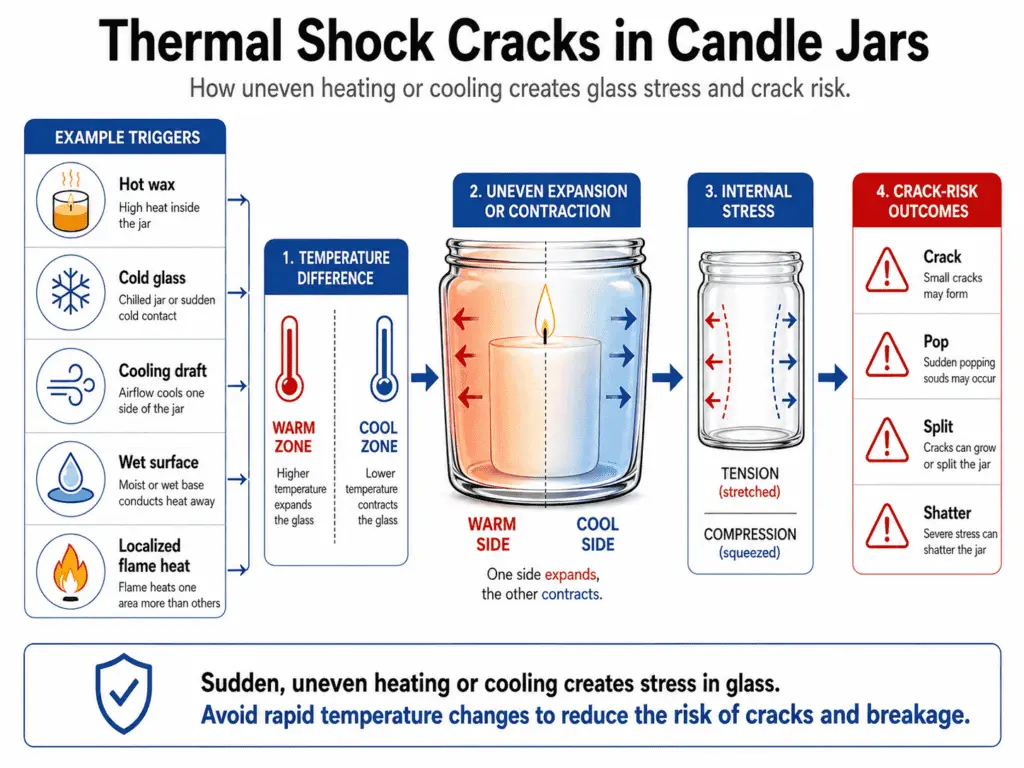
Normal warming is gradual and more evenly distributed; thermal shock is sudden and uneven. In candle containers and jars, the risk rises when hot wax, flame heat, cold glass, cooling drafts, wet surfaces, or localized heat create a sharp temperature difference across the vessel.
Temperature difference → uneven expansion or contraction → internal stress → crack, pop, split, or shatter risk.
| Failure Log Signal | Likely Heat Pattern | What It Means |
|---|---|---|
| Crack appears after pouring hot wax | Cold or flawed jar meets sudden heat | Pour-stage thermal stress |
| Crack starts near the base | Base heats or cools differently than wall | Uneven base response |
| Sidewall crack forms during burn | Heat concentrates near one side | Localized burn stress |
| Rim damage grows into a crack | Existing rim weakness meets heat change | Defect plus temperature change |
| Jar breaks after moving to a colder surface | Hot glass cools too fast | Cooling shock |
| Repeated hairline cracks appear | Small stresses accumulate over use | Candidate needs rejection or deeper testing |
Thermal shock is not the same as “glass got hot.” Candle glass is expected to warm during use, but it should not face sudden, uneven temperature shifts. When a jar passes visual screening but still has uncertain behavior, heat and burn testing for candle jars is the correct next route rather than guessing from thickness, brand, or appearance.
Pouring Hot Wax Into Glass
Hot wax can crack glass when it creates a sudden temperature difference across the jar, especially if the vessel is cold, flawed, uneven, or cooled too quickly.
For candle containers and jars, the risky moment is the temperature transition, not the act of filling alone. A heat-resistant glass candle jar is still only a candidate vessel until its hot-wax response and burn behavior are checked.
| Transition | Higher-Risk Condition | Safer Reading |
|---|---|---|
| Warm wax into room-temperature jar | Usually lower risk if the jar is sound and suitable | Still inspect first |
| Hot wax into cold jar | Sudden heat change across glass | Higher crack risk |
| Hot wax into chipped or scratched jar | Heat meets a weak point | Reject or test route |
| Hot wax into uneven-base jar | Base and wall may heat at different rates | Higher stress risk |
| Filled jar placed on cold surface | Hot glass cools unevenly | Cooling shock risk |
| Fast cooling in a draft | One side cools faster than another | Sidewall stress risk |
The practical distinction is pouring risk versus candle-use validation. A jar that survives the pour may still fail later when the wick, melt pool, and flame heat the glass differently. Use heat and burn testing for candle jars when the question moves from “did it crack during pouring?” to “is this vessel safe for the finished candle?”
Burn-Phase Heat Concentration
Localized burn heat can stress glass when flame position, melt-pool behavior, jar diameter, and wick heat concentrate energy near one part of the vessel.
During the burn phase, the jar is not heated evenly like a simple warm object. The flame, melt pool, wick, and container shape can push more heat toward one wall, one base area, or one side of the rim.
| Burn Pattern | What It Suggests | Container Risk |
|---|---|---|
| Flame leans toward one side | Draft, wick position, or uneven melt pool | Sidewall hot spot |
| Deep melt pool forms near the wall | Heat is pooling close to glass | Wall stress |
| Sooting and large flame appear together | Wick may be driving excess heat | Overheating risk |
| Base gets much hotter than walls | Heat is collecting low in the vessel | Base stress |
| Crack appears after several burns | Repeated heat cycles may expose weakness | Accumulated stress |
| Jar diameter and wick feel mismatched | Heat is not spreading as intended | Route to geometry diagnosis |
This is a container-safety issue, not a full wick-sizing lesson. If the pattern points to diameter, flame size, melt-pool width, or uneven heat near the wall, route the diagnosis to wick and jar geometry overheating rather than assuming the glass label alone decides safety.
Candle-Specific Thermal Shock Scenarios
Candle-specific thermal shock risk rises during hot pour into a cold jar, cold room to hot wax transitions, draft exposure, cold surface contact, and water contact.
These scenarios matter because the candle container is exposed to sudden temperature shifts, not just steady candle warmth. The warning sign is a fast change across part of the vessel: one area expands or contracts faster than another.
| Candle Scenario | Sudden Temperature Stress | Safer Interpretation |
|---|---|---|
| Hot wax poured into a cold jar | Interior heats faster than the outer wall | Higher pour-stage crack risk |
| Cold jar brought into a warm filling area | Glass temperature changes before filling | Let the vessel stabilize before judging suitability |
| Burning candle placed near a draft | One side cools while the flame side stays hotter | Sidewall stress can rise |
| Warm jar placed on a cold counter | Base cools faster than upper glass | Base or lower-wall stress can appear |
| Water hits warm candle glass | Local cooling happens suddenly | Crack or pop risk increases |
| Candle moved between hot and cold rooms | Whole vessel shifts temperature unevenly | Repeated stress cycles may expose weak points |
The practical rule is to judge the transition, not just the jar label. A heat-resistant candle jar candidate may handle normal warming during use, yet still fail if a cold surface, draft, water contact, or rapid room change creates uneven stress. If you need to simulate these scenarios rather than list them, route that work to heat and burn testing for candle jars instead of turning this section into a test procedure.
Glass Types for Candle Jars
Glass type helps screen candle-jar candidates, but soda-lime, container glass, tempered glass, and borosilicate glass still require candle-use suitability checks and testing.
For candle containers and jars, the glass label only sorts the vessel into a screening path. The decision still depends on intended candle use, vessel shape, wall and base evenness, visible defects, and candle-use testing.
| Glass Type or Label | Helps Screen For | Does Not Prove | Still Verify |
|---|---|---|---|
| Soda-lime glass | Common jar-style container category | Candle safety by itself | Intended use, wall evenness, defects, burn behavior |
| Container glass | Vessel made for holding contents | Suitability for flame-adjacent heat | Supplier use case and candle testing need |
| Tempered glass | Heat-treatment clue | Safe candle performance or no breakage risk | Whether the vessel is intended for candles |
| Borosilicate glass | Better heat-change assumptions in some glass products | Automatic candle-container approval | Candle-use design, dimensions, and testing |
| Thick decorative glass | Visual strength cue | Heat resistance or stress-free construction | Base, rim, seams, scratches, and prior damage |
| Unknown reused glass | Possible container reuse | Known heat history or safe prior condition | Reject-or-test decision before candle use |
A named glass type can raise or lower candidate confidence, but it cannot validate the finished candle. If the decision becomes a broader container-material choice, use glass vs tin candle containers as a separate comparison rather than turning glass-type screening into a full material guide.
Annealed vs Tempered vs Borosilicate for Candle Use
Annealed, tempered, and borosilicate labels can help interpret glass behavior for candle use, but none should be treated as an automatic candle-safety guarantee.
For candle containers and jars, use these labels to decide what to verify next. Annealed glass points to stress relief, tempered glass points to heat treatment, and borosilicate glass points to heat-change tolerance assumptions; the finished candle still needs vessel screening and candle-use testing.
| Glass Label | What It Helps You Understand | What It Does Not Prove | Candle-Use Reading |
|---|---|---|---|
| Annealed glass | Internal stress has been reduced after forming | Immune to thermal shock | Better candidate than poorly stress-relieved glass, not a guarantee |
| Tempered glass | Heat treatment may change strength and break behavior | Safe for any candle design | Verify intended candle use before relying on the label |
| Borosilicate glass | Often associated with better temperature-change tolerance | Automatically safe as a candle jar | Still judge shape, thickness, rim, base, and candle heat |
| Soda-lime container glass | Common in many jar-style vessels | Suitable for every wax and wick setup | Candidate status depends on design and testing |
| Unknown decorative glass | Appearance, weight, or thickness | Candle safety | Reject or route to testing only after strict screening |
Read each label as a screening clue, then return to the candle design. The jar still has to hold a melt pool, flame heat, cooling cycles, and the vessel geometry of the actual candle.
Wall Thickness, Base Thickness, Rim, Seams, and Stress Points
Thick glass can still fail if the wall, base, rim, seam, or stress concentration creates uneven heat response or hides flaws.
For candle containers and jars, thickness is only one part of geometry. A thick jar can look strong while still having a heavy cold base, uneven sidewall, stressed rim, visible seam, trapped bubble, or small defect that becomes more serious under heat.
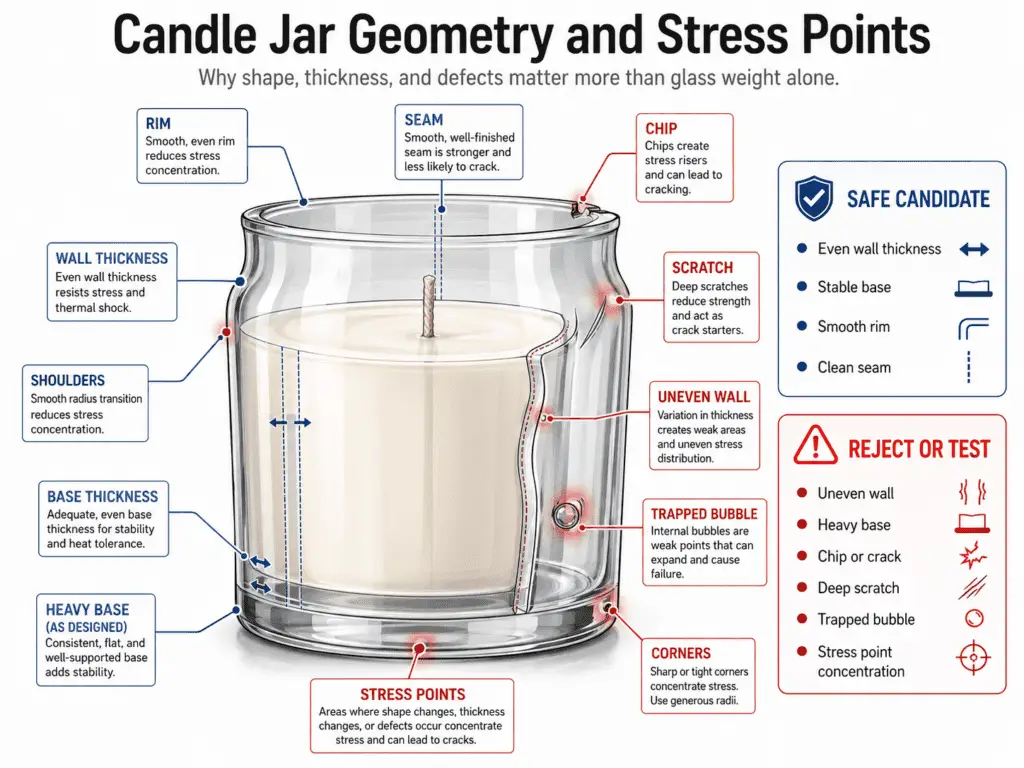
| Geometry Check | Safer Candidate Signal | Reject or Test Signal |
|---|---|---|
| Wall thickness | Even wall with no thin or bulging zones | Uneven wall, sharp thickness changes, or warped shape |
| Base thickness | Stable, flat base with even glass distribution | Very heavy base, uneven punt, wobble, or trapped defect |
| Rim | Smooth, chip-free, and evenly finished | Chips, cracks, sharp spots, or rough finishing |
| Seams | Clean seam with no sharp stress point | Raised, cracked, or visibly stressed seam |
| Corners and shoulders | Rounded transitions that spread heat more evenly | Tight angles that may concentrate stress |
| Surface condition | No deep scratches or impact marks | Scratches, bruises, chips, or unknown prior damage |
The useful rule is evenness before weight. A moderately thick, even, undamaged candle jar can be a better candidate than a very heavy vessel with stress points, rim damage, or an uneven base. When overheating depends on wick size, jar diameter, melt-pool behavior, or hot throw, wick and jar geometry overheating should handle that deeper diagnosis.
Visible Defects and Rejection Signals
Chips, cracks, deep scratches, uneven bases, damaged rims, suspicious bubbles, and stressed seams should make a glass jar a reject-or-test candidate before candle use.
For candle containers and jars, a small flaw matters because heat can turn a weak point into a crack path. This is especially important when prior use is unknown, so route used-container decisions through recycled jar safety for candles rather than treating a clean-looking jar as new.
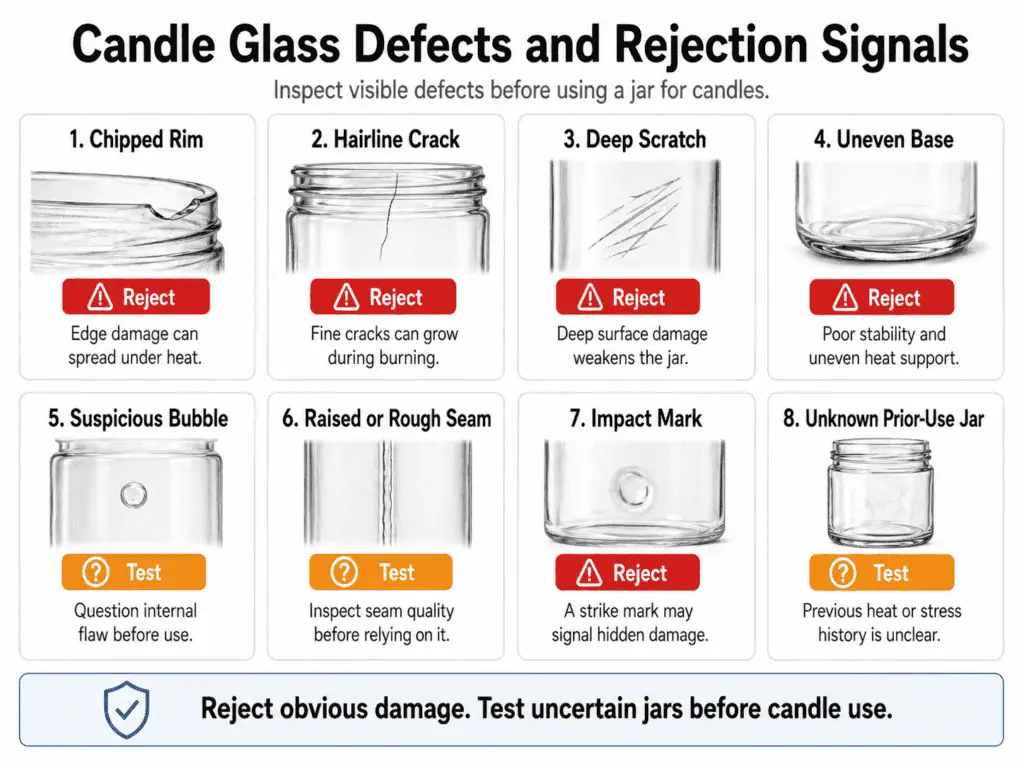
| Defect Signal | Why It Matters Under Candle Heat | Decision |
|---|---|---|
| Chipped rim | Heat and handling can extend the damage | Reject |
| Hairline crack | Existing crack can spread during warming or cooling | Reject |
| Deep scratch | Scratch can act like a stress line | Reject or test only if non-critical and professionally assessed |
| Uneven base | Base may heat or cool differently from the wall | Reject or test |
| Suspicious bubble | Trapped weakness may react poorly to heat stress | Test or reject |
| Raised or rough seam | Seam can become a stress point | Test or reject |
| Impact mark or bruise | Prior damage may be hidden below the surface | Reject |
| Unknown prior-use jar | Wear history is not controlled | Route before candle use |
Do not repair, patch, sand, or decorate around damage for candle use. A candle jar is either a sound candidate, a testing candidate, or a reject; visible damage should never be treated as a styling issue.
Heat-Resistant Candle Jar Selection Checklist
Use a candle-jar checklist to screen material, intended use, geometry, defects, temperature transitions, and testing need; the checklist does not replace heat and burn testing.
For candle containers and jars, “safe” at this stage means candidate selection only, not final validation. Use the checklist to narrow choices for choosing safe candle containers, then route uncertain or sale-intended vessels to heat and burn testing for candle jars before relying on them.
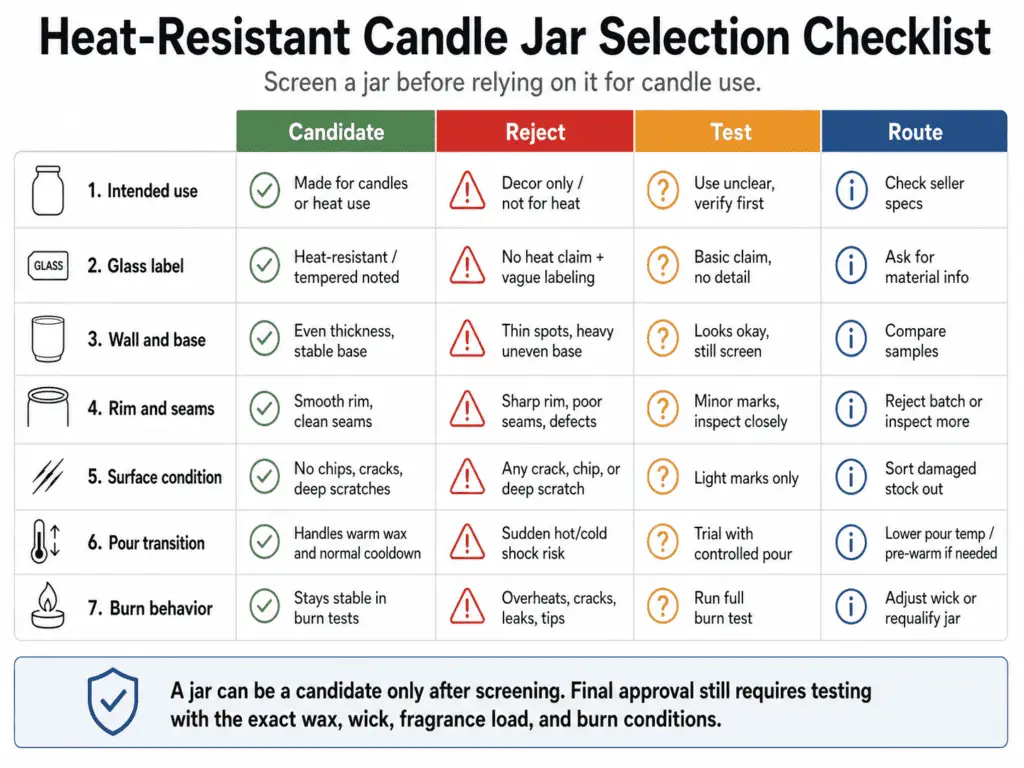
| Check Area | Candidate | Reject | Test | Route |
|---|---|---|---|---|
| Intended use | Sold or specified for candles | Decorative-only or unknown heat use | Supplier details unclear | Ask supplier or choose another vessel |
| Glass label | Candle-use glass with clear specs | Unknown decorative glass | Label is helpful but incomplete | Verify with seller specs |
| Wall and base | Even walls, stable base, no sharp transitions | Warped, wobbly, or uneven base | Heavy base or unusual shape | Test before repeated use |
| Rim and seams | Smooth rim, clean seam, no chips | Cracked, chipped, sharp, or rough | Seam looks raised or stressed | Reject or test conservatively |
| Surface condition | No deep scratches, bruises, or impact marks | Any crack or clear impact damage | Minor mark with unknown cause | Prefer rejection |
| Pour transition | Room-temperature vessel, controlled cooling | Cold jar, cold surface, or draft exposure | Unknown fill conditions | Use testing route |
| Burn behavior | Heat stays reasonable and even during checks | Hot spot, sidewall stress, crack, or pop | Flame or melt pool looks concentrated | Route to testing or wick-geometry diagnosis |
This checklist is not legal certification, a product standard, or a substitute for a controlled burn test. It is a screening tool that separates promising candle-jar candidates from vessels that should be rejected, tested, or sent to a more specific safety workflow.
FAQs
These FAQs give short boundary answers about heat-resistant glass for candle jars and route child-topic questions to their own container-safety pages.
Does annealed glass prevent thermal shock?
No. Annealing can make a candle glass vessel a better candidate by reducing residual stress, but sudden temperature shifts can still crack the jar. Use heat and burn testing for candle jars when you need to validate the finished candle rather than judge the glass label alone.
Can any thick glass jar be used for candles?
No. Thick glass can still fail if the base, wall, rim, seam, or hidden defect concentrates stress. Even thickness, intended candle use, clean finishing, and defect-free glass matter more than weight alone.
Are mason jars safe for candles?
Mason jars are a separate candle-container question because canning use and candle heat are not the same condition. Use mason jar safety for candles when the vessel is a canning-style jar, and keep the decision tied to that jar type rather than general decorative glass.
Are recycled jars safe for making candles?
Recycled jars need separate screening because prior use, impact damage, scratches, and unknown glass history increase uncertainty. Use recycled jar safety for candles when the container has been used before, even if it looks clean.
Can the wrong wick make glass crack?
Yes, wick behavior can contribute when flame size, melt-pool width, jar diameter, or sidewall heat creates a localized hot spot. Use wick and jar geometry overheating when the crack risk appears tied to burn behavior rather than glass type alone.
Is borosilicate glass automatically safe for candles?
No. Borosilicate can be a useful screening clue, but it does not make a vessel automatically candle-safe. The jar still needs suitable shape, clean finishing, no visible defects, and validation with the actual candle design.