
Candle containers are heat-qualified when the vessel stays intact, stable, and suitable for candle use after heat exposure, thermal-stress review, and burn-test approval.
The safest candidates are purpose-made candle jars, candle tins, and verified heat-resistant ceramic or glass vessels. Reject thin glass, plastic, raw wood, unstable novelty vessels, and any container with cracks, chips, unknown heat history, or unclear construction.
A candle container is any jar, tin, ceramic cup, or similar vessel intended to hold wax and burn with a flame inside it. Heat-qualified means the vessel has been approved for candle use after checking material suitability, thermal shock risk, visible damage, shape stability, and burn behavior. Heat resistant does not mean oven-safe, certified, or safe for every hot use; it means the container can tolerate candle-burn conditions without cracking, shattering, tipping, or failing. A safe container is approved only for the tested candle setup, and it should be retested or rejected when the vessel history, fill height, flame load, finish, or batch changes.
This page gives an operational candle-container qualification workflow. It does not replace ASTM certification, supplier compliance documents, or jurisdiction-specific safety rules.
What Makes a Candle Container Heat-Qualified?
A candle container is heat-qualified when its material, shape, visible condition, and burn-test behavior support safe use for the tested candle setup.
A heat-qualified candle container is approved for candle use after heat and integrity evaluation, not certified for every hot use. Heat resistant means the vessel can stay intact and stable during candle burn heat and ordinary burn-cycle stress, not that it is oven-safe or legally certified. A safe container is one that can be approved, retested, or rejected based on candle-use evidence.
| Container claim or condition | What it proves | Candle-use decision |
|---|---|---|
| Purpose-made candle jar with no visible flaws | It starts as a suitable candidate. | Suitable for burn testing |
| Thick glass jar | It may resist some stress, but thickness alone does not prove safety. | Conditionally suitable |
| Oven-safe or kitchen-safe dish | It was made for another heat pattern, not necessarily candle flame heat. | Retest needed |
| Ceramic or metal vessel | Material may help, but construction and finish still matter. | Conditionally suitable |
| Reused or thrifted jar | Prior heat, impact, or wear may be unknown. | Retest needed |
| Novelty or decorative vessel | Shape, coating, seams, or hidden construction can change heat behavior. | Reject or screen before testing |
Can any glass jar be used for candles? No. Glass has to be treated as a candle container candidate until its material behavior, shape, visible condition, and burn response support approval.
Does thick glass automatically mean safe? No. Thick glass can still crack if it has hidden defects, poor annealing, uneven heating, or sudden temperature changes.
Heat resistant and candle-safe are not the same claim. Heat resistant describes the vessel’s ability to remain intact under candle-burn heat, while candle-safe means the container has passed the approval logic for the actual candle setup. Glass, ceramic, and metal container guides and a jar capacity guide can answer narrower questions, but the core rule stays the same: approve the vessel by burn behavior, structural stability, and rejection criteria rather than by material label alone. The next risk to separate is thermal shock, because a container can tolerate steady heat yet fail when temperature changes too fast.
Why Thermal Shock Breaks Candle Containers
Thermal shock breaks candle containers when sudden temperature change makes one part of the vessel expand or contract faster than another part.
Thermal shock is not drop damage, shipping damage, or ordinary steady heat exposure. It happens when one part of the candle container expands or contracts faster than another part, creating stress that can lead to hairline cracks, base failure, or sudden breakage.
| Thermal-shock trigger | Why it matters | Action |
|---|---|---|
| Hot jar placed on a cold counter | The base cools faster than the warmer walls. | Retest or reject if damage appears |
| Cold room during testing | The outside surface may cool unevenly while the inside stays hot. | Control the test setting |
| Draft across one side of the vessel | One wall can cool faster than the other side. | Move the test away from drafts |
| Rapid cooldown after extinguishing | Stress can peak after the flame is out. | Inspect after cooling |
| Uneven support surface | Contact points can concentrate heat or cooling stress. | Use a flat, stable support |
| Cold vessel exposed to sudden flame heat | Fast heating can stress existing weak points. | Warm to room conditions before testing |
Can a cold surface crack a candle jar? Yes, especially when the jar is hot and the base cools much faster than the rest of the vessel.
Why did the vessel fail after the flame was out? The flame may be gone, but the container is still moving through a heat cycle. Cooling can reveal stress that did not show during the active burn.
Steady heat tolerance and temperature-swing tolerance are different. A jar may stay stable during a controlled burn yet fail when moved, cooled quickly, placed on a cold surface, or exposed to a draft. Ambient-condition details belong in the setup details, and failure-sign criteria decide whether the vessel is retested or rejected after stress appears. Cold surfaces, drafts, and room conditions narrow the next decision because they show when the same vessel can pass in one setup and fail in another.
How Shape, Wall Thickness, and Base Stability Change Heat Behavior
Container geometry is not decorative only; it changes heat flow, balance, and approval confidence during candle use.
For candle containers, container geometry means the vessel’s shape, wall behavior, and base support under burn conditions. Stable means the vessel resists tipping, rocking, localized hot spots, and shape-driven stress; sturdy does not mean heavy-looking or visually solid without burn evidence.
| Geometry pattern | Heat or stability effect | Qualification decision |
|---|---|---|
| Wide, low vessel | Lower tipping risk, but wider heat spread can change melt behavior. | Test under the intended candle setup |
| Tall, narrow vessel | More sidewall heat concentration and higher center of gravity. | Screen carefully before burn testing |
| Thick base | May add support, but can still stress under uneven heating or cooling. | Helpful, not automatic approval |
| Thin or uneven base | Less support and higher risk from surface contact. | Retest or reject if rocking appears |
| Smooth, even walls | Easier to read heat behavior and stress patterns. | Better candidate for testing |
| Handles, feet, seams, or embossing | Irregular features can bias heat or stability locally. | Review irregular features before approval |
Is a thick base always safer? No. A thick base can help with support, but it can still fail if the vessel rocks, cools unevenly, has hidden flaws, or concentrates stress at the wall-base join.
Does tall vs wide matter? Yes. Tall vessels can be more top-heavy and can concentrate heat along the sidewall, while wide vessels can be more stable but may spread heat differently across the container body.
Use this pre-test stability screen before approval:
- Place the empty vessel on a flat surface and check for rocking.
- Look for uneven wall thickness, warped base contact, or off-center weight.
- Check whether the opening, body, and base create a top-heavy profile.
- Note any seams, feet, handles, embossing, or raised features.
- Treat the vessel as unapproved until the burn test supports the same decision.
Method note: This screening uses observable shape and support variables rather than a fixed universal measurement, because candle containers vary by material, size, and construction. The National Candle Association, supplier technical sheets, and manufacturer use notes are the right reference types when a vessel maker provides dimension or use-condition guidance.
When flame size rather than vessel shape is driving the heat pattern, treat the issue as flame-load interaction and keep the geometry decision tied to burn-test evidence instead of style preference.
Reused vs New Containers: When to Test, Retest, or Reject
Reused containers need fresh inspection and qualification because prior stress history may be unknown.
A reused candle container is a previously owned, previously burned, or secondhand vessel being considered again for candle use. It is not approved just because it has been cleaned, and it is not automatically rejected if it can be inspected, screened, and requalified conservatively.
Use this reuse screen before treating the vessel as a candidate:
- Identify whether the vessel is new, previously used, thrifted, or unknown-origin.
- Reject it if you see cracks, chips, clouding, deep scratches, loose coatings, or base damage.
- Treat unknown heat history as a higher-risk condition.
- Do not rely on thickness, weight, or clean appearance as approval evidence.
- Requalify the vessel under the intended candle setup before use.
| Vessel history | Main risk | Decision |
|---|---|---|
| New purpose-made candle container | Lower unknown-history risk, but still needs approval for the setup. | Test before approval |
| Cleaned old candle jar | Prior heat cycles may have weakened the vessel. | Inspect and retest |
| Thrifted or secondhand vessel | Origin, glass type, and prior damage may be unknown. | Use a stricter screen |
| Vintage-looking glass | Manufacturing history and hidden stress may be unclear. | Screen as unknown-origin before testing |
| Reused food or drink container | Made for another use pattern, not candle burn heat. | Reject or test only with conservative screening |
| Vessel with label glue, finish, or residue | Contamination or finish behavior can change under heat. | Keep cleaning and restoration guidance separate from qualification |
Can I reuse an old candle jar? Yes, only if it passes inspection and is requalified for the intended candle setup. Cleaning removes residue, but it does not erase heat history, micro-cracks, or prior stress.
Is a thrifted vessel okay if it looks thick? Not by appearance alone. Thick thrifted glass can still have hidden cracks, unknown material behavior, or past impact damage that makes it a poor candle container candidate.
Method note: For reuse decisions, the safer method is to treat history as a risk variable and record the result as approve, retest, or reject. Do not invent a pass rate from appearance; use visible defects, known origin, and burn behavior as the decision evidence.
A reused vessel that passes visual screening still needs a controlled burn test because inspection can reduce risk, but it cannot prove how the container will behave under candle heat.
How to Run a Container Burn Test for Approval
Run a container burn test by pre-screening the vessel, testing the intended candle setup, recording active-burn behavior, cooling fully, and inspecting before approval.
A container is qualified only when this process supports candle use for the tested setup. Qualified does not mean regulator-certified, and it does not mean the same vessel stays approved after fill height, wick count, accessories, or batch conditions change.
Retest the container when fill height, wick count, flame behavior, accessories, support surface, batch, or vessel specification changes.
Use this burn-test sequence before approval:
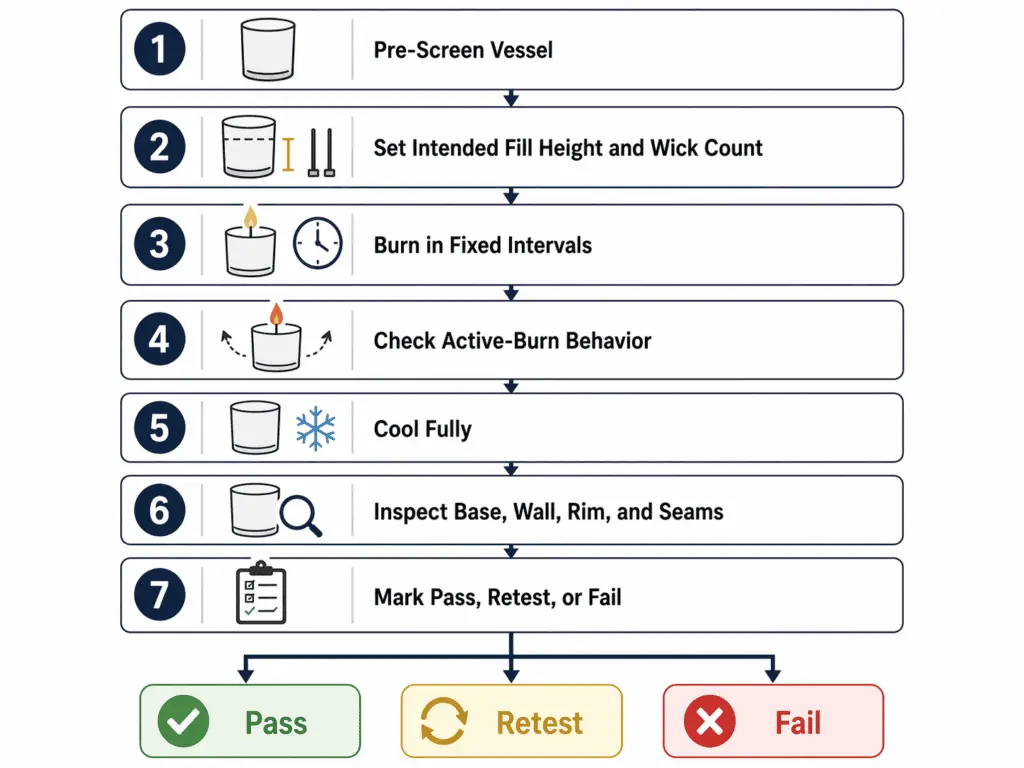
- Pre-screen the empty candle container for cracks, chips, rocking, unstable features, coatings, or unclear construction.
- Set up the candle with the intended fill height, wax, wick count, and accessory-free burn condition.
- Burn the candle in fixed intervals and record vessel temperature behavior, visible changes, sounds, and surface stability.
- Check the container during active burn for cracking, movement, hot spots, discoloration, or finish failure.
- Let the vessel cool fully before the final inspection.
- Inspect the base, wall, rim, seams, and any irregular features after cooldown.
- Mark the result as pass, retest, or fail based on the observed evidence.
| Variable to control | Why it matters | What changes the decision |
|---|---|---|
| Fill height and headspace | Overfilling can concentrate heat near the rim or sidewall. | Retest when fill height changes materially. |
| Wick count or flame load | More flame can raise vessel heat beyond the prior setup. | Retest when wick count or flame behavior changes. |
| Accessories and closures | Lids, wraps, inserts, and add-ons can distort heat behavior. | Remove them before burn testing. |
| Burn interval | Short burns can miss later-cycle stress. | Repeat checkpoints rather than relying on one burn. |
| Cooldown inspection | Cracks can appear after the flame is out. | Do not approve before post-cooldown review. |
| Same jar continuity | The same jar means the same approved vessel under materially consistent conditions. | Retest after batch, spec, or setup changes. |
How long should the test run? The test should run through fixed burn and cooldown checkpoints that match the intended candle use, not one informal burn that ends before the vessel is fully evaluated.
What must be checked after cooldown? Check the base, wall, rim, seams, finish, and any new sounds, cracks, chips, clouding, or instability that appeared after the heat cycle.
Method note: Treat the burn test as a documented approval process. Record the checkpoint, observation, and decision each time, and use manufacturer specifications, supplier technical sheets, ASTM standard summaries, or NCA safety guidance only as support for test conditions rather than as a substitute for the container’s own result.
Keep pass/fail thresholds separate from the test sequence itself: the test collects evidence, and the threshold rules decide whether that evidence means approve, retest, or reject. If the user’s real question becomes wick selection, use the wick sizing guide only as a short route because full wick systems are outside this page. If the question becomes volume math, keep the answer limited to test validity and refer capacity questions to the jar capacity guide.
Remove accessories unless they are part of the intended burn condition and are evaluated during the same test.
What Signs Mean the Container Is Failing
A failure sign is any visible, audible, or tactile indicator that the vessel is losing structural safety under candle use.
A safe candle container is free from vessel-failure signals that affect continued candle use. Safe does not mean free from every household hazard, and it does not mean cool enough to touch during or after burning. Failing means the container has shown evidence that should trigger rejection, retesting, or closer threshold review.
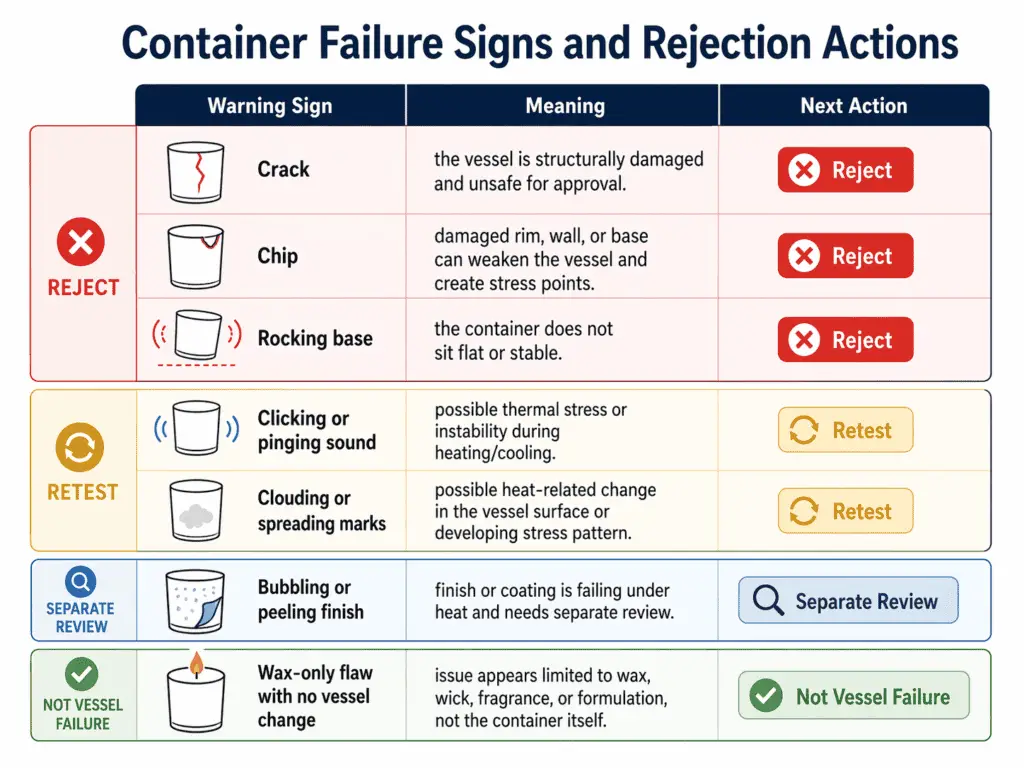
| Failure sign | Likely meaning | Immediate next move |
|---|---|---|
| Crack, even a small one | Structural integrity may be compromised. | Stop using and reject the vessel. |
| Chipping at rim, wall, or base | The vessel has a weakened stress point. | Reject unless the defect is proven unrelated before testing. |
| Clicking, pinging, or popping sounds | Heat stress may be moving through the material. | Stop, cool, inspect, and retest or reject. |
| New rocking or base movement | The container may no longer sit safely. | Reject for instability. |
| Clouding, new lines, or spreading marks | Hidden stress or damage may be appearing. | Retest or reject based on severity. |
| Finish bubbling, peeling, smoking, or odor | Coating or adhesive may be reacting to heat. | Reject or route through finish screening. |
| Wax-only flaw with no vessel change | The issue may not be container failure. | Keep it outside vessel-safety judgment unless heat behavior is affected. |
Is a small crack cosmetic? No. A crack in a candle container is a structural warning, not a cosmetic mark, because heat cycles can expand a weak point.
Do clicking sounds matter? Yes. Clicking, pinging, or popping can signal thermal stress, especially when paired with visible lines, sudden cooling, drafts, or uneven support.
A soot mark, scent issue, or wax surface defect is not automatically a vessel failure. It matters here only when it connects to container heat, cracking, finish breakdown, instability, or another vessel-safety signal. When a symptom traces back to room conditions, treat it as thermal-shock criteria rather than solving a full environment-placement problem here. When a symptom appears after a hotter flame setup, mention flame-load interaction briefly, but do not turn this section into wick engineering.
Use the failure logic in this order: stop unsafe use, let the vessel cool, document the symptom, inspect the container, then apply the next section’s pass, retest, or fail decision. That keeps warning signs tied to container approval instead of mixing them with wax-performance troubleshooting.
Pass, Retest, or Fail: Approval Thresholds
Pass/fail thresholds are the rules that turn candle-container test observations into approve, retest, or reject decisions.
Pass means the candle container shows no rejection signal under the tested setup. Retest means the evidence is incomplete, borderline, or changed by a setup variable. Fail means the vessel has a defect, failure sign, or risk condition that makes approval inappropriate. Here, pass/fail does not mean legal certification, retail defect policy, or style acceptability.
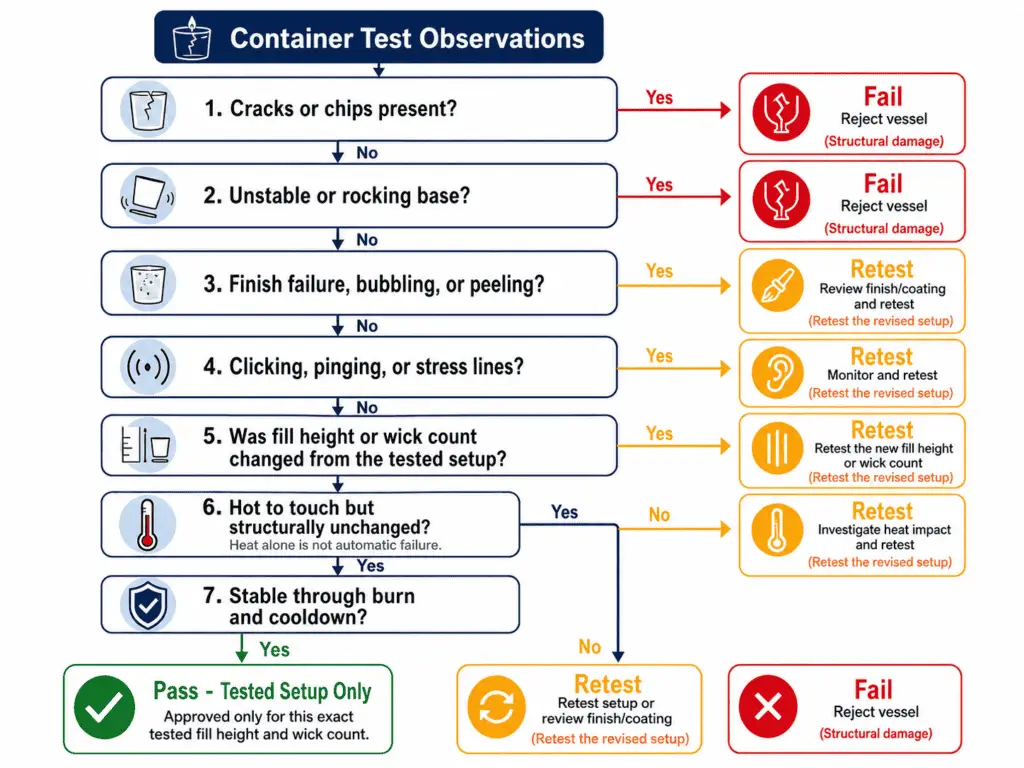
| Observation | Threshold action | Notes |
|---|---|---|
| No cracks, chips, new sounds, rocking, finish failure, or heat-stress marks | Pass | Approval applies only to the tested candle setup. |
| Fill height, wick count, or flame behavior changed after approval | Retest | The old result may no longer match the new heat pattern. |
| Container is hot to touch but has no structural warning signs | Warning or retest | Handling risk is not the same as structural failure. |
| Clicking, pinging, or visible stress lines appear | Retest or fail | Treat sound plus visible change as higher-risk evidence. |
| Any crack appears before, during, or after cooldown | Fail | Do not treat cracks as cosmetic. |
| Base rocks, shifts, warps, or becomes unstable | Fail | Stability loss rejects the vessel. |
| Supplier claim says heat resistant but the test result is poor | Fail | Test evidence overrules vague claims. |
| Standards language is requested instead of operational approval | Use separate standards guidance | Use the candle standards and compliance guide for formal certification detail. |
Does hot to touch automatically fail? No. Safe to touch means handling risk at that moment, not structural approval. A jar can be structurally approved but still require handling caution if it becomes too hot to move during or after a burn.
When is retest better than reject? Retest is better when the result is borderline, setup-dependent, or changed by a variable such as fill height, flame load, support surface, or accessory removal. Reject immediately when cracks, instability, finish breakdown, or vessel deformation appears.
Method note: This decision matrix is modeled from container-screening logic, the burn-test method, and common evidence types named by NCA, supplier technical sheets, ASTM standard summaries, and manufacturer specifications. It is not a certification system; it sorts each observation into pass, retest, or fail so approval does not rely on personal judgment.
Use the container qualification tool logic as a final sorter: observed defect, temperature pattern, and post-burn condition should produce one action state. Supplier or packaging claims belong in the manufacturer claims vs self-testing guide, because claims can inform the decision but should not replace the container’s actual candle-use result. When a warning from the failure signs section becomes a threshold decision, the vessel should move to pass, retest, or fail before it is used again.
Container Qualification Decision Tool
The container qualification decision tool turns inspection and burn-test evidence into one result: pass, retest, or fail.
| Question | If yes | If no |
|---|---|---|
| Does the container have a crack, chip, unstable base, or visible structural defect? | Fail | Continue |
| Did the container make new clicking, pinging, or popping sounds during heating or cooldown? | Retest or fail | Continue |
| Did the finish bubble, smoke, peel, soften, or smell under heat? | Fail or route to finish screening | Continue |
| Did fill height, wick count, flame behavior, support surface, or accessories change after approval? | Retest | Continue |
| Is the vessel hot to touch but structurally unchanged? | Add handling caution or retest if heat seems excessive | Continue |
| Did the vessel remain stable, intact, and unchanged through burn and cooldown? | Pass for the tested setup only | Retest if evidence is incomplete |
Which Containers Should Be Rejected Before Testing
Some vessels should be rejected or handled with separate specialty guidance before standard testing because construction uncertainty itself is part of the risk.
An unsafe candle container is structurally or contextually unsuitable for candle use under this page’s qualification rules. Unsafe does not mean universally illegal, toxic in every use, or merely unattractive. Early rejection protects the approval workflow from vessels whose construction, add-ons, hidden defects, or unknown behavior make normal testing a poor fit.
| Early disqualifier | Why it matters | Action |
|---|---|---|
| Visible crack, chip, loose base, or unstable footing | The vessel already shows structural weakness. | Auto-reject |
| Unknown double-wall or insulated construction | Hidden layers can trap or redirect heat unpredictably. | Use separate specialty guidance or reject |
| Novelty shape with handles, feet, narrow neck, or heavy appendages | Irregular structure can create local stress or tipping risk. | Use nonstandard vessel screening |
| Porous ceramic, cement, or unverified handmade vessel | Hidden fractures or absorption can change heat behavior. | Use the ceramic and cement hidden-defect guide |
| Painted, coated, glued, wrapped, or decaled heat zone | Finish behavior may change under burn heat. | Use the decorative-finish guide |
| Lid, insert, sleeve, or accessory left in burn condition | Add-ons can distort the test result. | Remove before testing or reject that setup |
| Food, drinkware, or thrifted vessel with unknown heat history | Prior use and material intent may not match candle burn heat. | Screen conservatively before any test |
| Vessel promoted mainly as decor, not as a candle vessel | Style approval is not burn approval. | Reject or use the glass, ceramic, and metal container guides |
Can any decorative vessel be tested? No. A decorative vessel should enter testing only if its material, finish, shape, and construction can be screened without adding unknown heat behavior.
When should nonstandard construction be rejected immediately? Reject it when the vessel has sealed voids, double walls, glued-on structural parts, unknown insulation, unstable appendages, or any feature that prevents a clear candle-use risk assessment.
Novelty means the shape or construction creates uncertainty under candle heat, not that the vessel looks unusual. Sealed means a porous or handmade material has a stable, heat-suitable surface for candle use; it does not mean every coating, glaze, or craft finish is acceptable.
Method note: This checklist is a screening dataset, not a material tutorial. It classifies container candidates as auto-reject, testable, or route-to-specialty review based on visible risk, construction uncertainty, and whether standard qualification can judge the vessel fairly.
If a reader needs full material engineering, finish chemistry, or specialty-vessel analysis, keep the decision here simple: reject the vessel or use a separate specialty guide because standard candle-container testing should not silently absorb that uncertainty.
PATCH SUMMARY:
Applied internal: 9
Skipped internal: 0
Applied external: 4
Skipped external: 0