

Mason jars can be used for candles only when they are true canning jars that pass inspection and controlled burn testing with the intended setup.
On this page, safe means suitable to screen and test as a candle-container candidate under controlled conditions. It does not mean that canning use alone makes a jar candle-rated, and it does not extend to decorative mason-style jars or unknown recycled jars.
Are Mason Jars Safe for Candles?
Yes, but only true canning jars that pass inspection and burn testing are worth using for candles.
A true canning jar is a better testing candidate than a decorative mason-style jar, but canning use alone does not make it a candle-rated container.
A mason jar is only a reasonable candle container when it is a real canning jar, has no damage, and stays stable with the exact wax and wick you plan to use. Safe here does not mean guaranteed safe in every setup. It means safe enough to test under controlled conditions, then stop using at the first sign of overheating, smoke, or glass stress. To widen the choice set, Compare candle-safe container options in our Candle Containers & Jars hub. The real pass-or-fail work starts when you Inspect Mason Jars for Cracks, Chips, and Wear and Burn-Test Mason Jar Candles Before Regular Use.
Safety calls are not based on the word “mason” alone. They depend on intended use, glass condition, wick fit, fill level, and repeat-burn behavior. How do you tell a true canning jar from a mason-style lookalike? Check whether it is sold and marked for canning or preserving food rather than decor, storage, or gift use. That is why makers often treat guidance from the National Candle Association, ASTM F2179 for glass candle containers, and ASTM F2417 for candle fire safety as part of a bigger system, not a label check by itself.
| Jar type | Intended use | Safety call |
| True canning jar | Home canning and repeated sealing use | Worth testing if undamaged |
| Decorative mason-style jar | Decor, storage, gift use | Do not assume candle-safe |
| Recycled food jar | Packaging for food products | Too uncertain for a default yes |
Use a simple gate before you pour:
- Start with a true canning jar from a known source.
- Reject any jar with cracks, chips, stress marks, or deep scratches.
- Match the wick to the jar’s inside diameter, not the outside width.
- Leave headspace instead of filling close to the rim.
- Run full burn tests before treating the jar as a regular candle container.
If you are not sure what the jar is, treat that as a no. In maker forums, later jar failures usually trace back to one of three causes: decorative lookalikes, hidden damage, or a wick that ran too hot for the jar.
Mason Jars vs Decorative or Recycled Glass
True canning jars may be worth testing, while decorative mason-style jars and recycled food jars should not be treated as equivalent by default.
A true canning jar is sold and marked as a jar for canning or preserving food. A decorative mason-style jar can look similar but may be made for storage, display, or gifts rather than repeated heat exposure. A recycled food jar has an even larger unknown, because the glass type, prior stress, and original purpose may all be unclear.
The fastest way to sort them is to check the jar’s origin, markings, and intended use. Brand identity, canning-specific labeling, and a product line built for food preservation are better clues than thickness or shape alone. If the jar came from salsa, sauce, or jam packaging, it should not be treated like a tested canning jar by default.
If the label or origin is unclear, Return to the mason-jar safety verdict and treat the container as unconfirmed until you Inspect Mason Jars for Cracks, Chips, and Wear. The same caution carries into New vs Reused Mason Jars, because reuse adds heat-history questions even when the glass looks clean.
Inspect Mason Jars for Cracks, Chips, and Wear
Any jar with cracks, chips, deep scratches, or stress marks is a reject for candle use.
Damage screening should take less than a minute, but it needs to be firm. A cracked rim, chipped lip, scratched sidewall, or stressed base can turn a jar from usable to risky before the first pour or during a later burn. When in doubt, See the mason-jar safety verdict first, then move through a fast screening routine. Damage checks become stricter in New vs Reused Mason Jars, and the same jar can still fail later if you do not Prevent Thermal Shock and Glass Stress.
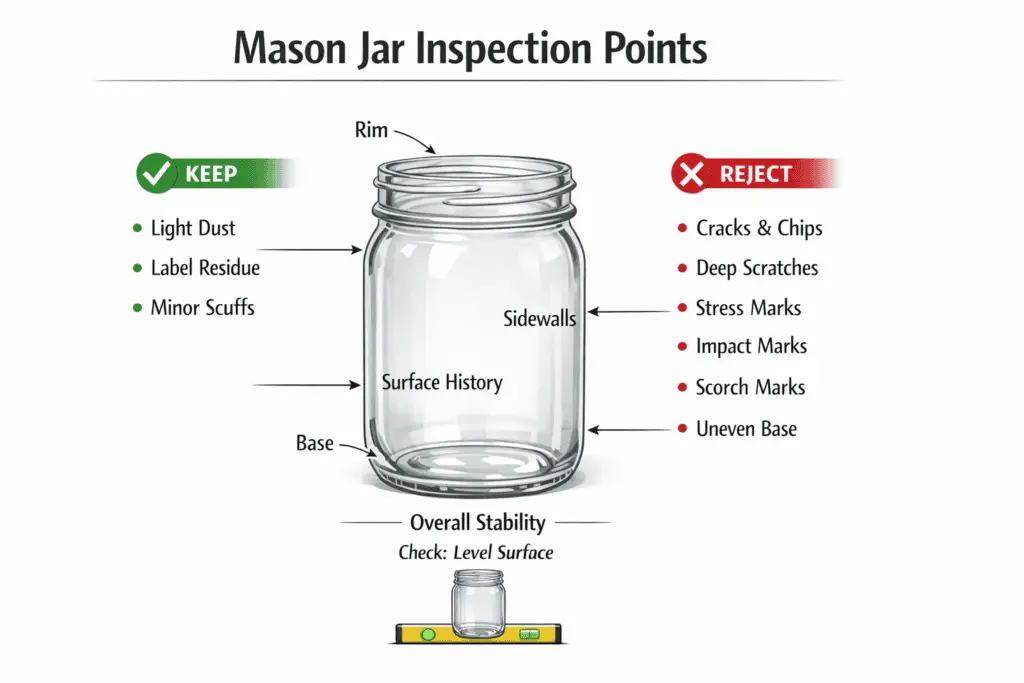
Check the jar in this order:
- Rim: look for chips, hairline cracks, and rough spots that catch a fingernail.
- Sidewalls: look for deep scratches, star-shaped marks, or cloudy stress lines.
- Base: look for impact marks, uneven wear, or cracks that spread from the bottom edge.
- Surface history: reject jars that show scorch marks, stubborn soot staining, or signs of prior overheating.
- Overall stability: set the jar on a flat surface and make sure it sits level.
Use this keep-or-reject rule:
- Keep: light surface dust, label residue, or minor cosmetic scuffs that do not break the glass.
- Reject: cracks, chips, deep scratches, stress marks, or any damage near the rim or base.
Chips are worse than ordinary light scratches because they remove material and create a weak point. Cosmetic wear can look ugly without changing the jar’s strength, but structural damage changes how heat and pressure move through the glass. Once you find meaningful damage, replace the jar instead of trying to make it work.
New vs Reused Mason Jars
New mason jars are the safer baseline, while reused jars need extra caution because past heat and hidden wear reduce predictability.
A reused jar is not automatically unsafe. It just starts from a lower level of certainty. A clean jar can still carry old stress from previous candle burns, dishwasher cycles, impact, or storage damage that is hard to see before reheating.
Before a second pour, Use the jar-inspection checklist first. Then review the wick-size resource by jar diameter again and Burn-Test Mason Jar Candles Before Regular Use, because reuse does not lock in the old setup forever.
Think of the choice this way:
- New jar: better starting point, clearer history, fewer unknowns.
- Reused jar with known history and no damage: possible to test again, but still needs full screening.
- Reused jar with unknown history or wear: retire it from candle use.
In maker forums, the common mistake is assuming that “clean” means “ready.” Clean only means the jar is free of wax and soot. It does not prove the glass still has the same margin it had before the last burn cycle.
Prevent Thermal Shock and Glass Stress
Sudden temperature shifts can crack an otherwise usable mason jar.
Thermal shock is glass failure caused by a fast temperature swing, not just by a wick that burns hot. A jar that is cold before pouring or moved while hot onto a cold surface carries more crack risk than one handled closer to room temperature.
Use this short handling routine before and after a hot pour:
- Let the jar sit indoors until it is close to room temperature.
- Pour on a dry, level surface instead of cold stone, bare metal, or a wet counter.
- Leave the jar where it is while the wax settles and cools.
- Do not move hot glass into a colder room or near an open window.
- Let the jar cool at its own pace before the first burn.
If a jar keeps cracking, inspect the glass first, then run controlled burn tests on a steady surface so you can separate heat build-up from fast temperature change. For the glass-specific side, see Heat-Resistant Glass for Candles: Annealing & Thermal Shock.
Wick fit still matters because a jar that is overwicked can run hotter than the glass can handle. Start with the jar’s inside diameter at the wax line, then use the dedicated wick-size resource for exact selection rather than treating this page as the final wick chart.
Fill line, one-vs-two wick choices, and wax changes should stay tied to the next controlled test, not be settled here. Use fill line and overheating guidance, jar shape and diameter guidance, double-wicking guidance, and the full burn-test series when you need the exact setup path.
Burn-Test Mason Jar Candles Before Regular Use
Burn-test a mason jar candle through repeated cycles before regular use, because early burns can look stable before later heat problems appear.
A real burn test checks the full jar-wax-wick combination, not only whether the first burn lights cleanly. The goal is to watch repeat behavior, log what changes, and stop as soon as the setup shows stress. Return to the mason-jar safety verdict when a jar starts acting unlike the rest of your test group. Use the full burn-test series when you need the exact next setup change, then watch for Stop-Use Red Flags During Burn Tests instead of guessing from one burn.
Keep the test method steady from run to run. Measure the inside diameter at the wax line, note whether wax family or fragrance load changed, change one variable at a time, and log the result before the next cycle. That keeps the pass-or-fail call tied to the setup you changed, not to random room differences.
| Burn cycle | What to log | Pass sign | Fail sign |
| First burn | flame shape, soot, melt spread, jar heat | calm flame, even early behavior | smoke, sharp heat rise, unstable flame |
| Next burn | repeat the same checks | similar behavior to the first run | hotter jar, new soot, rougher flame |
| Later burn | compare against earlier notes | stable pattern across runs | drift toward smoke, excess heat, or weak burn |
Use this burn-test sequence:
- Start with a screened jar and a measured wick path.
- Burn the candle in repeated cycles, not as a one-time check.
- Log the same signs each time.
- Stop the test as soon as the setup turns hotter, dirtier, or less stable.
- Retest only after one clear change.
Stop-Use Red Flags During Burn Tests
Any repeated soot, smoke, very high flame, or fast-rising jar heat means stop the test and change the setup before burning again.
Do not try to rescue the candle while it is burning. Stop the test, let the jar cool, record what failed, and retest only after one clear change. Use the full burn-test series when you need the exact correction path.
Repeated soot or smoke, a very high or wild flame, jar heat that rises faster than earlier cycles, or a candle that keeps drowning all mean the setup should be stopped and retested after one clear change.
Do lids or screw bands make a mason jar candle safer while burning? No. Lids, bands, and storage handling matter after the flame is out, but they do not prove the jar is safe. Use them for curing, dust control, and storage after the candle has cooled. Do not treat a lid or band as a shortcut that cancels the need for a real burn test.