

The best candle types for emergencies and power outages are emergency tins, sturdy unscented jar candles, and stable pillar candles used only as supervised backup light.
An emergency tin candle is a tinned or containerized candle made for storage-ready backup light, usually chosen for protection, compactness, and controlled wax containment.
Emergency candle types are candle formats suited for supervised backup lighting during power outages because they prioritize burn time, stability, low mess, storage readiness, and simple indoor placement over decoration or scent. The best candle type for an outage is not the brightest, cheapest, strongest-scented, or safest unattended option. It is the format that stays usable, sits securely, burns predictably, and creates as little indoor mess as practical. Candles should support short-term visibility when electric lights are unavailable, not replace flashlights, lanterns, or a full emergency plan.
For most homes, emergency tins are the strongest stored-kit choice because they are compact, protected, and made for readiness. Unscented jar candles are the best common household backup because the container supports stability and reduces loose-wax handling. Pillar candles can work as long-burn secondary options when placed on a heat-safe, stable base, while votives and tealights are better for short sessions or small-task light when used in proper holders.
What Makes a Candle Type Good for Emergencies?
A good emergency candle type is a supervised backup-lighting format that favors burn time, stability, low mess, storage readiness, and simple indoor placement.
That means the candle format matters more than decoration, scent, color, or brand name. For power outages, the strongest candle types are usually containerized or holder-ready formats that can sit securely, relight easily, and remain usable after storage.
“Best” means best for outage readiness. It does not mean the most decorative candle, the strongest-scented candle, the cheapest candle, the brightest flame, or a candle that is safe to leave unattended.
| Candle choice | Better for emergencies when | Poor emergency fit when |
|---|---|---|
| Emergency tin candle | It stores compactly and has a protected container. | The tin is damaged, poorly labeled, leaking, or too small for the outage need. |
| Unscented jar candle | The jar is sturdy, intact, and practical for supervised indoor use. | The glass is cracked, the scent is strong, or the jar is unstable. |
| Pillar candle | It sits on a heat-safe, stable base. | It is loose, oversized, dripping, or placed on an unsafe surface. |
| Votive candle | It is used inside a proper votive holder. | It is burned loose without a fitted holder. |
| Tealight candle | It supports short-task lighting in a stable cup or holder. | Many small flames are used to compensate for weak light. |
| Taper candle | It has a heavy, stable holder. | It is tall, loose, decorative, or easy to knock over. |
An emergency-ready candle type should answer five practical questions before it goes into a drawer or kit:
- Does it burn long enough for short outage sessions?
- Does it sit securely?
- Does it avoid heavy scent indoors?
- Can it be stored without melting, cracking, or collecting dirt?
- Does it require a holder, and is that holder stored with it?
Regular household candles can work during outages when they meet those conditions. Decorative candles are weaker choices when they are scented, unstable, oddly shaped, glittered, heavily dyed, or designed mainly for appearance.
Candles are still only backup lighting. For broader outage planning, an emergency preparedness checklist should cover flashlights, lanterns, batteries, chargers, water, food, and communication needs rather than treating candles as the main plan.
Best Candle Types for Emergencies: Jar, Tin, Pillar, Votive, Tealight, and Taper Compared
Emergency tins and sturdy unscented jar candles are usually the best all-around candle types for power outages.
They combine container support, storage practicality, and useful burn time better than loose or decorative formats. Pillars, votives, and tealights can still work in narrower roles, while tapers are usually the weakest outage choice unless they are held in a heavy, stable holder.
There is no single best candle type for every outage. The right choice depends on whether the priority is stored-kit readiness, long burn time, stable placement, compact backup, low mess, or short-task visibility.
| Candle type | Best for | Avoid when | Holder or container need | Emergency rank note |
|---|---|---|---|---|
| Emergency tin | Stored kits, storm prep, compact backup | The tin is flimsy, unlabeled, leaking, or too small | Built-in tin, placed on a stable surface | Best stored-kit format for many homes |
| Unscented jar candle | Common household backup and stable table placement | The jar is cracked, strongly scented, or top-heavy | Built-in glass container | Best everyday backup if sturdy and unscented |
| Pillar candle | Longer secondary burn sessions | It is loose, dripping, or placed without a heat-safe base | Heat-safe plate, tray, or holder | Useful but more placement-dependent |
| Votive candle | Short sessions and holder-based backup | No fitted votive holder is available | Proper votive holder required | Good small backup when the holder is stored with it |
| Tealight candle | Short-task light and compact storage | Many are burned at once to solve brightness | Stable tealight cup or holder | Compact but limited for long outages |
| Taper candle | Temporary use with a heavy holder | It is tall, loose, decorative, or in a light holder | Heavy taper holder required | Weakest emergency fit for most homes |
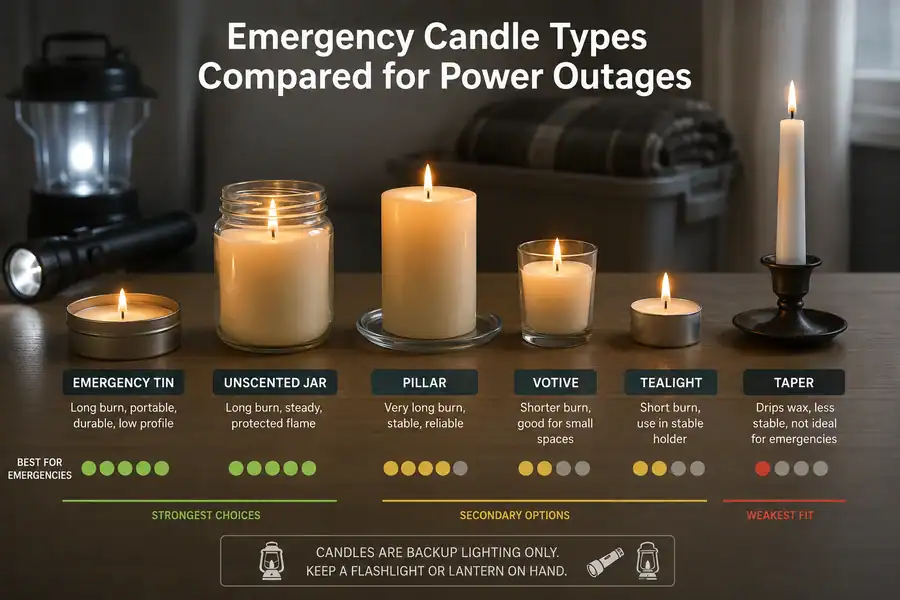
Best by scenario:
- Best for stored emergency kits: emergency tin candles.
- Best common household backup: sturdy unscented jar candles.
- Best long-burn secondary option: pillar candles on heat-safe, stable bases.
- Best compact short-session backup: tealights or votives in proper holders.
- Best candle type to avoid during outages: loose tapers, unstable novelty candles, and strong scented decorative candles.
For most households, a practical candle mix is simple. Keep one containerized long-burn option, one stable household backup such as an unscented jar candle, and a small number of holder-ready short-session candles. Store holders with any candle type that needs them.
Product reviews can help once the candle type is chosen, but brand rankings should not decide the whole page. Price, pack size, listed burn hours, and availability change more often than the type-level decision, so those details belong in an emergency candle product review rather than a candle-type guide.
How Much Light Can Candles Realistically Provide During a Power Outage?
Candles provide limited backup light for small areas or simple tasks, not full-room emergency lighting.
A candle can help you see a nearby table, check a small object, or create a small pool of visibility. It should not be treated as a replacement for flashlights, lanterns, headlamps, or battery-powered emergency lights when those are available.
| Candle type | Practical light use | Main limitation |
|---|---|---|
| Jar candle | Local table or counter visibility | Light stays near the candle. |
| Emergency tin | Compact backup light in one spot | It is usually not bright enough for room-wide use. |
| Pillar candle | Small-area light when placed securely | It needs a heat-safe base and clear space. |
| Votive candle | Short-range task support | It requires a fitted holder. |
| Tealight candle | Very small task or marker light | It has short range and short burn time. |
| Taper candle | Narrow flame height in a holder | It is easier to destabilize than containerized formats. |
Use candles where a small, stable light source helps most: a cleared table, a non-walkway counter, or another supervised location where the flame will not be bumped. Do not increase flame count just to make the room brighter; more open flames can make supervision harder.
For room-wide visibility, safer movement, or longer nighttime use, flashlights and lanterns are the better outage-lighting category. Candles fit best as backup support when electric lighting is unavailable, depleted, or being conserved.
Which Candle Types Last Longest During a Power Outage?
Purpose-made emergency tins, large unscented jar candles, and broad pillar candles are the strongest long-burn type categories, but exact runtime must come from the product label.
Burn time is still conditional. Candle size, wax blend, wick design, airflow, container shape, and burn session length can change how long a candle remains useful, so a listed burn time should be treated as a planning estimate rather than a guaranteed emergency runtime.
| Candle type | Practical burn-time range | Burn-time caveat | Best outage use |
|---|---|---|---|
| Emergency tin candle | Label-dependent long-burn category | Depends on tin size, wax fill, wick count, and label instructions | Stored-kit backup and multi-session use |
| Large unscented jar candle | Strong practical runtime for household backup | Glass condition, wick behavior, wax pool, and scent load matter | Common household backup |
| Pillar candle | High potential runtime when broad and stable | Needs a stable, heat-safe base and proper burn sessions | Secondary long-burn option |
| Votive candle | Lower capacity than jars, tins, or pillars | Requires a fitted holder and is often smaller than jar or pillar formats | Short supervised sessions |
| Tealight candle | Short burn category | Compact but limited by small wax volume | Brief task light or backup marker light |
| Taper candle | Variable runtime with weak emergency usefulness | Burn usefulness depends heavily on a heavy holder and low-traffic placement | Weak emergency option unless stabilized |
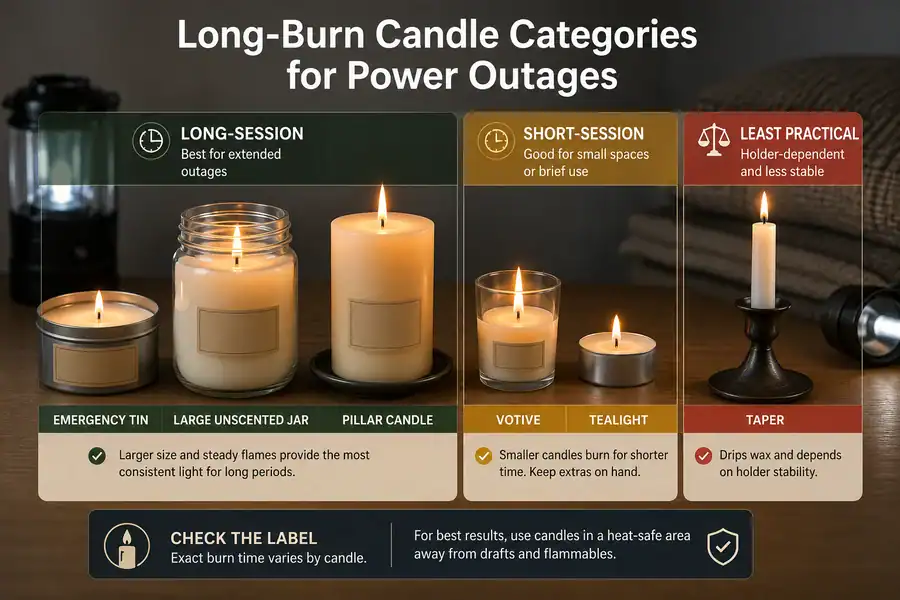
The longest-lasting candle is not always the best emergency candle. A loose pillar with a long listed burn time can be a worse outage choice than a shorter-burn candle in a sturdy container if the loose candle is harder to place and supervise.
For long outages, choose fewer stable long-burn formats rather than many small flames. Tealights and votives can help with short tasks, but they become harder to supervise when several are burning at once.
A practical home setup can use one long-burn containerized option as the main candle backup and smaller holder-ready candles for short sessions. If the goal is to calculate exact candle quantities for a 24-hour or multi-day outage, that belongs in a separate candle-count planning tool because exact needs depend on outage length, room layout, session duration, and available electric lights.
Method note: This table compares candle-type tendencies rather than tested products. Use the manufacturer’s label and use instructions for the specific candle because runtime and storage claims are product-dependent.
Which Candle Types Are Most Stable for Outage Use?
Emergency tins and sturdy jar candles are usually the most stable candle types for outage use because their containers reduce loose-wax handling and tip-over risk.
“Stable” means easier to place and supervise. It does not mean safe unattended, safe while sleeping, safe near clutter, or safer than flashlights and lanterns.
| Candle type | Stability strength | Main failure risk | Safer selection fix |
|---|---|---|---|
| Emergency tin candle | Low profile and built-in container | Thin tin, hot surface, or poor placement | Place on a stable, heat-safe surface. |
| Sturdy jar candle | Built-in container and broader base | Cracked glass, top-heavy jar, or strong scent | Use only intact jars on clear, level surfaces. |
| Pillar candle | Can stand well when broad and flat | Dripping, wobbling, or heat damage below | Use a heat-safe plate, tray, or holder. |
| Votive candle | Stable only inside a fitted holder | Loose votive wax can spill or melt outward | Store and burn with a proper votive holder. |
| Tealight candle | Compact and low-profile | Many small flames become hard to supervise | Use a stable holder and keep the count low. |
| Taper candle | Can work only in a heavy holder | Tall flame position and easy knockover risk | Avoid unless the holder is heavy and secure. |
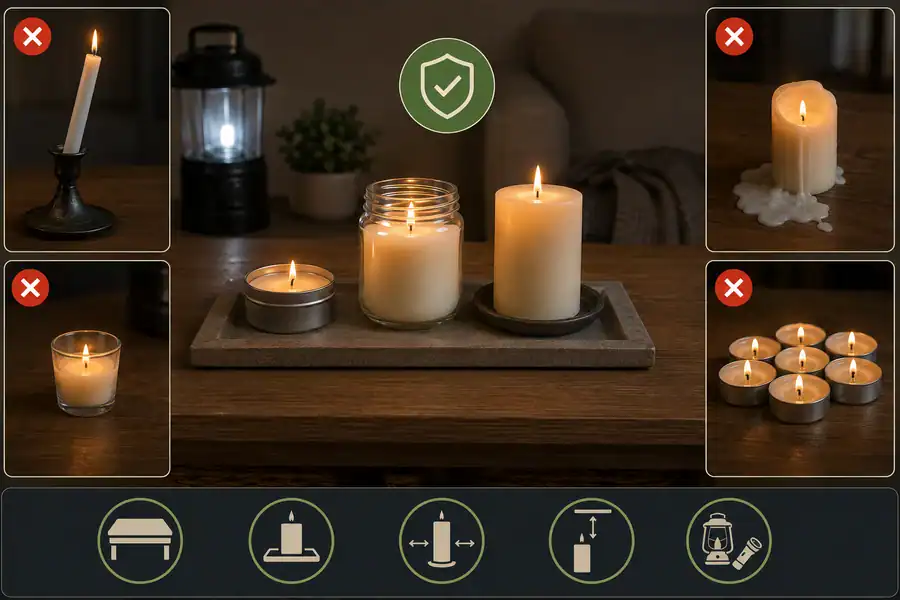
Container design matters because outages change the room environment. People move through darker spaces, surfaces may be crowded, and normal lighting cues are missing. A candle type that needs a separate holder is only emergency-ready if that holder is stored with it.
Do not treat any candle as safe while sleeping, away from the room, near curtains, or near clutter. The CDC recommends flashlights or battery-powered lights instead of candles when possible, and the National Candle Association recommends pillar or container candles if candles are used during power outages.
Stability failure log
| Failure | Root cause | Better candle-type decision |
|---|---|---|
| Candle tips or leans | Tall format, weak holder, uneven surface | Choose a tin, jar, or low-profile holder-ready candle. |
| Wax spills onto furniture | Loose candle or poor base | Use a containerized candle or heat-safe tray. |
| Flame sits too close to clutter | Bad placement in a dark room | Move the candle to a cleared, supervised surface. |
| Votive melts outward | No fitted votive holder | Store votives only with holders. |
| Too many small flames are burning | Trying to brighten a room with tealights | Use fewer stable candles and switch to lanterns for brightness. |
| Taper becomes unstable | Holder is too light or narrow | Avoid tapers for outage use unless heavily stabilized. |
The best stability choice for most homes is a containerized candle placed on a cleared, level, heat-safe surface. Full indoor candle safety, child and pet precautions, and fire-clearance rules deserve their own safety guide; this section only explains which candle types are easier to supervise during an outage.
Why Unscented, Low-Mess Candles Work Better Indoors During Outages
Unscented, low-mess candles usually work better during outages because long indoor burn sessions can make strong fragrance, visible smoke, soot, and dripping wax harder to tolerate.
“Low-smoke” means less likely to create visible smoke or a heavy scent burden when properly burned in suitable supervised conditions. It does not mean smoke-free, medically safe for everyone, non-toxic, or independent of wick condition, airflow, wax blend, and burn behavior.
| Candle type | Scent status | Low-smoke or low-mess note | Emergency use note |
|---|---|---|---|
| Unscented emergency tin | Usually plain or low-scent | Container helps reduce loose-wax mess | Strong stored-kit choice when label and condition are suitable |
| Unscented jar candle | Best when fragrance-free and intact | Container helps control wax handling | Good household backup if the jar is stable and not cracked |
| Beeswax candle | Often lightly natural-smelling | Can be pleasant, but still not smoke-free | Useful only when the format is stable and properly placed |
| Unscented pillar candle | Depends on wax, wick, and placement | Can drip or smoke if poorly burned | Better as a secondary option on a heat-safe base |
| Scented decorative candle | Strong fragrance may build indoors | Scent, dye, wick, and container quality vary | Poorer fit for long outage sessions |
| Novelty or heavily dyed candle | Often made for appearance | Shape, dye, glitter, or additives may increase mess | Avoid as emergency lighting |
Scent is not just a preference issue during an outage. A candle that smells pleasant for 20 minutes can become distracting during a long evening without ventilation, especially in a small room or apartment. For emergency use, unscented candles are easier to tolerate and easier to pair with other stored supplies.
Mess matters as much as scent. A candle that drips, smokes, tunnels badly, or leaves residue can create extra work during an already stressful outage. Containerized candles and properly held votives reduce loose-wax handling, while loose pillars and tapers need more careful setup.
Avoid broad claims such as “clean-burning,” “non-toxic,” or “smoke-free” unless the claim is tied to a specific candle, label, and support source. For this page, the safer decision rule is simple: choose unscented, stable, low-mess formats for indoor backup light, and route deeper smoke, soot, allergy, or air-quality questions to a dedicated candle smoke or indoor candle safety guide.
Does Wax Type Matter for Emergency Candles?
Wax type can matter for emergency candles, but it is only one selection factor beside candle format, size, wick, container, storage condition, and supervision.
Paraffin, soy, beeswax, and blended wax can affect burn behavior, scent load, soot tendency, storage feel, and user preference. Wax type should not override the more practical outage questions: will the candle sit securely, store well, relight easily, and provide usable backup light without creating heavy mess?
| Wax type | Emergency advantage | Emergency limitation | Claim caveat |
|---|---|---|---|
| Paraffin | Common, widely available, and often used in practical candle formats | Quality, wick, scent, and container design vary widely | Do not treat all paraffin candles as equal. |
| Soy | Common in jars and often sold in unscented or low-scent forms | Softer wax may be more storage-sensitive in heat | “Natural” does not automatically mean better for outages. |
| Beeswax | Often firm and slower-burning in some formats | Can cost more and may still need a proper holder | Do not call it universally cleaner or safer. |
| Blended wax | Can balance burn behavior, structure, scent throw, and cost | Blend details may be unclear without a label | Judge the finished candle, not the marketing term. |
| Purpose-made emergency blend | May be designed for storage and long burn sessions | Quality depends on manufacturer and label instructions | Use the label before relying on burn-time claims. |
“Natural” and “clean” are not emergency-selection shortcuts. In this article, those words mean practical wax tradeoffs that may affect storage, burn behavior, scent, soot potential, or preference. They should not be used to mean universally safer, healthier, non-toxic, or better for every indoor outage.
For emergency readiness, a plain wax in a stable container can be better than a premium wax in a poor format. A soy jar candle may be useful if it is unscented and stored well. A beeswax taper may be a weak outage choice if it is tall and holder-dependent. A paraffin emergency tin may be practical if the label, container, and storage condition are sound.
Wax claims need boundaries because this page is about candle types, not wax chemistry. A deeper wax guide can compare paraffin, soy, beeswax, and blends in more detail, while this section should keep wax in its proper role: one attribute inside emergency candle selection.
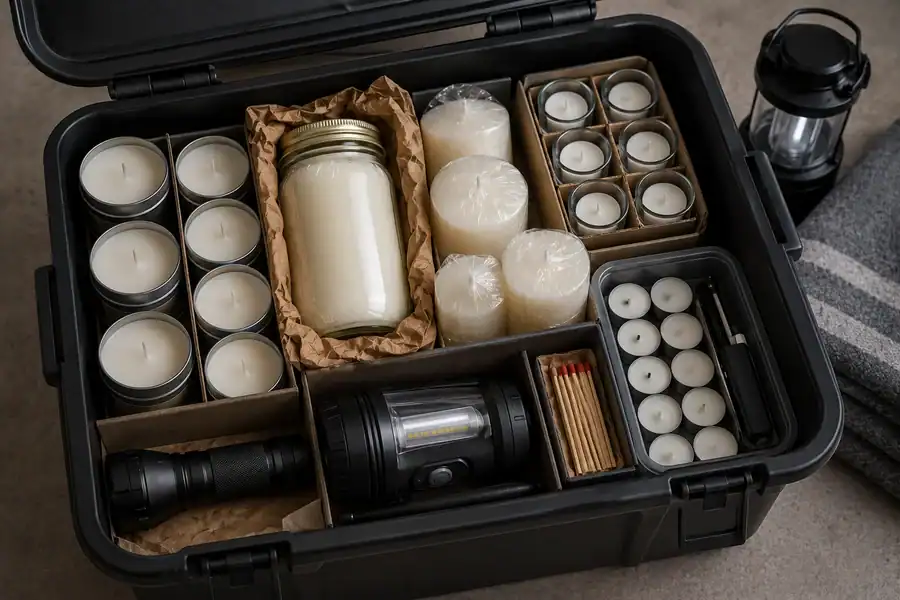
Which Candle Types Store Best for Emergency Kits?
Emergency tins, sealed jar candles, and well-packaged votives or tealights usually store better for outage kits than loose tapers or unprotected decorative candles.
“Reliable” means likely to remain usable when stored cool, dry, protected, and paired with ignition supplies. It does not mean indefinite shelf life, heat-proof storage, or a complete emergency plan by itself.
| Candle type | Storage strength | Storage risk | Best storage fix |
|---|---|---|---|
| Emergency tin candle | Compact and container-protected | Tin damage, label loss, or heat exposure | Keep sealed, labeled, and stored cool. |
| Jar candle | Wax is protected inside a container | Glass can crack or become unstable | Store upright in a padded or protected spot. |
| Pillar candle | Can store well when wrapped | Can melt, dent, collect dust, or deform | Wrap and store on a cool, flat surface. |
| Votive candle | Small and easy to group | Useless without fitted holders | Store votives with holders. |
| Tealight candle | Compact and easy to pack | Short burn time and cup damage | Store in a rigid box or sealed bag. |
| Taper candle | Slim and easy to store in quantity | Bends, breaks, and needs a heavy holder | Avoid as a main kit candle. |
Storage readiness matters because an outage candle has to work later, not just look useful when purchased. A candle stored in a hot garage, loose drawer, or dusty box may be cracked, warped, sticky, or missing the holder it needs.
Storage readiness checklist
- Store candles in a cool, dry place.
- Keep candles away from direct sun, heaters, and hot garages.
- Store holder-dependent candles with the correct holders.
- Keep matches or a lighter nearby, but protected from children and moisture.
- Check candles before storm season.
- Replace candles with cracked glass, damaged tins, warped wax, or missing labels.
- Keep a small flashlight or lantern with the same kit whenever possible.
Common storage failures
| Failure | Likely cause | Better choice next time |
|---|---|---|
| Wax melts or warps | Heat exposure | Use emergency tins or sealed jars stored indoors. |
| Glass cracks | Poor packing or impact | Store jar candles upright and protected. |
| Candle collects dust | Loose storage | Use tins, jars, sealed bags, or rigid boxes. |
| Holder is missing | Candle and holder stored separately | Store votives, tapers, and tealights with holders. |
| No ignition source is available | Matches or lighter stored elsewhere | Keep protected ignition supplies in the same outage area. |
Candles are only one backup-lighting item in an emergency kit. A full emergency kit checklist should cover water, food, medication needs, communication, batteries, chargers, first aid, and safer electric lighting rather than relying on candles alone.
When Candles Are Not the Right Outage Lighting Choice
Candles are not the right outage lighting choice when a flame cannot be supervised, placed securely, or kept away from people, pets, drafts, and flammable materials.
Use flashlights, lanterns, headlamps, or battery-powered lights first when they are available. Candles are backup lighting for short, supervised use, not room-wide lighting, overnight lighting, heating, cooking, or child-safe emergency lighting.
| Situation | Better choice | Why candles are a poor fit |
|---|---|---|
| Sleeping or leaving the room | Flashlight or lantern | Candles should not burn unattended. |
| Moving around the house | Headlamp or handheld flashlight | Open flames are harder to supervise while walking. |
| Children or pets are nearby | Battery lantern placed out of reach | Flame, wax, glass, and tipping risk increase. |
| The room needs bright light | Lantern or rechargeable light | Candles provide limited small-area visibility. |
| Heating or cooking is needed | Proper emergency heat or cooking equipment | Candles are not a safe cooking or heating plan. |
| Long multi-day outage | Planned electric lighting supplies | Candle quantity, storage, and supervision become harder. |
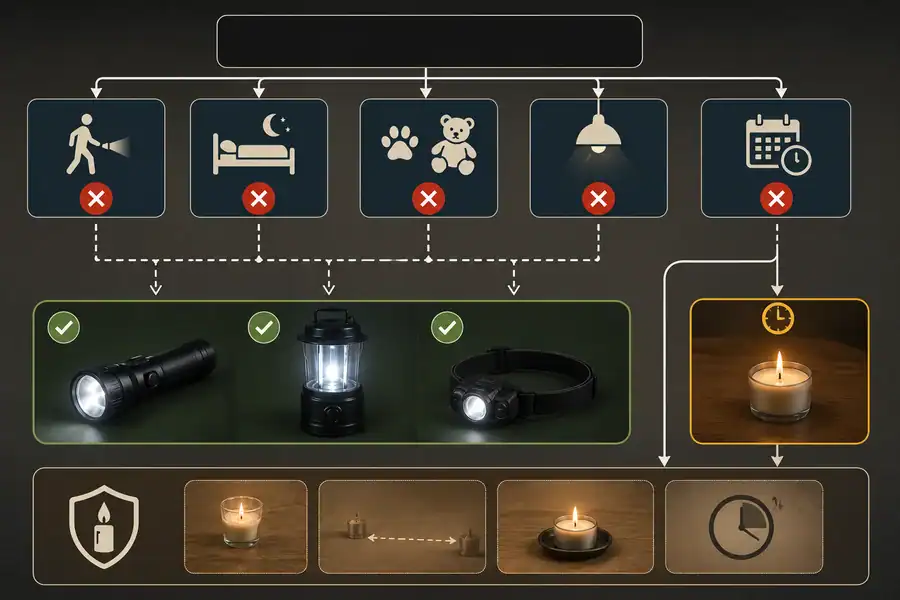
A candle can be useful for a short task at a cleared table. It is a poor choice for sleeping, walking through cluttered rooms, lighting a whole room, or compensating for missing emergency supplies.
This article compares candle types only. Flashlight and lantern buying guides, full indoor candle safety rules, brand-by-brand emergency candle reviews, and complete emergency kit planning belong on separate pages because they answer different decisions.
What Candle Type Should Most Homes Keep for Power Outages?
Emergency tins and sturdy unscented jar candles are the best all-around candle types for most power outages, while pillars, votives, and tealights work best in narrower backup roles.
Choose candle types by practical outage criteria: burn time, container stability, low mess, unscented indoor use, storage readiness, and supervised placement. Avoid loose tapers, novelty candles, heavily scented decorative candles, and any candle setup that depends on unattended flame use.
For the safest outage plan, store candles as backup lighting only and keep flashlights or lanterns as the primary light source.