
A gel candle is a container candle made with transparent gel wax, which gives it a clear or glass-like look compared with most traditional wax candles.
Gel candles are for people comparing decorative container candles with standard wax candles before buying or making one. The main difference goes beyond appearance: gel candles also depend on a candle-suitable container, compatible additives, candle-suitable embeds, and controlled burning conditions.
This article treats wax candles as a broad comparison class, not a full breakdown of soy, paraffin, beeswax, coconut wax, or blends. Start with the basic definition first, because the material explains nearly every practical difference that follows.
What Is a Gel Candle?
A gel candle is a wick candle made with transparent gel wax, usually poured into a container so the candle body looks clear rather than opaque.
Most gel candles are decorative container candles. They are often chosen for visual depth, visible embeds, and a glass-like body, while most wax candles are chosen for more familiar formats such as jars, pillars, votives, melts, or tapers. For a wider breakdown of candle formats, use a candle types guide after this definition is clear.
Gel candles should not be treated as liquid candles, resin crafts, or ordinary wax candles with a clear finish. The gel material changes the container need, decoration rules, scent and dye choices, and the way a beginner should plan the project.
| Term | Plain meaning | Why it matters |
|---|---|---|
| Gel candle | A container candle made with transparent gel wax and a wick. | It explains the clear appearance and container dependence. |
| Gel wax | A transparent candle medium used for gel candles. | It behaves differently from opaque wax bodies. |
| Wax candle | A candle made with a wax body, such as a jar, pillar, taper, or votive candle. | It is the comparison class, not one single material. |
| Container candle | A candle designed to burn inside a vessel. | Gel candles usually need this form. |
| Decorative embed | An object placed inside the candle for visual effect. | It must be suitable for candle burning and placement. |
| Gel-compatible additive | Fragrance or dye chosen for use with gel wax. | Ordinary candle additives should not be assumed safe for gel wax. |
A finished gel candle can be simple to use when it comes from a careful maker and has a suitable vessel. A DIY gel candle needs more planning because the container, wick, fragrance, dye, and embeds must match the gel wax. For actual measured steps, use a beginner gel candle tutorial rather than treating this definition as a recipe.
Why Gel Wax Is Different From Regular Candle Wax
Gel wax is different from regular candle wax because it forms a transparent, gel-like candle medium rather than the opaque solid body most people associate with wax candles.
That material difference changes the candle’s job. Gel wax is used when the maker wants clarity, depth, and visible decoration inside a container. Regular wax candles are more flexible across shapes, wax types, and everyday candle formats.
This page treats wax candles as a general comparison class. For soy, paraffin, beeswax, coconut wax, palm wax, and blends, use a candle wax types guide instead of expanding this article into a full wax taxonomy.
| Difference | Gel wax effect | General wax candle effect | Practical outcome |
|---|---|---|---|
| Appearance | Clear or glass-like. | Usually opaque or creamy. | Gel works well for visible layers and embeds. |
| Form | Best suited to containers. | Can be used in jars, pillars, votives, tapers, or melts, depending on wax. | Gel has a narrower format range. |
| Decoration | Embeds can be seen through the candle body. | Decorations are usually on the surface, in color, or in the vessel. | Gel gives more visual depth but adds safety checks. |
| Additives | Fragrance and dye must be suitable for gel wax. | Additives depend on the wax type and candle design. | Do not transfer wax-candle habits without checking compatibility. |
| Beginner risk | Looks simple but has hidden setup limits. | Some wax projects are more forgiving, depending on format. | Gel is easy to admire but less forgiving to make. |
Common material-confusion failures:
| What went wrong | Likely wrong assumption | Better route |
|---|---|---|
| The maker treated gel like ordinary jar wax. | “Clear wax works the same as regular wax.” | Check gel-specific container, wick, and additive guidance. |
| The project became cloudy or unattractive. | “Clear gel will stay clear with any supply choice.” | Route cloudy gel and bubbles to a gel candle troubleshooting guide. |
| The candle was planned like a freestanding pillar. | “Any candle material can hold its own shape.” | Use gel as a container-candle medium unless a supplier states otherwise. |
The key comparison is practical, not cosmetic. Gel wax changes how the candle looks, but it also changes what must be checked before the candle is burned or made.
Gel Candles vs Wax Candles: Key Differences
Gel candles differ from wax candles mainly by material, appearance, container use, visible embeds, additive compatibility, burn behavior, safety limits, and best-fit use cases.
The biggest difference is that gel candles are built around transparent gel wax, while wax candles are usually built around an opaque wax body. That makes gel candles better for visual display, but it also narrows how they should be made and used. For a full breakdown of soy, paraffin, beeswax, coconut wax, and blends, use a candle wax types guide.
| Difference | Gel candles | Wax candles | Why it matters |
|---|---|---|---|
| Main material | Transparent gel wax. | Solid candle wax, depending on the type. | Gel changes the look and the setup rules. |
| Appearance | Clear, glass-like, or translucent. | Usually opaque, creamy, or colored. | Gel works well when the candle body is part of the design. |
| Main format | Usually container-based. | Can be jars, pillars, tapers, votives, tealights, or melts. | Wax gives more format options. |
| Decorative embeds | Often visible through the candle body. | Usually less visible unless placed on top or outside. | Gel can display objects, but the objects must be candle-suitable. |
| Container need | Stronger container dependence. | Depends on wax type and candle format. | Gel should not be planned like a freestanding pillar candle. |
| Fragrance and dye | Must be suitable for gel wax. | Must match the chosen wax and candle type. | Additives cannot be copied from a basic wax recipe without checking. |
| Burn behavior | Wick burns inside a clear gel medium. | Wick burns through the chosen wax body. | Burn performance depends on material, wick, vessel, and setup. |
| Beginner use | Simple in appearance, less forgiving in setup. | Some wax formats are more forgiving. | Gel needs more checks before a DIY project. |
| Best fit | Decorative container display. | Wider everyday candle formats. | The better choice depends on the job, not a universal winner. |
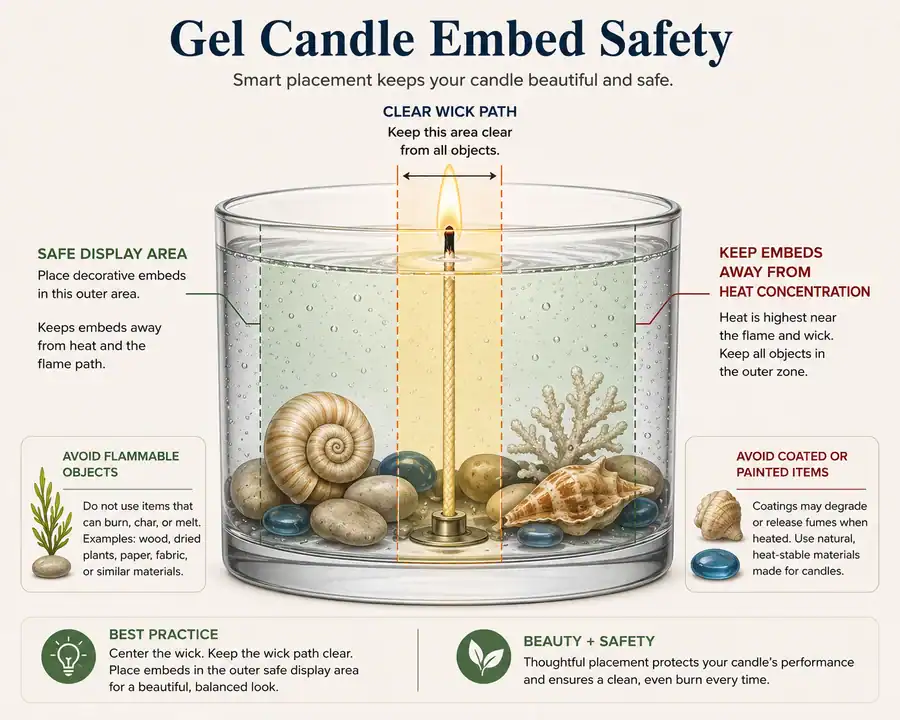
A gel candle is not automatically safer, cleaner, longer-lasting, or higher quality than a wax candle. Those outcomes depend on the actual candle design, including the container, wick, additives, embeds, and burning habits. For safety depth, route container and burn questions to gel candle safety rules rather than treating this comparison table as a safety manual.
The practical outcome is simple: choose gel when transparency and display matter most, and choose a wax candle when you need broader shapes, wax choices, or simpler making paths.
Why Do Gel Candles Look Clear?
Gel candles look clear because transparent gel wax lets light and embedded decorations show through the candle body.
That clear look is the main reason gel candles stand apart from most traditional wax candles. Opaque wax hides most objects inside the candle body, while gel wax can make shells, stones, glass-safe decorative pieces, or color layers visible when they are suitable for candle use.
Clarity is visual, not a safety rating. A clear gel candle can still be poorly made if the vessel, wick, fragrance, dye, or embed choice is wrong. A cloudy gel candle is not always unsafe either, but cloudiness can point to supply, heating, pouring, or compatibility problems. For those failure causes, use a guide on why gel candles turn cloudy.
| Visual feature | What it means | What it does not prove |
|---|---|---|
| Clear body | The candle uses a transparent gel medium. | It does not prove the candle is safer. |
| Visible embeds | Objects can be seen through the gel. | It does not mean every object is safe to burn near. |
| Glass-like depth | Light passes through the candle body. | It does not prove higher quality by itself. |
| Color tint | Dye or colored gel may be present. | It does not prove the dye is gel-compatible. |
| Bubbles or haze | Air, handling, or compatibility may affect appearance. | It does not give a full diagnosis without troubleshooting. |
A useful visual comparison is clear gel beside an opaque wax candle. The gel candle shows internal depth, while the wax candle shows surface color, shape, and finish. This is why gel candles often work as decorative display pieces, while wax candles cover more everyday candle forms.
Can You Put Decorative Objects Inside Gel Candles?
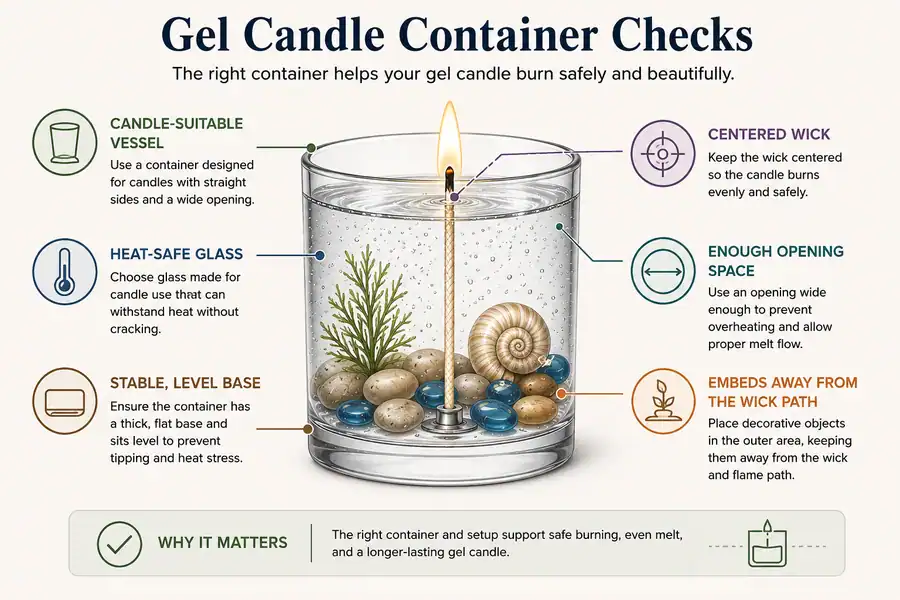
Gel candles can show decorative objects clearly, but embeds should only be used when the material and placement are appropriate for candle burning.
This is one reason people choose gel candles over ordinary wax candles. The transparent body can display shells, stones, glass-safe pieces, color layers, or themed decorations in a way opaque wax usually cannot. The visual benefit does not mean any object can go inside a burning candle.
Use a basic safety screen before planning decorative embeds.
| Embed question | Safer decision rule |
|---|---|
| Can the object melt, scorch, smoke, or give off odor near heat? | Do not use it inside the burn area. |
| Is the object flammable, painted, plastic, paper, fabric, or coated? | Avoid it unless a candle supplier clearly marks it as suitable. |
| Will the object sit close to the wick or flame path? | Move it away or leave it out. |
| Can the object trap heat, shift, or block the wick? | Do not use it in the candle. |
| Is the object added only for decoration? | Keep decoration secondary to burn safety. |
Common embed mistakes:
| What went wrong | Likely cause | Better route |
|---|---|---|
| Decoration sat too close to the wick. | The design treated the candle like a display jar, not a burning object. | Keep the flame path clear and use gel candle safety rules. |
| The maker used a random craft object. | The object looked decorative but was not chosen for candle heat. | Use only suitable materials and supplier guidance. |
| The project became a décor craft instead of a candle. | Visual design overtook wick, vessel, and additive checks. | Use a beginner gel candle tutorial for project planning. |
Decorative gel candles need a safety boundary before design ideas. A candle-safe layout matters more than the theme, color, or object choice. If the goal is décor only, a non-burning display may be a better route than adding risky objects to a candle.
Why Gel Candles Need the Right Container
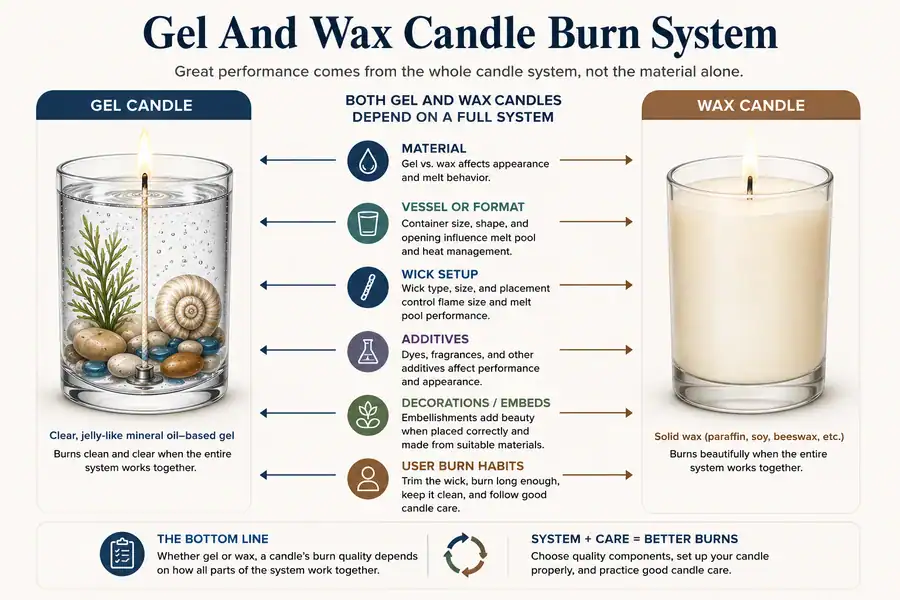
Gel candles need the right container because gel wax is generally used as a container-candle medium, not as a firm wax that can stand on its own like a pillar candle. In this section, the right container means a candle-suitable vessel that is heat-safe, stable, and matched to the wick and fill design.
A container is the vessel that holds the gel wax while the candle burns. For gel candles, that vessel must be suitable for candle heat, stable on a flat surface, and matched to the candle’s wick and fill design. A decorative jar is not automatically a safe candle container.
Use this container screen before buying or making a gel candle.
| Container check | Why it matters |
|---|---|
| The vessel is meant for candle use. | Random glass can crack, overheat, or fail. |
| The vessel is heat-safe for the candle design. | Gel candles place heat inside a clear container system. |
| The base is stable and level. | Tipping risk increases with tall or narrow vessels. |
| The opening gives the flame enough space. | A cramped opening can raise heat and soot risk. |
| The wick is centered and sized for the vessel. | Poor wick setup can overheat one area. |
| Embeds do not crowd the wick path. | Decoration should not interfere with burning. |
Common container failures:
| What went wrong | Likely wrong assumption | Safer boundary |
|---|---|---|
| A decorative glass cracked. | “Any pretty glass jar can hold a candle.” | Use a candle-suitable vessel, not random décor glass. |
| The candle overheated near one side. | “The container matters less than the wax.” | Match vessel, wick, and fill design. |
| The candle was planned as a freestanding shape. | “Gel wax works like pillar wax.” | Treat gel wax as a container medium unless supplier instructions say otherwise. |
This section gives the basic container rule, not a certification process. For vessel testing, professional requirements, and deeper burn setup, use a gel candle container safety guide before making or selling gel candles.
How Do Gel Candles Burn Compared With Wax Candles?
Gel candles burn differently from many wax candles because the wick burns inside a transparent gel medium that is usually held in a container.
The burn result depends on the full candle system: gel wax, vessel, wick, fragrance, dye, embeds, and burn habits. A gel candle should not be described as always longer-burning, cleaner-burning, safer, or better than a wax candle without the exact candle design being known.
| Burn factor | Gel candle effect | Wax candle effect | Safe takeaway |
|---|---|---|---|
| Candle body | Wick burns through transparent gel wax. | Wick burns through the chosen wax body. | Material changes the setup, not just the look. |
| Container | Usually central to the candle design. | Needed for jar candles but not every wax format. | Gel burn behavior depends strongly on the vessel. |
| Wick setup | Must suit the gel, vessel, and additives. | Must suit the wax type and candle size. | Poor wick choice can hurt either candle type. |
| Additives | Must be suitable for gel wax. | Must match the wax and candle format. | Fragrance and dye affect more than scent and color. |
| Embeds | Can affect heat flow and flame path. | Less common inside opaque candle bodies. | Decoration should not interfere with burning. |
| User habit | Burn time, trimming, and placement still matter. | Burn time, trimming, and placement still matter. | Safe use depends on the person burning the candle too. |
This comparison uses practical burn variables rather than fixed burn-time promises because burn time changes with vessel size, fill amount, wick choice, and candle design.
The best way to read burn claims is to ask what they are based on. A large gel container may last longer than a small wax candle, but that is not proof that gel wax always burns longer than wax. A well-made wax jar can burn more predictably than a poorly matched gel candle.
For wick sizing, flame height, tunneling, or overheating patterns, use a candle wick sizing guide or a gel candle troubleshooting guide. This page only compares burn behavior at a high level so the gel-versus-wax difference stays clear.
Are Gel Candles Safe?
Gel candles can be safe to use, but only when the container, fragrance, dye, embeds, wick setup, and burning practices are appropriate for gel wax.
Here, safe means fire-use suitability, not health, legal, certification, or recall status for every gel candle. Gel candles are not unsafe by definition, but their clear body can hide extra decisions that a buyer or beginner might miss. The container must be candle-suitable, the wick must match the vessel, and any scent, color, or decoration must suit gel wax.
Use this safety boundary before burning or making a gel candle.
| Safety check | What to confirm |
|---|---|
| Container | The vessel is suitable for candle heat and stable during use. |
| Wick | The wick is centered and matched to the vessel and gel. |
| Fragrance | The fragrance is suitable for gel wax. |
| Dye | The dye is suitable for gel wax. |
| Embeds | Decorative objects do not sit in the flame path or add heat risk. |
| Burn area | The candle is burned away from drafts, clutter, children, and pets. |
| Burn habit | The user follows the maker’s label and stops use if the candle behaves oddly. |
Common safety failures:
| What went wrong | Likely cause | Better route |
|---|---|---|
| A candle was made in random decorative glass. | The container was chosen for looks, not candle heat. | Use gel candle container safety rules. |
| Scent or color behaved badly. | The additive was not chosen for gel wax. | Check gel wax fragrance compatibility before use. |
| Decoration crowded the wick. | The design focused on display rather than burn space. | Keep embeds away from the flame path. |
| The candle smoked, overheated, or burned unevenly. | The candle system was not matched well. | Stop burning it and route the issue to troubleshooting. |
These examples are grouped as failure patterns because safety problems usually come from a mismatched system, not from one isolated word such as “gel” or “wax.”
Common Safety Questions
Common gel candle safety questions usually concern container heat, flammable embeds, wick setup, and whether a clear gel body changes burn risk.
Are gel candles more dangerous than wax candles?
Gel candles are not automatically more dangerous than wax candles, but they need gel-specific checks for containers, additives, embeds, and wick setup.
Can any glass jar be used for a gel candle?
No. A glass jar should not be used just because it looks thick or decorative. The vessel needs to be suitable for candle heat and the planned candle design.
Are gel candles safe with shells or stones inside?
They can be, but only when the object and placement are suitable for candle burning. Objects should not crowd the wick or sit in the flame path.
Is a clear gel candle cleaner than a wax candle?
Clear appearance does not prove a cleaner burn. Burn quality depends on the candle design, wick, additives, vessel, and how the candle is used.
Should beginners make gel candles at home?
Beginners can start with simple container projects, but they should follow gel-specific instructions instead of adapting a regular wax candle recipe.
This section gives basic safety boundaries, not legal advice, certification, or incident investigation. For deeper requirements, use a gel candle safety guide or a general candle safety guide before selling, gifting at scale, or testing new designs.
Can Gel Candles Be Scented or Colored?
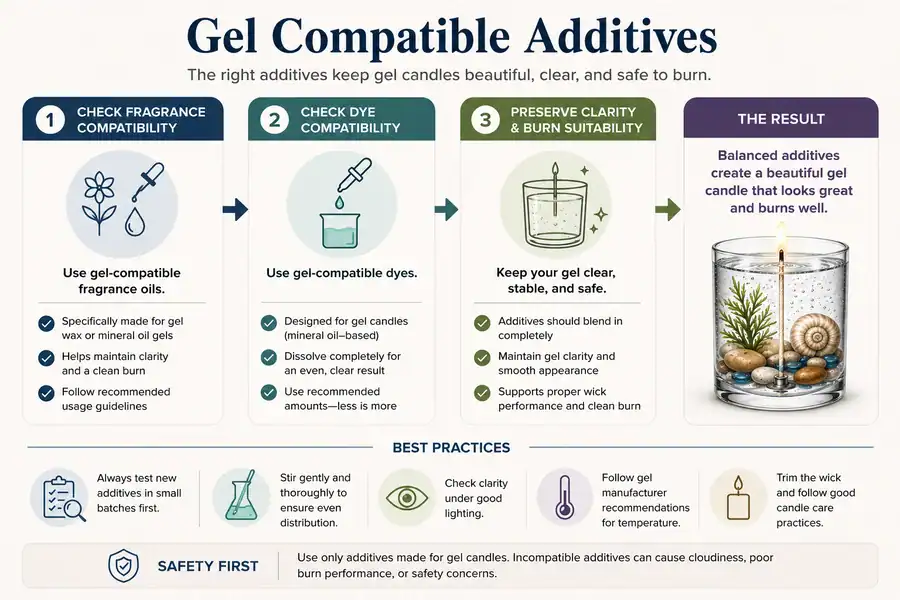
Gel candles can be scented or colored, but the fragrance oil and dye must be suitable for gel wax.
A gel-compatible fragrance oil is a scent oil that the supplier marks as suitable for transparent gel wax. A gel-compatible dye is a colorant meant for gel wax rather than a random soap, resin, or cosmetic colorant. This matters because gel wax does not let makers copy every additive habit from ordinary wax candles.
| Additive choice | What to check | What to avoid |
|---|---|---|
| Fragrance oil | Supplier says it is suitable for gel wax. | Using any candle scent without gel guidance. |
| Dye | Dye is made or approved for gel wax. | Soap dye, food coloring, resin pigment, or unknown craft color. |
| Amount | Follow supplier guidance for the exact gel wax. | Guessing from a wax candle recipe. |
| Clarity | Additive should not ruin the clear look unless tint is intended. | Assuming every scent or dye stays transparent. |
| Safety | Additive should match the candle’s burn design. | Treating scent and color as cosmetic-only choices. |
Common additive mistakes:
| What went wrong | Likely wrong assumption | Better route |
|---|---|---|
| The gel turned cloudy. | “Any fragrance that works in wax works in gel.” | Check gel wax fragrance compatibility. |
| The color separated or looked uneven. | “Any craft colorant can tint a candle.” | Use dye meant for gel wax. |
| The scent choice changed the burn result. | “Fragrance only affects smell.” | Treat fragrance as part of the candle system. |
Additive guidance is kept at a compatibility level here because exact fragrance load, flash point, and supplier data sheet interpretation belong in a gel wax fragrance compatibility guide.
Scented or colored gel candles can work well, but the additive must match gel wax first. The safe order is material compatibility, then appearance, then scent strength or color preference.
When Should You Choose Gel Candles Instead of Wax Candles?
Choose gel candles when transparency, visible embeds, or decorative container display matters more than freestanding shapes or broad wax-type options.
Gel candles are best-fit choices, not universal upgrades. They make sense when the candle’s clear body is part of the reason for buying or making it. Wax candles make more sense when the goal is a wider range of shapes, simpler formats, or a specific wax type such as soy, beeswax, paraffin, coconut wax, or a blend.
| Situation | Better fit | Why |
|---|---|---|
| You want a clear candle body. | Gel candle | Gel wax gives a transparent or glass-like look. |
| You want visible embeds. | Gel candle | The clear body can display suitable decorations. |
| You want a decorative container candle. | Gel candle | Gel works well when the vessel and visual depth matter. |
| You want a pillar, taper, melt, or votive. | Wax candle | Wax covers more candle formats. |
| You want the simplest beginner path. | Often wax candle | Some wax projects have fewer hidden compatibility checks. |
| You want to compare wax types. | Wax candle guide | Gel versus wax is not the same as soy versus paraffin versus beeswax. |
| You want a product recommendation. | Buying guide | This page explains criteria, not rankings or prices. |
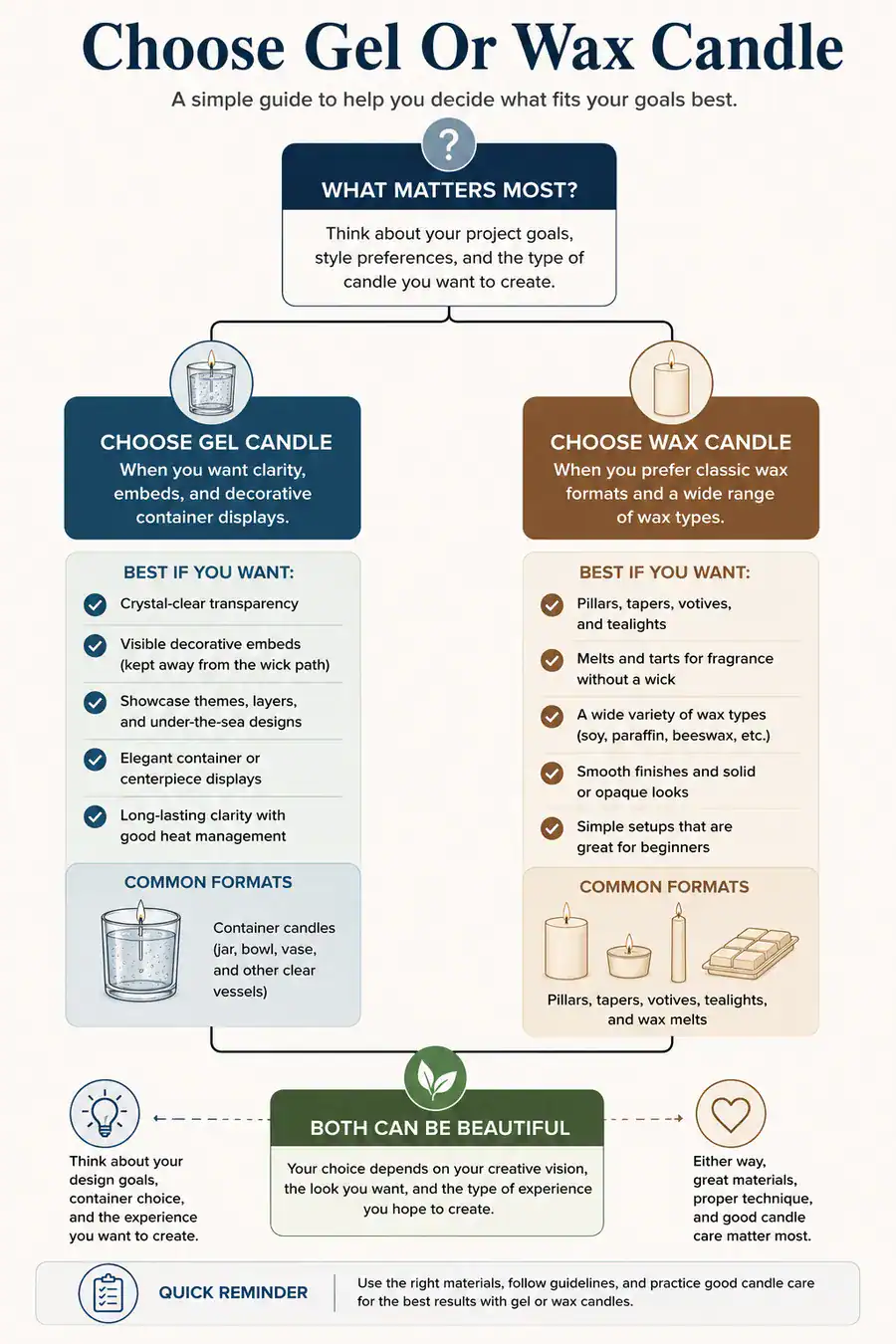
A gel candle is a good choice when the candle is meant to be seen through. A wax candle is often a better choice when structure, wax type, scent style, or format variety matters more than transparency.
For buying decisions, separate three intents before choosing: a finished gel candle, gel wax supply, or a DIY starter kit. Finished candles need a good vessel and clear care instructions. Supplies need gel-specific compatibility details. Starter kits need beginner-safe instructions, not just attractive photos.
Are Gel Candles Beginner-Friendly?
Gel candles can be beginner-friendly for simple container projects, but they are less forgiving than they look because containers, additives, embeds, and wick setup must suit gel wax.
A finished gel candle is usually easier for a beginner than a DIY gel candle. The buyer mainly needs to check the vessel, label, burn instructions, and visible design. The maker needs to choose the right gel wax, container, wick, fragrance, dye, and decorations before pouring anything.
Use this beginner screen before deciding whether to make one.
| Beginner question | Better answer |
|---|---|
| Am I buying a finished gel candle? | Check the container, label, wick position, and burn instructions. |
| Am I making a simple clear container candle? | Use a beginner gel candle tutorial with measured supplies. |
| Am I adding shells, stones, or other embeds? | Keep the wick path clear and use only suitable materials. |
| Am I adding fragrance or dye? | Confirm the additive is suitable for gel wax. |
| Am I copying a wax candle recipe? | Do not copy it unless it is written for gel wax. |
| Am I troubleshooting bubbles, haze, or cloudiness? | Use a dedicated gel candle troubleshooting resource. |
Common beginner failures:
| What happened | Likely cause | Better route |
|---|---|---|
| The project looked easy but failed during setup. | The maker focused on the clear look and skipped compatibility checks. | Start with a simple container project. |
| The candle looked cloudy or bubbly. | The process or additive choice may not have suited gel wax. | Route cloudiness and bubbles to troubleshooting. |
| The embeds made the candle harder to burn safely. | Decoration was treated as the main goal. | Keep design secondary to container, wick, and burn safety. |
Beginner Questions People Often Ask
Beginner gel candle questions usually concern whether gel is easier than wax, whether normal kits work, and which variables must be checked before making one.
Is making gel candles easier than making wax candles?
Gel candles may look easier because they use a container and clear gel, but they can be less forgiving when additives, embeds, or vessel choices are wrong.
Can I use a normal candle-making kit for gel candles?
Not unless the kit is made for gel candles. Gel wax needs compatible fragrance, dye, vessel, wick, and instructions.
Can I make gel candles without fragrance?
Yes. Unscented gel candles can be a simpler beginner route because fragrance compatibility is one less variable to manage.
Are gel candles good for a first candle project?
They can be good for a careful beginner using a simple gel-specific kit or tutorial. They are not a good first project when the plan includes random jars, unknown scents, or many embeds.
What should I learn before making one?
Learn the container rule, gel-compatible additive rule, safe embed placement, and wick setup before trying decorative designs.
Actual making steps require measured supplies and safety checks. Use a beginner gel candle tutorial for the process, and use troubleshooting help if the gel turns cloudy, forms bubbles, separates, smokes, or overheats.
What to Check Before Buying or Making a Gel Candle
When choosing a gel candle, gel wax, or starter kit, first decide whether you are buying a finished candle, a candle-making supply, or a DIY project kit.
Those three purchases have different checks. A finished candle is judged by vessel quality, wick placement, label clarity, and design safety. Gel wax supply is judged by material details and supplier instructions. A starter kit is judged by whether every included part is suitable for gel wax.
| Buying choice | What to check | Avoid |
|---|---|---|
| Finished gel candle | Stable candle-suitable container, centered wick, clear burn instructions, safe-looking embed placement. | Random decorative vessels, crowded wick paths, missing care guidance. |
| Gel wax supply | Supplier instructions, intended candle use, clarity notes, additive guidance. | Unlabeled gel material or craft gel not meant for candles. |
| Fragrance oil | Suitability for gel wax. | Assuming every candle fragrance works in gel. |
| Dye | Suitability for gel wax and desired transparency. | Food coloring, soap dye, resin pigment, or unknown craft color. |
| Starter kit | Gel-specific instructions, compatible supplies, simple project scope. | Kits that sell the look but do not explain vessel, wick, and additive limits. |
| Decorative embeds | Candle-suitable material and safe placement guidance. | Plastic, paper, fabric, coated, painted, or unknown objects near the flame path. |
A good gel candle buying decision is criteria-based, not brand-first. Look for a candle or kit that explains the vessel, burn care, and gel-specific material choices. Product rankings, prices, marketplace deals, and brand comparisons belong in a gel candle buying guide, not in this definition and comparison page.
The final decision is practical: choose gel when the clear container display is the main value, and choose a traditional wax candle when you want broader formats, simpler material choices, or a familiar everyday candle type.