
Beeswax often burns longer and cleaner, while soy often wins on cost, container use, and flexible fragrance throw.
“Burns better” means the better candle-making result for burn time, soot control, scent throw, cost per hour, vessel fit, wick compatibility, and user needs. This comparison covers soy and beeswax candles for home candle making, including jars, tapers, pillars, fragrance, sourcing, and basic testing limits.
This page compares candle-making performance. It does not fully cover candle safety, allergy diagnosis, HVAC placement, wax cleanup, UV storage testing, high-altitude wick testing, or full blend-ratio formulation.
Wick size, vessel diameter, fragrance load, room temperature, humidity, and drafts can change the result. Use the sections below as a decision path: compare the attribute, test the setup, then choose the wax that fits the candle you are making.
Soy vs Beeswax Candles: Quick Decision Table
Soy is usually better for scented containers and cost control; beeswax is usually better for long burns, firm shapes, and natural wax scent.
The better wax depends on the candle form and the attribute being compared. Use the table as a first decision layer before testing wick size, vessel width, fragrance load, and room conditions.
| Decision attribute | Soy candle advantage | Beeswax candle advantage | Best first choice |
|---|---|---|---|
| Burn time | Can last well when properly wicked | Often burns slower per ounce | Beeswax |
| Soot control | Can burn cleanly with correct wick heat | Often looks cleaner in simple unscented setups | Test both |
| Scent throw | Usually easier for scented jars | Can soften scents with a honeyed wax note | Soy |
| Cost per hour | Often lower purchase cost | Slower burn can narrow the price gap | Soy, then calculate |
| Containers | Works well in jars and tins | Can tunnel in wide jars if under-wicked | Soy |
| Tapers and pillars | Needs the right pillar-grade wax or blend | Firmer structure suits freestanding forms | Beeswax |
| Vegan fit | Plant-derived when not blended with animal wax | Animal-derived | Soy |
| Natural wax scent | Usually neutral or mild | Often honeyed and warm | Beeswax |
| Limited testing time | More forgiving for many container candles | Needs tighter wick and vessel matching | Soy |
For a fair comparison, test the same fill weight, jar diameter, wick family, wick trim, burn interval, room placement, and fragrance load. Change one variable at a time so the result points to the wax instead of the setup.
Soy vs Beeswax: Burn Time Compared
Beeswax usually burns slower per ounce than soy, but wick size, vessel width, and room conditions can reverse the result.
For candle making, hours per ounce means how long one ounce of wax burns under the same vessel, wick, trim, and room setup. Use the soy vs beeswax comparison as the parent decision, then treat burn time as a tested result rather than a wax-label promise.
Beeswax tends to resist fast melt-pool spread because it is harder and higher-melting than many soy container waxes, which can extend burn time. Soy can still last longer if beeswax is over-wicked, burned in a wide jar, or exposed to drafts.
| Test variable | Soy candle result to watch | Beeswax candle result to watch | Better reading |
|---|---|---|---|
| Mass loss rate | g/hr after a timed burn | g/hr after a timed burn | Lower g/hr usually means longer burn |
| Hours per ounce | 28.35 ÷ g/hr | 28.35 ÷ g/hr | Higher h/oz wins |
| Melt-pool edge | Full edge without overheating | Full edge without tunneling | Even pool, no smoke |
| Flame behavior | Stable, not weak | Stable, not tall or smoky | Steady flame wins |
| Jar wall | Clear, not blackened | Clear, not blackened | Clean glass supports the result |
Run at least three burn sessions per wax using the same jar diameter, wick family, wick trim, wax weight, and room placement. Record starting weight, ending weight, burn duration, visible soot, melt-pool width, and flame stability.
For a fair test, choose wick types and sizes before changing wax. A wick that is too hot can make beeswax look fast, smoky, and wasteful. A wick that is too cool can make soy look slow because it is tunneling rather than burning well.
Longer burn time is not automatically the better candle. A very slow burn can give weak hot throw, a narrow melt pool, and leftover wax on the glass. A faster burn can be acceptable when the scent is stronger, the jar stays clear, and the flame remains controlled.
The useful comparison is not “hard wax beats soft wax.” It is “which wax gives the most steady hours in the candle design you are making.”
Soy vs Beeswax: Soot and Clean Burn
Trim wicks, reduce drafts, and match wick heat to the jar before blaming soot on soy or beeswax alone.
For candle making, clean burn means clear jar walls, a stable flame, low visible smoke, and no harsh after-smell. In the soy vs beeswax performance comparison, beeswax can look cleaner in many setups, but over-wicking, poor trimming, and airflow can make either wax soot.
Soot forms when the flame does not burn fuel cleanly, often because the wick is too large, the flame is flickering, or the candle is placed near moving air.
| Soot sign | Likely cause | Fix |
|---|---|---|
| Black jar rim | Wick too large or flame too tall | Wick down one size or trim before relighting |
| Smoke at relight | Mushroomed wick or long wick | Trim charred tip before the next burn |
| Flickering flame | Draft from window, fan, vent, or hallway | Move candle away from moving air |
| Smoke after extinguishing | Wick smolders after blow-out | Use a snuffer or dip-and-straighten method |
| Soot after adding fragrance | Fragrance load or wick heat too high | Retest with lower load or cooler wick |
| Uneven melt pool with soot | Draft plus hot wick | Move location before changing wax |
A simple photo log helps separate wax behavior from setup errors. Take one photo before lighting, one after the first full session, and one after several repeat burns. Compare the jar wall, wick tip, melt-pool edge, and flame shape under the same room conditions.
Soy and beeswax differ, but the biggest soot fixes are usually the same:
- Trim the wick.
- Reduce airflow.
- Lower wick heat when the flame is too tall.
- Extinguish without smoke when the session ends.
- Retest before changing wax.
Beeswax may tolerate a firmer structure and slower burn, while soy container candles may need careful wick choice to keep the melt pool open without overheating. If two candles use different jars, wicks, or fragrance loads, the wax comparison is not fair.
Soy vs Beeswax: Fragrance Throw and Baseline Wax Scent
Soy often supports broader fragrance throw; beeswax can mute or color scents with its natural honey note.
For candle making, cold throw is scent strength before lighting, and hot throw is scent strength while the melt pool is warm. In the soy vs beeswax comparison, soy is usually easier for scented container candles because many soy waxes are built for fragrance loading.
Baseline wax scent is the wax’s own aroma before added fragrance is judged. Beeswax can add a mild honey note, while many soy bases sit closer to neutral.
| Fragrance test | Soy candle tendency | Beeswax candle tendency | What to adjust first |
|---|---|---|---|
| Cold throw | Often noticeable in jars | Often softer unless fragrance is strong | Cure time and fragrance oil choice |
| Hot throw | Often broad in small to medium rooms | Can be softer or honey-colored | Wick heat and fragrance pairing |
| Scent accuracy | Neutral wax base helps clean notes | Natural wax scent can change the note | Choose compatible fragrance families |
| Overheating risk | Can smell sharp if over-wicked | Can smell smoky or heavy if over-wicked | Wick down before adding more oil |
| Unscented use | Mild base scent or neutral profile | Natural honey-like profile | Match wax to user expectation |
Test each candle after the same cure period, in the same room, with the same jar size, wick family, wax weight, and fragrance percentage. Ask three people to score cold throw before lighting, then hot throw at the same burn interval. Record scent strength, scent accuracy, smoke, and whether the wax base changes the fragrance character.
Soy is usually the better first choice when the candle maker wants clear vanilla, citrus, floral, or room-filling fragrance in a jar. Beeswax is often better when the goal is a lightly scented, naturally warm candle where the wax note is part of the experience.
Beeswax often works well with honey, vanilla, resin, spice, wood, and soft floral directions. Soy often works well when the maker wants a cleaner base for citrus, green, herbal, or delicate floral notes.
Stronger is not always better. A clean, accurate scent at moderate strength beats a harsh scent caused by too much oil or too much wick heat.
Adding more fragrance before checking wick performance can create smoke, sweating, or poor scent accuracy.
Soy vs Beeswax: Melt Point, Hardness, and Wick Heat
Higher melt point usually means beeswax needs more wick heat and tighter process control than soy.
For candle making, melt point is the temperature band where wax changes from solid to liquid. It matters because the wick must draw melted wax upward and feed the flame.
Soy container waxes usually sit in lower melt-point bands than beeswax, while beeswax is harder and needs more heat to form a useful melt pool. That is why the same wick can underperform in beeswax and overheat soy.
| Wax behavior | Soy candle reading | Beeswax candle reading | Wick response |
|---|---|---|---|
| Melt pool reaches edge too fast | Wick may be too hot | Less common but possible in narrow vessels | Wick down or shorten burn session |
| Melt pool stays narrow | Wick may be too cool or jar too wide | Common when wick heat is too low | Wick up or test a hotter series |
| Flame is tall and smoky | Over-wicked or draft-stressed | Over-wicked, especially in containers | Wick down and move from airflow |
| Wax remains on jar wall | Could be early memory or under-wicking | Often under-wicking in wide jars | Repeat test before changing wax |
| Scent is weak | Melt pool may be too cool | Melt pool may be too narrow | Fix heat delivery before adding oil |
In a side-by-side maker log, record wax type, supplier melt-point band, jar diameter, wick series, wick size, room temperature, melt-pool width, melt-pool depth, flame height, and soot after the same burn interval.
The useful data point is not melt point alone. It is melt point plus wick heat, vessel width, and flame behavior.
Soy is more forgiving for many container candles because it can form a usable melt pool with less heat. Beeswax can give a slower, firmer burn, but it asks more from wick choice and vessel design.
In a taper, beeswax firmness can be an advantage. In a wide jar, it can become tunneling unless the wick is matched to the wax and diameter.
Do not treat higher melt point as “hotter flame.” The flame is shaped by wick size, fuel flow, oxygen, wax pool, and airflow. Higher melt point mainly tells the maker that beeswax needs enough heat to liquefy and travel through the wick without producing a tall, smoky flame.
Soy vs Beeswax: Cost per Hour of Burn
Soy often costs less per hour, but a longer beeswax burn can narrow or reverse the gap.
For candle making, cost per hour means wax cost divided by measured burn time, not price per kg alone.
Use this formula to compare soy and beeswax economics:
Cost per hour = price per kg × g burned per hour ÷ 1000
A cheaper wax can become costly if it burns fast, tunnels, wastes wax on the jar wall, or needs repeated wick corrections.
| Input | Unit | Soy entry | Beeswax entry | Why it matters |
|---|---|---|---|---|
| Wax price | €/kg | Your supplier price | Your supplier price | Starting material cost |
| Mass loss | g/hr | Scale reading | Scale reading | Real burn rate |
| Formula | €/hr | price × g/hr ÷ 1000 | price × g/hr ÷ 1000 | Final cost comparison |
| Example only | €/hr | €10 × 5 ÷ 1000 = €0.05/hr | €18 × 3 ÷ 1000 = €0.054/hr | Slower burn can close the price gap |
| Sensitivity check | ±10% | Recalculate price and g/hr | Recalculate price and g/hr | Shows whether the result is stable |
Control burn rate with wick sizing before judging the wax. A hot wick can make both waxes look expensive because it increases mass loss, smoke, and fragrance loss. A cool wick can make the cost per hour look low while leaving unusable wax on the sides.
Mini calculator steps:
- Enter wax price per kg.
- Weigh the candle before lighting.
- Burn for a fixed test period.
- Weigh again after cooling.
- Divide mass lost by hours burned.
- Multiply price/kg by g/hr.
- Divide by 1000.
The better value is the candle that gives clean, usable burn hours. Soy often wins on purchase price and container flexibility. Beeswax can stay competitive when it burns slower, needs less fragrance, or fits a premium unscented candle.
Compare the final cost with soot, scent, and leftover wax, because a low €/hr number is weak if the candle performs poorly.
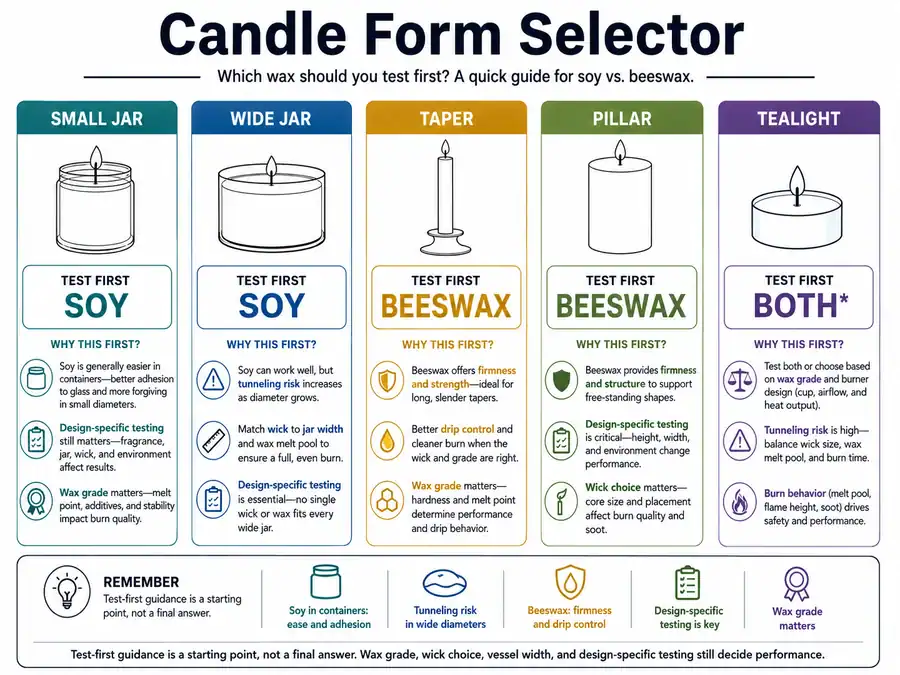
Soy vs Beeswax: Best Uses in Containers, Tapers, and Pillars
Soy suits containers; beeswax suits tapers and firmer freestanding forms, but testing can reverse the result.
For candle making, a container candle burns inside a jar or tin, while a taper is a tall candle made to stand in a holder. Compare soy vs beeswax by form, not by wax name alone.
Soy is often easier in jars because the container holds the melt pool. Beeswax is often stronger for tapers because its firmer structure helps shape, drip control, and flame stability.
| Candle form | Soy result to expect | Beeswax result to expect | Better choice when |
|---|---|---|---|
| Small jar | Forgiving melt pool and easy scent setup | Can work, but may need hotter wick testing | You want simple scented containers |
| Wide jar | Can work with careful wick sizing | Higher tunneling risk if under-wicked | You can run repeat wick tests |
| Taper | Softer wax may bend or drip more easily | Firmer body and cleaner taper shape | You want dinner candles or holders |
| Pillar | Needs pillar-grade blend, not soft container soy | Often firmer and more stable | You want freestanding structure |
| Tealight | Easy with container-style soy | Works, but wax cost may be higher | You want small, simple burn cups |
Compare one soy jar, one beeswax jar, one soy taper, and one beeswax taper after equal burn windows. Track flame tilt, drip path, melt-pool width, holder fit, jar wall residue, and whether the candle stays upright.
Use wick types as the next test variable after candle form. A soy jar that burns well with one wick family may fail as a taper, and a beeswax taper that burns cleanly may tunnel in a wide jar.
The practical split is simple:
- Choose soy first for scented jars.
- Choose beeswax first for tapers, dinner candles, and firm freestanding shapes.
The exception is design-specific performance. If the wick, vessel, draft exposure, or wax grade is mismatched, either wax can drip, smoke, tunnel, or leave wax behind.
Soy vs Beeswax: Wick Compatibility and Fair Testing
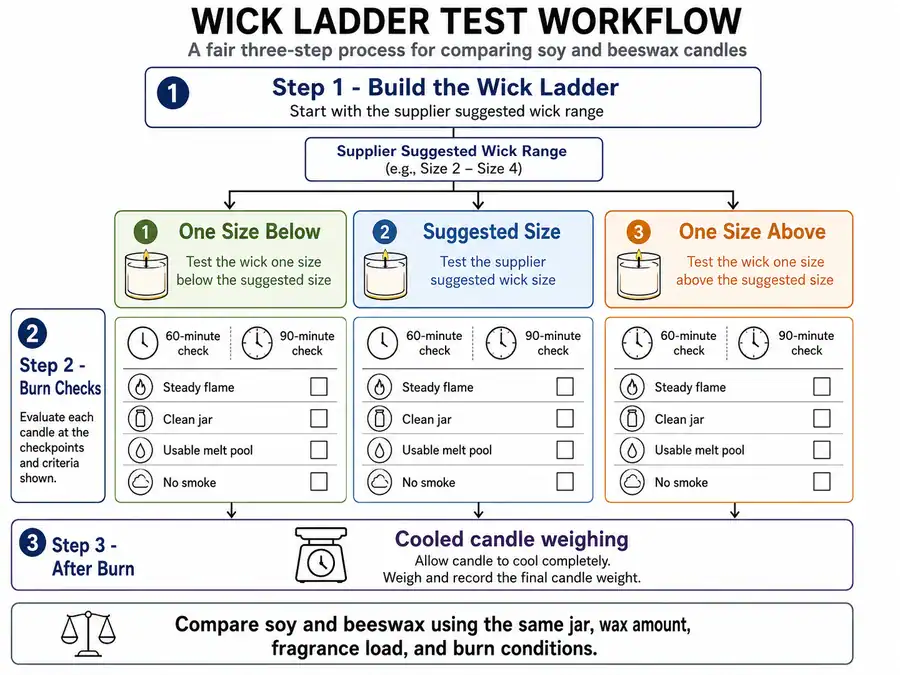
Start with jar diameter and melt point, then ladder-test adjacent wick sizes before choosing soy or beeswax as the winner.
For candle making, wick sizing means matching wick heat to wax hardness, jar width, fragrance load, and burn goal. In soy vs beeswax tests, jar diameter sets the starting range, but melt point changes the heat needed.
Beeswax often needs a hotter wick series or a larger size than soy in the same jar, while soy may overheat if copied from a beeswax setup.
| Jar diameter class | Soy starting logic | Beeswax starting logic | Test result to watch |
|---|---|---|---|
| Narrow jar | Start low; avoid overheating | Start moderate; check melt-pool width | Flame too tall or weak pool |
| Medium jar | Test supplier midpoint first | Test midpoint plus one hotter option | Full pool without smoke |
| Wide jar | Consider multi-wick only after single-wick tests | Beeswax may need hotter wick or narrower vessel | Tunneling vs soot |
| High fragrance load | Retest because oil changes fuel flow | Retest because oil plus beeswax can alter burn | Smoke, sweating, weak throw |
| Unscented candle | Lower fuel complexity | Wax behavior is easier to isolate | Cleaner comparison |
Three-step ladder test:
- Choose the supplier’s suggested wick range for the jar diameter.
- Test one size below, the suggested size, and one size above.
- Keep the wick that gives a steady flame, clean jar, and usable melt pool without smoke.
Check melt-pool width at 60 and 90 minutes, then weigh the cooled candle after the session. Do not change wick series, fragrance load, and jar diameter in the same test round.
A universal wick-size promise is not reliable for soy or beeswax. The right wick is the one that heats the exact wax, jar, fragrance load, and room setup without smoke or tunneling.
Beeswax may ask for more heat, but too much heat wastes wax and blackens glass. Soy may ask for less heat, but too little heat leaves wax on the sides.
Soy vs Beeswax: Sustainability, Vegan Fit, and Sourcing Claims
Sourcing quality depends on traceable origin, clear claim language, and documents—not the word “natural.”
For candle making, sustainable sourcing means the seller can show where the wax came from, how it was produced, how far it traveled, and which claim can be checked.
Soy is plant-derived when it is not blended with animal wax, so it usually fits vegan buyers better. Beeswax is animal-derived, so its claim strength depends on beekeeper practices, hive-product sourcing, filtering, transport, and disclosure.
Use this soy vs beeswax comparison to understand trade-offs, not to crown a universal winner. Local beeswax may have strong origin proof and short transport. Soy wax may be a good choice when the supplier can document responsible farming, processing, and shipping.
| Claim or criterion | Soy wax question | Beeswax question | Good document to request |
|---|---|---|---|
| Vegan fit | Is the wax plant-derived and not blended with animal wax? | Beeswax is animal-derived | Supplier specification |
| Origin | Which country or region grew the soy? | Which beekeeper, region, or processor supplied it? | Supplier origin statement |
| Production practice | Are farming and processing claims explained? | Are bee-welfare and filtering claims explained? | Supplier specification sheet |
| Transport | How far did the wax travel to you? | Is it local, regional, or imported? | Invoice, batch note, shipment detail |
| Additives | Is it pure soy or a blend? | Is it pure beeswax or blended? | SDS or product specification |
| Claim support | Can “vegan,” “local,” or origin wording be checked? | Can “local,” “raw,” or “filtered” be checked? | Certificate or written supplier reply |
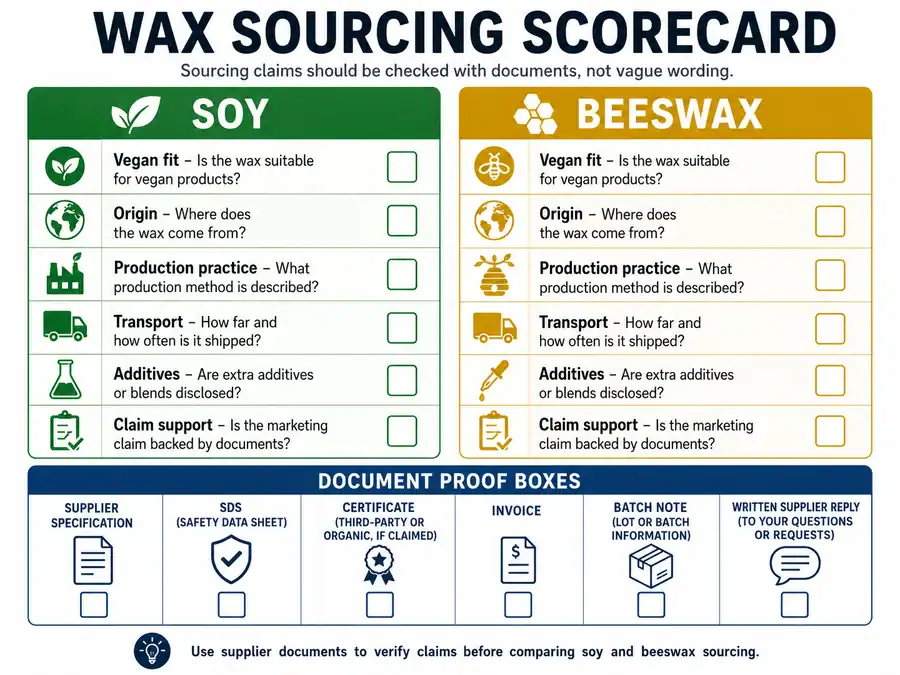
Keep a vendor scorecard with supplier name, wax type, batch or lot number, origin, transport route, certificates, SDS, and the date documents were checked.
Soy can be a strong choice for vegan buyers, large container batches, and sellers who can trace agricultural sourcing. Beeswax can be a strong choice for buyers who value local origin, natural wax scent, and beekeeper traceability.
The weaker option is the one backed only by unsupported environmental wording. Documentation matters more than the wax label.
Should You Use a Soy-Beeswax Blend?
A soy-beeswax blend can balance soy’s container ease with beeswax’s firmness, but it must be tested as a new wax.
For candle making, a soy-beeswax blend is a measured mix of both waxes. It can change melt point, wick heat, scent behavior, surface finish, and burn time.
Do not assume a universal best ratio. Raising beeswax content can increase hardness and heat demand, while jar diameter, fragrance load, wick series, and room conditions can change the result.
| Blend question | What to compare | Decision rule |
|---|---|---|
| Do you need firmer soy? | Plain soy vs soy-beeswax test candle | Keep the blend only if the finish improves without smoke or weak throw |
| Do you need a slower burn? | Measured g/hr for each wax setup | Keep the blend only if burn time improves with usable melt pool |
| Do you need stronger scent clarity? | Hot throw and scent accuracy | Keep soy if beeswax softens the fragrance too much |
| Do you need firmer shapes? | Jar, pillar, or taper performance | Use the form test before changing the whole recipe |
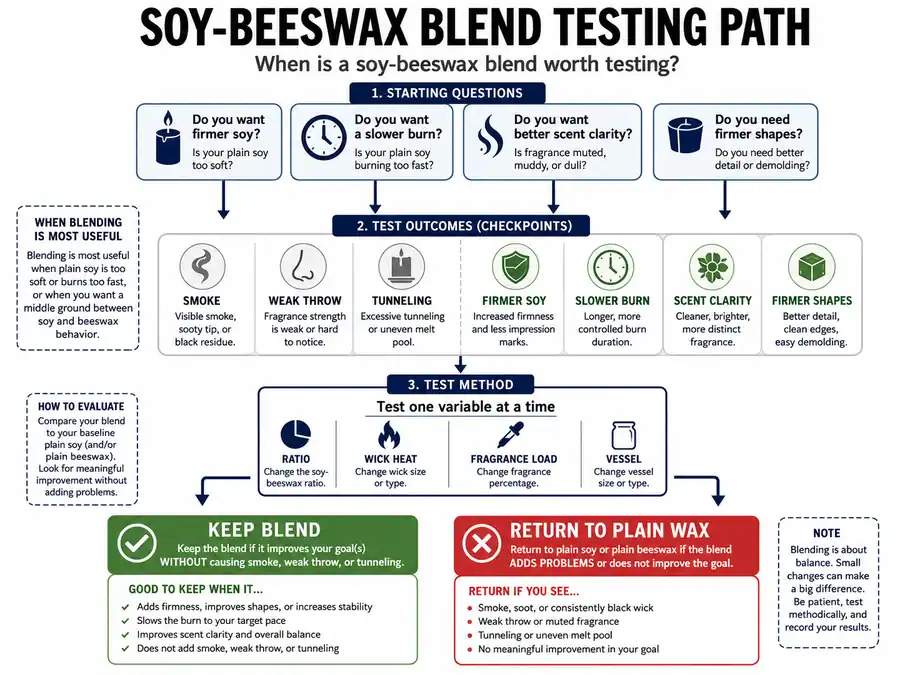
A blend that looks good on paper can tunnel when the jar is wide, smoke when the wick is too hot, or lose scent clarity when the beeswax percentage rises.
If a blend fails, change only one variable in the next test. If ratio and wick both change at once, you cannot tell whether the wax mix, wick heat, fragrance load, or vessel caused the result.
Final Verdict: Choose Soy, Beeswax, or a Blend
Choose soy for scented jars and cost control; choose beeswax for longer burns, tapers, firmer forms, and a natural wax scent.
Use soy first when the candle is a scented container candle, the budget matters, the buyer wants a vegan wax, or the maker needs a more forgiving jar setup.
Use beeswax first when the candle is a taper, pillar, dinner candle, unscented premium candle, or design where firmness, slower burn, and a honeyed wax note are part of the product.
Test both when burn time, soot, scent throw, or cost per hour matters more than the wax label. The winning candle is the one with a steady flame, clean jar, usable melt pool, expected scent, and acceptable cost per hour in the exact design being made.
Consider a soy-beeswax blend only when plain soy is too soft or plain beeswax is too demanding for the vessel. Treat the blend as a separate formula and verify it with the same burn-test controls.