

Candle additives are optional ingredients added to wax to change structure, scent handling, appearance, or stability. On this page, the best additive means the additive family that best fits your wax, candle type, and confirmed problem with the smallest useful formula change—not the cheapest option, not the strongest scent result regardless burn quality, not the hardest formula regardless brittleness, and not one additive for every candle.
Use this page to choose a starting additive family, confirm compatibility, and validate the result with a small burn test before you scale up. This page helps you narrow the first choice; deeper troubleshooting, UV, scent, and ingredient-specific questions stay on the linked child pages.
If your current formula already burns evenly, holds scent, and looks right after cure, the right choice may be to leave the wax unchanged rather than add another variable.
Quick decision matrix: wax × product × problem → additive starting point
Use this matrix to choose a starting additive family—or decide that no additive is needed yet—based on your wax, candle type, and the exact problem you are trying to fix. Start with candle additives and enhancers if you want the parent overview, review common candle additives if you want the main families in one place, and compare with candles without additives before changing a formula that already burns and looks the way you want.
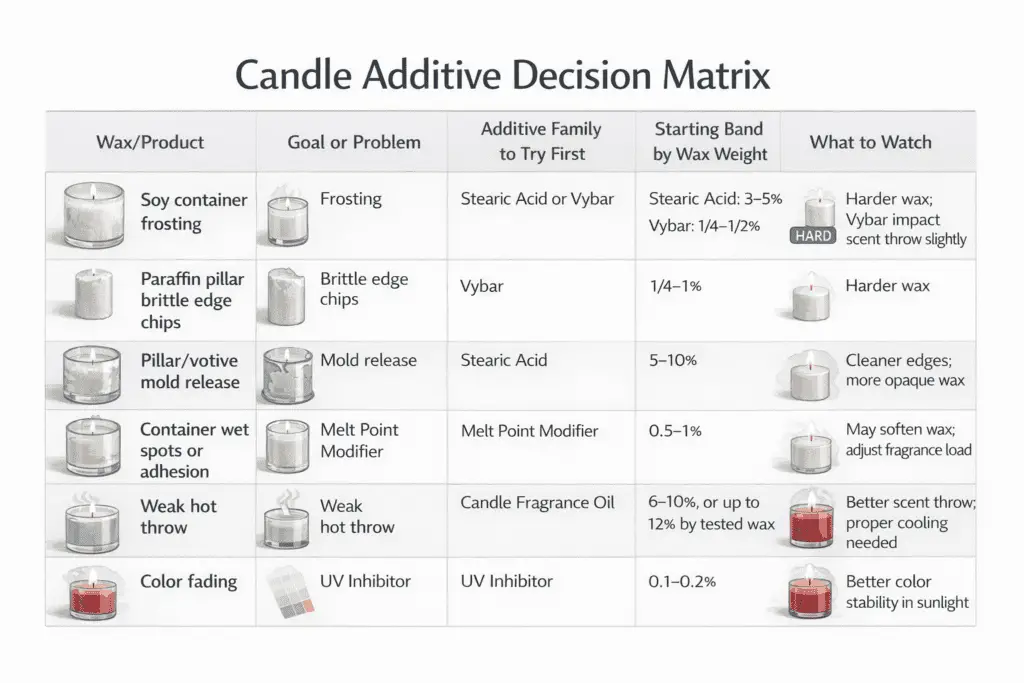
Wax / product | Goal or problem | Additive family to try first | Starting band (by wax weight) | What to watch (stop/adjust when…) |
Soy container | Frosting | Micro-blend wax (coconut/paraffin) + cooling control | 1–2% micro-blend | Frosting drops but flame shrinks or wet spots increase |
Paraffin pillar | Brittle edge chips | Microcrystalline (toughness) | 1–4% | Edges improve but burn gets sluggish or soot rises |
Pillar/votive | Stuck in mold | Stearic (shrink/release) | 2–4% | Clean release improves but chipping/brittleness appears |
Any container | Wet spots / poor adhesion | Handling first, then microcrys as viscosity tweak | 0.2–0.5% | Sidewall improves but wick struggles or oiliness appears |
Any container | Weak hot throw | Polymer binder (Vybar-type) in micro-steps | 0.2–0.5% | Throw drops (binder trapping) or flame weakens |
Any | Color fading in light | UV absorber (+ antioxidant when needed) | 0.05–0.20% | Haze/clarity issues, burn shifts, or color still changes in the dark |
Stearic vs microcrystalline: which raises melt point and hardness?
Use stearic (1–5%) for sharper hardness and higher melt point; use microcrystalline (1–5%) for toughness and adhesion with smaller melt-point gains.
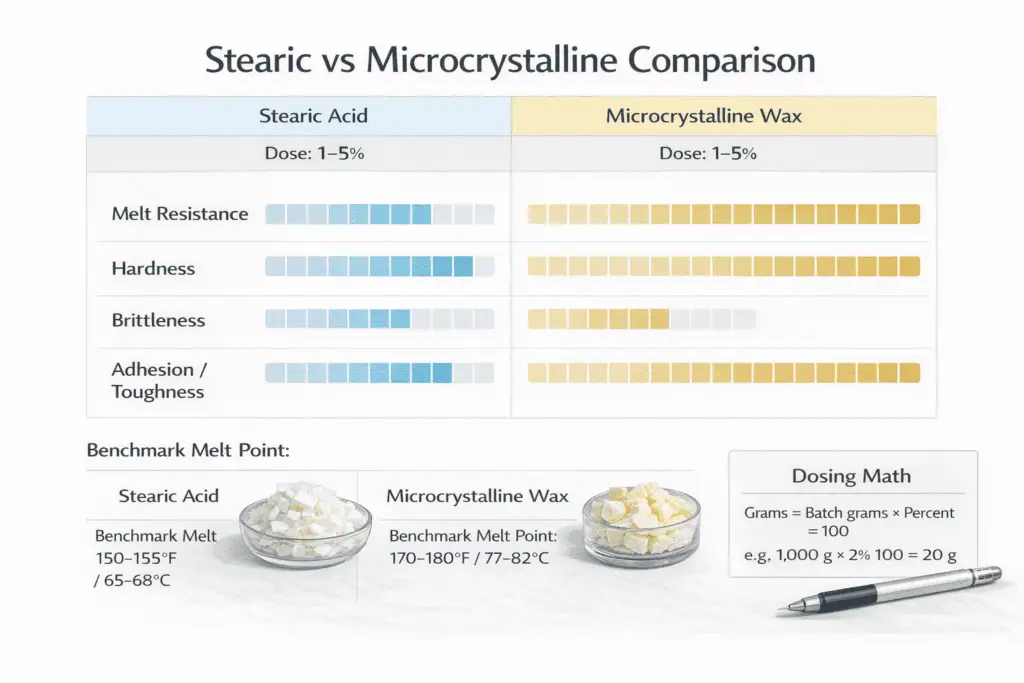
Use stearic when you need a firmer, higher-melt-point result and use microcrystalline when you need more toughness and adhesion. After any hardness change, compare a control candle with one small test batch and watch flame stability, soot, and melt pool before you scale up; if you need the deeper hardener-versus-binder decision, compare stearic and polymers.
How vybar, microcrys or light oil affect scent throw
Start with a minimal polymer dose (about 0.2–0.5%), avoid mineral-oil micro-doses unless tests prove a benefit, and change in 0.1–0.2% steps while re-checking wick performance.
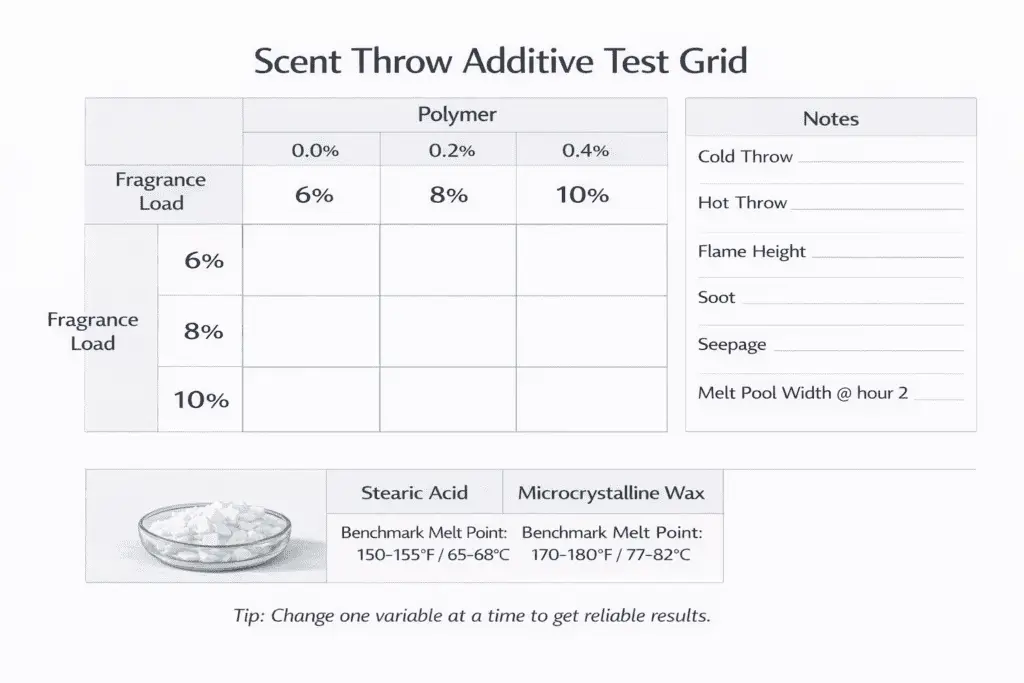
Vybar-type polymer binders can help hold fragrance and reduce visible oil issues, but higher doses can suppress scent release or weaken the flame. Use this page to choose the additive family first, then use adjust fragrance load or mix candle additives for the deeper test path.
Steps to reduce or create mottling with additives
Use vybar at 0.1–0.4% with steady cooling to reduce mottling; use petrolatum in a small test ladder (0.1%, 0.3%, 0.5%) with slower cooling to create a mottled look on purpose.
For prevention, start in the low end of the range (by weight), stir thoroughly, and keep the cool-down consistent; for intentional effects, change only one variable at a time so the pattern is repeatable.
To keep changes safe and predictable, follow supplier guidance and keep burn behavior aligned with a steady-flame, low-soot, stable-melt-pool check whenever you alter a formula.
If you want the shortest decision path, understand additive roles by separating “opacity control” (vybar) from “phase-separation styling” (petrolatum).
Color matters too—adjust color load to suit finish because some dye systems show haze or banding more easily when the wax is pushed toward higher opacity.
And if you’re testing bold shades, protect colors from UV fade so you don’t confuse light-fading with a mottling change.
What UV stabilizer to use for strong colors (and safe dosing)
Use a UV absorber at a low supplier-supported dose by wax weight and add an antioxidant when needed, then limit direct light exposure to keep colors from shifting. This page only flags UV absorbers for light-driven fading and antioxidants for storage yellowing; for deeper dosing and test details, review stabilizer options.
How to reduce soy frosting with small additive changes
Temper soy and stabilize room temperature, then micro-blend 1–2% compatible wax to reduce frosting.
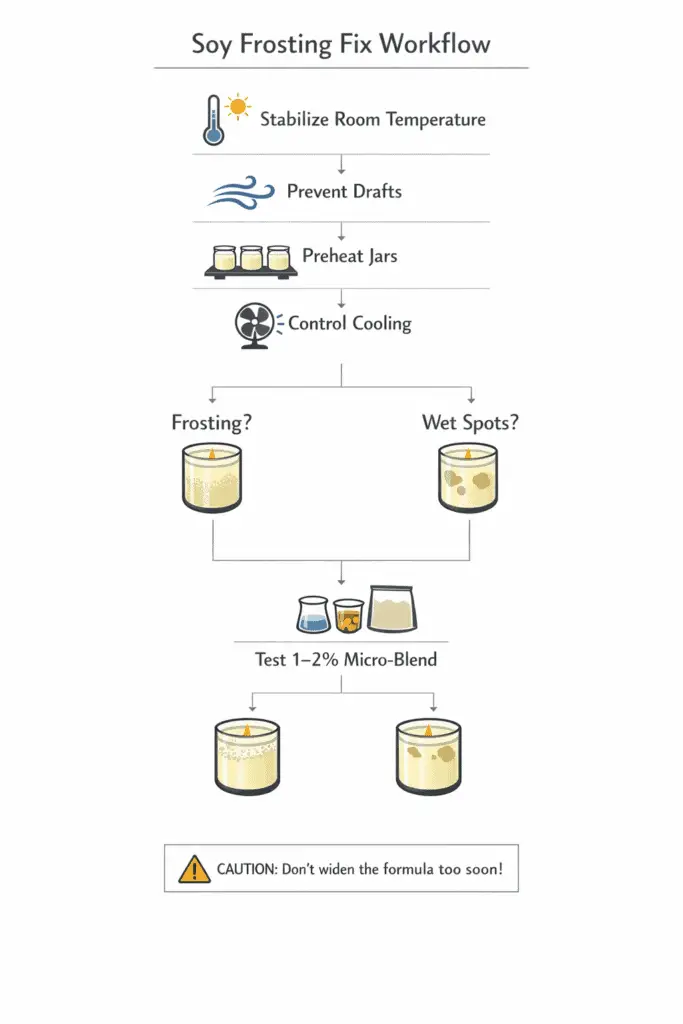
Frosting is a soy crystal pattern that looks like a white surface bloom, so use additive micro-blends only after cooling conditions are steady and the problem is not actually a wet-spot or adhesion issue. For the deeper fix path, distinguish wet spots from frosting or use fix candle additive issues.
Steps to calculate stearic % for clean mold release
Start pillars around 2–4% stearic, then adjust for mold material and release behavior while watching for brittleness.
Use stearic as a release aid, not as a maximum-shrinkage target. Match the first test to your mold type and finish, then use compare stearic and polymers when you need the deeper hardener-versus-binder path.
How to fix glass adhesion with micro-dose viscosity tweaks
Better glass adhesion usually comes from steadier jar temperatures and pour conditions, plus tiny viscosity tweaks (microcrys at or below 0.5%)—not from piling on polymers.
Treat sidewall pull-away as a handling-first issue before you add a modifier. If the problem survives steady jar temperature and pour control, use use viscosity modifiers or distinguish wet spots from frosting on the dedicated troubleshooting path.
How to mitigate vanillin discoloration realistically
Vanillin discoloration can be slowed with stabilizers, UV protection, and smart storage, but it usually can’t be eliminated when the fragrance oil contains vanillin.
Separate light-driven fading from chemical darkening before you change the formula, and plan for some color shift when vanillin is present. For the deeper treatment path, use prevent candle discoloration or the dedicated vanillin discoloration guide.
Small-batch testing protocols (DOE for additive % × wick × fragrance)
Use a simple 2–3 level test matrix (low/medium/high) and change one factor set at a time so you learn faster than “one-off tinkering.”
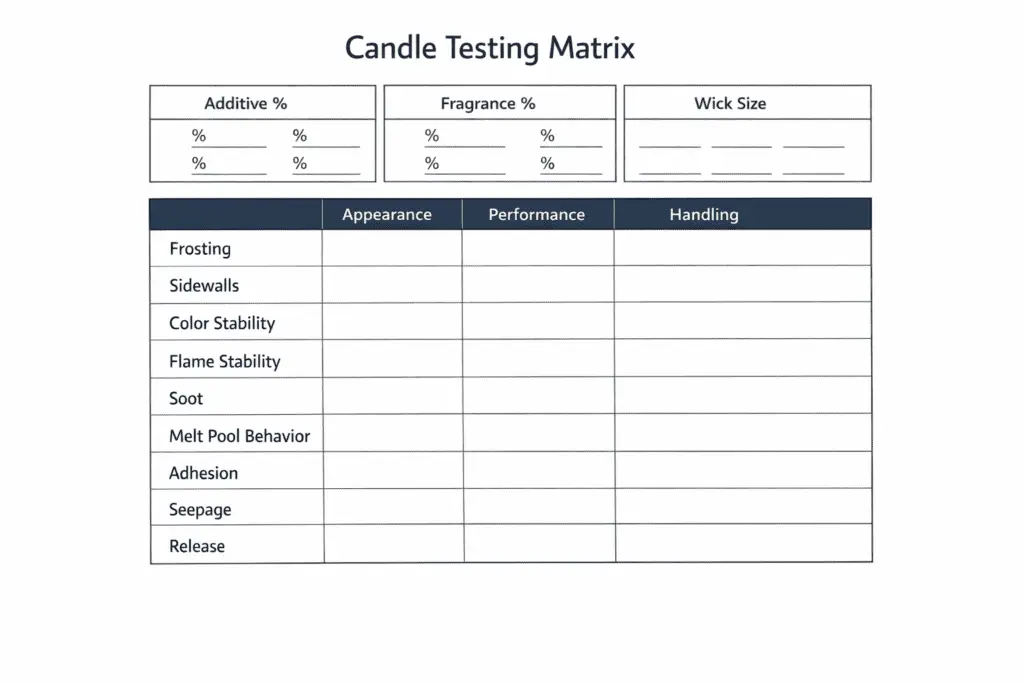
A starter matrix you can run without fancy tools
- Additive %: 0 / low / medium
- Fragrance %: baseline / +2% (within safe guidance)
- Wick: baseline / one size up