

Use a snug, strong box, immobilize the candle with non-abrasive wrap and partitions, fill all voids, seal with an H-tape pattern, and test packs with shake and drop checks so glass, tins, and pillars arrive without breakage.
Most candle breakage comes from two causes: movement inside the carton and shock concentrated on one hard edge. When a jar can shift even a few millimeters, it builds momentum and chips the rim, bruises the wax, or dents tins. Good packaging creates soft first contact, rigid separation, and a box strong enough to stay square through repeated handling. Start by sizing the carton and cushion system to the vessel, then verify the result with quick shake and drop checks before scaling up.
How to choose the right box size and strength for shipping candles
Choose the smallest strong box that still leaves room for cushioning on every side, so the candle cannot build speed or hit a hard edge.
Start with a right-size carton so the candle cannot gain momentum, then match the carton strength to the shipment weight and how rough parcel handling is likely to be. A box that is too large forces you to add more filler, which increases the chance of settling and side-to-side drift. A box that is too weak can bow, crease, or burst at the corners, turning a good interior pack into a failed delivery.
Aim for a snug fit that still allows cushioning on all sides, including top and bottom. If the wrapped candle rocks or slides when you tilt the box, the carton is too large for that pack style. If you have to force the flaps closed or the walls bulge, the carton is too small or the cushioning is too rigid.
ECT, or Edge Crush Test, is a corrugated rating that estimates stacking strength. Higher ratings resist crushing and help corners stay intact. Single-wall cartons are usually suitable for lighter shipments, while double-wall cartons are better for heavier orders, multi-item glass shipments, longer routes, or more demanding handling conditions.
Use these clearances and board ratings as starting rules, then confirm them with your own pack tests and actual carrier handling results.
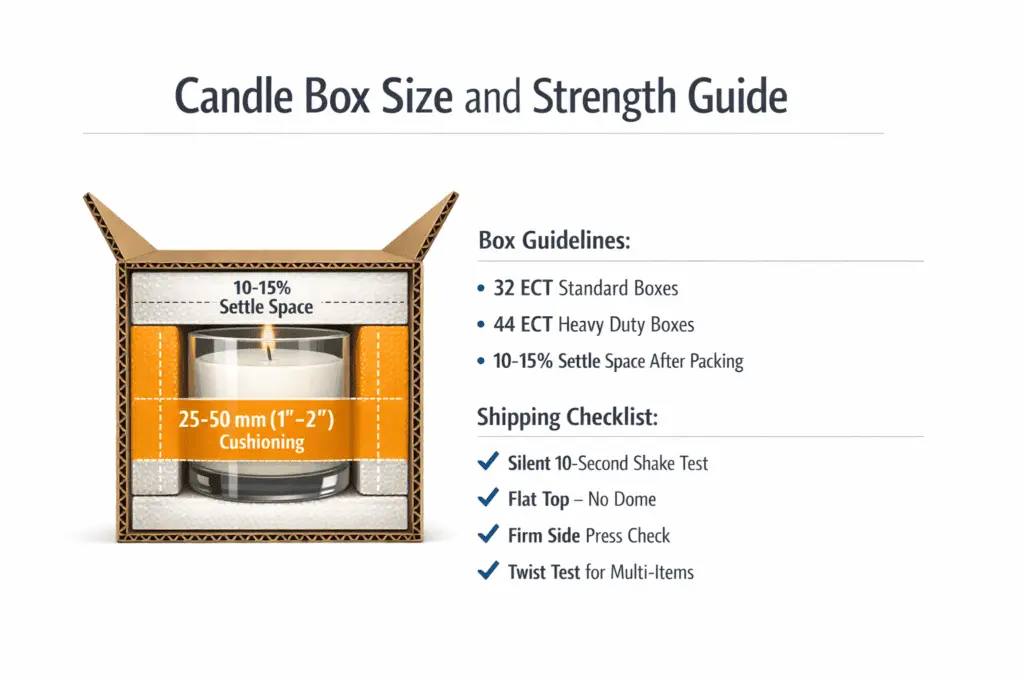
Practical box rules
Use these box rules as starting checks before you lock a pack method in.
- Leave about 25 to 50 mm, or 1 to 2 inches, of protection on every side for glass.
- Keep empty settle space to about 10 to 15 percent of the box height after packing. More than that usually leads to loosening and movement.
- Common supplier ratings include 32 ECT for standard parcel boxes and 44 ECT for heavier-duty single-wall cartons. Move up when you see corner crush, bowing, or seam splitting.
Quick carton check at the bench
Run these quick checks before you seal the carton.
- Pick the smallest carton that fits the candle plus cushioning on all sides.
- Close the box without strain. The top should sit flat, not domed.
- Shake the box for 10 seconds. You should hear no sliding, clicking, or clunking.
- Press each side panel with your palm. The wall should not collapse inward easily.
- For multi-item orders, lift the carton from one corner. If it twists out of square, the board is too weak.
If you use rigid inserts or molded supports, the carton can fit more tightly because the insert helps manage impact. If you rely on loose fill alone, you usually need more space, more filler, and a stronger carton to prevent settling.
How to pack by vessel type
Pack each candle according to its weak point. Glass needs rim protection and separation, tins need dent resistance, and pillars need surface and corner protection.
The vessel decides where the pack has to resist impact, abrasion, and drift first.
Glass jars
For glass jars, focus on immobilization and rim safety. Wrap the jar so it cannot rotate within the cushioning, and add extra protection around the upper third where chips often start. If the lid is separate, secure it so it cannot become a hard projectile inside the box. When shipping more than one jar in a carton, never allow glass-to-glass contact. Use partitions or individual sleeves so each jar stays in its own protected space.
Tins
For tins, focus on dent prevention and scuff control. Tins deform under concentrated pressure, so they need a firmer buffer that spreads force over a wider area. Protect the lid edge and side seam because small dents there make the product look damaged even when the candle still works. If labels matter, place a smooth, non-abrasive layer over the label before adding textured cushioning.
Pillars
For pillars, protect the surface and corners first, then manage temperature risk. Pillars do not shatter, but they can arrive with flattened edges, gouges, rub marks, or cloudy surfaces. Use a smooth inner wrap to protect the finish, then add cushioning that holds the candle securely without compressing the wax. If you ship during warm weather or into hot regions, use faster transit methods whenever possible because softened wax can deform even when the outer carton looks fine.
Keep heat handling brief here: use faster transit and protective packing when softened wax is a risk, and keep blackout or routing rules in a separate shipping policy.
Pass or fail checks by format
Use these pass or fail checks to confirm the protection matches the vessel format.
- Glass jars: pass if there are no clinks and no vertical lid movement when shaken. Fail if you hear clicking or see rim contact marks.
- Tins: pass if there are no corner voids and no lid-edge pressure points. Fail if the tin can drift toward a carton corner or divider edge.
- Pillars: pass if there are no rub marks after shaking and corners stay crisp. Fail if you see surface haze, bruising, or flattened corners.
How to protect labels and surfaces so candles arrive gift-ready
Protect labels with a smooth inner sleeve, keep wrap tails and tape away from seams, and add edge guards where needed so nothing rubs during transit.
Assume every vibration cycle acts like a tiny sanding pass. Start with a smooth inner layer, such as tissue, a soft sleeve, or thin poly, so corrugated edges, textured paper, and tape never touch the printed surface. Then position tape lines and wrap tails away from the label seam so they cannot catch and scuff during shipment.
Quick scuff check
Use this short check to confirm the wrap is not scuffing the surface in transit.
- Pack one candle exactly as you would for a real order.
- Shake it for 10 seconds.
- Unpack it and inspect the label under bright light.
Pass if there are no dull patches on gloss labels and no shine lines on matte labels. Fail if you see edge scuffs or visible rub marks.
How to build partitions that stop rattle and edge chipping
Build fitted dividers so each candle has its own cell, then fill the remaining gaps so nothing can drift or clink against a hard edge.
A partition works best when each cell is sized to the wrapped candle, not the bare vessel. The divider stops item-to-item contact, while cushioning absorbs shock.
How to size a divider cell
Size the cell from the wrapped candle so the divider controls movement instead of creating slack.
- Wrap the jar or tin to the thickness you would normally ship.
- Measure the widest point of the wrapped candle.
- Set the cell width to the wrapped diameter plus about 6 to 12 mm, or 1/4 to 1/2 inch, of breathing room.
- Pack the box and run a 10-second shake test.
- Adjust the cell size in small increments until the box stays silent.
Divider rules that work
These divider rules keep the insert stable after packing and handling.
- Measure the wrapped candle, not the unwrapped vessel.
- Make sure all divider tabs seat fully. Half-seated tabs collapse easily.
- Add bumpers at carton corners and any point where the candle could meet a hard edge.
- Fill all remaining internal gaps so the divider itself cannot drift.
- If you hear even one clink, adjust the fit before sealing the shipment.
Loose paper alone can still fail because it settles over time. Partitions work better because they physically prevent candles from hitting each other.
How to pack one candle vs multiple candles in the same box
For one candle, center the wrapped vessel, lock the corners, and fill the top and bottom so it cannot drift. For multiple candles, give each item its own wrapped cell or sleeve, prevent any glass-to-glass or tin-to-tin contact, and fill the remaining gaps so the divider cannot move inside the carton.
How to choose void fill that limits movement without crushing
Choose void fill that locks corners and removes movement without crushing tins or deforming wax.
Tightly crumpled kraft paper often immobilizes candles better than air pillows. Peanuts can work if you lock the corners first and control static. The key is to confirm how much the candle actually moves after packing, not just how full the box looks.
Movement test
Use this quick test to see whether the void fill is actually stopping drift.
- Put a small pencil mark on the inside wall of the carton at the candle’s widest point.
- Shake the box for 10 seconds.
- Open it and measure how far the candle moved from the mark.
Pass if movement is 3 mm or less and there are no audible clicks. Fail if movement is greater than 3 mm or you hear any clink or rattle.
Use the 3 mm threshold as a house QC limit unless your own test data or pack standard supports a different pass line.
General fill guidance
| Void fill material | Best use | Watch-outs |
|---|---|---|
| Crumpled kraft paper | Strong corner lock and top cap | Must be packed firmly enough to resist settling |
| Air pillows | Light products with stable geometry | Can allow drift if corners are not locked |
| Biodegradable peanuts | Good when corners are packed first | Static and migration can open voids |
Match the fill to the failure mode:
- If you hear clicking, move to paper or a tighter corner-packed peanut method and add a top cap.
- If jars chip at the rim, increase top and side compression and remove any hard object above the lid.
- If tins dent, avoid loose pockets and use more even support.
How to make sustainable wrap choices without increasing breakage
Only switch materials after side-by-side testing shows the same or lower movement and the same cosmetic results as your current method.
Honeycomb paper can protect jars well, but it often needs more layers and tighter taping than small-bubble wrap to stop slipping. Reduce plastic where results remain stable, not where you are guessing.
Simple A/B test
Pack the same candle, in the same box, with the same void fill and divider setup. Change only the wrap material.
Pass if movement stays at 3 mm or less, there are no clinks, and the candle and label remain clean.
| Wrap material | Typical performance | Watch-outs |
|---|---|---|
| Small-bubble wrap | Strong impact absorption and low movement | Less sustainable |
| Honeycomb paper | Good protection when layered properly | Can creep or scuff unless sleeved |
| Molded pulp insert | Excellent control when the fit is right | Must match the vessel closely |
If you test a rougher outer material, add a smooth inner sleeve first so you do not confuse abrasion with impact failure.
A practical rollout is to test new materials on low-risk single-item orders first, then expand only after repeated successful packs.
How to standardize your packing bench
Standardize tools, layout, and a short QC step so every pack is built the same way, even during busy periods.
10-second QC check
- Silent shake, no clunks, clicks, or sliding
- No exposed hard contact points
- Top cap filled and corners locked
- Seams sealed and tape edges pressed down
If you change the method, version it clearly so you can measure whether the change helped or hurt.
How to seal cartons with the right tape width and tension
Seal the main seam with an H-pattern and press the tape down firmly so the carton cannot peel open at edges or corners.
The H-pattern means one strip down the center seam and one strip across each end. Repeat it on both the top and bottom for anything beyond the lightest shipments.
For most candle cartons, use shipping tape wide enough to cover the seam cleanly and apply it under steady tension so it stays flat instead of lifting at the edges.
A Fragile or This Side Up label can help with handling, but it does not replace immobilization, cushioning, and a fully sealed carton.
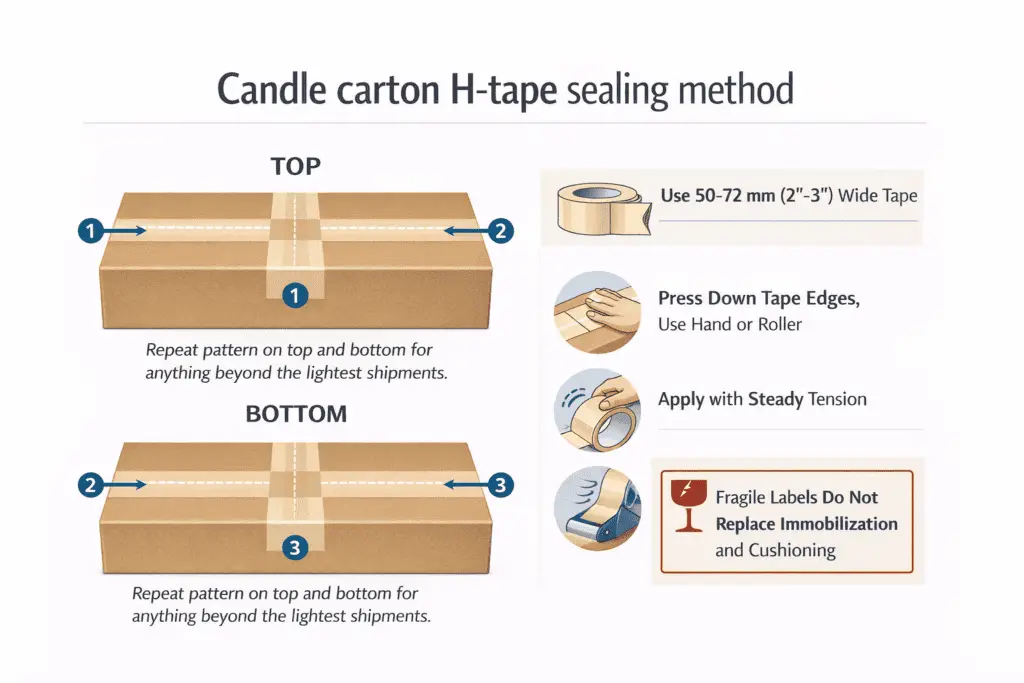
Good tape sealing method
Use this sealing sequence to close the carton the same way every time.
- Apply one straight strip along the center seam
- Add one strip across the front edge
- Add one strip across the back edge
- Press every strip down firmly by hand or with a roller
Most mystery breakage starts after a carton opens slightly, corners crush, and the candle begins to move. Good sealing prevents that chain reaction.
For heavier cartons or longer transit lanes, use wider and stronger tape so the seal resists creep, stretch, and peeling.
How to validate your packing with shake and drop testing
Validate the pack with a silent shake test and a simple drop test. If movement appears, change one variable and test again.
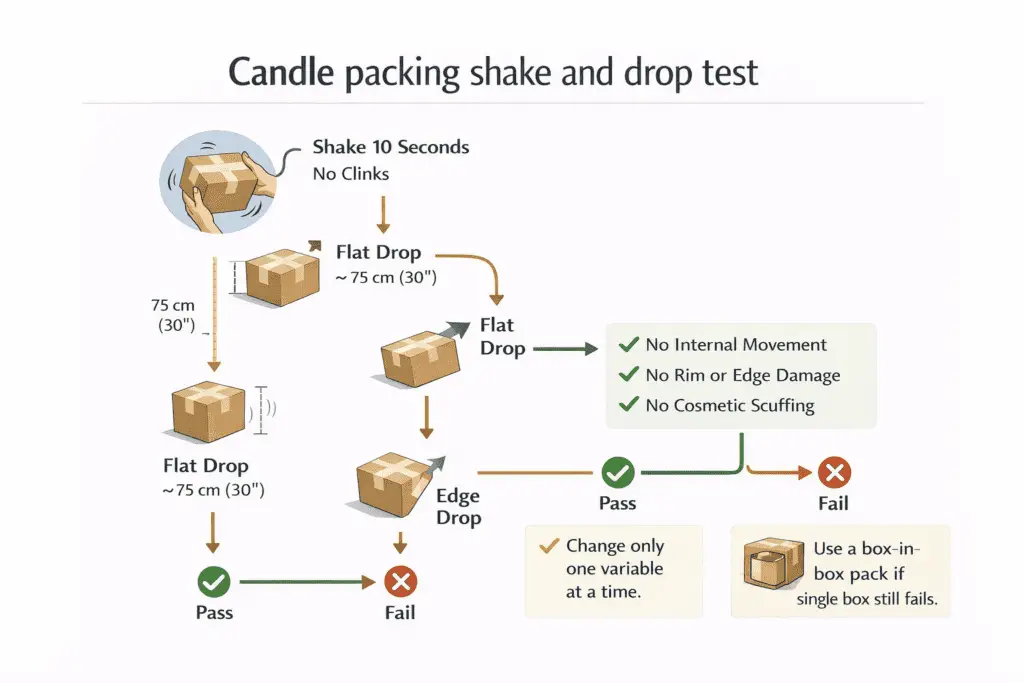
Home test method
Use this short home test to check whether the pack stays stable through basic handling shocks.
- Shake the packed carton for 10 seconds using short, firm motions. Pass if there are no clinks.
- Drop the box from about 75 cm, or 30 inches, onto a hard surface:
- 1 flat drop on the bottom face
- 1 drop on a long edge
- 1 drop on the most vulnerable corner
- Inspect after each drop
Pass if there is no internal movement, no rim or edge damage, and no cosmetic scuffing.
If the test fails, change only one variable at a time. Do not change the box, wrap, and fill all at once or you will not know what actually fixed the problem.
When to double-box a candle shipment
Use a box-in-box pack when a glass order still fails after you tighten the single-box method, when heavier multi-jar packs keep showing corner crush, or when the outer carton cannot stay square without more protection. Seal the inner box first, then cushion that box inside a larger outer box so the inner pack cannot shift.
How to track damage rate and improve with data
Track damage rate by shipment and by pack version, then compare results over the same SKU mix and shipping lanes.
The simplest formula is:
Damage rate (%) = (Damaged shipments ÷ Total shipments) × 100
Break the number down by vessel type, order type, and pack method. That shows whether failures come from a specific format or a specific packaging version.
Final takeaway
Candles break in transit when they can move, collide, or take impact through one hard edge. The safest shipping method is not complicated, but it has to be disciplined:
- Use the smallest strong box that still allows full cushioning
- Protect the vessel according to its weak point
- Stop all internal movement
- Keep labels and finishes away from abrasion
- Seal the carton properly
- Validate with shake and drop tests
- Track breakage by pack version so improvements stick
If the box is silent, the vessel is immobilized, and the outer carton stays square, you are already ahead of most fragile shipments.